Free Printable Dimensioning Worksheets for Class 10
Class 10 dimensioning worksheets from Wayground provide comprehensive printables and practice problems to help students master geometric measurement techniques, featuring free PDF downloads with complete answer keys.
Explore printable Dimensioning worksheets for Class 10
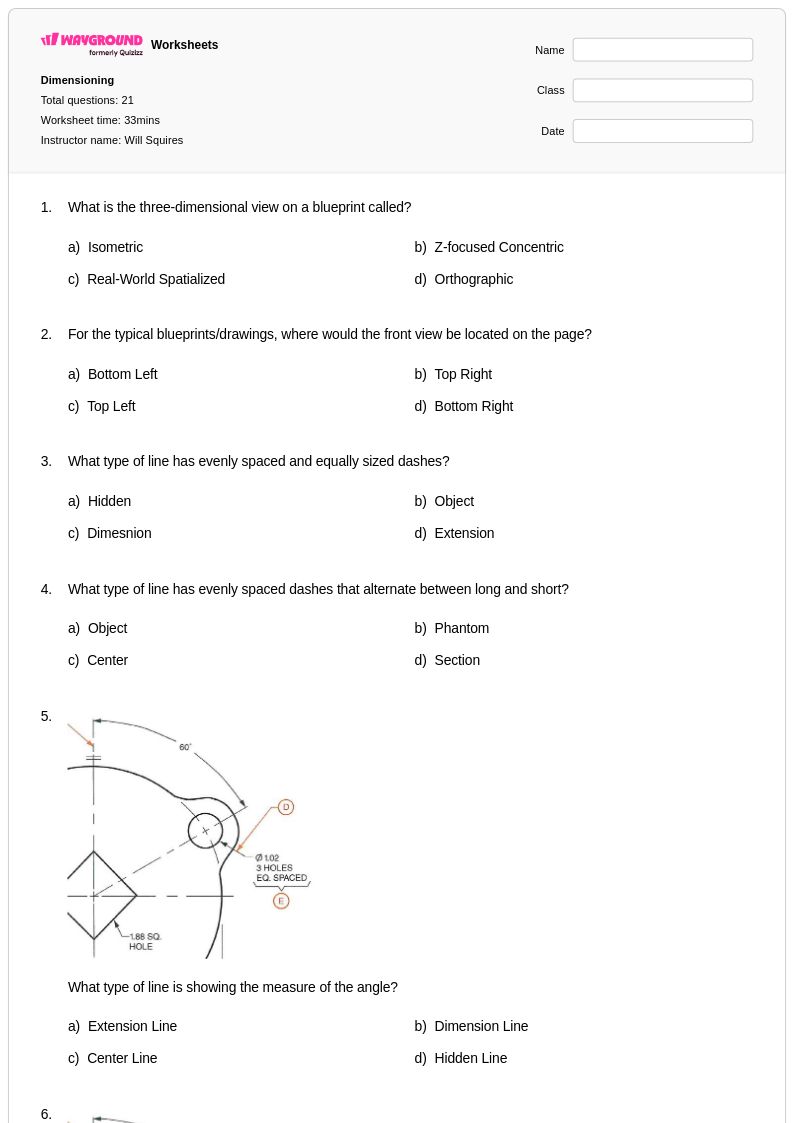
Dimensioning worksheets for Class 10 students available through Wayground (formerly Quizizz) provide comprehensive practice in the fundamental skill of accurately measuring, labeling, and interpreting geometric dimensions. These carefully crafted resources strengthen students' abilities to apply proper dimensioning conventions, read technical drawings, and understand spatial relationships in two and three-dimensional figures. The practice problems within these worksheets systematically build proficiency in linear measurements, angular dimensions, and proportional scaling while reinforcing critical geometric principles. Each printable resource includes detailed answer keys that enable students to verify their understanding and identify areas requiring additional focus, with free pdf formats ensuring accessibility for both classroom instruction and independent study.
Wayground (formerly Quizizz) empowers educators with an extensive collection of millions of teacher-created dimensioning worksheets specifically designed to meet Class 10 geometry standards and learning objectives. The platform's robust search and filtering capabilities allow teachers to quickly locate resources aligned with specific curriculum requirements, while differentiation tools enable customization based on individual student needs and skill levels. These flexible worksheets are available in both printable and digital formats, including downloadable pdfs, making them ideal for diverse instructional settings and learning environments. Teachers can effectively utilize these resources for targeted skill practice, remediation sessions, enrichment activities, and comprehensive lesson planning, ensuring that all students develop mastery in geometric dimensioning concepts essential for advanced mathematical study and real-world applications.
FAQs
How do I teach dimensioning conventions to Grade 10 students?
By Grade 10, students should already be comfortable with basic measurement and scale — so the teaching emphasis shifts to precision and convention. Focus on why standardized notation exists: a dimension placed ambiguously on a drawing causes real errors in construction or manufacturing. Giving students a deliberately mis-dimensioned drawing to critique is an effective way to build that critical eye before they practice producing correct ones.
What dimensioning skills are appropriate for Grade 10?
Grade 10 students should be working with linear and angular dimensions on both 2D and 3D figures, applying proportional scaling accurately, and beginning to interpret drawings that use multiple dimension types on the same figure. If they've covered the basics in Grade 9, this is the level to introduce more complex geometric contexts — irregular polygons, composite figures, and simple orthographic views.
What mistakes do Grade 10 students commonly make with dimensioning?
At this level, the basic errors (missing units, crowded lines) should be fading, but two problems tend to persist: incorrect angular dimension placement — students often draw the arc in the wrong location relative to the vertex — and scale inconsistency across multi-view or composite figures. Students also sometimes apply linear dimensioning conventions to curved features where radial or diametral notation is required.
How do I use these Grade 10 dimensioning worksheets?
These worksheets are available as printable PDFs and as digital assignments on Wayground. Running them digitally gives students immediate feedback as they work through problems. Every worksheet includes a complete answer key, which is especially useful when students are self-pacing through practice. For schools managing screen time, the PDF versions provide the same problems on paper — and the Wayground for Teachers app makes grading printed submissions straightforward.
How does dimensioning fit into the Grade 10 Common Core geometry progression?
Common Core high school geometry builds toward students being able to use coordinates and geometric properties to solve design problems — dimensioning is the practical language that makes that possible. At Grade 10, students are typically deepening their work with congruence, similarity, and geometric modeling. Dimensioning reinforces all three: you can't annotate a scaled drawing correctly without understanding proportional relationships, and you can't dimension a figure unambiguously without understanding its geometric properties.
Can I differentiate these worksheets for mixed-ability Grade 10 students?
Yes. Wayground lets you create alternate versions of the same worksheet with adjusted font size or spacing — helpful for students who find dense technical drawings hard to parse visually. For students who need more scaffolding, pairing reduced answer choices with multiple-choice dimensioning questions gives them a supported entry point before moving to open-ended annotation tasks. These settings apply per student, so the rest of the class works from the standard version without any disruption.