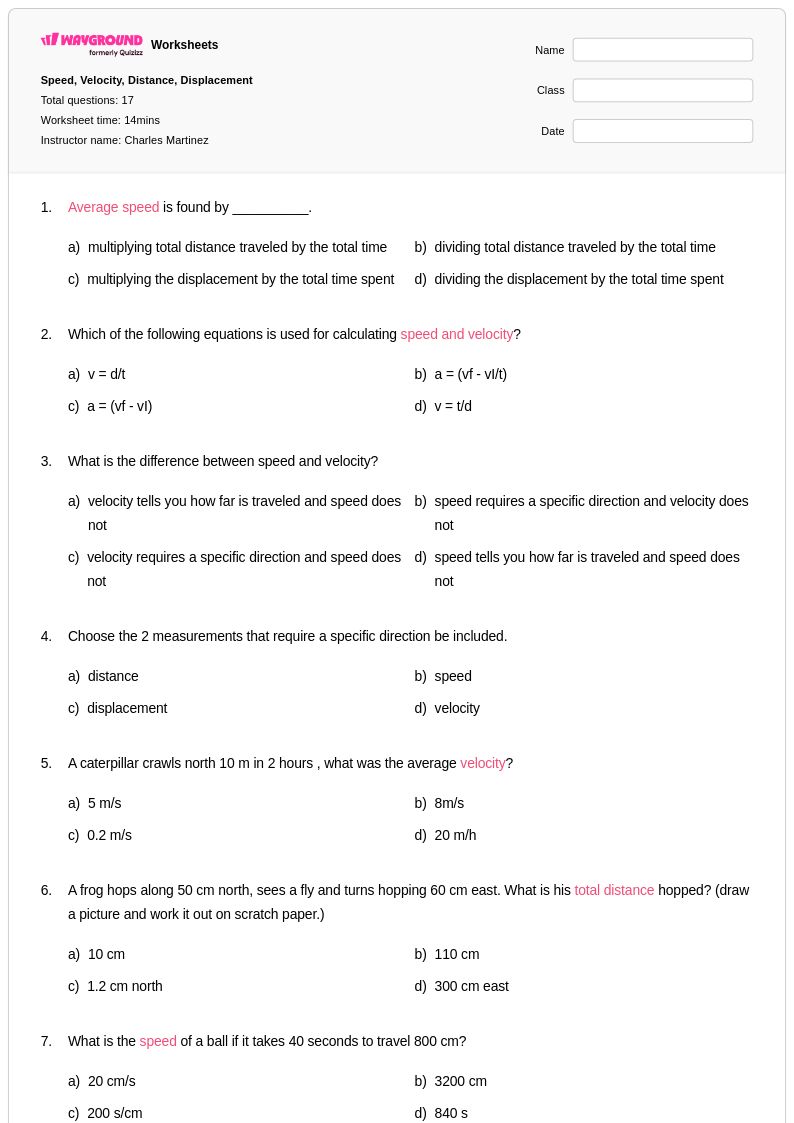
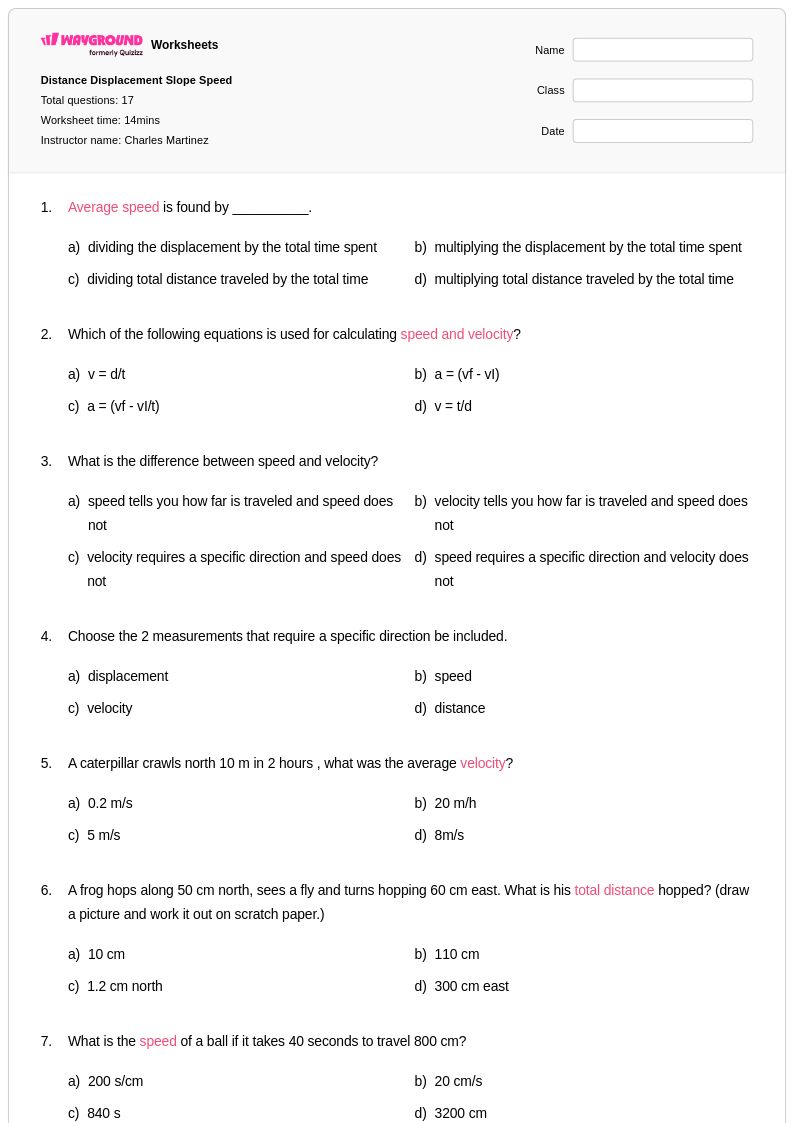
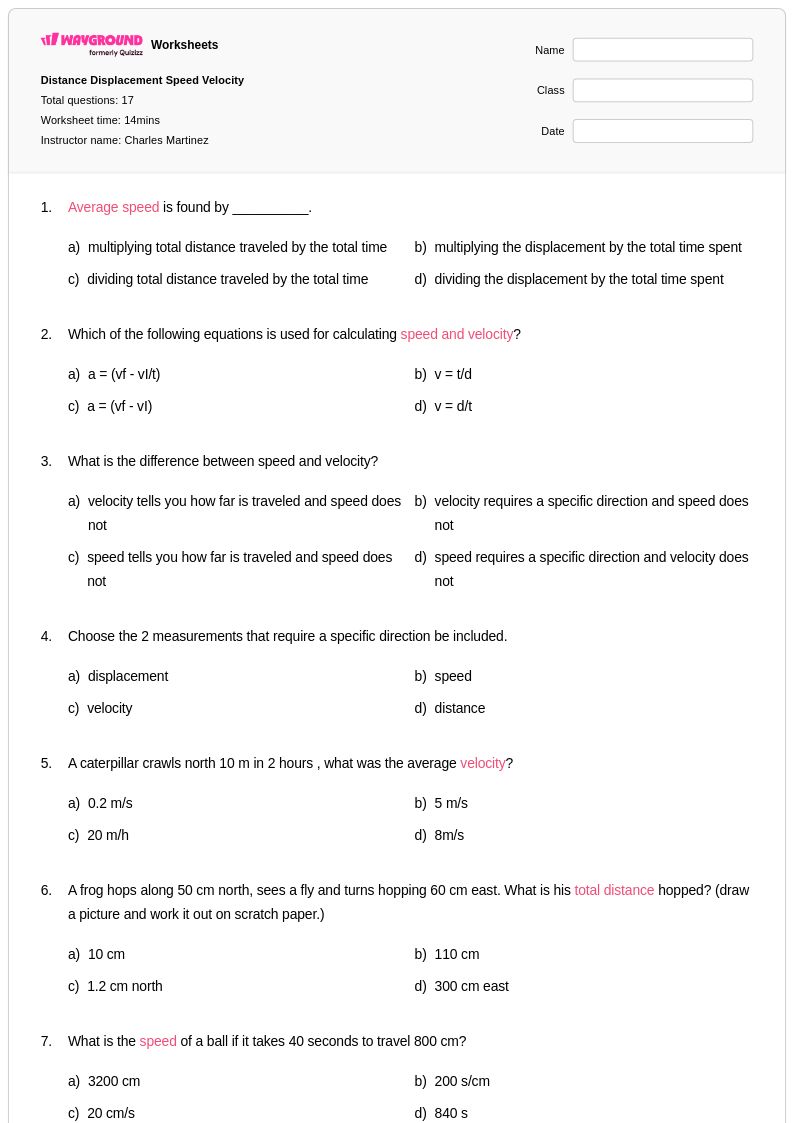
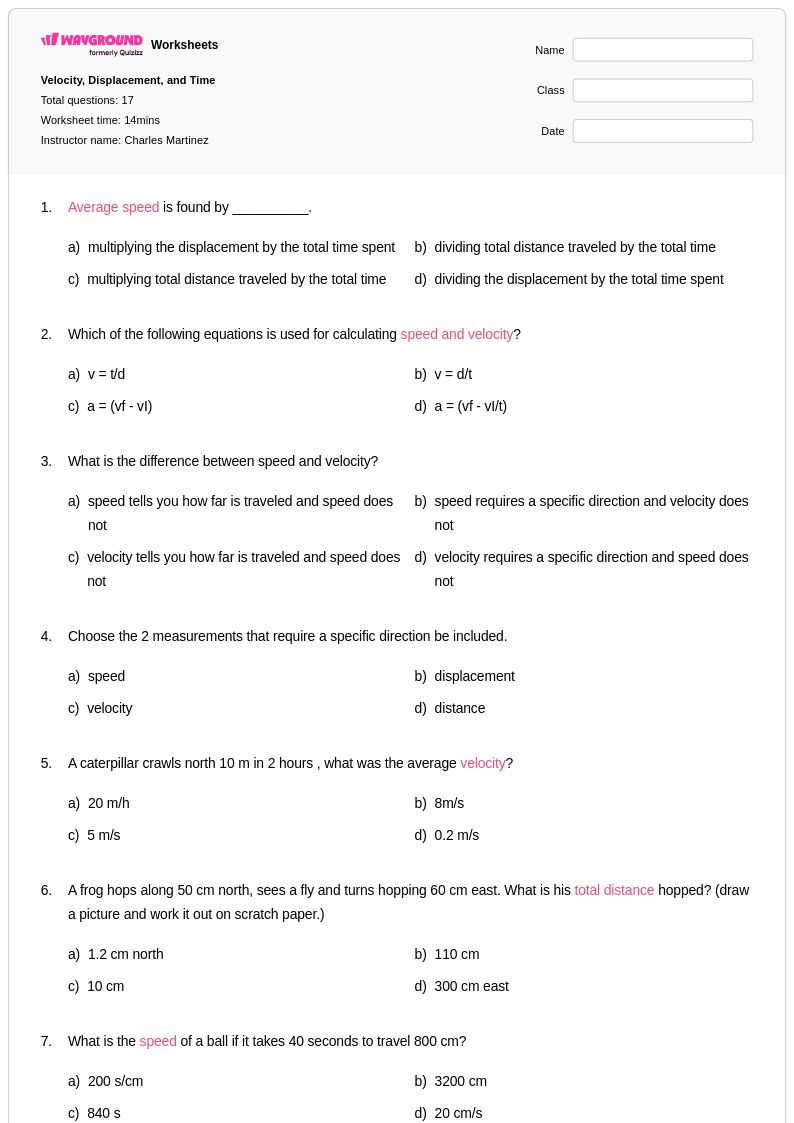
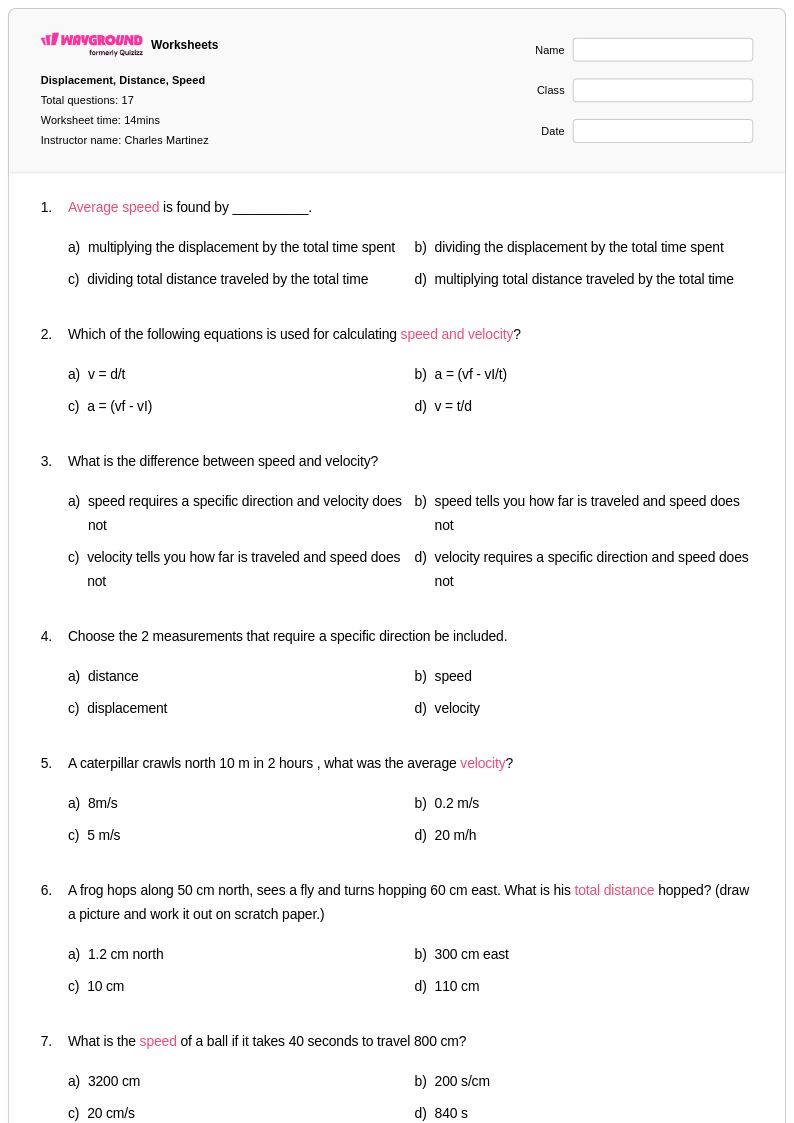
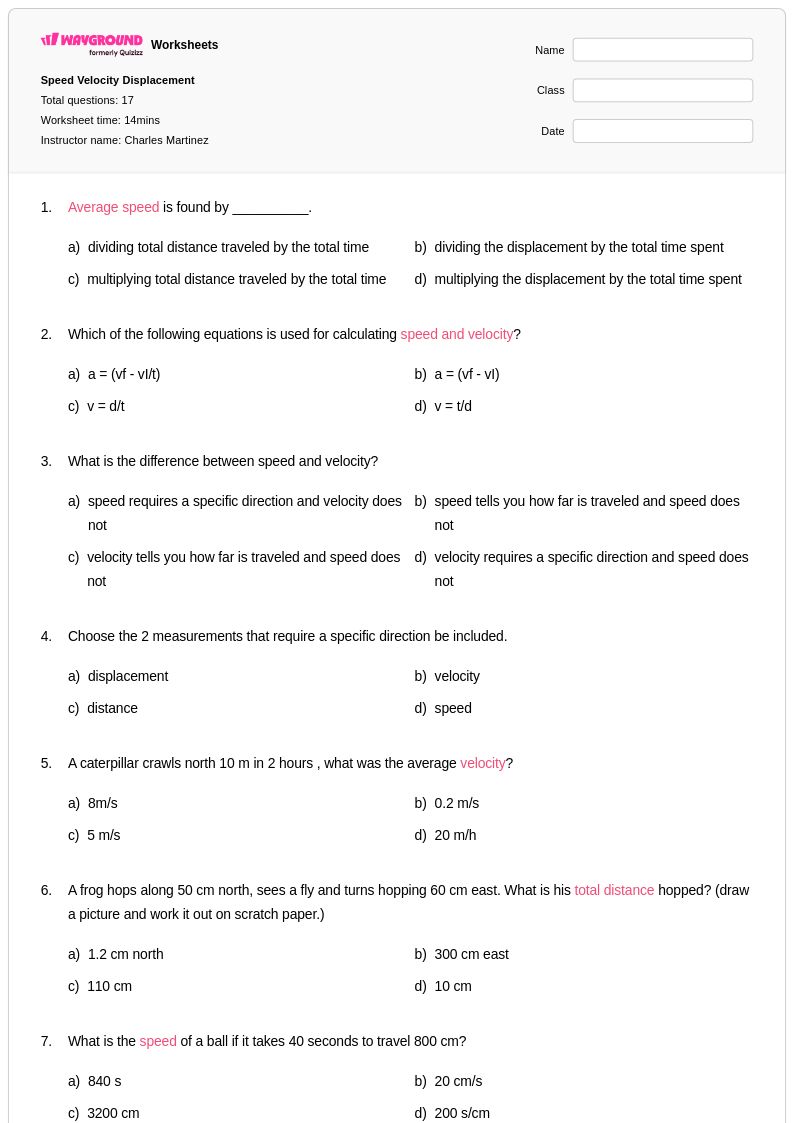
Explore Wayground's comprehensive collection of displacement physics worksheets featuring free printables, practice problems, and answer keys to help students master vector quantities, position changes, and motion calculations.
Displacement worksheets available through Wayground (formerly Quizizz) provide comprehensive coverage of this fundamental physics concept, helping students master the distinction between distance traveled and net change in position. These expertly designed resources strengthen critical analytical skills by guiding learners through vector calculations, graphical interpretations, and real-world applications of displacement in one and multiple dimensions. Each worksheet collection includes detailed practice problems that progress from basic position changes to complex motion scenarios, complete with answer keys that facilitate self-assessment and independent learning. The free printables encompass various problem types, from simple displacement calculations along straight paths to more advanced vector addition problems, ensuring students develop both computational fluency and conceptual understanding of this essential physics principle.
Wayground (formerly Quizizz) empowers educators with millions of teacher-created displacement worksheet resources that support diverse instructional needs across all physics education levels. The platform's robust search and filtering capabilities enable teachers to quickly locate materials aligned with specific curriculum standards, while differentiation tools allow for seamless customization based on individual student readiness and learning objectives. These displacement worksheet collections are available in both printable pdf formats and interactive digital versions, providing maximum flexibility for classroom implementation, homework assignments, and assessment preparation. Teachers can efficiently plan targeted instruction, provide focused remediation for struggling learners, offer enrichment opportunities for advanced students, and deliver consistent skill practice that reinforces the mathematical and conceptual foundations of displacement in physics education.
FAQs
How do I teach displacement vs. distance to physics students?
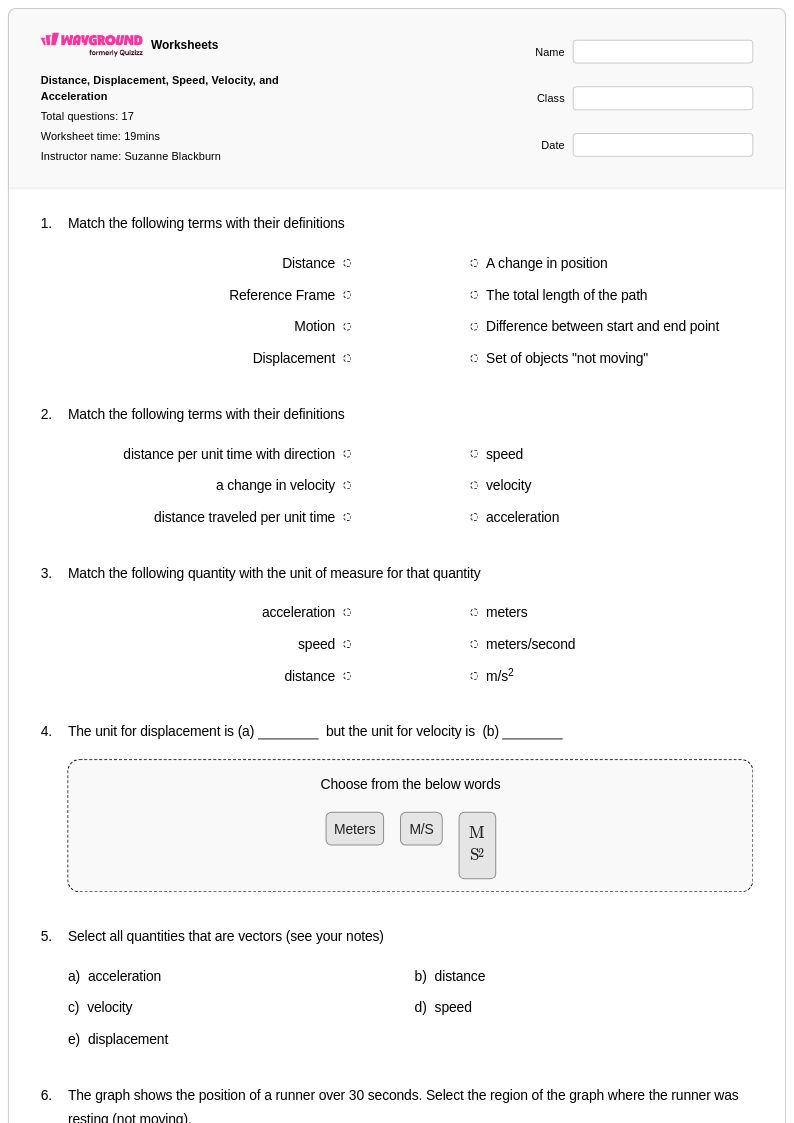
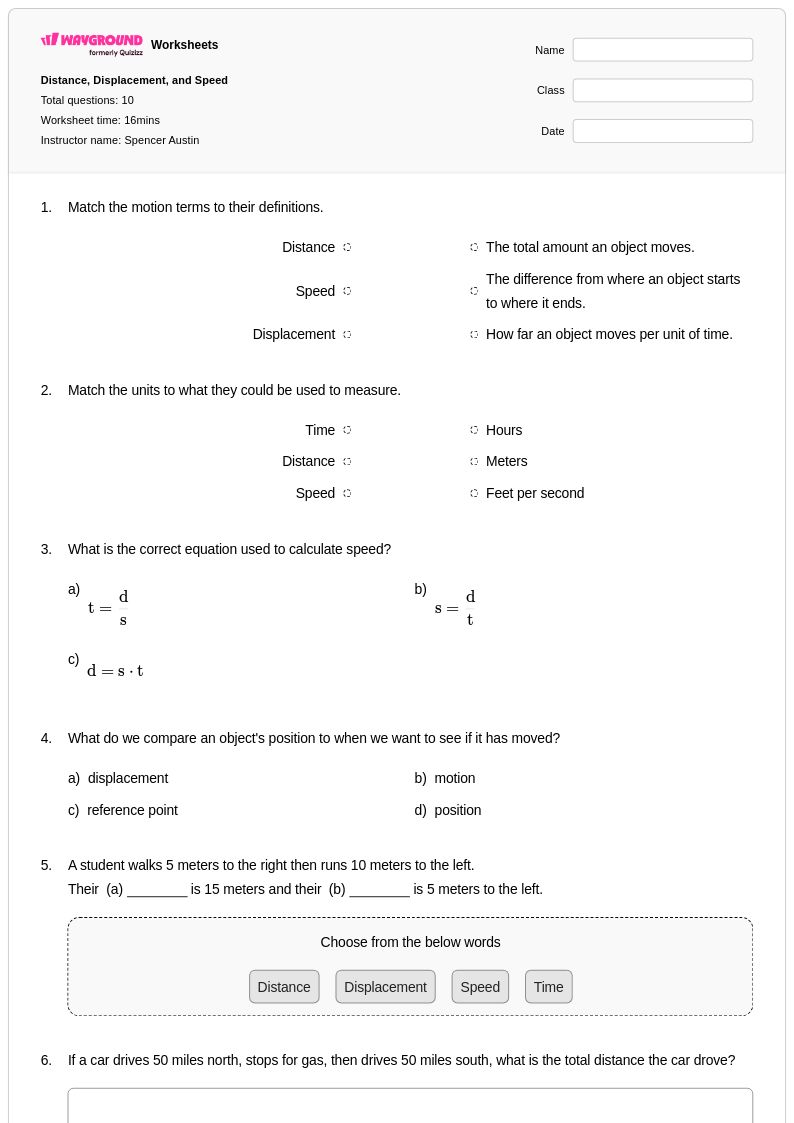
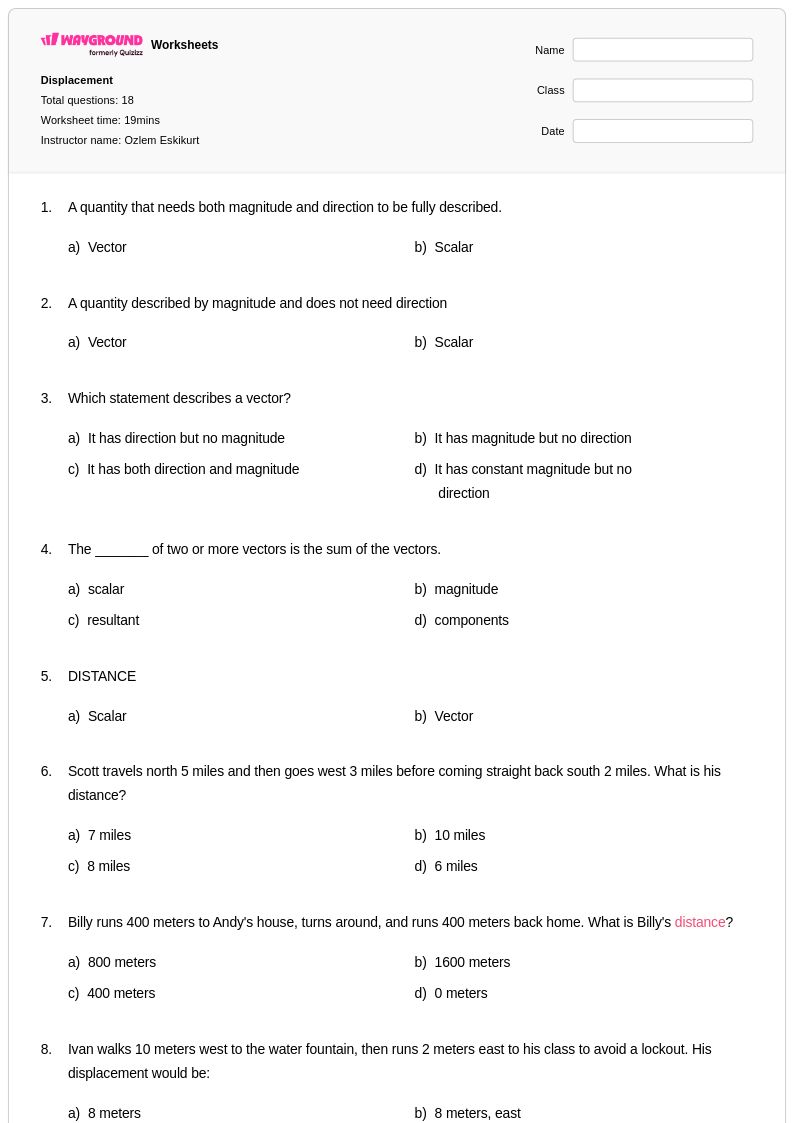
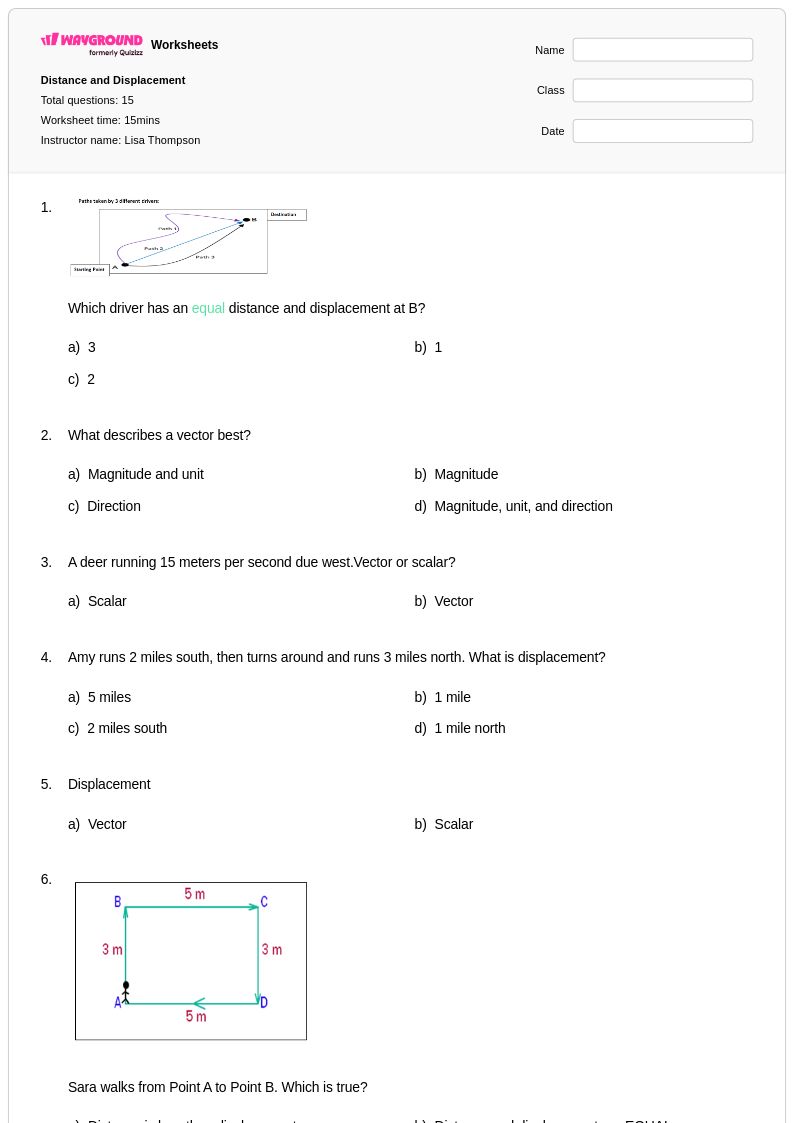
Start by grounding students in the difference between scalar and vector quantities before introducing displacement as a vector that describes the straight-line change in position from start to end point, regardless of the path taken. Use concrete examples like a student walking around a track — their distance may be 400 meters, but their displacement is zero if they return to the starting point. Diagrams and number-line problems are especially effective for building this intuition before students move to multi-dimensional problems.
What types of practice problems help students get better at calculating displacement?
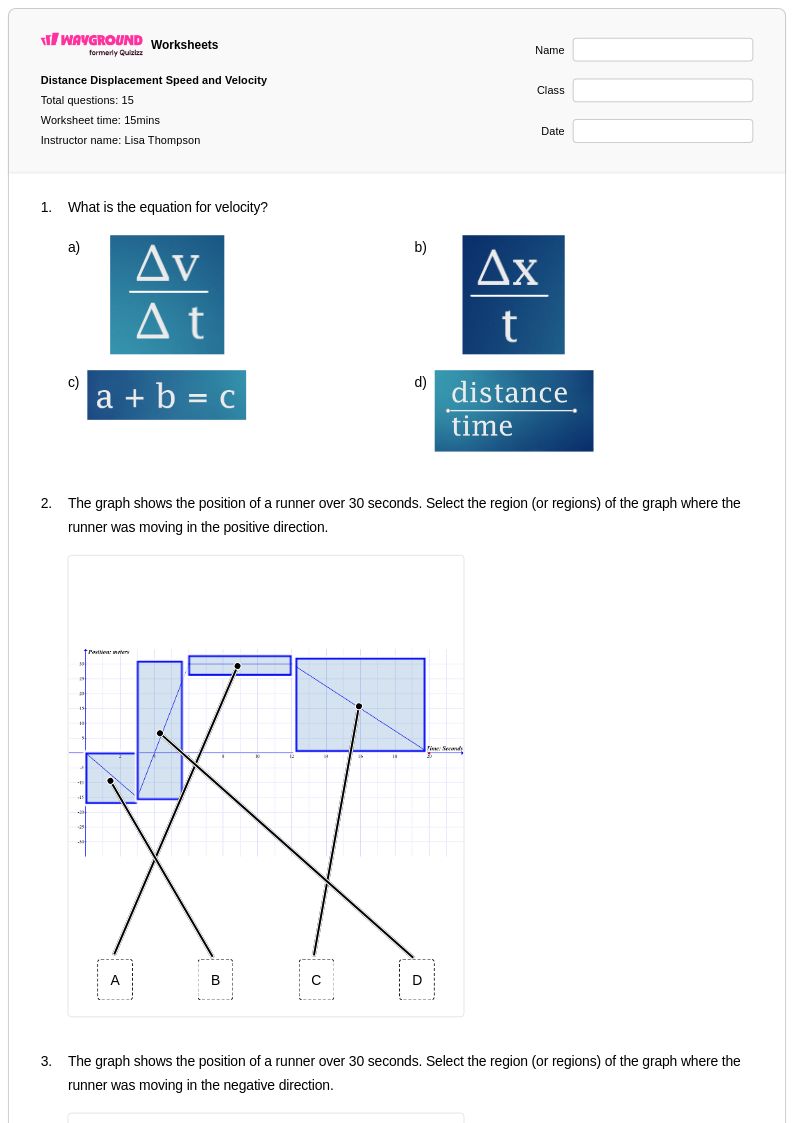
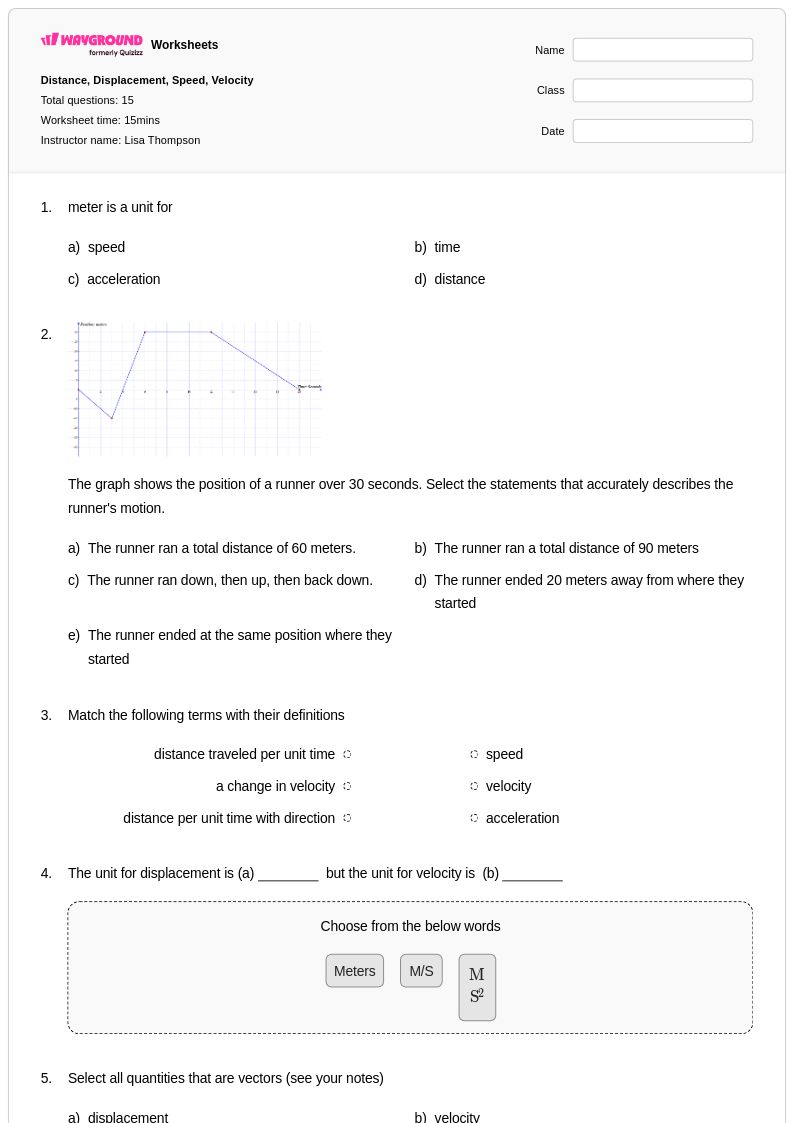
Effective displacement practice should progress from one-dimensional problems along straight paths to two-dimensional vector addition scenarios. Students benefit from problems that require them to draw position diagrams, apply the displacement formula (Δx = x_final - x_initial), and work with both positive and negative values to represent direction. Including real-world motion contexts, such as a car traveling north then east, reinforces both computational fluency and conceptual understanding of direction as part of displacement.
What mistakes do students commonly make when solving displacement problems?
The most common error is confusing total distance traveled with displacement — students often add up all segments of a path instead of calculating the net change in position. A second frequent mistake is ignoring direction: students treat displacement as a positive scalar rather than a signed or vector quantity, which causes errors in problems where motion reverses. Targeted practice with problems that involve backtracking or circular paths directly addresses both misconceptions.
How do I use displacement worksheets to support students at different skill levels?
For struggling learners, begin with single-direction displacement problems on number lines before introducing signed values or two-dimensional scenarios. For advanced students, extend practice to vector addition problems involving perpendicular components and magnitude calculations using the Pythagorean theorem. On Wayground, teachers can apply accommodations such as reduced answer choices or read-aloud support to individual students, allowing the same worksheet to serve diverse learners without singling anyone out.
How do I use Wayground's displacement worksheets in my classroom?
Wayground's displacement worksheets are available as printable PDFs for traditional classroom use and in digital formats for technology-integrated environments, giving teachers flexibility for in-class work, homework, or assessment prep. Digital versions can be hosted as a quiz directly on Wayground, enabling automatic grading and real-time progress tracking. All worksheets include answer keys, which support both teacher-led review and independent student self-assessment.
How do I assess whether students truly understand displacement versus just memorizing the formula?
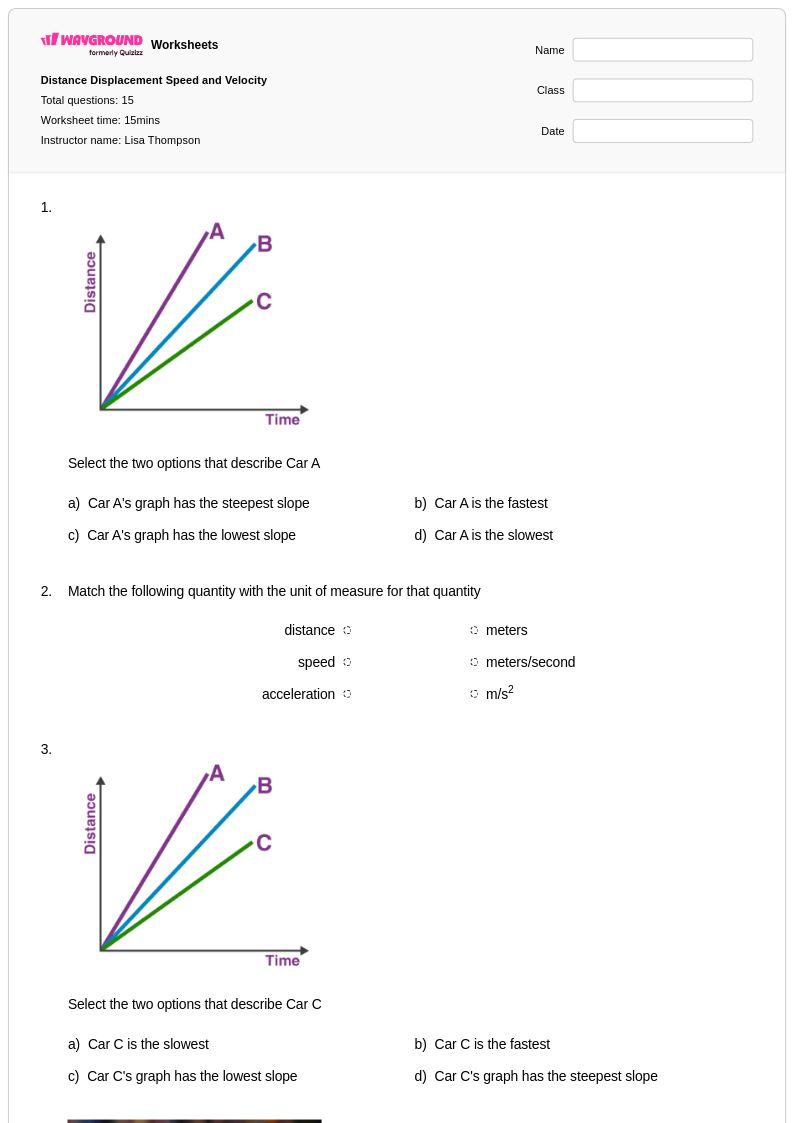
Conceptual understanding goes beyond plugging values into Δx = x_final - x_initial — look for whether students can correctly identify the starting and ending positions, assign appropriate signs or directions, and explain why a round trip yields zero displacement. Graphical interpretation tasks, where students read position-time graphs to extract displacement, are a reliable way to distinguish rote formula application from genuine understanding. Common assessment errors include sign mistakes and misidentifying which position is initial versus final.