Free Printable Division As Repeated Subtraction Worksheets for Class 2
Wayground's free Class 2 division as repeated subtraction worksheets provide printable PDF practice problems with answer keys to help students master this foundational division strategy through engaging mathematical exercises.
Explore printable Division As Repeated Subtraction worksheets for Class 2
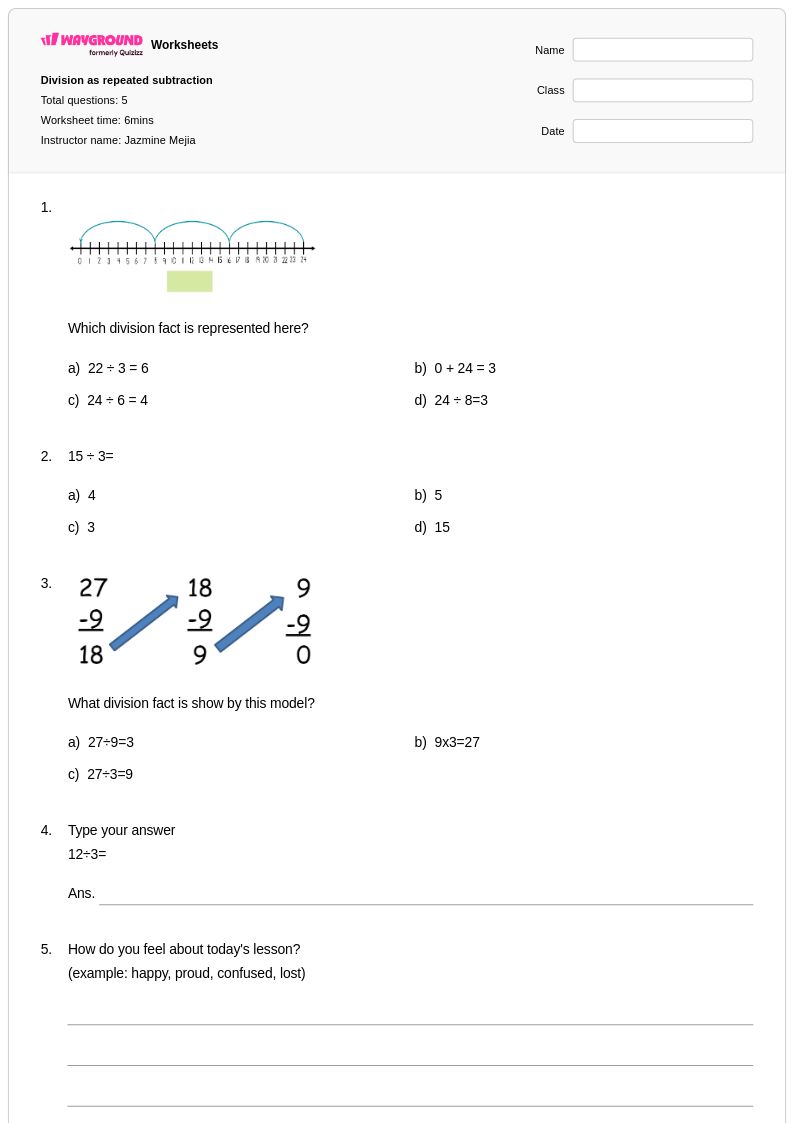
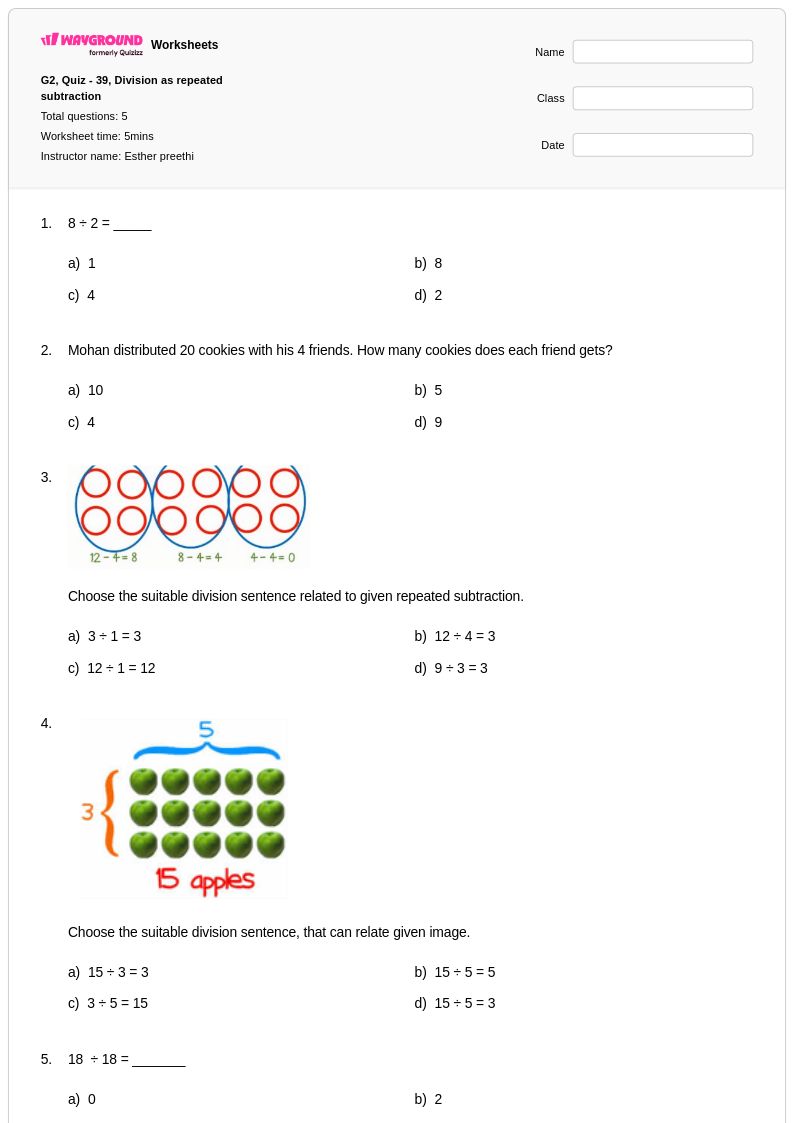
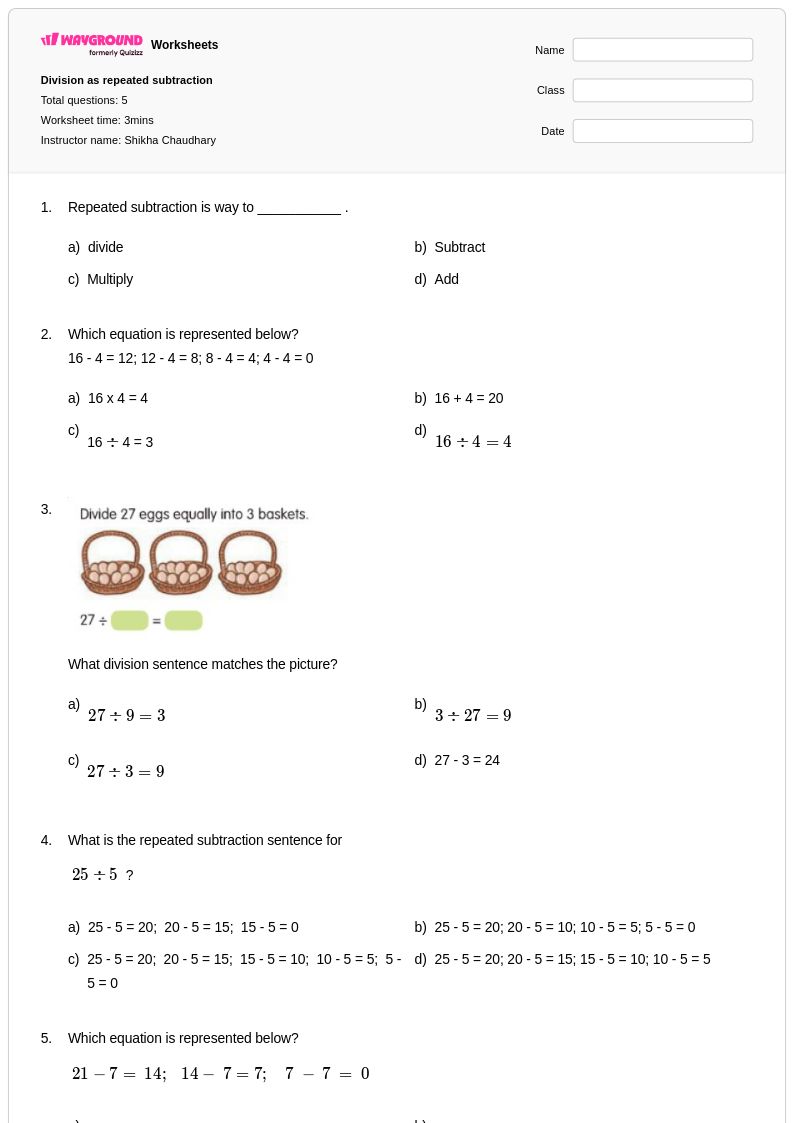
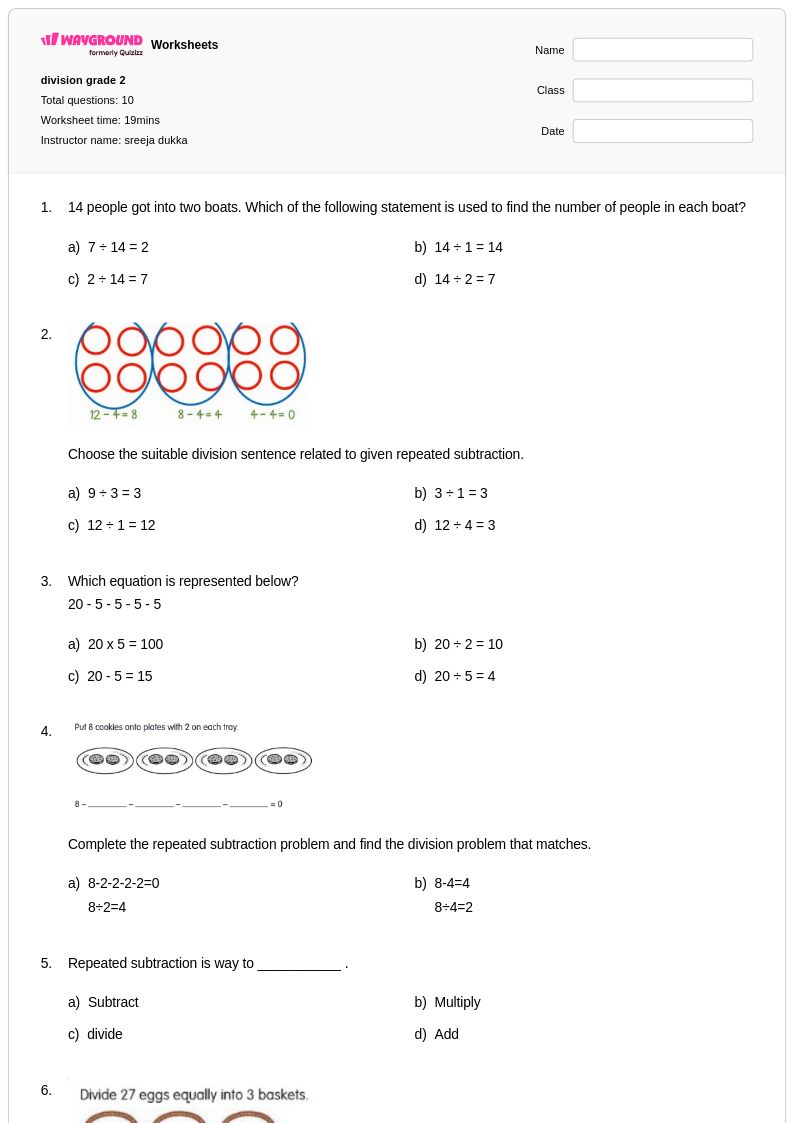
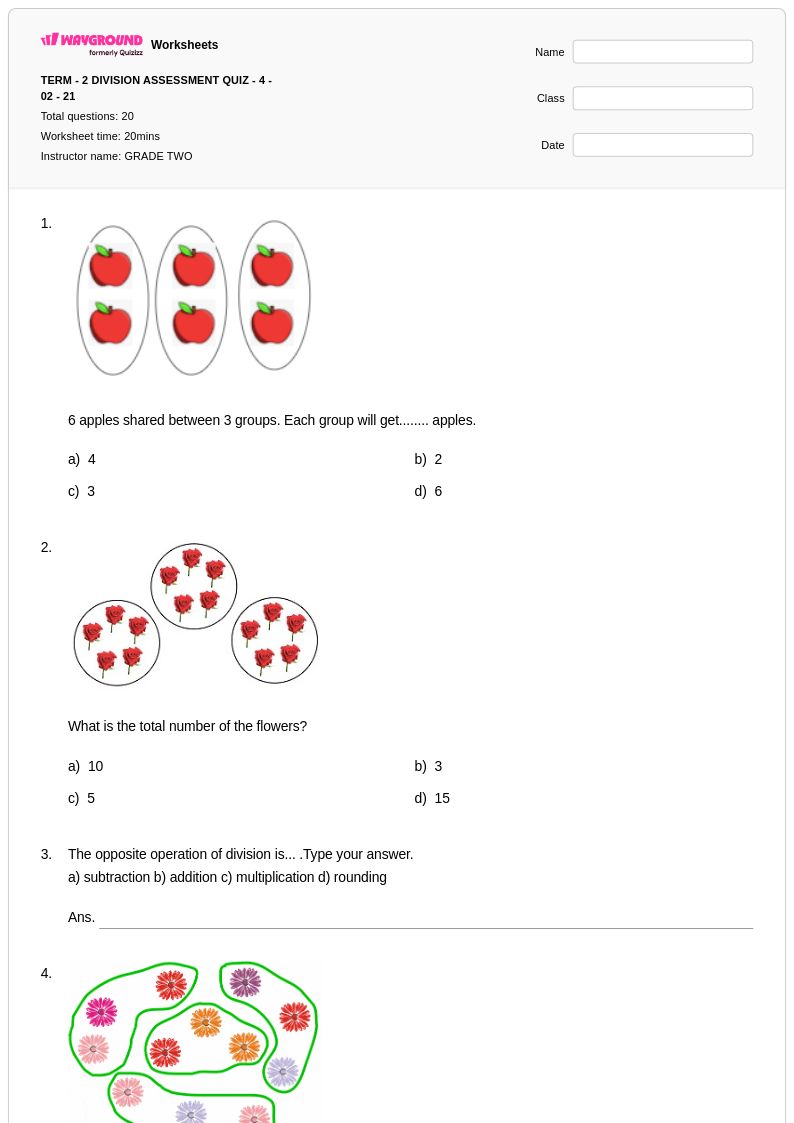
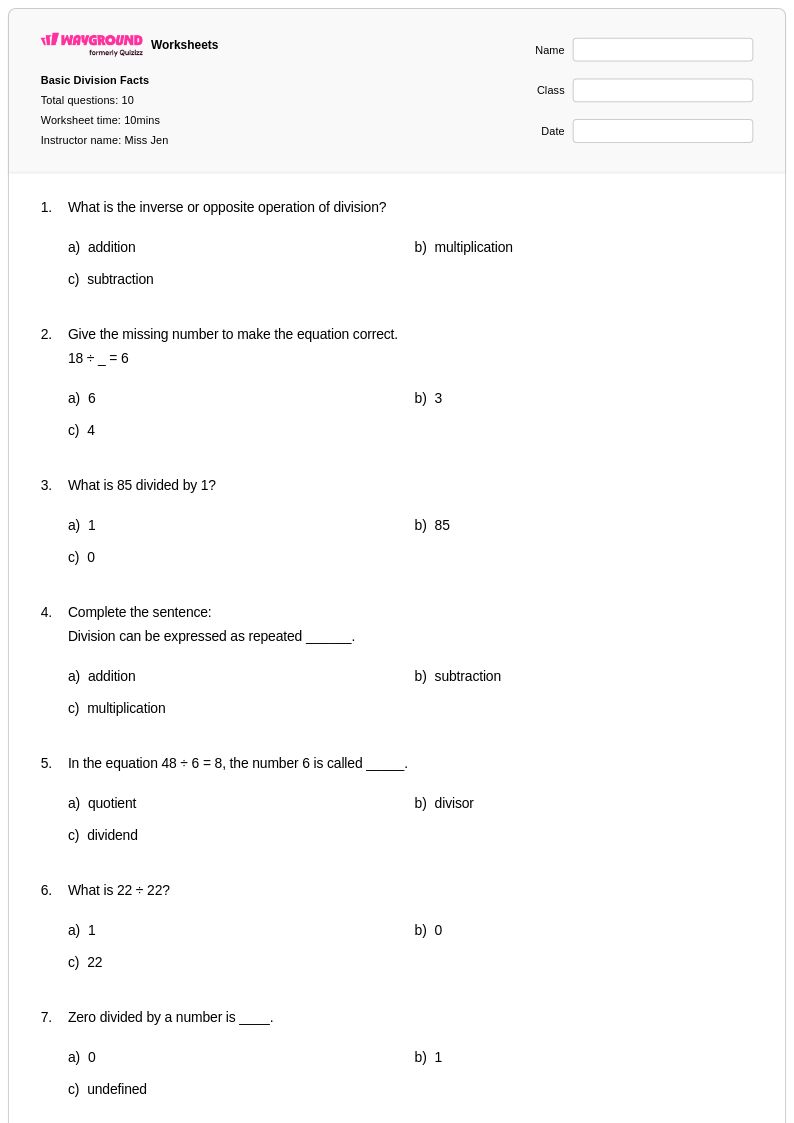
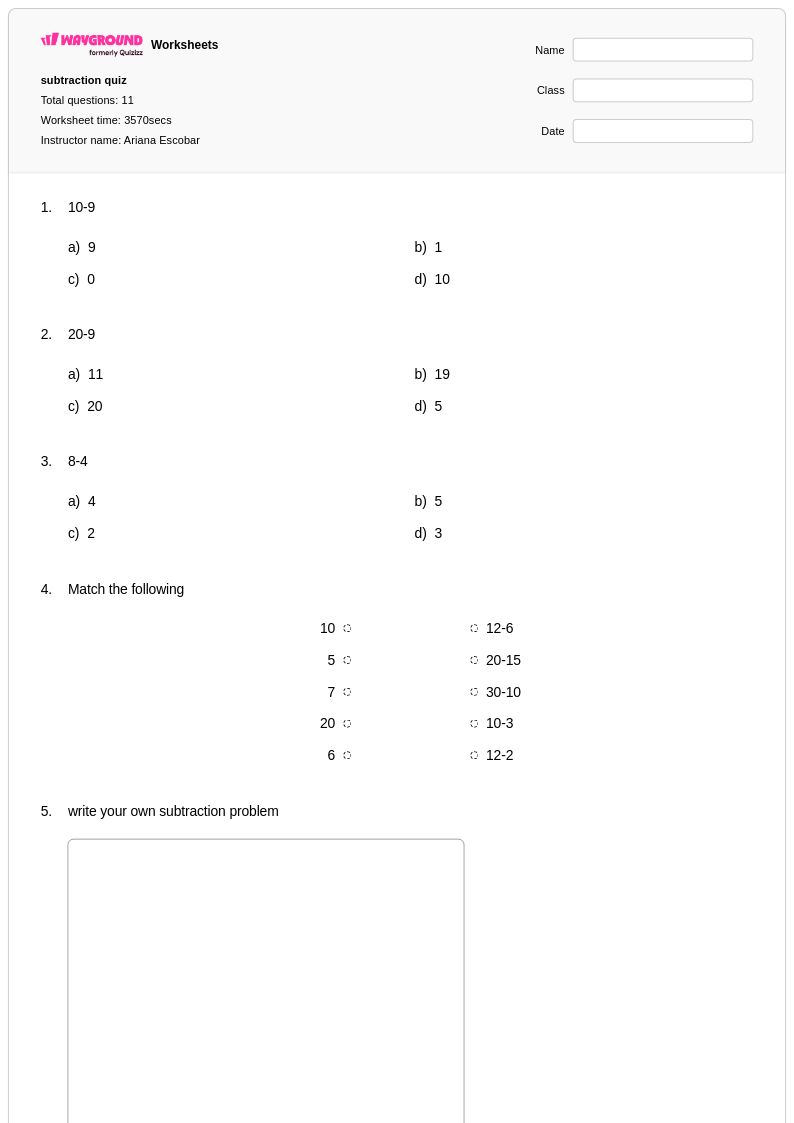
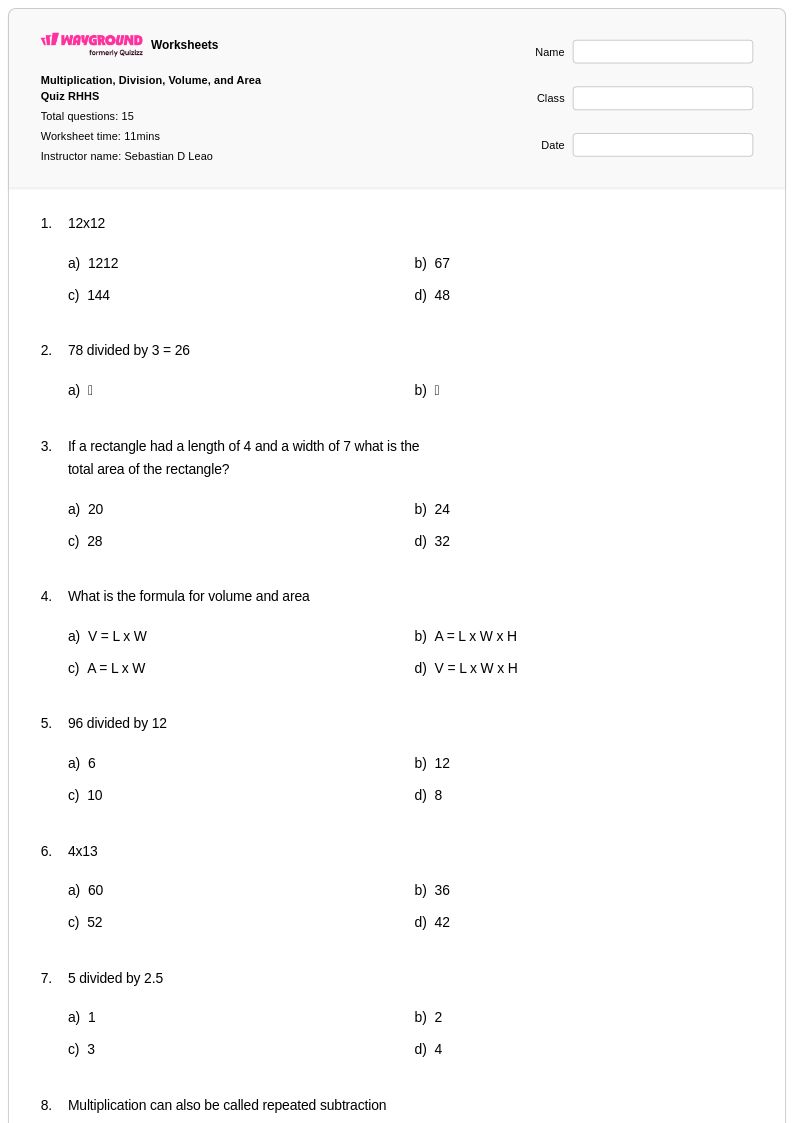
Division as repeated subtraction worksheets for Class 2 students available through Wayground (formerly Quizizz) provide essential foundational practice for understanding the conceptual relationship between division and subtraction operations. These carefully designed printables help young learners visualize division problems by repeatedly subtracting the divisor from the dividend until they reach zero, making abstract mathematical concepts concrete and accessible. Students work through practice problems that demonstrate how 12 ÷ 3 equals 4 because they can subtract 3 from 12 exactly four times, building number sense and computational fluency simultaneously. Each worksheet includes comprehensive answer keys and free pdf formats that support both classroom instruction and independent practice, ensuring students develop strong mental math strategies while mastering this critical division approach.
Wayground (formerly Quizizz) empowers educators with millions of teacher-created resources specifically focused on division as repeated subtraction and other Class 2 mathematical concepts, featuring robust search and filtering capabilities that align with curriculum standards and learning objectives. The platform's differentiation tools allow teachers to customize worksheets based on individual student needs, offering both remediation support for struggling learners and enrichment opportunities for advanced students ready for more challenging problems. Available in both printable and digital pdf formats, these resources seamlessly integrate into lesson planning workflows, providing flexibility for in-class activities, homework assignments, and targeted skill practice sessions. Teachers can efficiently assess student progress through varied problem sets that build from simple single-digit divisions to more complex scenarios, ensuring comprehensive mastery of this fundamental mathematical strategy.
FAQs
How do I teach division as repeated subtraction in Grade 2?
By Grade 2, students can handle the written subtraction sequence without needing pictures for every problem. Introduce a problem like 18 ÷ 3 by writing out the full chain: 18 − 3 = 15, 15 − 3 = 12, and so on, then count the steps. Once students are comfortable, connect it explicitly to multiplication: if you subtracted 3 six times, then 3 × 6 = 18. That link between repeated subtraction and multiplication facts is the key conceptual move at this grade.
What exercises help Grade 2 students practice division as repeated subtraction?
At Grade 2, the most useful practice combines the written subtraction chain with a simple recording structure: students write each step, circle the number of subtractions, and write the corresponding division equation. This forces them to connect the process to the notation. Problems with divisors of 2, 3, 4, and 5 keep the chains short enough to complete without losing track.
What mistakes do Grade 2 students make with division as repeated subtraction?
Two patterns stand out. First, students subtract inconsistently — they'll subtract the right divisor most of the time but slip up mid-chain, especially when the intermediate numbers are less familiar. Second, they confuse the number of subtractions with the final remainder, reporting the last number in the chain as the answer instead of counting the steps. A simple two-column format (one column for the running total, one for the tally of subtractions) prevents both.
How do I use these Grade 2 division worksheets in my classroom?
Print the PDF for independent practice or small-group work — every worksheet includes a complete answer key, so students can self-check or you can review as a class. For a digital session, host the worksheet as a quiz on Wayground and students work through it on a device with instant feedback. Paper practice is also a natural fit here for schools that limit device time during foundational math work.
How does division as repeated subtraction fit into the Grade 2 Common Core math progression?
Common Core places formal division in Grade 3, but Grade 2 is where students build the prerequisite understanding. Second graders are expected to work with equal groups, arrays, and repeated addition — and repeated subtraction is the inverse of that work. A student who can see that adding 4 three times gives 12 is ready to see that subtracting 4 from 12 three times brings you back to zero. That reversibility is exactly what makes the transition to division notation in Grade 3 make sense rather than feel arbitrary.
How can I differentiate division as repeated subtraction practice for my Grade 2 class?
For students still building subtraction fluency, stick to divisors of 2 and 5 so the individual subtraction steps are automatic and the focus stays on counting the steps. For students ready for more, introduce problems that don't divide evenly and ask them to identify the remainder. On Wayground, the Read Aloud accommodation helps students who struggle with reading directions independently, and you can adjust font size and spacing in the worksheet itself for students who need a less visually dense page.