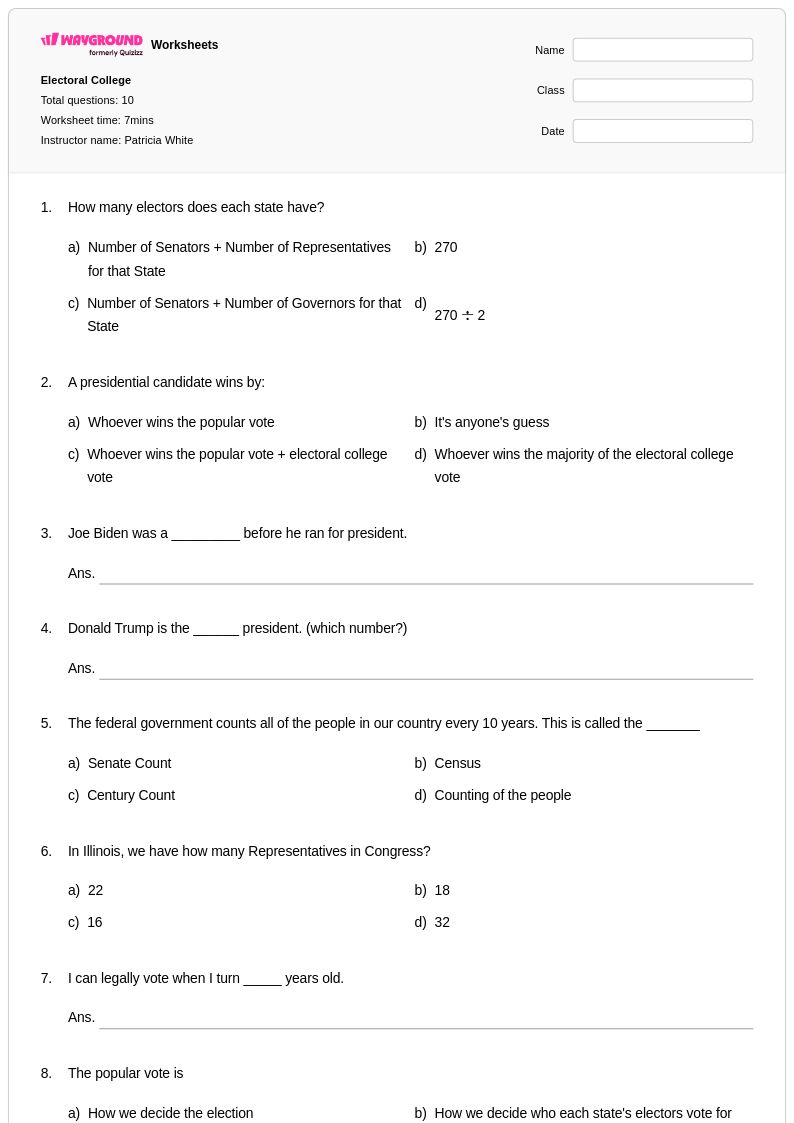
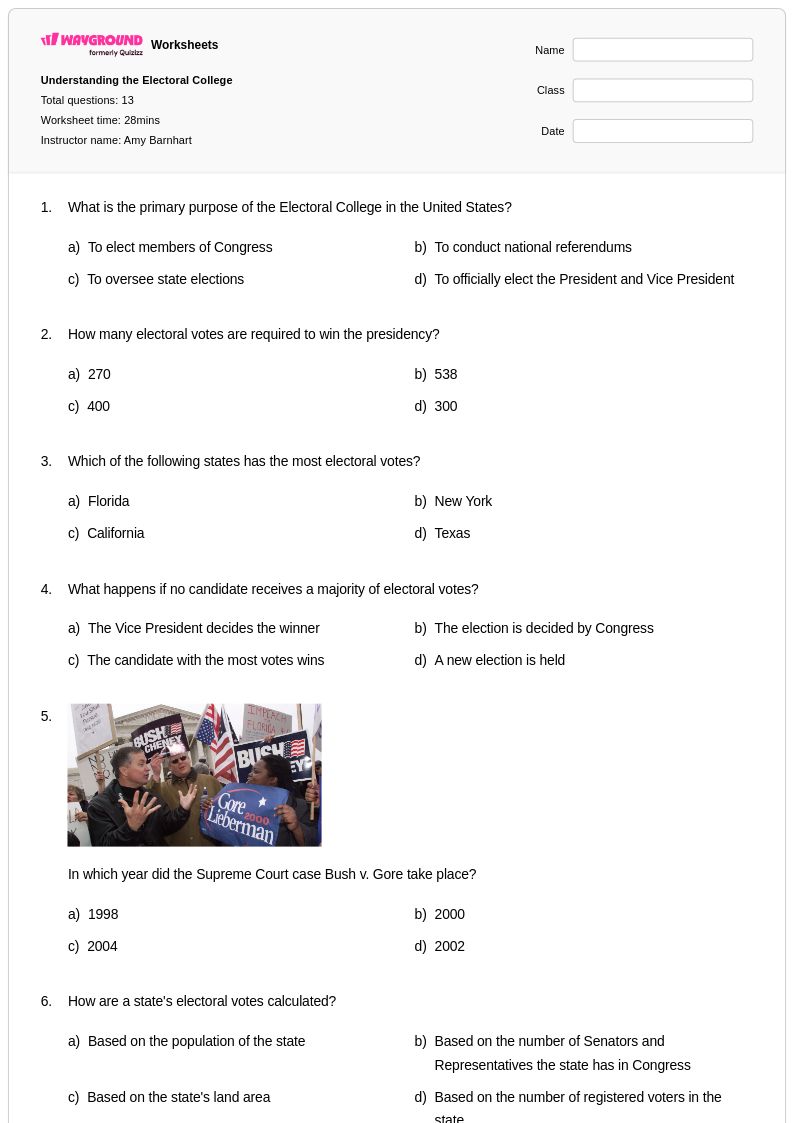
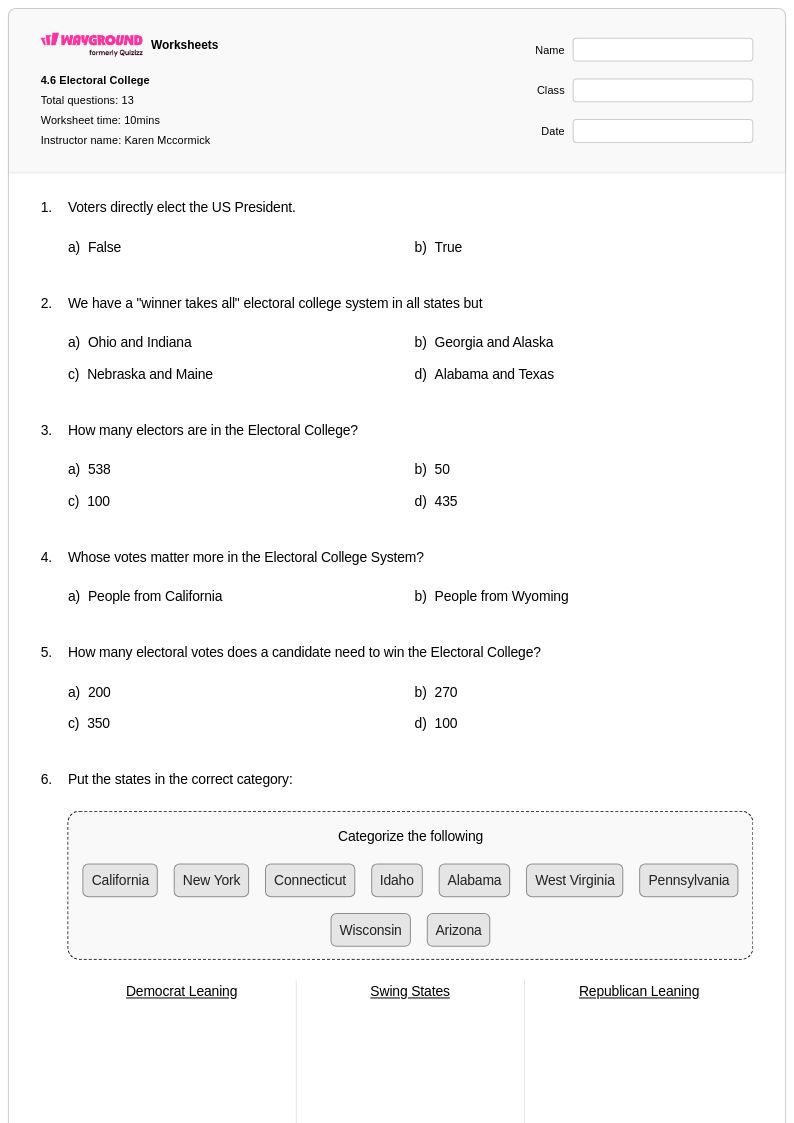
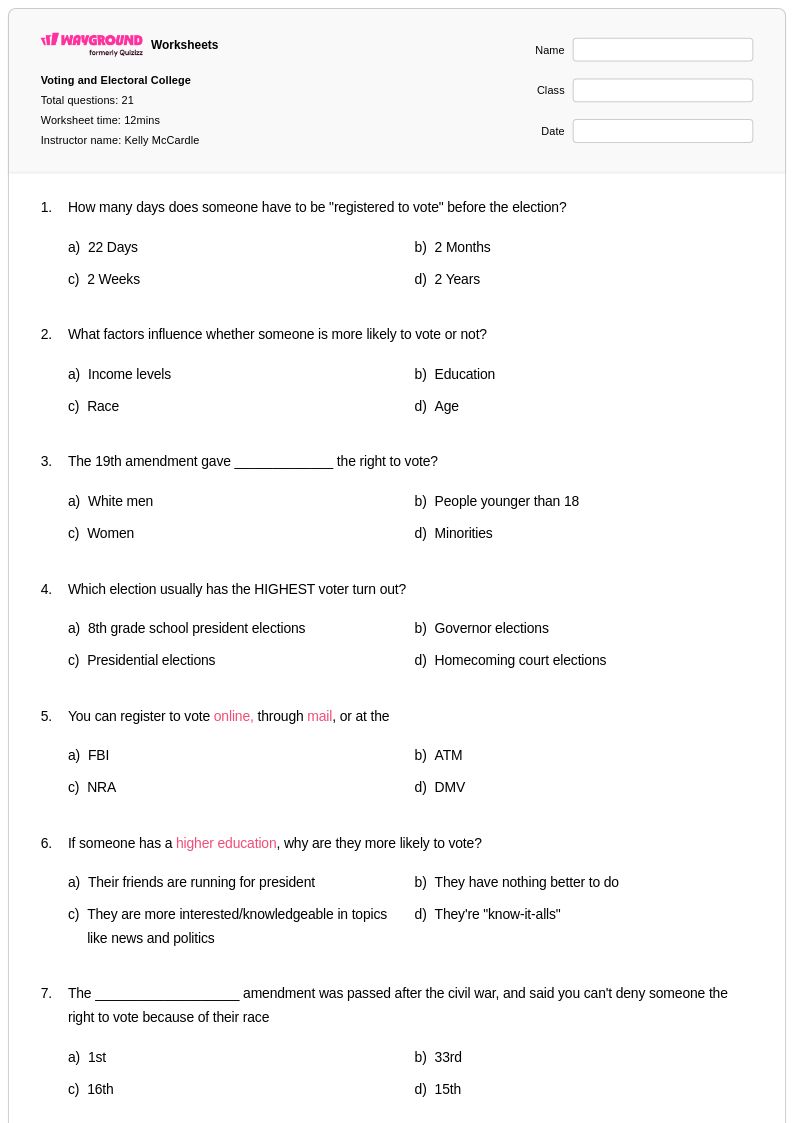
Explore Wayground's comprehensive collection of free Electoral College worksheets and printables that help students understand the presidential election process through engaging practice problems and detailed answer keys.
Electoral College worksheets available through Wayground (formerly Quizizz) provide comprehensive educational resources that demystify one of America's most complex constitutional mechanisms for students across multiple grade levels. These meticulously crafted materials guide learners through the intricate process of how presidents are actually elected, covering essential concepts such as the allocation of electoral votes based on congressional representation, the winner-take-all system used by most states, and the critical distinction between popular vote and electoral vote outcomes. Each worksheet collection includes detailed answer keys that enable both independent study and classroom instruction, while the free printable format ensures accessibility for diverse learning environments. Students engage with practice problems that reinforce their understanding of swing states, faithless electors, and historical elections where the Electoral College outcome differed from the national popular vote, building crucial analytical skills needed for civic participation.
Wayground's extensive platform supports educators with millions of teacher-created Electoral College resources that streamline lesson planning and enhance student comprehension of this fundamental democratic institution. The robust search and filtering capabilities allow teachers to locate materials perfectly aligned with state social studies standards and specific learning objectives, whether focusing on constitutional foundations, mathematical calculations of electoral vote distribution, or comparative analysis of electoral systems. Advanced differentiation tools enable instructors to customize worksheets for varying ability levels, ensuring that struggling learners receive appropriate scaffolding while advanced students encounter enriching challenges that deepen their constitutional knowledge. These versatile resources are available in both printable PDF format for traditional classroom use and digital formats that facilitate remote learning, making them invaluable for targeted skill practice, remediation of misconceptions about presidential elections, and enrichment activities that connect historical precedents to contemporary political discourse.
FAQs
How do I teach the Electoral College to middle or high school students?
Start by grounding students in the constitutional basis for the Electoral College before moving into how electoral votes are allocated based on each state's congressional representation. Use concrete examples like comparing a small state's electoral weight to a large state's to make the math tangible. From there, introduce the winner-take-all system and contrast it with the national popular vote so students can analyze how outcomes differ. Connecting the system to real historical elections where the popular vote winner lost the Electoral College helps students engage critically rather than passively.
What exercises help students practice understanding how the Electoral College works?
Effective practice exercises include electoral vote allocation problems where students calculate how many votes each state receives based on its congressional seats, as well as scenario-based questions where students determine who wins the presidency under different vote distribution outcomes. Worksheets that ask students to identify swing states, explain the significance of faithless electors, or compare elections where the popular vote and Electoral College results diverged build both content knowledge and analytical skills. These types of structured practice problems reinforce the mechanics of the system in a way that pure reading cannot.
What misconceptions do students commonly have about the Electoral College?
One of the most persistent misconceptions is that the candidate who wins the most individual votes nationwide automatically becomes president, which ignores how the Electoral College functions as a state-by-state system. Students also frequently confuse the role of electors, assuming they are required by federal law to vote for the candidate their state chose, when in fact faithless electors have occurred historically. Another common error is misunderstanding that the 270-vote threshold is not a majority of the total population but a majority of 538 total electoral votes. Addressing these misconceptions directly in instruction prevents students from carrying flawed civic knowledge into adulthood.
How can I use Electoral College worksheets to support students with different learning needs?
Wayground's platform includes built-in accommodation tools that allow teachers to assign extended time, read-aloud support, or reduced answer choices to individual students without disrupting the rest of the class. These settings can be configured per student from the Students tab or session settings page and carry over to future sessions, which reduces setup time for recurring accommodations. For students who struggle with the abstract nature of electoral systems, scaffolded worksheets that walk through each step of electoral vote calculation are particularly effective. Advanced learners benefit from open-ended analytical prompts that connect historical Electoral College outcomes to contemporary debates about electoral reform.
How do I use Wayground's Electoral College worksheets in my classroom?
Wayground's Electoral College worksheets are available as printable PDFs for traditional classroom use and in digital formats for technology-integrated or remote learning environments, including the option to host them as a quiz directly on Wayground. Each worksheet includes a complete answer key, making them suitable for independent student work, small group review, or teacher-led instruction. The digital format allows teachers to assign worksheets as self-paced assessments and track student responses, while the printable version works well for bell ringers, homework, or test prep.
At what grade level should students learn about the Electoral College?
The Electoral College is most commonly introduced in upper middle school and high school social studies or civics courses, typically in grades 7 through 12, where students have enough prior knowledge of U.S. government structure to contextualize it. However, simplified versions of the concept, such as how states contribute different numbers of votes, can be introduced in upper elementary grades during presidential election years. The appropriate depth of instruction increases with grade level, moving from basic mechanics in middle school to constitutional analysis and comparative evaluation of electoral systems in high school.