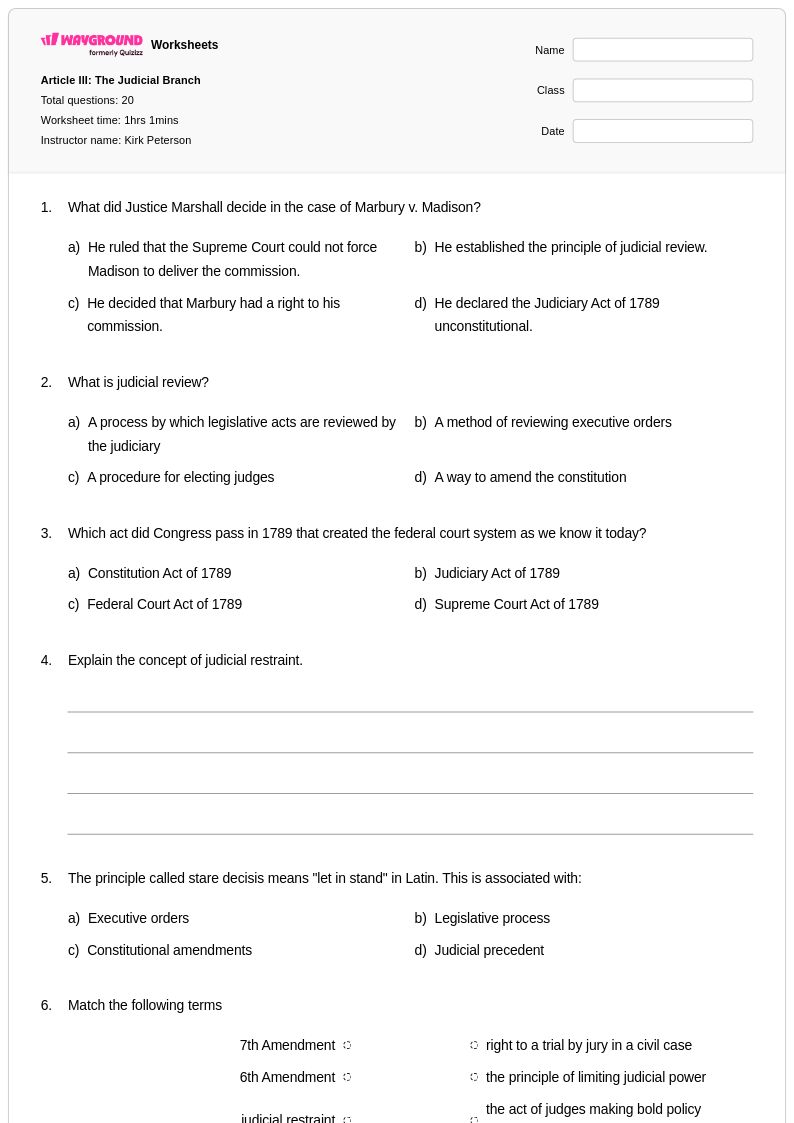
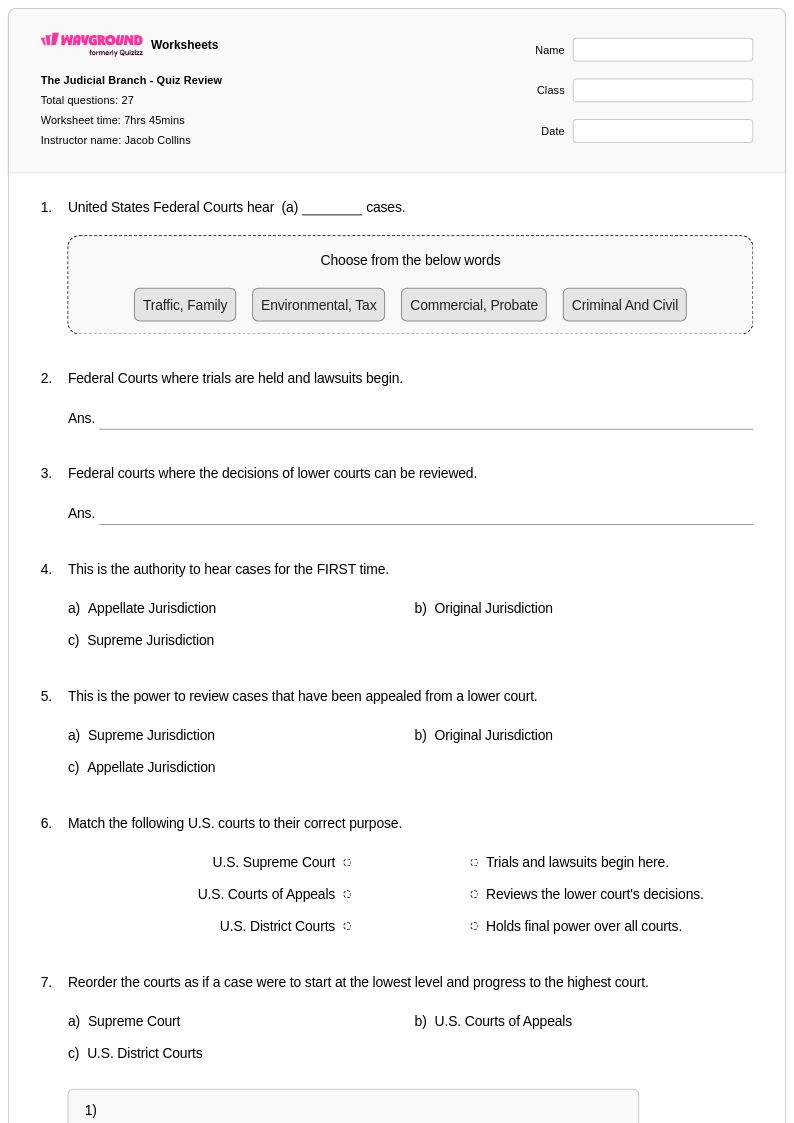
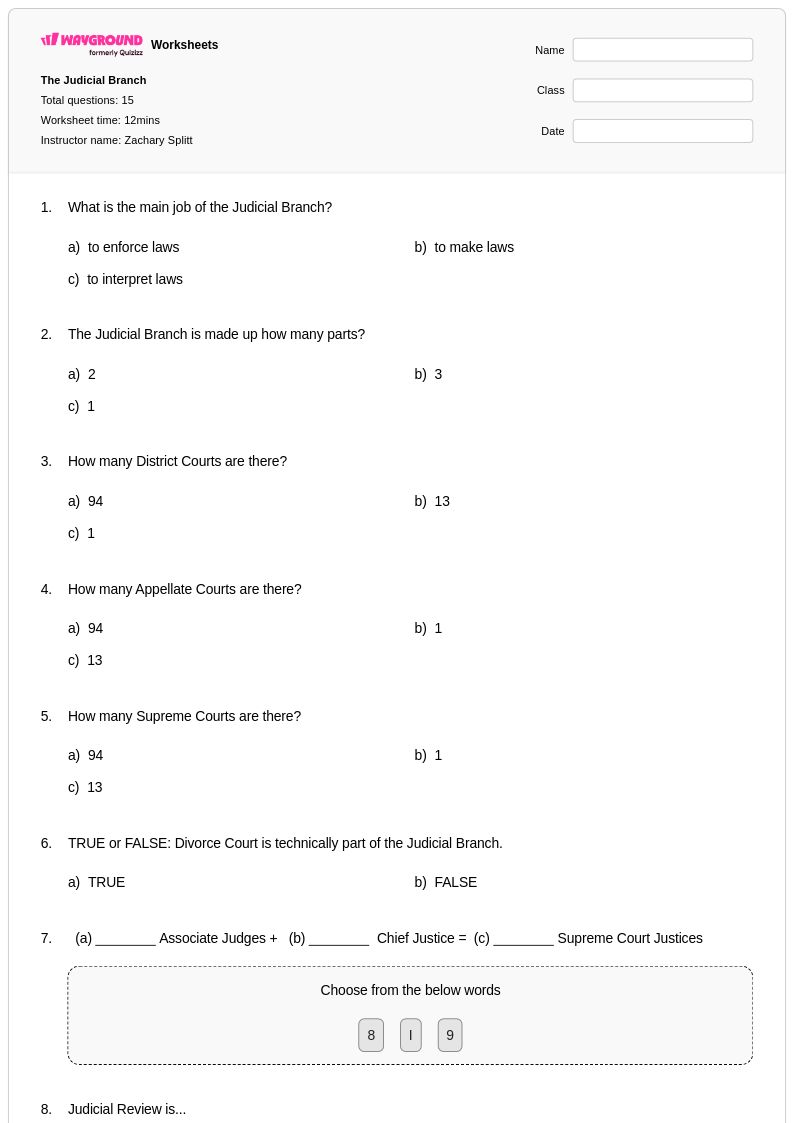
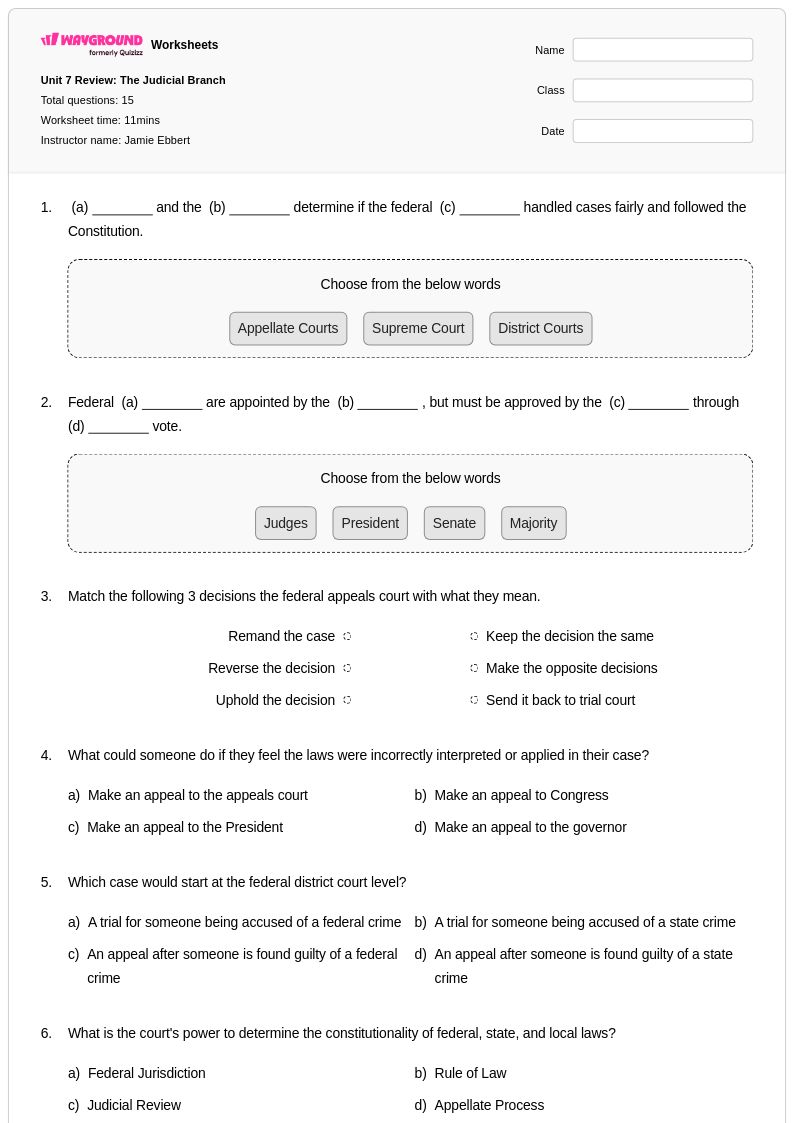
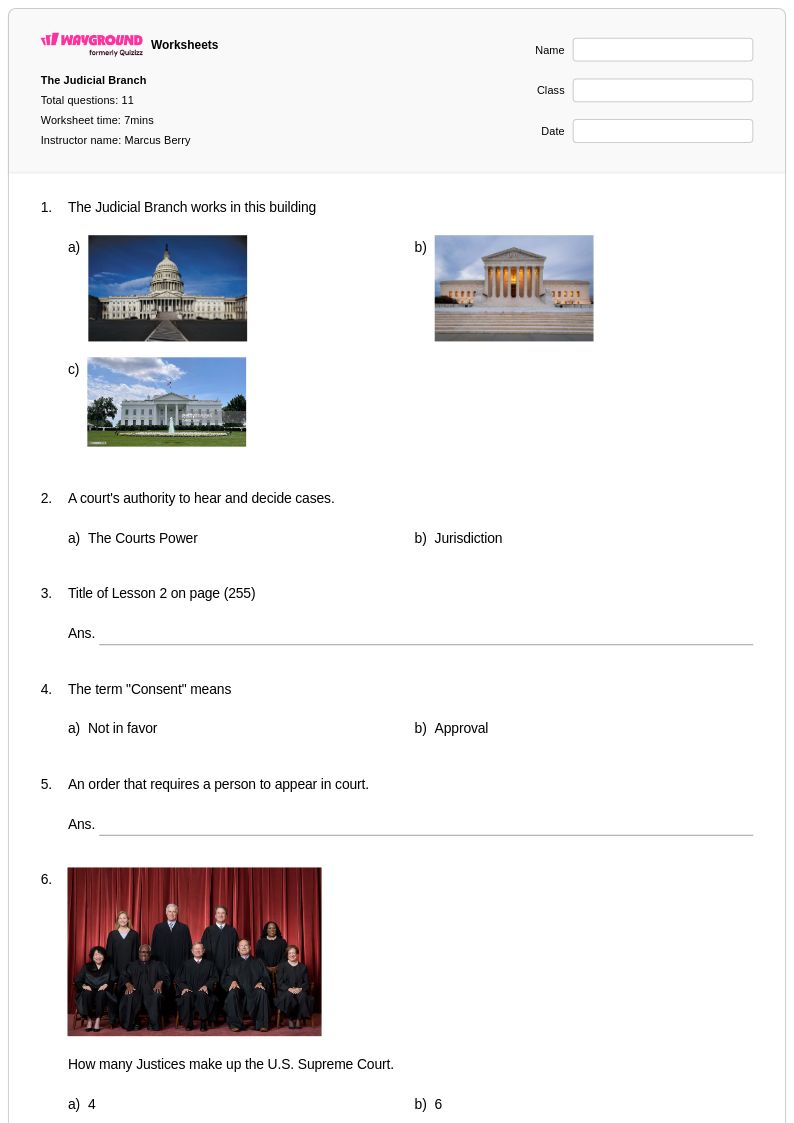
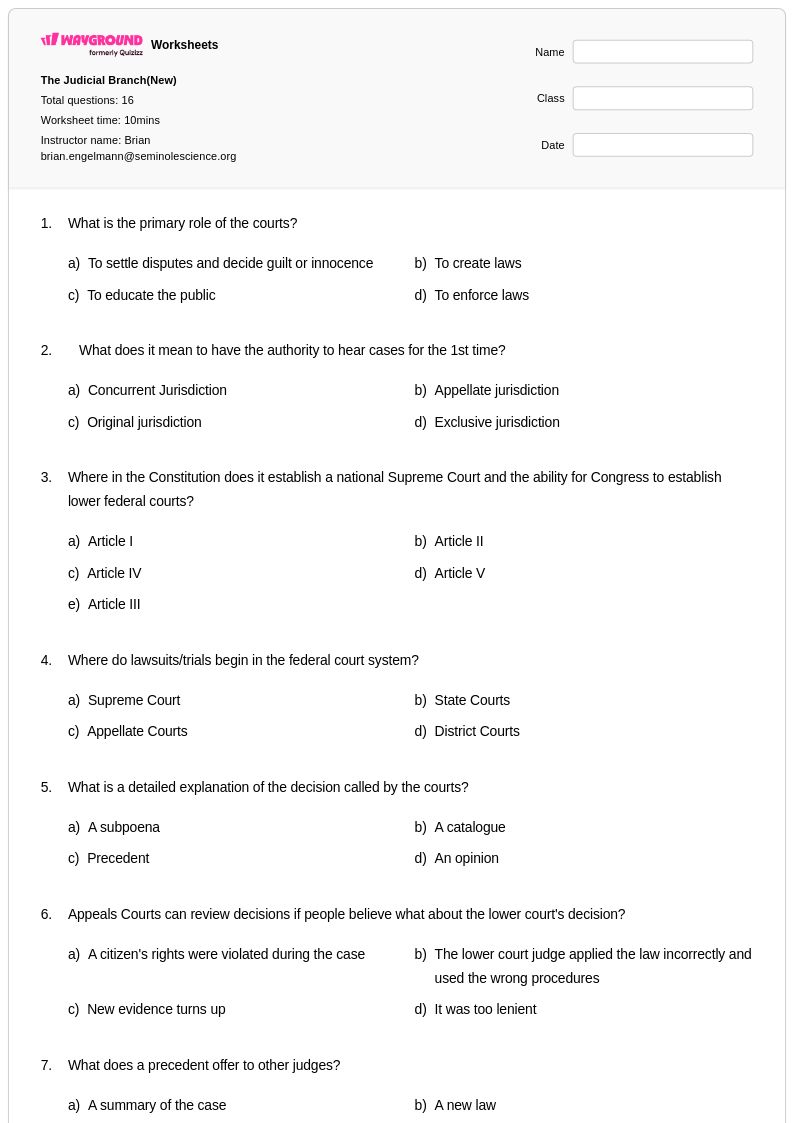
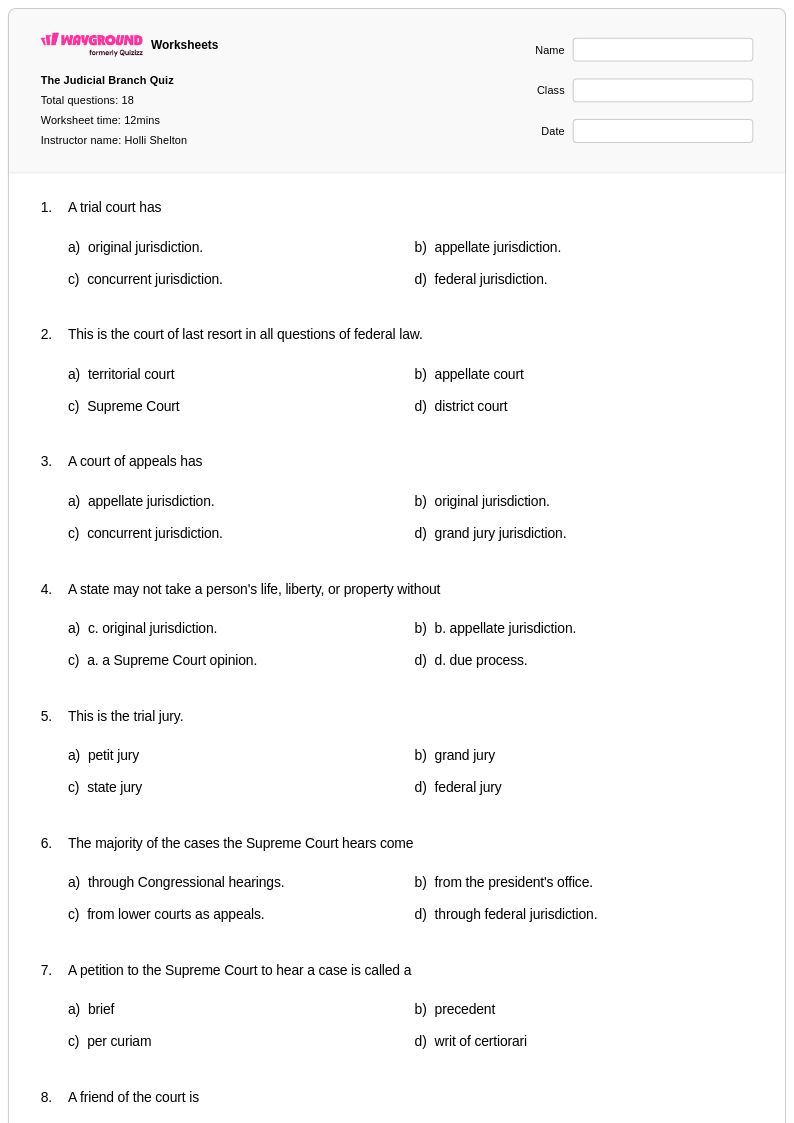
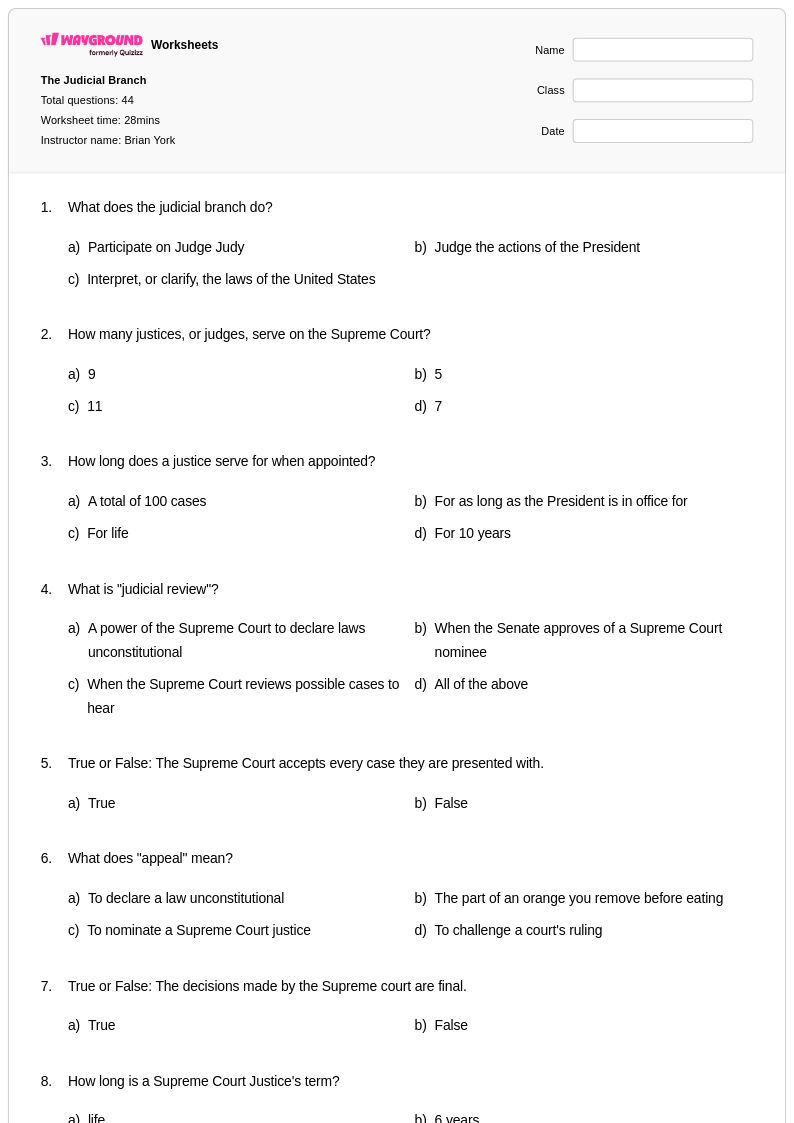
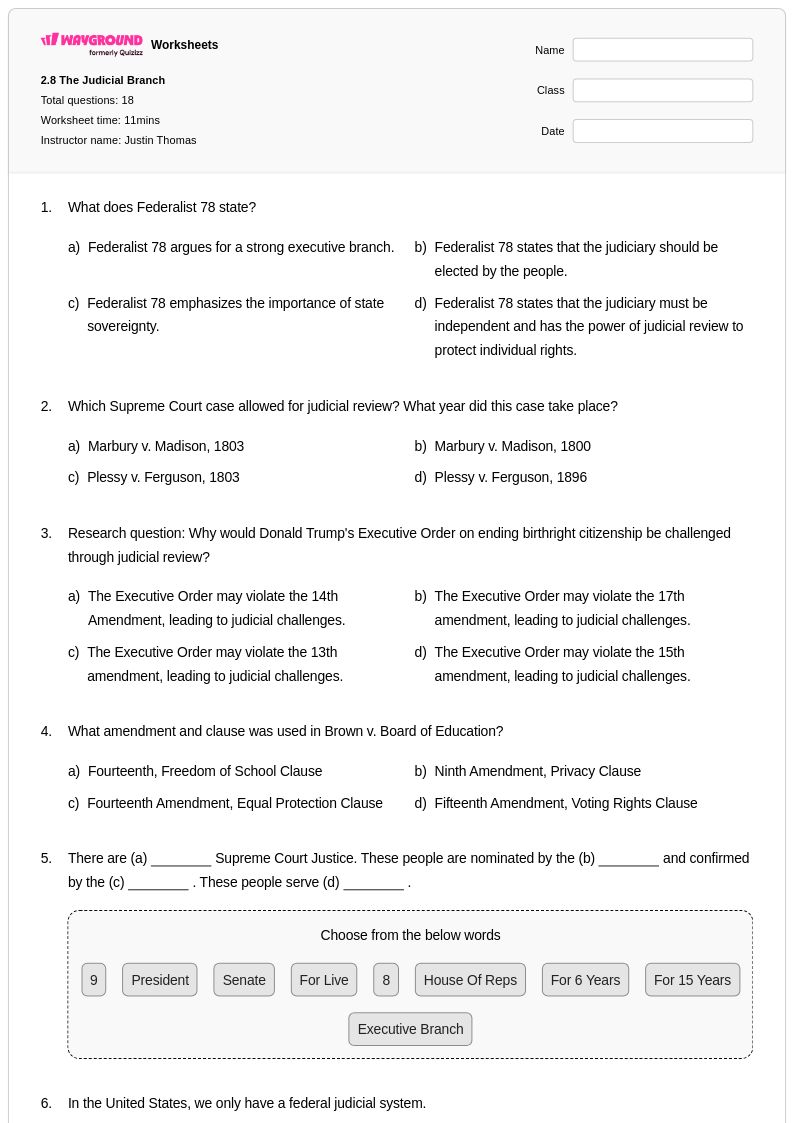
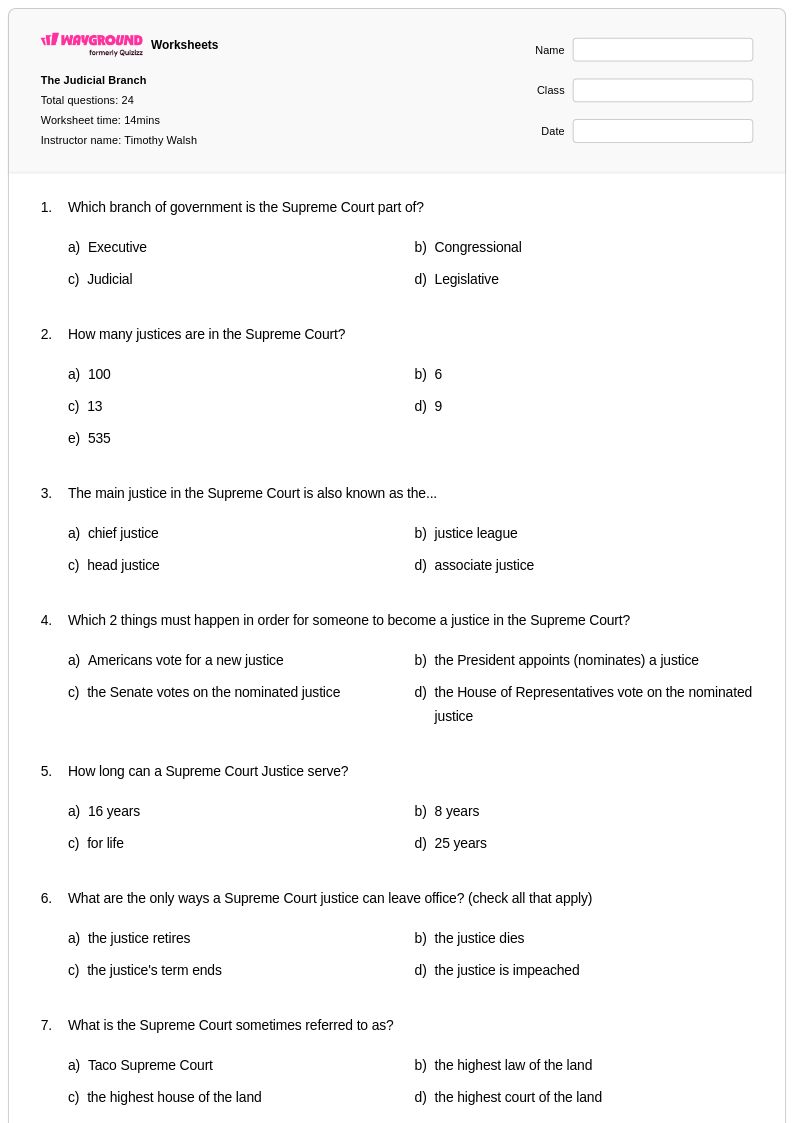
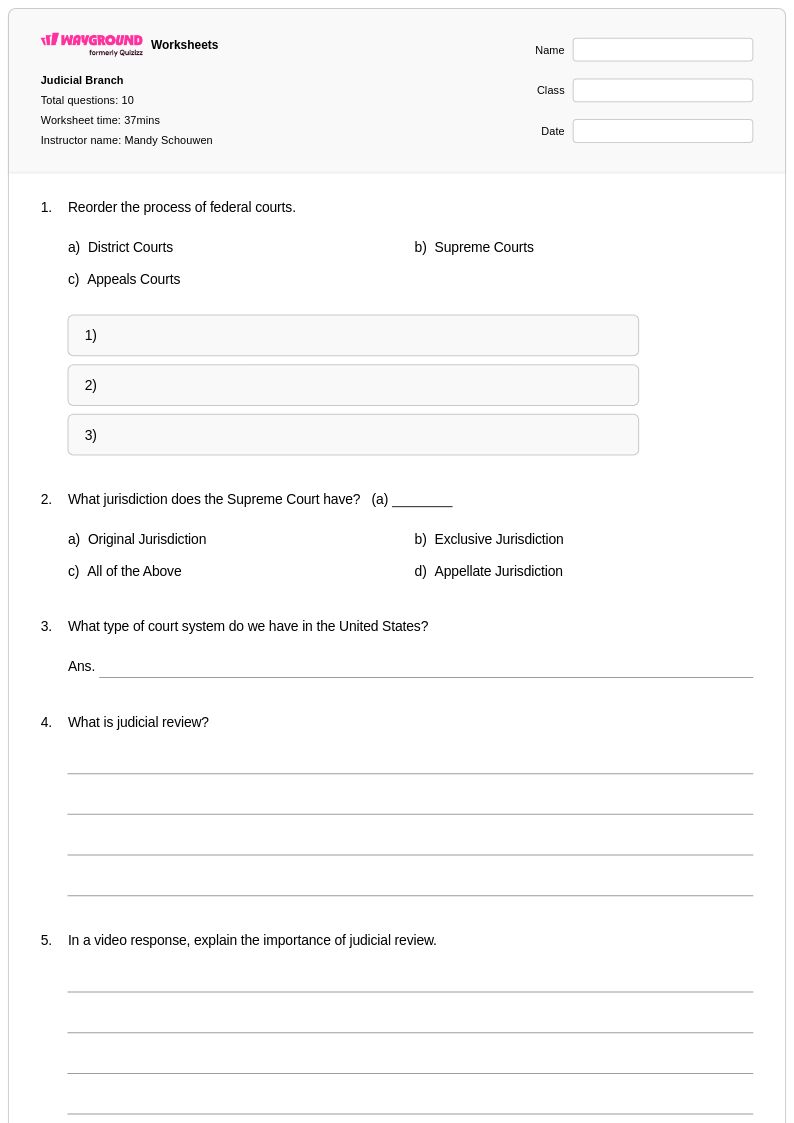
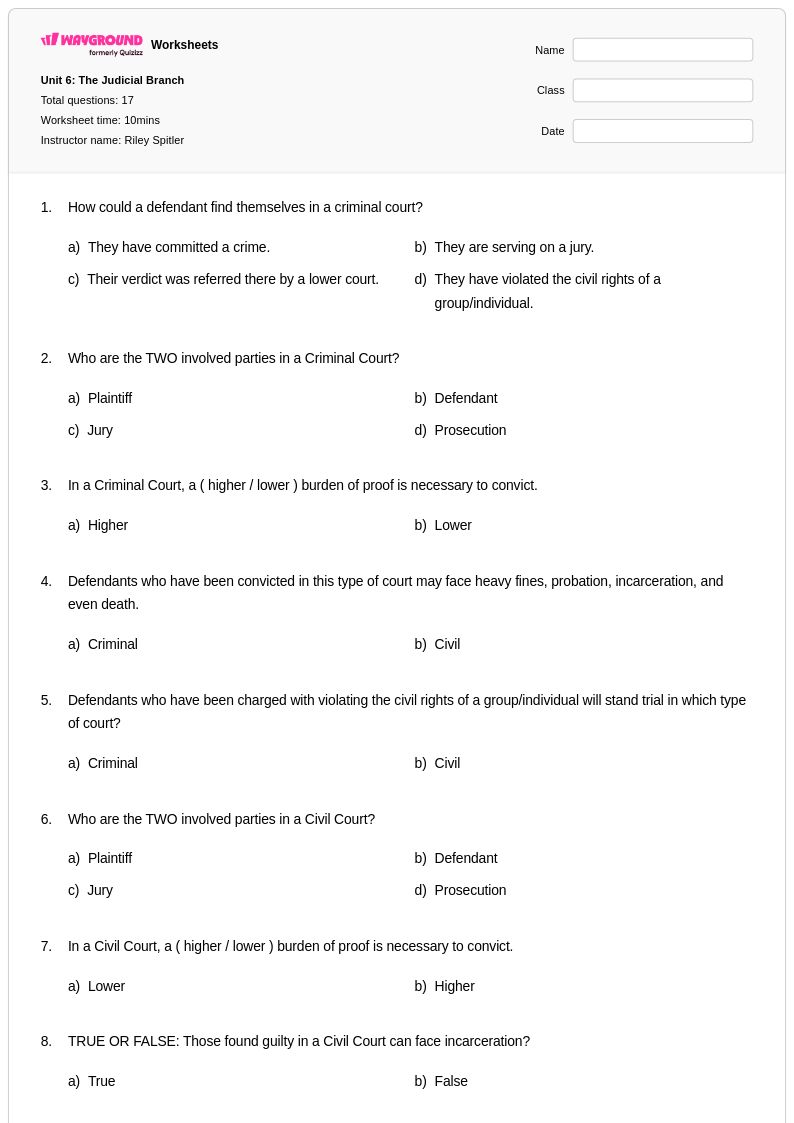
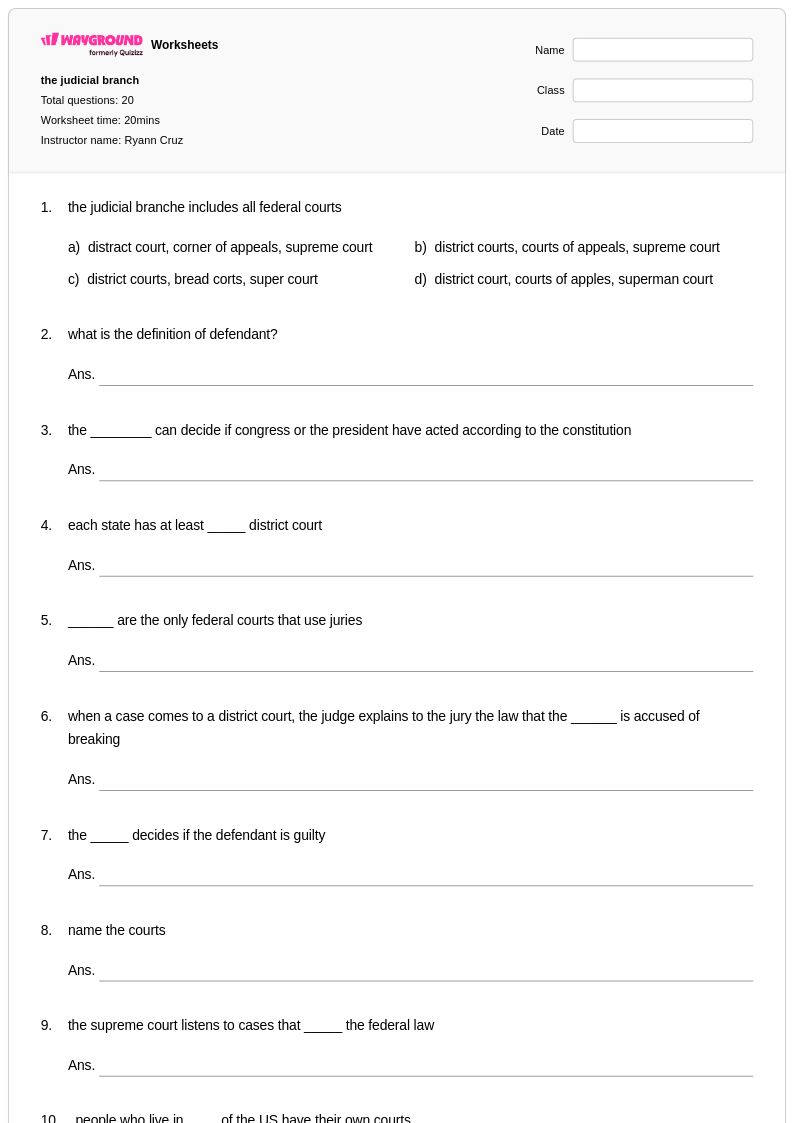
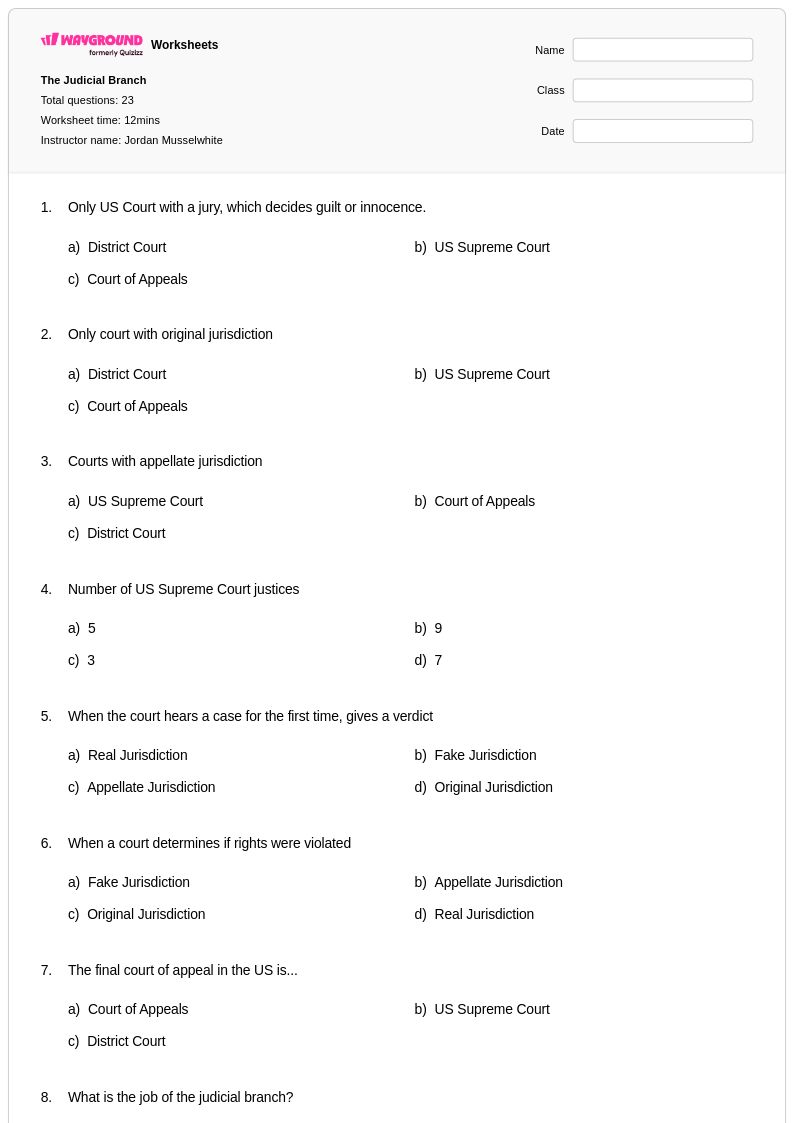
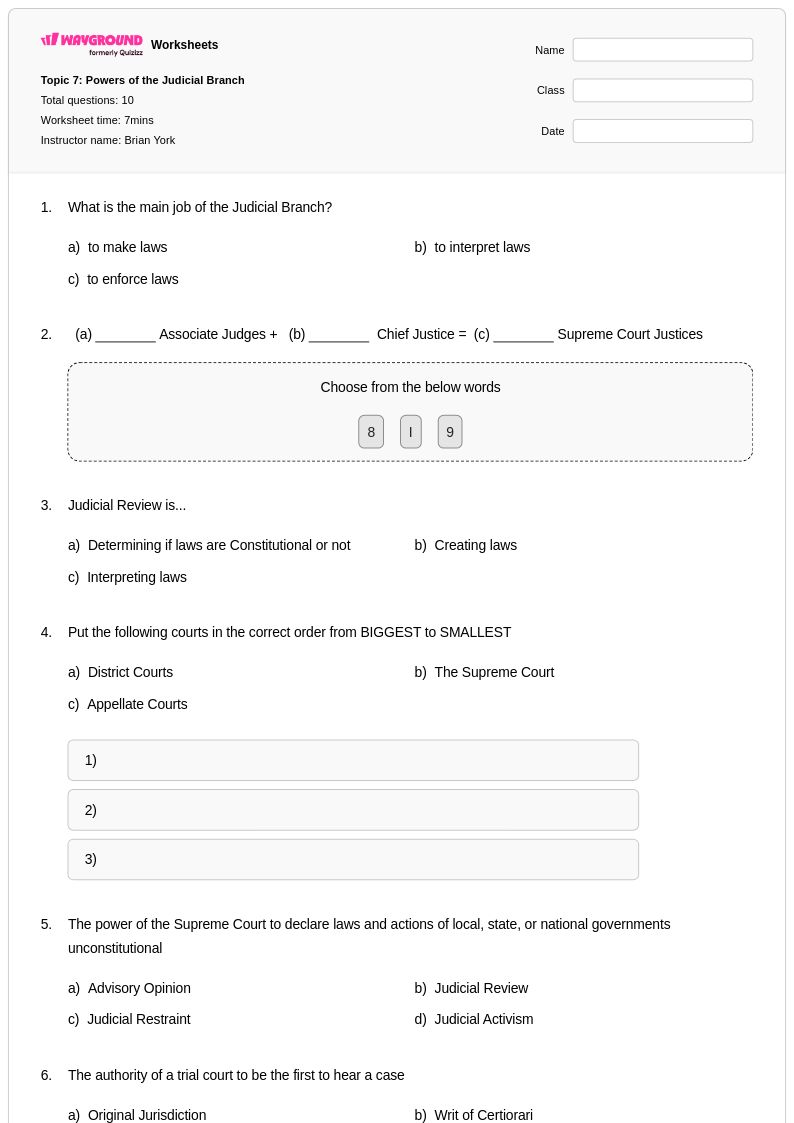
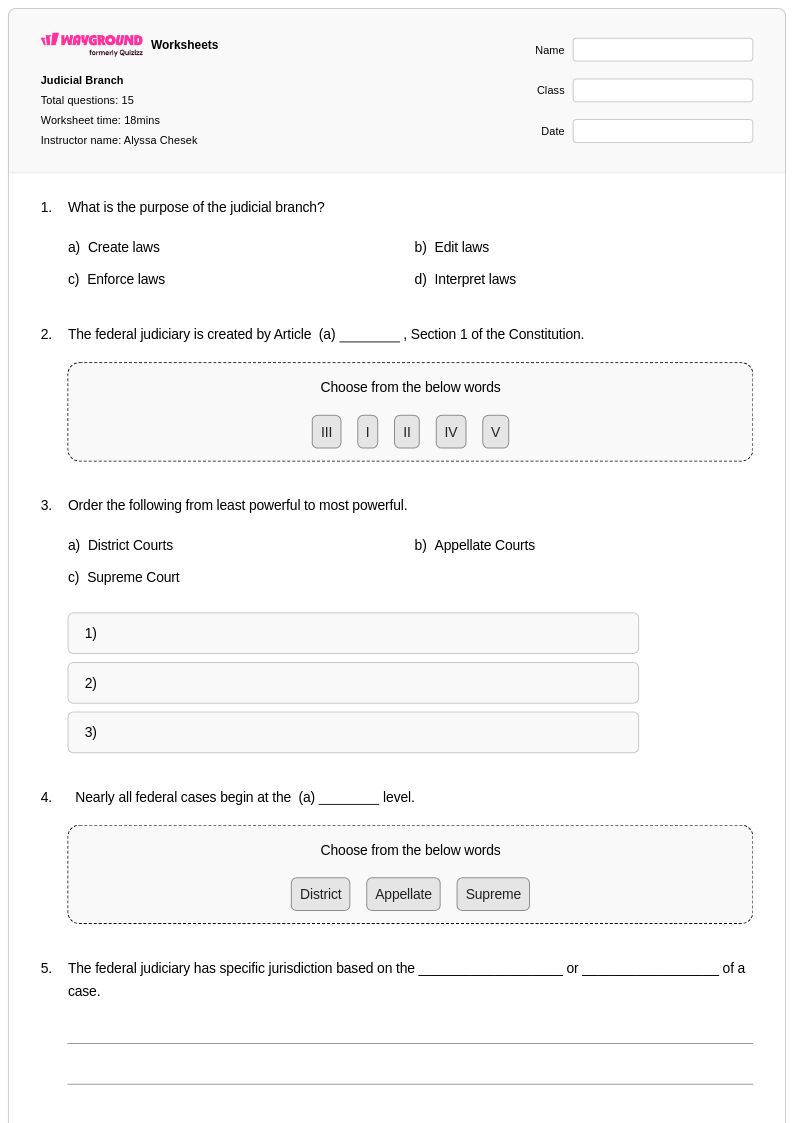
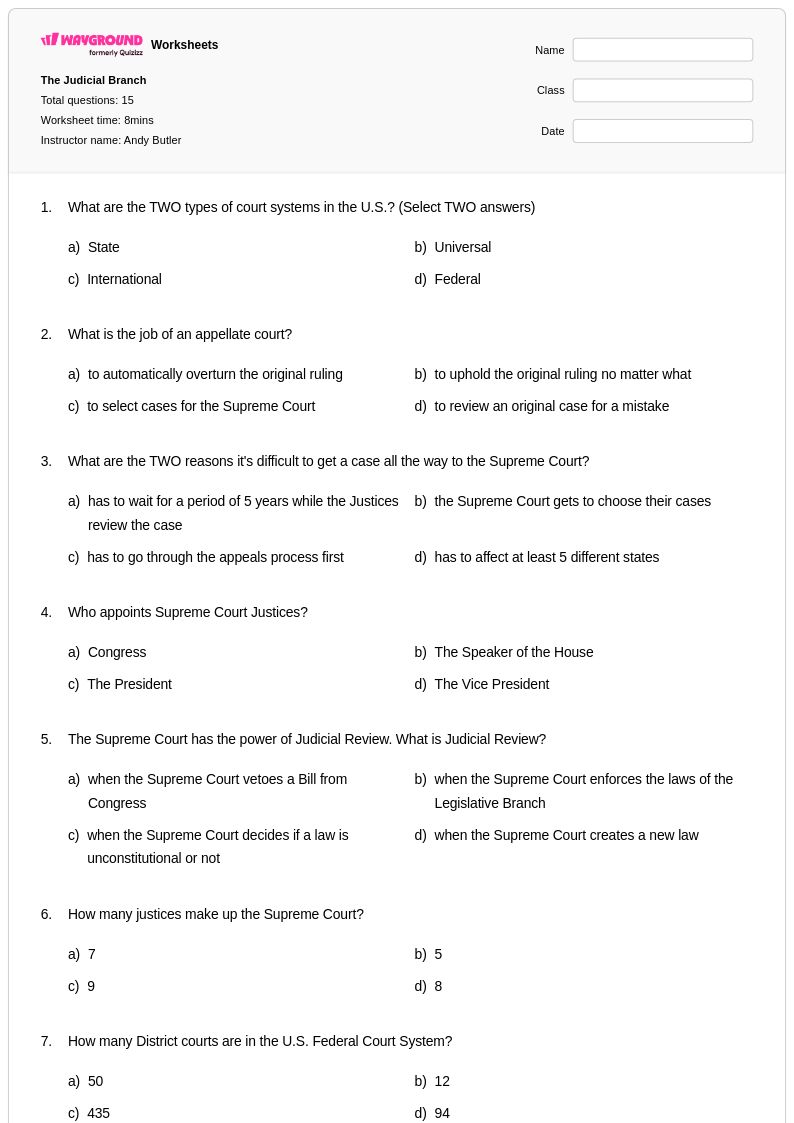
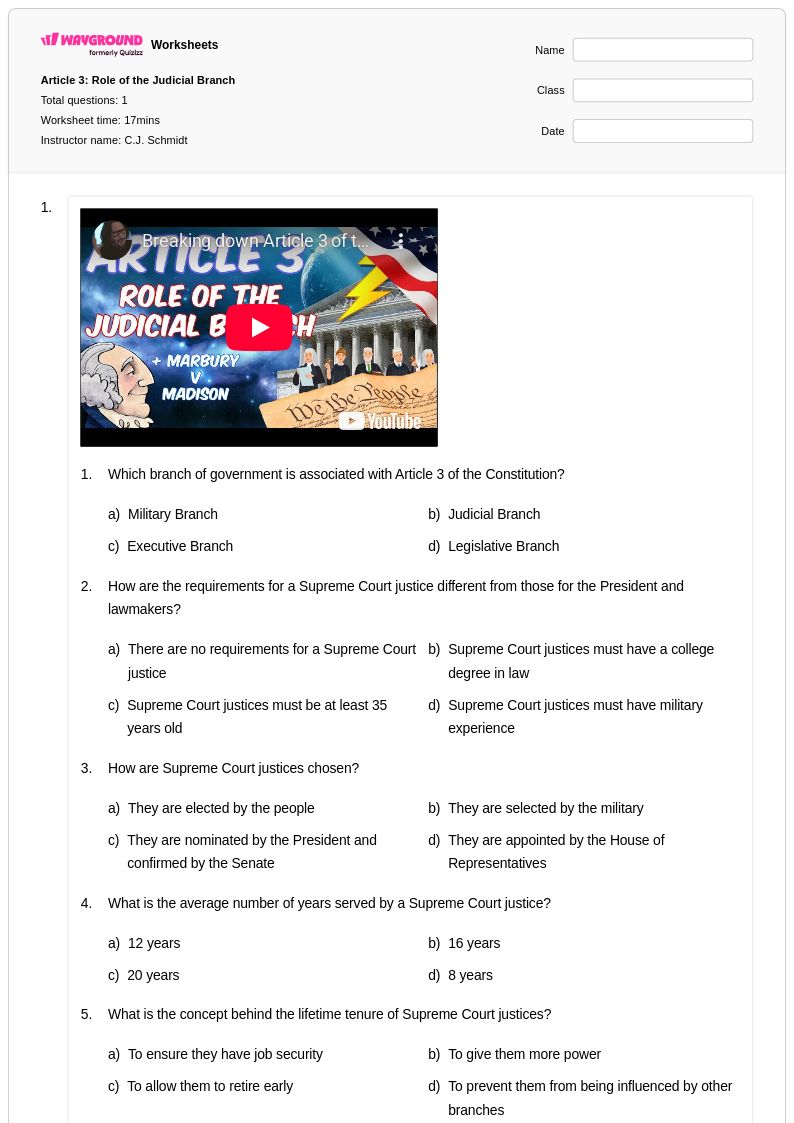
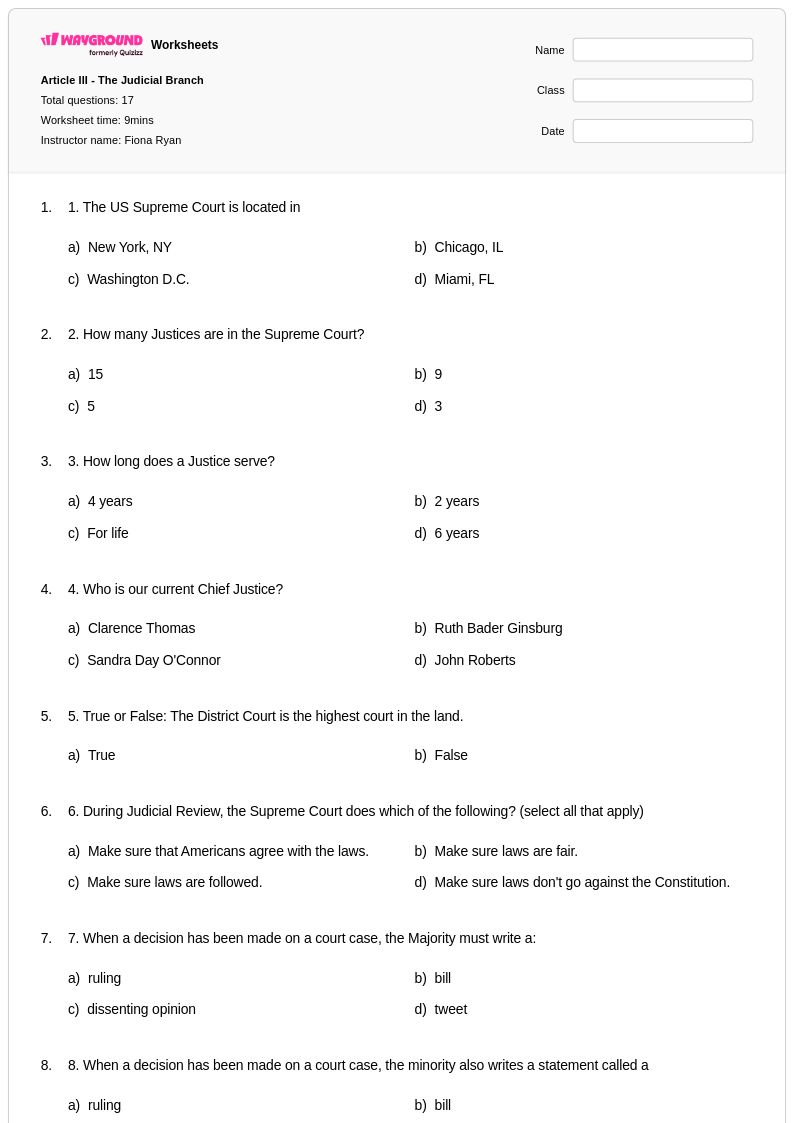
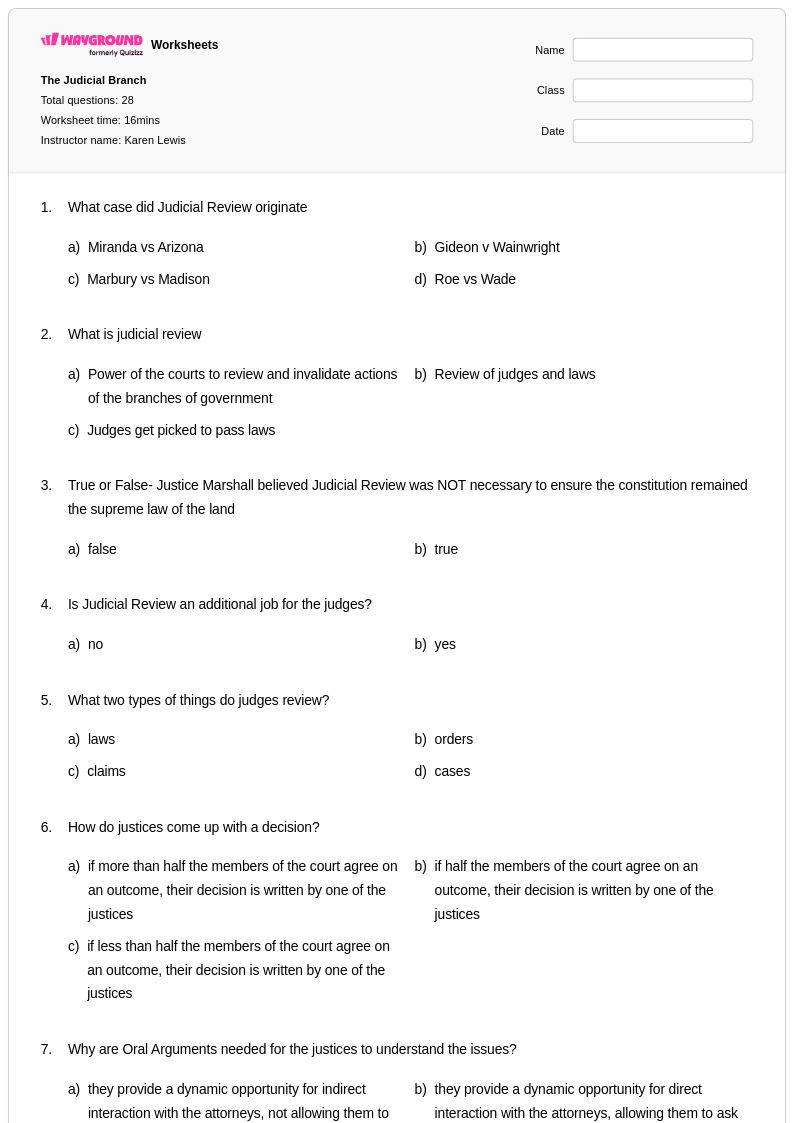
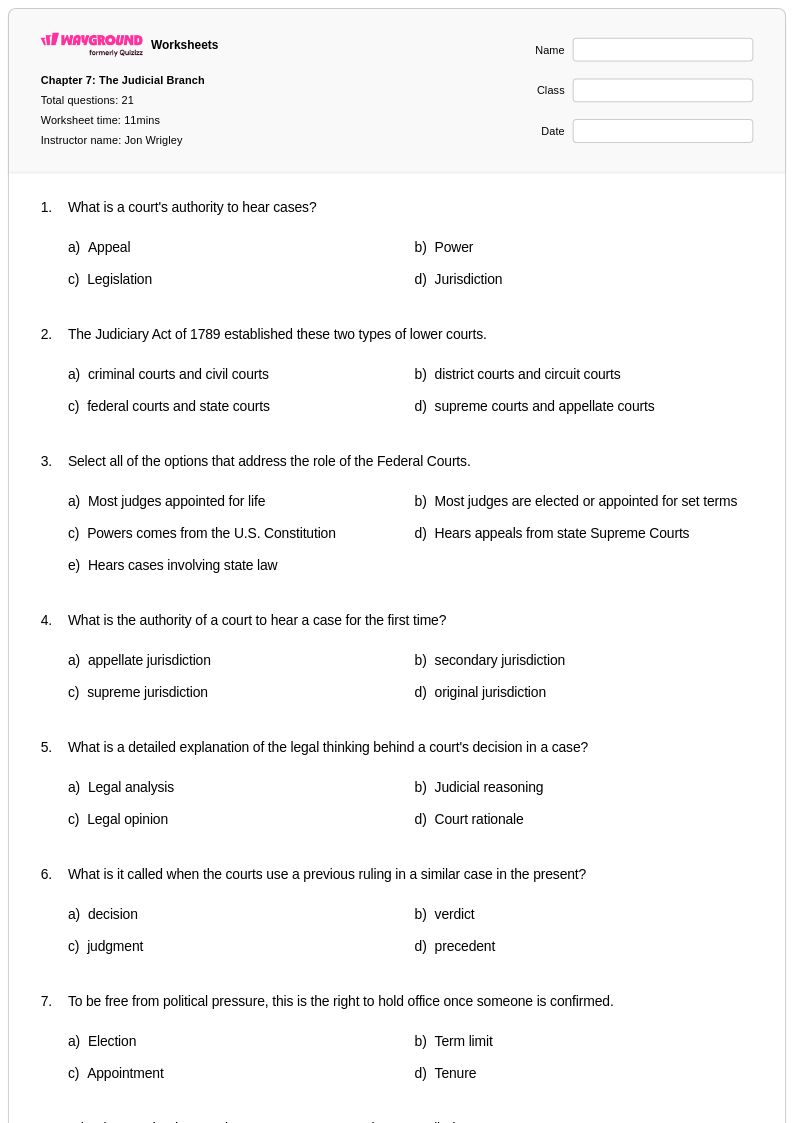
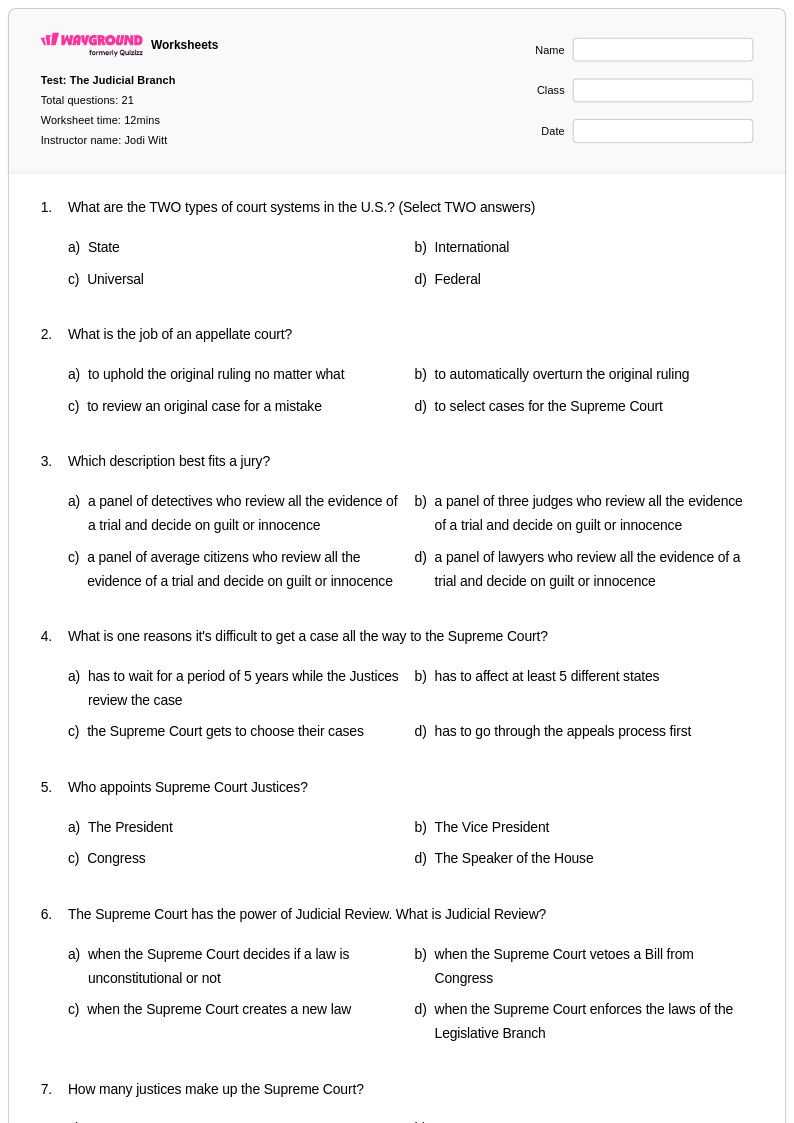
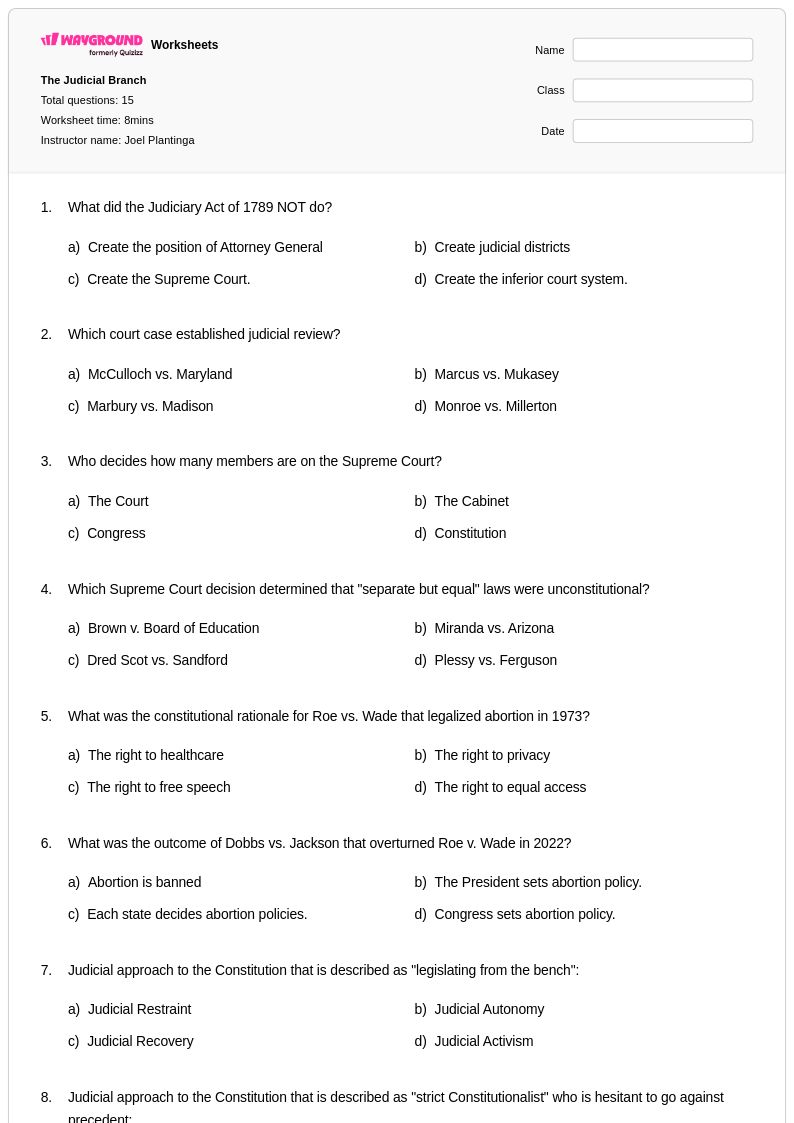
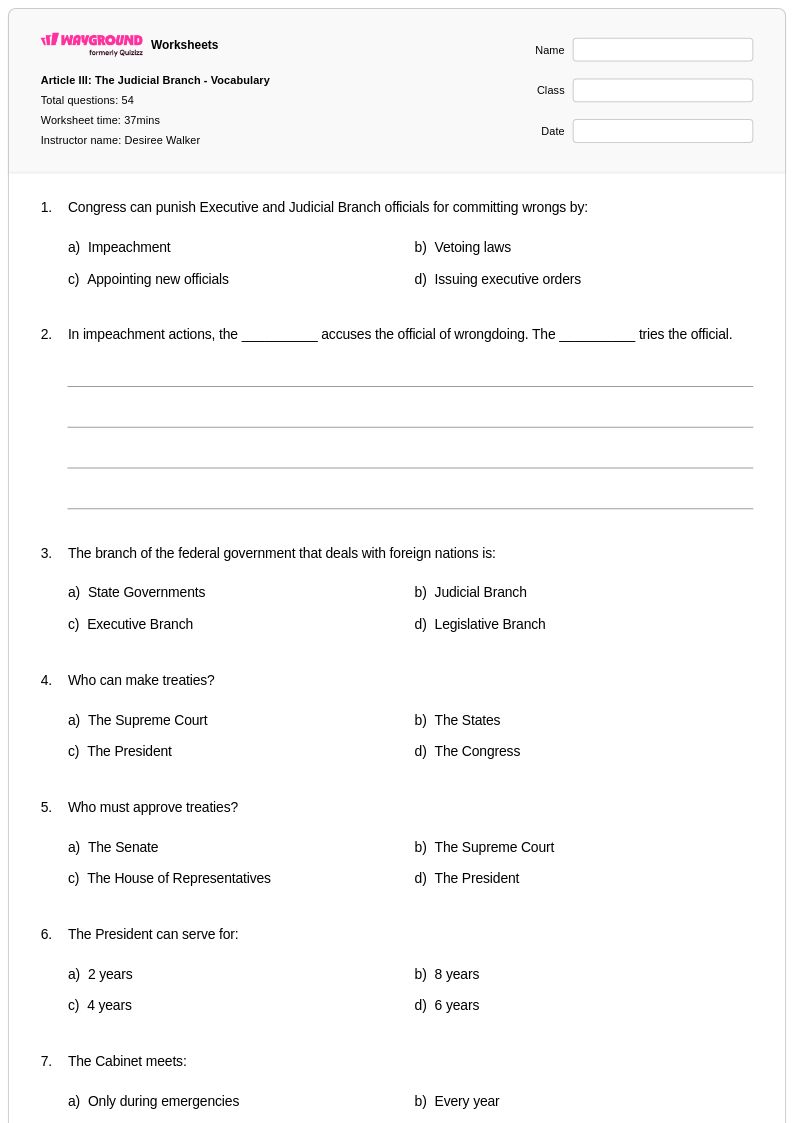
Explore Wayground's free judicial branch worksheets and printables that help students understand court systems, judicial review, and constitutional interpretation through engaging practice problems with comprehensive answer keys.
The Judicial Branch worksheets available through Wayground (formerly Quizizz) provide comprehensive coverage of the third branch of government, helping students master fundamental concepts about the court system's structure, functions, and role in American democracy. These educational resources strengthen critical thinking skills as students explore topics including the Supreme Court's constitutional authority, the federal court hierarchy, judicial review, landmark cases, and the appointment process for federal judges. Each worksheet incorporates practice problems that challenge students to analyze real-world scenarios, interpret constitutional principles, and evaluate the impact of judicial decisions on society. Teachers can access complete answer keys and utilize these free printables to reinforce classroom instruction while building students' understanding of how the judiciary serves as a check on legislative and executive power.
Wayground (formerly Quizizz) supports educators with millions of teacher-created resources specifically designed for judicial branch instruction, featuring robust search and filtering capabilities that allow teachers to quickly locate materials aligned with state and national civics standards. The platform's differentiation tools enable instructors to customize worksheets based on individual student needs, while flexible formatting options provide both printable pdf versions and interactive digital alternatives suitable for various learning environments. These features streamline lesson planning by offering ready-to-use materials for skill practice, targeted remediation for students struggling with constitutional concepts, and enrichment activities for advanced learners seeking deeper exploration of judicial precedents and legal reasoning. The comprehensive collection ensures teachers have access to high-quality resources that effectively communicate the complexity and importance of the judicial system in maintaining constitutional governance.
FAQs
How do I teach the judicial branch to middle or high school students?
Start by grounding students in the three-tier federal court structure before introducing the concept of judicial review, as students need to understand where authority originates before they can evaluate how it is exercised. Use landmark cases like Marbury v. Madison or Brown v. Board of Education as anchors, since real cases make abstract constitutional principles concrete. From there, students can analyze how the judiciary functions as a check on legislative and executive power rather than treating it as a passive institution.
What exercises help students practice understanding judicial review?
Scenario-based practice works well for judicial review because it requires students to apply constitutional reasoning rather than recall definitions. Give students a hypothetical law and ask them to evaluate whether it would survive constitutional scrutiny and which court would have jurisdiction. Worksheets that pair landmark case summaries with guided analysis questions are especially effective at building this interpretive skill progressively.
What common mistakes do students make when learning about the judicial branch?
The most frequent misconception is that the Supreme Court automatically hears all cases appealed to it — students often do not understand the certiorari process or the concept of judicial discretion. Another common error is conflating the roles of federal and state courts, or assuming all constitutional questions reach the federal level. Students also frequently misattribute judicial review as a power explicitly written into the Constitution rather than established through precedent in Marbury v. Madison.
How do I help students understand the difference between the federal and state court systems?
Use a side-by-side comparison structure that maps each level of the federal hierarchy against its state equivalent, so students can see parallel functions rather than treating the two systems as entirely separate. Emphasize jurisdiction as the organizing concept — what kinds of cases each court can hear — because it explains why some cases stay in state courts and others escalate to federal. Providing real examples of cases at each level helps students move from abstract structure to practical understanding.
How can I use Wayground's judicial branch worksheets in my classroom?
Wayground's judicial branch worksheets are available as printable PDFs for traditional classroom use and in digital formats for technology-integrated environments, making them adaptable whether you are teaching in person or remotely. You can also host them as a quiz directly on Wayground, which gives you real-time data on how students are performing. All worksheets include complete answer keys, so they work equally well for guided instruction, independent practice, or targeted remediation for students struggling with constitutional concepts.
How do I differentiate judicial branch instruction for students at different levels?
For students who need additional support, reduce the cognitive load by focusing first on the Supreme Court before introducing the full federal hierarchy, and use simplified case summaries rather than primary source excerpts. For advanced learners, extend the task by asking them to trace a legal issue through each court level or compare the reasoning across two landmark decisions. Wayground's platform also supports individual accommodations such as read aloud, extended time, and reduced answer choices, which can be assigned to specific students without disrupting the rest of the class.