Explore Wayground's comprehensive collection of free greenhouse effect worksheets and printables that help students understand how atmospheric gases trap heat, complete with practice problems and answer keys in convenient PDF format.
Greenhouse Effect worksheets available through Wayground (formerly Quizizz) provide comprehensive resources for students to explore one of Earth's most critical atmospheric processes. These expertly designed materials guide learners through the fundamental mechanisms of how greenhouse gases trap heat in Earth's atmosphere, enabling them to understand both natural greenhouse processes and human-induced climate change. The worksheets strengthen essential scientific skills including data interpretation, cause-and-effect analysis, and systems thinking as students examine how carbon dioxide, methane, and water vapor interact with incoming solar radiation and outgoing thermal energy. Each resource includes detailed practice problems that challenge students to calculate energy balances, analyze atmospheric composition data, and evaluate the relationship between greenhouse gas concentrations and global temperature trends, with accompanying answer keys ensuring accurate comprehension of complex atmospheric science concepts available in convenient pdf format.
Wayground (formerly Quizizz) empowers educators with millions of teacher-created greenhouse effect resources that streamline lesson planning and enhance student understanding of this vital Earth and Space Science concept. The platform's robust search and filtering capabilities allow teachers to quickly locate worksheets aligned with specific learning standards, while differentiation tools enable customization for diverse learning needs and skill levels. These printable and digital materials, including downloadable pdf formats, support flexible classroom implementation whether teachers need quick formative assessments, comprehensive review sessions, or targeted remediation activities. The extensive collection facilitates both foundational skill practice for students new to atmospheric science and enrichment opportunities for advanced learners ready to explore complex climate modeling and environmental policy connections, ensuring every educator can find appropriate greenhouse effect resources to meet their instructional goals.
FAQs
How do I teach the greenhouse effect to middle or high school students?
Start by distinguishing between the natural greenhouse effect and human-amplified warming, since students often conflate the two. Use energy diagrams to show how solar radiation enters the atmosphere and how infrared radiation is trapped by gases like carbon dioxide, methane, and water vapor. Connecting the mechanism to observable outcomes, such as rising global temperatures and shifting climate patterns, helps students move beyond memorization into systems thinking.
What exercises help students practice understanding the greenhouse effect?
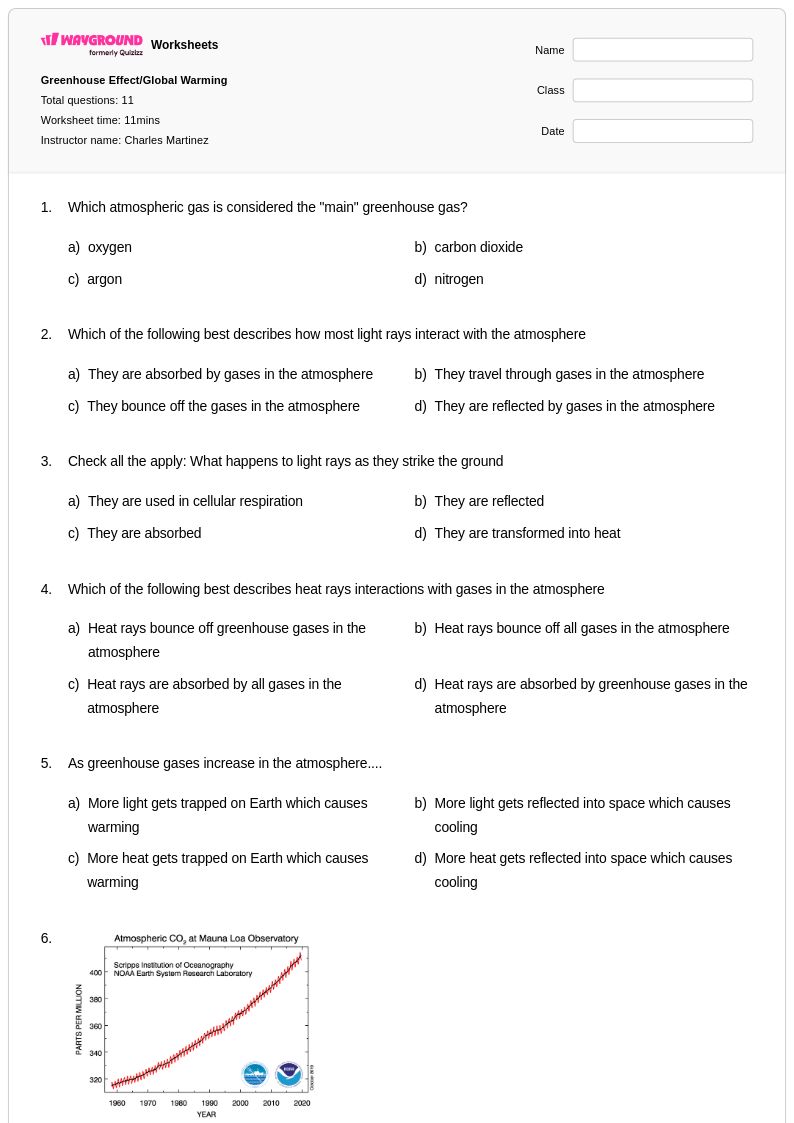
Effective practice exercises include analyzing atmospheric composition data, calculating energy balances between incoming solar and outgoing thermal radiation, and interpreting graphs that show correlations between greenhouse gas concentrations and global temperature trends. Cause-and-effect organizers are also useful for helping students map how individual gases contribute to heat retention. These activities build the data interpretation and scientific reasoning skills central to atmospheric science.
What misconceptions do students commonly have about the greenhouse effect?
The most common misconception is that the greenhouse effect is inherently harmful, when in fact the natural greenhouse effect is essential for life on Earth. Students also frequently confuse the greenhouse effect with ozone depletion, treating them as the same phenomenon. Another common error is assuming carbon dioxide is the only greenhouse gas, overlooking the roles of methane, nitrous oxide, and water vapor in trapping thermal energy.
How can I differentiate greenhouse effect instruction for students at different skill levels?
For students new to atmospheric science, focus on the foundational mechanism of how greenhouse gases absorb and re-emit infrared radiation before introducing data analysis. Advanced learners can be challenged with climate modeling scenarios, energy budget calculations, and discussions of environmental policy implications. On Wayground, teachers can apply accommodations such as read aloud, reduced answer choices, or extended time to individual students, ensuring every learner accesses the material at an appropriate level without disrupting the rest of the class.
How do I use Wayground's greenhouse effect worksheets in my classroom?
Wayground's greenhouse effect worksheets are available as printable PDFs for traditional classroom use and in digital formats for technology-integrated environments, giving teachers flexibility depending on their setup. Digital versions can also be hosted as a quiz directly on Wayground, making them suitable for formative assessment, independent review, or targeted remediation. Each worksheet includes an answer key, so teachers can use them efficiently without additional preparation time.
How do I assess whether students understand the greenhouse effect versus just memorizing it?
Strong understanding goes beyond recalling which gases are greenhouse gases. Look for students who can explain why certain molecular structures absorb infrared radiation, interpret a graph showing temperature anomalies against CO2 concentrations, or distinguish between natural variability and human-induced trends. Asking students to evaluate a scenario, such as predicting what would happen to Earth's temperature if methane concentrations doubled, reveals whether they genuinely understand the system rather than just its labels.