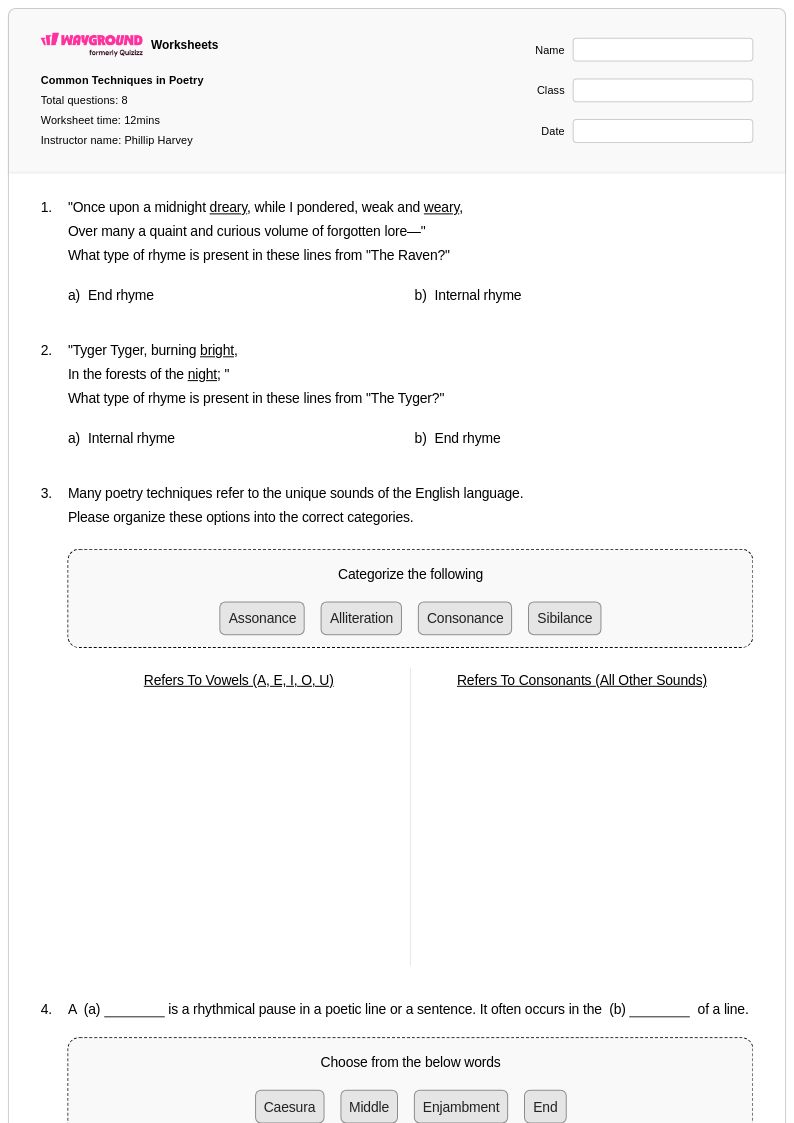
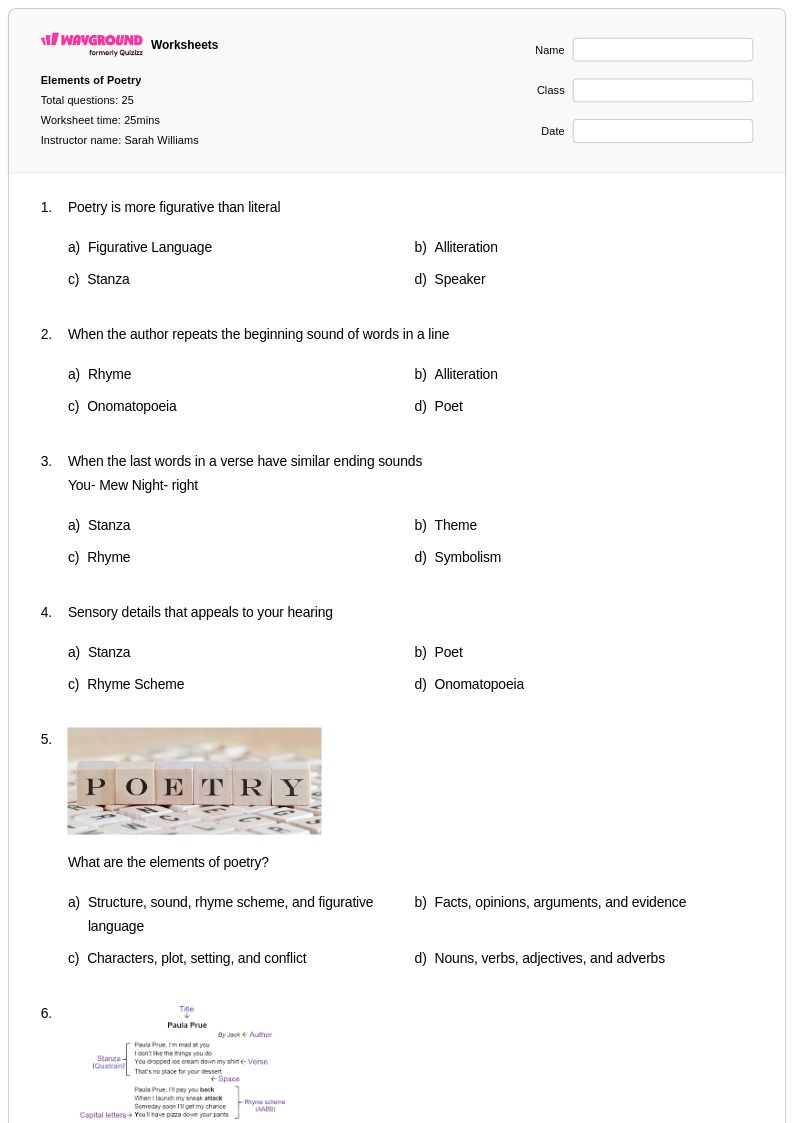
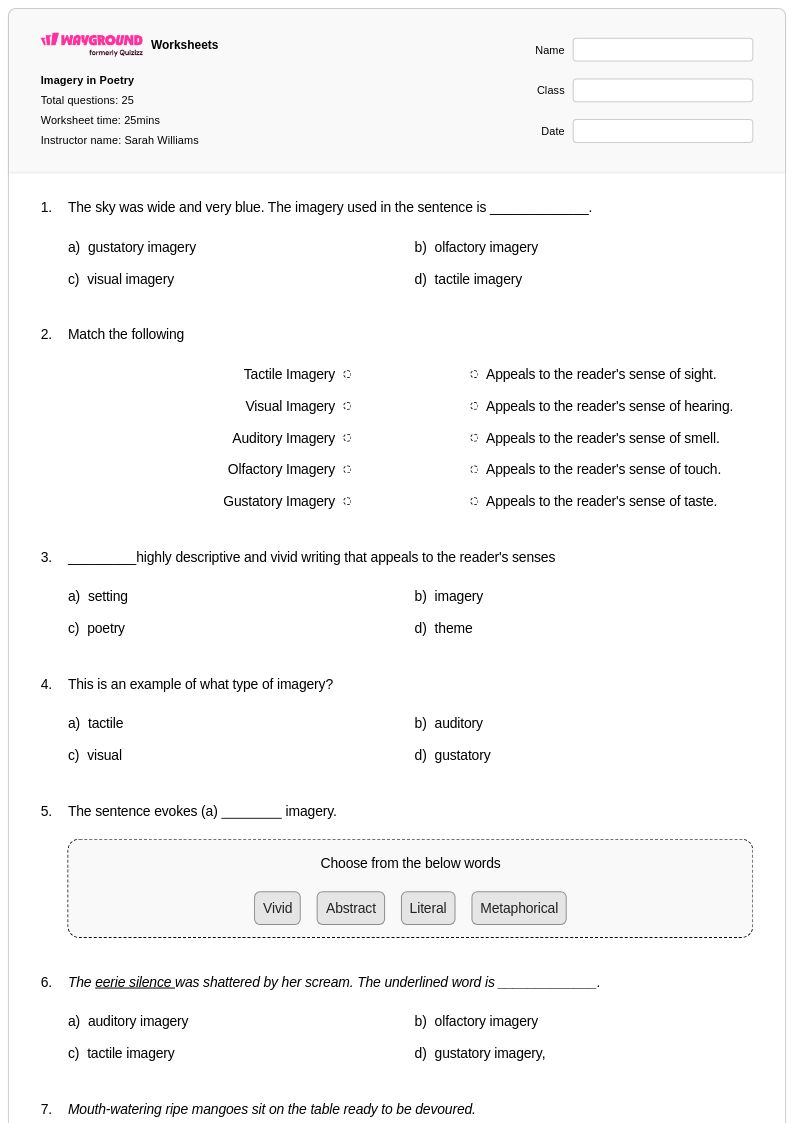
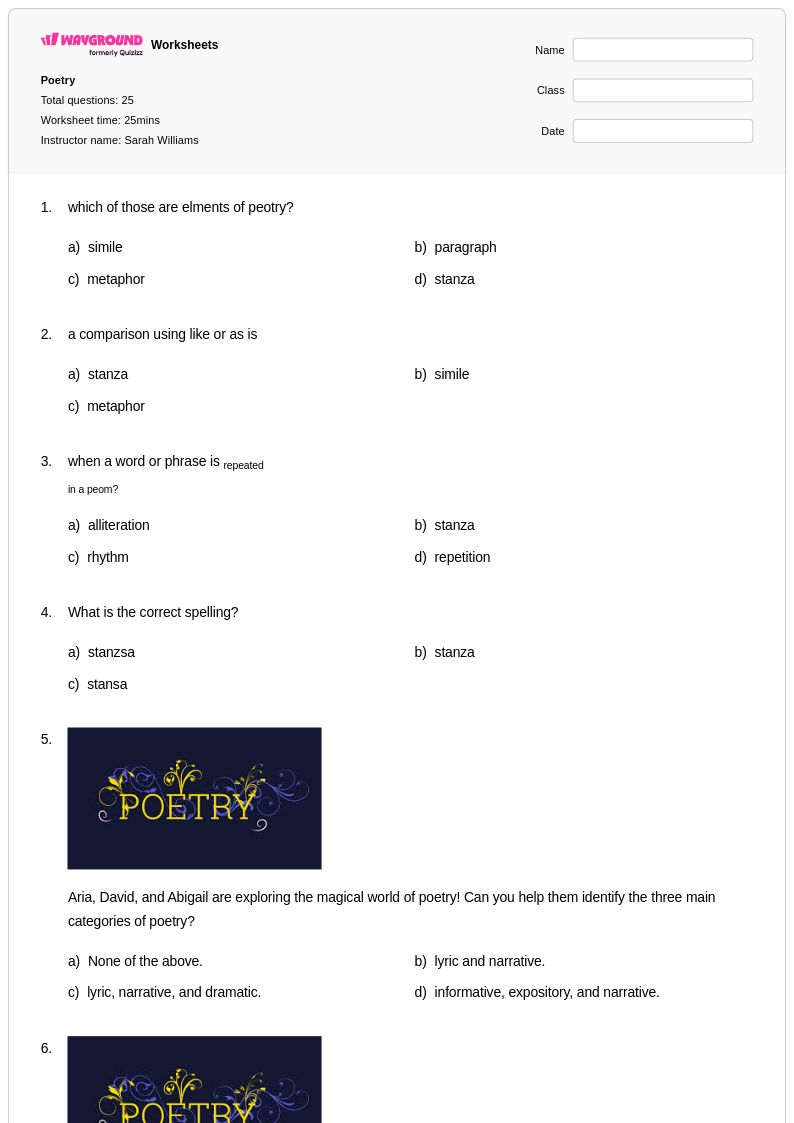
Enhance Class 11 students' poetry skills with Wayground's comprehensive collection of free worksheets, printables, and PDFs featuring practice problems and answer keys to develop creative writing techniques and poetic expression.
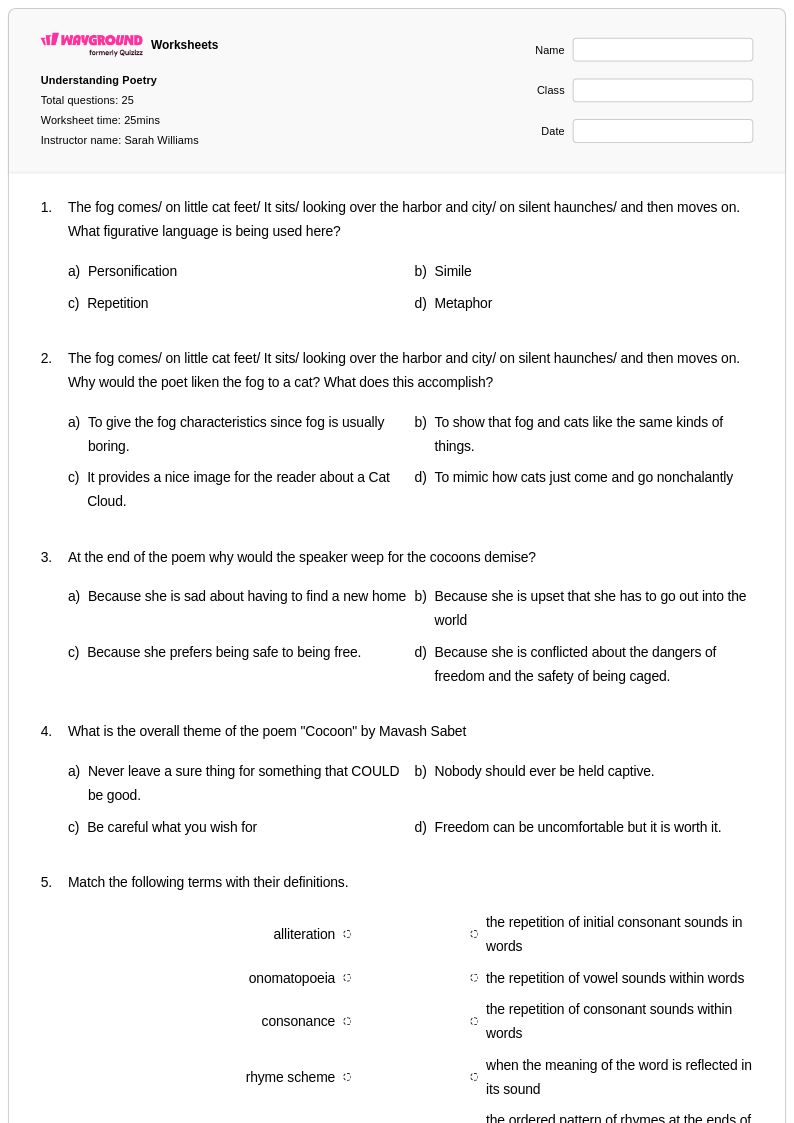
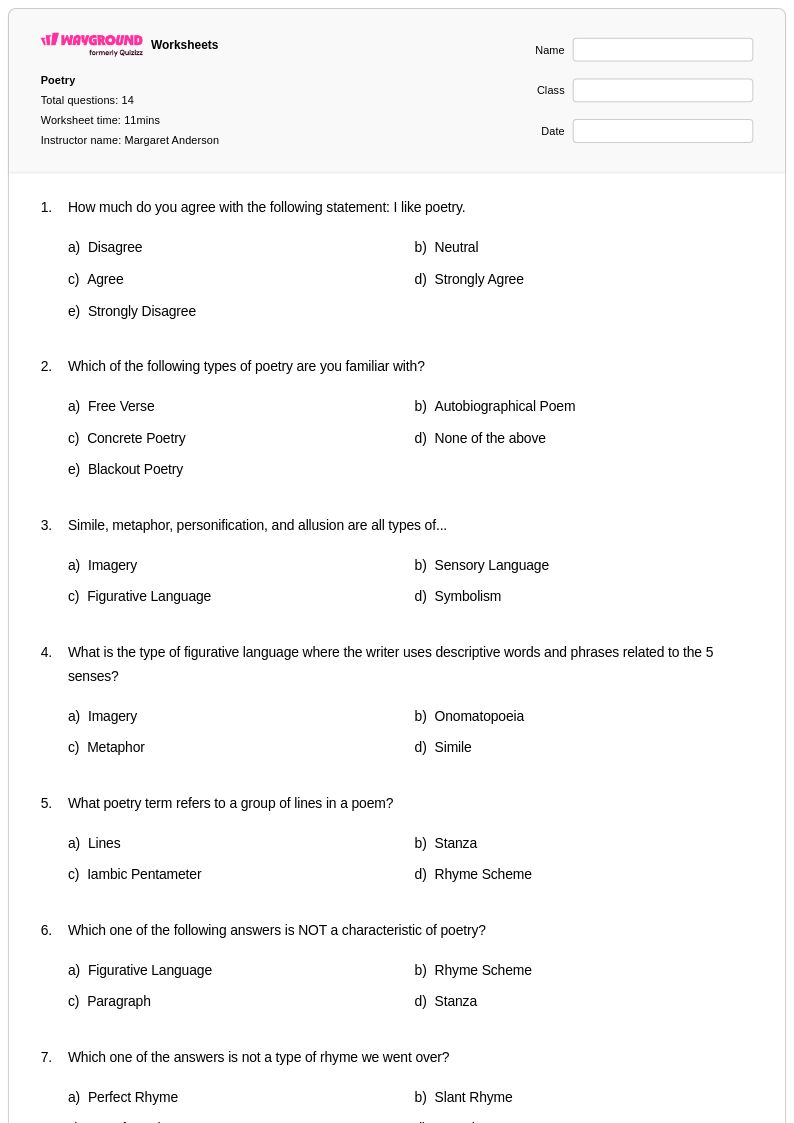
Poetry worksheets for Class 11 students on Wayground (formerly Quizizz) provide comprehensive resources that develop advanced literary analysis and creative writing skills essential for upper-level English studies. These carefully crafted materials guide students through sophisticated poetic concepts including meter, rhyme scheme, figurative language, thematic development, and structural analysis across various poetic forms from sonnets to free verse. Each worksheet collection includes detailed answer keys that support both independent study and classroom instruction, while printable pdf formats ensure accessibility for diverse learning environments. Students engage with practice problems that challenge them to identify literary devices, analyze poet's craft, interpret meaning, and create original poetry that demonstrates mastery of specific techniques and forms.
Wayground's extensive library of teacher-created poetry resources supports Class 11 English educators with millions of professionally developed worksheets that can be easily located through robust search and filtering capabilities. The platform's standards alignment ensures that poetry instruction meets curriculum requirements while differentiation tools allow teachers to customize materials for varying skill levels within the classroom. These flexible resources are available in both digital and printable pdf formats, enabling seamless integration into lesson planning whether for whole-class instruction, small group work, or individual assignments. Teachers utilize these comprehensive collections for targeted skill practice, remediation of challenging concepts like scansion or metaphorical interpretation, and enrichment activities that prepare advanced students for college-level literary analysis and creative expression.
FAQs
How do I teach poetry to students who struggle with figurative language?
Start by grounding students in concrete examples before moving to abstract interpretation. Teach one device at a time — metaphor, simile, alliteration — using short, familiar poems so students can isolate each technique. Once students can identify a device in context, move them toward explaining its effect on tone or meaning rather than just labeling it. Repeated exposure through structured analysis of diverse poem types, including haiku, sonnets, and free verse, builds the pattern recognition students need to work independently.
What exercises help students practice identifying rhyme scheme in poetry?
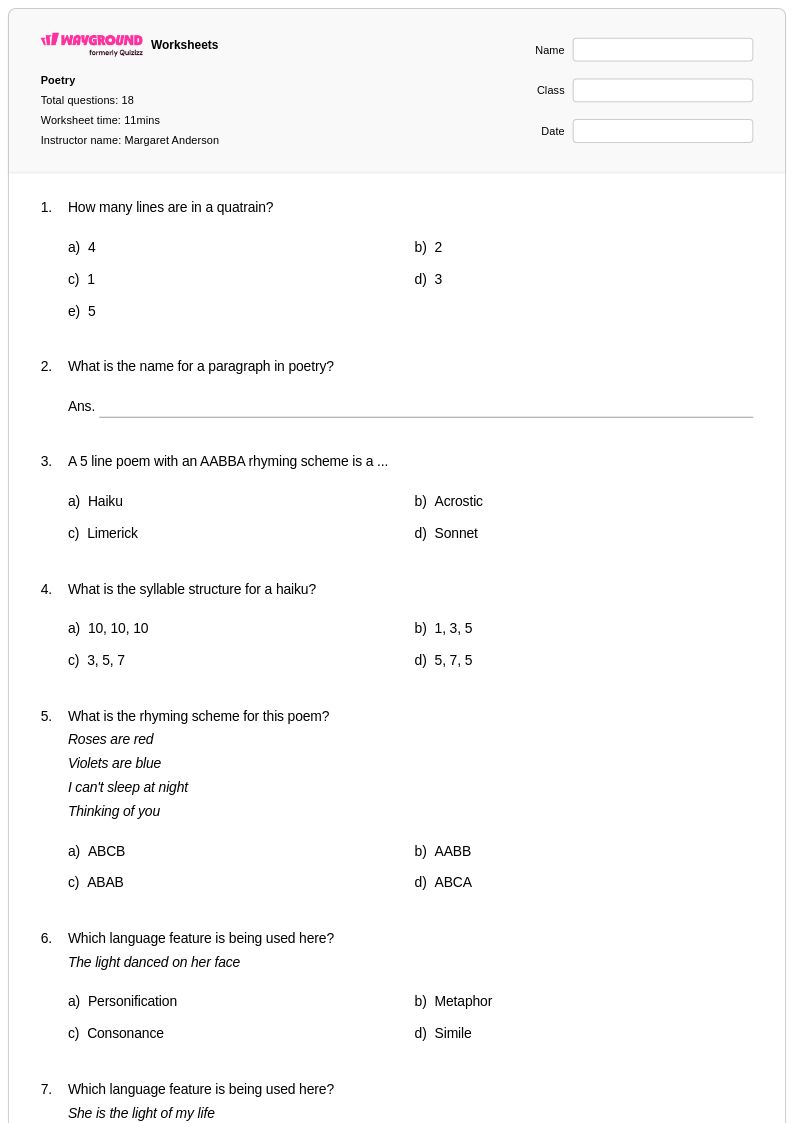
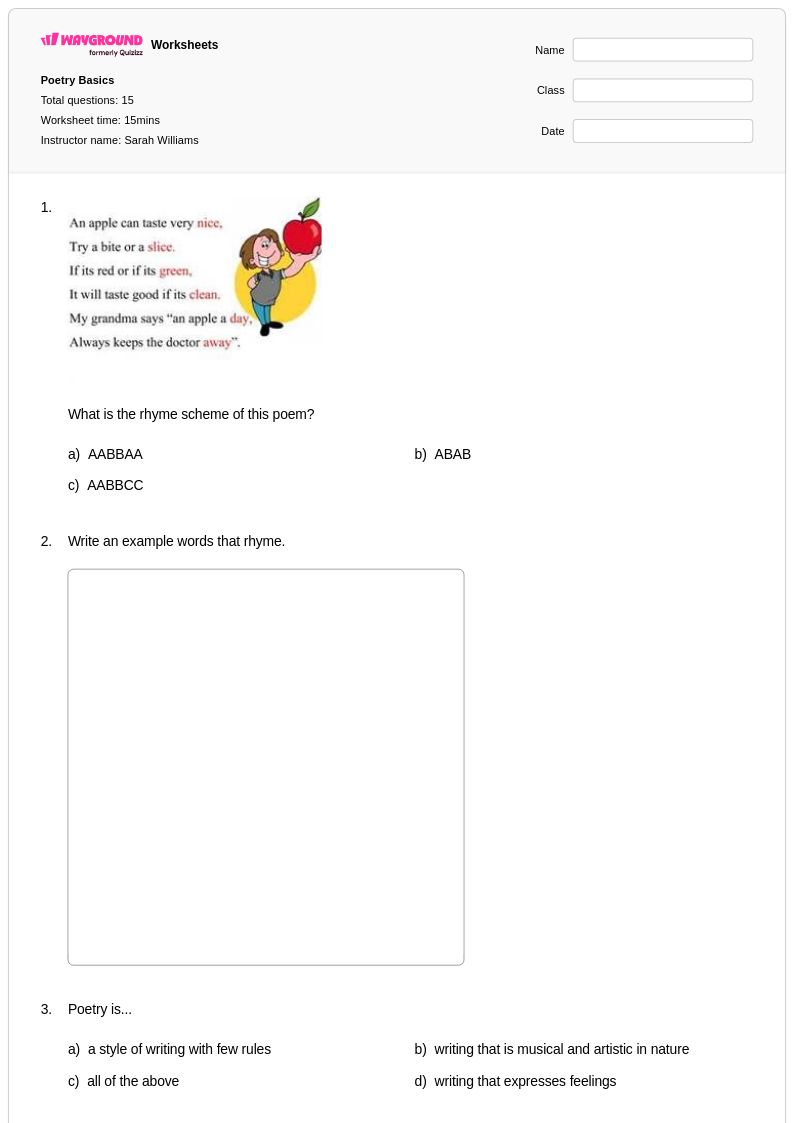
Have students label end rhymes using letter notation (ABAB, AABB, etc.) on printed poems before they attempt to analyze meaning, so they develop the habit of reading for sound patterns as well as content. Progress from simple couplets and limericks to more complex schemes like the Shakespearean sonnet (ABAB CDCD EFEF GG) as students gain confidence. Worksheets that pair rhyme scheme identification with questions about how the structure reinforces the poem's message push students toward deeper literary thinking rather than mechanical labeling.
What common mistakes do students make when writing or analyzing a haiku?
The most frequent error is miscounting syllables, particularly with multi-syllable words or words ending in silent letters. Students also frequently treat haiku as a simple three-line exercise without engaging with the traditional thematic focus on nature, a moment in time, or juxtaposition between two images. In analysis tasks, students often describe what a haiku is about rather than explaining how the syllabic constraint and sparse language create meaning. Targeted practice with scansion and guided analysis prompts helps correct both errors.
How do I explain iambic pentameter to students who find meter confusing?
Introduce iambic pentameter by having students clap or tap the stress pattern in spoken words before applying it to verse — 'da-DUM da-DUM da-DUM da-DUM da-DUM' gives students a physical anchor for an abstract concept. Use familiar phrases and common speech first ('I WENT to SCHOOL to DAY') to show that iambic rhythm appears naturally in English. Once students can mark stressed and unstressed syllables in isolated lines, move to Shakespearean sonnets where they can see how poets work within and deliberately break the pattern for effect.
How can I use poetry worksheets to assess student understanding of poetic devices?
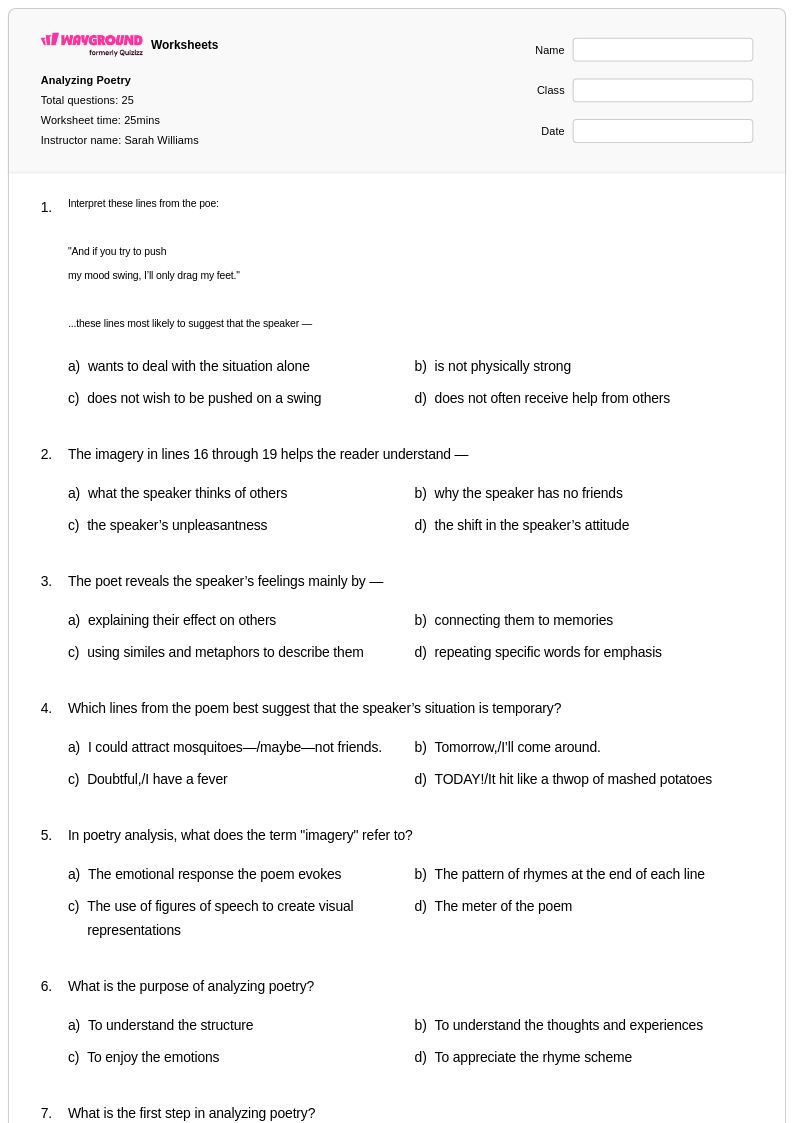
Effective poetry assessment moves beyond identification toward application and analysis — a strong worksheet asks students not just to find a metaphor but to explain what it reveals about the speaker's attitude or the poem's theme. Use poem analysis worksheets that present an unseen poem and require students to identify structural choices, name devices, and defend an interpretation with textual evidence. This mirrors the kind of close-reading tasks students encounter on standardized assessments and in secondary English coursework.
How do I use Wayground's poetry worksheets in my classroom?
Wayground's poetry worksheets are available as printable PDFs for traditional classroom use and in digital formats for technology-integrated learning environments, giving teachers flexibility across in-person, hybrid, and remote settings. Teachers can also host worksheets as a quiz directly on Wayground, making it easy to assign structured practice, collect responses, and review results in one place. Each worksheet includes a complete answer key, so teachers can use them for independent practice, guided instruction, or homework without additional prep.