Free Printable Salem Witch Trials Worksheets for Class 4
Explore Class 4 Salem Witch Trials worksheets and printables from Wayground that help students learn about this pivotal period in colonial American history through engaging practice problems and comprehensive answer keys.
Explore printable Salem Witch Trials worksheets for Class 4
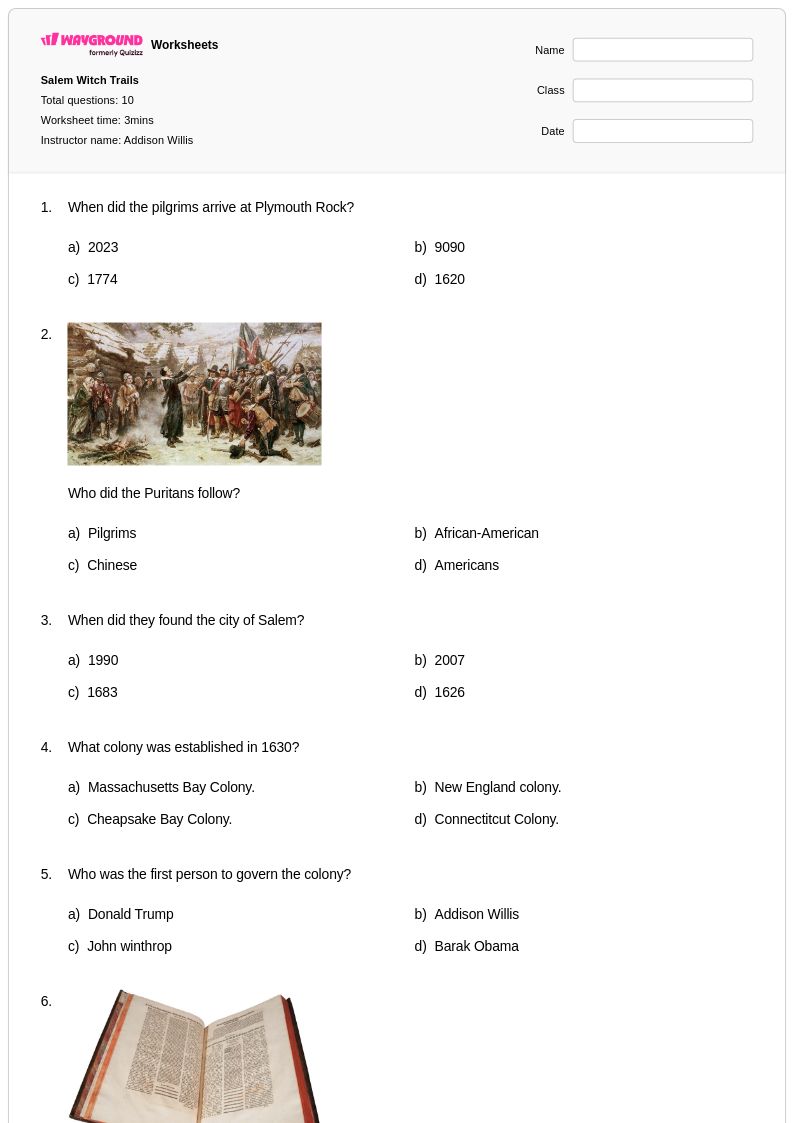
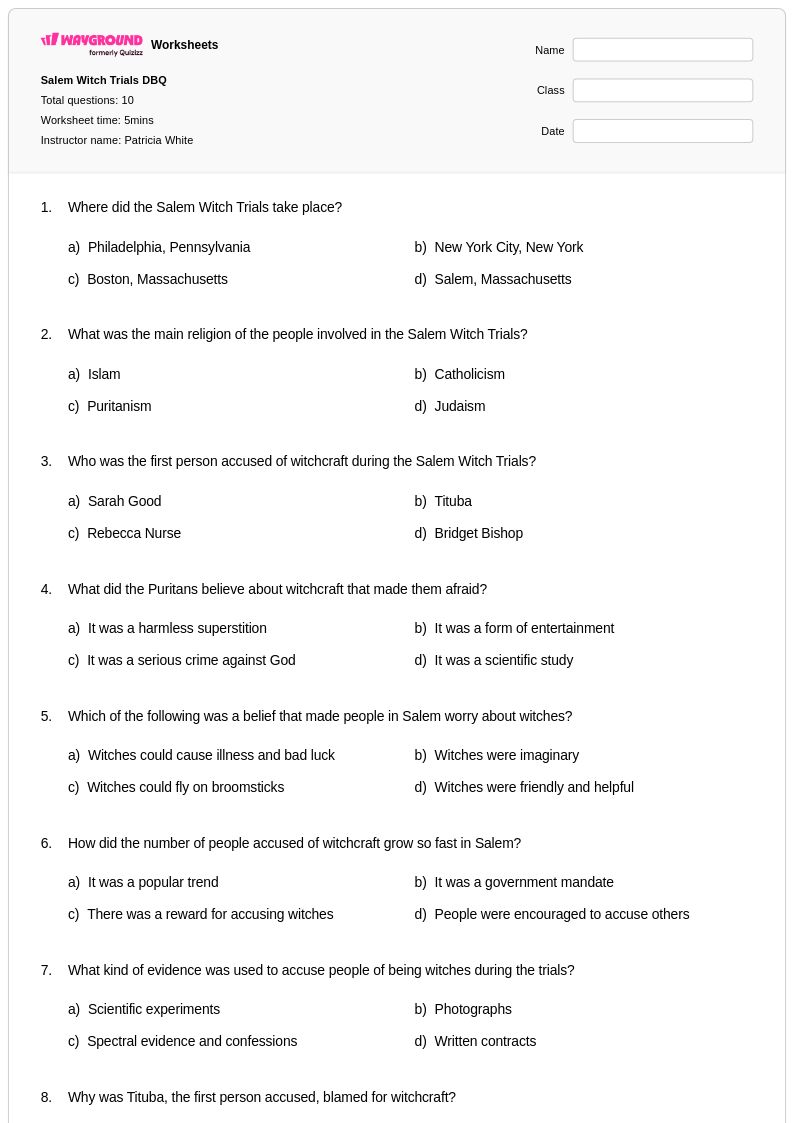
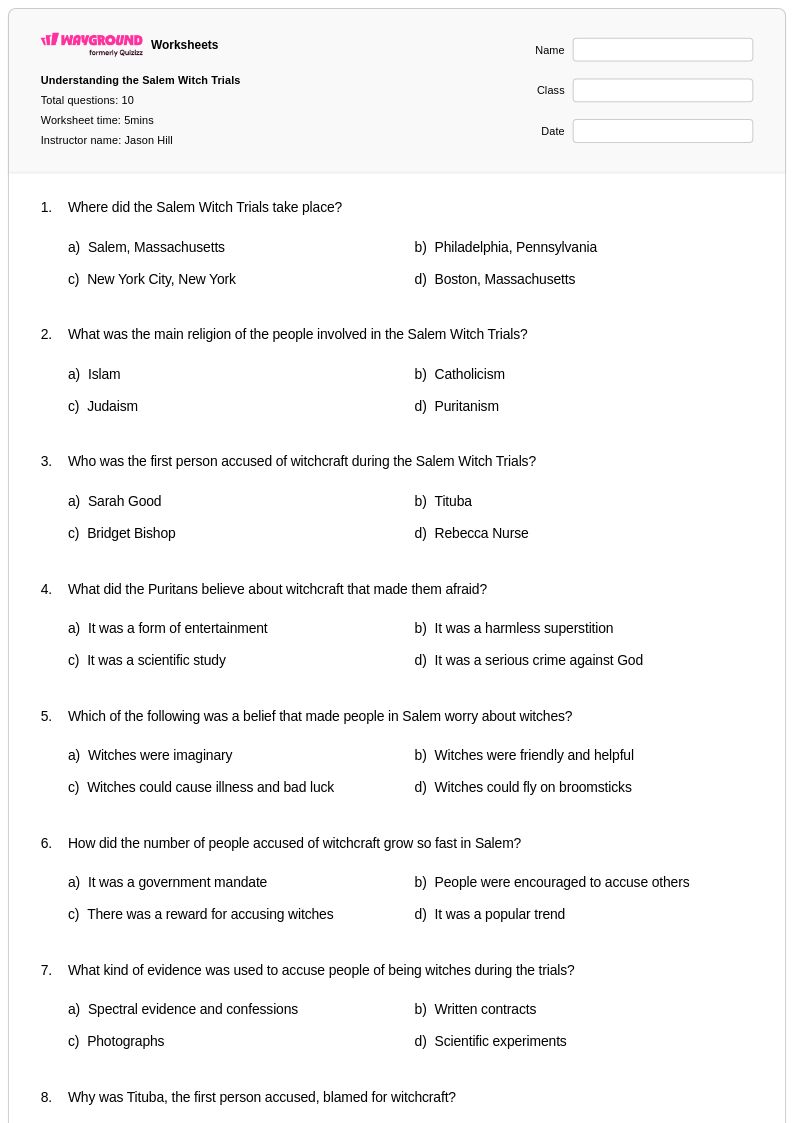
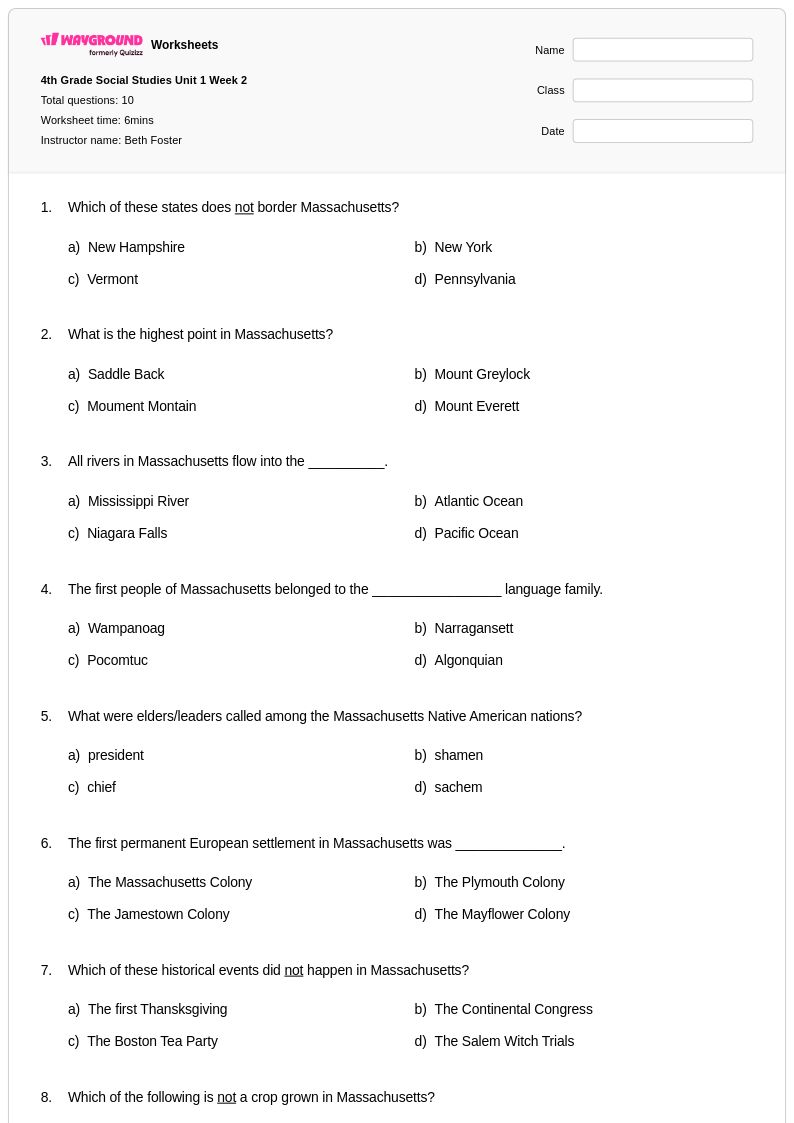
Salem Witch Trials worksheets for Class 4 students provide an age-appropriate introduction to one of the most significant and troubling episodes in early American colonial history. These educational resources help young learners understand the events that unfolded in Salem Village, Massachusetts in 1692-1693, when accusations of witchcraft led to trials, imprisonments, and executions that deeply impacted the community. The worksheets available through Wayground focus on developing critical thinking skills as students examine primary source materials, analyze cause and effect relationships, and explore how fear and superstition influenced colonial society. Each printable resource includes comprehensive practice problems that encourage students to think about historical evidence, witness testimony, and the social conditions that contributed to the crisis, with answer key materials provided to support both independent learning and classroom instruction in pdf format.
Wayground's extensive collection of Salem Witch Trials worksheets draws from millions of teacher-created resources, offering educators powerful search and filtering capabilities to find materials perfectly suited to their Class 4 curriculum needs. The platform's robust differentiation tools allow teachers to customize content for various learning levels, ensuring that students can engage with this complex historical topic through appropriately scaffolded activities that meet relevant social studies standards. Whether used for initial instruction, skill practice, or remediation, these resources are available in both printable and digital formats, giving teachers the flexibility to adapt lessons for different classroom environments and learning preferences. The comprehensive nature of Wayground's worksheet collection supports educators in planning engaging units that help students develop historical thinking skills while exploring how the Salem Witch Trials reflected broader themes of justice, community conflict, and the dangers of mass hysteria in early American society.
FAQs
How do I teach the Salem Witch Trials to middle or high school students?
Teaching the Salem Witch Trials effectively requires addressing the social, religious, and political pressures of Puritan New England alongside the specific events of 1692–1693. Start by grounding students in the historical context of colonial Massachusetts before introducing the accusations and trials. Using primary source documents, timeline activities, and analysis of key figures like Tituba, Bridget Bishop, and Cotton Mather helps students move beyond surface-level facts toward understanding how fear, superstition, and social tension converged to produce mass hysteria and injustice.
What exercises help students practice analyzing the Salem Witch Trials?
Effective practice exercises for the Salem Witch Trials include primary source document analysis, cause-and-effect mapping of the social and religious factors behind the accusations, and timeline sequencing of key events from 1692 to 1693. Analytical writing prompts that ask students to evaluate the roles of specific figures or assess the fairness of the trial proceedings deepen historical thinking. These activities reinforce critical thinking skills while helping students connect the trials to broader themes like due process, prejudice, and evidence-based reasoning.
What misconceptions do students commonly have about the Salem Witch Trials?
A common misconception is that the accused were burned at the stake — in reality, those executed were hanged, and one man was pressed to death with stones. Students also frequently misattribute the hysteria to a single cause, overlooking the complex interplay of religious doctrine, land disputes, social rivalries, and political instability. Another error is treating the events as isolated rather than connecting them to broader Puritan theology and the social dynamics of 17th-century colonial America.
How can I connect the Salem Witch Trials to modern themes of justice and civil rights?
The Salem Witch Trials offer a powerful case study in due process failures, mob mentality, and the dangers of evidence-free accusation, all of which connect directly to civil rights and justice standards. Teachers can scaffold comparisons between the trials and later events like McCarthyism or wrongful conviction cases to help students recognize recurring patterns of prejudice and institutional failure. Discussion prompts and analytical exercises that ask students to identify parallels between 1692 and contemporary examples of scapegoating or hysteria are particularly effective for building civic reasoning skills.
How do I use Salem Witch Trials worksheets from Wayground in my classroom?
Wayground's Salem Witch Trials worksheets are available as printable PDFs for traditional classroom use and in digital formats for technology-integrated or remote learning environments, giving teachers flexibility across instructional settings. Each worksheet includes a complete answer key, which reduces prep time and supports consistent grading. Teachers can use these resources for direct instruction, independent practice, homework assignments, or enrichment activities, and digital versions can be hosted as a quiz directly on Wayground for immediate student feedback.
How do I differentiate Salem Witch Trials instruction for students with different learning needs?
Differentiation for the Salem Witch Trials can include scaffolded primary source documents with guided annotation prompts for struggling readers and open-ended analytical tasks for advanced learners. On Wayground, teachers can apply individual accommodations such as Read Aloud for students who need audio support, reduced answer choices to lower cognitive load, and extended time per question. These settings can be assigned to individual students without notifying their peers, allowing the same worksheet to serve the full range of learners in one class.