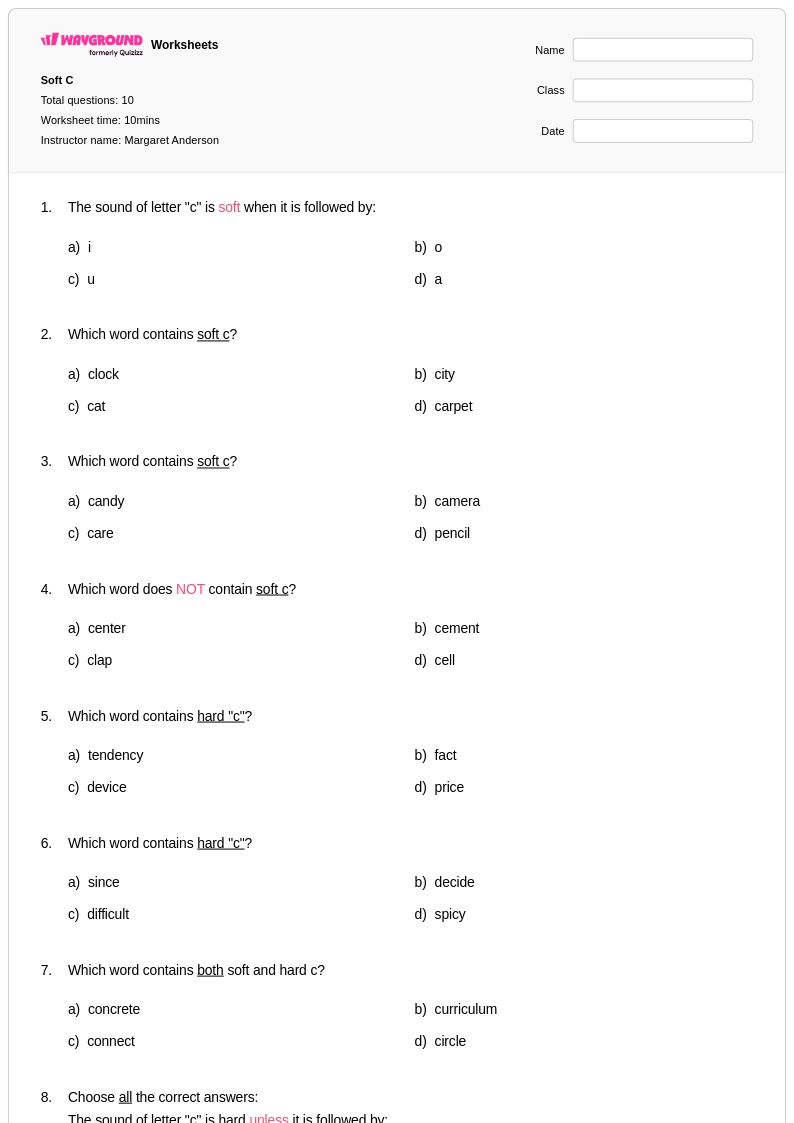
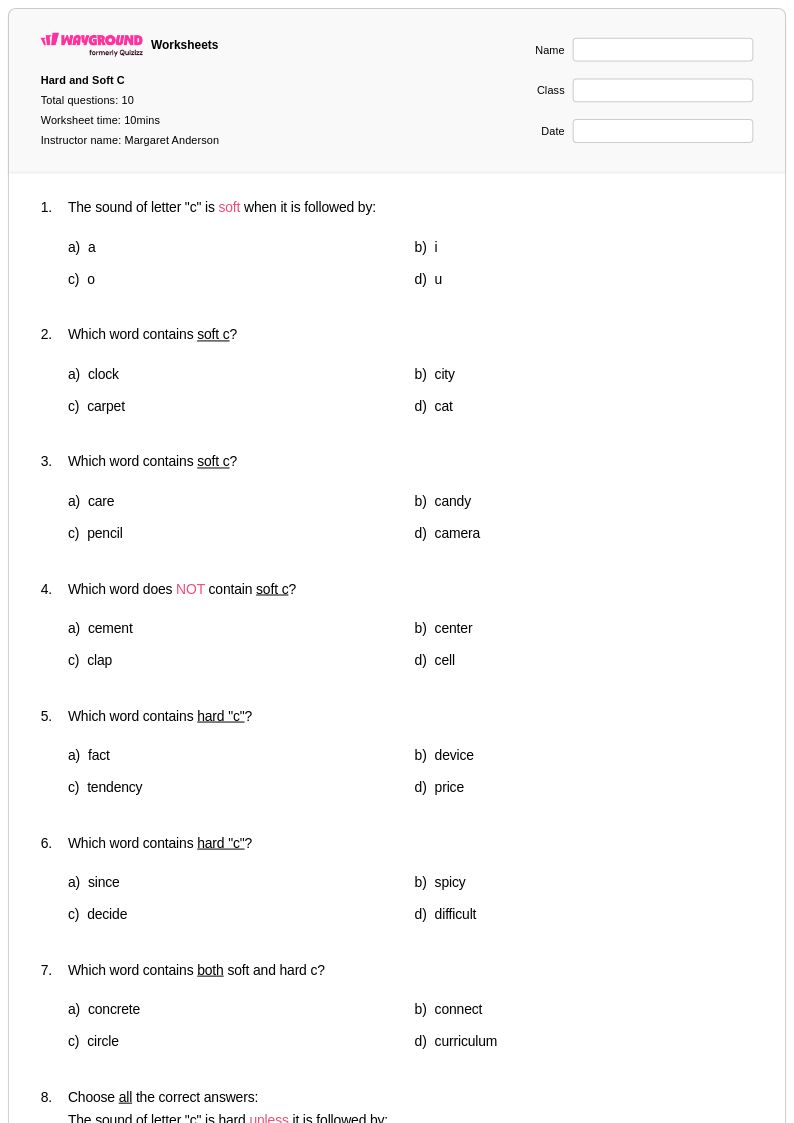
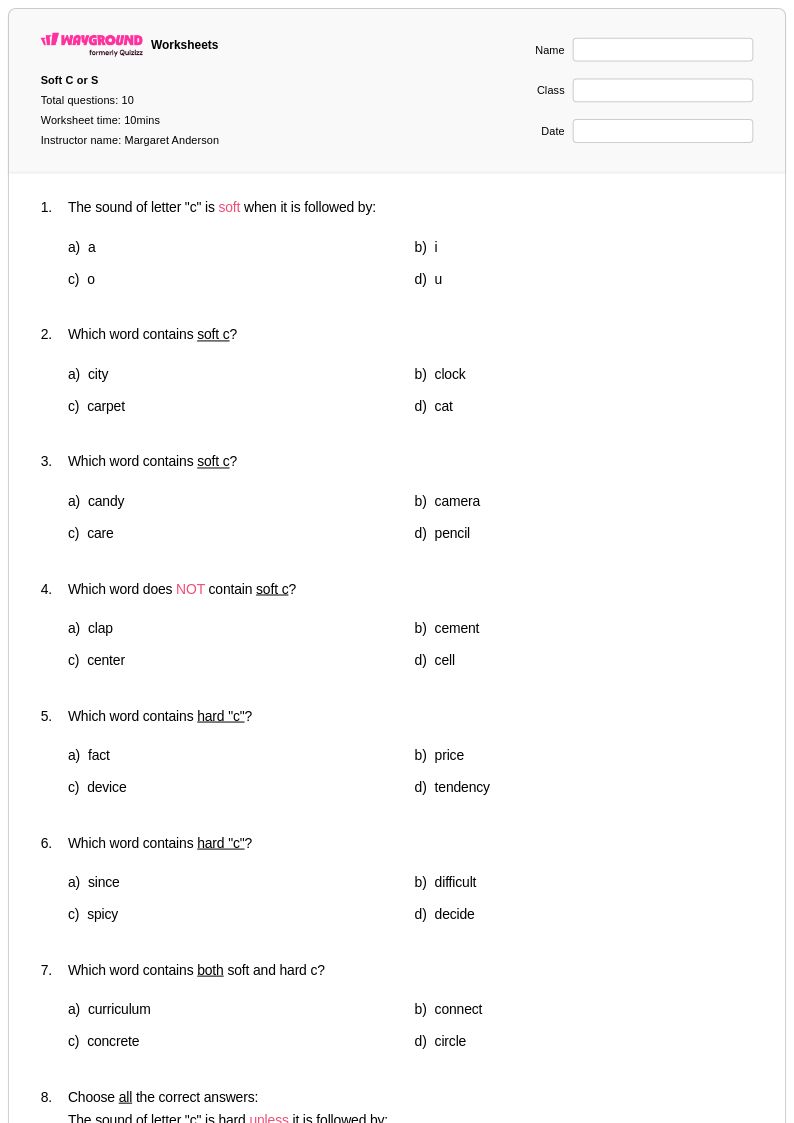
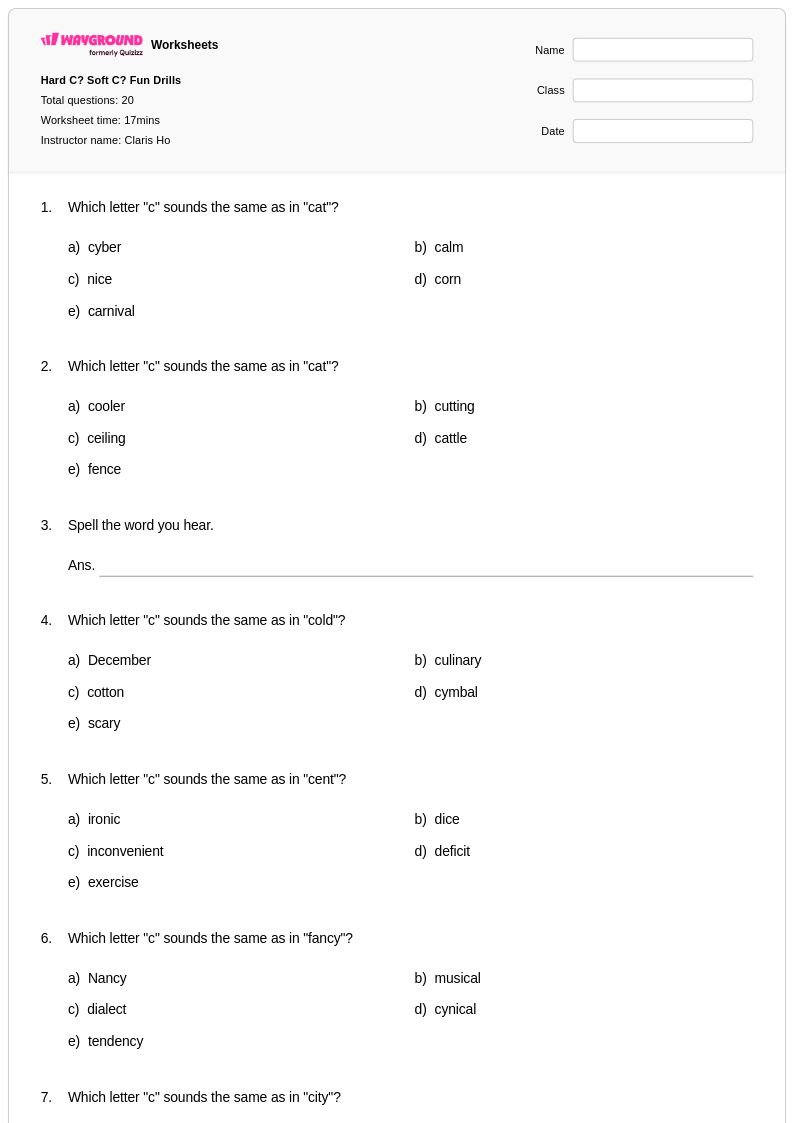
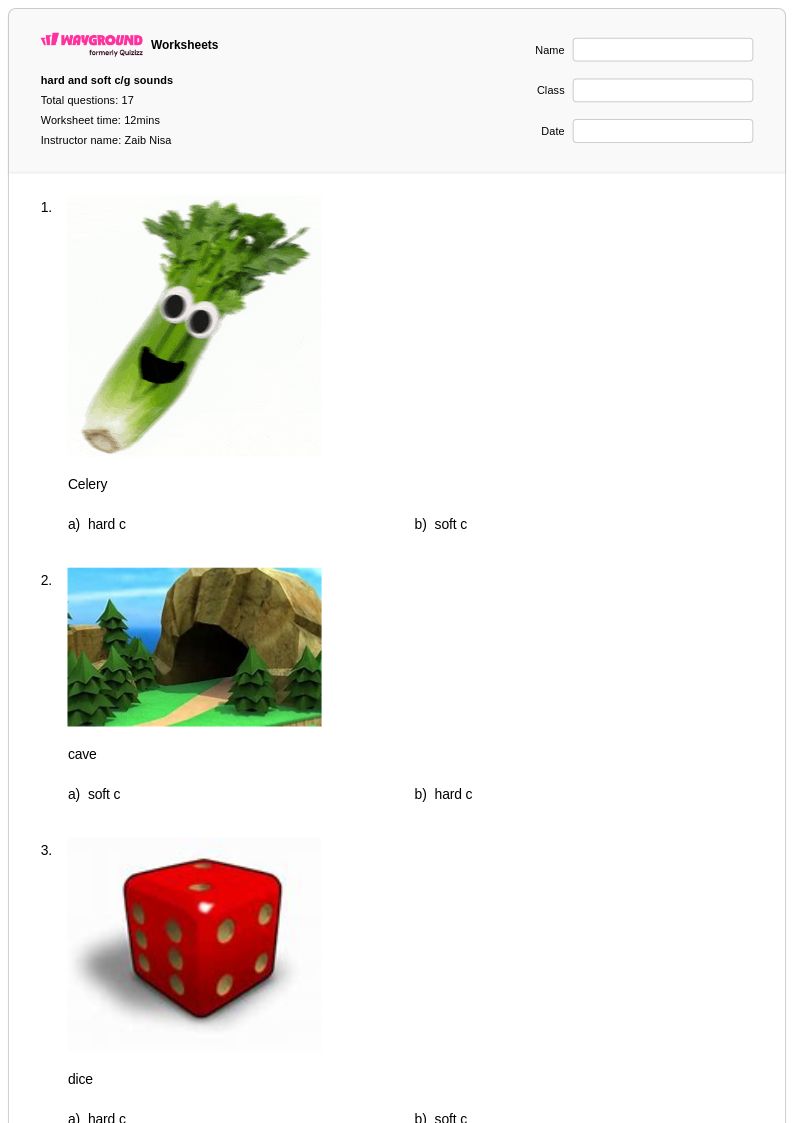
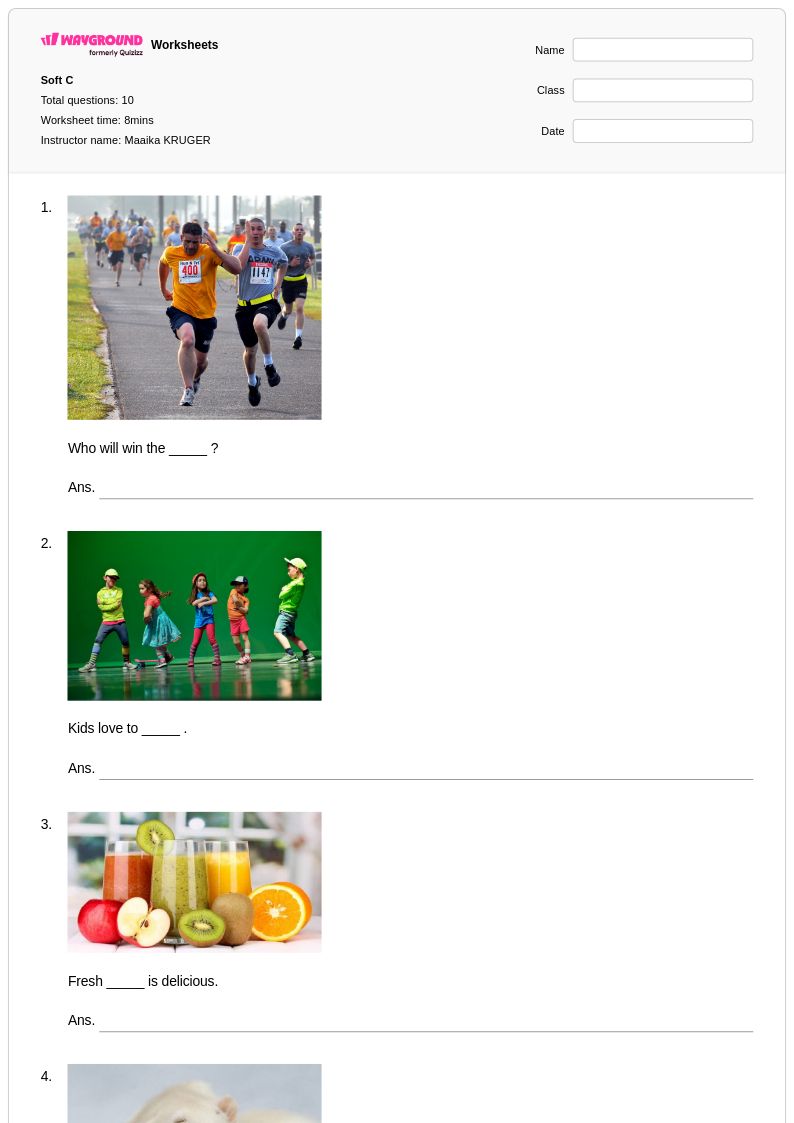
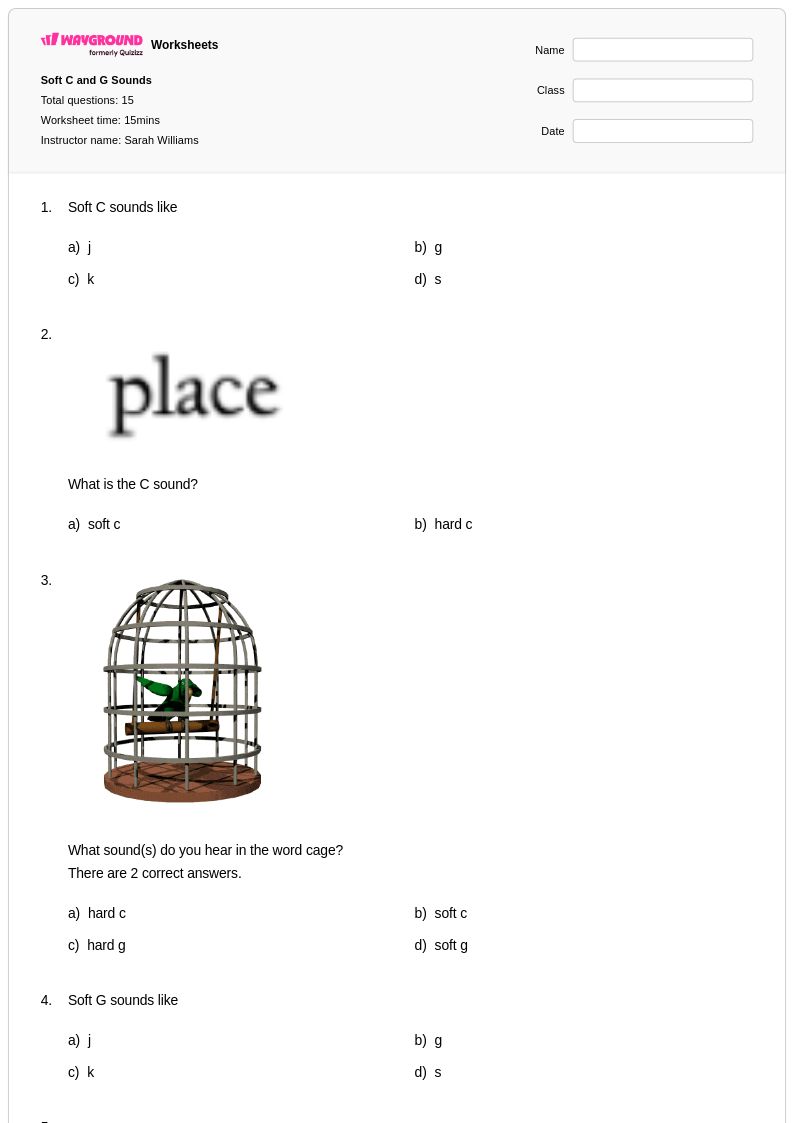
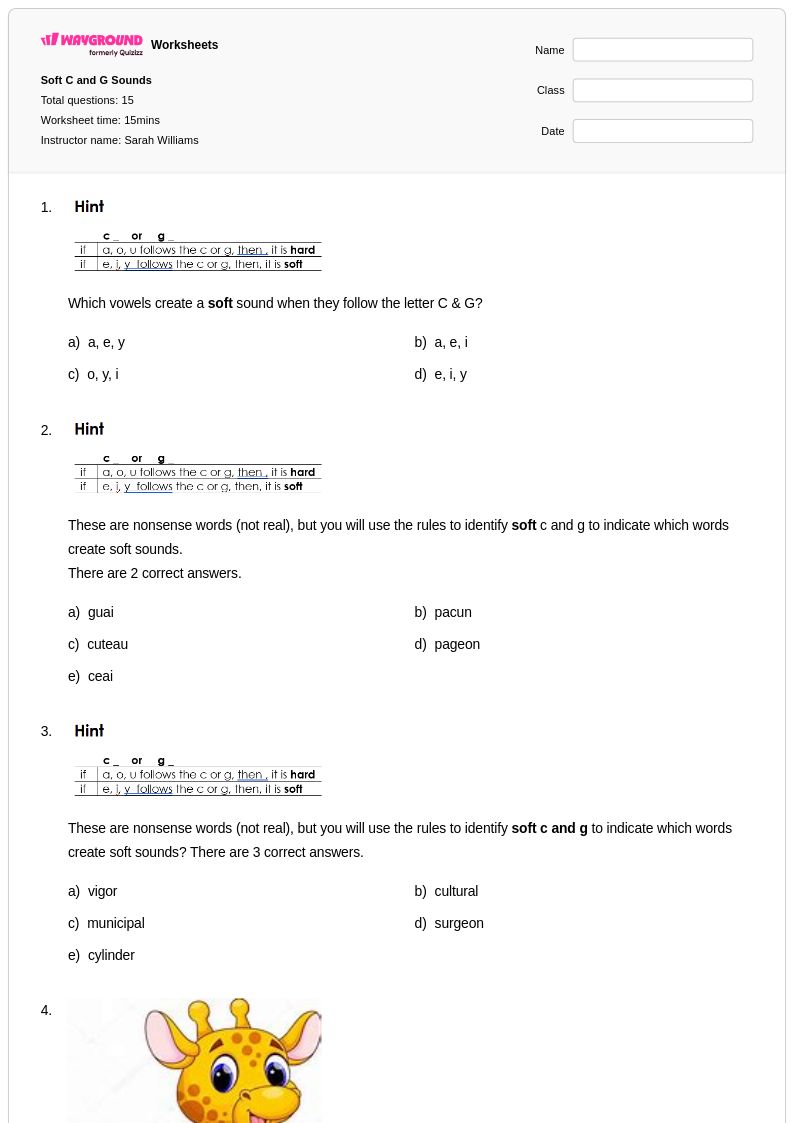
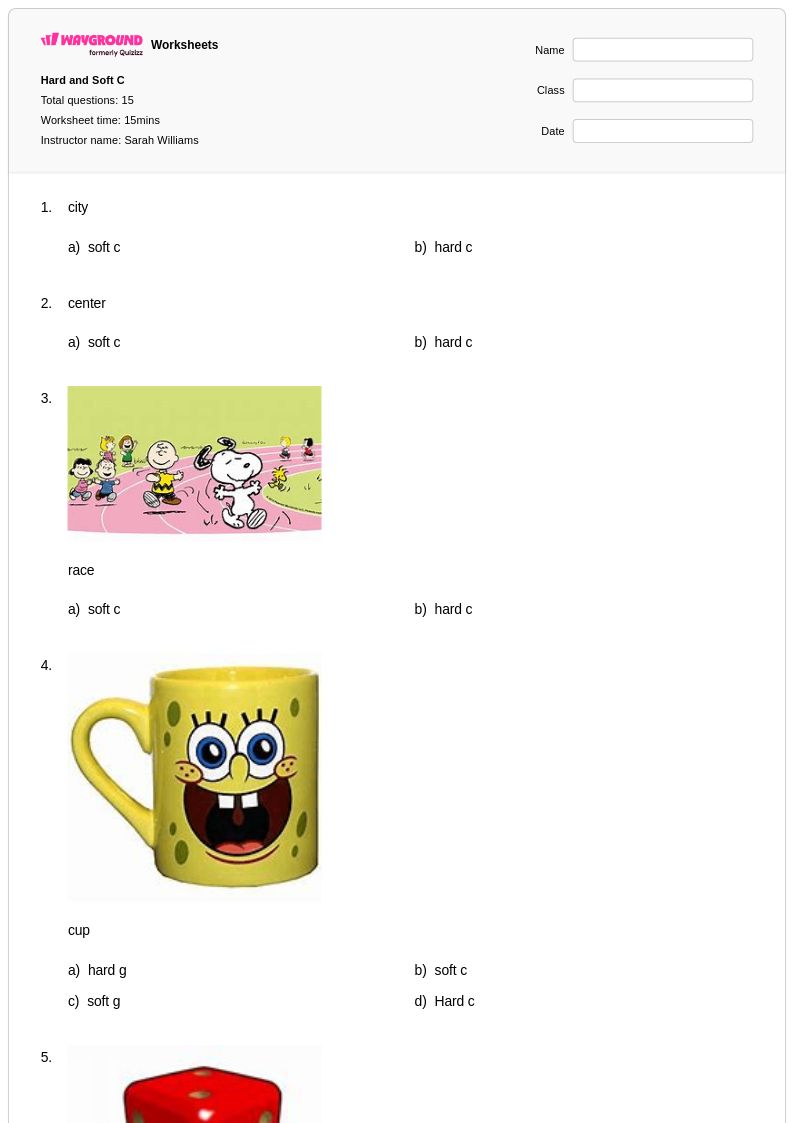
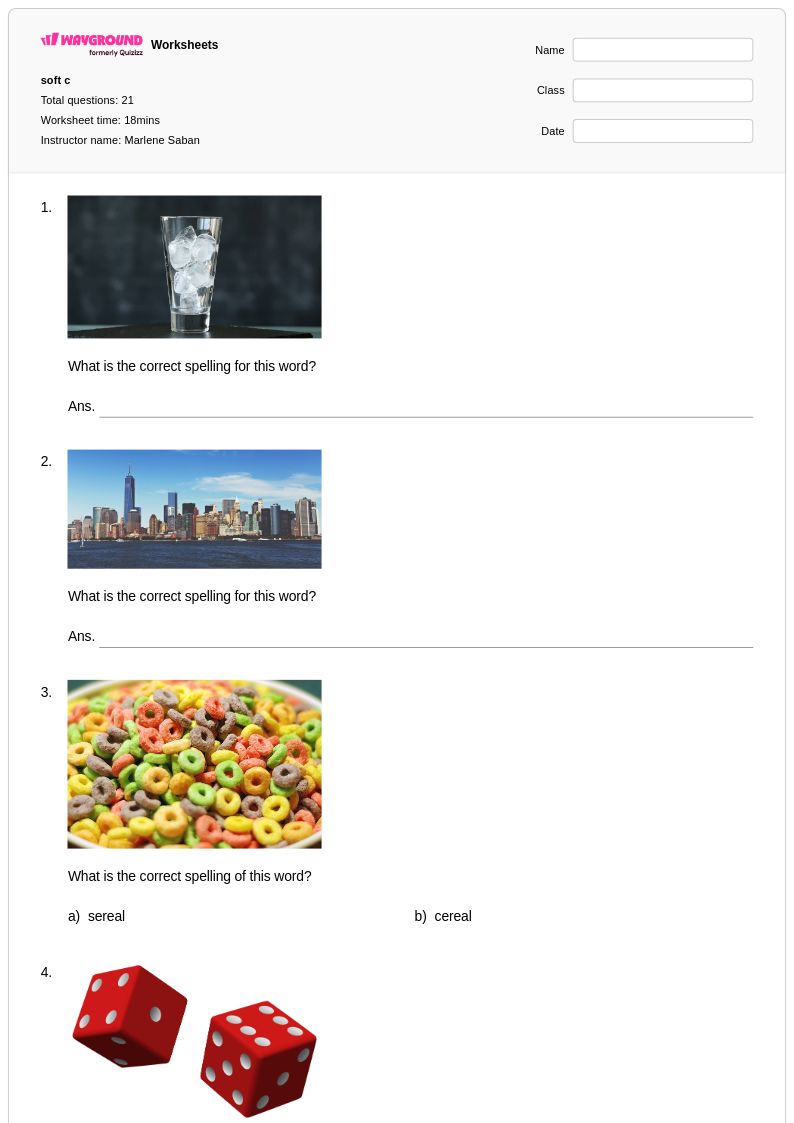
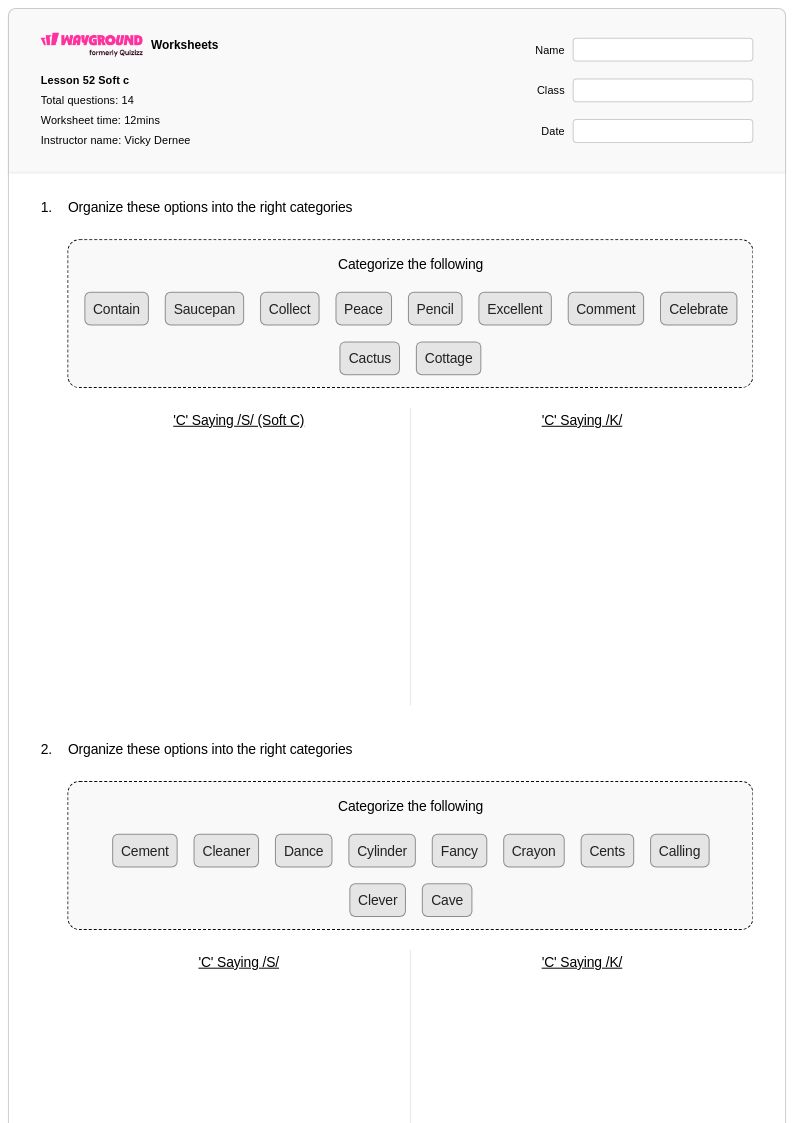
Explore Class 2 soft C phonics worksheets and printables that help students master the gentle C sound through engaging practice problems, complete with answer keys and free PDF downloads.
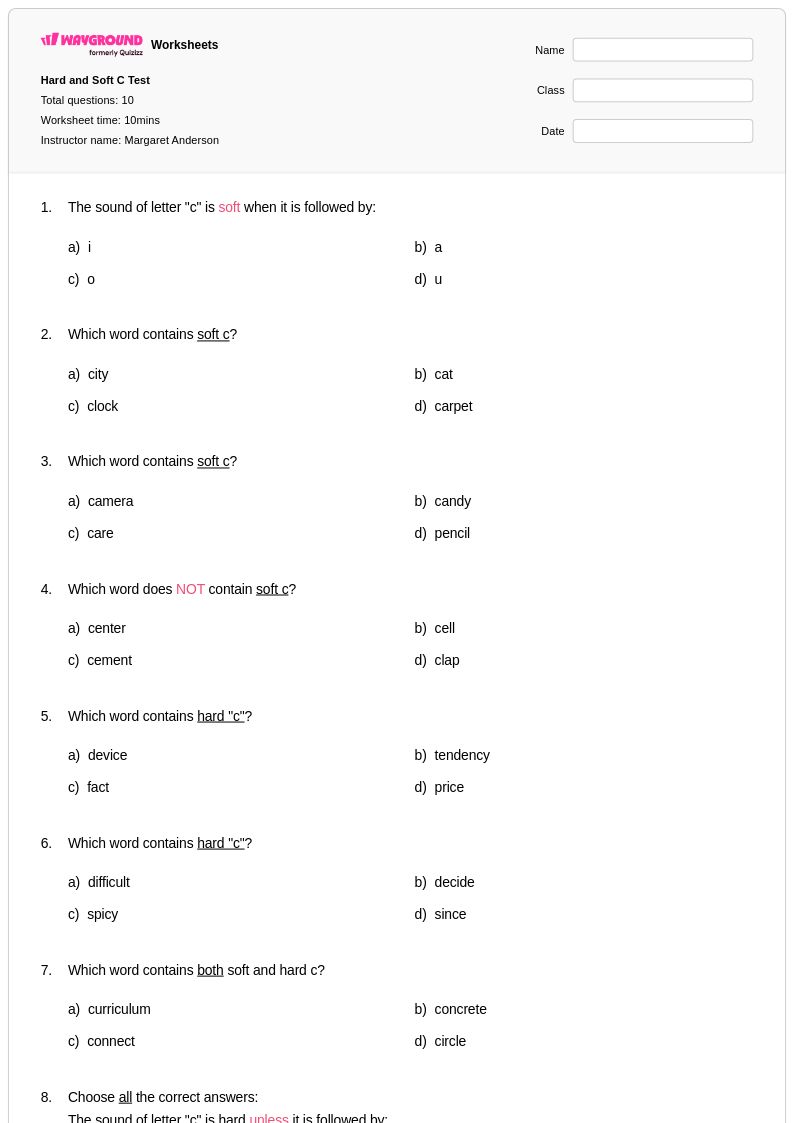
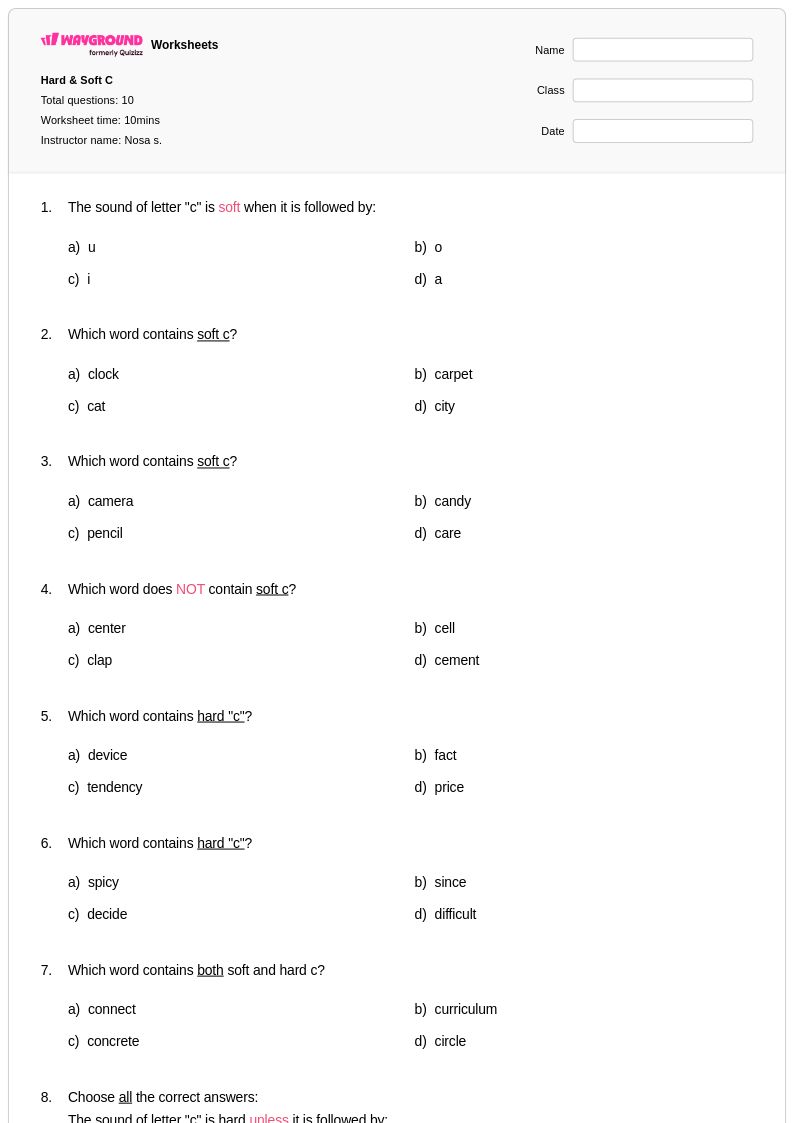
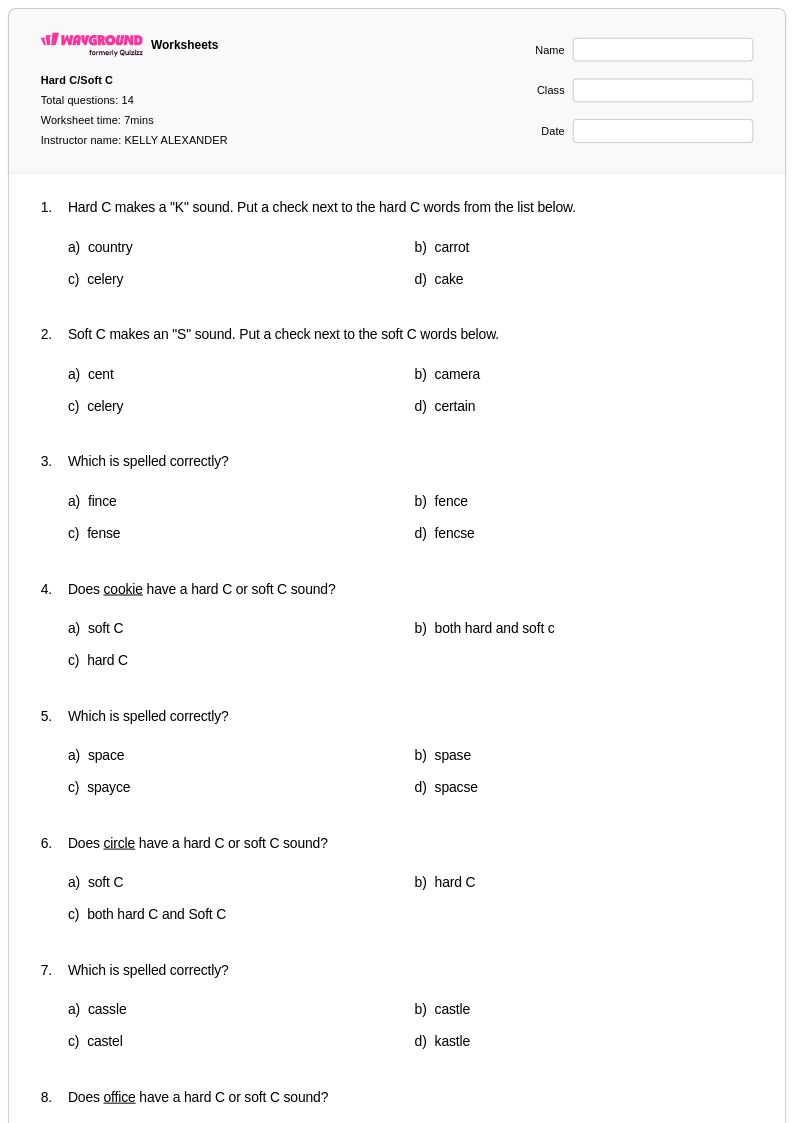
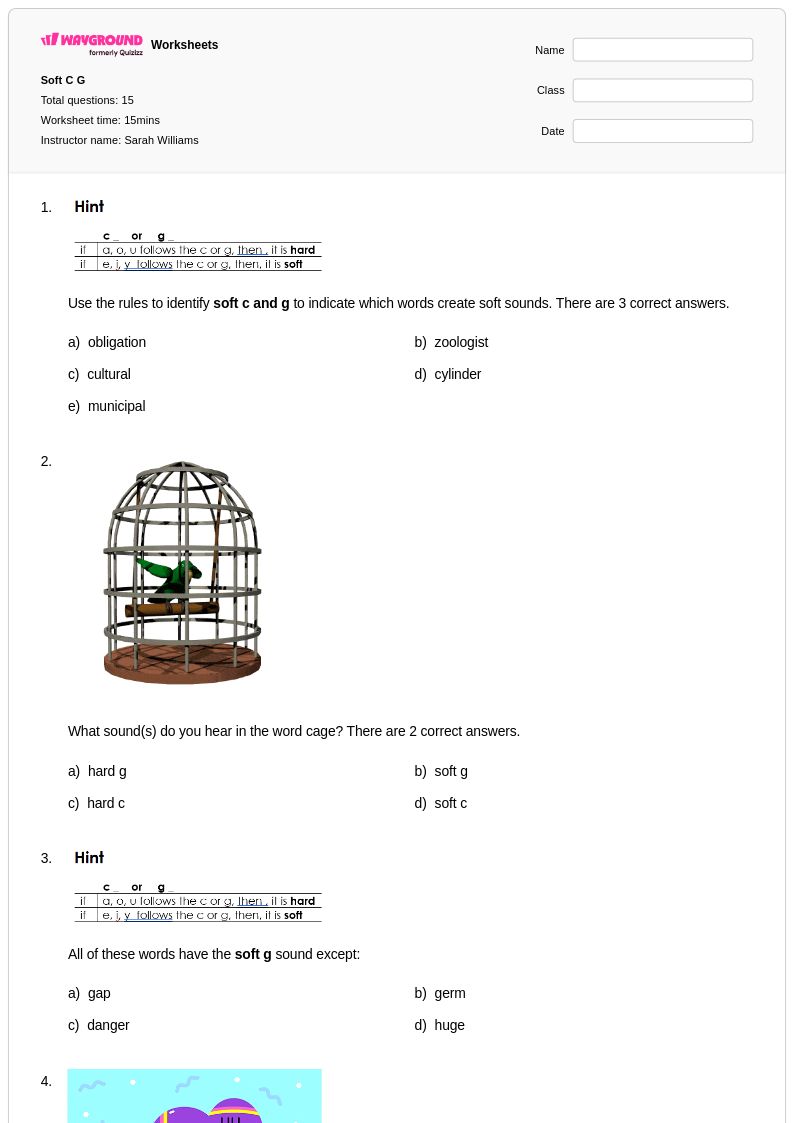
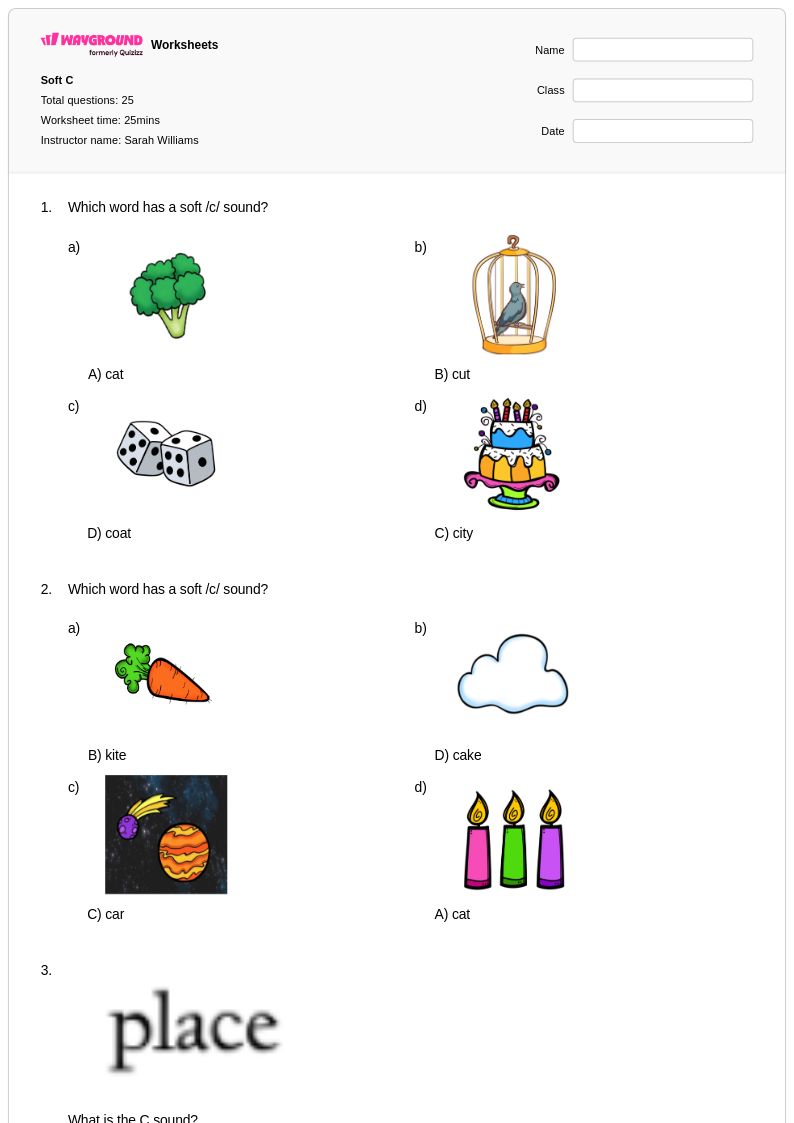
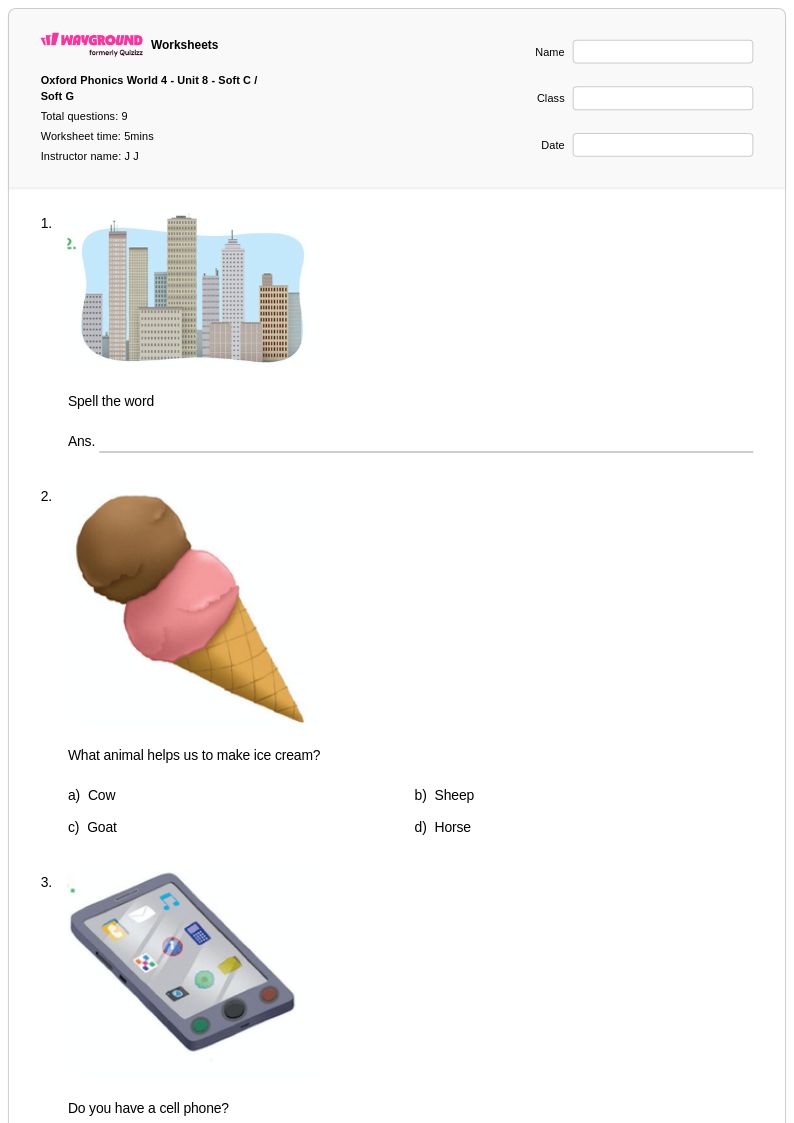
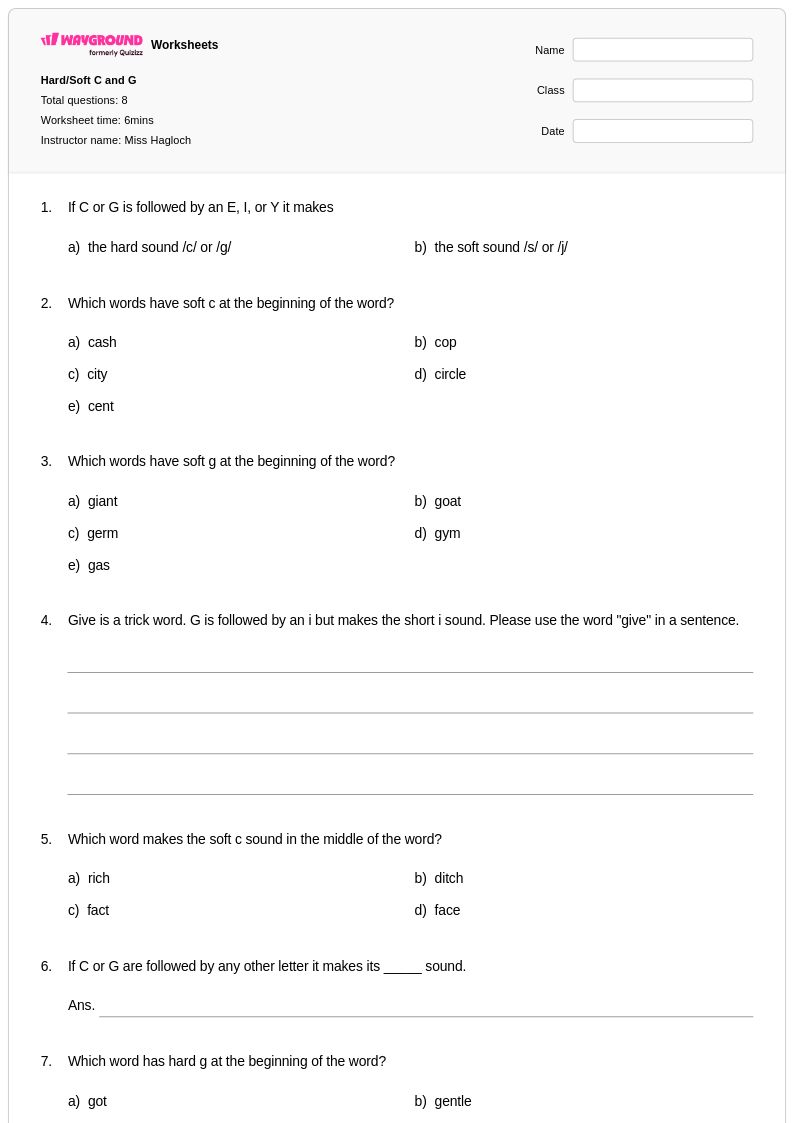
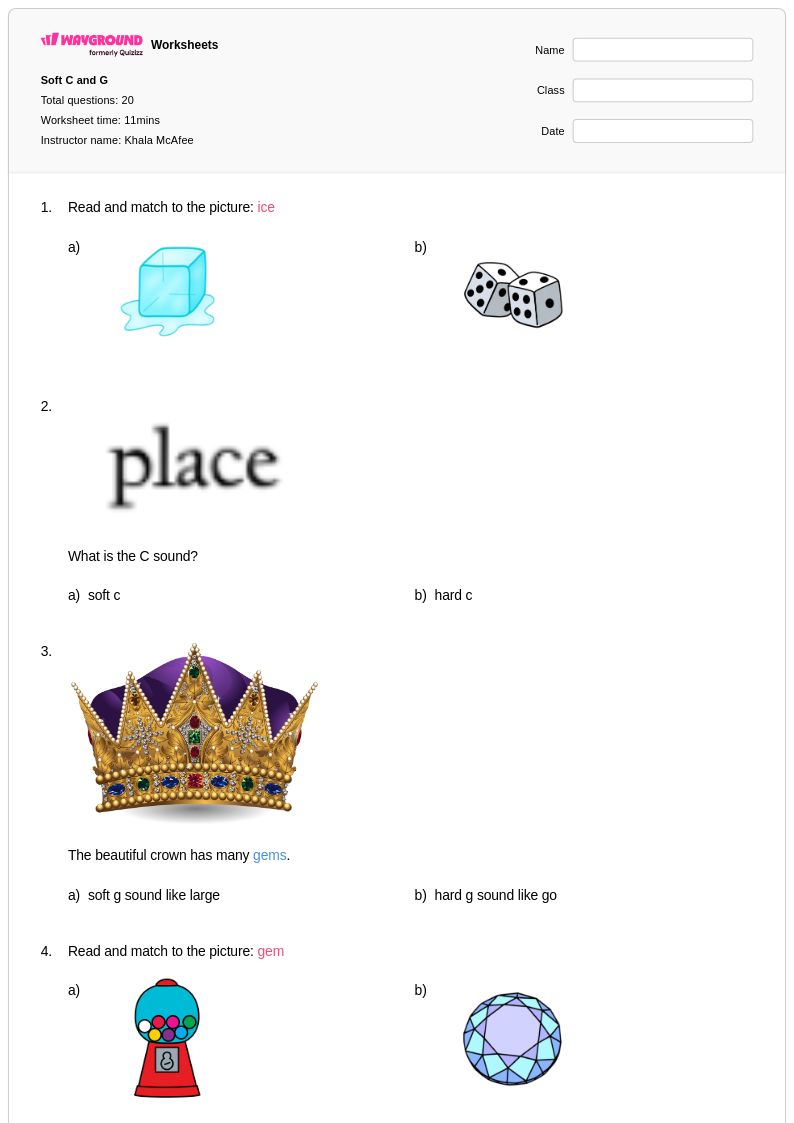
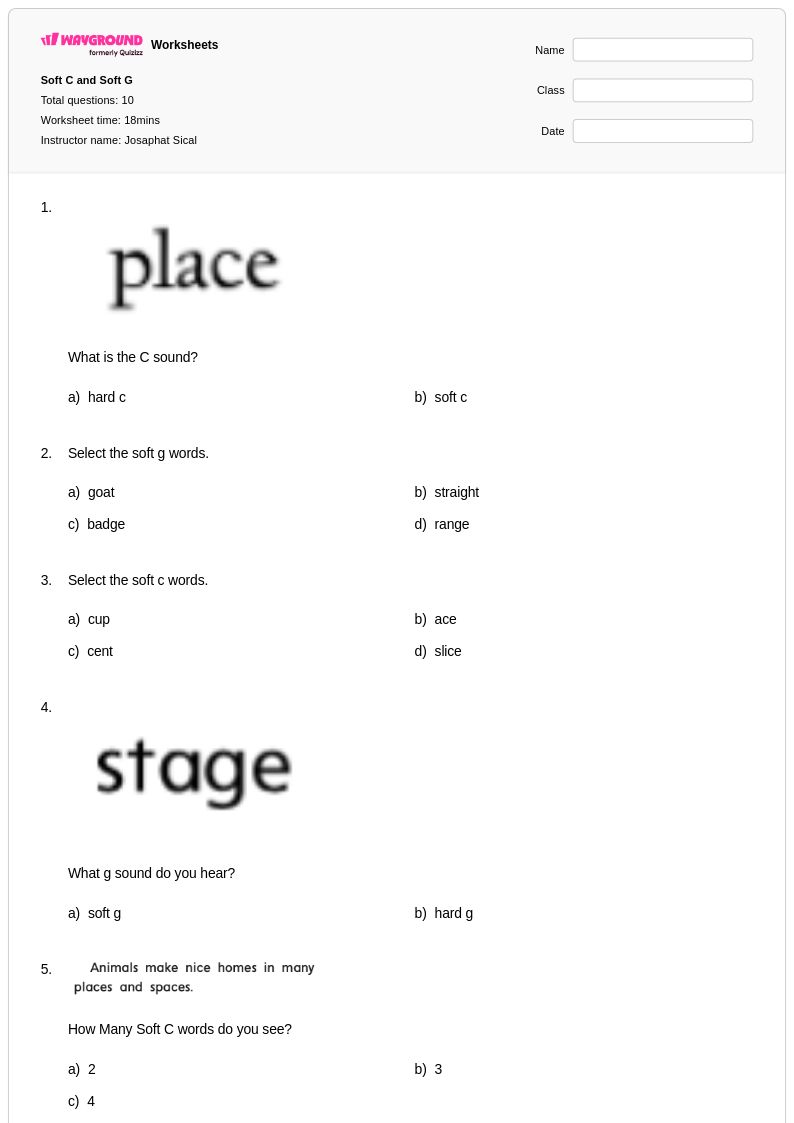
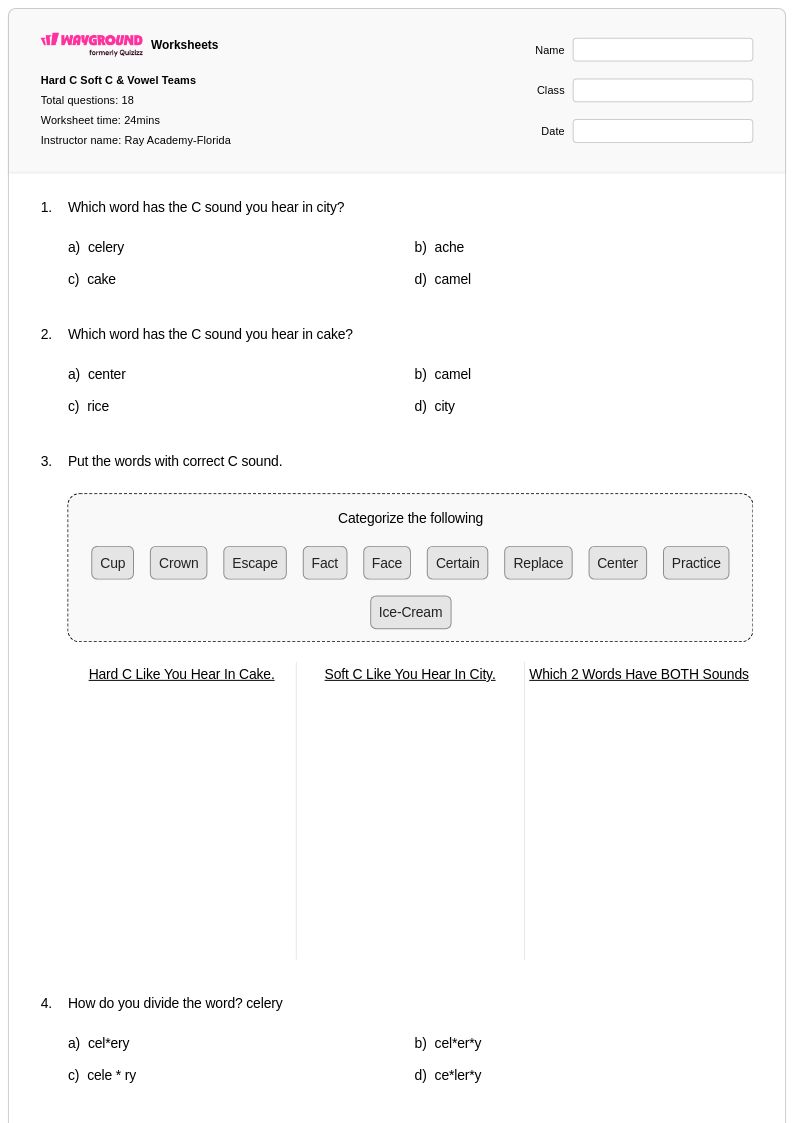
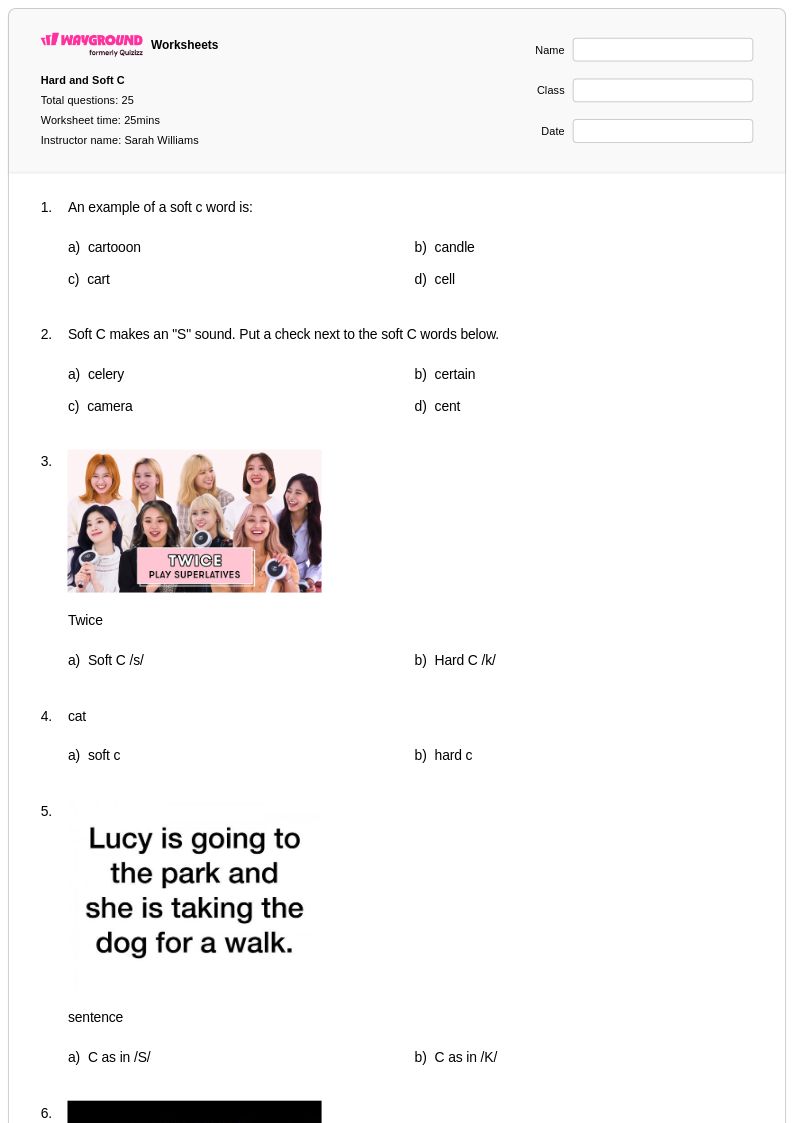
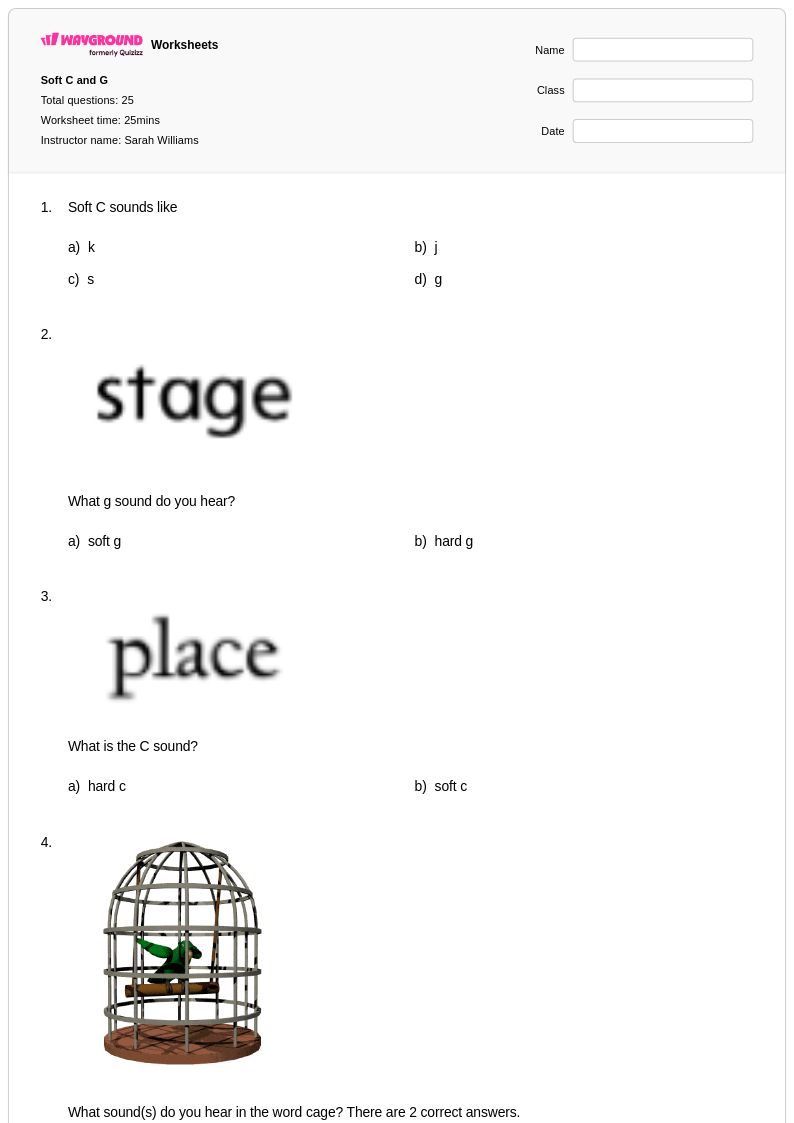
Soft C worksheets for Class 2 students available through Wayground (formerly Quizizz) provide comprehensive practice with one of the most important phonetic concepts in early reading development. These carefully crafted resources help young learners master the rule that the letter C makes a soft "s" sound when followed by the vowels E, I, or Y, as in words like "city," "cent," and "cycle." The worksheets strengthen decoding skills through systematic practice problems that build automaticity in recognizing soft C patterns, while the included answer key allows for immediate feedback and self-correction. Teachers can access these free printables in convenient PDF format, making it easy to incorporate targeted phonics instruction into daily lessons and independent practice time.
Wayground (formerly Quizizz) empowers educators with an extensive collection of teacher-created soft C resources that streamline instruction and support differentiated learning needs. The platform's robust search and filtering capabilities allow teachers to quickly locate worksheets aligned with specific phonics standards and grade-level expectations, while customization tools enable educators to modify content for remediation or enrichment purposes. These versatile materials are available in both printable and digital formats, giving teachers the flexibility to adapt instruction for various learning environments and student preferences. The comprehensive worksheet library supports effective lesson planning by providing ready-to-use practice activities that reinforce soft C concepts through engaging exercises designed to build phonemic awareness and reading fluency in second-grade students.
FAQs
How do I teach the soft C sound to early readers?
Teach soft C by introducing the rule that the letter C makes an /s/ sound when followed by E, I, or Y, as in 'cent,' 'city,' and 'cycle.' Start with high-frequency examples students already know, then use word-sorting activities to help them categorize soft C words from hard C words. Connecting the rule to real reading contexts, rather than isolated drill, helps students internalize the pattern more reliably.
What words should I use to practice the soft C sound with students?
Strong soft C practice words include 'city,' 'face,' 'icy,' 'cent,' 'circle,' 'cycle,' 'race,' 'twice,' and 'pencil.' Effective practice moves from simple CVC-pattern words like 'ace' to multisyllabic words like 'celebrate' or 'sentence,' which deepens pattern recognition across reading levels. Mixing soft C words into decodable sentences gives students context for applying the rule during authentic reading.
What mistakes do students commonly make with the soft C rule?
The most common error is over-applying the hard C sound to all C words, especially when students are still automatizing phonics rules. Students also frequently confuse soft C with the letter S, which can affect spelling accuracy even when reading is correct. Another common mistake is failing to apply the soft C rule in multisyllabic words where the C appears in an unstressed syllable, such as in 'acceptance' or 'concentrate.'
How can I use soft C worksheets to support differentiated instruction?
Soft C worksheets can be tiered by complexity, beginning with single-syllable word identification and progressing to multisyllabic decoding and sentence-level application for students who are ready. On Wayground, teachers can apply accommodations such as read-aloud support, reduced answer choices, and extended time to individual students, ensuring that learners with different needs access the same phonics content at an appropriate level. These settings are reusable across future sessions, reducing setup time for recurring differentiation needs.
How do I use Wayground's soft C worksheets in my classroom?
Wayground's soft C worksheets are available as printable PDFs for traditional classroom use and in digital formats for technology-integrated environments, making them flexible for whole-class lessons, small groups, or independent work. Teachers can also host the worksheets as a quiz directly on Wayground, enabling real-time student responses and instant feedback. Answer keys are included with every worksheet, so grading and review require minimal additional preparation.
How does the soft C rule affect students' spelling development?
Understanding the soft C rule directly improves spelling accuracy because students learn to choose between C and S when representing the /s/ sound in words like 'center' versus 'sender.' Without explicit instruction, students often default to spelling the /s/ sound with S even in words that require C, producing errors like 'sircle' for 'circle.' Systematic phonics practice that highlights the CE, CI, and CY patterns gives students a reliable spelling strategy rather than relying on memorization alone.