

Wayground
Making Connections/Summary - Printable English Worksheets kindergarten - Wayground

Making Connections/Summary

15 questions

6th - 6th Grade

English

This Grade 6 English worksheet helps students make and classify text connections while reading. Through seven multiple-select scenarios, students distinguish text-to-self, text-to-text, and text-to-world connections, including connections involving characters, other books or authors, personal experiences, current events, and real-world issues. The worksheet also develops summary comprehension through eight multiple-choice questions. Students identify what a summary includes, recognize the Somebody-Wanted-But-So-Then structure, determine the story’s conflict, solution, and resolution, and distinguish theme from other story elements. This free printable worksheet is suitable for reading instruction, guided practice, or an independent check of understanding, and it includes a complete answer key for efficient review and grading.

Worksheet settings

Font size

S
M
L
XL
Worksheets

Making Connections/Summary

Total questions: 15

Name
Class
Date
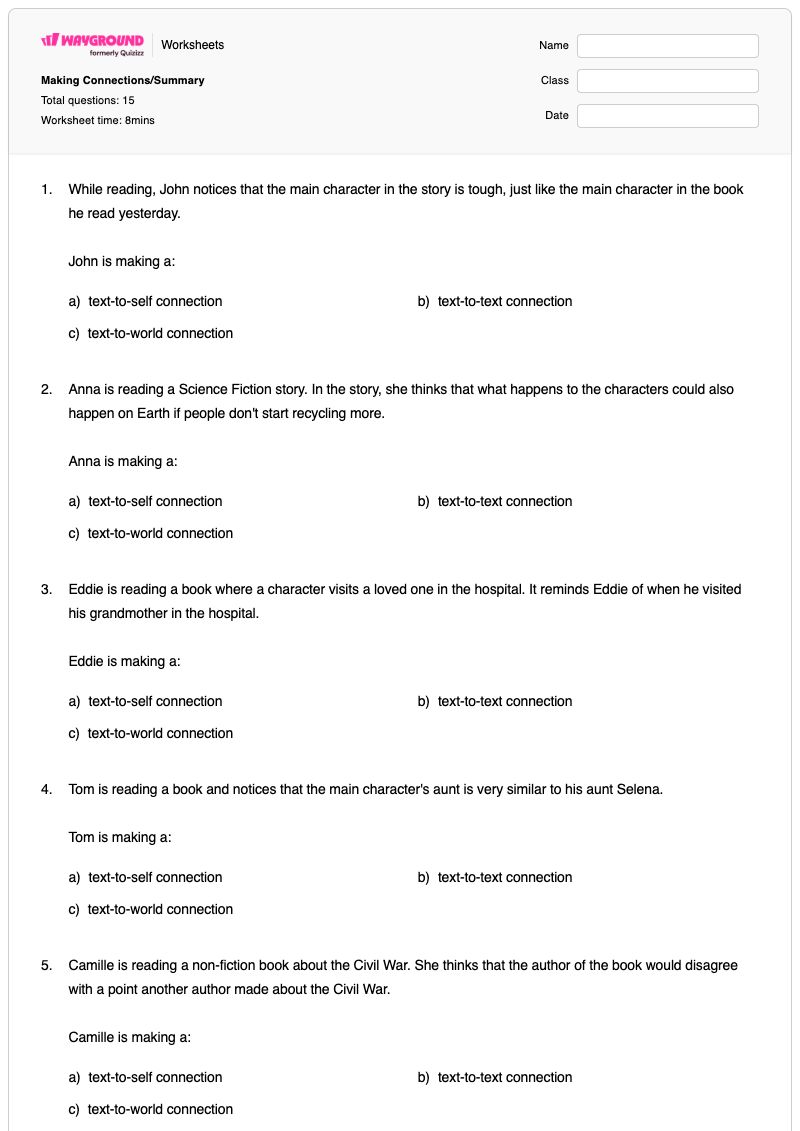
1.

While reading, John notices that the main character in the story is tough, just like the main character in the book he read yesterday.


John is making a:

a)

text-to-self connection

b)

text-to-text connection

c)

text-to-world connection

2.

Anna is reading a Science Fiction story. In the story, she thinks that what happens to the characters could also happen on Earth if people don't start recycling more.


Anna is making a:

a)

text-to-self connection

b)

text-to-text connection

c)

text-to-world connection

3.

Eddie is reading a book where a character visits a loved one in the hospital. It reminds Eddie of when he visited his grandmother in the hospital.


Eddie is making a:

a)

text-to-self connection

b)

text-to-text connection

c)

text-to-world connection

4.

Tom is reading a book and notices that the main character's aunt is very similar to his aunt Selena.


Tom is making a:

a)

text-to-self connection

b)

text-to-text connection

c)

text-to-world connection

5.

Camille is reading a non-fiction book about the Civil War. She thinks that the author of the book would disagree with a point another author made about the Civil War.


Camille is making a:

a)

text-to-self connection

b)

text-to-text connection

c)

text-to-world connection

6.

Mike is reading an article about different viruses that ravaged many countries. While he is reading, he thinks about the news report he just watched on the television about this new variant of covid-19.


Mike is making a:

a)

text-to-self connection

b)

text-to-text connection

c)

text-to-world connection

7.

What is a summary?

a)

briefly retelling a story using important details

b)

a short story you write

c)

a paragraph

d)

a detailed piece of writing that tells a story

8.

What information should go in your summary?

a)

small details

b)

the most important information

c)

your opinion

d)

a list of characters

9.

What main parts should be in your summary?

a)

Somebody, Wanted, Then, And Later That

b)

Beginning, Middle, End

c)

Somebody, Wanted Something, But, So, Then

d)

Somebody, wanted, but, so then what

10.

What question do you ask when identifying the SOMEBODY part in the Summary? (PICK 2 ANSWERS)

a)

Who is the main character of the story?

b)

Who is the story about?

c)

Can anybody find me somebody to love?

d)

Who is the villain?

11.

You should ask this question when determining the WANTED: What does the character want?

a)

False

b)

True

12.

What is the BUT in a story?

a)

Conflict (problem) in a story

b)

Something smelly

c)

Who the story is about

d)

The correct answer

13.

What is the SO part of a summary?

a)

What does the character do to solve the problem?

b)

What events happen?

c)

Who else gets involved?

d)

How does the story end?

14.

What is the THEN part of your summary?

a)

The problem in the story

b)

One of the events in the story

c)

The character's feelings

d)

What was the resolution? How did the story end?

15.

What is the lesson or message the author wants you to take away from the story?

a)

Conflict

b)

Summary

c)

Theme

d)

Main idea

Answer Key

Making Connections/Summary

Total questions: 15

1.
b)

text-to-text connection

2.
c)

text-to-world connection

3.
a)

text-to-self connection

4.
a)

text-to-self connection

5.
b)

text-to-text connection

6.
c)

text-to-world connection

7.
a)

briefly retelling a story using important details

8.
b)

the most important information

9.
c)

Somebody, Wanted Something, But, So, Then

10.
a)

Who is the main character of the story?

, b)

Who is the story about?

11.
b)

True

12.
a)

Conflict (problem) in a story

13.
a)

What does the character do to solve the problem?

14.
d)

What was the resolution? How did the story end?

15.
c)

Theme

FAQs

What does the Making Connections/Summary worksheet cover?

This Grade 6 English worksheet uses seven multiple-select scenarios to help students classify reading connections as text-to-self, text-to-text, or text-to-world. Its eight multiple-choice questions then assess summary concepts, including the Somebody-Wanted-But-So-Then structure, conflict, solution, resolution, and theme.

How can I use this worksheet to teach text connections and summary structure?

Introduce the three connection types with the worksheet’s scenarios, asking students to explain which clue links the reading to their experience, another text, or the wider world. Then model a short story with Somebody, Wanted Something, But, So, Then and have students use the worksheet questions to identify each element, including the conflict, solution, and ending.

What mistakes should I watch for when students complete this worksheet?

Students may confuse text-to-text connections with text-to-world connections when both involve information outside the story, or choose text-to-self without identifying a personal experience. In the summary section, watch for students who treat small details, opinions, or a character list as the summary, confuse the But and So elements, or select main idea instead of theme.

How do I assign and grade this Making Connections/Summary worksheet?

Wayground provides this worksheet as a printable PDF and as a digital quiz, with a complete answer key covering all 15 items. For printable submissions, you can scan student work with the Wayground for Teachers app to support grading and review.

How can I differentiate this worksheet for my students?

In the worksheet’s Advanced Settings, adjust font spacing or choose a larger font size to make the connection scenarios and summary answer choices easier to read. You can also apply a dyslexia-friendly font or translate the worksheet into another language while keeping its multiple-select and multiple-choice format.

Where can I find more worksheets like this on Wayground?

Wayground offers a comprehensive collection of free printable worksheets and practice problems across all subjects, with downloadable PDFs and answer keys to support essential skills and concepts. Browse more resources at https://wayground.com/en-us/worksheets.