

Wayground
Simple, Compound, Complex Sentence Types - Printable English Worksheets kindergarten - Wayground

Simple, Compound, Complex Sentence Types

15 questions

3rd - 3rd Grade

English

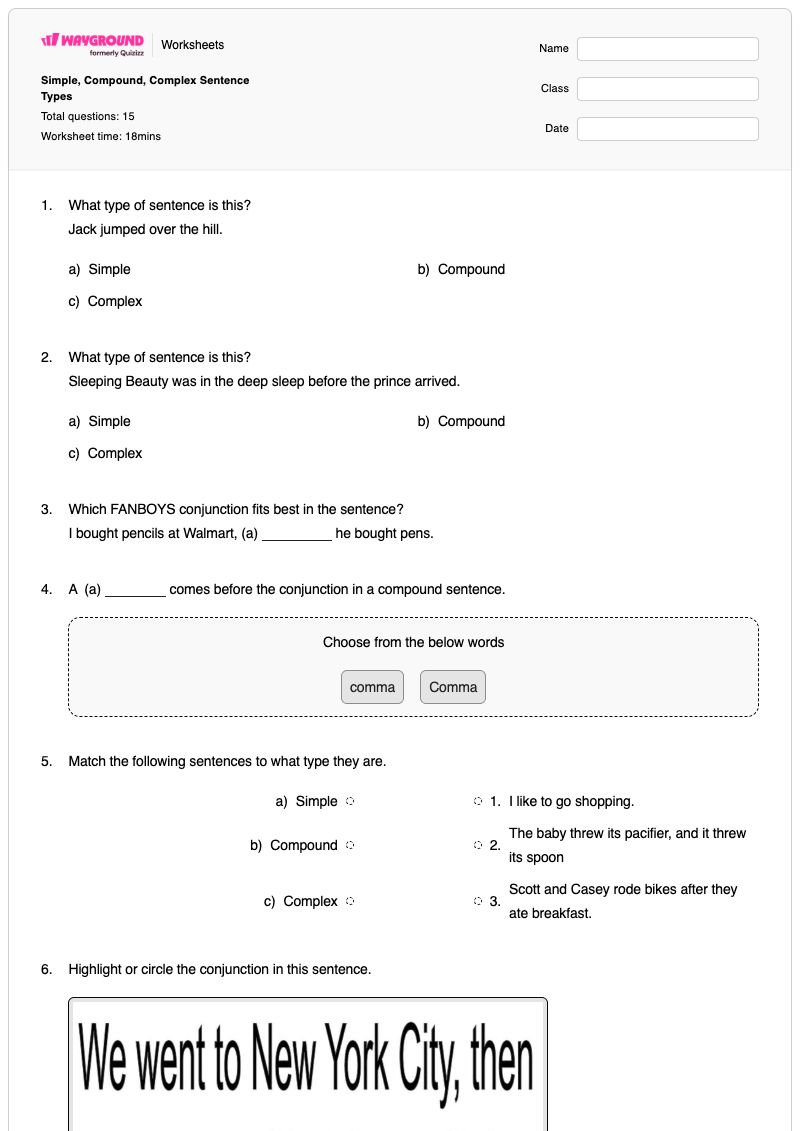
This free printable Grade 3 English worksheet helps students distinguish among simple, compound, and complex sentences. Through 15 varied items, students classify sentence types, match examples, identify conjunctions such as FANBOYS and subordinating conjunctions, choose conjunctions to complete sentences, and recognize comma placement in compound sentences. The worksheet also asks students to explain what each FANBOYS conjunction stands for and identify the four types of simple sentences. The mixed format includes multiple-choice questions, fill-in-the-blank items, a dropdown, matching activities, a highlighting or circling task, a drawing response, and an open-ended question. These formats give students practice applying sentence-structure rules rather than only memorizing definitions. Designed for Grade 3 learners, it can support direct instruction, guided practice, independent review, or a quick check of understanding. A complete answer key is included for efficient checking and feedback.

Worksheet settings

Font size

S
M
L
XL
Worksheets

Simple, Compound, Complex Sentence Types

Total questions: 15

Name
Class
Date
1.

What type of sentence is this?

Jack jumped over the hill.

a)

Simple

b)

Compound

c)

Complex

2.

What type of sentence is this?

Sleeping Beauty was in the deep sleep before the prince arrived.

a)

Simple

b)

Compound

c)

Complex

3.

Which FANBOYS conjunction fits best in the sentence?

I bought pencils at Walmart, (a)   he bought pens.

4.

A ​ (a)   comes before the conjunction in a compound sentence.

Choose from the below words
comma
Comma
5.

Match the following sentences to what type they are.

Simple

I like to go shopping.

Compound

The baby threw its pacifier, and it threw its spoon

Complex

Scott and Casey rode bikes after they ate breakfast.

6.

Highlight or circle the conjunction in this sentence.

7.

What type of sentence is this?

Sam got his driver's license.

a)

Simple

b)

Compound

c)

Complex

8.

Which one is NOT a FANBOYS conjunction?

a)

Before

b)

And

c)

Or

d)

So

9.

Match the following sentences to what they are.

The white and black spotted dog chased the ball.

Simple

The rocket flew high, but it didn't go far.

Compound

Since I started working out, I feel better.

Complex

10.

What is the conjunction in this sentence?

While I was eating, Teen Titans was playing on the TV.

a)

While

b)

Was

c)

Playing

d)

On

11.

What is the conjunction in this sentence?

I don't like oranges, nor do I like apples.

a)

Nor

b)

Like

c)

Don't

d)

I

12.

Which conjunction will best complete the sentence?

I like to walk, (a)   I don't like to run.

13.

What does each FANBOYS stand for?

4 lines
14.

How many different types of simple sentences are there?

a)

1

b)

2

c)

3

d)

4

15.

Match the following sentences types.

How are you?

Simple

When I went to the mall, I saw my friends.

Complex

I don't like fruits, but I love oranges.

Compound

Answer Key

Simple, Compound, Complex Sentence Types

Total questions: 15

1.
a)

Simple

2.
c)

Complex

3.
and, but, yet
4.
comma
5.

Simple

 - 

I like to go shopping.

, 

Compound

 - 

The baby threw its pacifier, and it threw its spoon

, 

Complex

 - 

Scott and Casey rode bikes after they ate breakfast.

6.
n/a
7.
a)

Simple

8.
a)

Before

9.

The white and black spotted dog chased the ball.

 - 

Simple

, 

The rocket flew high, but it didn't go far.

 - 

Compound

, 

Since I started working out, I feel better.

 - 

Complex

10.
a)

While

11.
a)

Nor

12.
but, yet, and
13.
n/a
14.
d)

4

15.

How are you?

 - 

Simple

, 

When I went to the mall, I saw my friends.

 - 

Complex

, 

I don't like fruits, but I love oranges.

 - 

Compound

FAQs

What does this worksheet cover about simple, compound, and complex sentences?

This Grade 3 worksheet uses multiple-choice, matching, fill-in-the-blank, dropdown, highlighting, drawing, and open-ended tasks to help students distinguish simple, compound, and complex sentences. Students also identify conjunctions, select FANBOYS conjunctions to complete sentences, recognize comma placement in compound sentences, explain what FANBOYS stands for, and review the four types of simple sentences.

How can I use this worksheet to teach sentence types and FANBOYS conjunctions?

Begin by modeling how to identify the sentence type and locate the conjunction in an example. Then use the matching and multiple-choice items for guided practice, pausing to discuss why a sentence is simple, compound, or complex; follow with the conjunction-selection and comma items as independent practice. Use the open-ended FANBOYS question and the highlighting task to check whether students can explain and locate conjunctions, not just recognize sentence labels.

What mistakes should I watch for when students complete this sentence-types worksheet?

Students may confuse a sentence with a compound subject or compound predicate with a compound sentence, so check whether they are identifying complete clauses rather than simply counting conjunctions. They may also mistake subordinating conjunctions such as before or while for FANBOYS, overlook the comma before the conjunction in a compound sentence, or choose a conjunction without considering the relationship between the clauses. Review their matching, highlighting, and fill-in-the-blank responses together to pinpoint the error.

How do I assign and grade this worksheet?

You can assign this Simple, Compound, Complex Sentence Types worksheet as a printable PDF or as a digital quiz on Wayground. It includes a complete answer key for the multiple-choice, matching, fill-in-the-blank, dropdown, and other response items. For printable submissions, scan student work with the Wayground for Teachers app to help grade responses efficiently.

How can I differentiate this sentence-types worksheet for my students?

Use the worksheet’s Advanced Settings to adjust font spacing or choose a larger font size so the sentence examples, matching choices, and response areas are easier to read. You can also enable a dyslexia-friendly font for the sentence-identification tasks or translate the worksheet into another language when students need language support for the instructions and examples.

Where can I find more worksheets like this on Wayground?

Wayground offers a broad collection of free printable worksheets and practice problems across all subjects, including downloadable PDFs and answer keys to support essential skills and concepts. Browse more resources at https://wayground.com/en-us/worksheets.