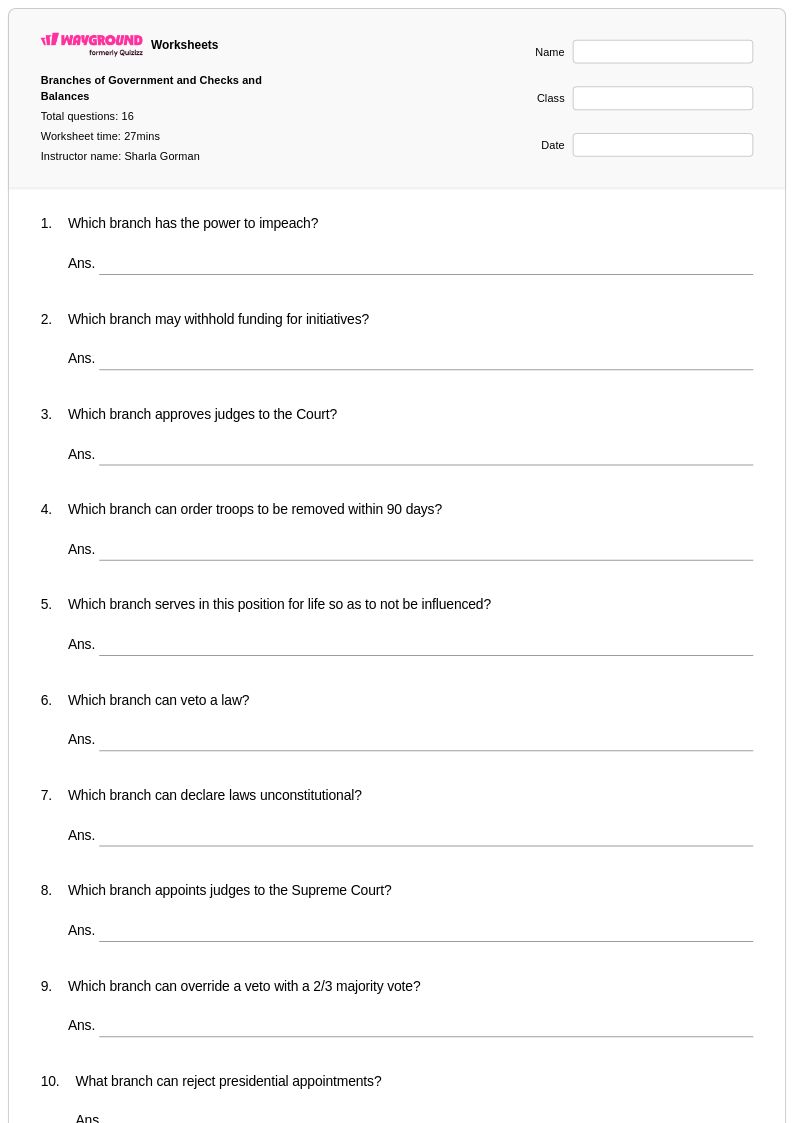
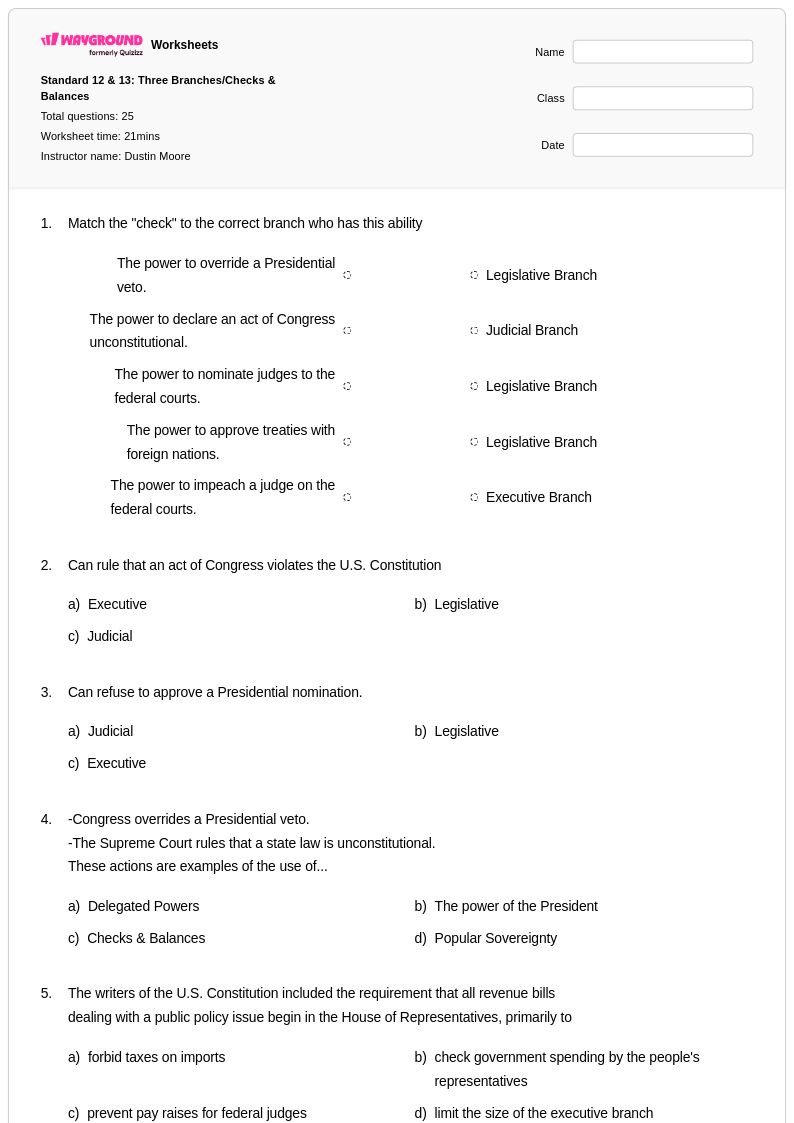
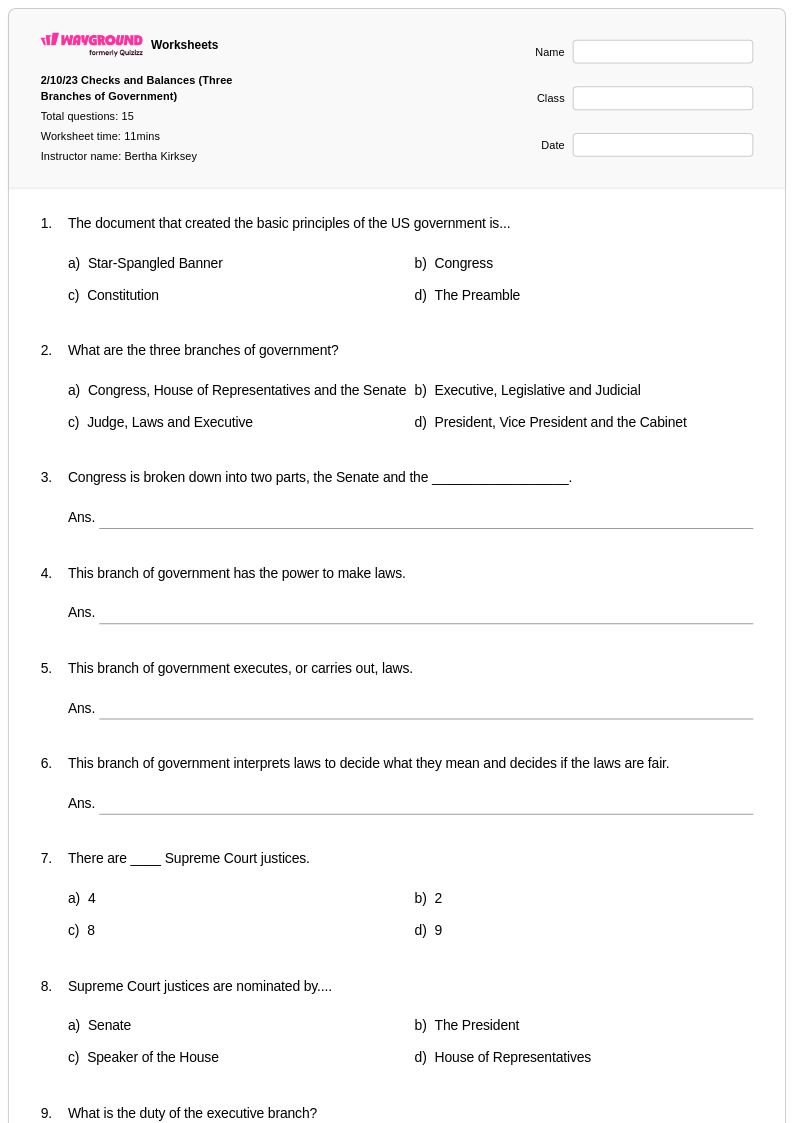
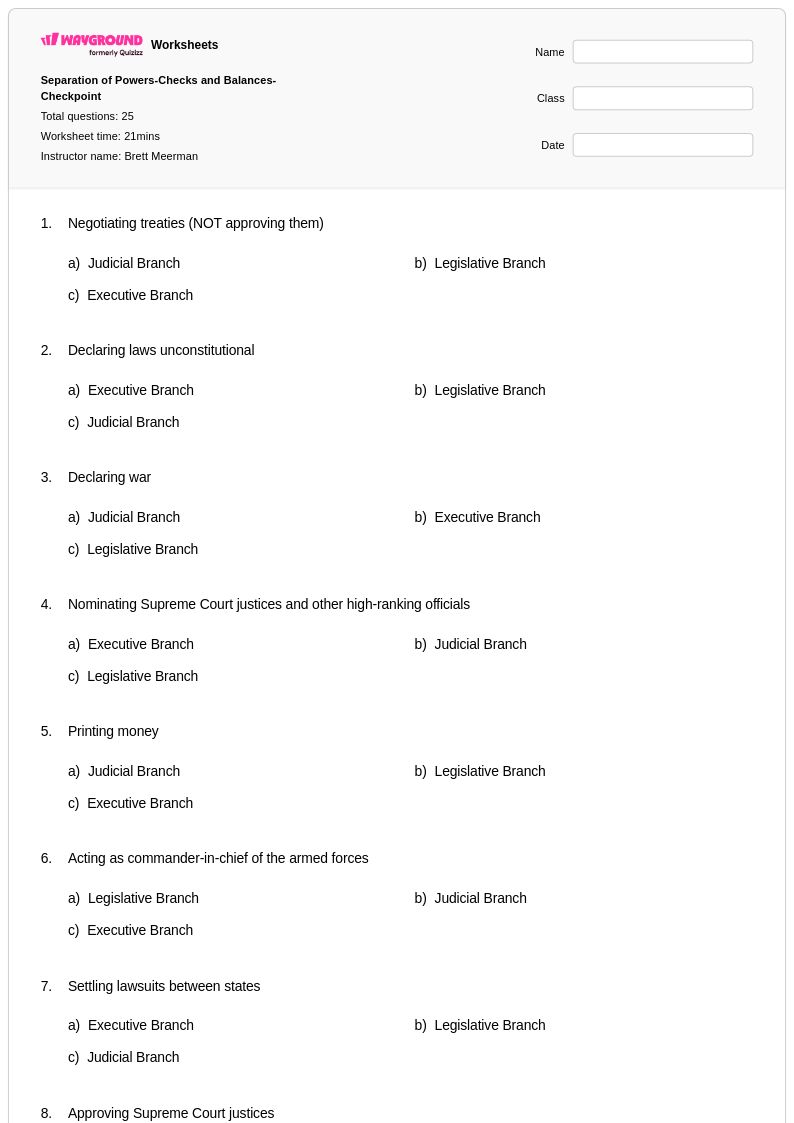
Explore Wayground's free checks and balances worksheets and printables that help social studies students understand how the three branches of government limit each other's power through engaging practice problems and comprehensive answer keys.
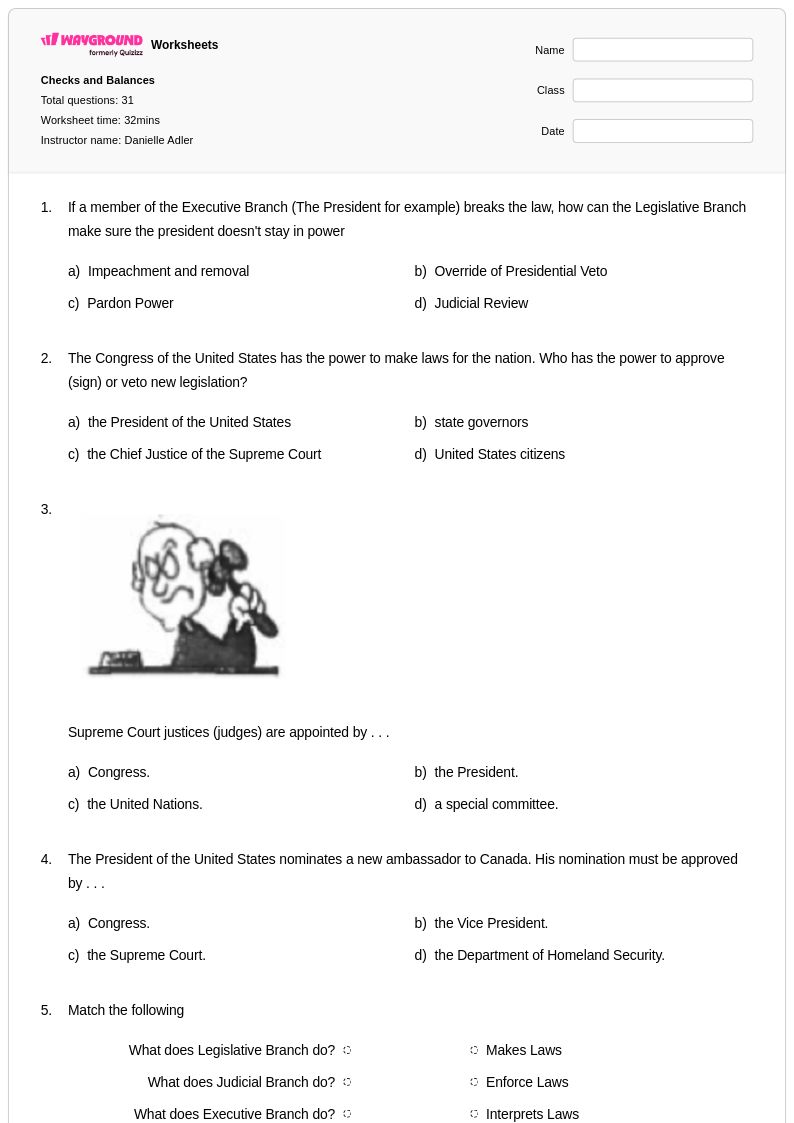
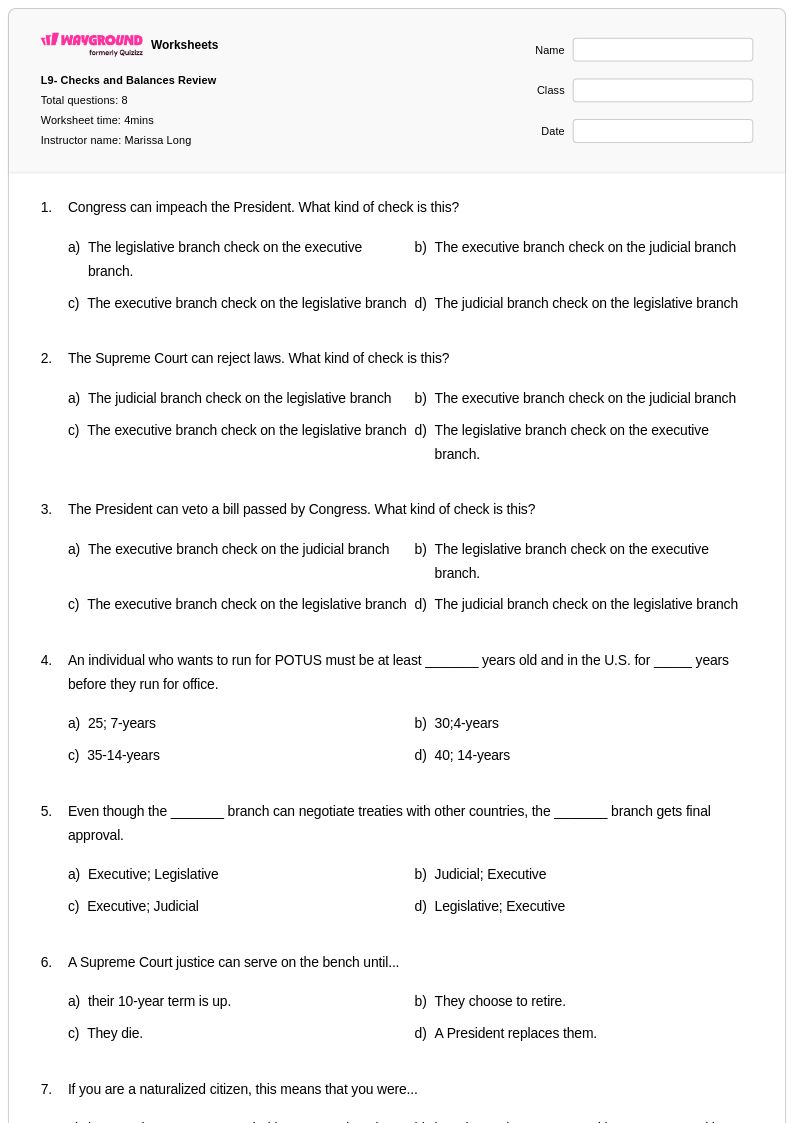
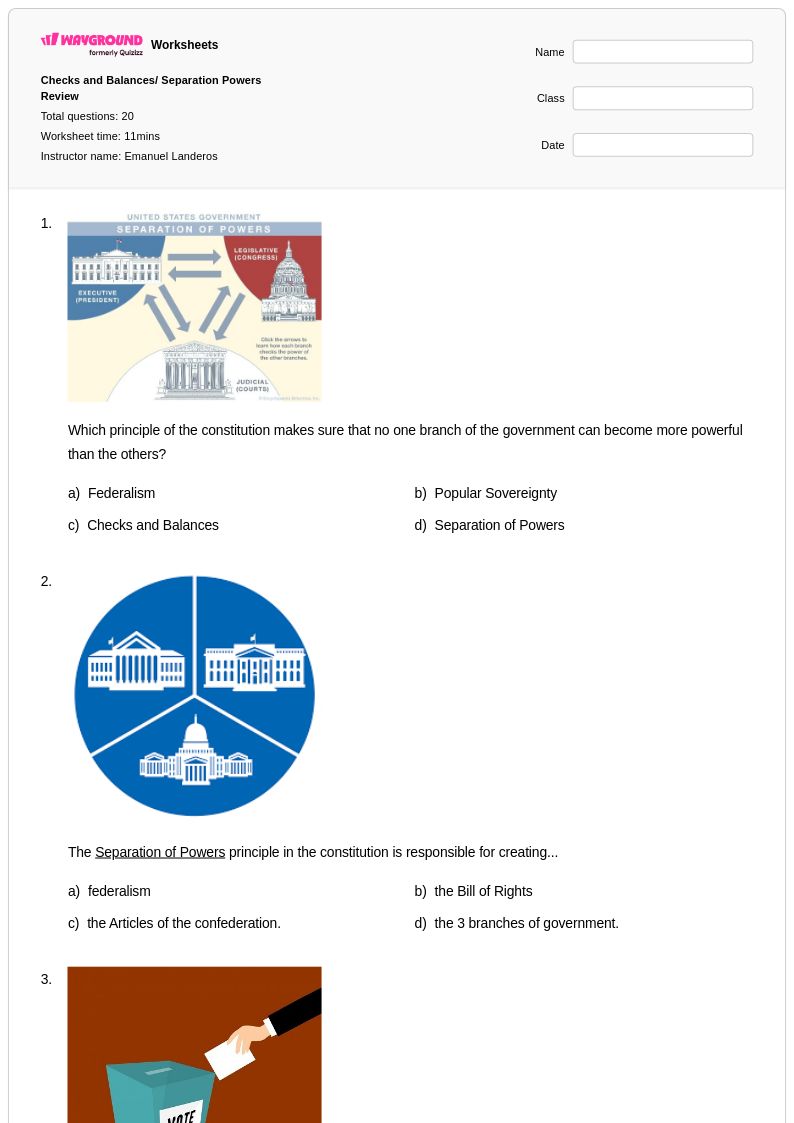
Checks and balances worksheets available through Wayground (formerly Quizizz) provide students with comprehensive practice in understanding one of the fundamental principles of American government. These educational resources focus on helping students master how the executive, legislative, and judicial branches of government limit each other's power through constitutional mechanisms. The worksheets strengthen critical thinking skills as students analyze real-world scenarios, identify which branch holds specific powers, and evaluate how different governmental actions serve as checks on other branches. Students work through practice problems that require them to apply their knowledge of presidential vetoes, congressional oversight, judicial review, and other constitutional safeguards. Each worksheet collection includes detailed answer keys and is available as free printables in pdf format, making them accessible for both classroom instruction and independent study.
Wayground (formerly Quizizz) supports educators with millions of teacher-created resources specifically designed to teach checks and balances concepts effectively. The platform's robust search and filtering capabilities allow teachers to quickly locate worksheets that align with specific curriculum standards and match their students' learning objectives. Advanced differentiation tools enable instructors to customize content difficulty levels, while the flexible format options include both printable pdf versions and interactive digital materials that can be adapted for various learning environments. These comprehensive worksheet collections facilitate targeted lesson planning, provide structured remediation opportunities for struggling students, and offer enrichment activities for advanced learners. Teachers can seamlessly integrate these resources into their civics instruction to reinforce constitutional principles and help students develop a deeper understanding of how democratic institutions maintain their balance of power.
FAQs
How do I teach checks and balances to middle or high school students?
Start by grounding students in the three branches of government and their core functions before introducing how each branch limits the others. Use concrete examples like presidential vetoes, Senate confirmation hearings, and Supreme Court judicial review to make the mechanisms tangible. Scenario-based activities where students must identify which branch is acting as a check on another are especially effective for building transferable understanding.
What kinds of practice problems help students understand checks and balances?
Effective practice problems ask students to identify which branch holds a specific power, explain how a given action serves as a check on another branch, and apply their knowledge to real or hypothetical governmental scenarios. Exercises involving presidential vetoes, congressional override votes, and judicial review of legislation push students to think analytically rather than simply recall definitions. These types of tasks build the critical thinking skills needed to understand how constitutional safeguards function in practice.
What mistakes do students commonly make when learning about checks and balances?
A frequent misconception is that the three branches are completely equal in all circumstances, rather than understanding that each branch holds distinct powers that specifically limit the others. Students also commonly confuse which branch performs which check, for example, misattributing judicial review to Congress rather than the courts. Another common error is treating checks and balances as a fixed list to memorize rather than an interconnected system where actions in one branch trigger responses in another.
How can I use checks and balances worksheets to support students who are struggling?
For struggling students, focus first on worksheets that isolate individual mechanisms, such as the veto process or Senate confirmation, before moving to multi-step scenarios that require comparing multiple checks at once. On Wayground, teachers can apply accommodations such as read aloud support, reduced answer choices, and extended time to individual students, which reduces cognitive load without signaling any difference to the rest of the class. These settings are reusable across future sessions, making them easy to maintain throughout a unit.
How do I use checks and balances worksheets from Wayground in my classroom?
Wayground's checks and balances worksheets are available as printable PDFs for traditional classroom use and in digital formats for technology-integrated environments, so they work whether students are completing work on paper or on a device. Teachers can also host the worksheets as a quiz directly on Wayground, which allows for real-time student responses and built-in answer key grading. All worksheets include complete answer keys, making them practical for both direct instruction and independent practice.
How do checks and balances connect to broader civics and constitutional law standards?
Checks and balances is a foundational concept in civics education and connects directly to standards covering separation of powers, constitutional design, and democratic governance. Understanding this system is prerequisite knowledge for studying topics like impeachment, executive orders, landmark Supreme Court cases, and legislative procedure. Teachers can use checks and balances instruction as a throughline for the entire civics curriculum, returning to it whenever students encounter new examples of interbranch interaction.