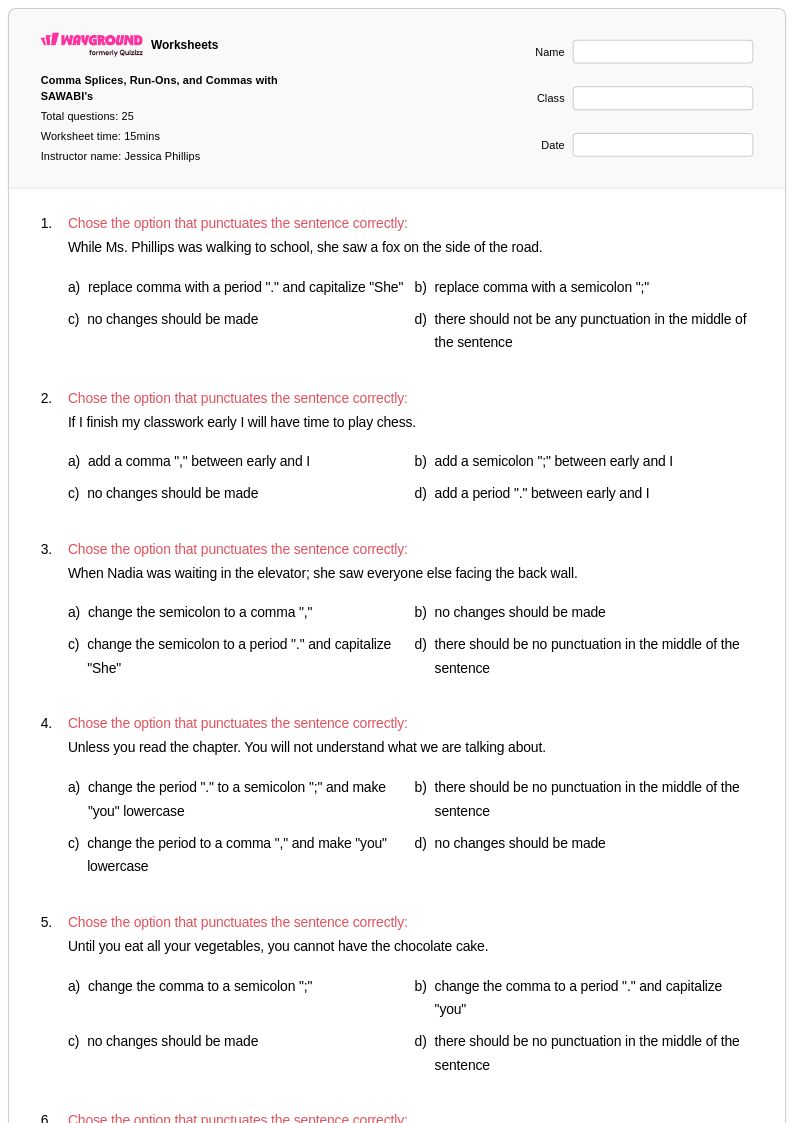
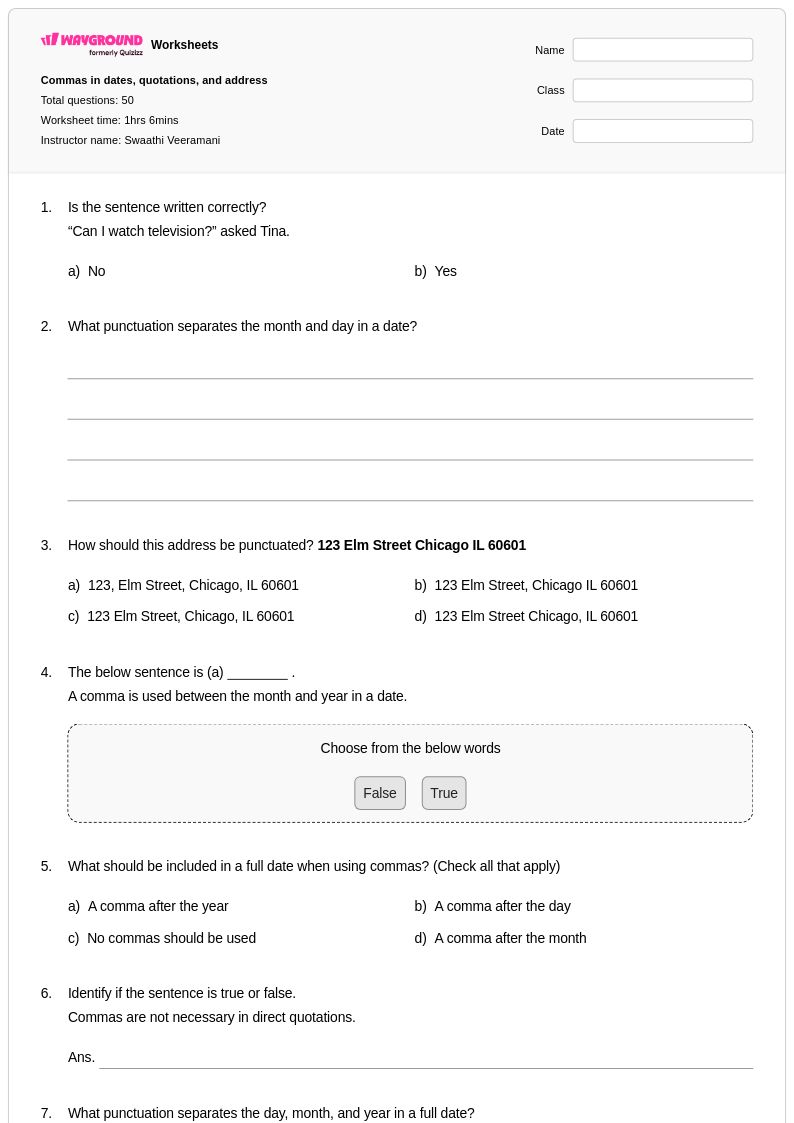
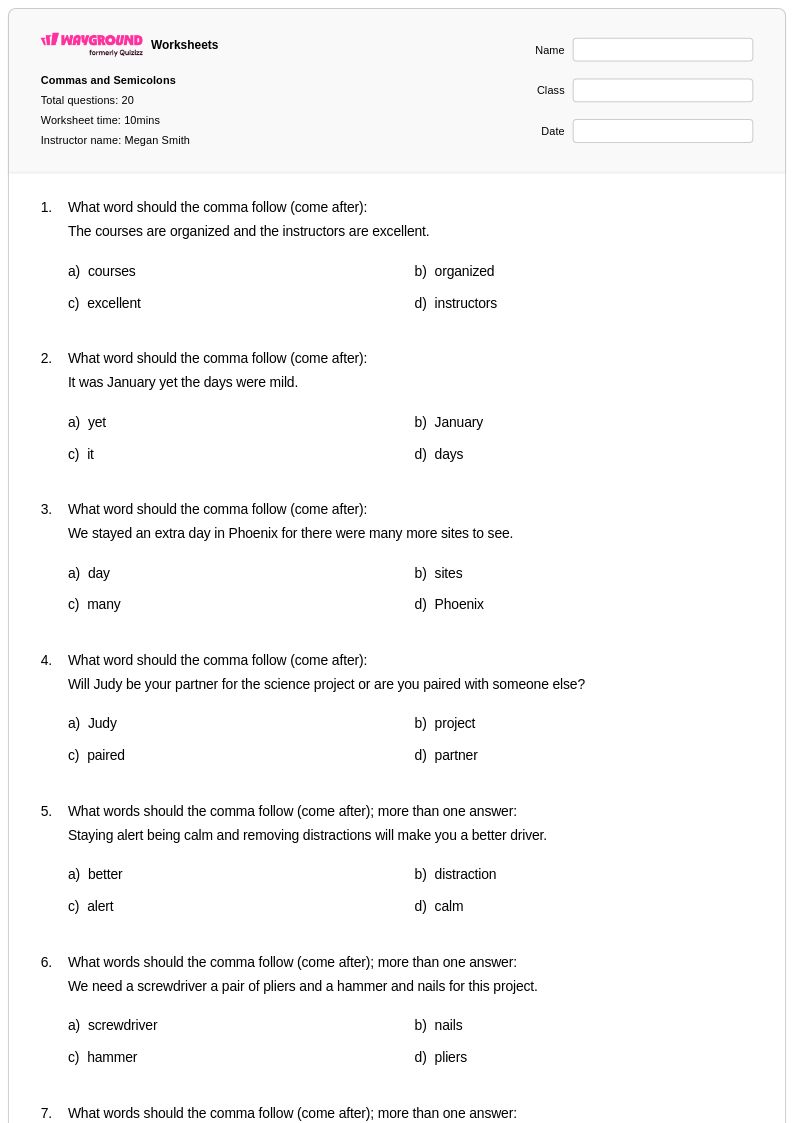
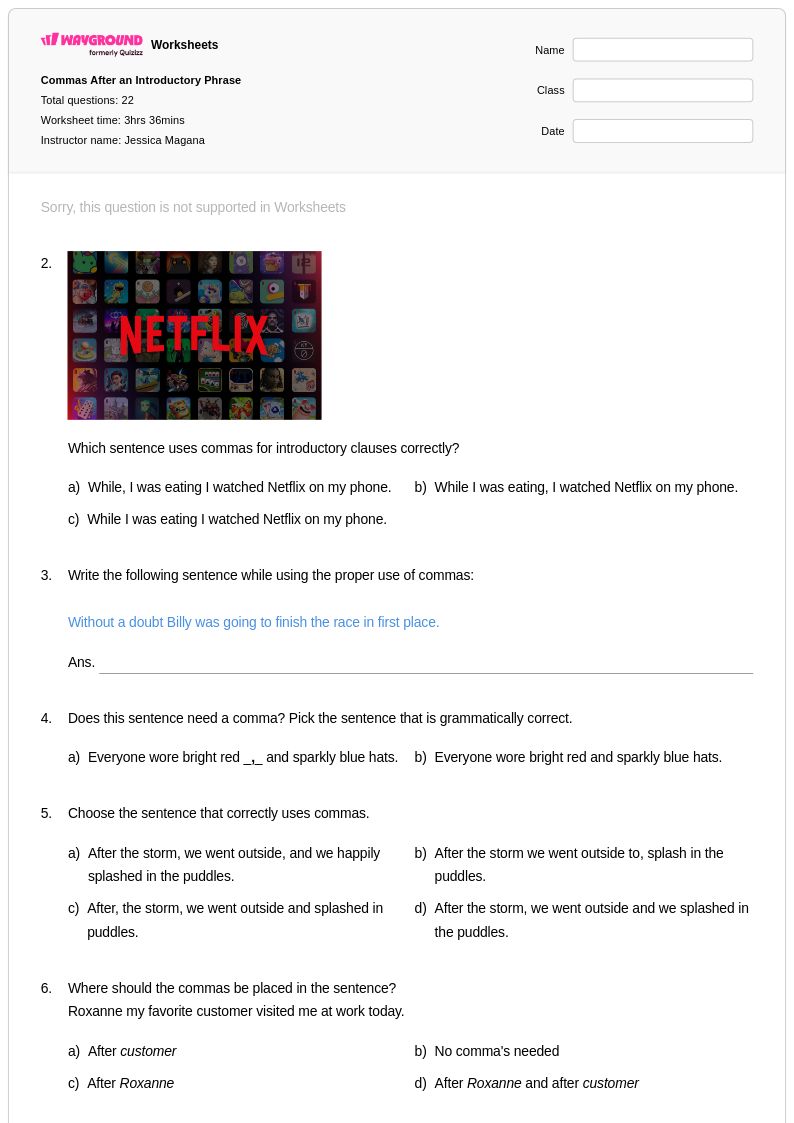
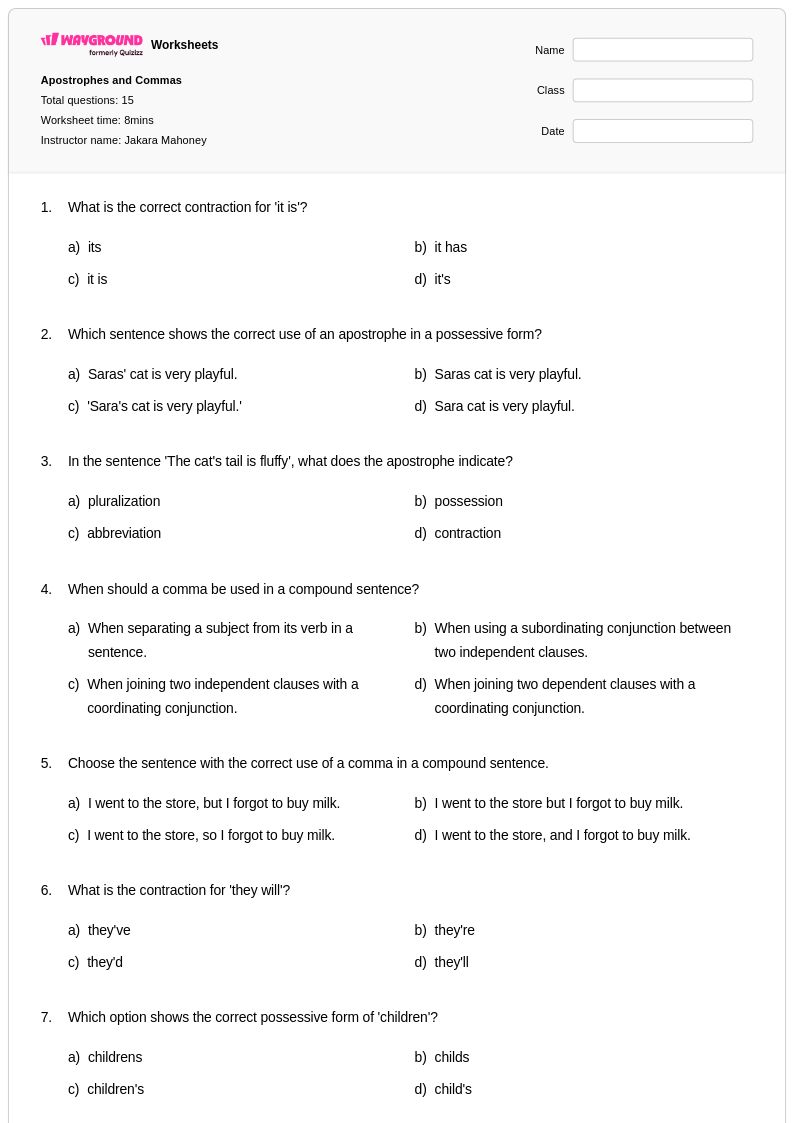
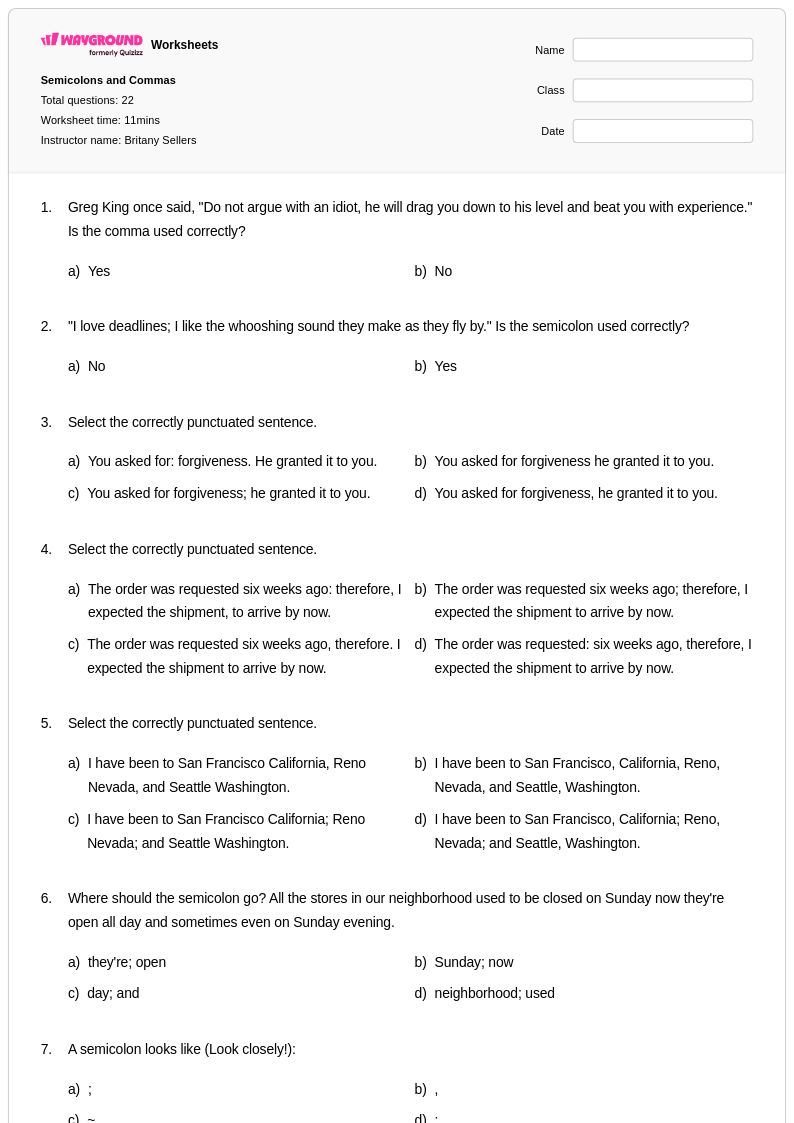
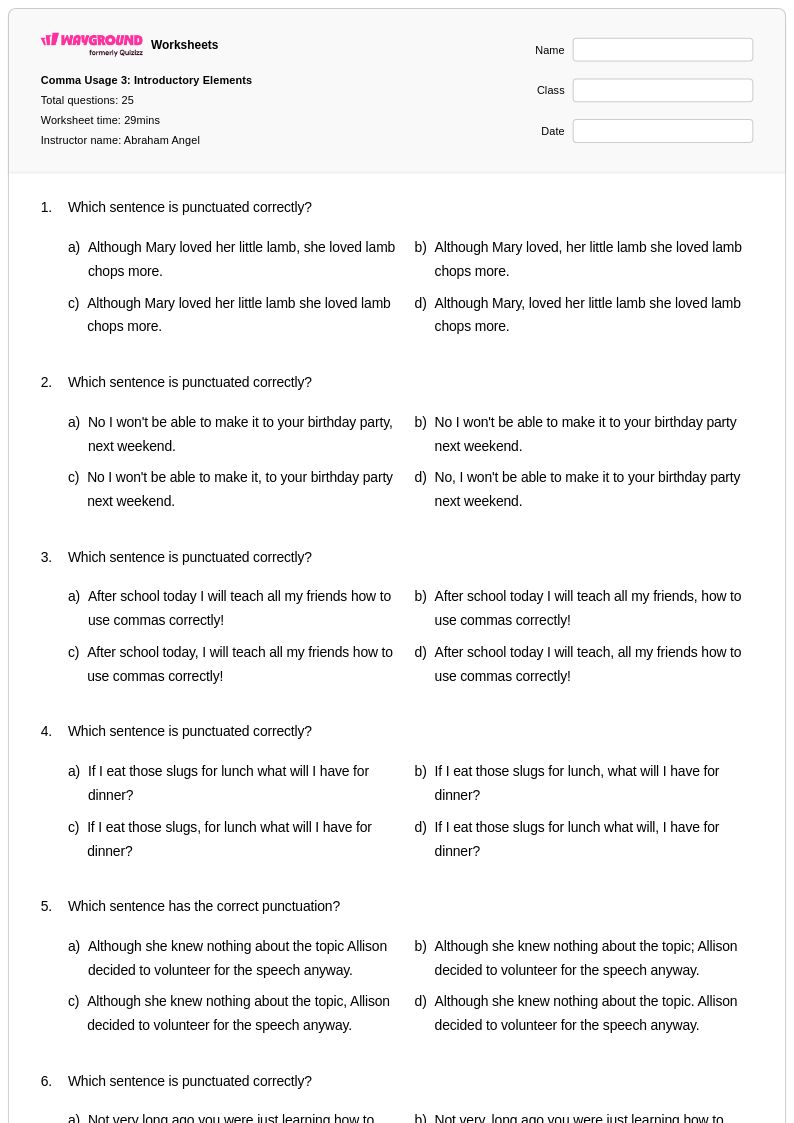
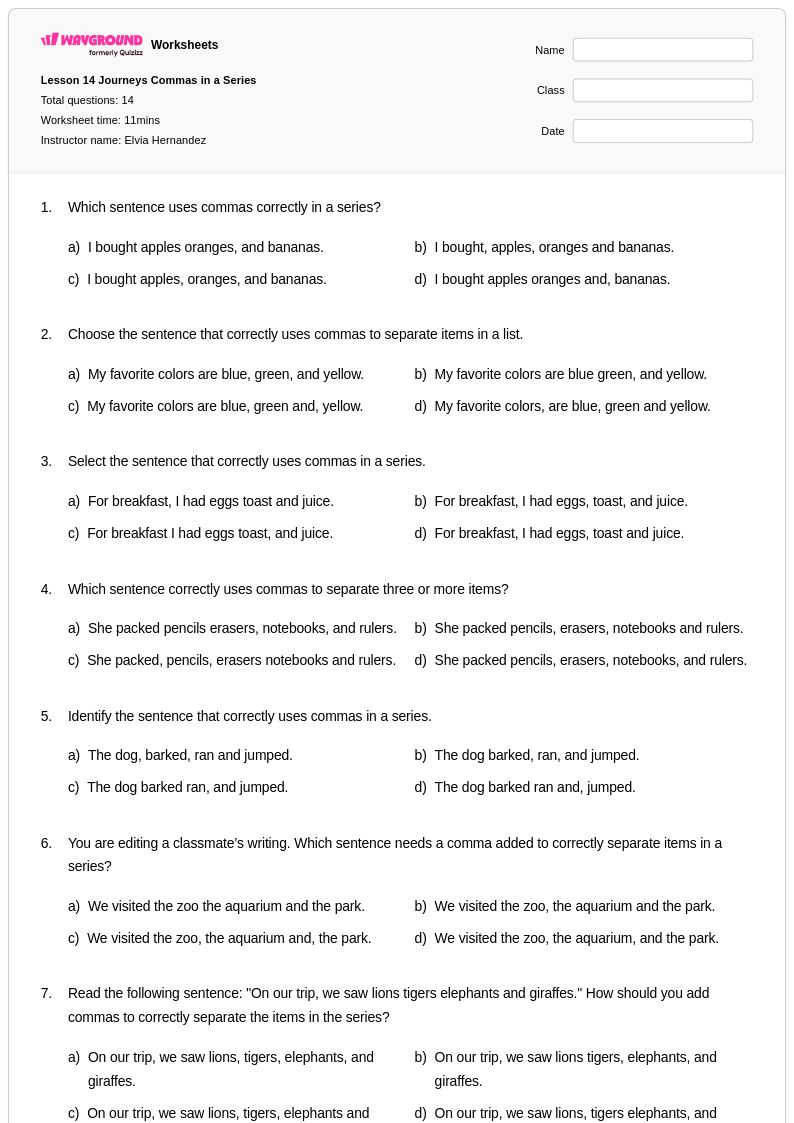
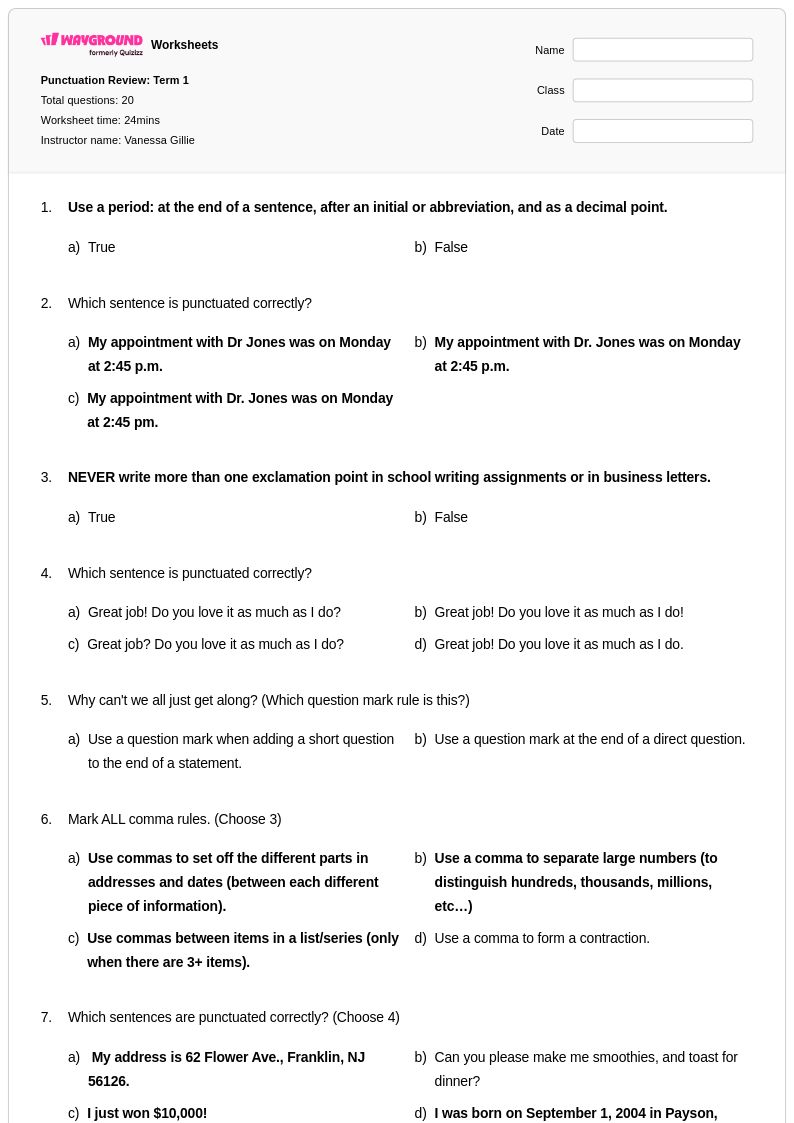
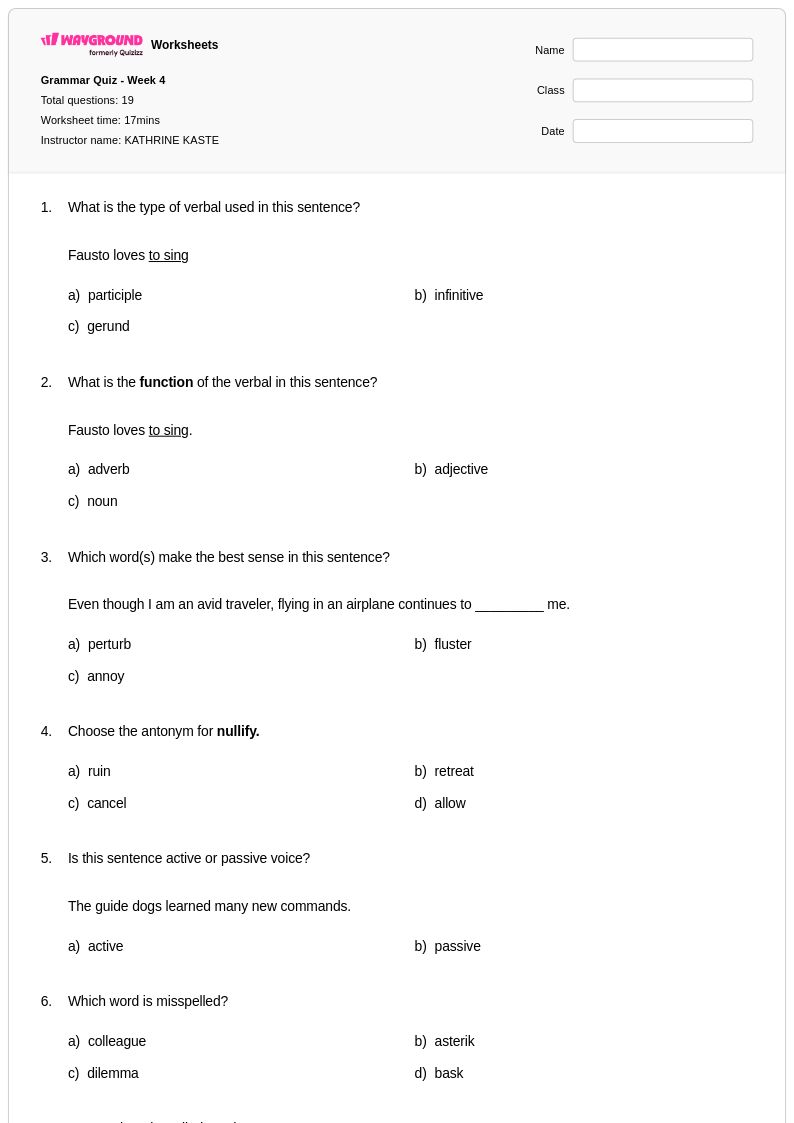
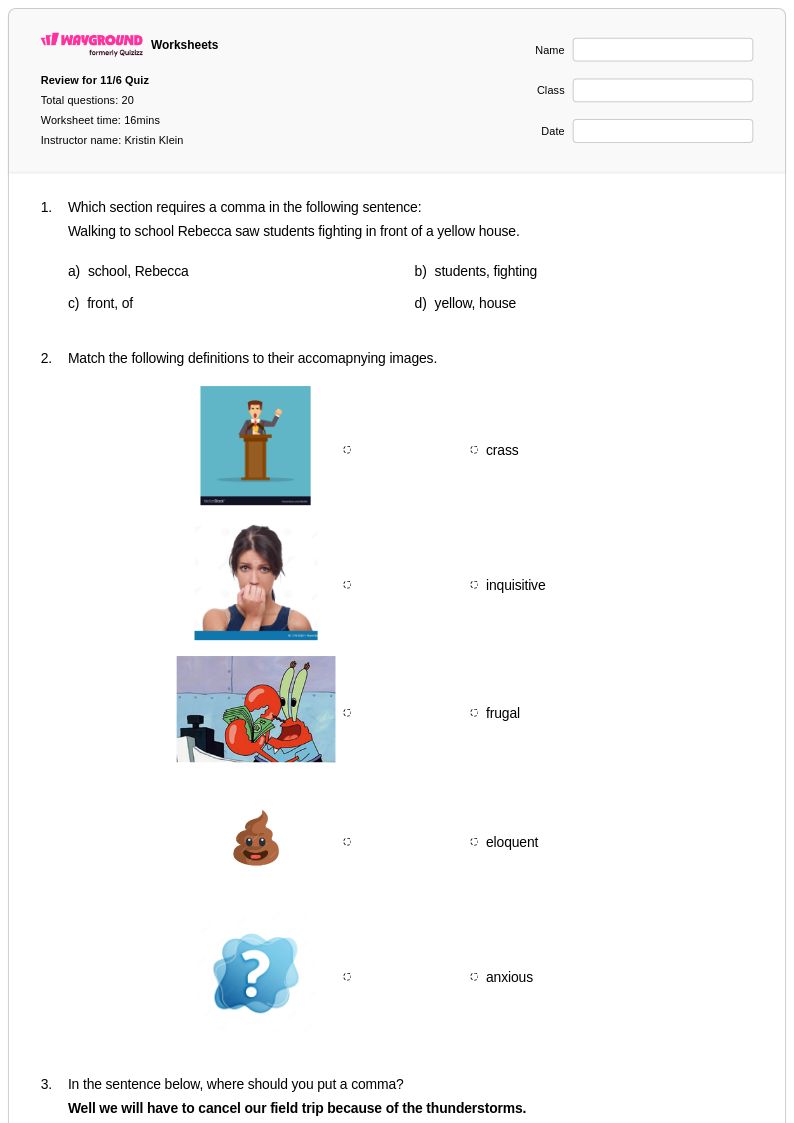
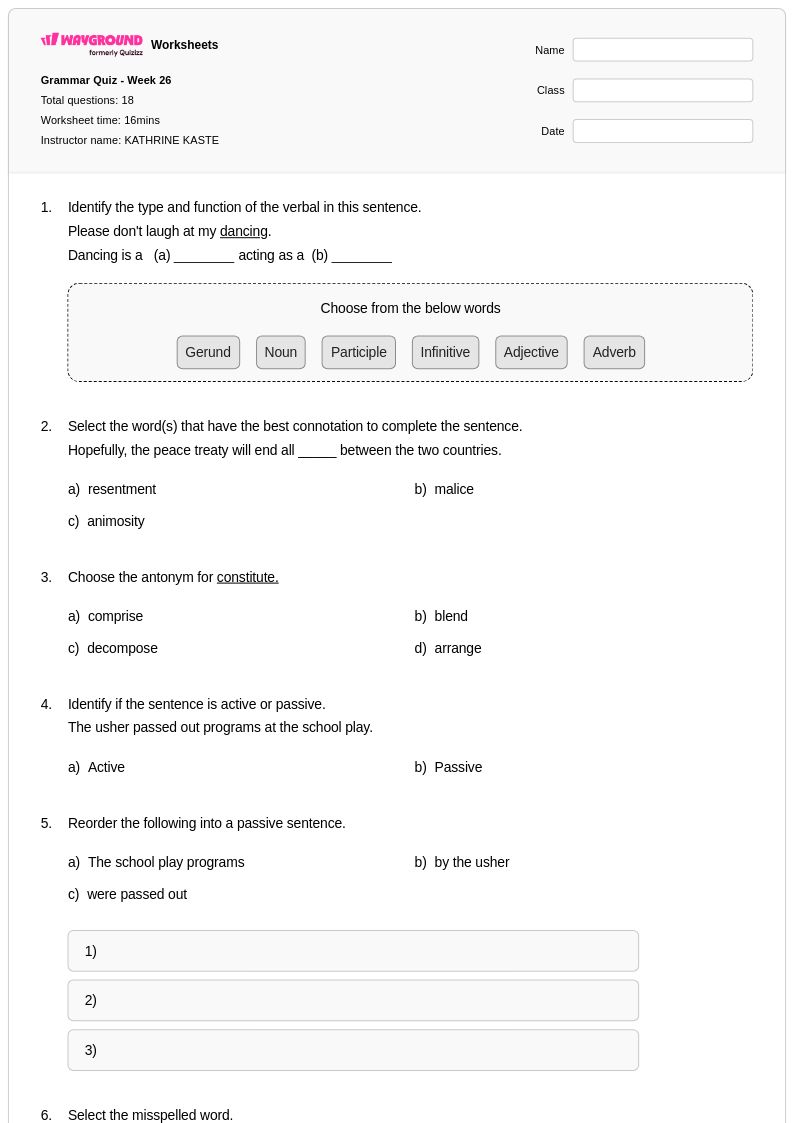
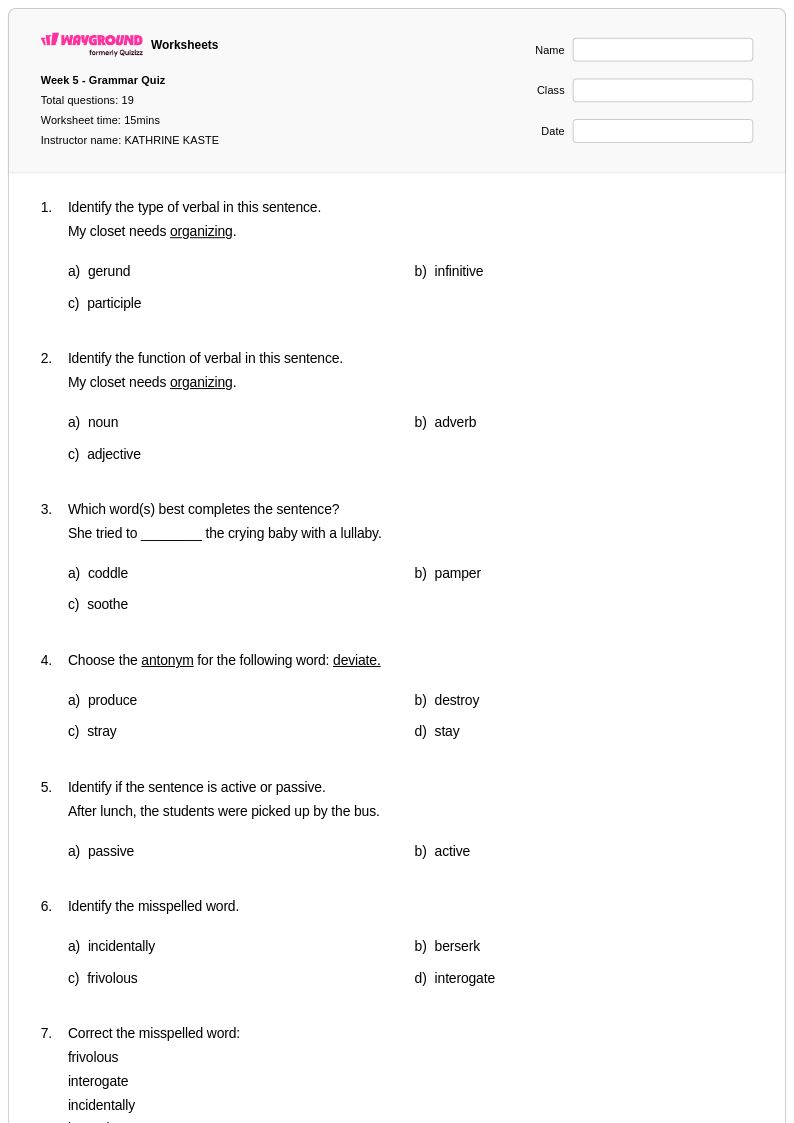
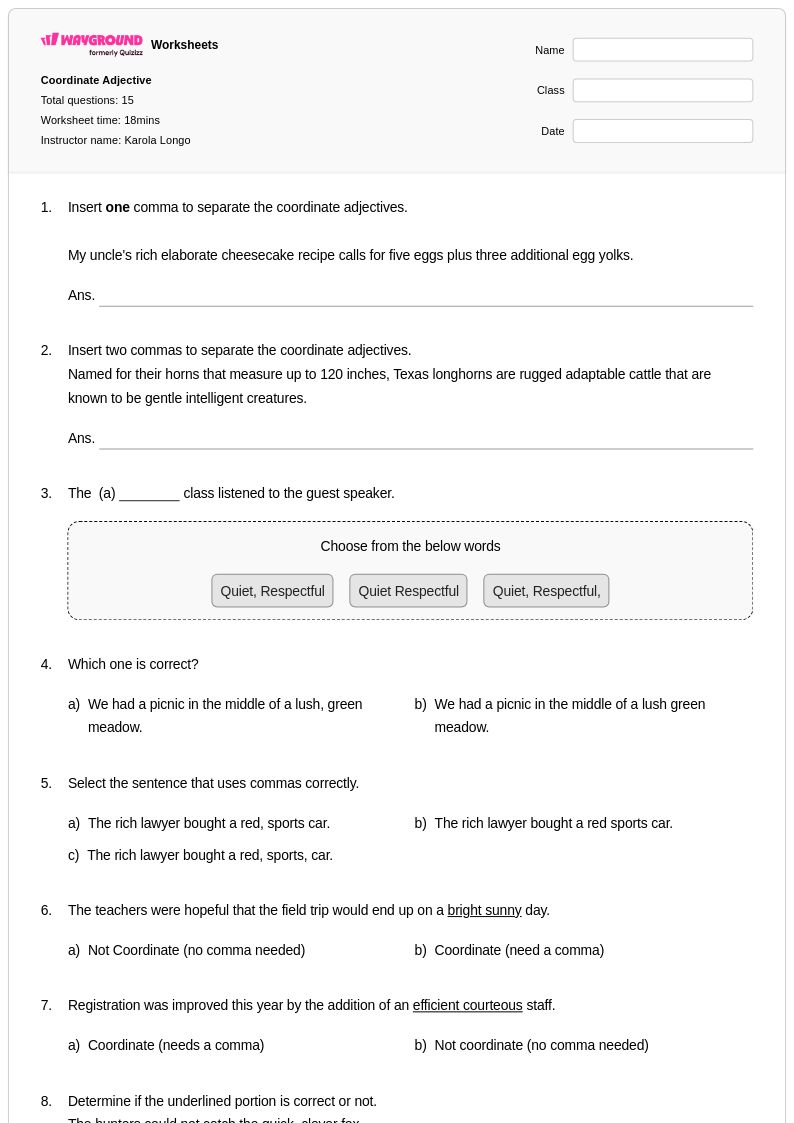
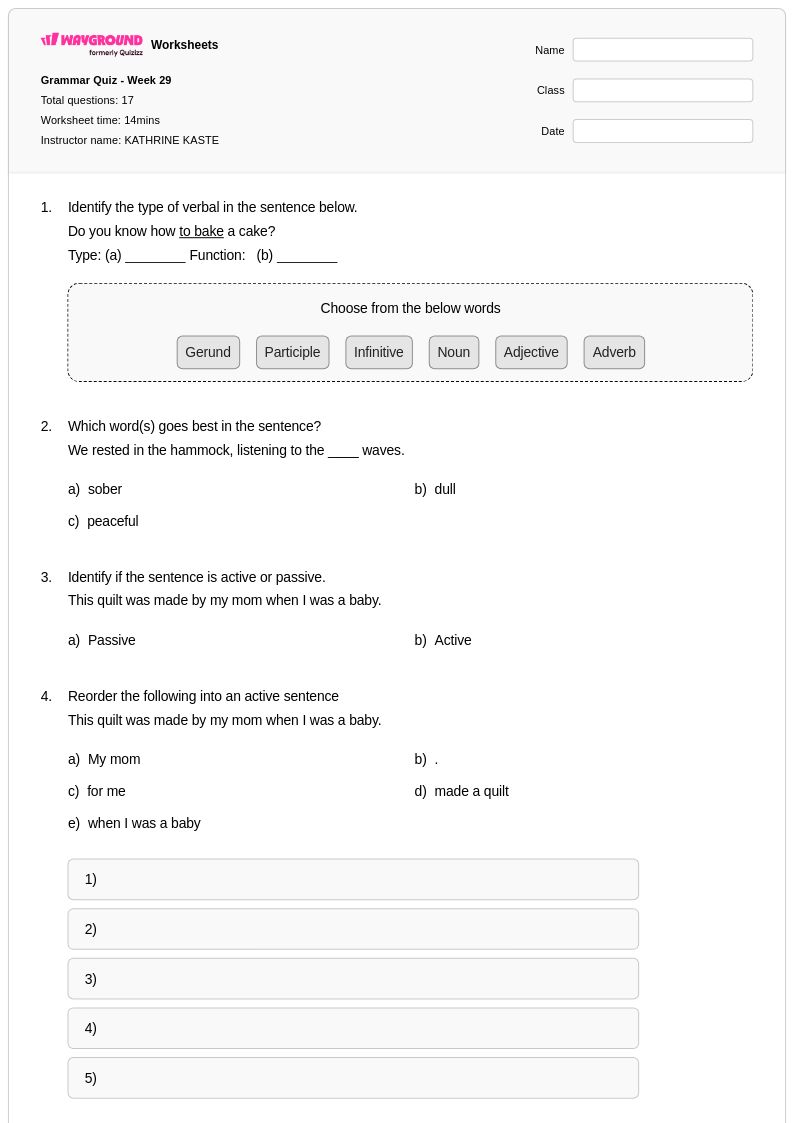
Grade 8 comma worksheets from Wayground provide comprehensive printables and practice problems to help students master comma usage, featuring free PDF downloads with complete answer keys.
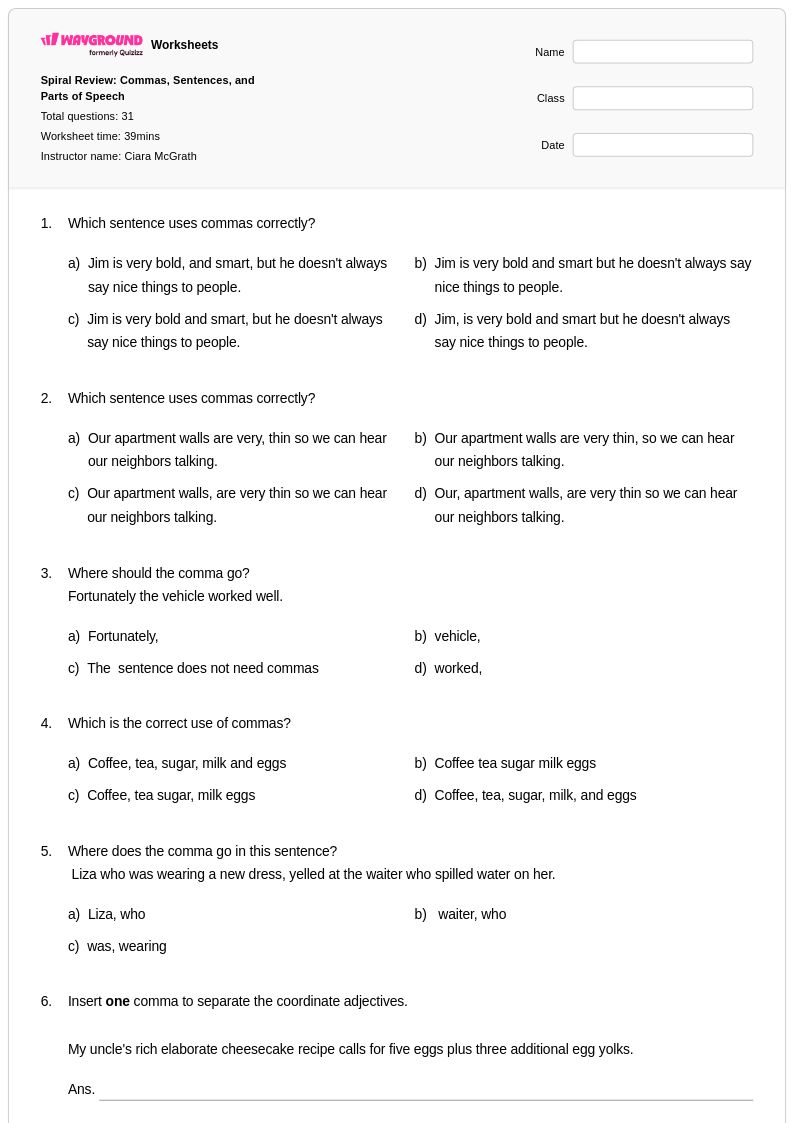
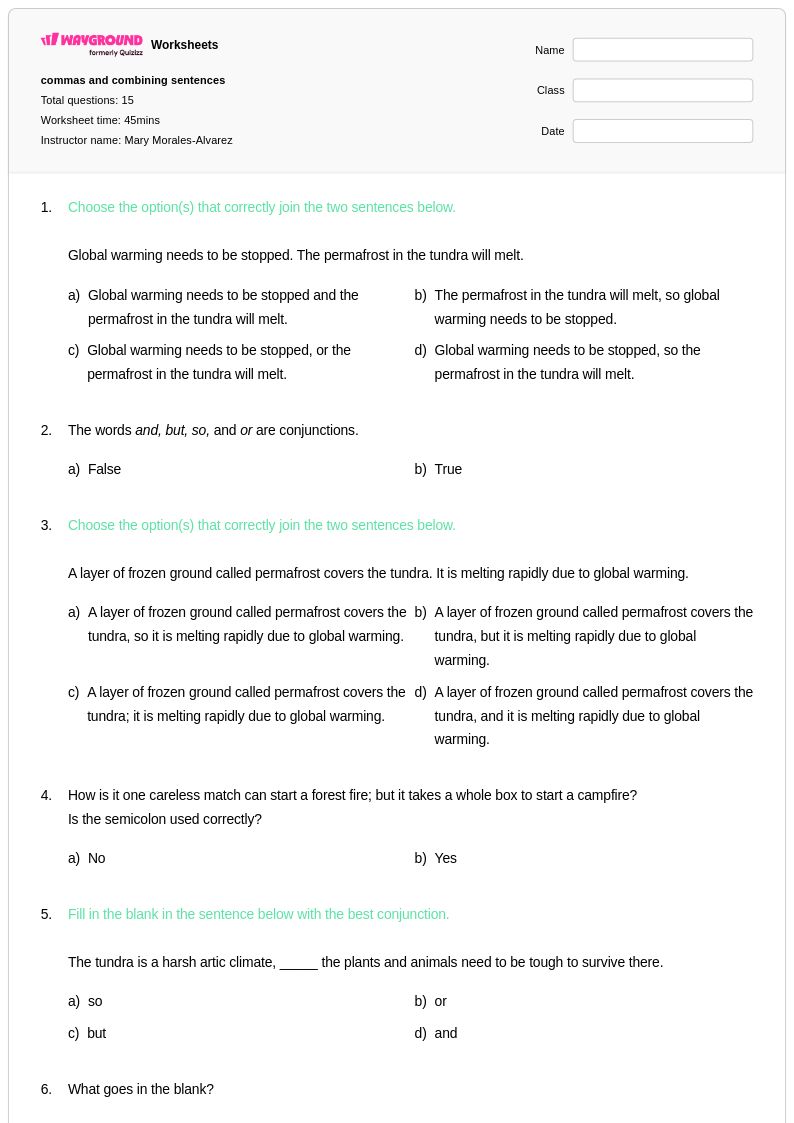
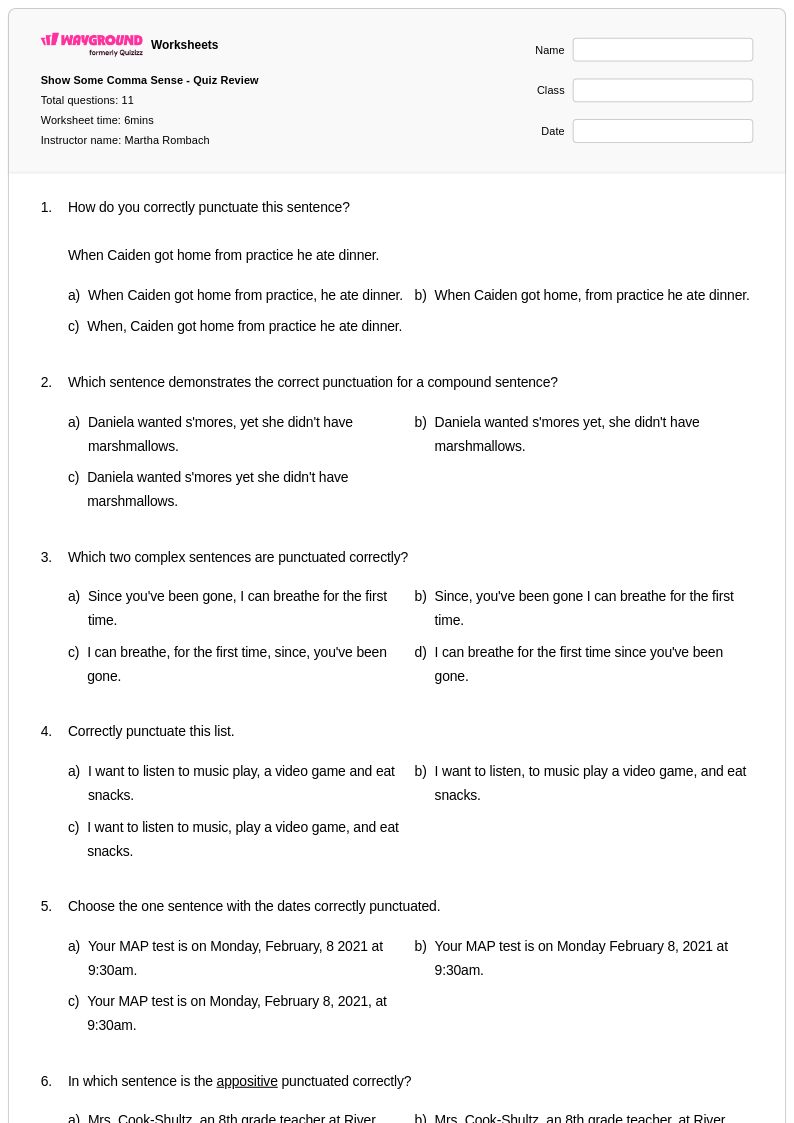
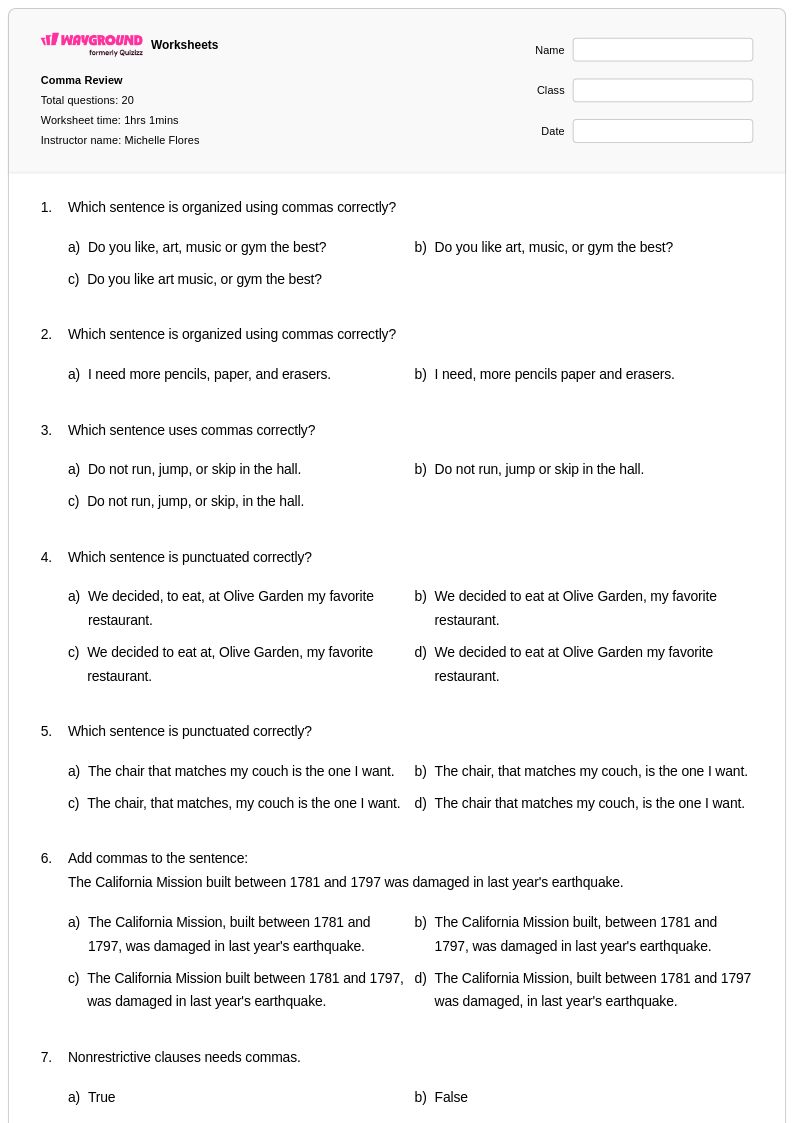
Grade 8 comma worksheets from Wayground (formerly Quizizz) provide comprehensive practice with one of the most essential punctuation skills in English writing. These carefully crafted resources help students master the complex rules governing comma usage, including separating items in a series, setting off introductory elements, joining independent clauses with coordinating conjunctions, and punctuating nonrestrictive clauses and phrases. Each worksheet focuses on building student confidence through systematic practice problems that progress from basic comma applications to more sophisticated usage patterns commonly found in advanced middle school writing. Teachers can access complete answer keys alongside printable pdf versions, making it simple to implement both independent practice sessions and guided instruction that targets specific comma rule deficiencies.
Wayground's extensive collection of comma worksheets draws from millions of teacher-created resources, offering educators powerful search and filtering capabilities to locate materials perfectly aligned with grade 8 English language arts standards. The platform's differentiation tools allow teachers to customize worksheet difficulty levels and focus areas, ensuring that struggling students receive targeted remediation while advanced learners engage with enrichment activities that challenge their punctuation mastery. These flexible resources are available in both printable and digital formats, supporting diverse classroom environments and learning preferences. Whether used for daily skill practice, assessment preparation, or intervention support, these comma worksheets provide the structured practice opportunities that eighth-grade students need to develop sophisticated punctuation skills essential for academic and professional writing success.
FAQs
How do I teach comma rules to students who keep getting them wrong?
The most effective approach is to teach comma rules one at a time rather than all at once, anchoring each rule to a clear, memorable pattern. Start with commas in a series, then move to introductory phrases, coordinate adjectives, and nonrestrictive elements in sequence. Students internalize rules faster when they practice identifying correct and incorrect usage in authentic sentences before producing their own writing.
What exercises help students practice comma placement?
Targeted practice exercises work best when they progress from recognition to application — for example, having students first identify where commas belong in a given sentence, then rewrite sentences correctly, and finally compose original sentences that require a specific comma rule. Exercises focused on individual rules, such as commas after introductory phrases or commas with nonrestrictive elements, build precision before students tackle mixed-rule practice.
What comma mistakes do students make most often?
The most common errors are comma splices (joining two independent clauses with only a comma), omitting commas after introductory phrases, and misusing commas with restrictive versus nonrestrictive clauses. Students also frequently forget commas in a series, especially before the Oxford comma, or overuse commas by inserting them wherever they pause while reading aloud. Targeted practice on each of these error patterns individually is more effective than general comma review.
How do I help students understand the difference between restrictive and nonrestrictive clauses?
Teach students to ask whether the clause is essential to identifying the noun it modifies. If removing the clause changes the meaning or makes the sentence ambiguous, it is restrictive and takes no commas. If the clause simply adds extra information about an already-identified noun, it is nonrestrictive and must be set off with commas. Using sentence pairs where only the comma placement differs helps students see how meaning shifts.
How do I use Wayground's comma worksheets in my classroom?
Wayground's comma worksheets are available as printable PDFs for traditional classroom use and in digital formats for technology-integrated instruction, making them flexible for homework, independent practice, or whole-class lessons. Teachers can also host the worksheets as a quiz directly on Wayground, allowing students to complete them digitally with immediate feedback. All worksheets include complete answer keys, so grading is efficient whether students work independently or in guided settings.
How can I differentiate comma practice for students at different skill levels?
For students who are still building foundational skills, begin with single-rule worksheets focused on commas in a series or after introductory phrases before introducing more complex rules like nonrestrictive elements. On Wayground, teachers can apply accommodations such as reduced answer choices to lower cognitive load for individual students, or enable Read Aloud so that questions are read to students who need auditory support. These settings can be assigned per student, allowing the rest of the class to work with default settings without disruption.