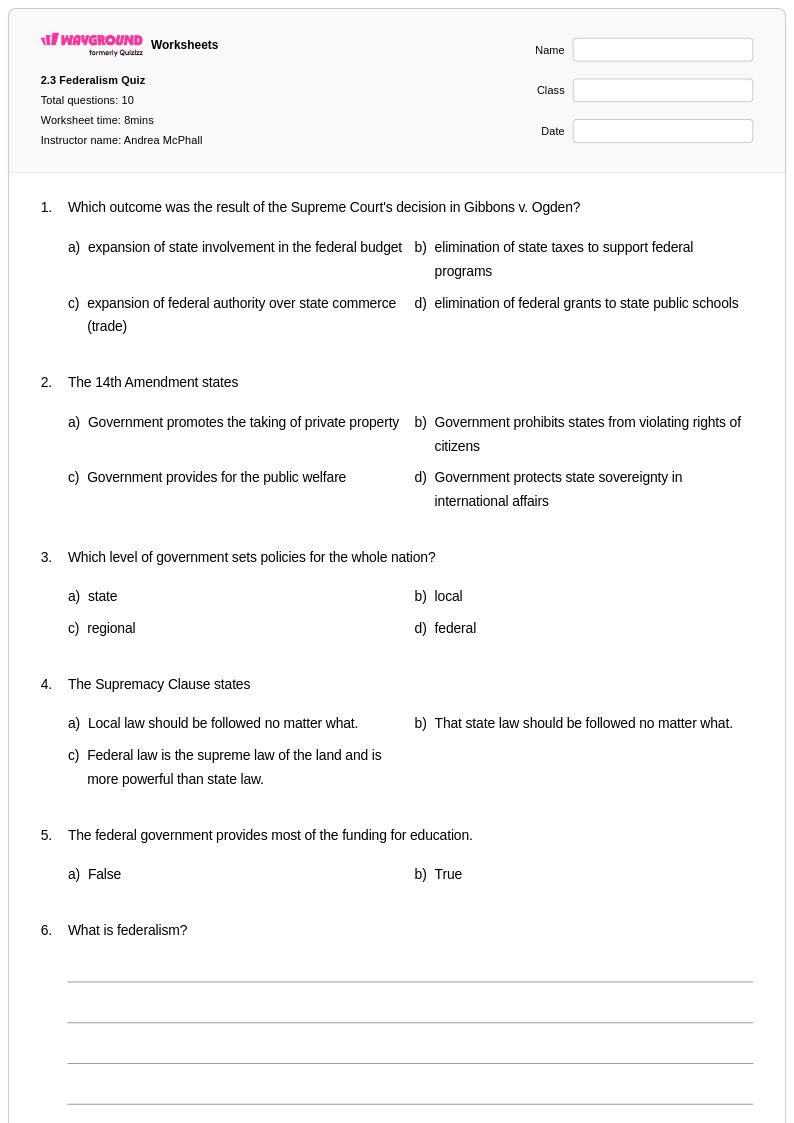
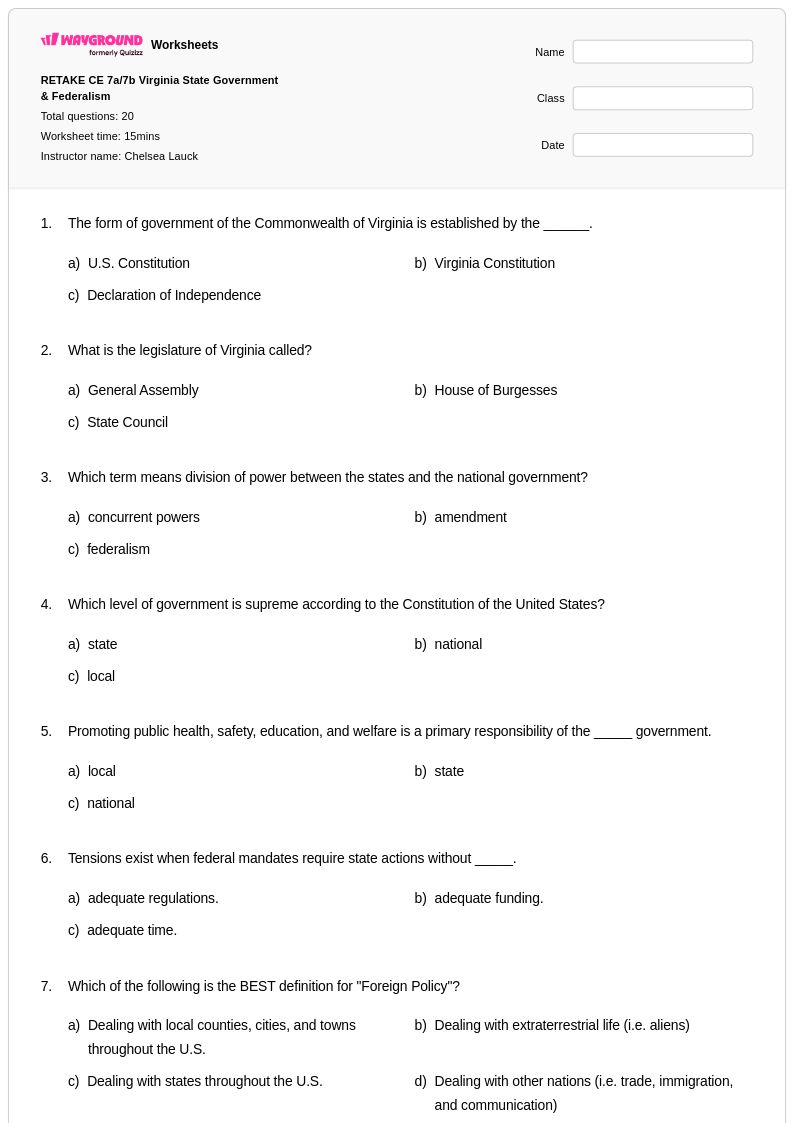
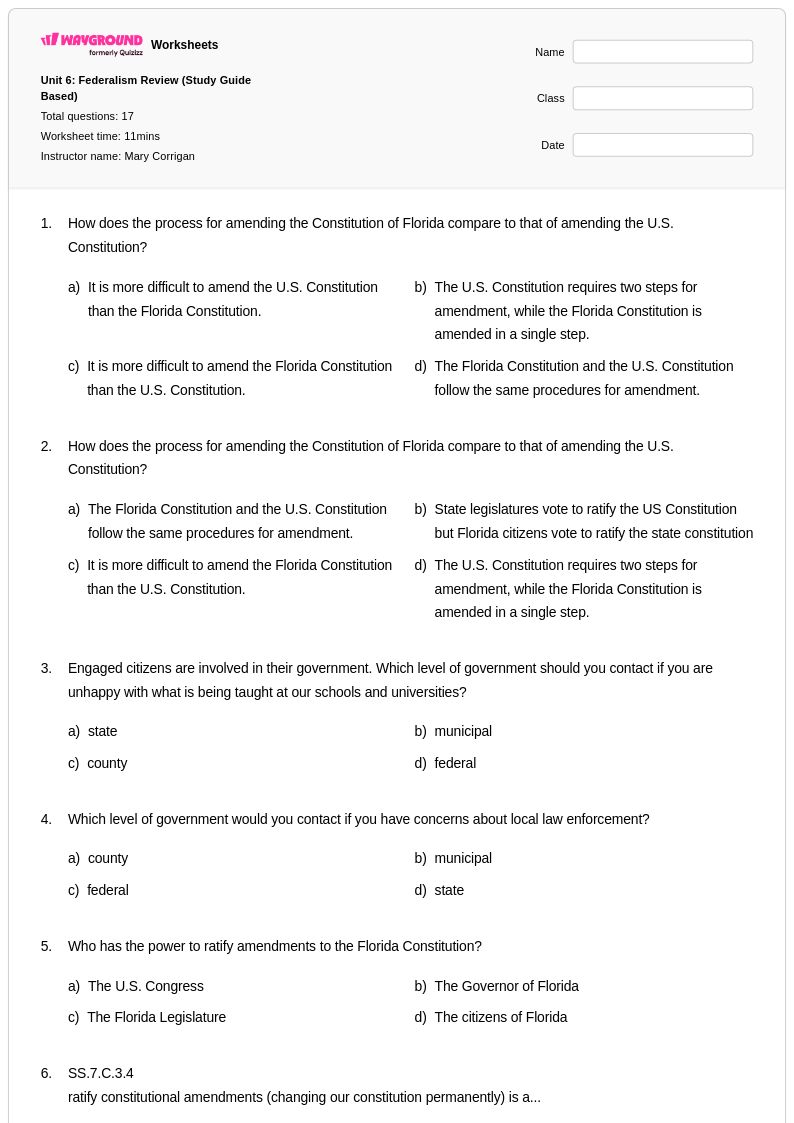
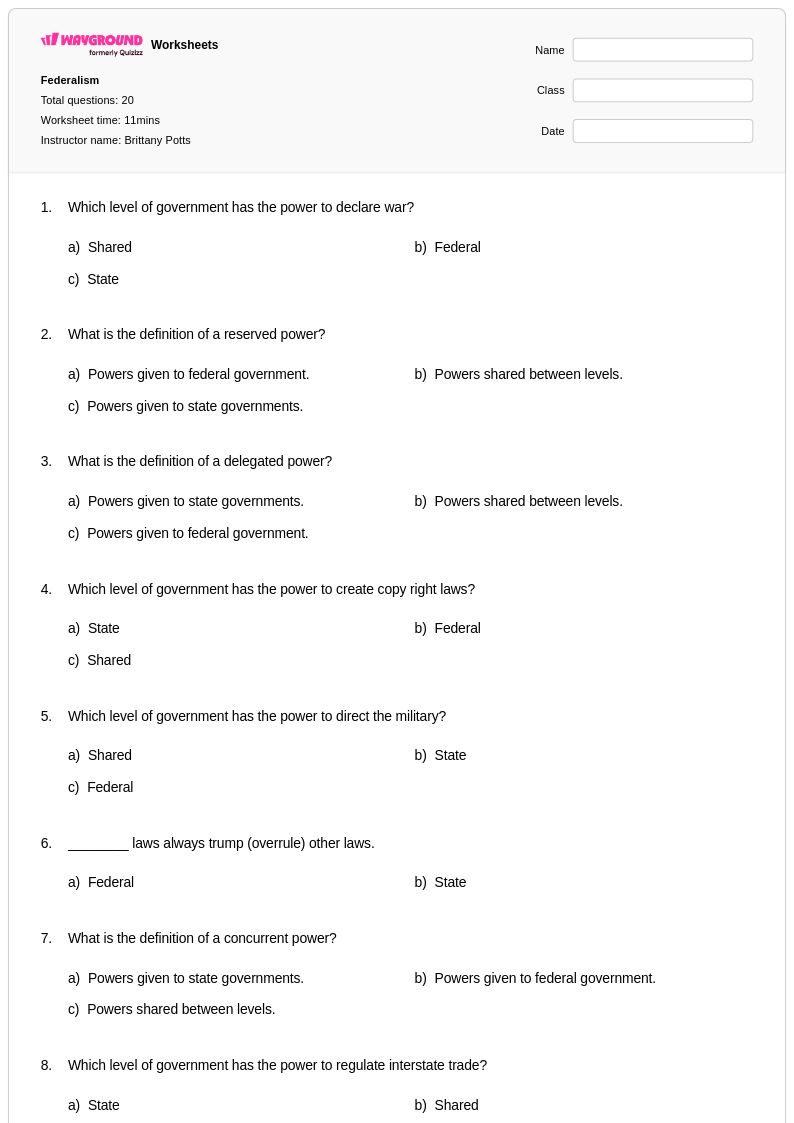
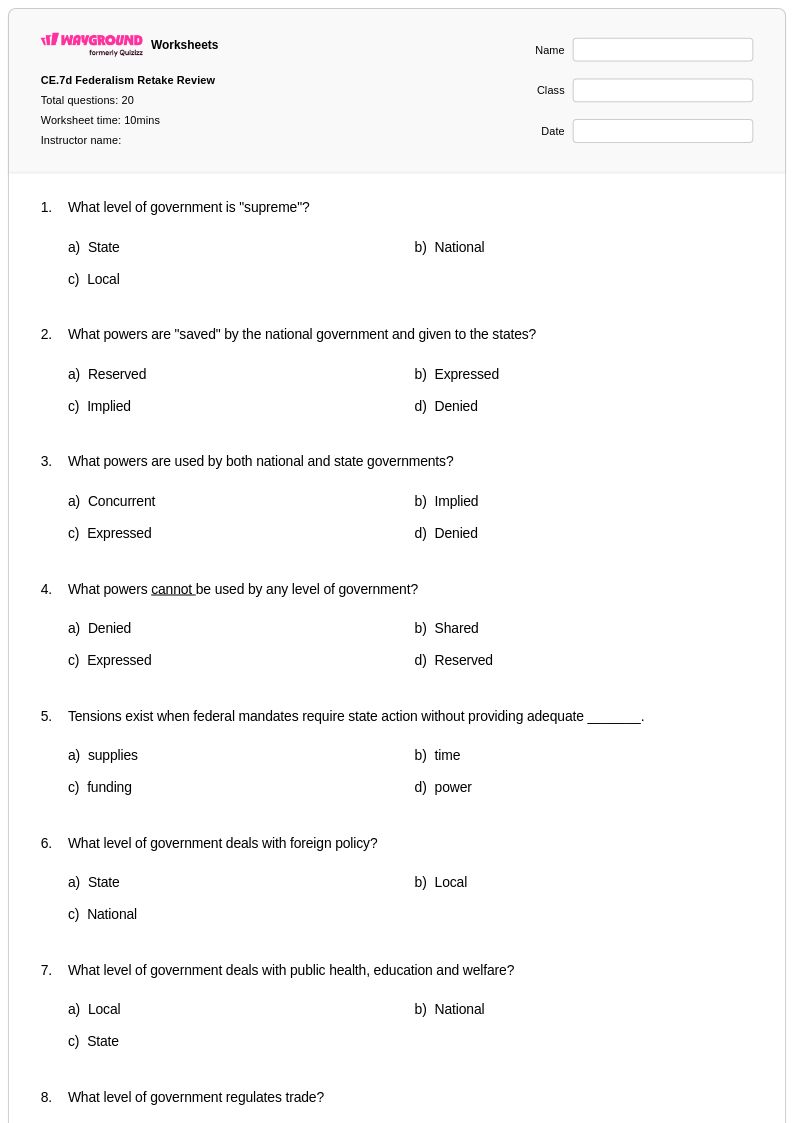
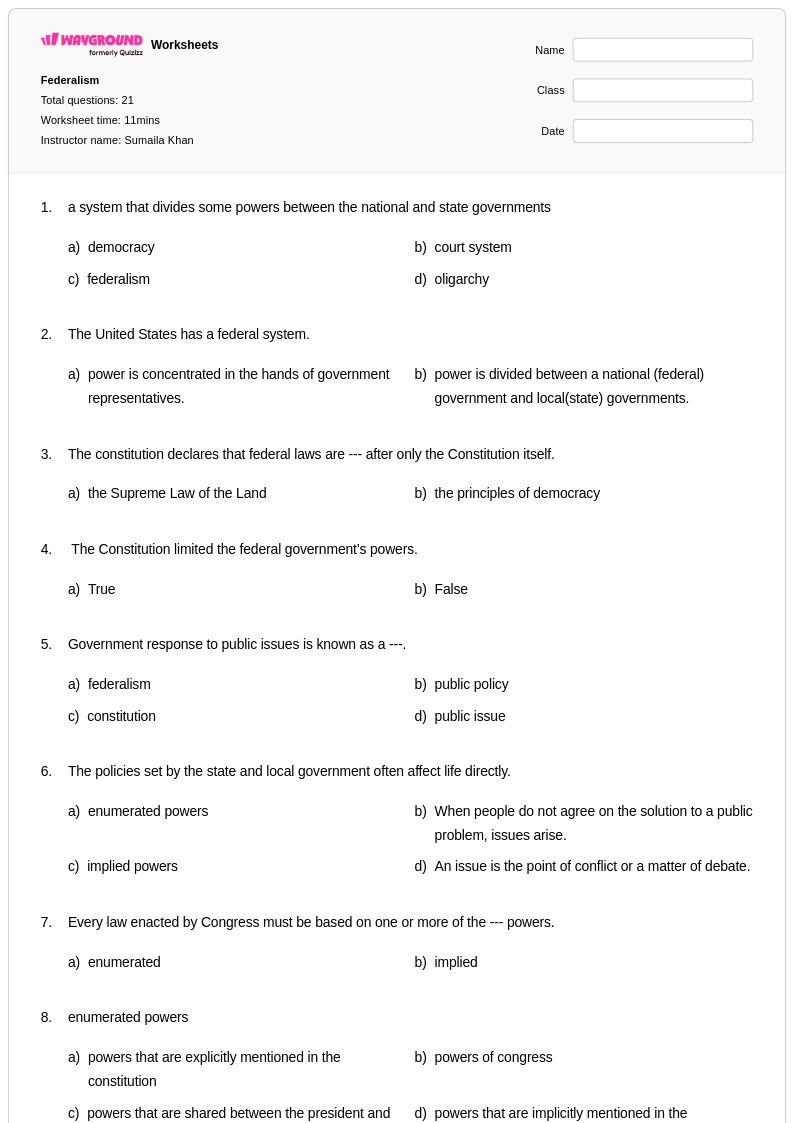
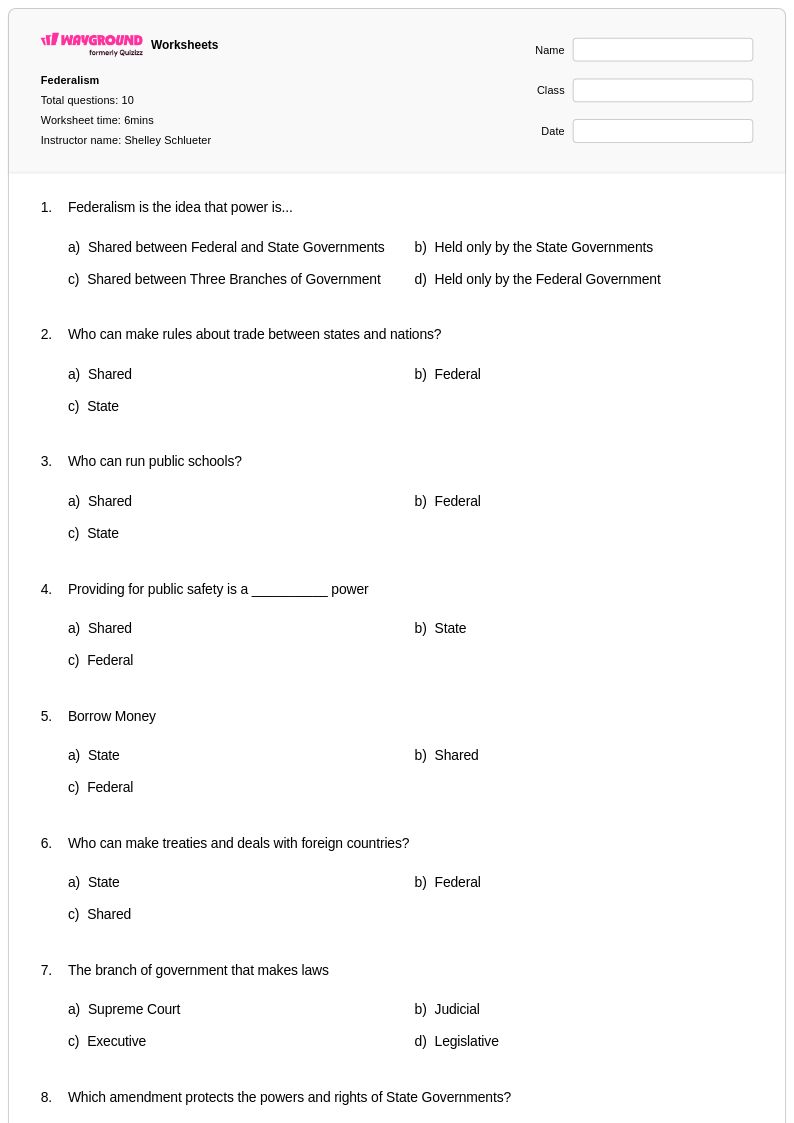
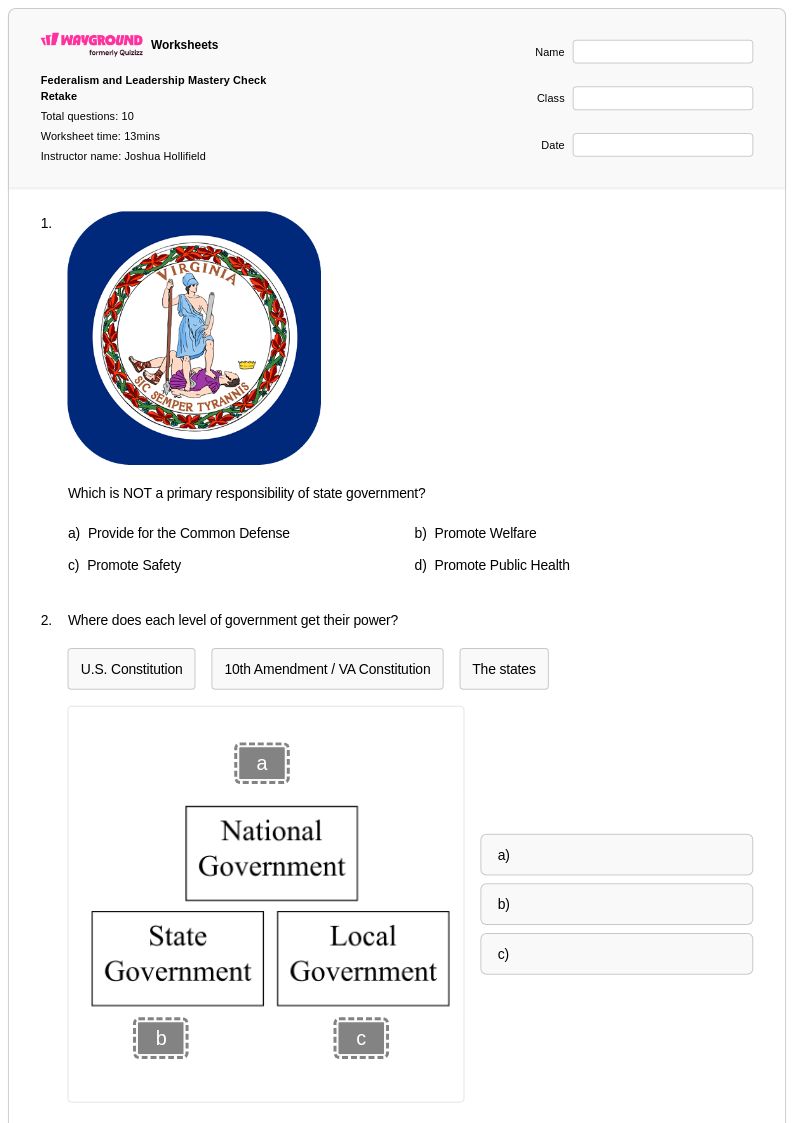
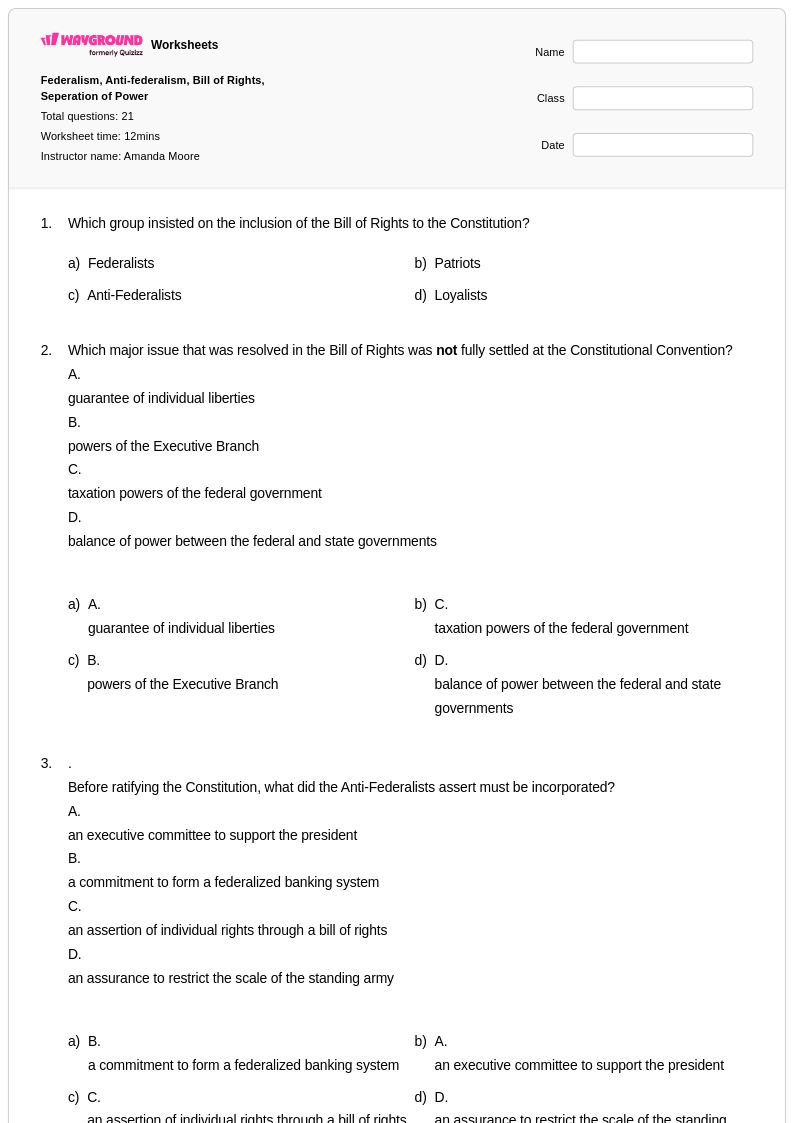
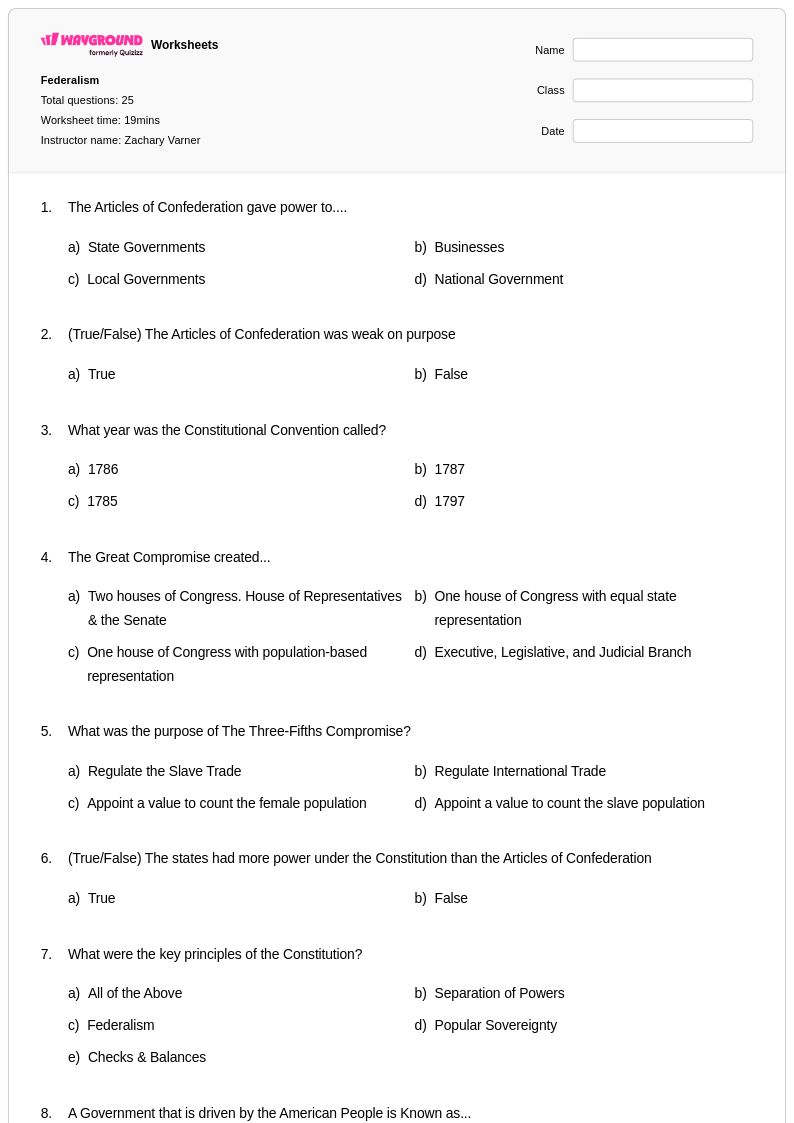
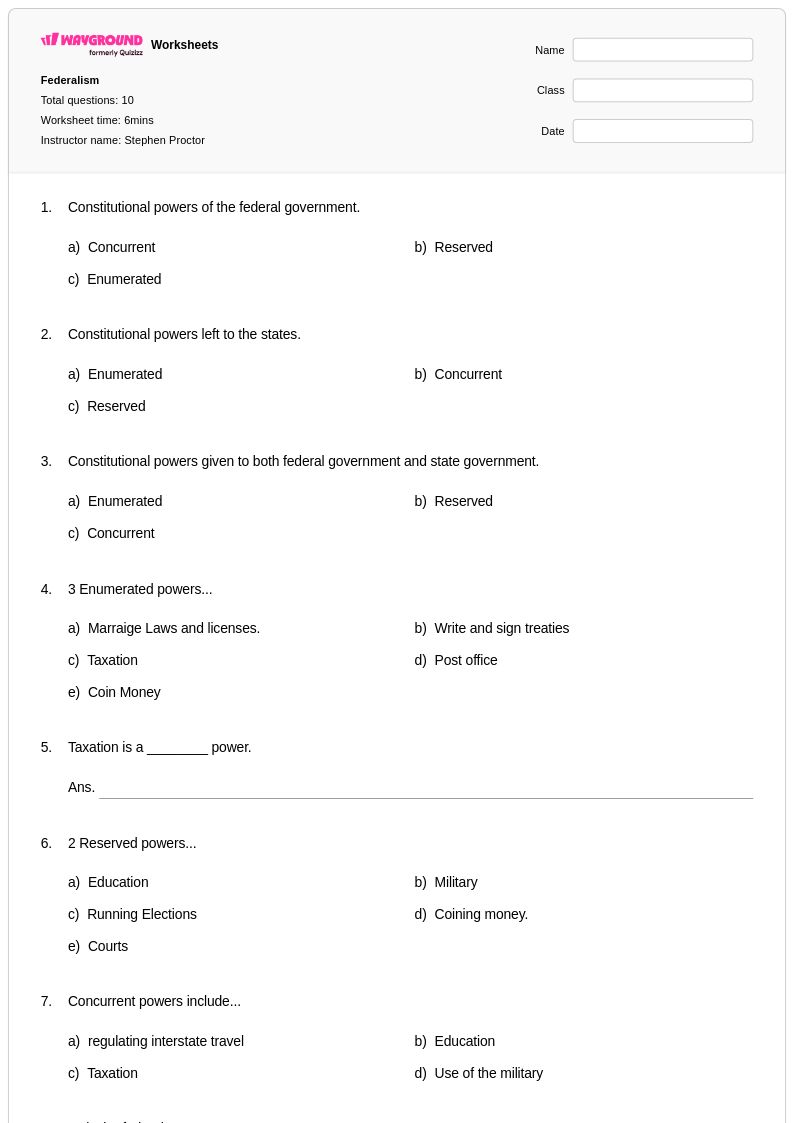
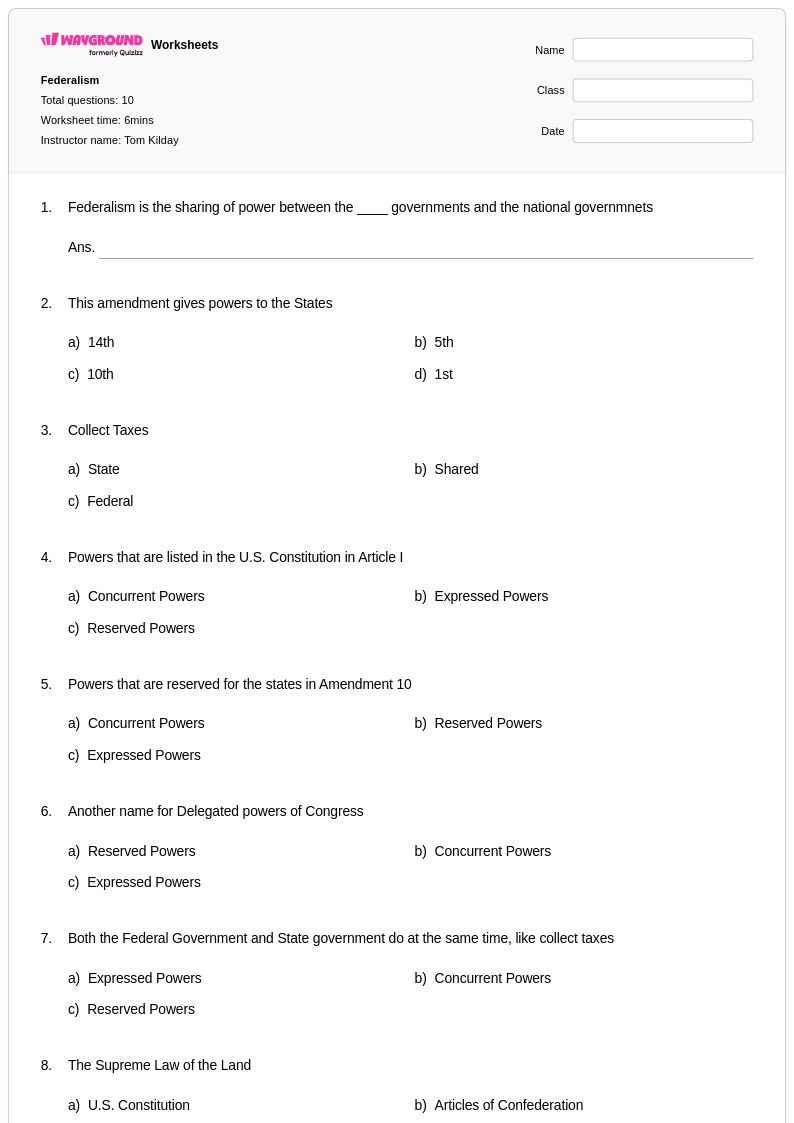
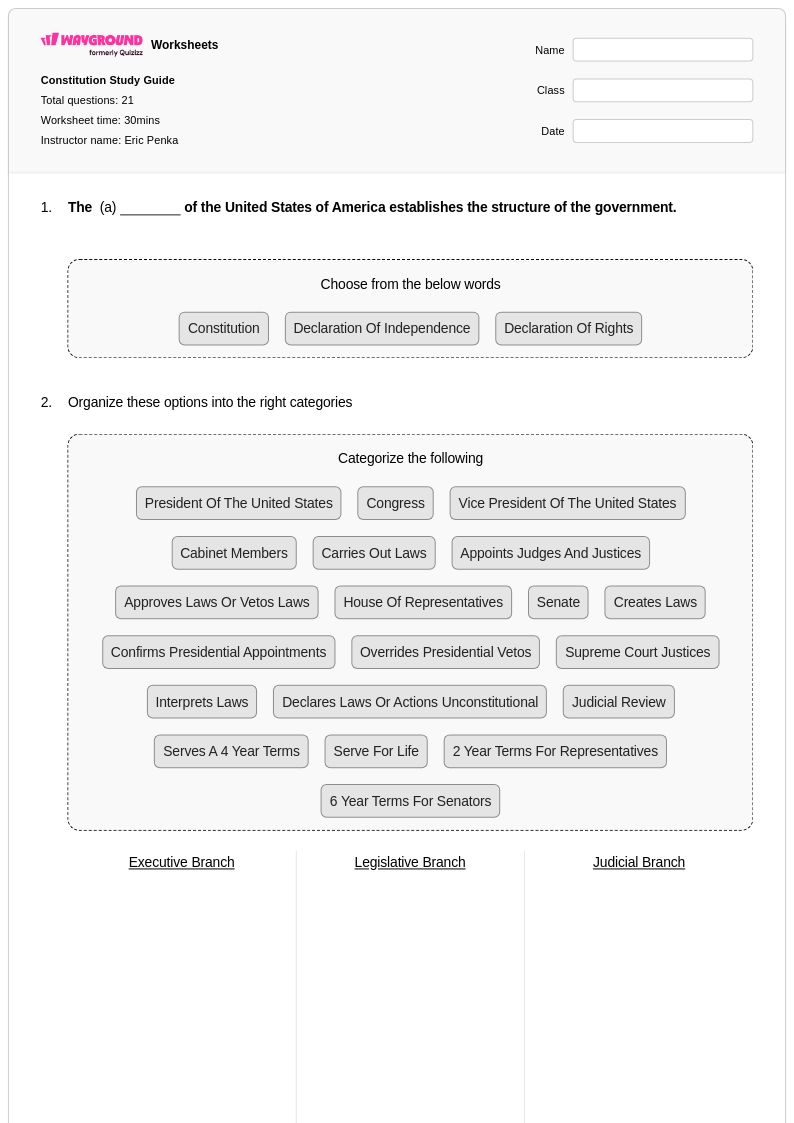
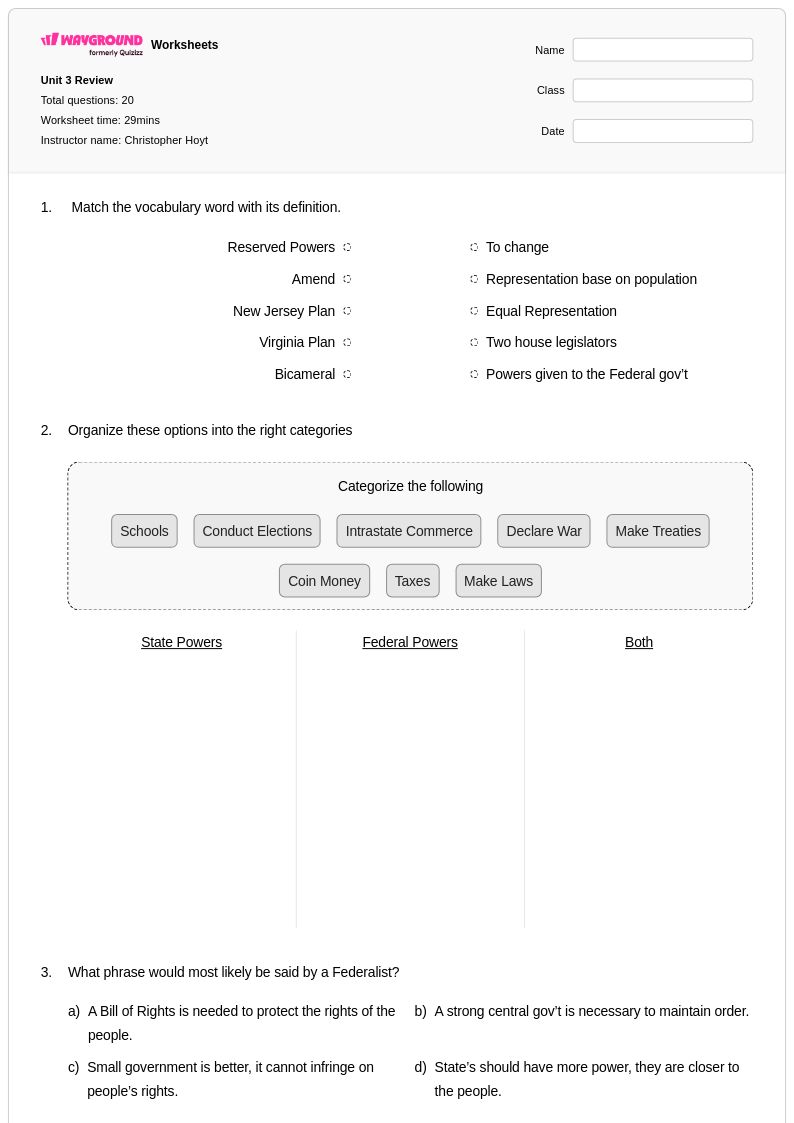
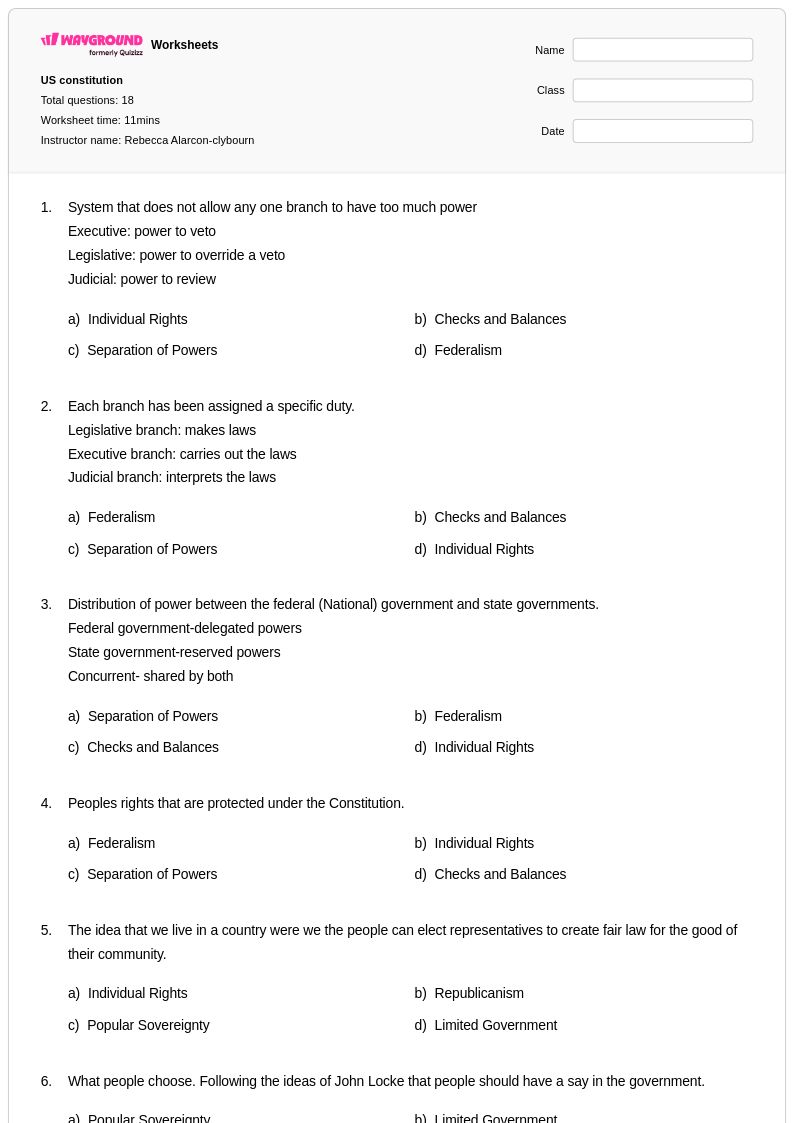
Grade 8 federalism worksheets from Wayground help students master the division of powers between federal and state governments through engaging printables, practice problems, and comprehensive answer keys.
Explore printable Federalism worksheets for Grade 8
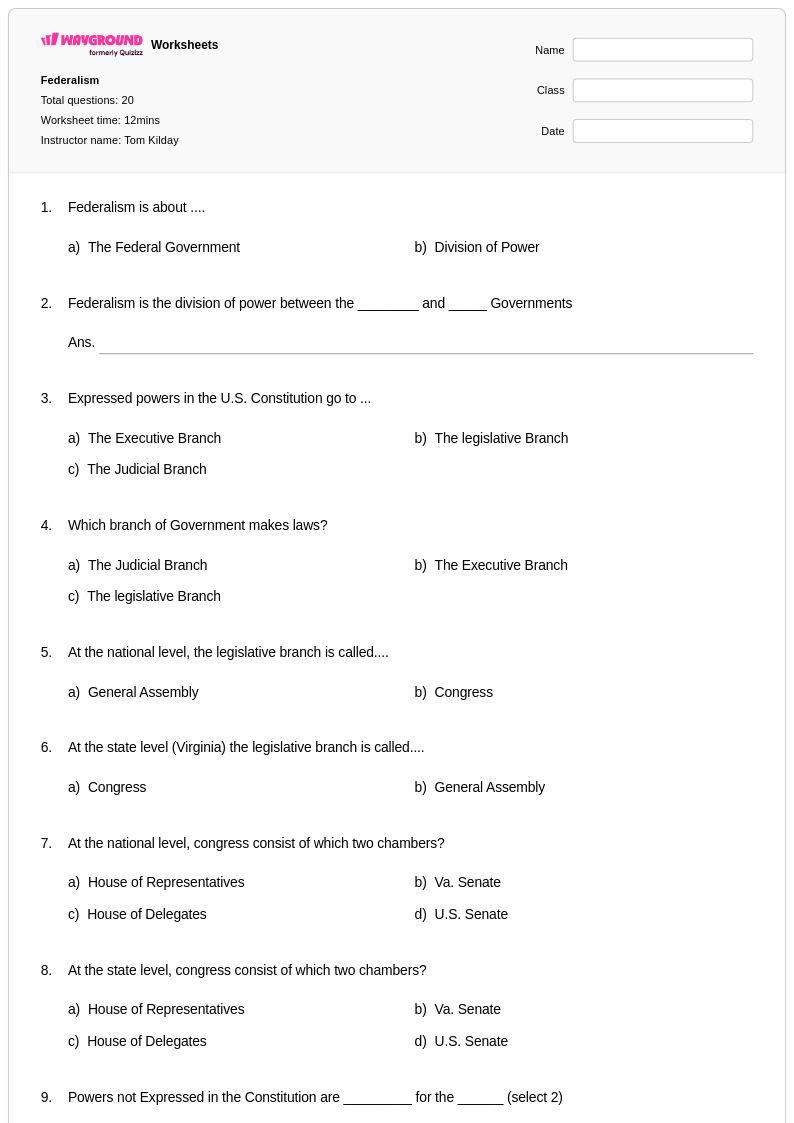
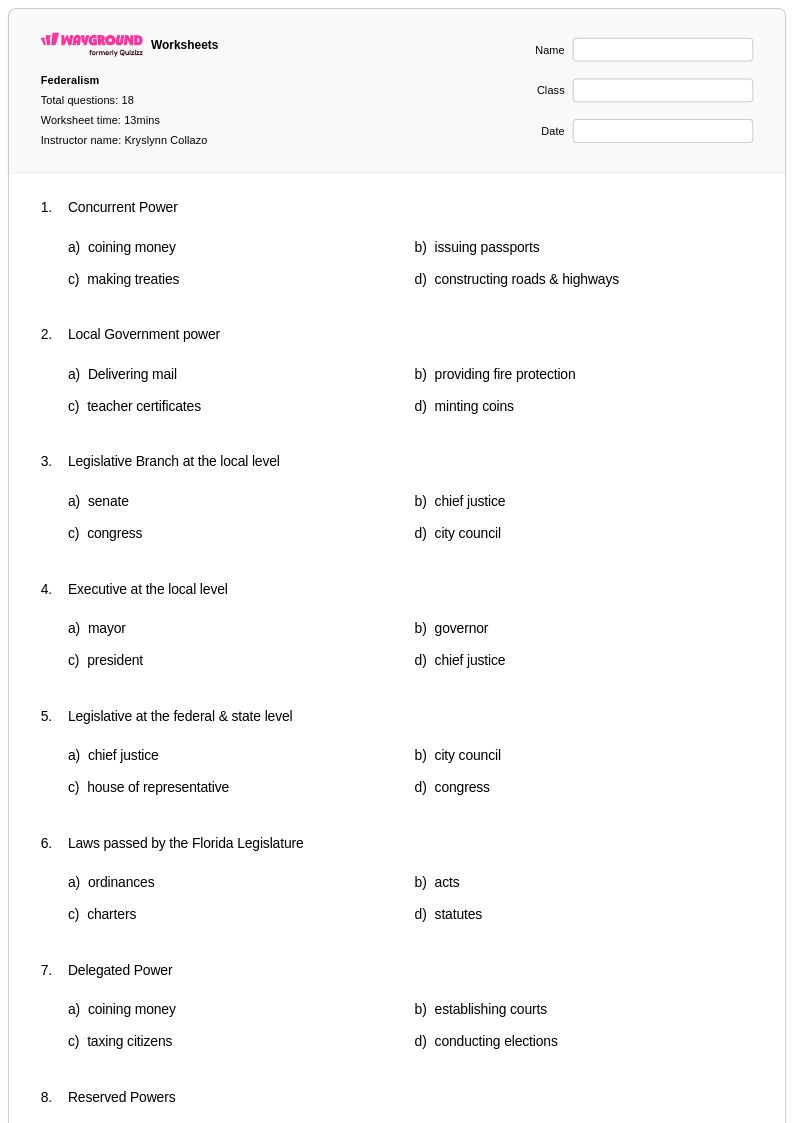
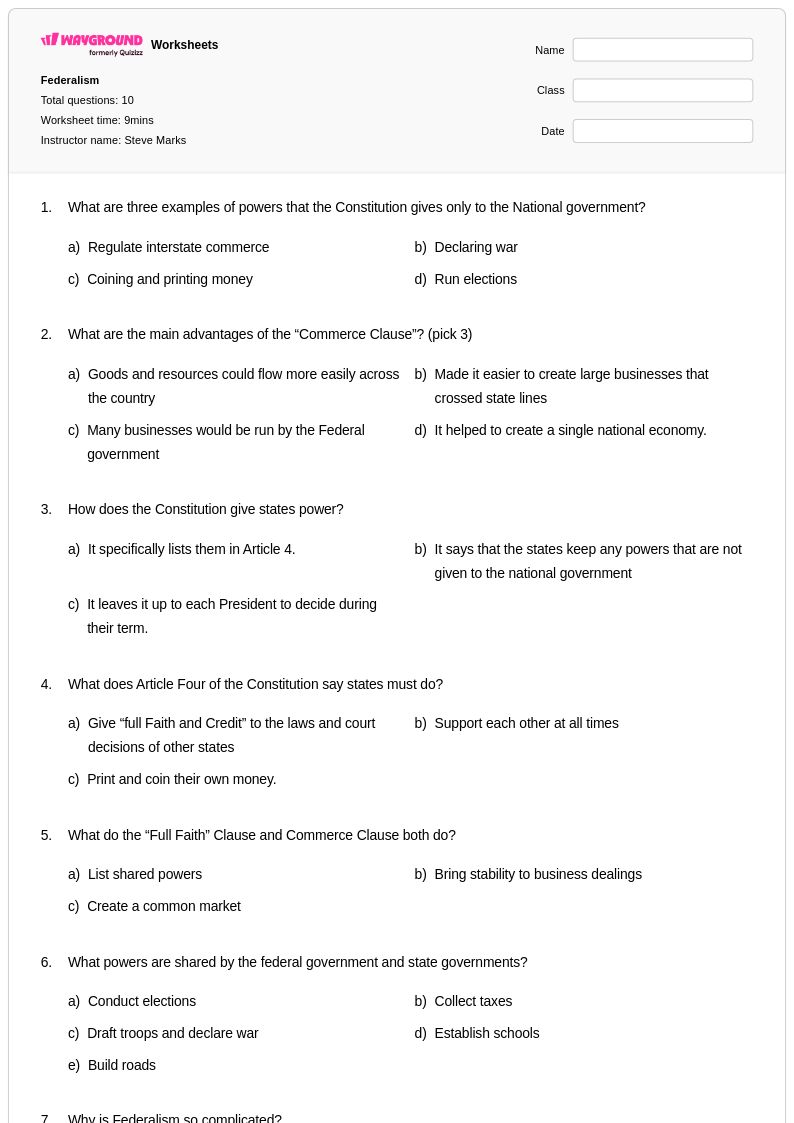
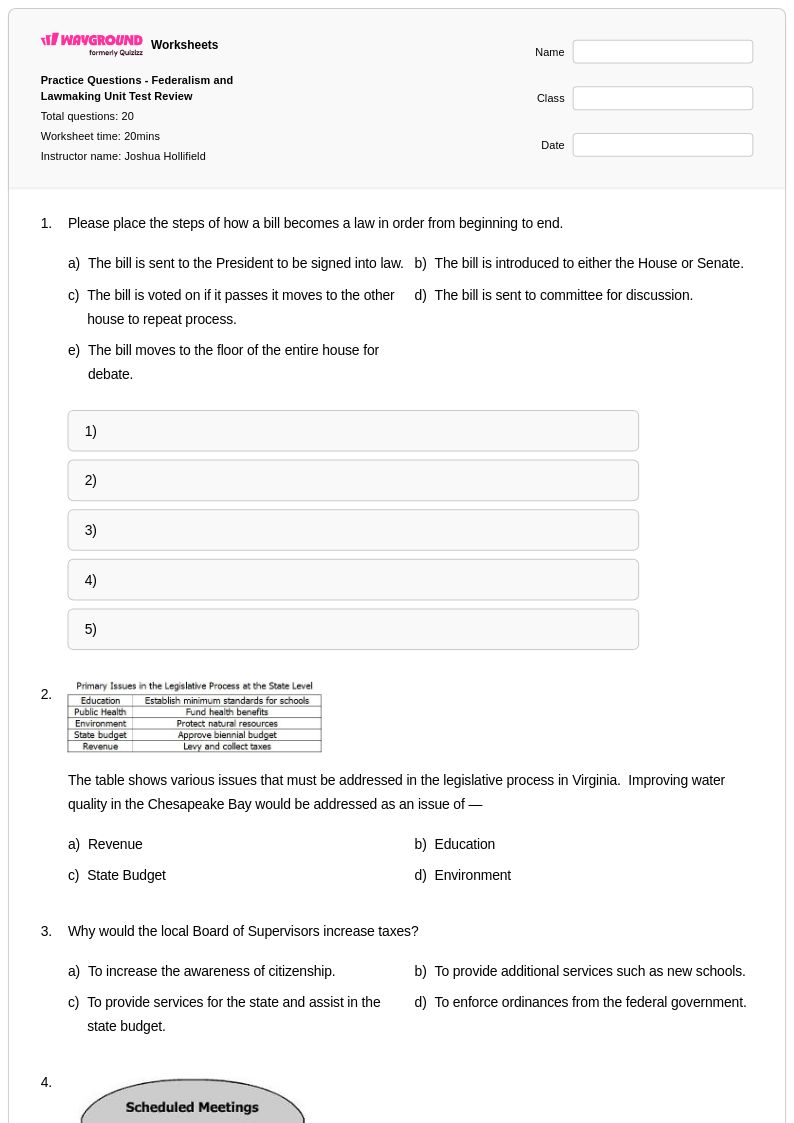
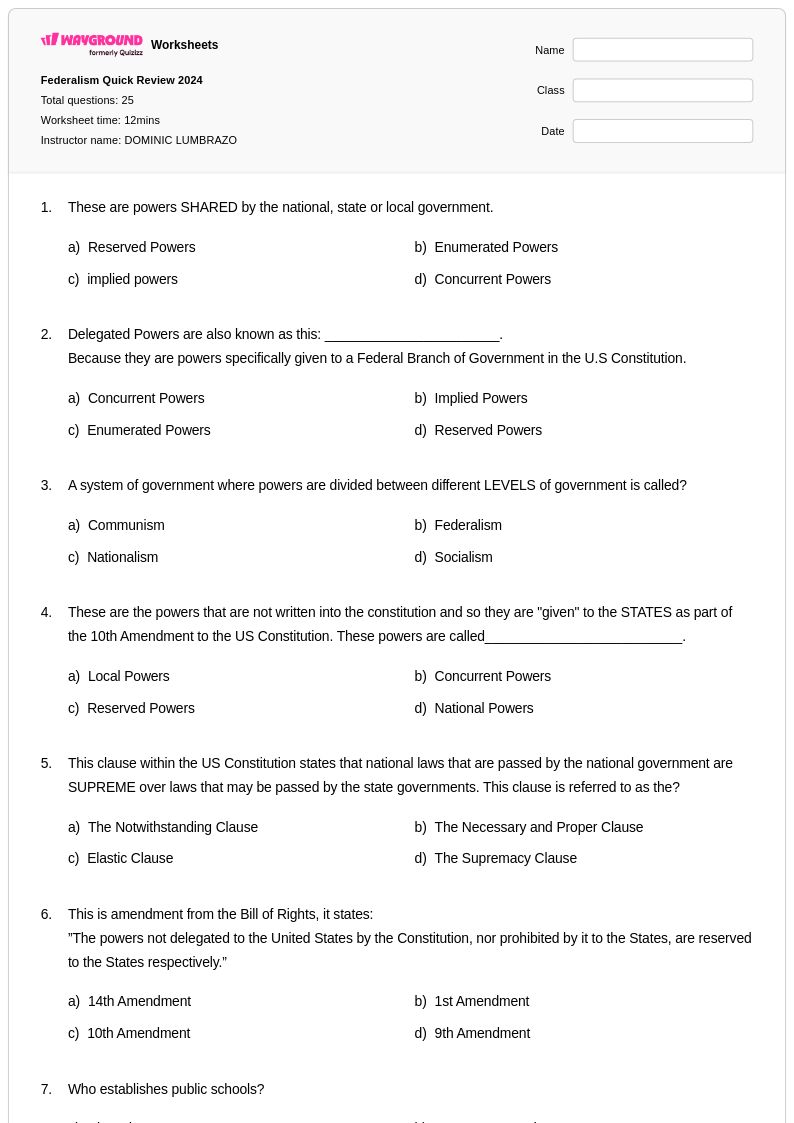
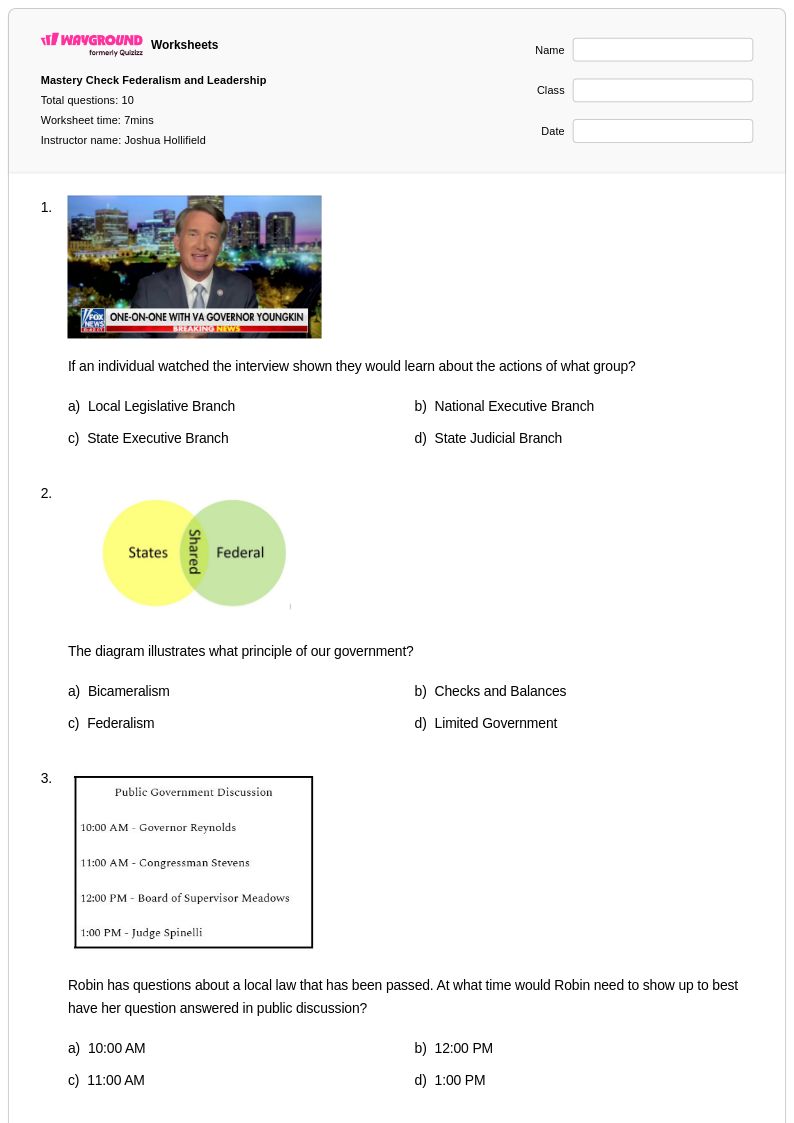
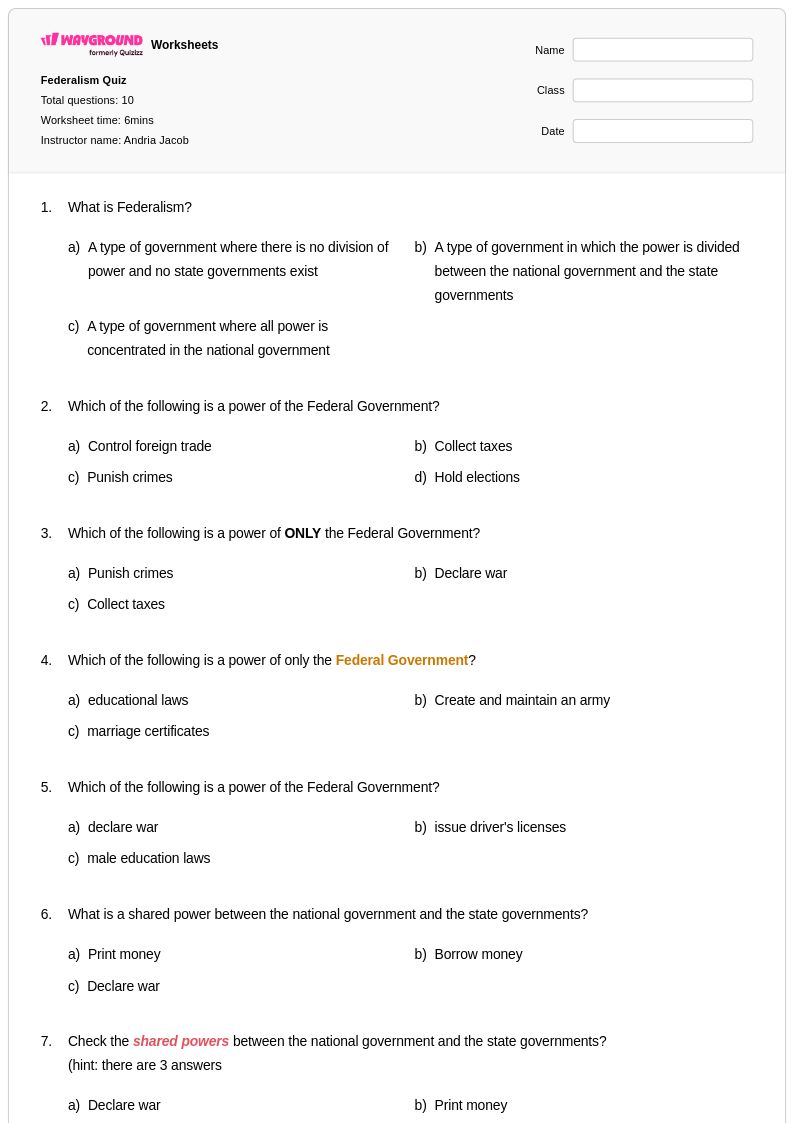
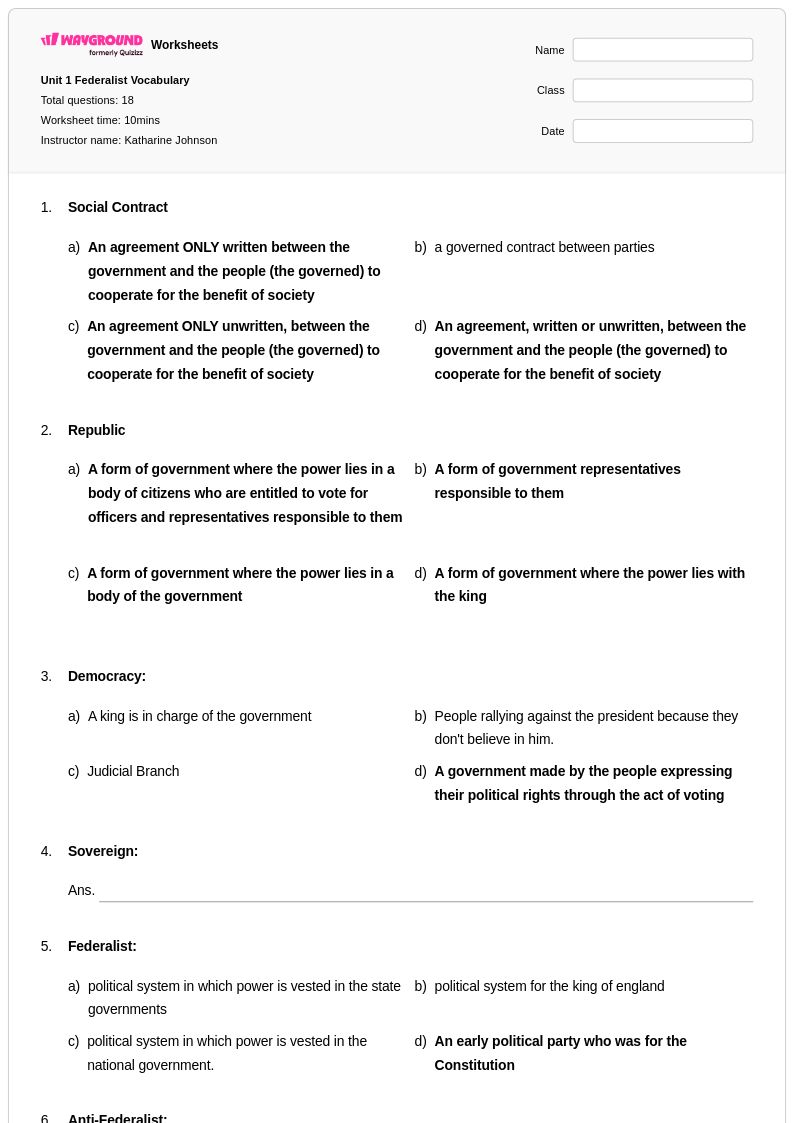
Federalism worksheets for Grade 8 students available through Wayground (formerly Quizizz) provide comprehensive coverage of the division of powers between federal and state governments in the United States. These educational resources strengthen students' understanding of constitutional principles, helping them analyze how authority is shared across different levels of government and examine real-world applications of federalism in action. The worksheets include practice problems that challenge students to identify federal versus state responsibilities, evaluate the supremacy clause, and explore concepts like dual federalism and cooperative federalism. Each printable resource comes with detailed answer keys that support both independent study and classroom instruction, while free pdf formats ensure accessibility for diverse learning environments.
Wayground (formerly Quizizz) empowers educators with millions of teacher-created federalism resources that support effective Grade 8 civics instruction through robust search and filtering capabilities aligned with social studies standards. Teachers can easily differentiate instruction by selecting from worksheets that range from foundational concept review to advanced constitutional analysis, with flexible customization options that allow educators to modify content based on individual student needs. The platform's comprehensive collection is available in both printable and digital formats, including downloadable pdfs, making lesson planning efficient whether teachers need materials for remediation, enrichment activities, or regular skill practice. This extensive resource library enables educators to seamlessly integrate federalism concepts into their curriculum while providing students with varied opportunities to master this fundamental aspect of American government.
FAQs
How do I teach federalism to students?
Teaching federalism effectively starts with clearly distinguishing the three types of governmental powers: enumerated (delegated) powers held by the federal government, reserved powers held by the states, and concurrent powers shared by both. Use real-world examples like interstate highway funding, marijuana legislation, and education policy to show students how the division of power plays out in practice. Anchoring lessons to the Supremacy Clause and the Tenth Amendment helps students understand the constitutional framework that governs federal-state conflicts.
What are common misconceptions students have about federalism?
A frequent misconception is that the federal government holds unlimited authority over states, when in fact the Constitution explicitly reserves powers to the states through the Tenth Amendment. Students also tend to confuse enumerated powers with implied powers, not recognizing that the Necessary and Proper Clause expands federal reach beyond what is explicitly listed. Another common error is treating federalism as a static system rather than an evolving relationship shaped by court decisions, legislation, and political change.
What exercises help students practice understanding the division of powers in federalism?
Scenario-based exercises are particularly effective, where students classify a given government action as federal, state, or concurrent and justify their reasoning using constitutional text. Graphic organizers that sort powers into Venn diagrams also reinforce the distinction between enumerated, reserved, and concurrent powers in a visual format. Practice problems involving real legislative examples, such as interstate commerce regulation or the Supremacy Clause in action, push students to apply concepts rather than simply recall definitions.
How do I use Wayground's federalism worksheets in my classroom?
Wayground's federalism worksheets are available as printable PDFs for traditional classroom use and in digital formats for technology-integrated or hybrid learning environments. Teachers can also host worksheets as a quiz directly on Wayground, making them suitable for both formative assessment and independent practice. The included answer keys support self-assessment and allow teachers to use the materials with minimal preparation time.
How do I differentiate federalism instruction for students with different learning needs?
For students who need additional support, reduce the complexity of scenarios by focusing first on clear-cut examples of federal versus state power before introducing concurrent or contested powers. On Wayground, teachers can apply individual accommodations such as read aloud, reduced answer choices, and extended time to specific students without alerting the rest of the class. These settings can be saved and reused across future sessions, making differentiation manageable at scale.
How does federalism connect to other civics and government topics?
Federalism is foundational to understanding separation of powers, checks and balances, and constitutional interpretation, making it a natural bridge topic in any government or civics unit. The concept also connects directly to Supreme Court cases, since landmark decisions like McCulloch v. Maryland and United States v. Lopez have reshaped the boundaries of federal and state authority over time. Students who understand federalism are better equipped to analyze policy debates, legislative conflicts, and the structural logic of the U.S. Constitution.