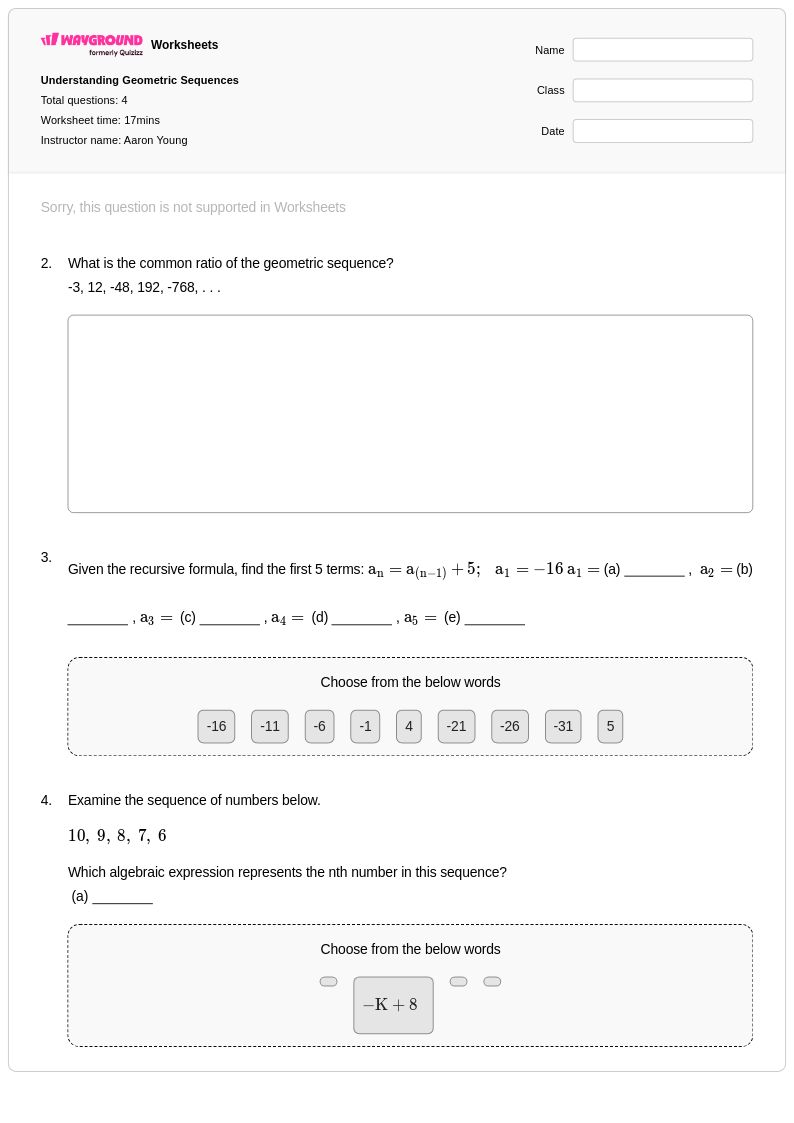
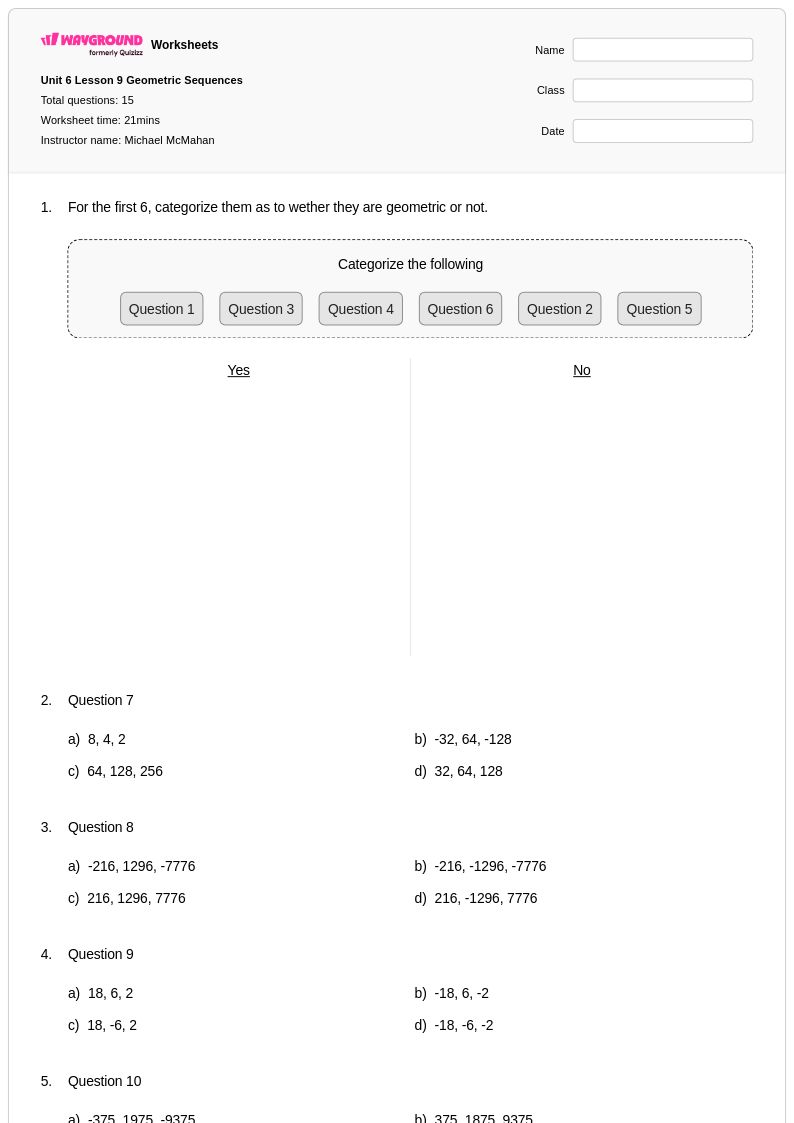
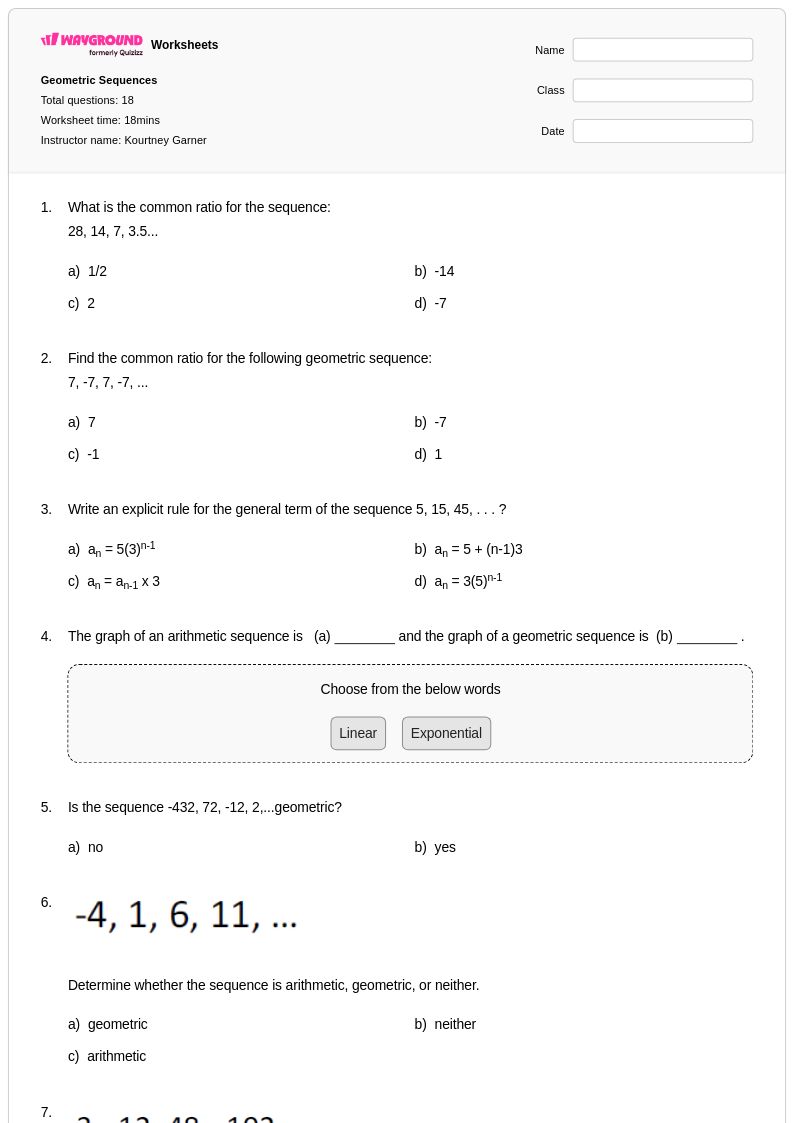
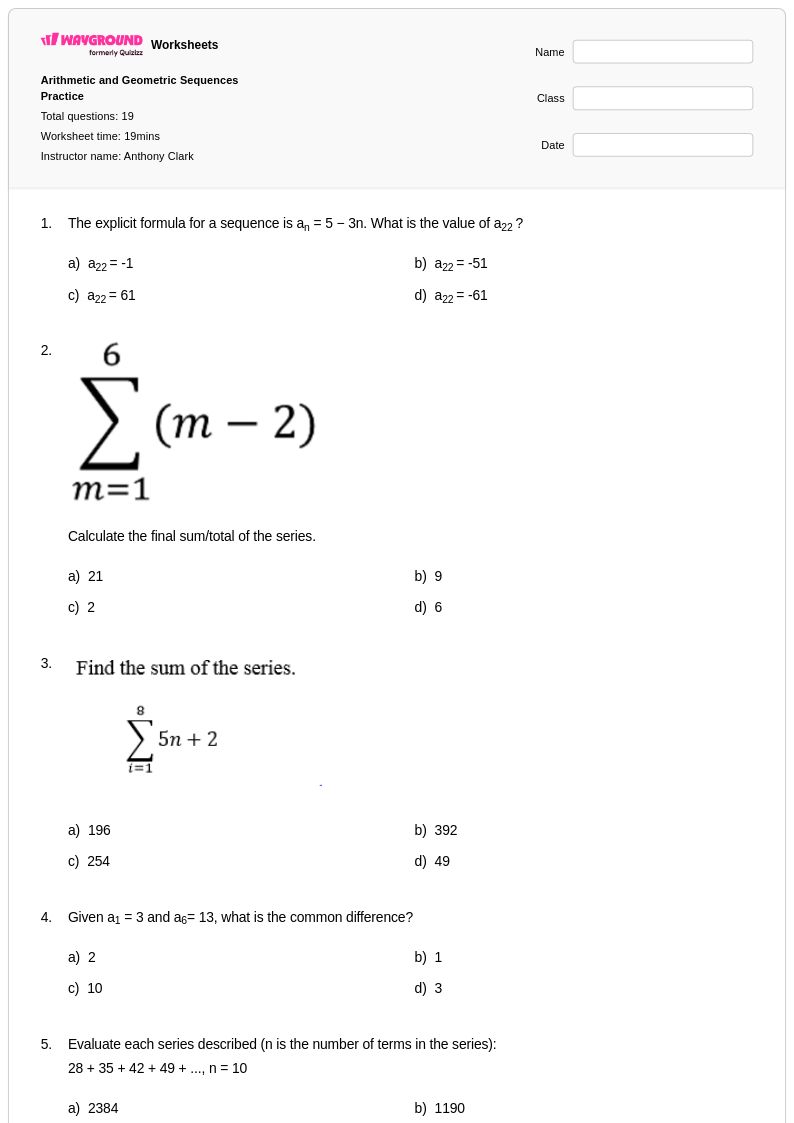
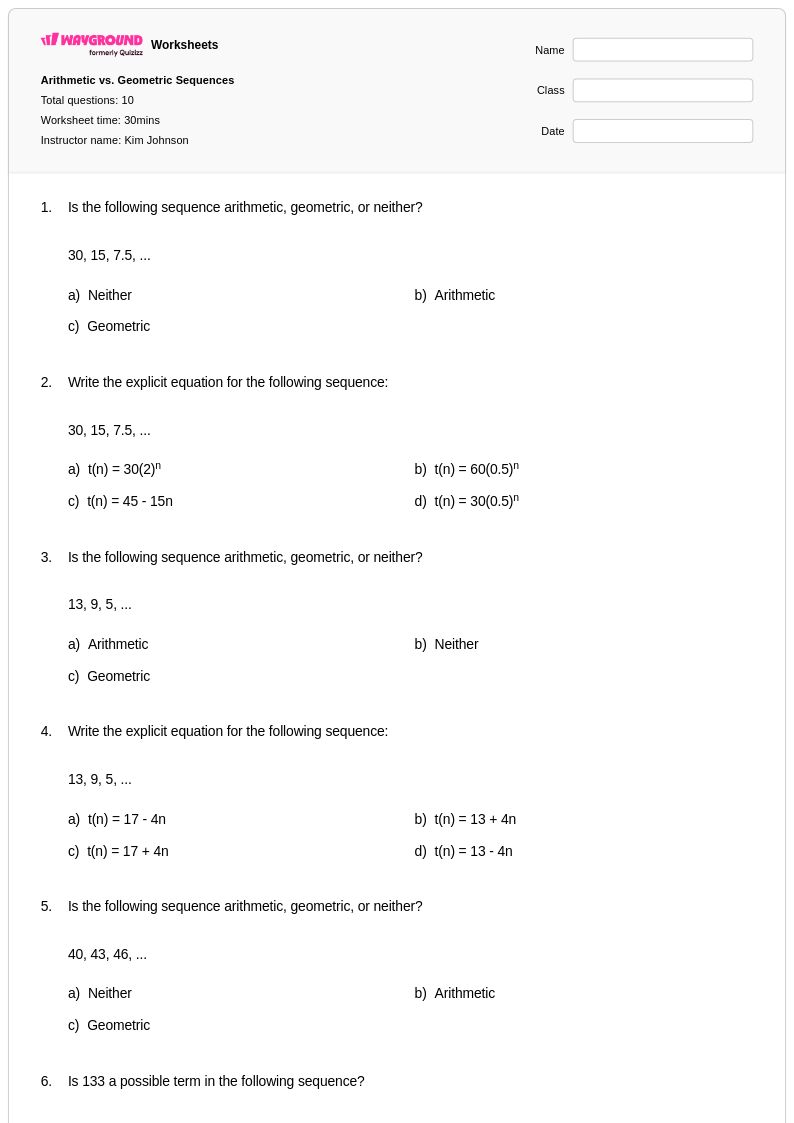
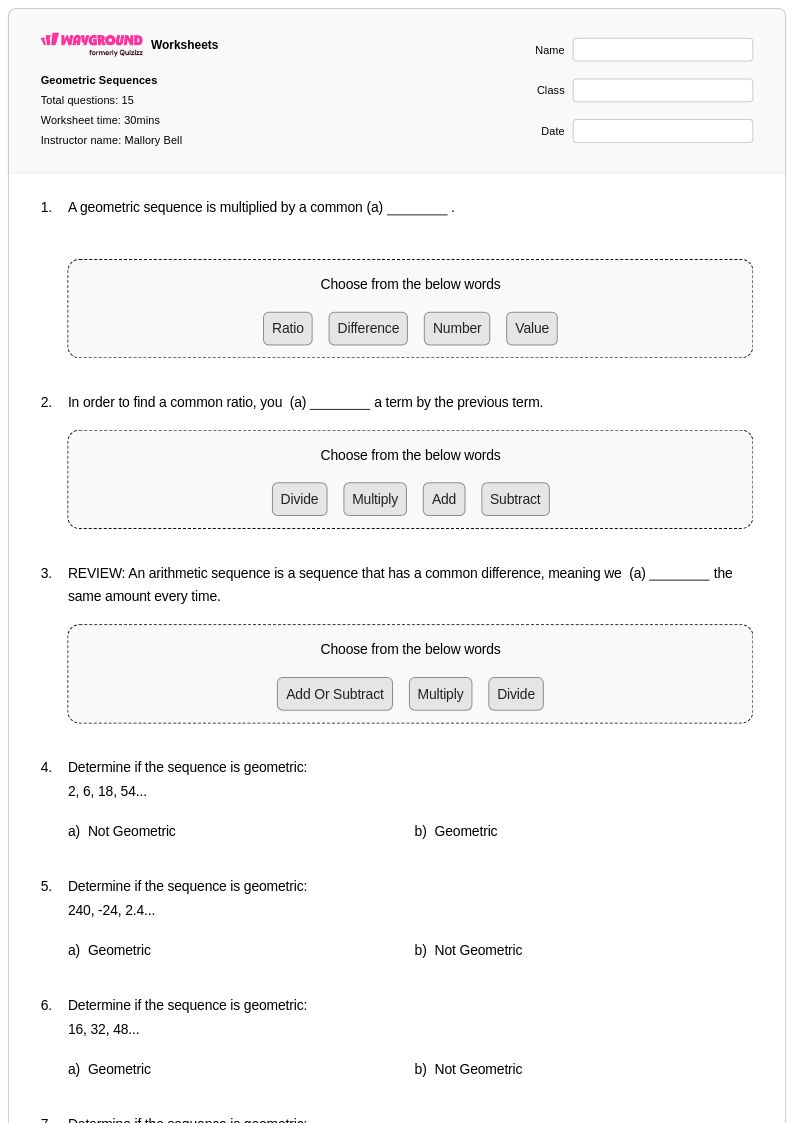
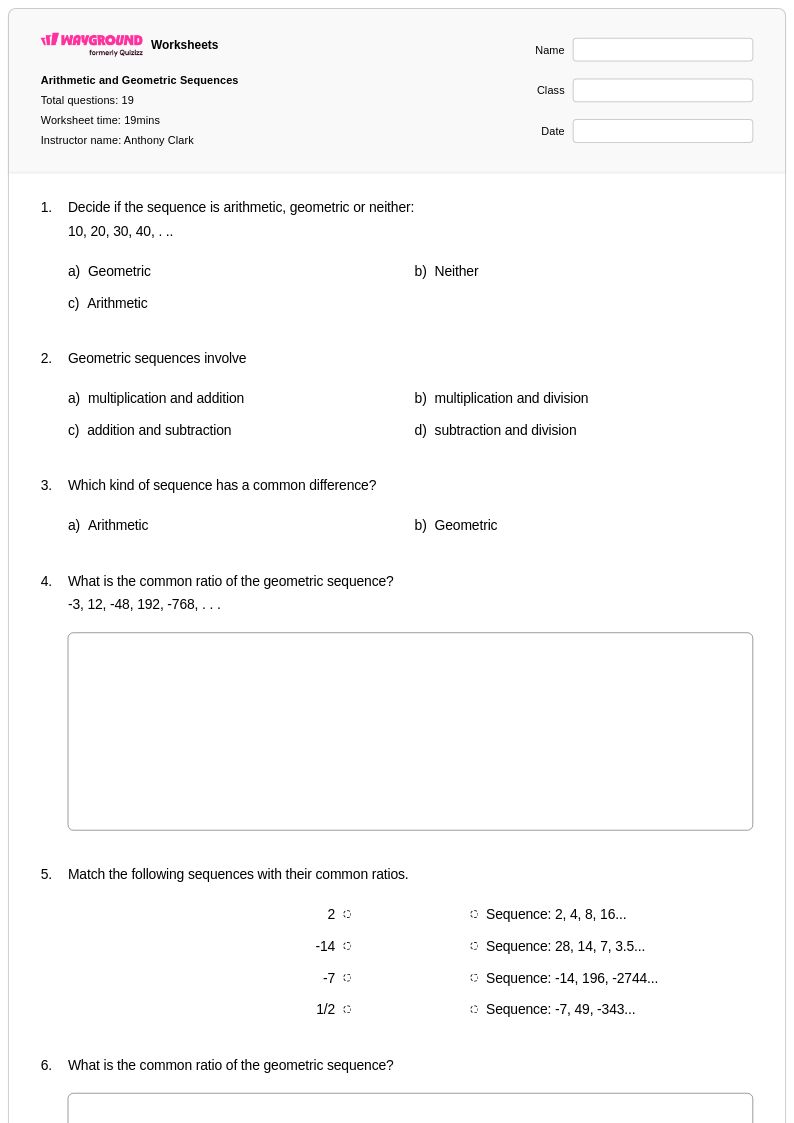
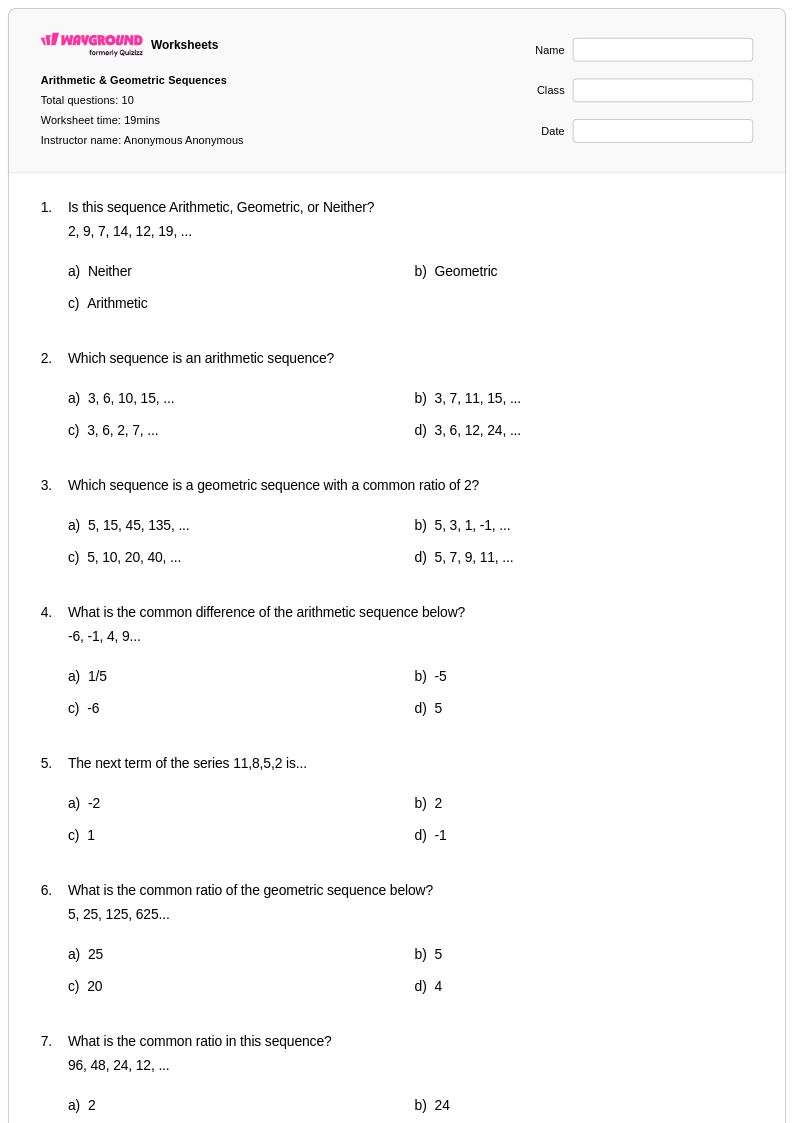
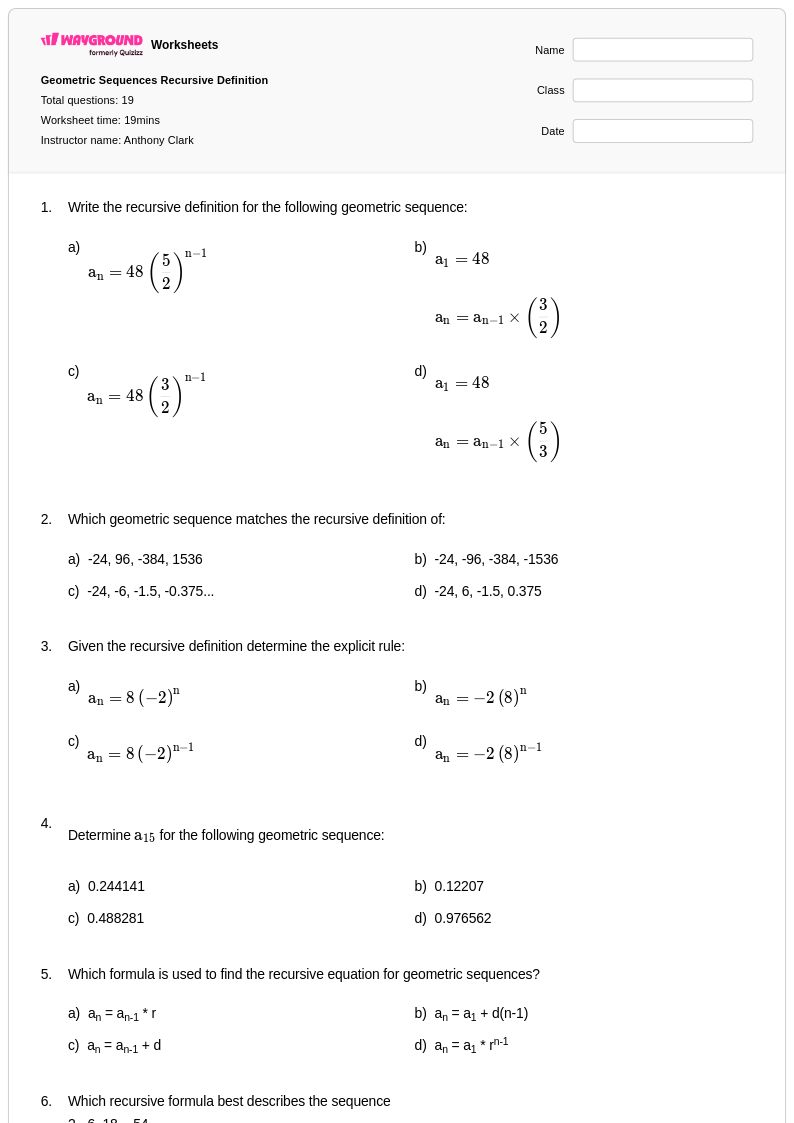
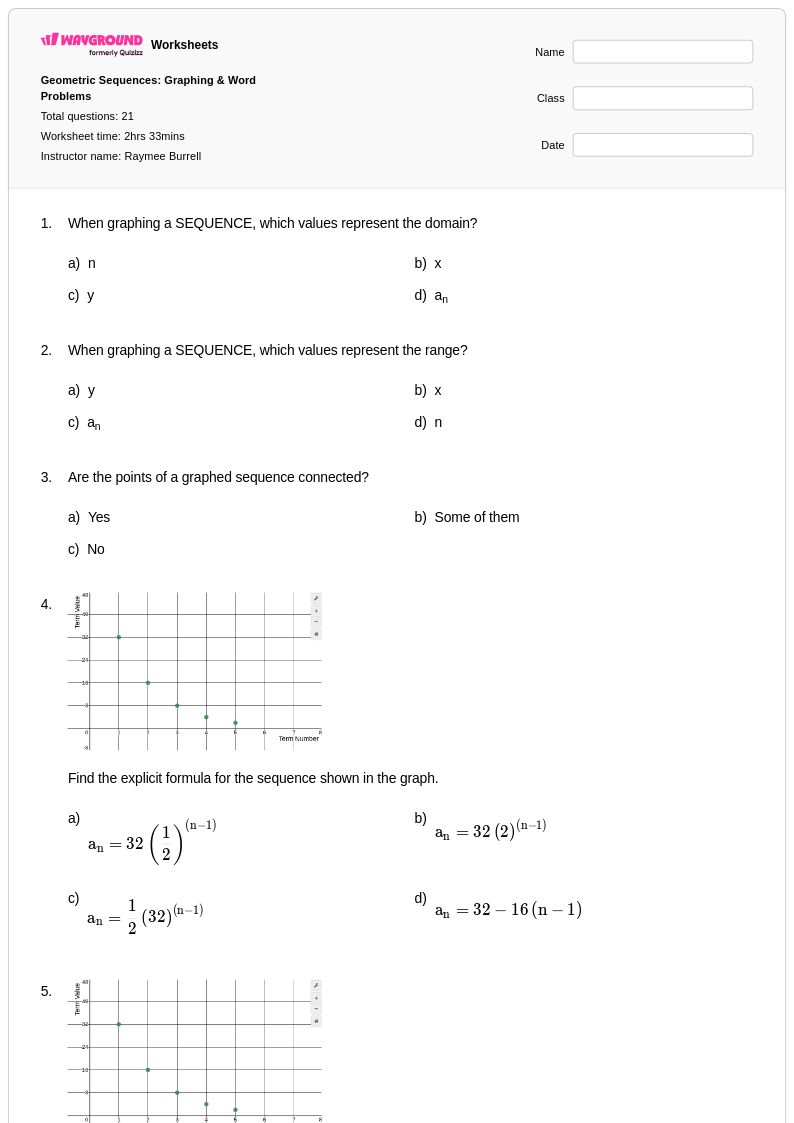
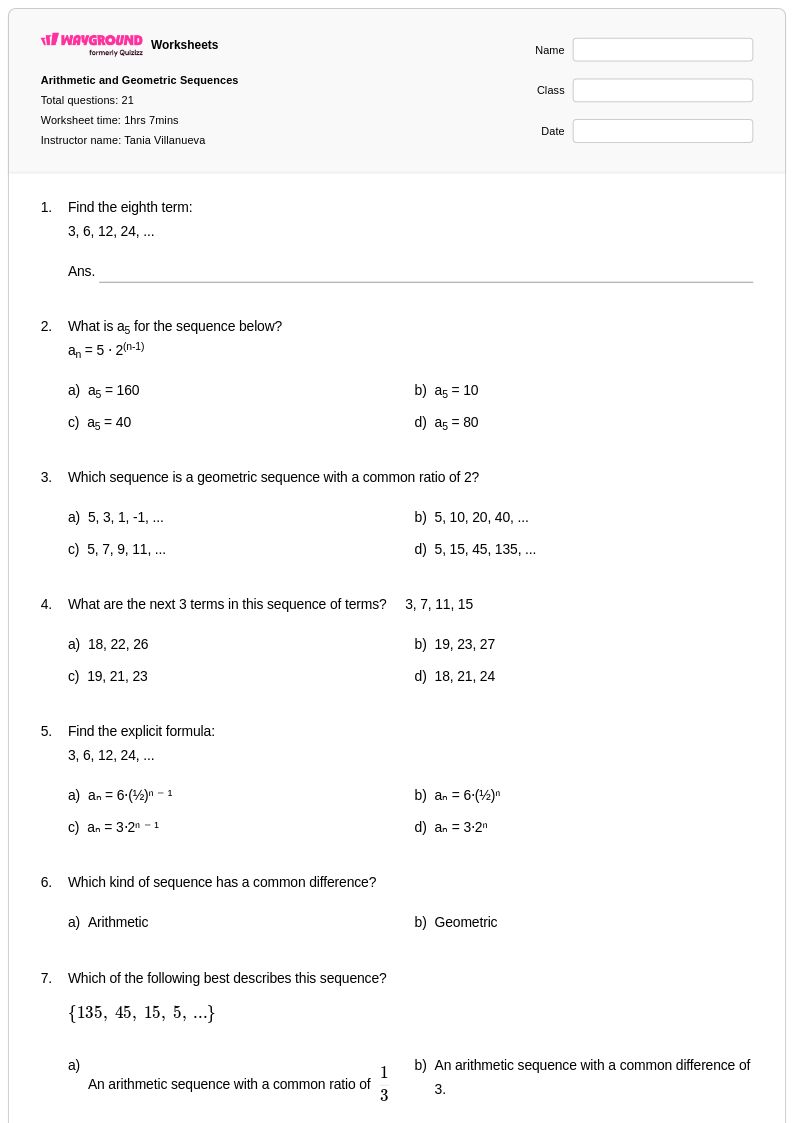
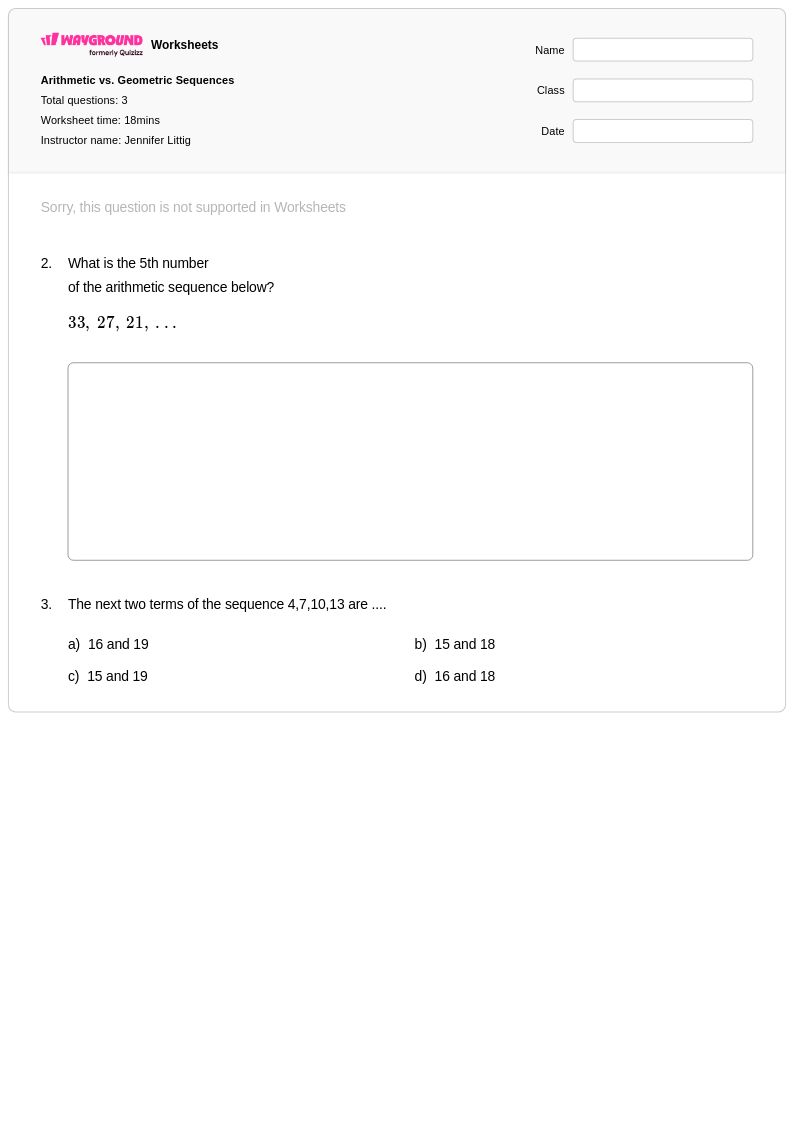
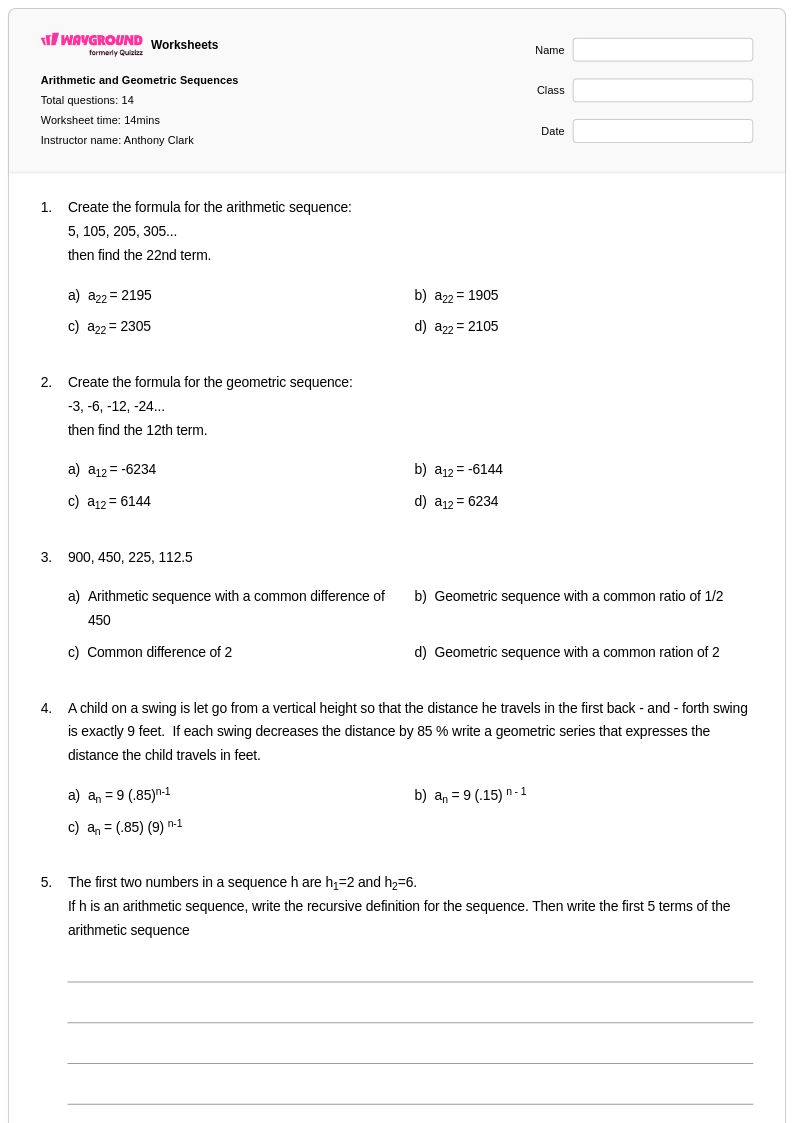
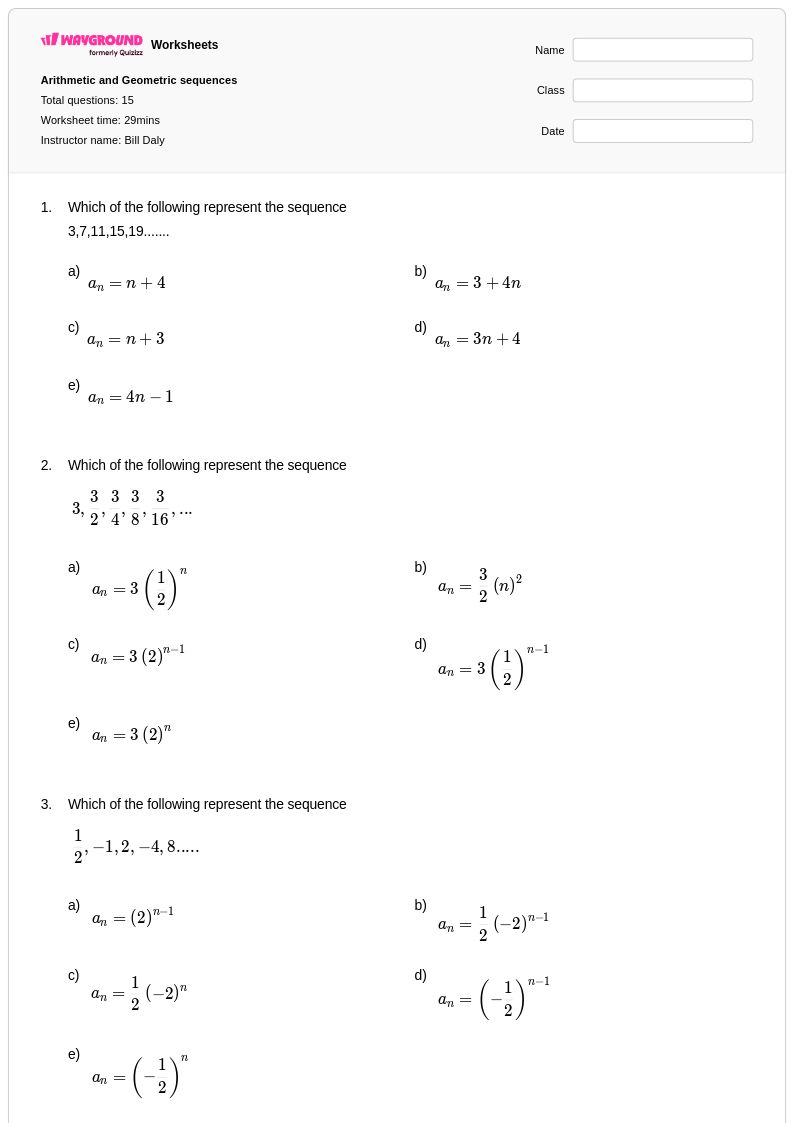
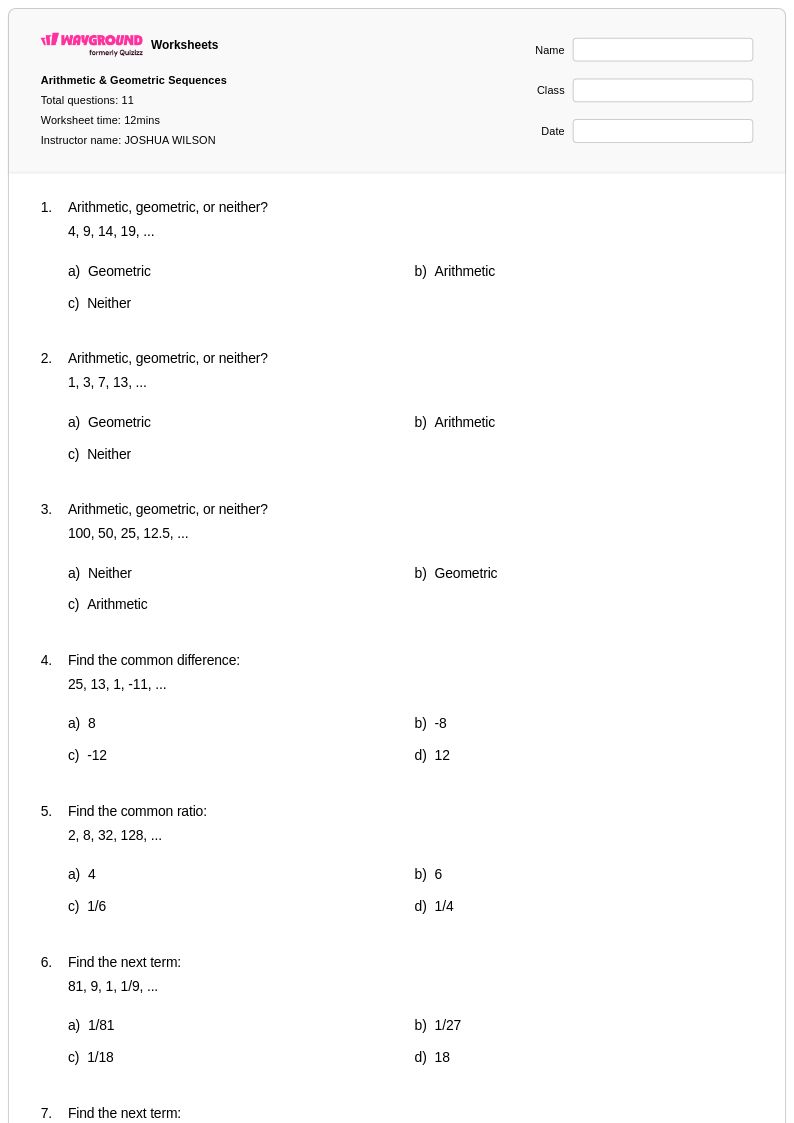
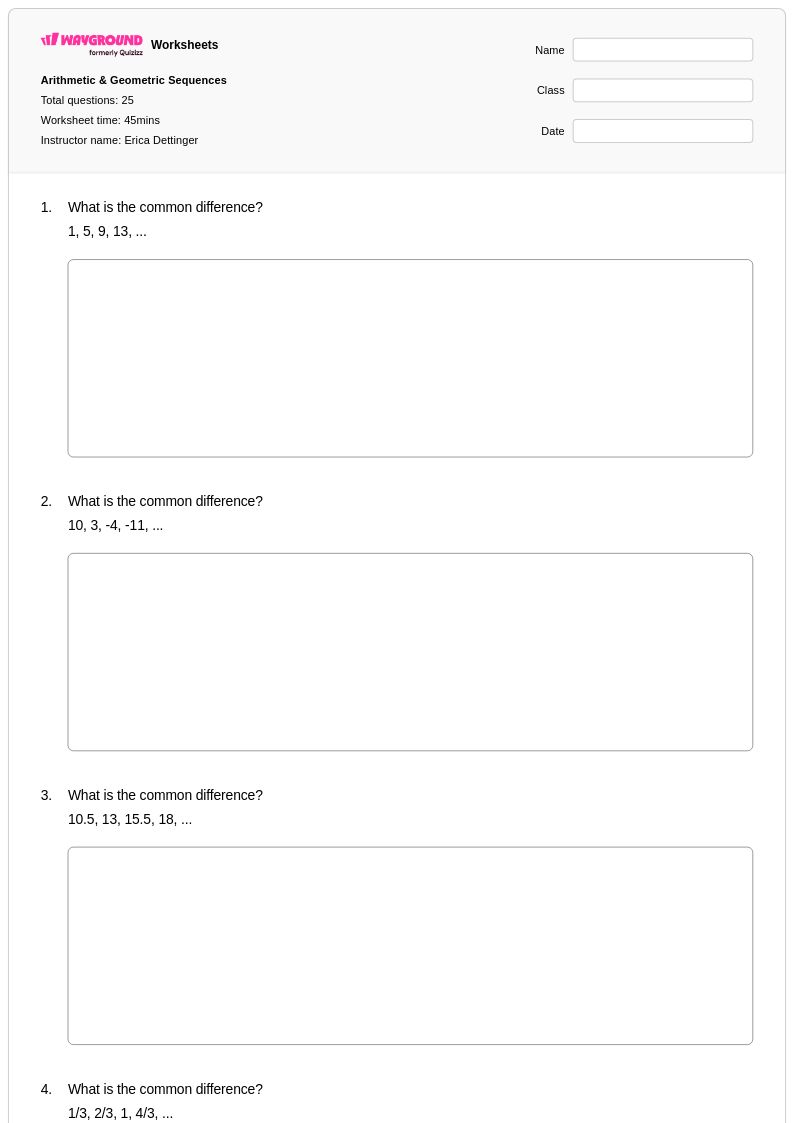
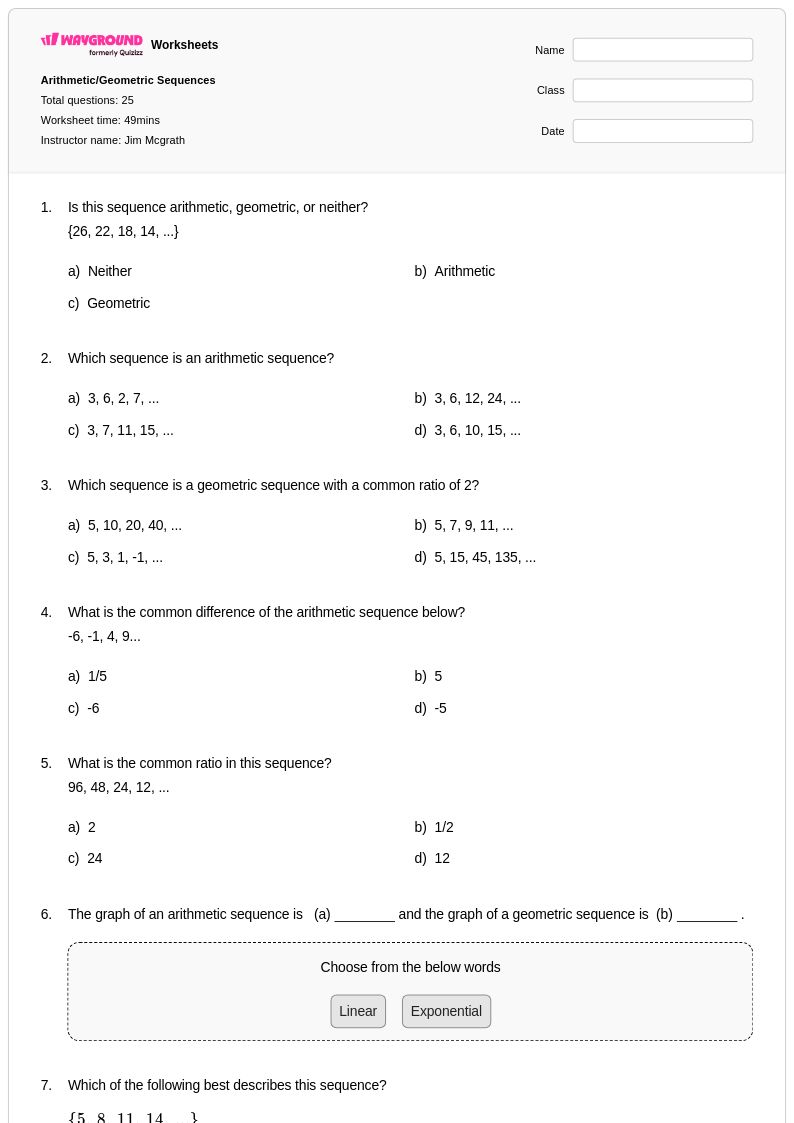
Wayground's free geometric sequences worksheets and printables help students master identifying patterns, finding common ratios, and calculating terms through comprehensive practice problems with detailed answer keys.
Geometric sequences worksheets from Wayground (formerly Quizizz) provide comprehensive practice opportunities for students to master the fundamental concepts of exponential patterns and multiplicative relationships. These carefully crafted educational resources help students develop essential skills in identifying common ratios, finding specific terms using explicit formulas, and calculating the sum of finite geometric series. Each worksheet includes a complete answer key and is available as a free printable pdf, making it easy for educators to incorporate these practice problems into both classroom instruction and independent study sessions. Students work through progressively challenging exercises that strengthen their ability to recognize geometric patterns in real-world contexts, apply the geometric sequence formula, and solve complex problems involving growth and decay scenarios.
Wayground's extensive collection of geometric sequences worksheets draws from millions of teacher-created resources, offering educators unparalleled variety and quality in their instructional materials. The platform's advanced search and filtering capabilities enable teachers to quickly locate worksheets aligned with specific learning standards and differentiated for various skill levels, supporting effective lesson planning and targeted remediation strategies. These customizable resources are available in both printable pdf format and interactive digital versions, allowing for flexible implementation across diverse learning environments. Teachers can easily modify existing worksheets or combine multiple resources to create comprehensive practice sets that address individual student needs, whether for foundational skill building, enrichment activities, or intensive review sessions before assessments.
FAQs
How do I introduce geometric sequences to students?
Start with a simple, relatable pattern, like a social media post that gets shared and then re-shared. Ask students to describe the rule for how it spreads. This helps them discover the core idea of a 'common ratio'—a constant multiplier—before you introduce formal terms like 'explicit formula' or 'geometric series'.
What types of problems help students practice geometric sequences?
Effective practice includes a mix of skill-building and application. Start with exercises for identifying the common ratio and finding the next term. Then, progress to using the explicit formula to find a specific term (e.g., the 10th term). Finally, introduce real-world scenarios involving exponential growth or decay, such as compound interest or population decline.
What are common student errors when working with geometric sequences?
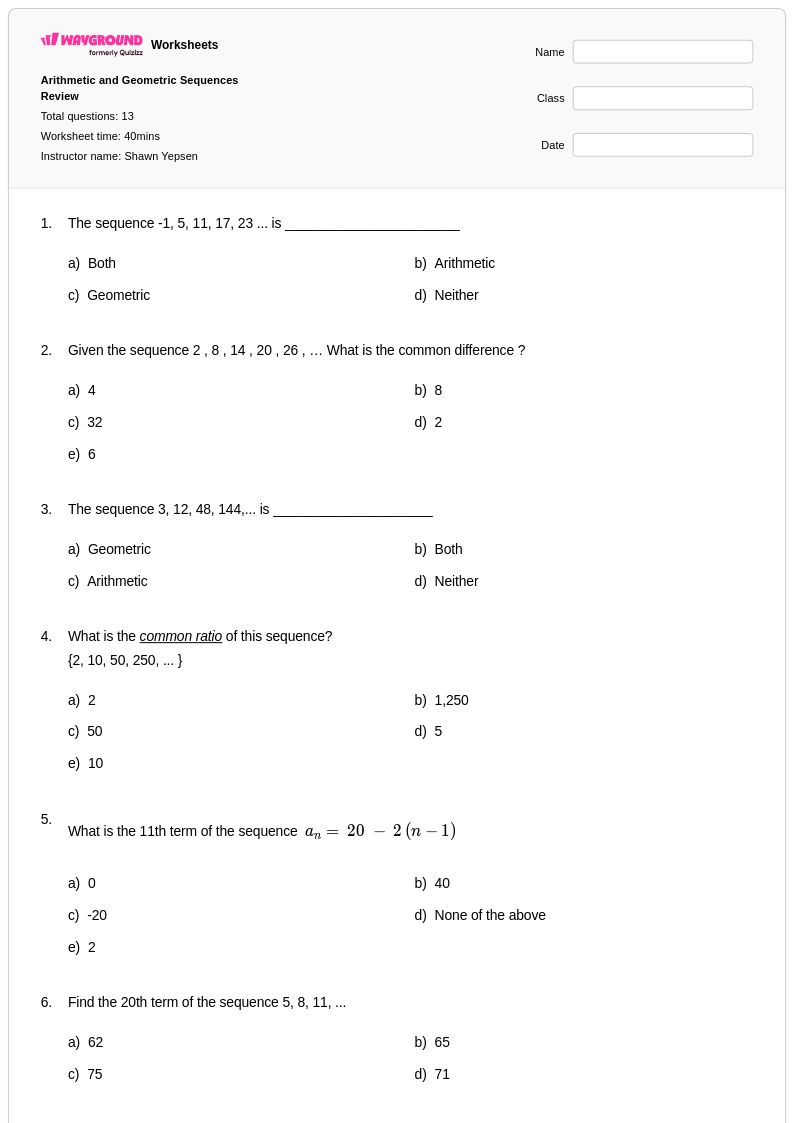
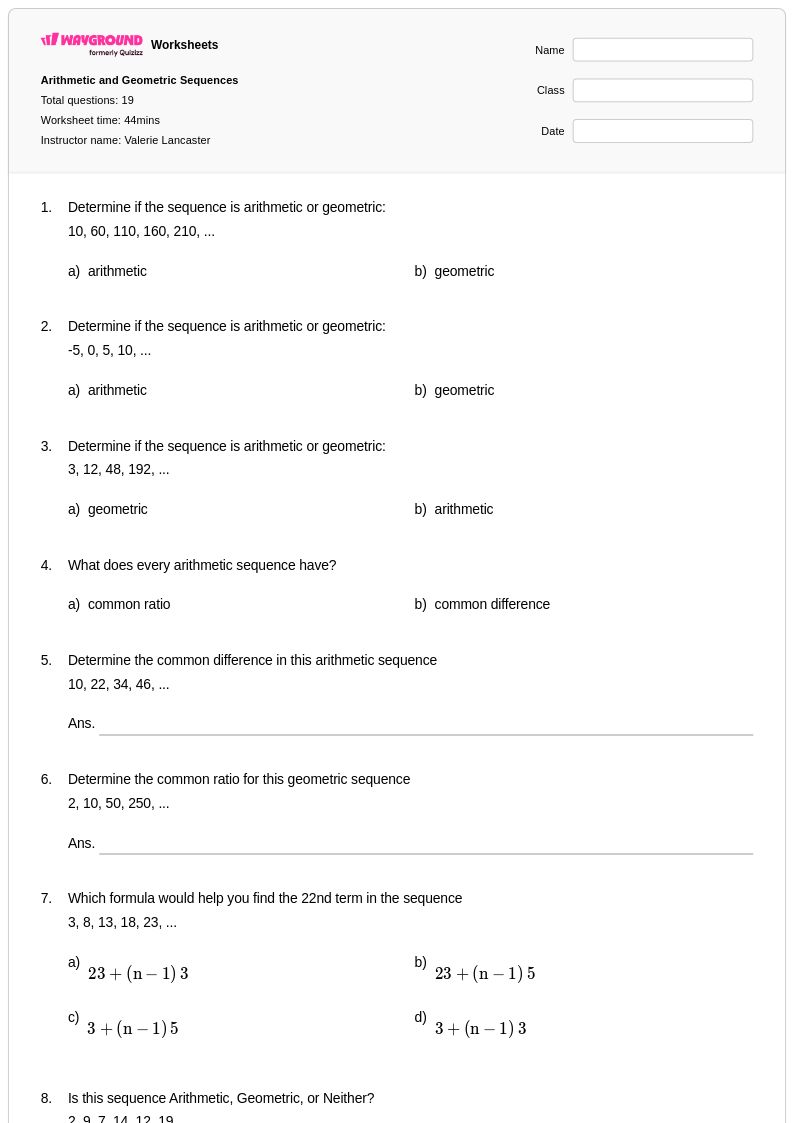
Students often confuse geometric sequences (multiplicative) with arithmetic sequences (additive). Another common mistake involves negative common ratios, where students may forget to alternate the signs of the terms. When using the formula a_n = a₁rⁿ⁻¹, errors frequently occur in calculating the exponent or applying the order of operations.
How can I use this geometric sequences worksheet in my class?
This worksheet is designed for flexible use. You can assign it as a digital activity on the Wayground platform or print it as a PDF for hands-on practice. Every worksheet includes a complete answer key, which supports self-checking or efficient grading. For paper assignments, you can use the Wayground for Teachers app to quickly scan and grade student work.
How do geometric sequences fit into the high school math curriculum?
Geometric sequences are a key topic in Algebra 1 and Algebra 2, aligning with the Common Core's emphasis on functions. They serve as a student's first concrete introduction to exponential functions, building a bridge between simple patterns and the formal study of exponential growth and decay models.
How can I support students who struggle with geometric sequences?
For students needing support, use Wayground's digital accommodation tools. You can reduce the number of answer choices on multiple-choice questions to lower cognitive load or enable the Read Aloud feature for students with reading difficulties. These settings can be applied individually, allowing you to discreetly support learners without altering the assignment for the rest of the class.