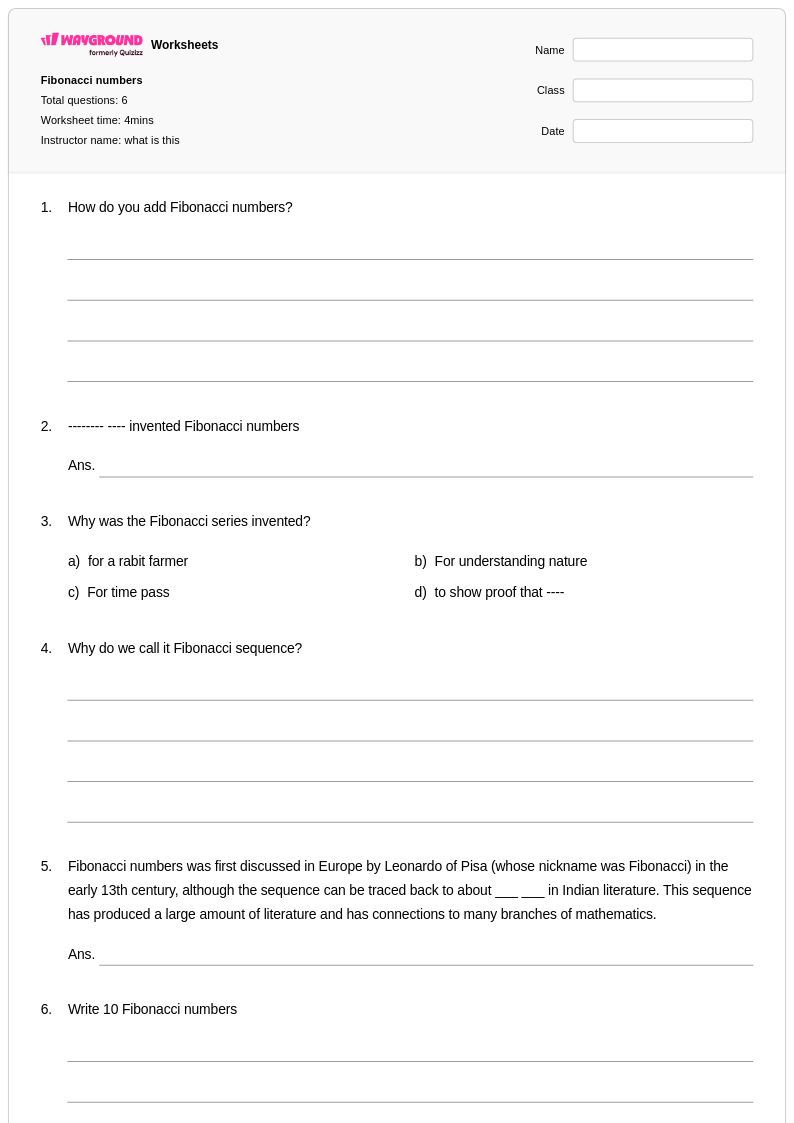
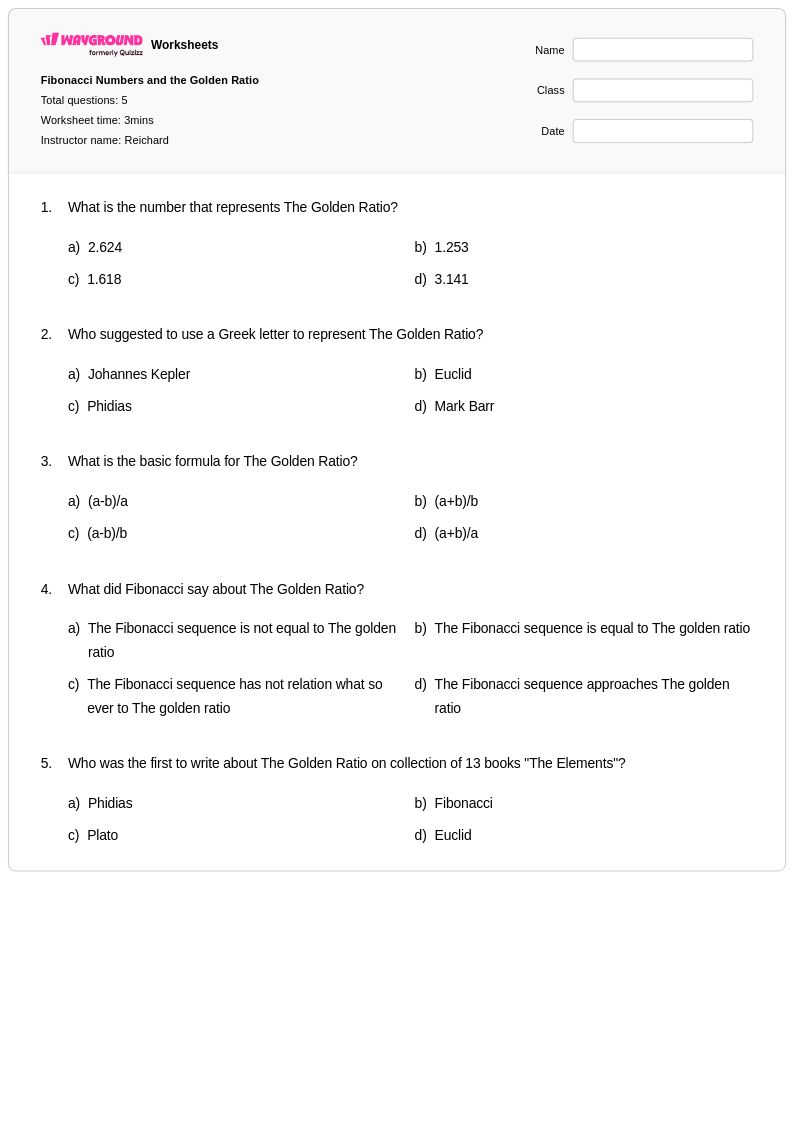
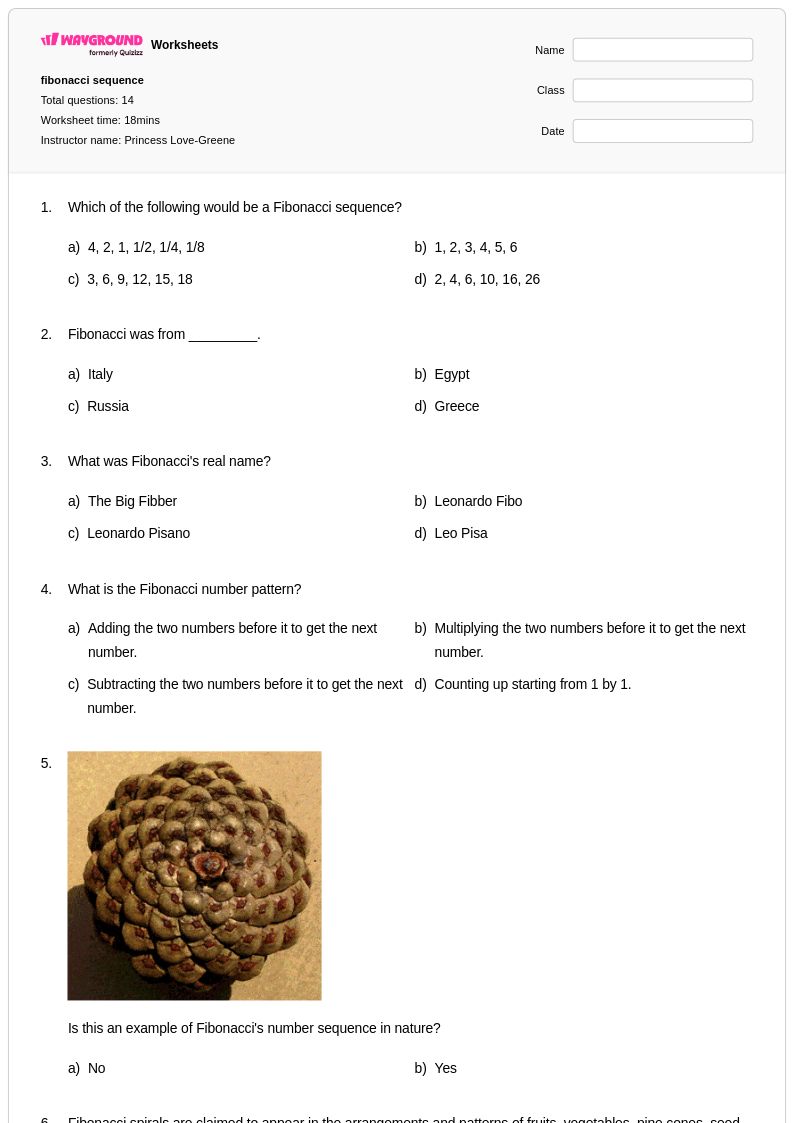
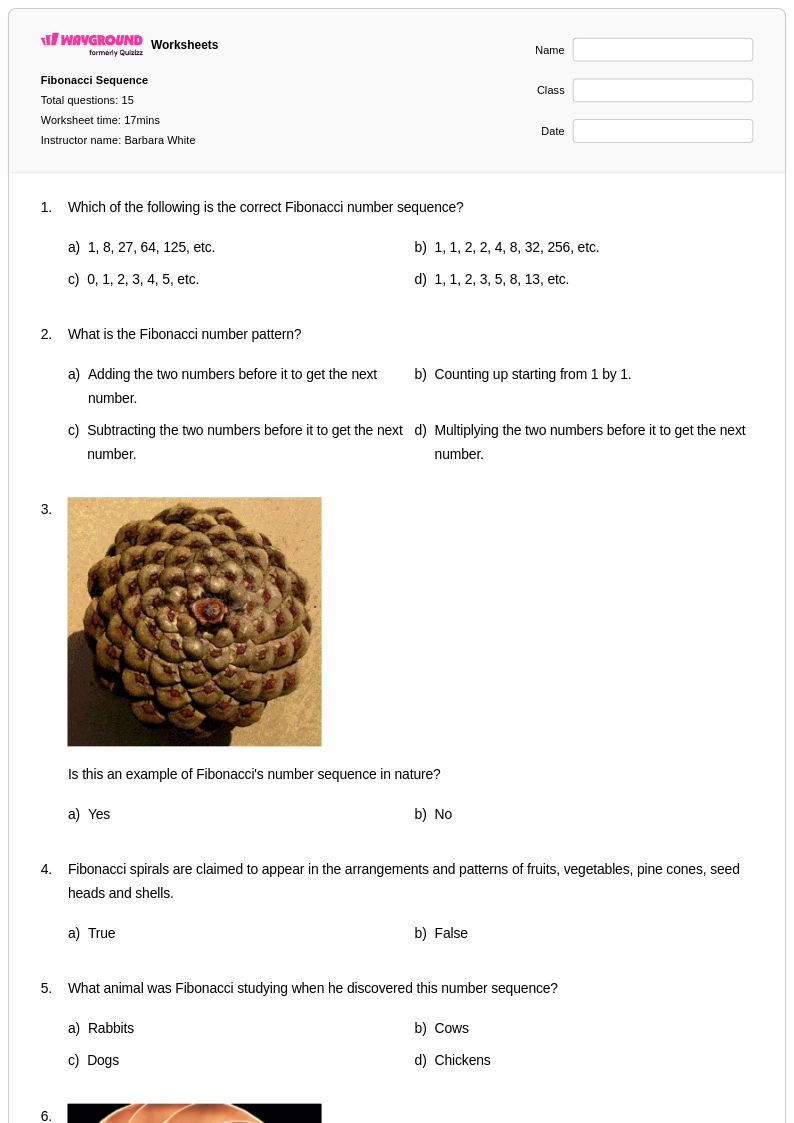
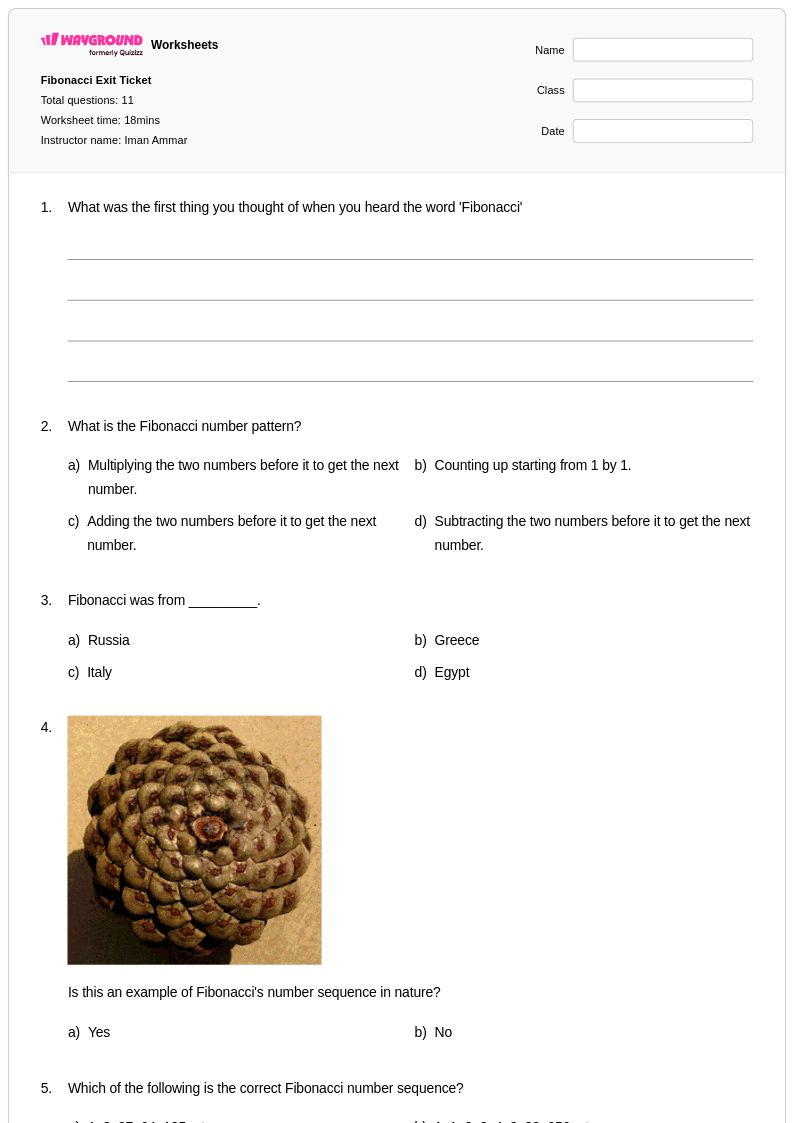
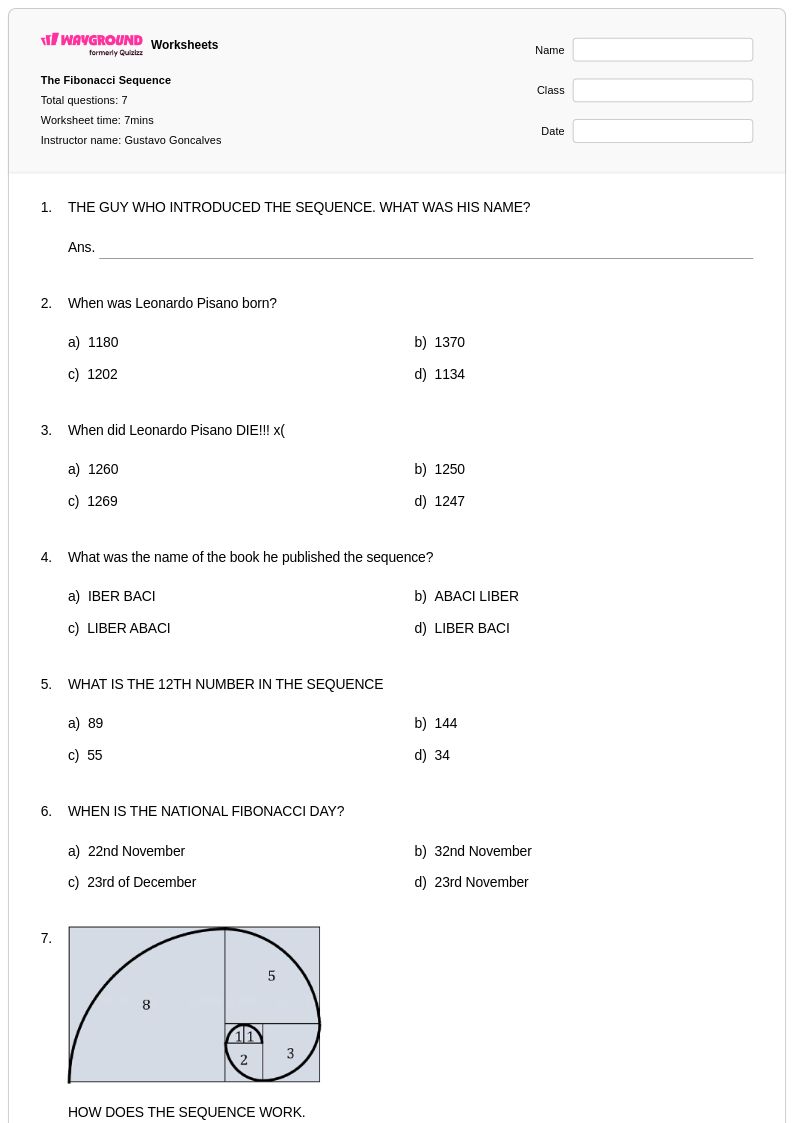
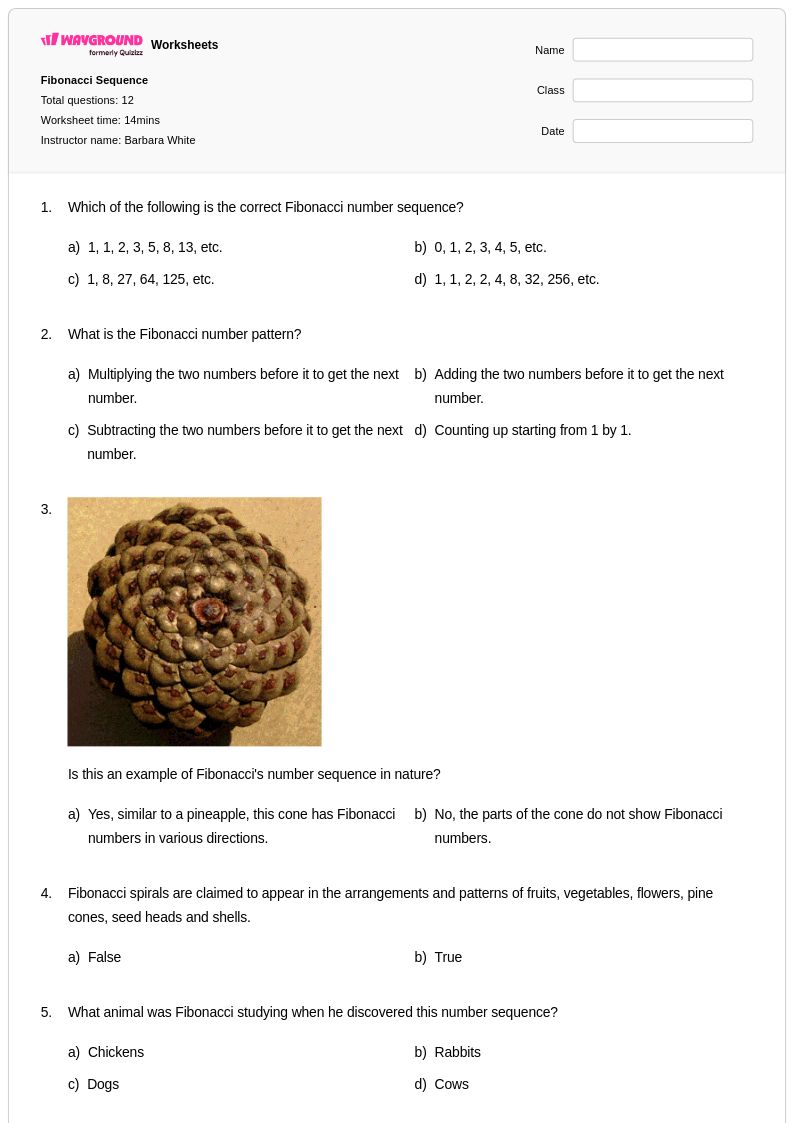
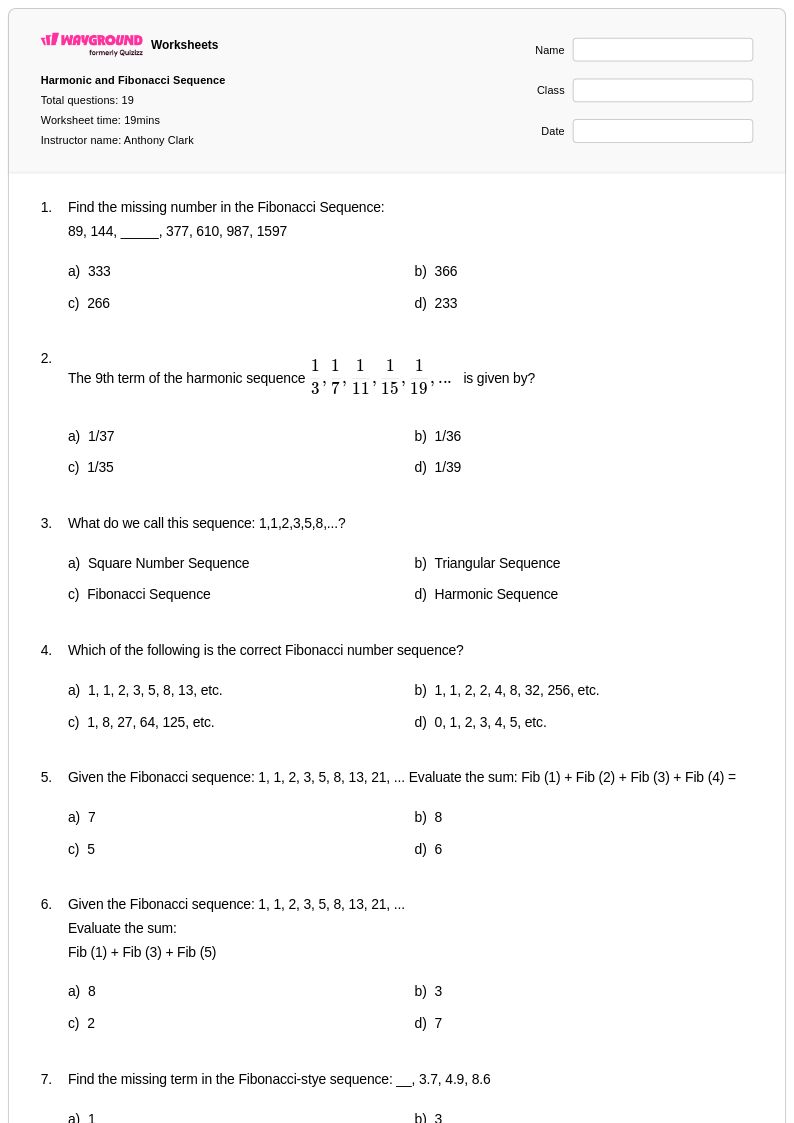
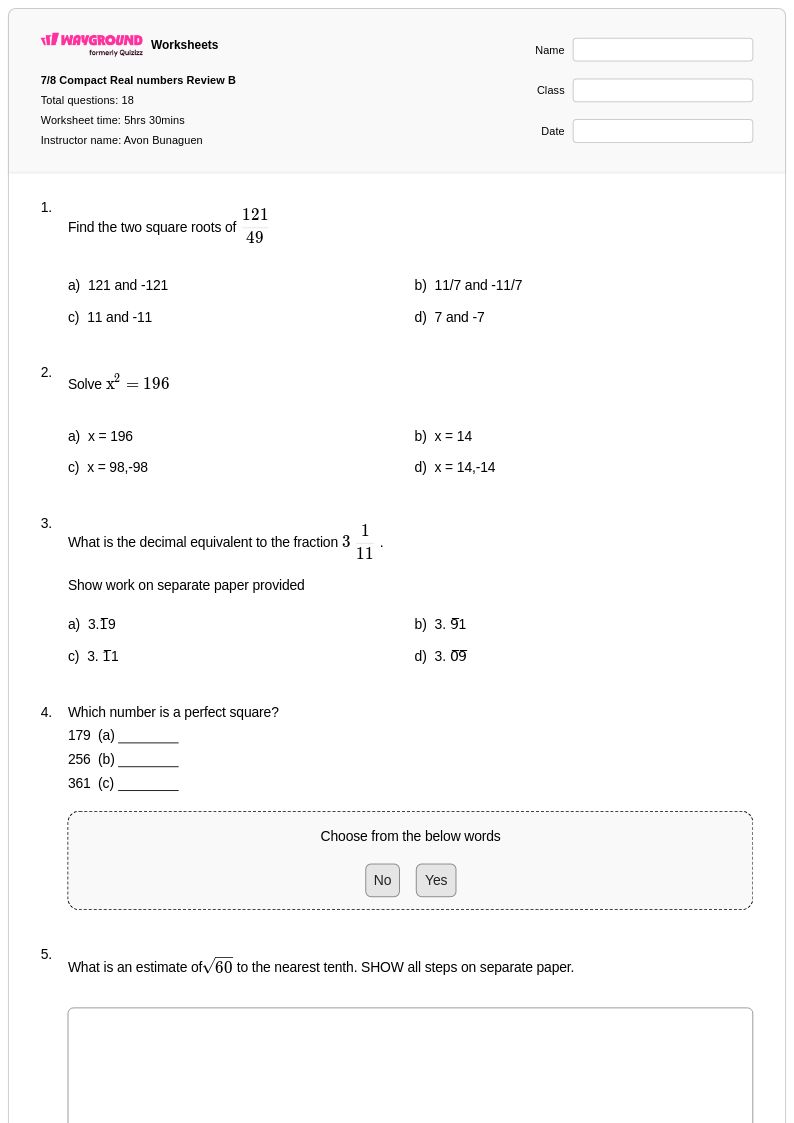
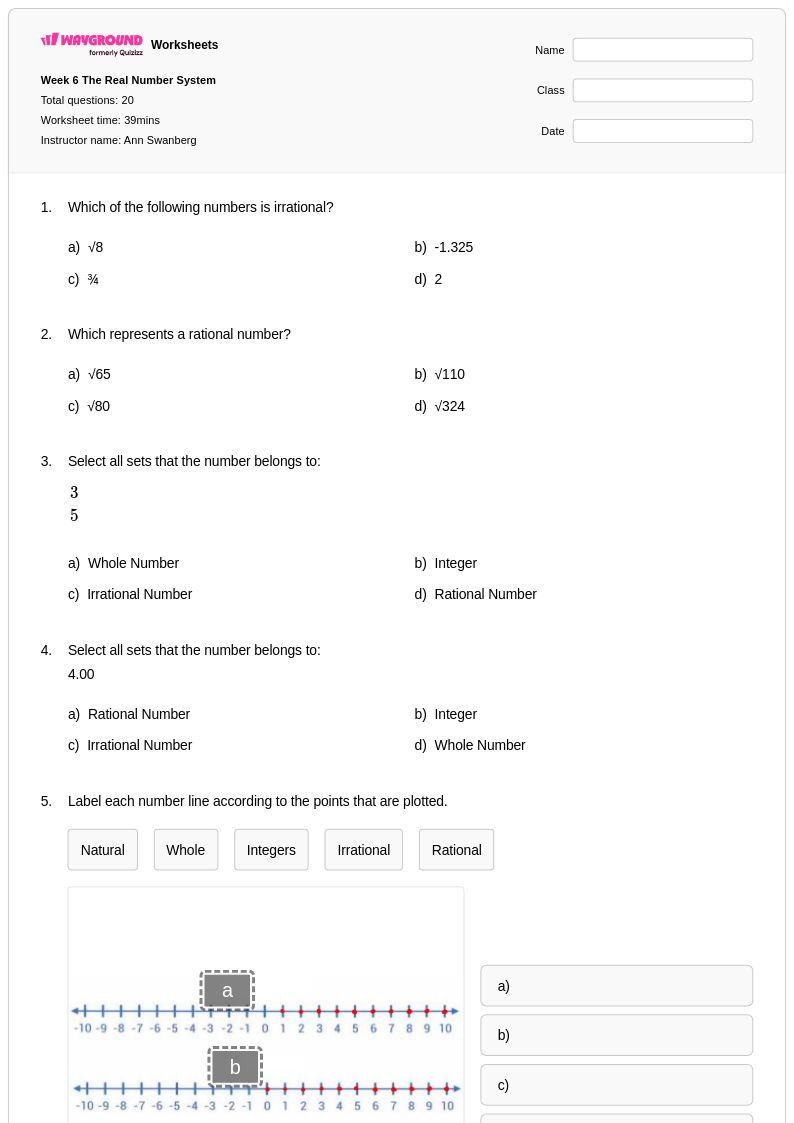
Explore Wayground's comprehensive collection of free Fibonacci Numbers worksheets and printables that help students master this fundamental mathematical sequence through engaging practice problems and detailed answer keys.
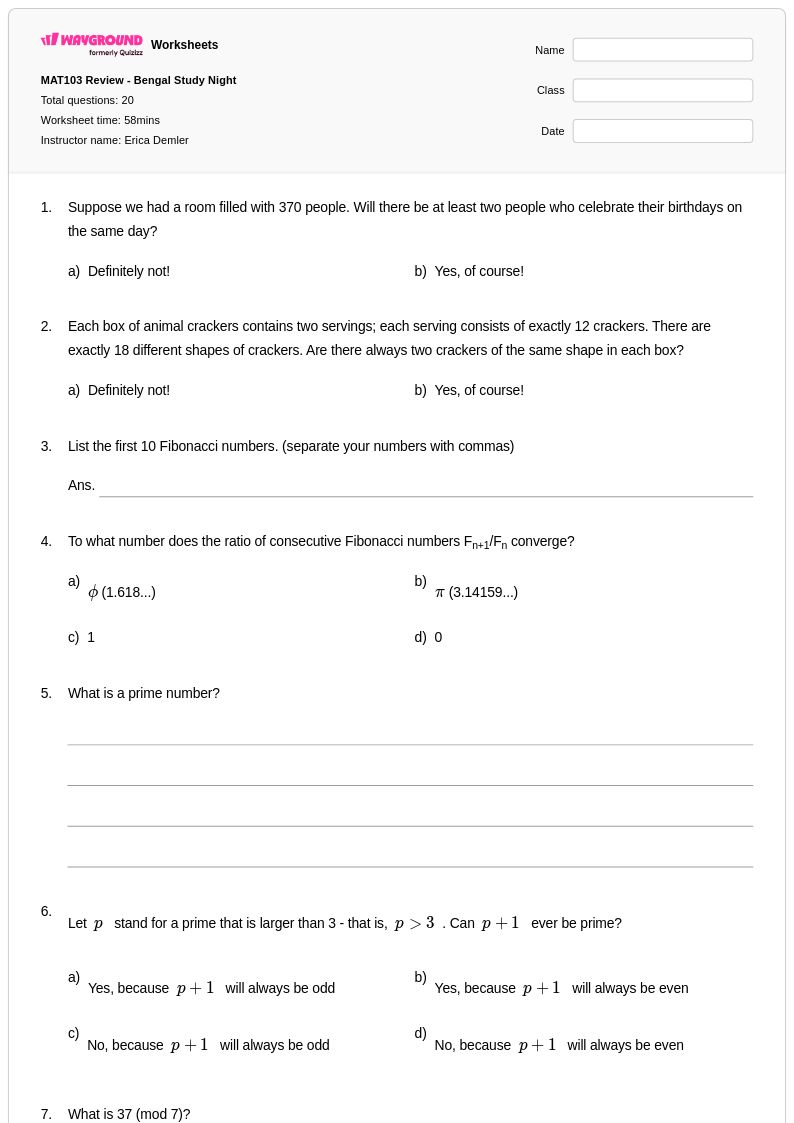
Fibonacci Numbers worksheets available through Wayground (formerly Quizizz) provide comprehensive practice opportunities for students to master this fascinating mathematical sequence where each term equals the sum of the two preceding terms. These expertly crafted resources strengthen essential skills including pattern recognition, recursive thinking, algebraic reasoning, and mathematical modeling as students explore the properties and applications of the Fibonacci sequence. The worksheet collections feature diverse practice problems ranging from basic sequence generation and term identification to advanced applications involving golden ratio relationships, spiral patterns in nature, and real-world mathematical modeling scenarios. Each worksheet includes detailed answer keys and is available as free printable pdf resources, enabling educators to seamlessly integrate Fibonacci number exploration into their mathematics curriculum while providing students with structured practice to build confidence and computational fluency.
Wayground (formerly Quizizz) empowers educators with millions of teacher-created Fibonacci Numbers worksheets that can be easily discovered through robust search and filtering capabilities, allowing instructors to locate resources perfectly aligned with their specific curriculum standards and learning objectives. The platform's differentiation tools enable teachers to customize worksheets for various skill levels, supporting both remediation for struggling learners and enrichment opportunities for advanced students ready to explore complex Fibonacci applications in art, architecture, and natural phenomena. These versatile resources are available in both printable and digital formats, including downloadable pdf versions, making lesson planning efficient whether teachers need quick practice sheets, comprehensive skill assessments, or engaging activities that demonstrate the mathematical beauty and practical relevance of Fibonacci sequences across multiple disciplines.
FAQs
How do I teach Fibonacci numbers to students?
Start with the rule before the sequence: ask students to add any two numbers and keep going. Once they see how the pattern self-generates, introduce the actual Fibonacci sequence (1, 1, 2, 3, 5, 8, 13...) and let them verify it themselves. From there, move outward — pinecones, sunflower spirals, and nautilus shells give the sequence a visual anchor that makes the math feel discovered rather than assigned. For older students, exploring why consecutive Fibonacci terms approach the golden ratio (~1.618) adds a layer of genuine mathematical surprise.
What exercises help students practice the Fibonacci sequence?
The most effective practice moves from generation to application. Start with fill-in-the-missing-term problems to confirm students understand the recursive rule, then shift to problems where they identify Fibonacci numbers embedded in a larger set. More challenging exercises ask students to work backwards (given a term, find the two that precede it) or extend the sequence into negative integers. Connecting the sequence to ratio tables — dividing consecutive terms to watch the quotient converge toward the golden ratio — turns arithmetic practice into genuine pattern investigation.
What mistakes do students commonly make with Fibonacci numbers?
The most common error is treating the sequence as additive from a single starting point rather than always summing the two preceding terms — students will add a fixed number instead of the previous term. A related mistake: forgetting that the sequence begins with two 1s (or 0 and 1, depending on convention), which throws off every subsequent term. When students move to ratio work, they often round too aggressively and miss the convergence toward the golden ratio entirely. Catching these early with a quick "show your work" check on the first five terms saves a lot of downstream confusion.
How do I use Wayground's Fibonacci Numbers worksheets in my class?
Each worksheet comes with a complete answer key, so you can assign it for independent practice without extra prep. For in-class or homework use, download the printable PDF and grade submissions using the Wayground for Teachers app, which lets you scan or capture student work directly. If you're running a digital session, host the worksheet as an interactive quiz on Wayground — same problems, immediate feedback for students.
Where do Fibonacci numbers fit in the math curriculum?
Fibonacci numbers aren't pinned to a single Common Core domain, but they sit naturally at the intersection of several progressions. In elementary grades, they reinforce the addition and pattern-recognition work students are already doing with number sequences. By middle school, they connect to ratio reasoning — students who have worked with proportional relationships are ready to explore why the ratio of consecutive Fibonacci terms converges to the golden ratio. At the high school level, the sequence becomes a gateway to recursive functions and geometric sequences, bridging arithmetic pattern work to formal algebraic thinking.
How can I differentiate Fibonacci number practice for mixed-ability students?
For students who need more support, Wayground's reduced answer choices accommodation lowers the cognitive load on multiple-choice problems, and the read-aloud feature helps students who struggle to parse multi-step written instructions independently. For layout accessibility, you can generate an alternate version of the same worksheet with a dyslexia-friendly font or larger text — useful when the visual density of a sequence table is the barrier, not the math itself. Advanced students can be directed to the ratio and golden-ratio extension problems without any changes to what the rest of the class receives.
What grade level are Fibonacci numbers taught?
Fibonacci numbers appear across a wide grade band depending on depth. Third and fourth graders encounter them as a pattern-recognition exercise — extend the sequence, fill in missing terms. By grades 5 and 6, students explore the sequence's properties more analytically, including relationships between consecutive terms. High school students revisit Fibonacci in the context of recursive sequences, exponential growth comparisons, and the golden ratio. The concept scales well because the entry point (add the last two numbers) is accessible early, while the mathematics behind it stays interesting for years.