Free Printable Fibonacci Numbers Worksheets for Grade 4
Grade 4 Fibonacci Numbers worksheets from Wayground help students discover and practice this famous mathematical sequence through engaging printables, free practice problems, and comprehensive answer keys in PDF format.
Explore printable Fibonacci Numbers worksheets for Grade 4
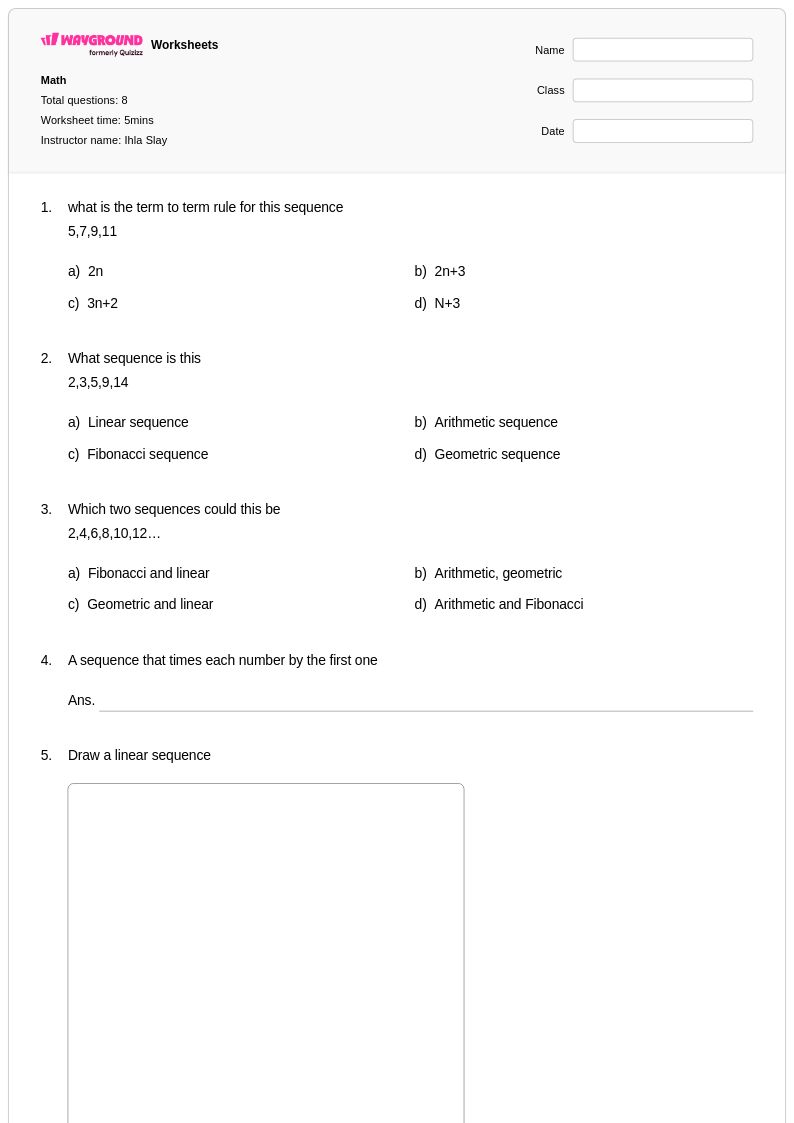
Fibonacci Numbers worksheets available through Wayground (formerly Quizizz) introduce Grade 4 students to one of mathematics' most fascinating numerical patterns, where each number represents the sum of the two preceding numbers in the sequence. These carefully designed practice problems help young learners recognize the pattern within the famous sequence (1, 1, 2, 3, 5, 8, 13, 21...) while strengthening critical mathematical thinking skills including pattern recognition, logical reasoning, and basic addition operations. The comprehensive worksheet collection includes various difficulty levels with complete answer keys, allowing students to explore this foundational concept through engaging activities that range from filling in missing numbers to identifying Fibonacci patterns in nature and art. These free printables serve as valuable resources for building number sense and introducing students to the beauty of mathematical sequences in an age-appropriate format that supports both classroom instruction and independent practice.
Wayground (formerly Quizizz) empowers educators with access to millions of teacher-created Fibonacci Numbers resources that streamline lesson planning and support diverse learning needs in Grade 4 mathematics instruction. The platform's robust search and filtering capabilities enable teachers to quickly locate worksheets that align with specific curriculum standards while offering differentiation tools to accommodate various skill levels within the classroom. These flexible resources are available in both printable pdf formats and interactive digital versions, allowing educators to seamlessly integrate Fibonacci number exploration into traditional paper-based activities or technology-enhanced learning environments. Teachers can customize existing worksheets or combine multiple resources to create comprehensive practice sets that support skill development, provide targeted remediation for struggling learners, or offer enrichment opportunities for advanced students ready to explore more complex mathematical patterns and relationships.
FAQs
How do I teach Fibonacci numbers to fourth graders?
Fourth graders are ready to do more than extend the sequence — they can start asking why it works. After students generate the first 10–12 terms, have them write the rule in their own words before you formalize it. Then give them a "broken" sequence with one wrong term and ask them to find and fix the error. That diagnostic task reveals whether they understand the recursive rule or are just pattern-matching by feel. Connecting the sequence to addition practice they already know (multi-digit addition) keeps the cognitive load manageable while the concept itself stretches their thinking.
What Fibonacci exercises work well for Grade 4 practice?
Good Grade 4 practice includes: extending the sequence beyond the commonly memorized terms (past 21), identifying which numbers in a mixed list are Fibonacci numbers, and filling in missing terms in the middle of a sequence rather than just at the end. Problems that ask students to spot Fibonacci patterns in simple nature images — petal counts, spiral arrangements — add context without requiring advanced math. Keep ratio work off the table at this grade; the goal is fluency with the recursive rule and confidence with the sequence itself.
What mistakes do fourth graders make with Fibonacci numbers?
The most persistent mistake is adding a fixed increment rather than the two preceding terms — students who are used to skip-counting patterns default to that approach. A second common error is starting the sequence at 1, 2 instead of 1, 1, which shifts every subsequent term. When problems ask students to find a missing middle term, some work only forward from the start rather than using the terms on both sides of the gap, which is slower and more error-prone. Pointing out that they can work backwards (subtract the earlier term from the later one) is a useful strategy to teach explicitly.
How do I use Wayground's Grade 4 Fibonacci worksheets?
Every worksheet includes a complete answer key, making it easy to use for independent practice or homework without extra prep. Host it as a digital quiz on Wayground for in-class sessions where you want automatic scoring, or download the printable PDF for paper-based work. If you go the print route, the Wayground for Teachers app lets you scan and grade student submissions directly from your phone.
Where do Fibonacci numbers fit in the Grade 4 math curriculum?
Common Core doesn't include Fibonacci numbers as a required standard, but the sequence fits naturally into Grade 4's emphasis on recognizing and generating number patterns — the same domain where students analyze arithmetic sequences and explain rules in their own words. Working with Fibonacci reinforces multi-digit addition (terms grow quickly past 100 by the 12th term) and lays informal groundwork for the algebraic thinking students will formalize in later grades. It works well as an enrichment topic or as a context for practicing addition fluency with numbers that have a meaningful relationship.