Free Printable Fibonacci Numbers Worksheets for Grade 3
Discover free Grade 3 Fibonacci Numbers worksheets and printables through Wayground that help students explore number patterns and sequences with engaging practice problems and comprehensive answer keys.
Explore printable Fibonacci Numbers worksheets for Grade 3
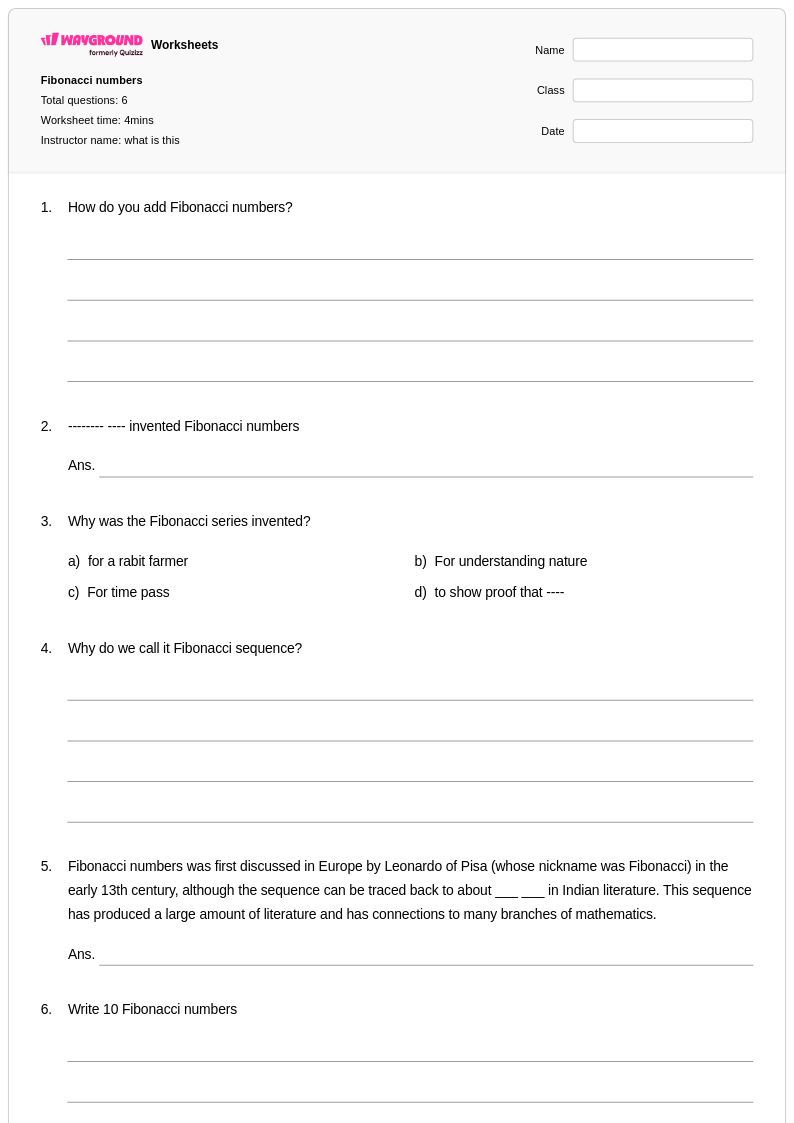
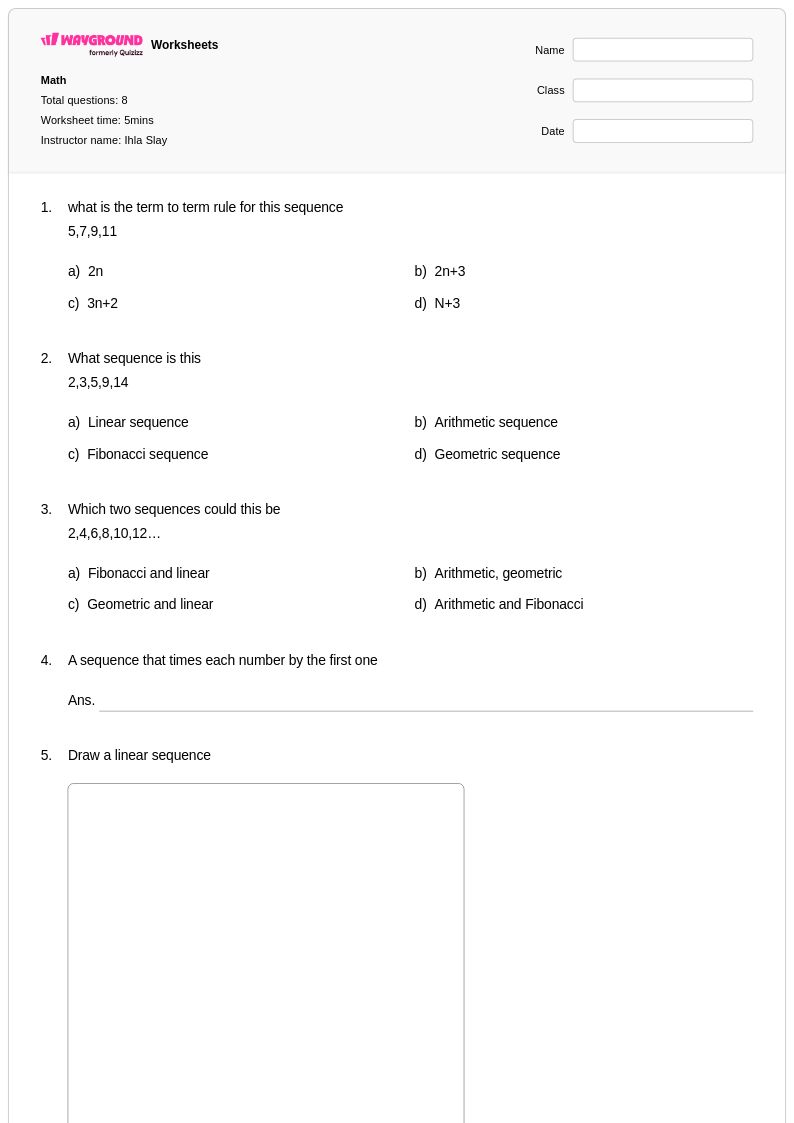
Fibonacci Numbers worksheets for Grade 3 students available through Wayground (formerly Quizizz) introduce young learners to one of mathematics' most fascinating numerical patterns. These carefully designed practice problems help third-grade students recognize and extend the famous sequence where each number equals the sum of the two preceding numbers (1, 1, 2, 3, 5, 8, 13...). The worksheets strengthen pattern recognition skills, logical thinking, and early algebraic reasoning as students discover the mathematical relationships inherent in this special sequence. Each printable resource includes comprehensive answer keys and free access to engaging activities that make abstract mathematical concepts accessible to elementary learners through visual representations and hands-on practice.
Wayground (formerly Quizizz) empowers educators with millions of teacher-created Fibonacci Numbers resources specifically aligned to Grade 3 learning standards and developmental needs. The platform's advanced search and filtering capabilities allow teachers to quickly locate differentiated worksheets that match their students' varying ability levels, from basic pattern completion to more challenging sequence extension problems. These customizable materials are available in both printable PDF format and interactive digital versions, providing flexibility for classroom instruction, homework assignments, remediation sessions, and enrichment activities. Teachers can seamlessly modify existing worksheets or combine multiple resources to create comprehensive lesson plans that build mathematical confidence while introducing students to the beauty and logic of mathematical sequences.
FAQs
How do I introduce Fibonacci numbers to third graders?
Keep the entry point concrete: give students a row of blank boxes and tell them the first two numbers are 1 and 1, then ask them to fill in each box by adding the two before it. Let them discover the sequence themselves before naming it. Visual supports help — linking cubes or a number line make the addition tangible for students still building fluency with two-digit sums. Once they've generated the sequence a few times, show them a pinecone or sunflower image and ask them to count the spirals. That moment of recognition is what makes the lesson stick.
What Fibonacci practice is appropriate for Grade 3 students?
At this level, the right exercises are sequence completion (fill in the next three terms), missing-number problems within the first ten terms, and simple true/false questions about whether a given number belongs to the sequence. Avoid ratio or golden-ratio work — third graders are building addition fluency and pattern recognition, and those are the skills worth targeting here. Visual worksheets that pair the sequence with pictures of natural spirals give students a reason to care about the pattern beyond the arithmetic.
What errors do third graders make when working with the Fibonacci sequence?
Most errors come down to one misunderstanding: students add a constant number instead of the previous term. For example, they'll write 1, 1, 2, 3, 4, 5 because they keep adding 1. A quick fix is to have students draw arrows connecting the two terms they're adding before they write the next one — making the rule visible slows down the automatic "just add one more" response. Some students also lose their place in longer sequences, so shorter rows with clear spacing help.
How do I use these Grade 3 Fibonacci worksheets in my classroom?
Print the PDF for paper practice — offline work suits the focused, low-distraction environment that pattern tasks benefit from, and you can grade submissions quickly using the Wayground for Teachers app by scanning the completed sheets. Every worksheet includes an answer key, so self-checking is an option for early finishers. If you want to run it as a whole-class activity on devices, host it as a digital quiz on Wayground instead.
How can I support diverse learners with Fibonacci worksheets in Grade 3?
For students who find dense number rows hard to track, generate a version of the worksheet with wider font spacing or a larger font size — Wayground's worksheet tools let you do this without rebuilding the activity. The read-aloud accommodation helps students who can do the math but struggle to read the instructions independently. For students who need a simpler entry point, the reduced answer choices setting on digital versions narrows the options so they can focus on the pattern rather than the selection process.