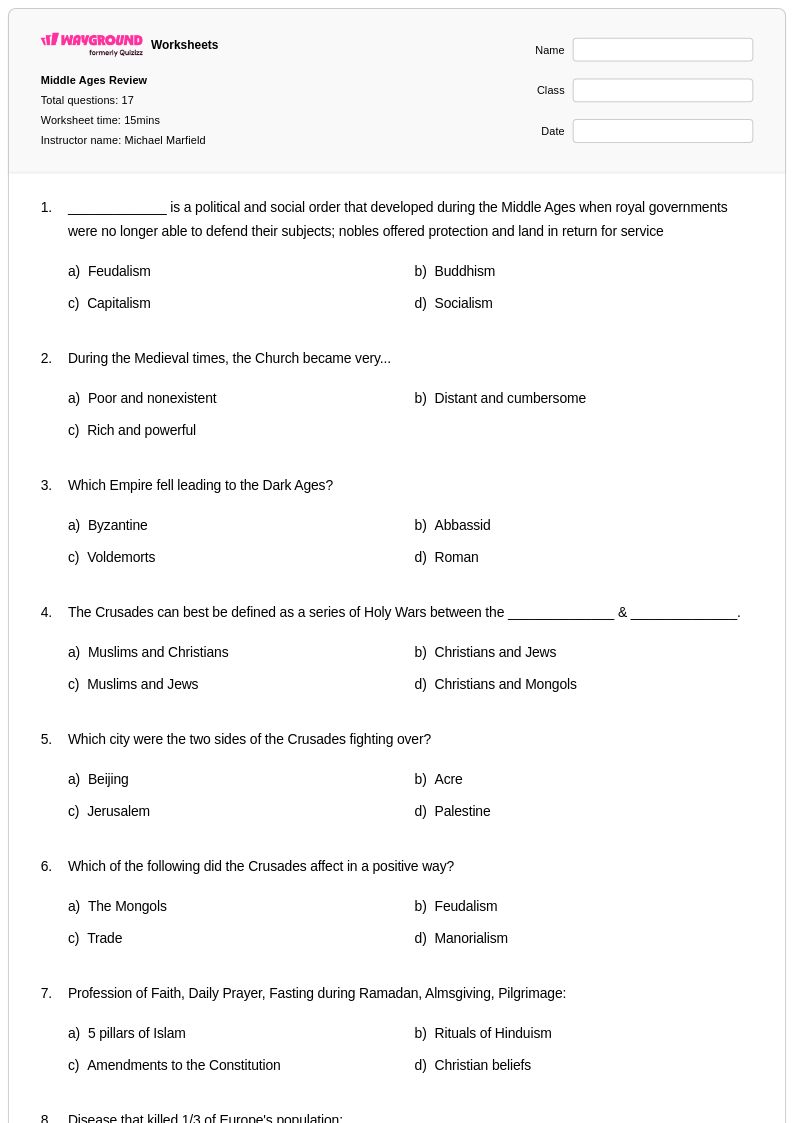
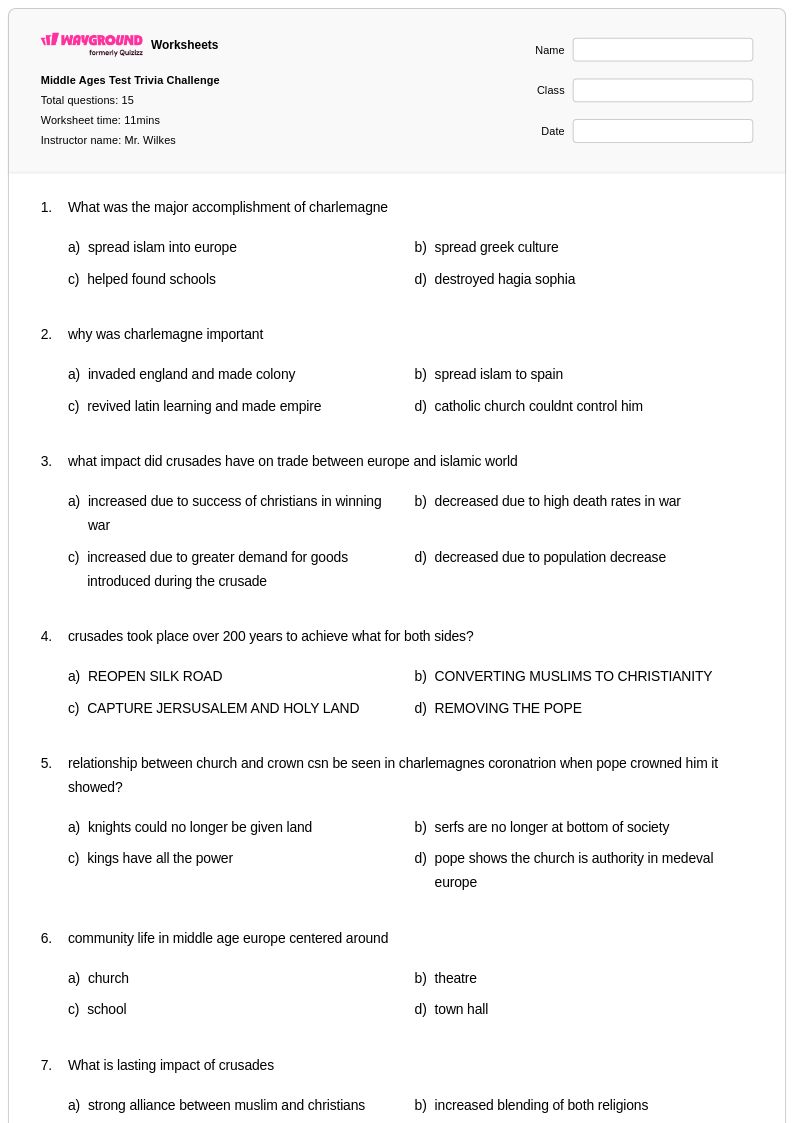
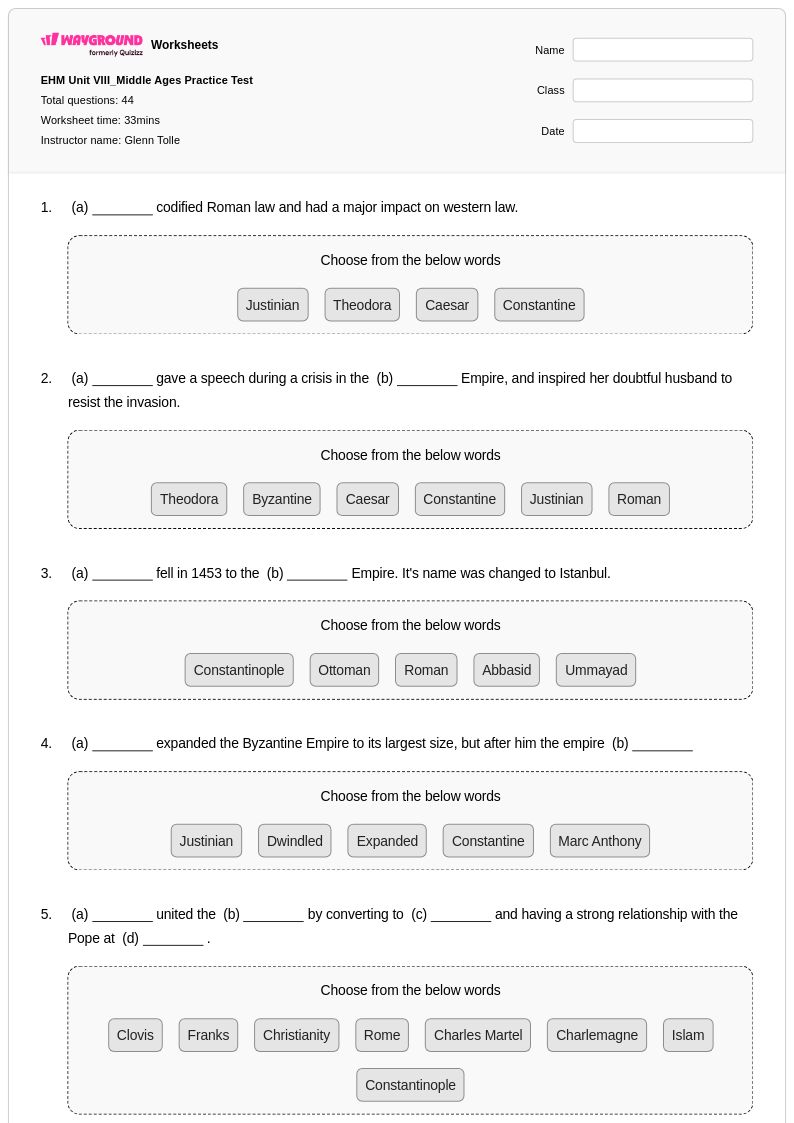
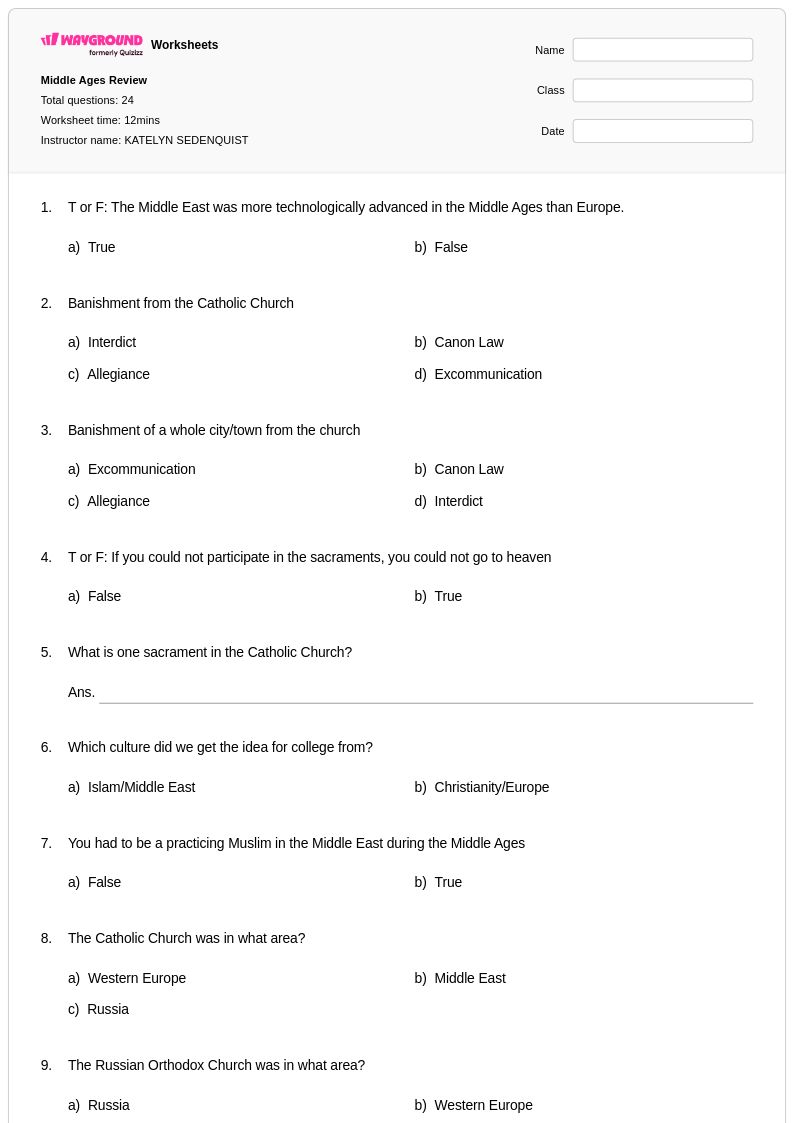
Grade 9 Middle Ages worksheets from Wayground offer comprehensive printables and practice problems covering medieval history, complete with answer keys to help students master this pivotal period in world history.
Explore printable Middle Ages worksheets for Grade 9
Middle Ages worksheets for Grade 9 students available through Wayground (formerly Quizizz) provide comprehensive coverage of medieval European history from approximately 500 to 1500 CE. These educational resources strengthen critical thinking skills as students analyze the complex social, political, and economic systems that defined feudalism, examine the role of the Catholic Church in medieval society, and explore significant events such as the Crusades, the Black Death, and the rise of medieval towns and trade. The worksheets include diverse practice problems that challenge students to interpret primary sources, compare medieval institutions across different regions, and evaluate the lasting impact of medieval innovations on modern civilization. Each worksheet collection includes detailed answer keys to support both independent study and classroom instruction, with many resources available as free printables in convenient pdf format.
Wayground's extensive platform supports educators with millions of teacher-created Middle Ages worksheets specifically designed for Grade 9 social studies instruction. The platform's robust search and filtering capabilities enable teachers to quickly locate resources aligned with state and national standards, while differentiation tools allow for seamless customization to meet diverse learning needs within the classroom. These worksheet collections are available in both printable pdf format and interactive digital versions, providing flexibility for various teaching environments and learning preferences. Teachers can efficiently plan comprehensive units on medieval history, create targeted remediation materials for struggling students, develop enrichment activities for advanced learners, and design focused skill practice sessions that reinforce key concepts such as the manorial system, medieval warfare, Gothic architecture, and the intellectual achievements of medieval scholars and universities.
FAQs
How do I teach the Middle Ages to middle or high school students?
Teaching the Middle Ages effectively means organizing instruction around key thematic pillars: feudalism and social hierarchy, the role of the Catholic Church, the Crusades, and the rise and fall of empires like the Byzantine Empire. Begin with a timeline anchoring students to the period roughly 500 to 1500 CE before moving into cause-and-effect relationships between political, religious, and cultural developments. Primary source analysis and medieval art interpretation help students move beyond memorization toward genuine historical thinking.
What exercises help students practice medieval history concepts?
Effective practice exercises for medieval history include timeline sequencing activities, primary source analysis tasks, and structured questions that ask students to explain the social hierarchies of feudal society or trace the influence of the Catholic Church across regions and centuries. Critical thinking prompts that connect the Viking expansions or the Crusades to broader consequences in European and world history push students to apply content rather than just recall it. Varied question formats, including matching, short answer, and document-based questions, build both breadth and depth of understanding.
What misconceptions do students commonly have about the Middle Ages?
One of the most persistent misconceptions is that the Middle Ages were a uniform period of stagnation, when in fact they encompassed nearly a thousand years of significant political, religious, artistic, and intellectual change. Students often underestimate the complexity of medieval society, assuming feudalism was a rigid system that applied uniformly across Europe, when regional variation was substantial. Another common error is conflating the fall of the Western Roman Empire with the collapse of all Roman civilization, overlooking the continuity represented by the Byzantine Empire.
How can I use Middle Ages worksheets to support students at different skill levels?
Middle Ages worksheets can be differentiated by selecting tasks that range from foundational knowledge checks, such as labeling a feudal hierarchy or identifying key dates on a timeline, to higher-order analysis of primary sources or comparative essay prompts. On Wayground, teachers can apply individual student accommodations including reduced answer choices to lower cognitive load for struggling learners, extended time for students who need it, and read-aloud support for students with reading difficulties, all without signaling differences to the rest of the class.
How do I use Wayground's Middle Ages worksheets in my classroom?
Wayground's Middle Ages worksheets are available as printable PDFs for traditional classroom use and in digital formats for technology-integrated or remote learning environments. Teachers can also host worksheets as an interactive quiz directly on Wayground, allowing for real-time student response and automatic grading. Each worksheet includes a detailed answer key, making them practical for independent study, homework assignments, or in-class practice with minimal prep time.
What topics within the Middle Ages should I prioritize in my curriculum?
Core topics that anchor most medieval history curricula include feudalism and manorialism, the political and spiritual authority of the Catholic Church, the Crusades and their long-term consequences, the Byzantine Empire's preservation of Roman and Greek knowledge, and the Viking expansions that reshaped Northern and Western Europe. Cultural achievements, including Gothic architecture, illuminated manuscripts, and the development of universities, are also essential for giving students a balanced view of the period beyond warfare and politics.