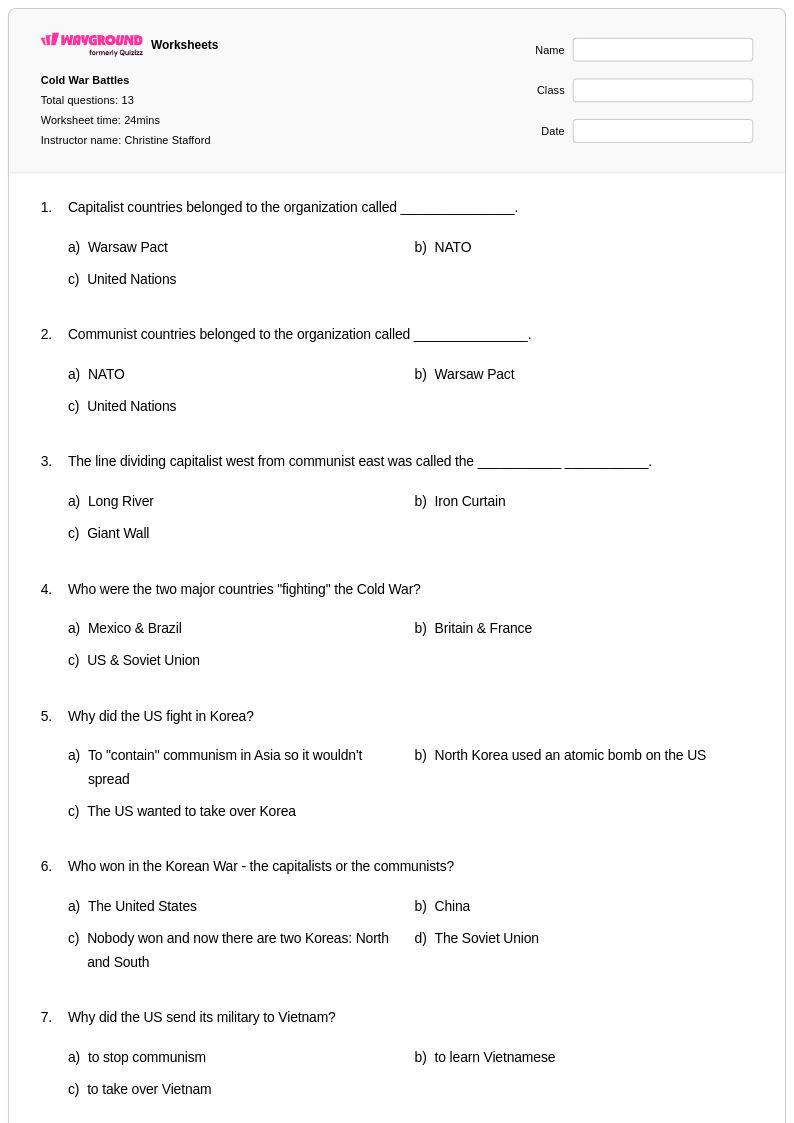
Explore Grade 12 NATO worksheets and printables that help students understand the history, formation, and impact of this crucial military alliance through comprehensive practice problems and answer keys.
NATO worksheets for Grade 12 students available through Wayground (formerly Quizizz) provide comprehensive coverage of the North Atlantic Treaty Organization's formation, evolution, and contemporary significance in global politics. These educational resources strengthen critical analytical skills by examining NATO's origins in Cold War tensions, its expansion phases, collective defense principles, and ongoing strategic challenges in the 21st century. Students engage with primary source documents, timeline activities, and comparative analysis exercises that deepen their understanding of multilateral security arrangements and transatlantic relations. The worksheet collection includes detailed answer keys and practice problems that support independent study, while free printables in PDF format ensure accessibility for diverse classroom environments and homework assignments.
Wayground (formerly Quizizz) supports educators with millions of teacher-created NATO resources that streamline lesson planning and enhance instructional effectiveness. The platform's robust search and filtering capabilities allow teachers to locate worksheets aligned with specific curriculum standards and learning objectives, whether focusing on NATO's Article 5 provisions, membership criteria, or contemporary operations. Differentiation tools enable customization of content complexity and question formats to meet varied student needs, supporting both remediation for struggling learners and enrichment for advanced students. Available in both printable and digital PDF formats, these resources facilitate flexible implementation across traditional and technology-enhanced classrooms, helping teachers provide targeted skill practice in diplomatic history, alliance theory, and international security analysis that prepares Grade 12 students for college-level political science coursework.
FAQs
How do I teach NATO to high school students?
Teaching NATO effectively starts with grounding students in the post-World War II context that made collective security a political priority. Begin with the 1949 North Atlantic Treaty itself, focusing on Article 5's mutual defense clause, then trace NATO's expansion phases and key Cold War flashpoints like the Berlin Crisis. Connecting these historical moments to contemporary NATO challenges helps students see the alliance as a living institution rather than a Cold War relic.
What topics should a NATO worksheet cover?
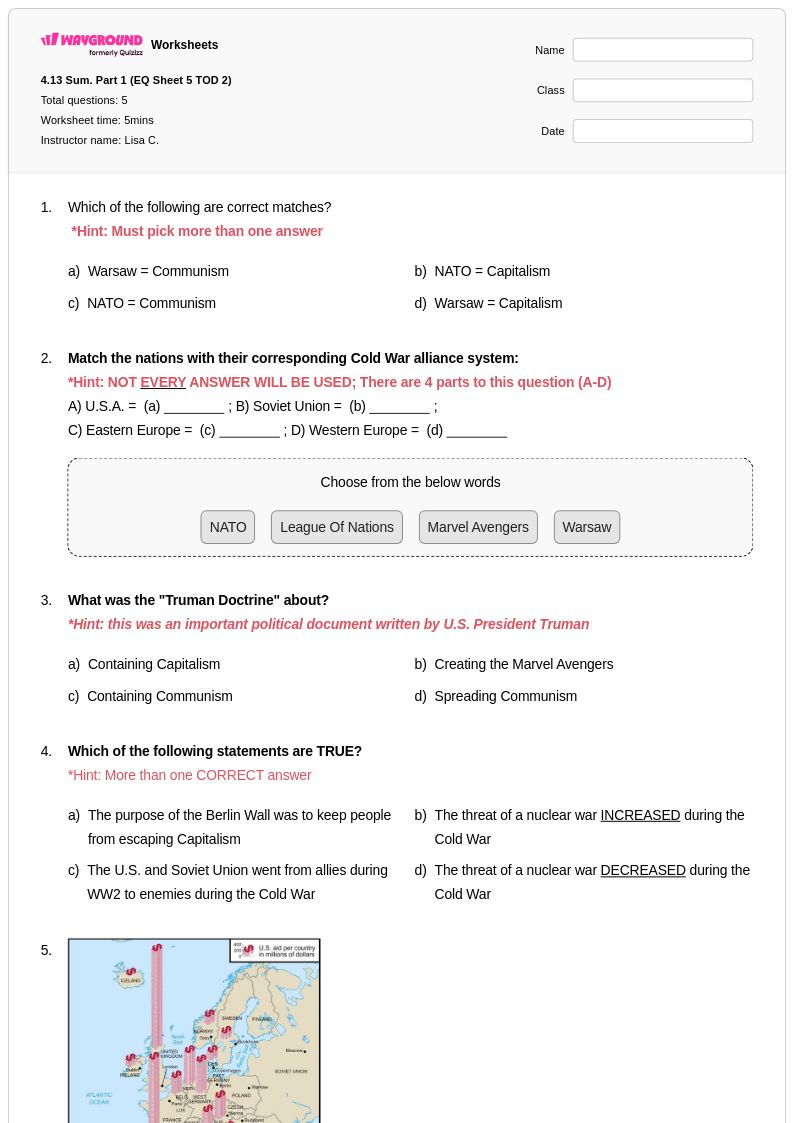
A well-designed NATO worksheet should cover the alliance's founding in 1949, the core principles of collective defense under Article 5, NATO's expansion phases from its original 12 members to its current size, and critical interventions such as the Kosovo operation. Strong worksheets also ask students to analyze primary sources like treaty excerpts and apply concepts of geopolitics and international security to real historical scenarios.
What common mistakes do students make when learning about NATO?
Students frequently conflate NATO with the United Nations, misunderstanding that NATO is a military alliance with binding mutual defense obligations rather than a broad multilateral body. Another common error is treating NATO as a purely Cold War institution and failing to account for its post-1991 evolution, including eastward expansion and out-of-area operations. Targeted practice problems that require students to distinguish NATO's structure and mandate from other international organizations help address both misconceptions.
How can I use NATO worksheets to build students' analytical skills in foreign policy?
NATO worksheets that include document analysis, cause-and-effect questions, and scenario-based prompts push students beyond recall and into genuine historical reasoning. Asking students to evaluate why specific countries joined NATO at particular moments, or to assess the strategic logic of collective defense, develops the same analytical skills used in broader foreign policy and diplomatic history study. Pairing these exercises with primary source excerpts from the treaty or Cold War speeches deepens critical thinking further.
How do I use Wayground's NATO worksheets in my classroom?
Wayground's NATO worksheets are available as printable PDFs for traditional classroom use and in digital formats for technology-integrated or remote learning environments, and teachers can also host them as a quiz directly on Wayground. Each worksheet includes a complete answer key, making them easy to deploy for guided practice, independent work, or formative assessment. Wayground also supports student-level accommodations such as extended time, read aloud, and reduced answer choices, which can be assigned to individual students without disrupting the rest of the class.
How do I differentiate NATO instruction for students at different levels?
For students who need foundational support, focus on NATO's basic purpose, the year it was founded, and the meaning of collective defense before introducing treaty articles or expansion timelines. Advanced students benefit from analyzing NATO's strategic evolution, evaluating the alliance's post-Cold War relevance, and examining contemporary debates around burden-sharing and eastern expansion. Wayground's differentiation tools allow teachers to customize content complexity and focus areas to meet both groups within the same lesson plan.