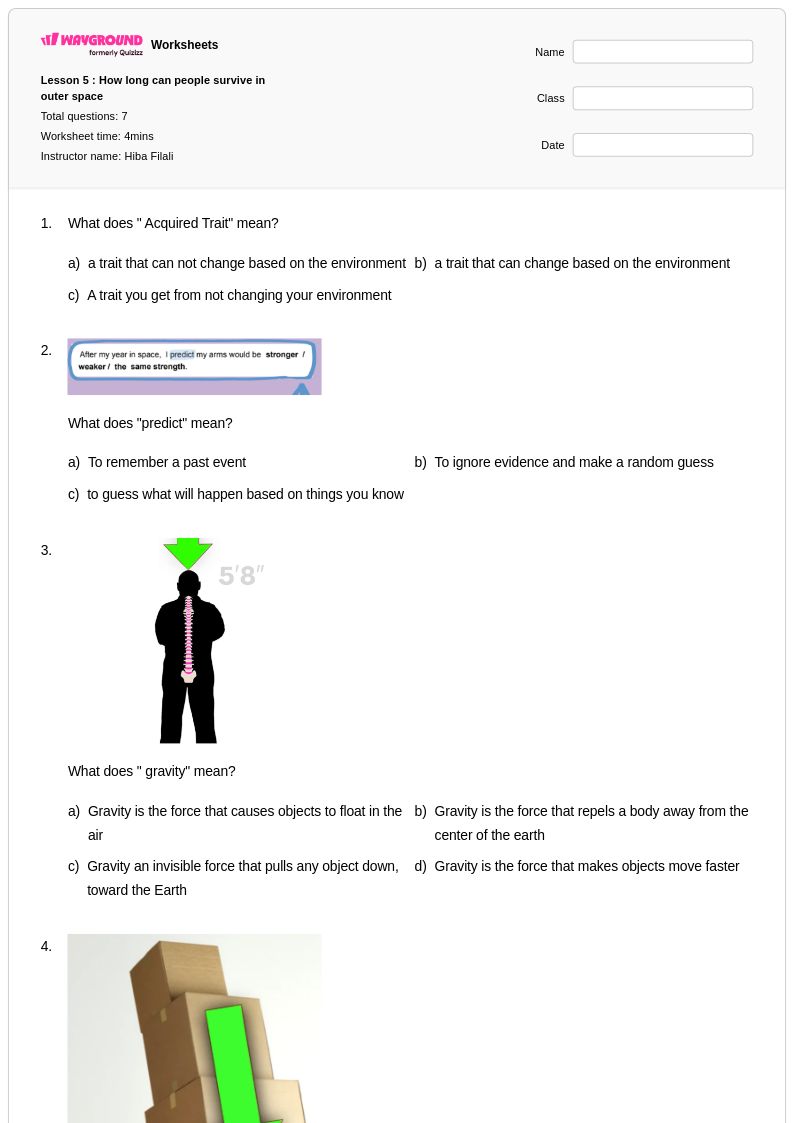
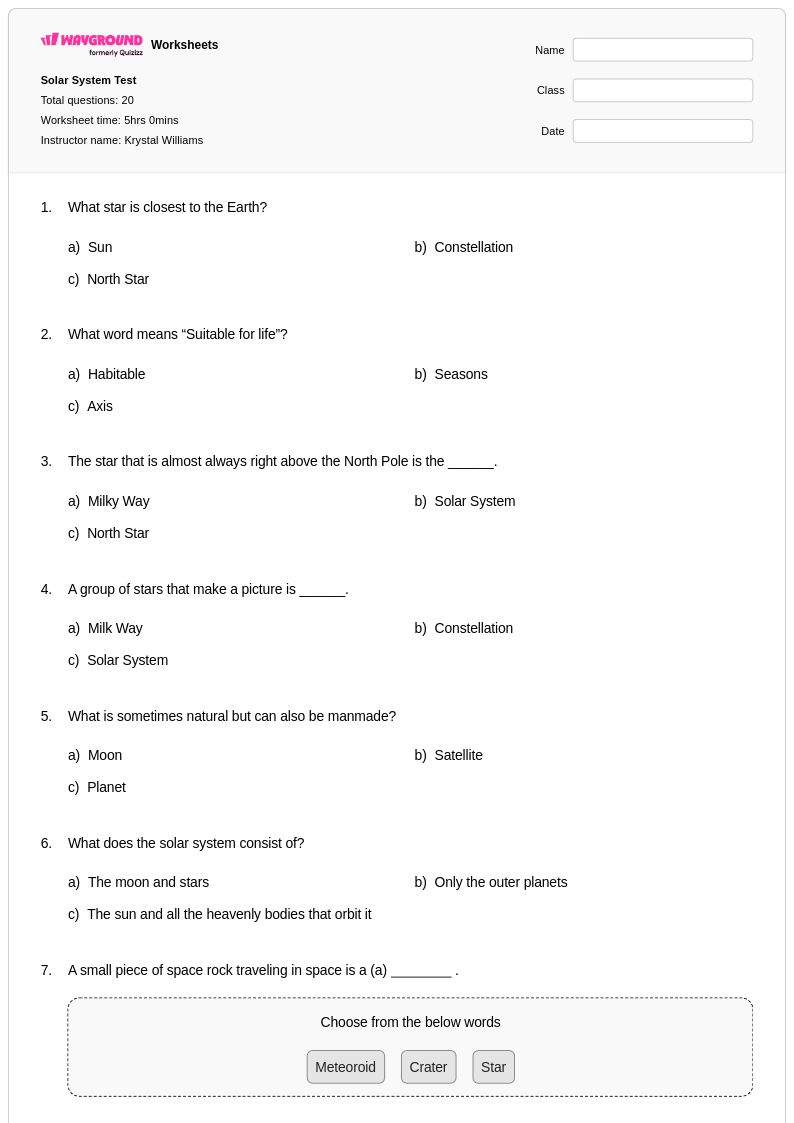
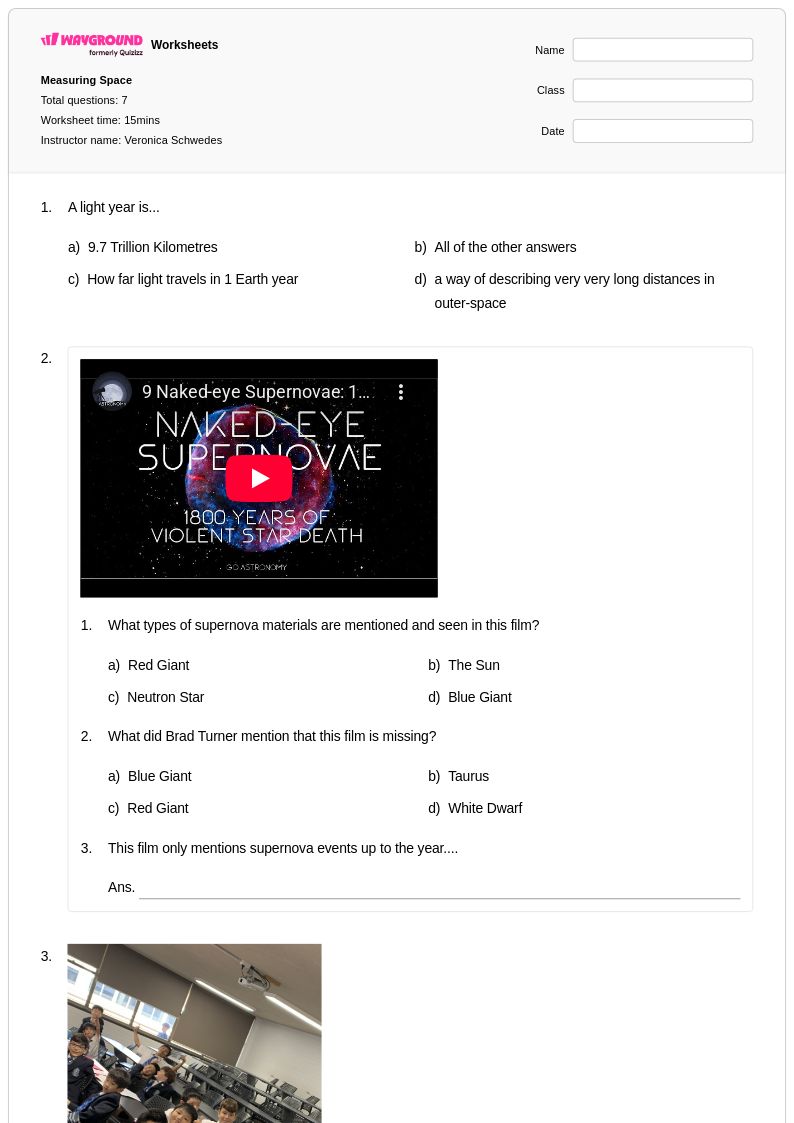
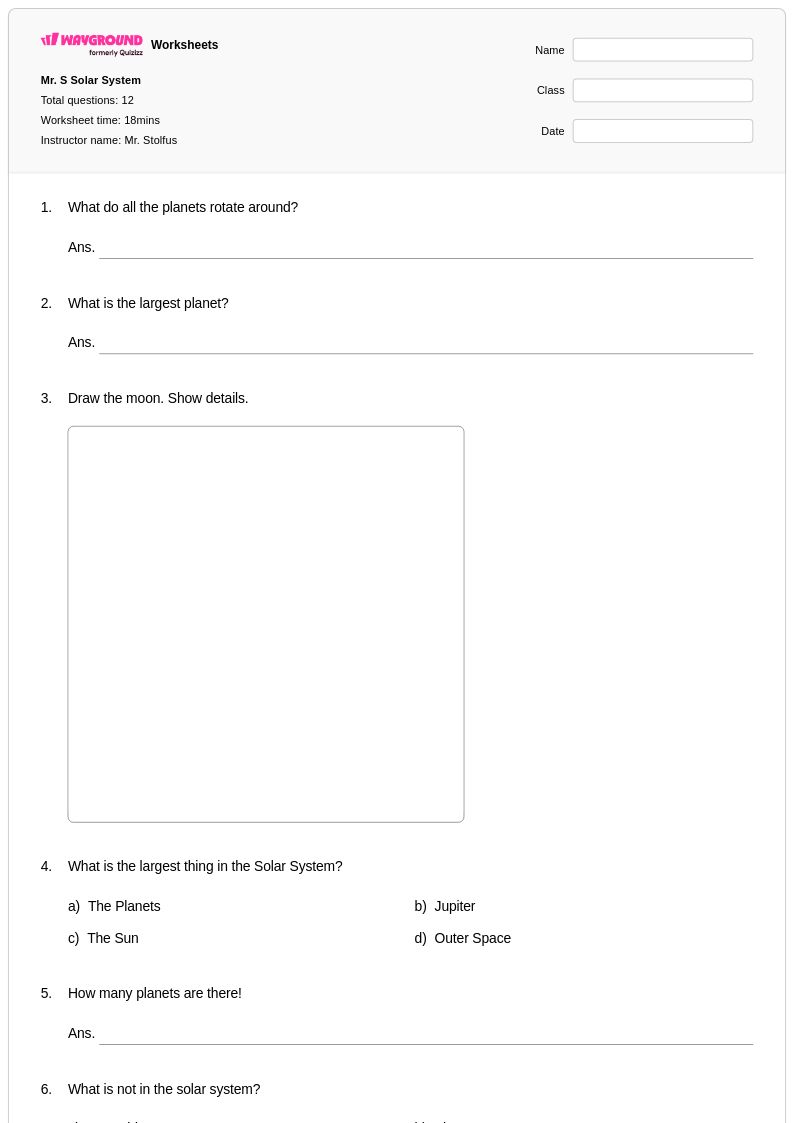
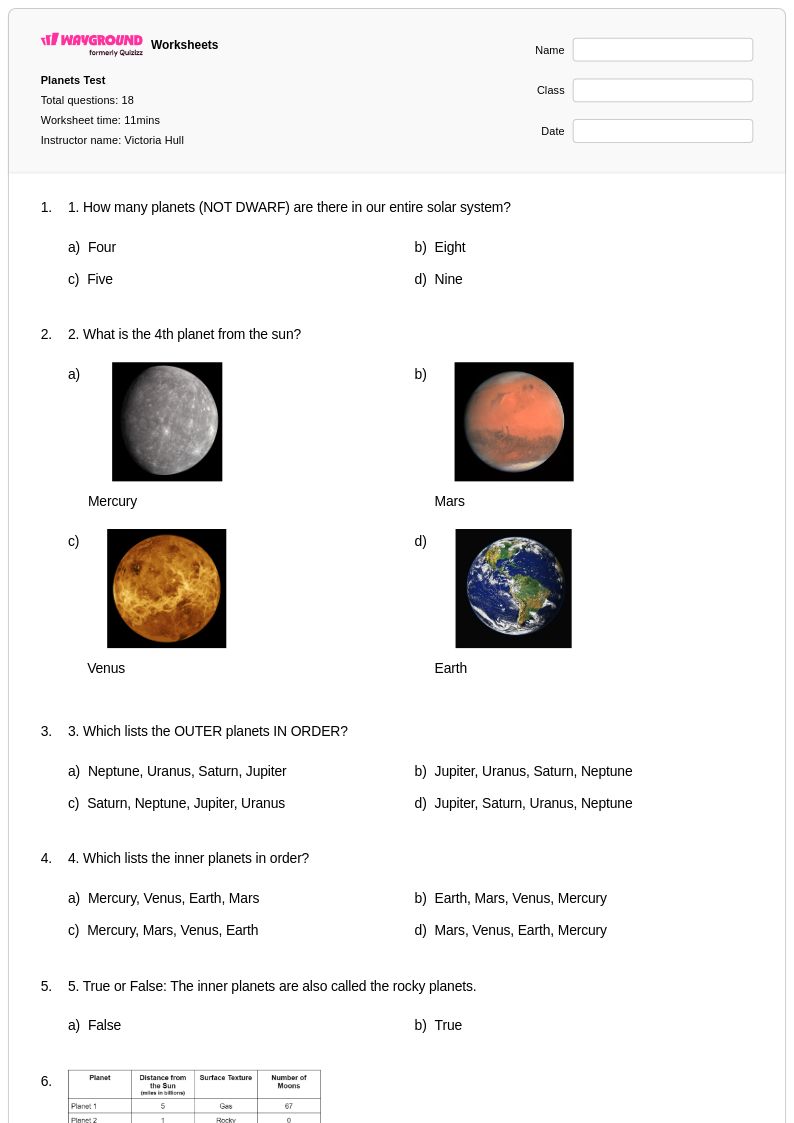
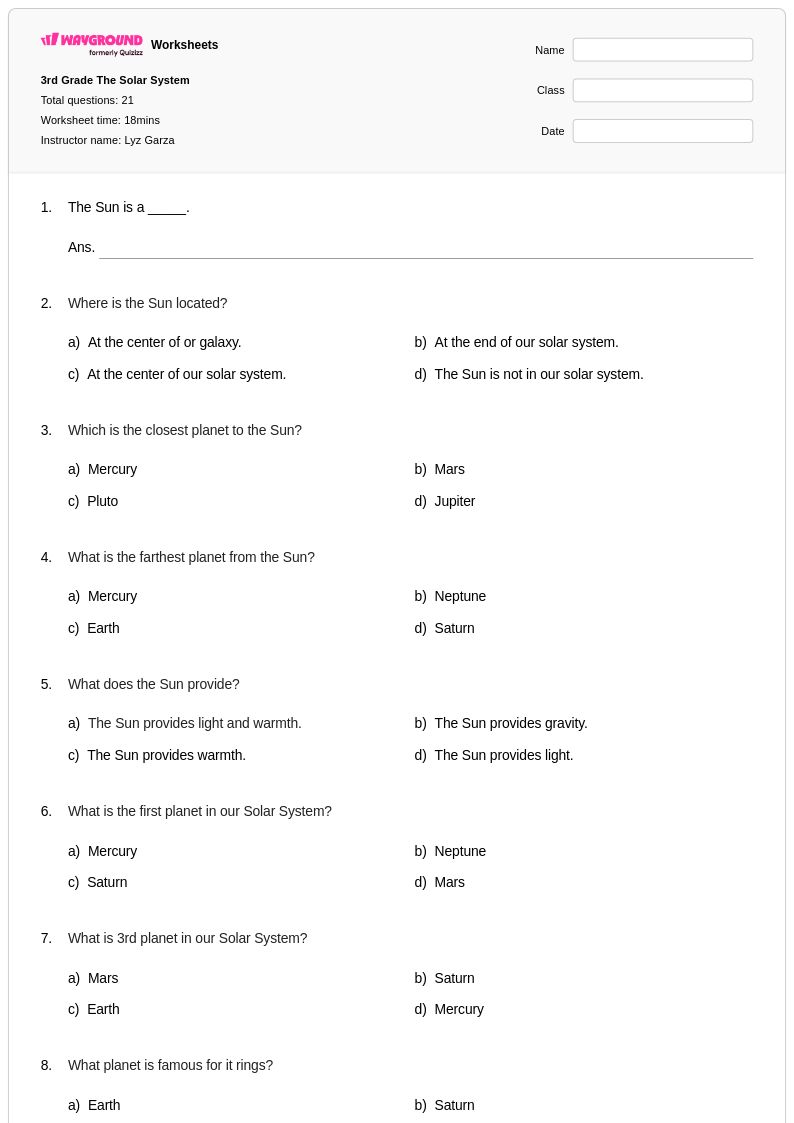
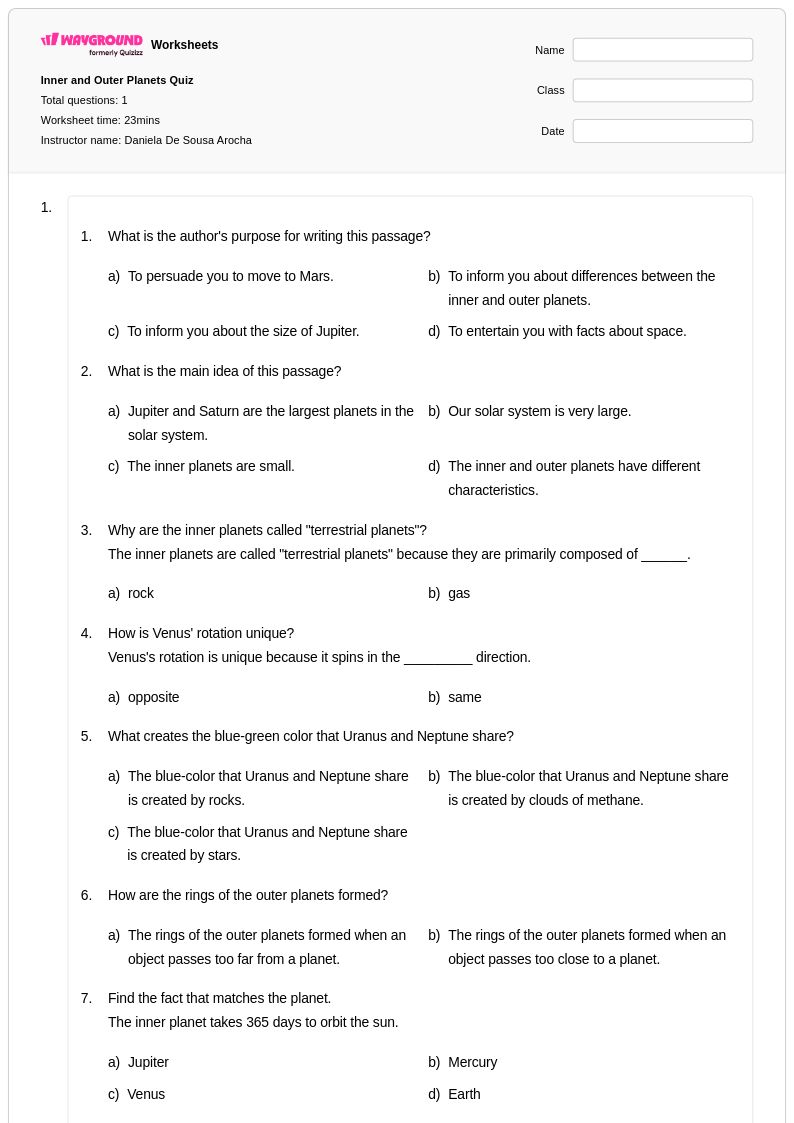
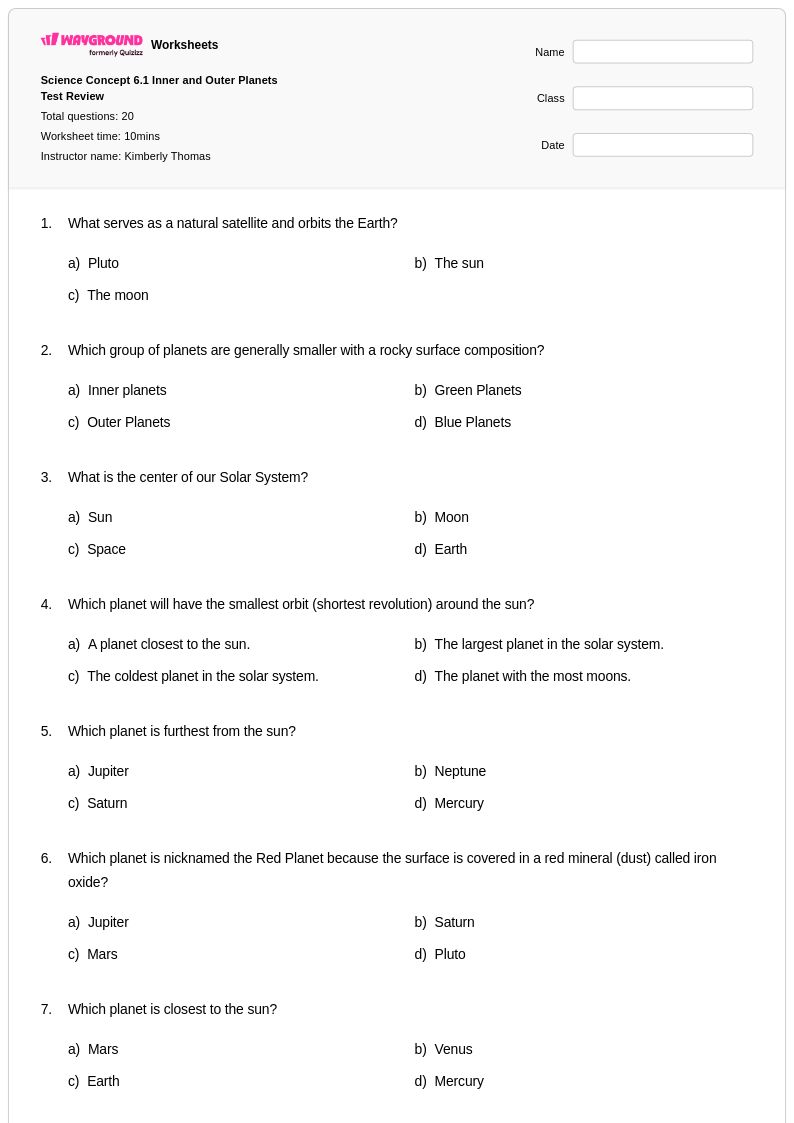
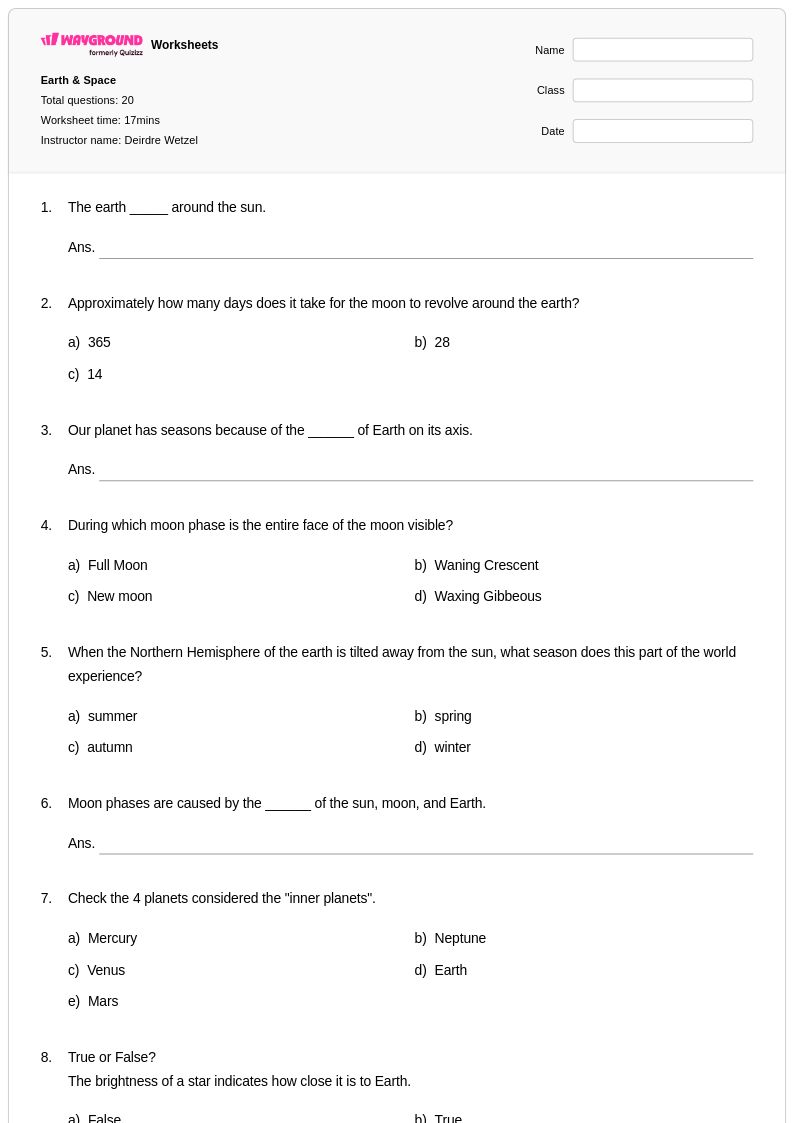
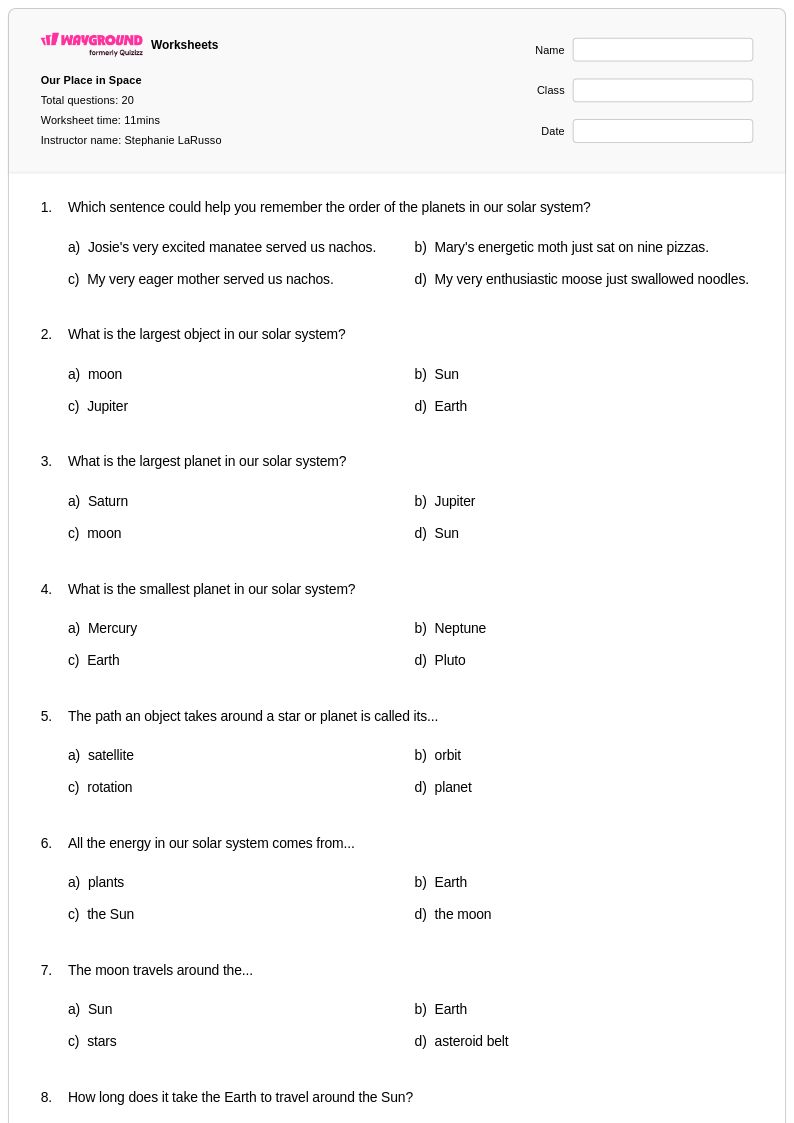
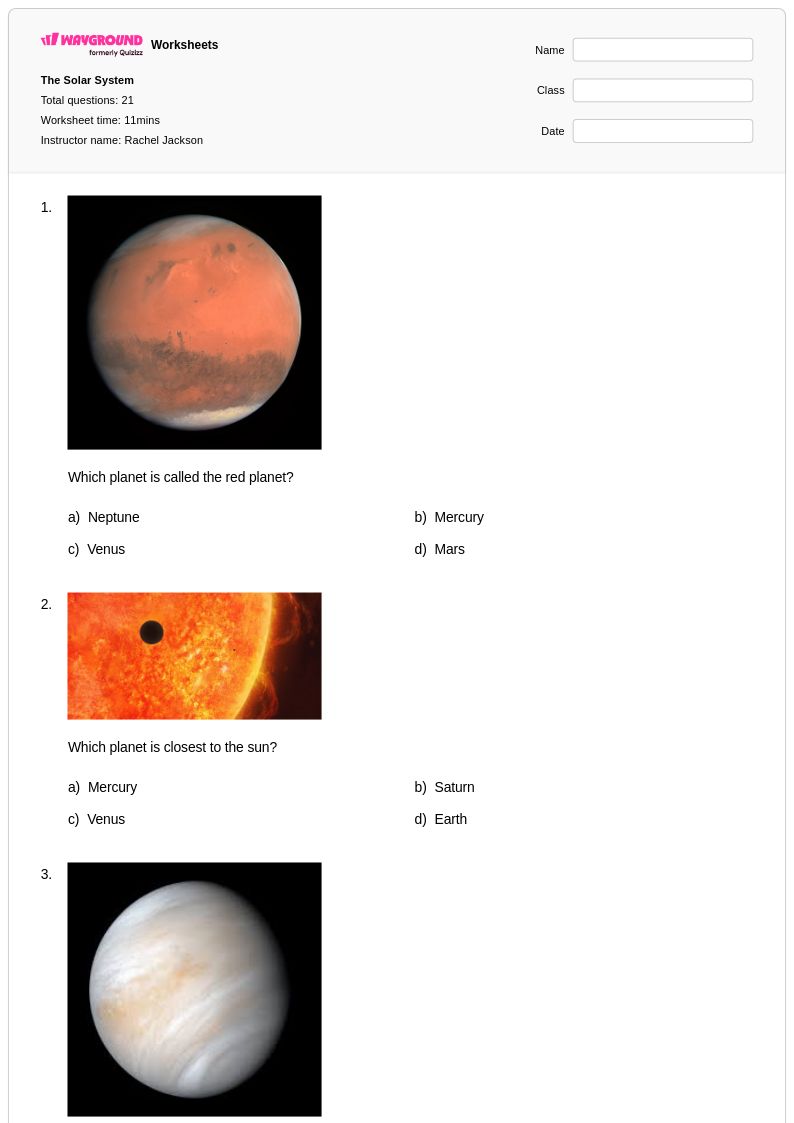
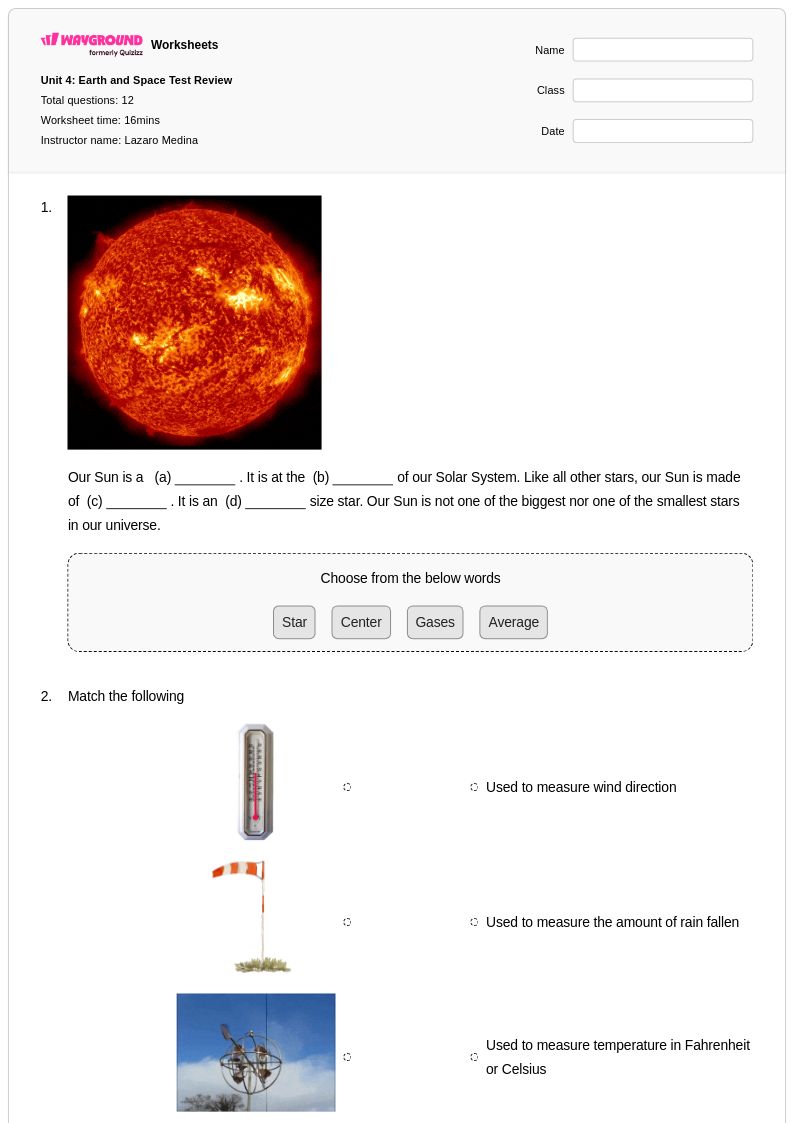
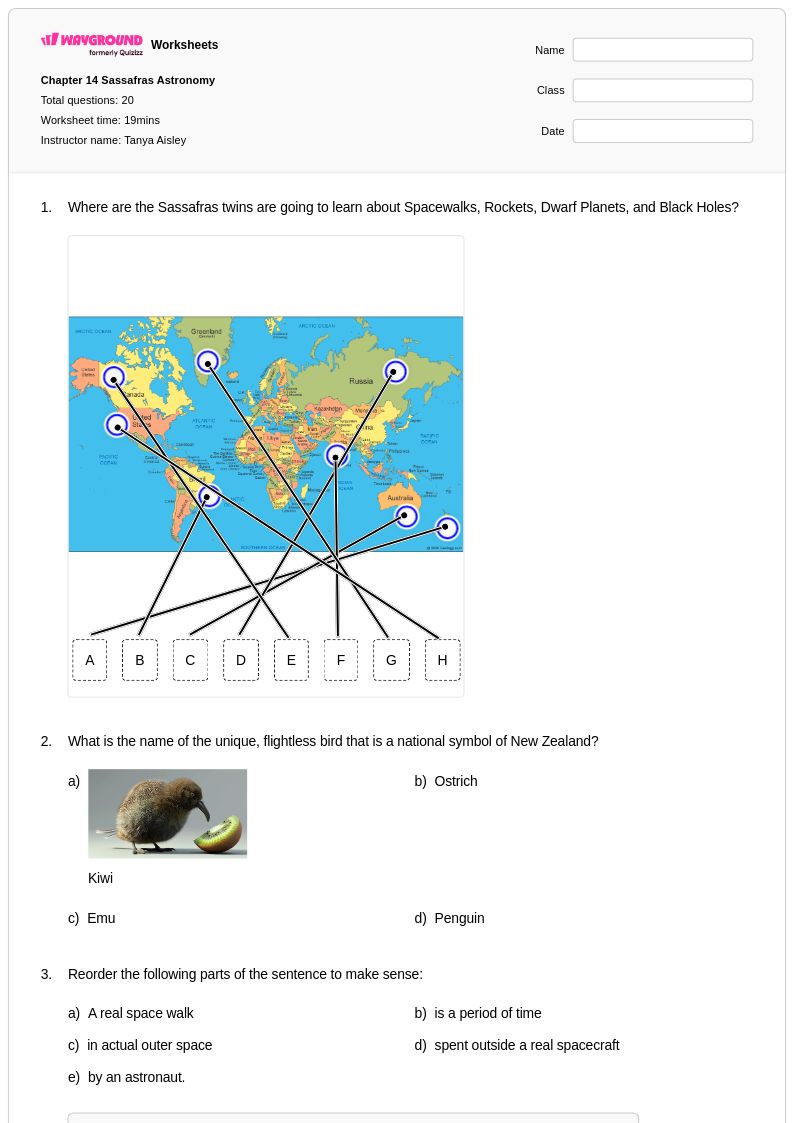
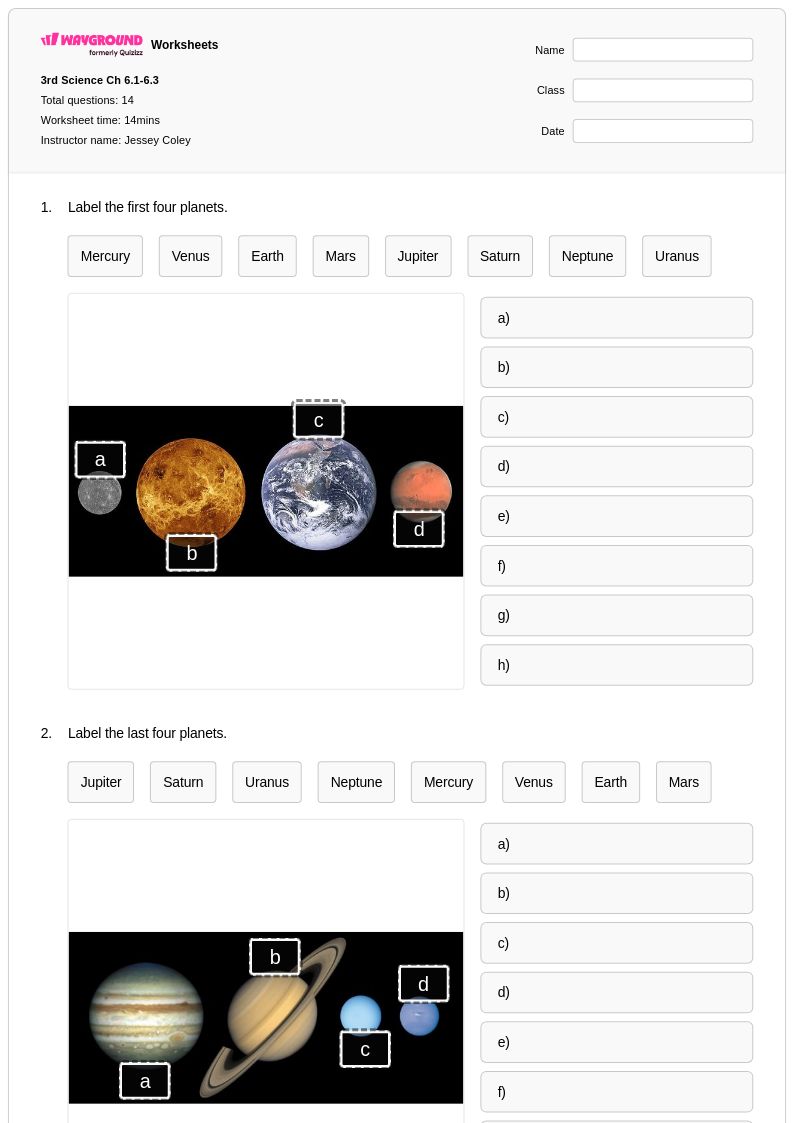
Explore Grade 3 outer space printables and free worksheets from Wayground that help students discover planets, stars, and galaxies through engaging practice problems with complete answer keys.
Explore printable Outer Space worksheets for Grade 3
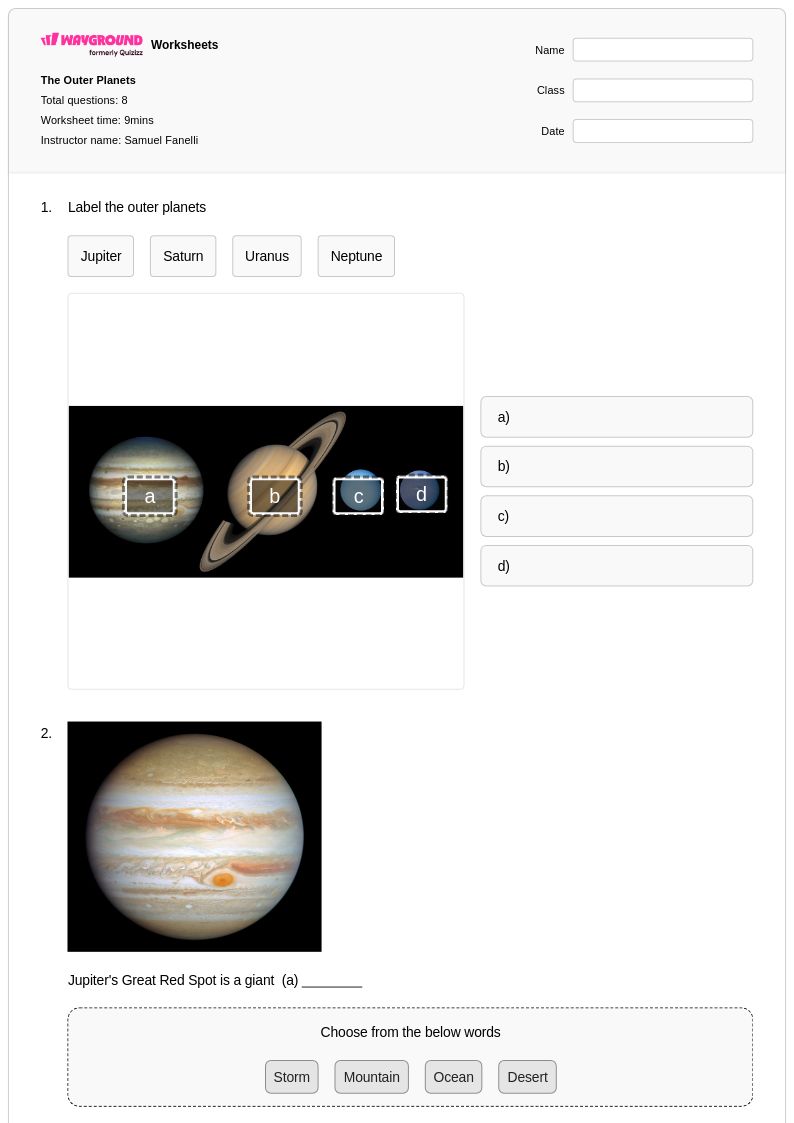
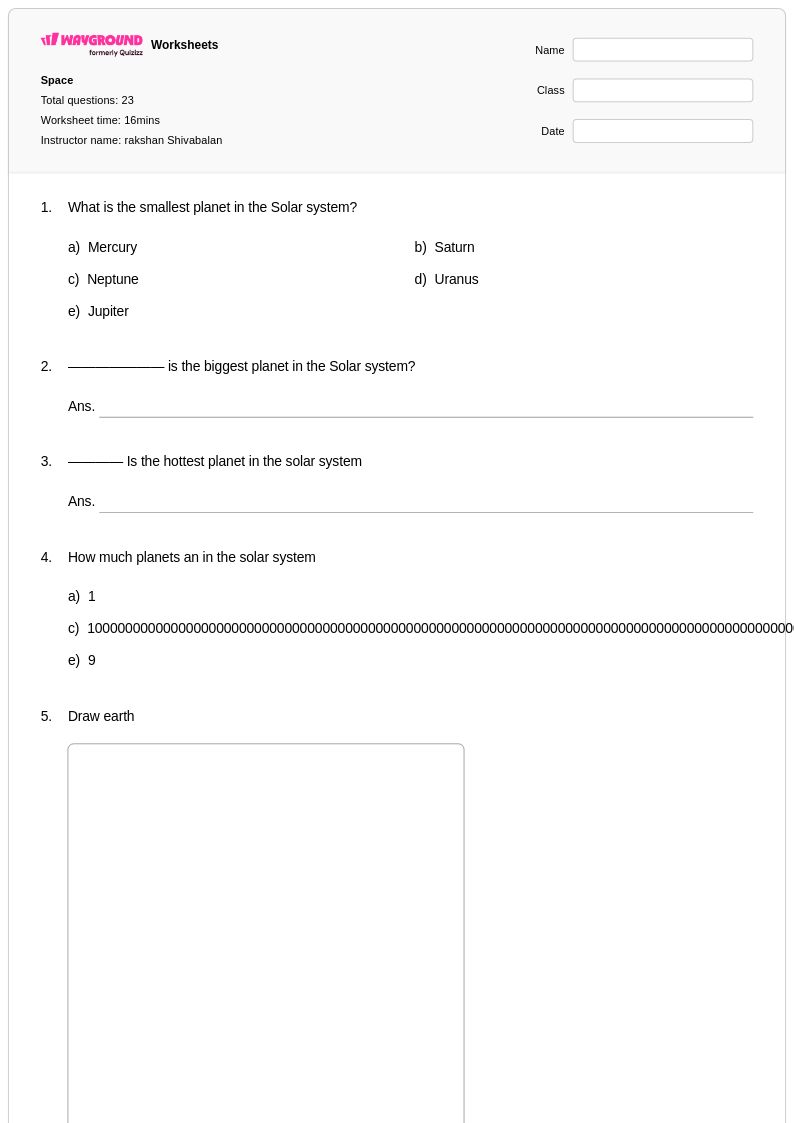
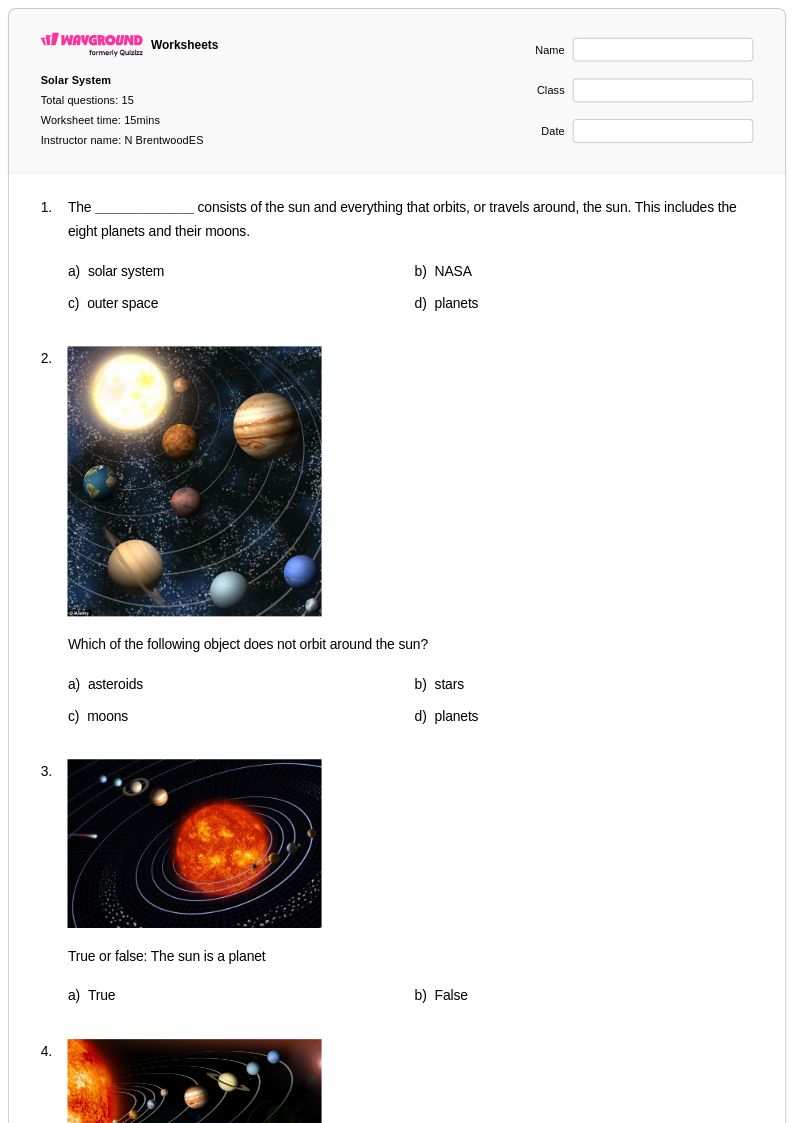
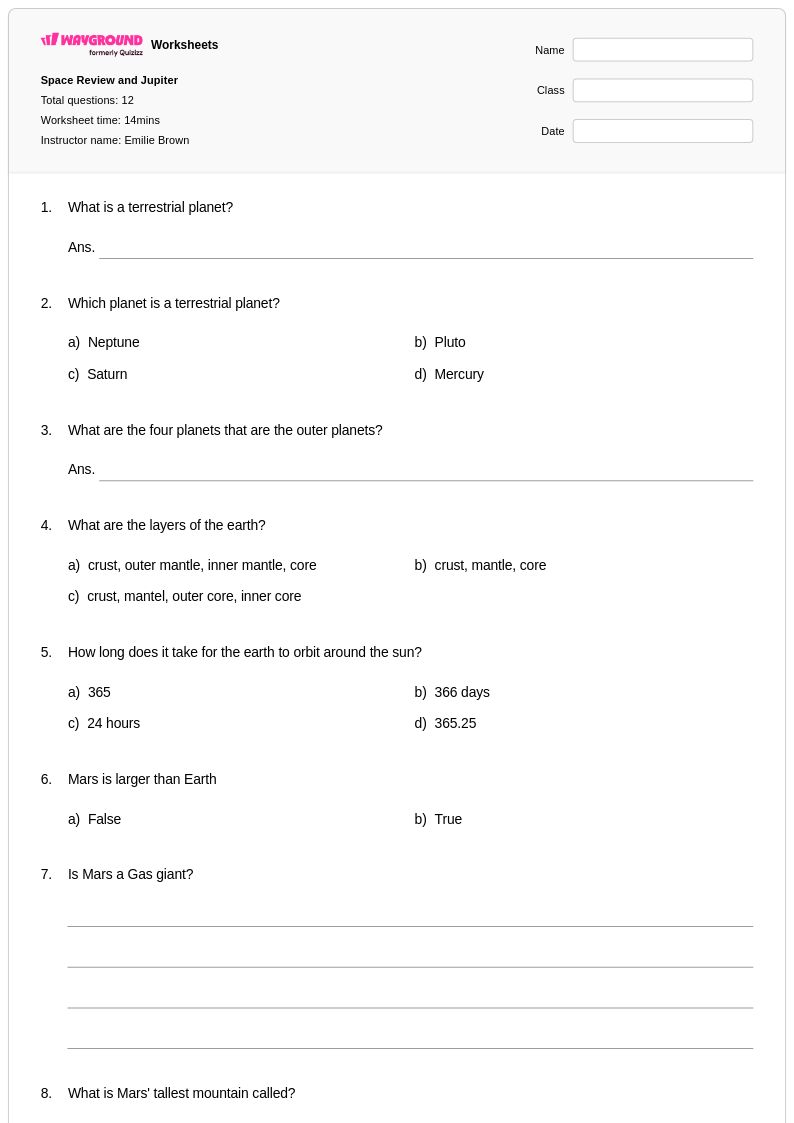
Grade 3 outer space worksheets available through Wayground (formerly Quizizz) provide young learners with engaging opportunities to explore the fascinating world beyond Earth's atmosphere. These carefully designed educational resources help students develop foundational knowledge about planets, stars, moons, and other celestial bodies while strengthening essential scientific observation and inquiry skills. Each worksheet focuses on age-appropriate concepts such as identifying different planets in our solar system, understanding day and night cycles, and recognizing basic characteristics of the sun, moon, and stars. The comprehensive collection includes practice problems that encourage critical thinking about space phenomena, complemented by answer keys that support both independent learning and teacher-guided instruction. These free printables serve as valuable tools for reinforcing classroom lessons and building scientific vocabulary related to astronomical concepts that capture third-grade students' natural curiosity about the universe.
Wayground (formerly Quizizz) empowers educators with an extensive library of millions of teacher-created outer space resources specifically curated for Grade 3 learners. The platform's robust search and filtering capabilities enable teachers to quickly locate worksheets that align with specific learning standards and curriculum requirements, while differentiation tools allow for seamless customization based on individual student needs and abilities. These versatile materials are available in both printable pdf format and interactive digital versions, providing flexibility for various classroom environments and teaching approaches. Teachers can effectively utilize these resources for lesson planning, targeted skill practice, remediation for struggling learners, and enrichment activities for advanced students, ensuring that all third-graders can successfully engage with fundamental outer space concepts at their appropriate learning level.
FAQs
How do I teach outer space concepts to students at different grade levels?
Start with concrete, observable phenomena before moving to abstract concepts. Early grades benefit from planet identification, ordering the solar system, and Moon phase observation, while upper grades can tackle stellar lifecycles, galaxy formation, and gravitational mechanics. Anchoring lessons in visual diagrams and real data comparisons helps students build accurate mental models before tackling cause-and-effect relationships like why seasons occur or how eclipses form.
What worksheets help students practice solar system and space science skills?
Effective outer space practice sequences begin with identifying and ordering planets, then progress to explaining observable phenomena such as seasons, lunar phases, and eclipses based on Earth-Moon-Sun spatial relationships. Diagram interpretation and data comparison activities are especially useful for developing the analytical skills students need to connect abstract orbital mechanics to real-world observations. Worksheets that include cause-and-effect analysis reinforce deeper conceptual understanding beyond simple memorization.
What are the most common misconceptions students have about outer space?
The most persistent misconception is that Earth's seasons are caused by its changing distance from the Sun rather than axial tilt. Students also frequently confuse rotation with revolution, misapplying both terms when describing planetary and lunar motion. A third common error is believing the Moon generates its own light rather than reflecting sunlight, which can distort understanding of Moon phases and eclipses.
How do I use outer space worksheets to address the seasons misconception specifically?
Directly target this misconception by presenting data showing Earth is actually closer to the Sun during Northern Hemisphere winter, which contradicts the distance-based explanation students assume. Diagrams that emphasize Earth's axial tilt at different orbital positions are more effective than text alone. Follow up with cause-and-effect questions that require students to explain why the Southern Hemisphere experiences summer when the Northern Hemisphere experiences winter, which reinforces tilt as the causal mechanism.
How do Wayground outer space worksheets work, and what formats are available?
Wayground outer space worksheets are available as printable PDFs for traditional classroom use and in digital formats for technology-integrated learning environments, including interactive quizzes hosted directly on Wayground. Each worksheet includes detailed answer keys, and resources are searchable by grade, concept, and science standard. The platform also supports student-level accommodations such as extended time, read aloud, and reduced answer choices, making it straightforward to differentiate for diverse learners within the same assignment.
How can I differentiate outer space worksheets for students who need extra support or enrichment?
For struggling students, begin with identification and sequencing tasks before introducing explanatory or analytical questions, and use Wayground's read aloud and reduced answer choice accommodations to lower access barriers without altering content expectations. Advanced students benefit from data analysis tasks involving stellar classification, galaxy types, or comparative planetary science that require synthesis rather than recall. Wayground's customizable content supports remediation through enrichment levels within the same resource library.