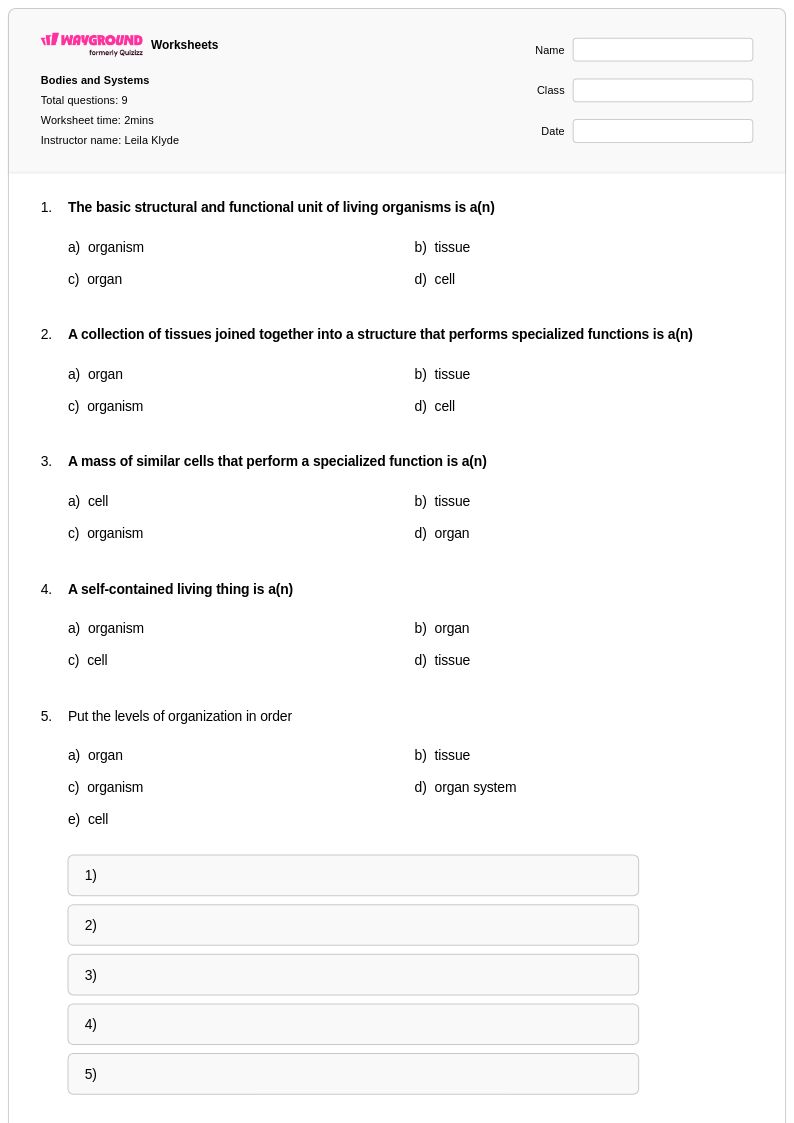
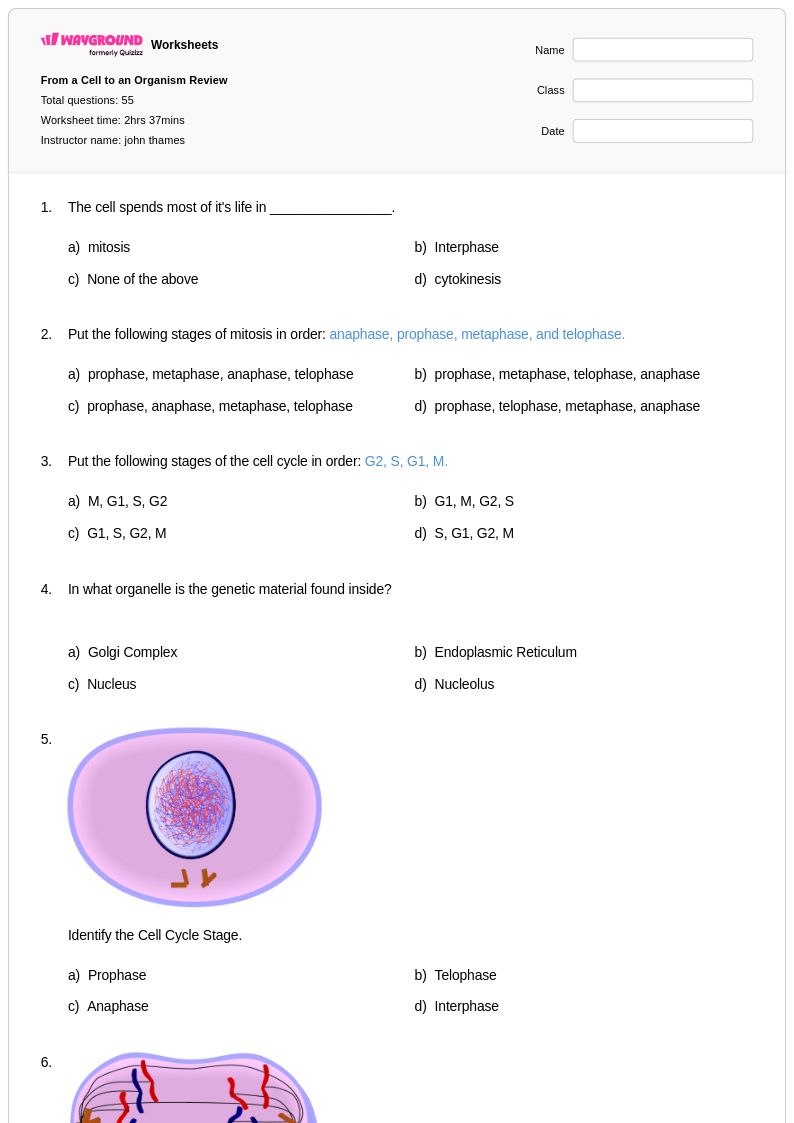
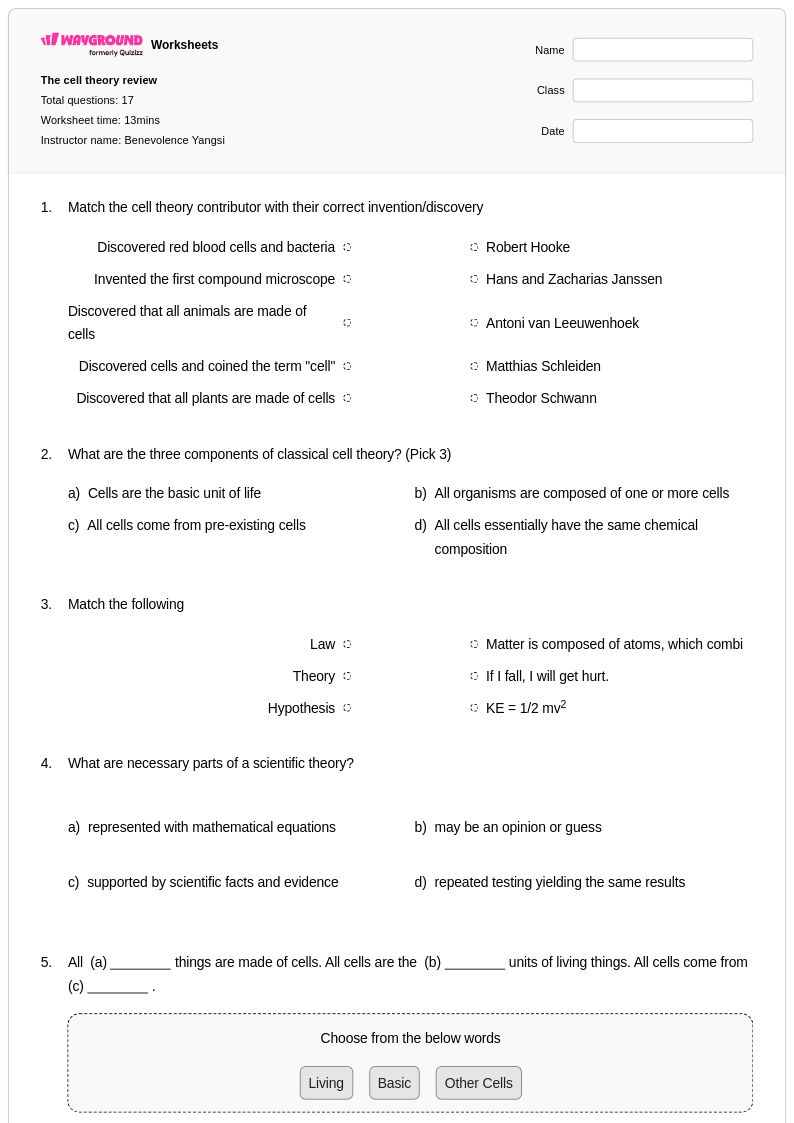
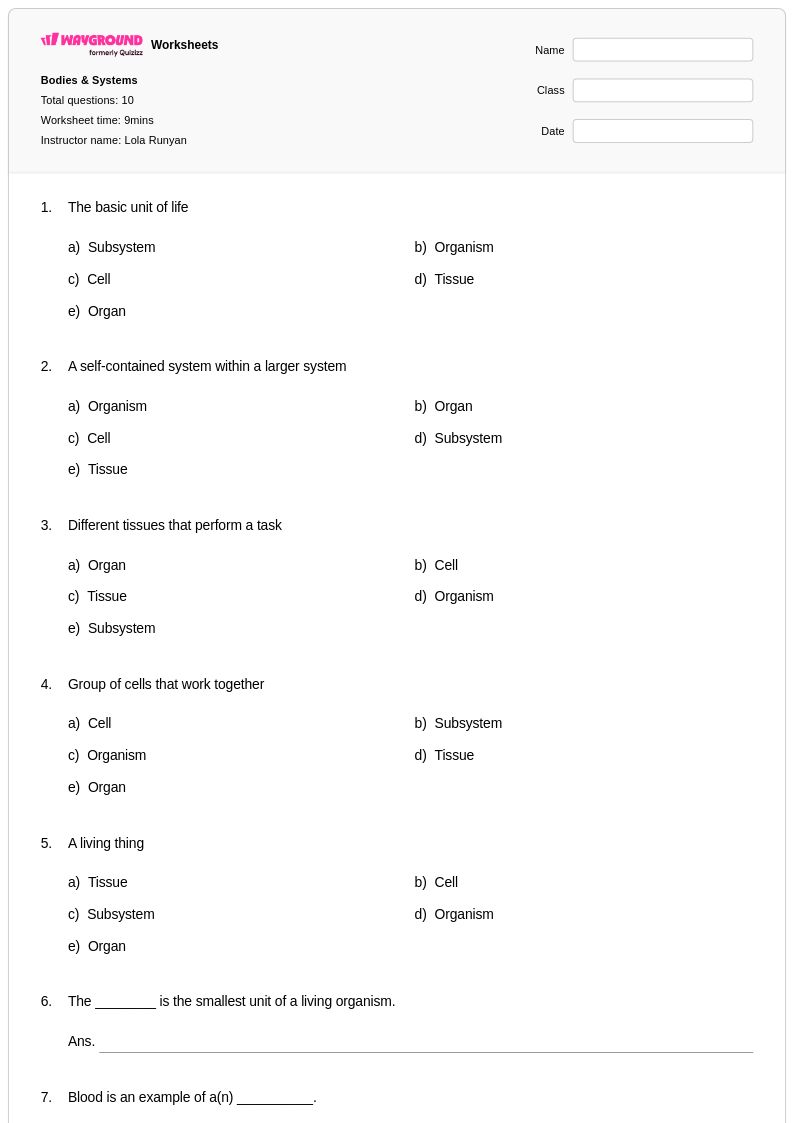
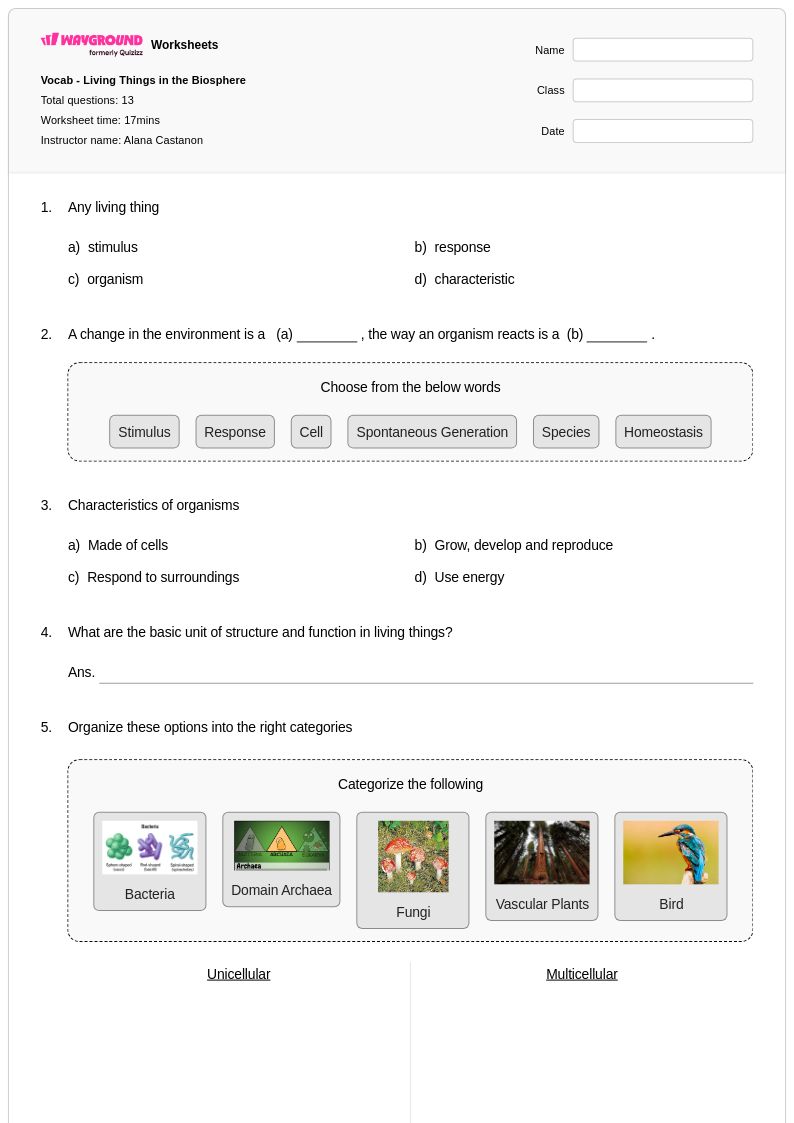
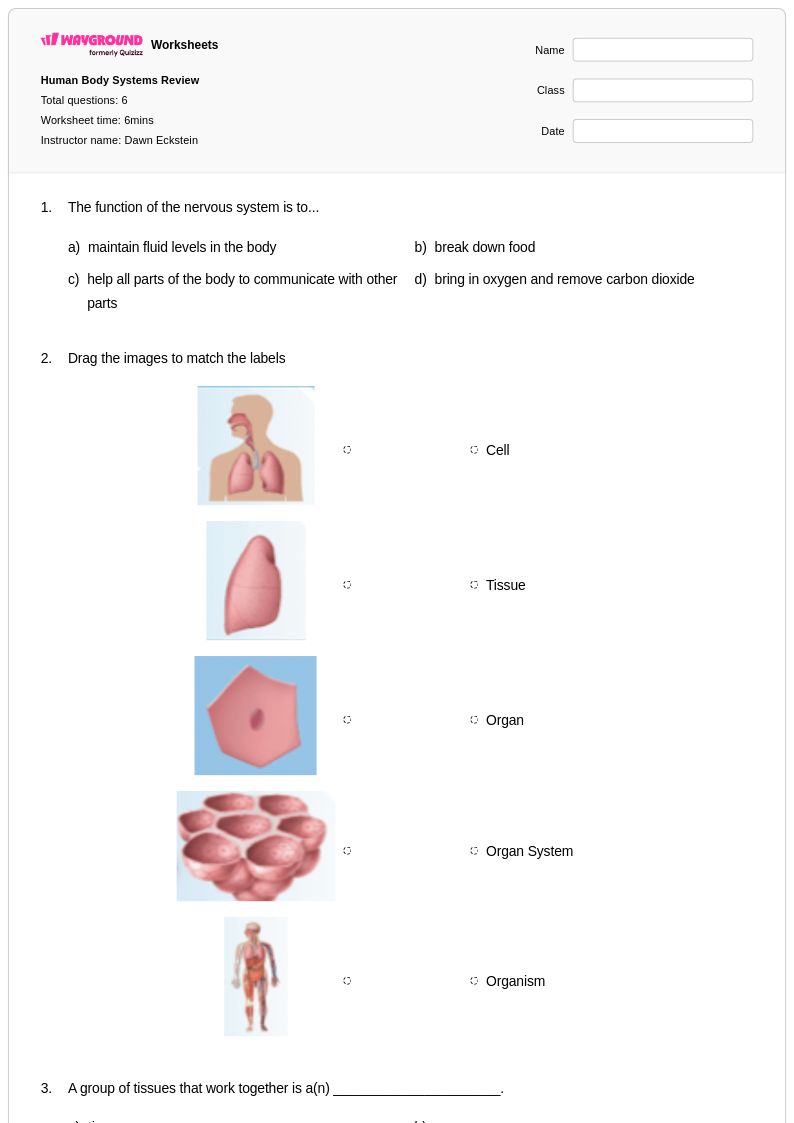
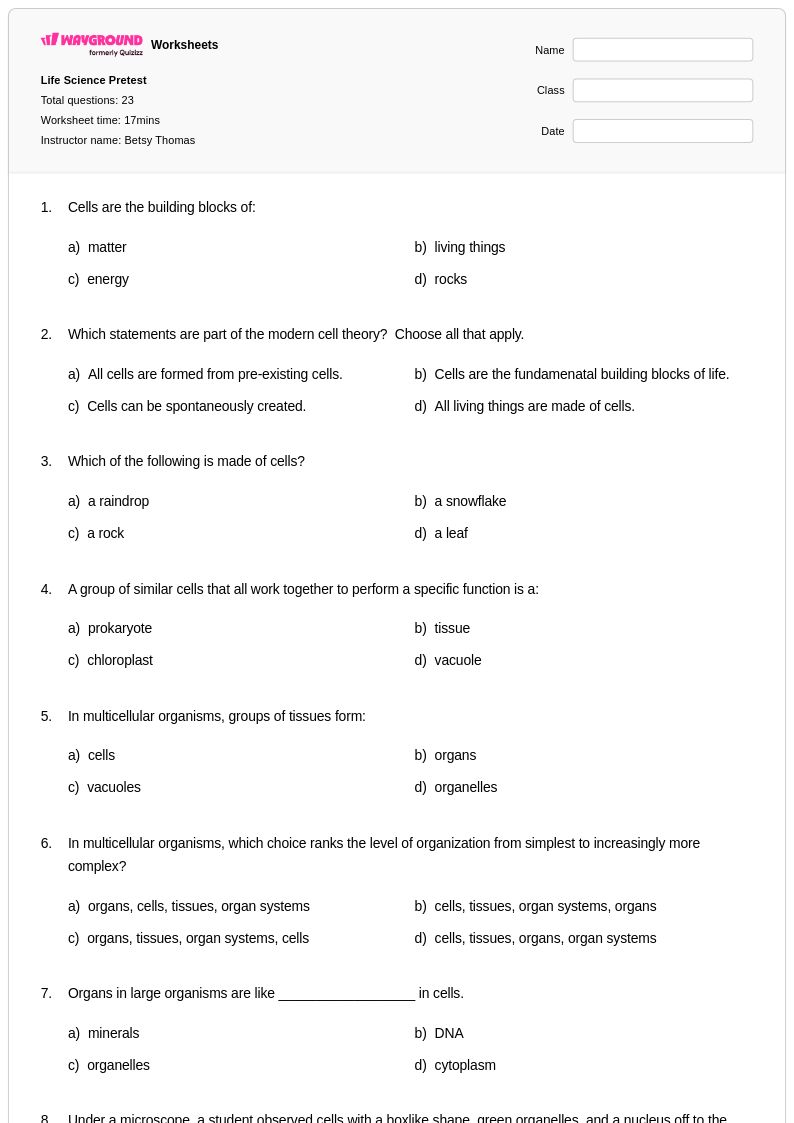
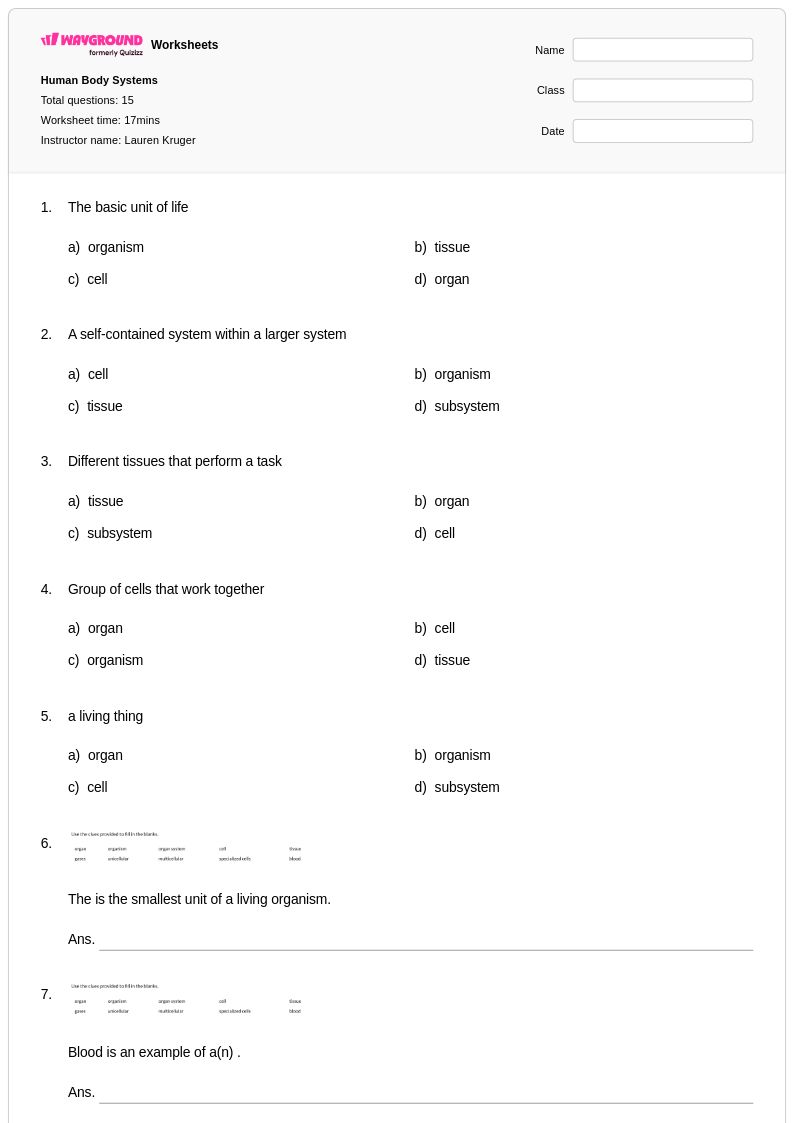
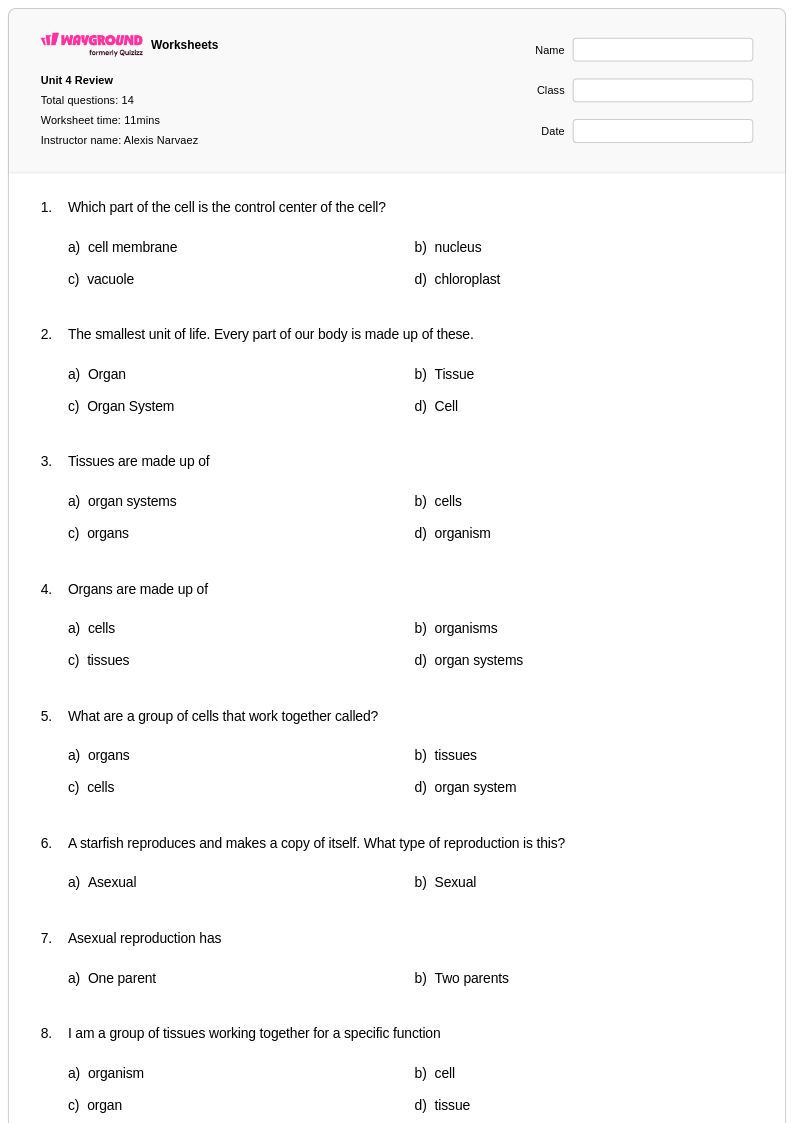
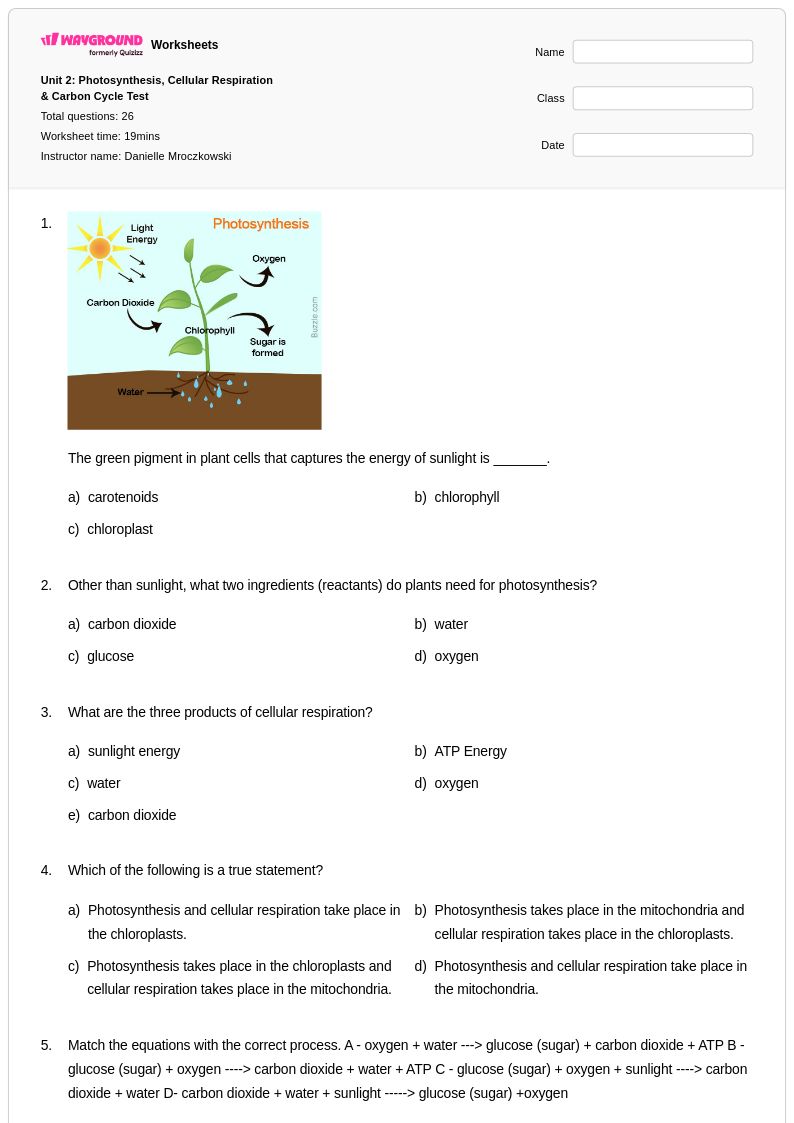
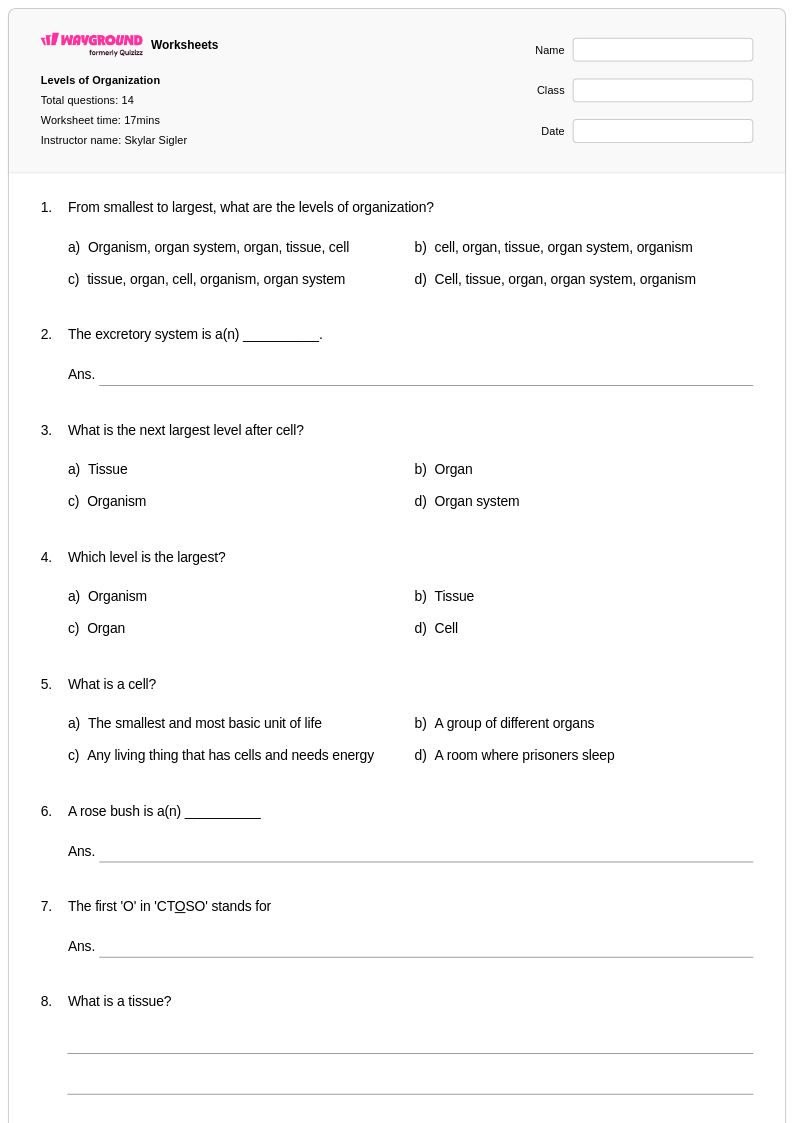
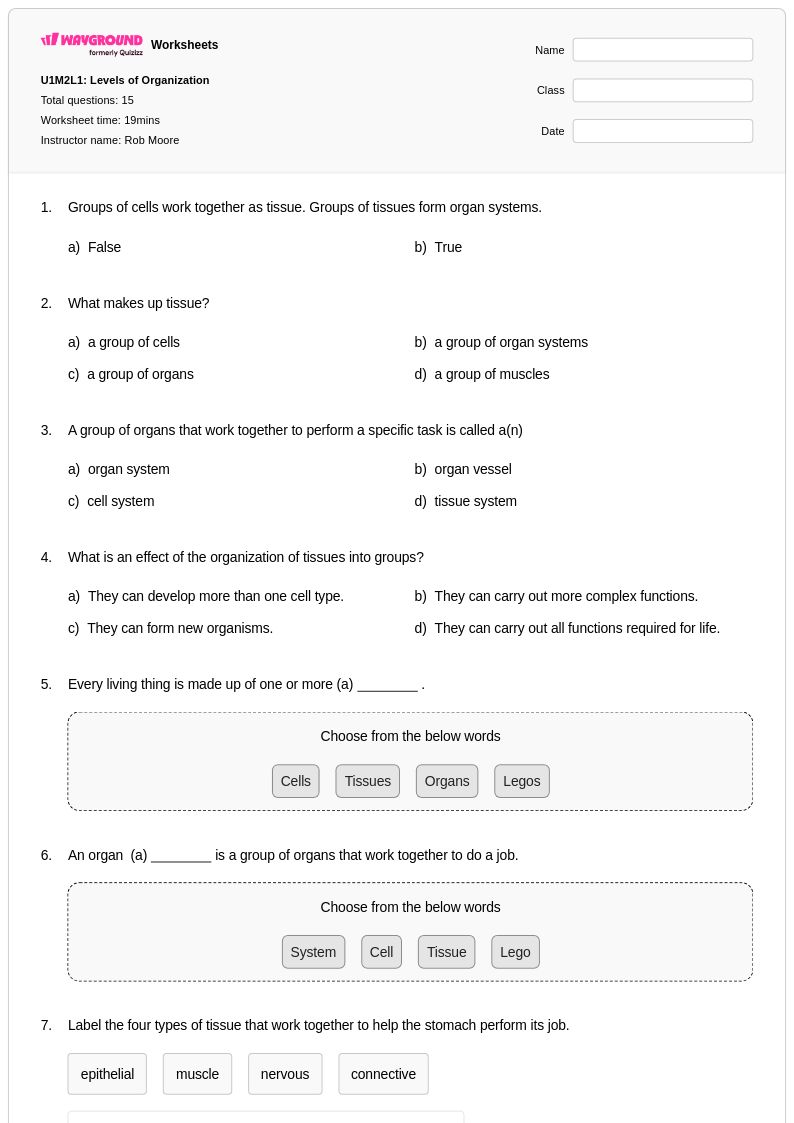
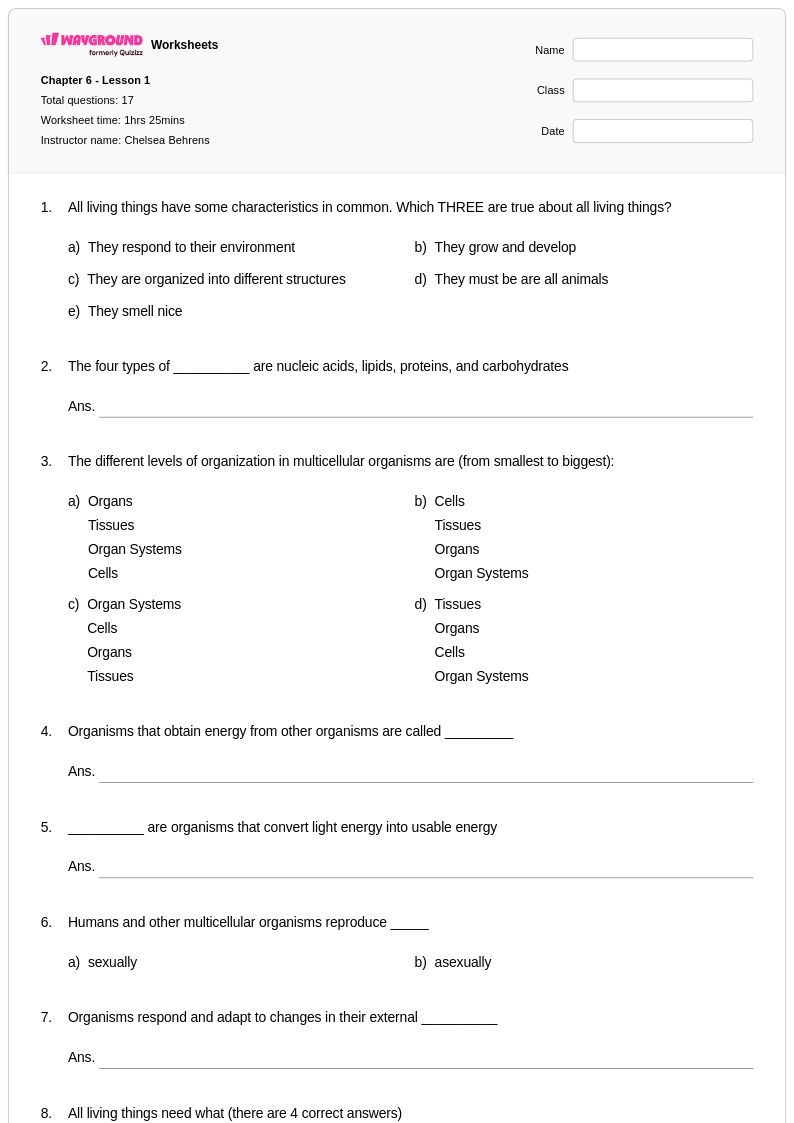
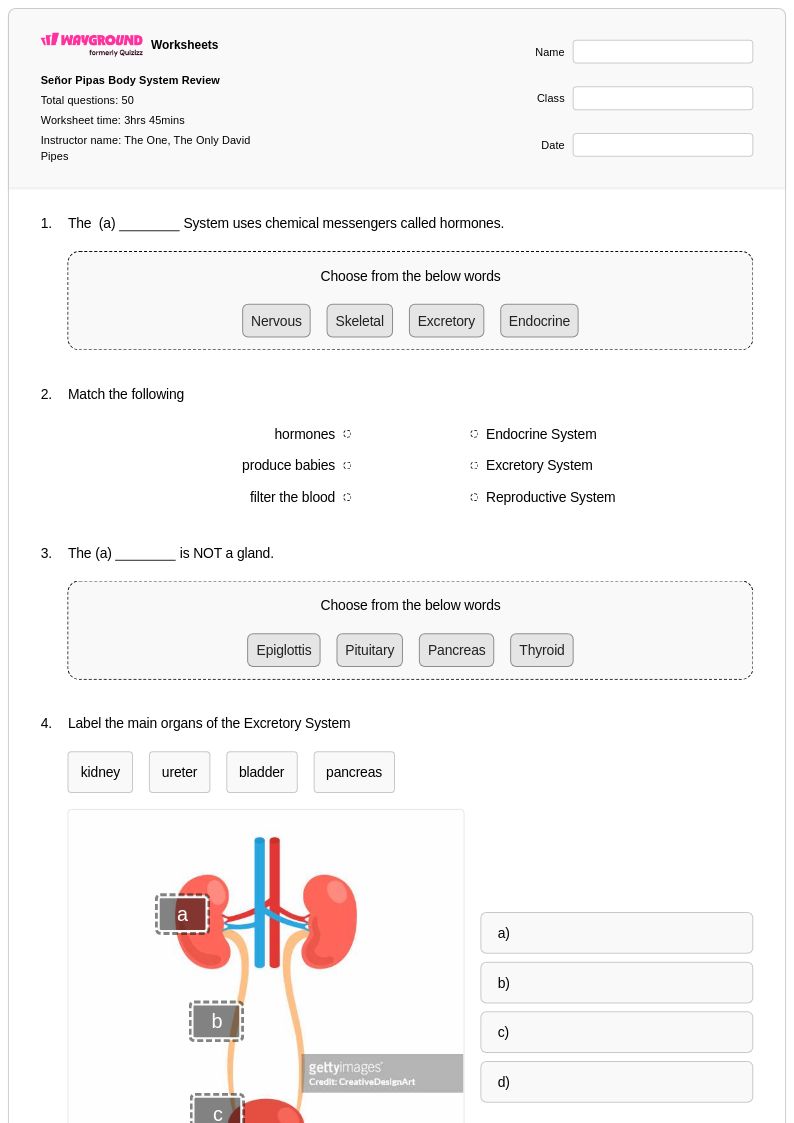
Explore Wayground's comprehensive collection of Grade 6 biology tissues worksheets, featuring free printables and practice problems with answer keys to help students master cellular organization and tissue types.
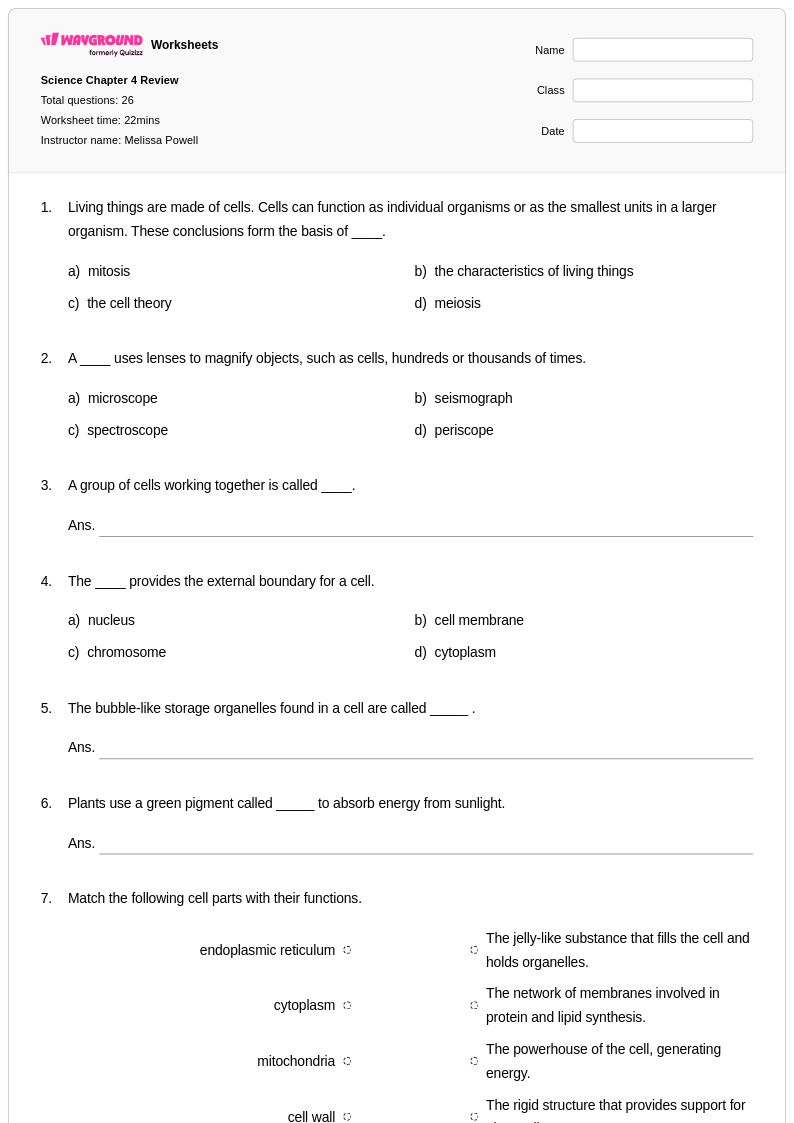
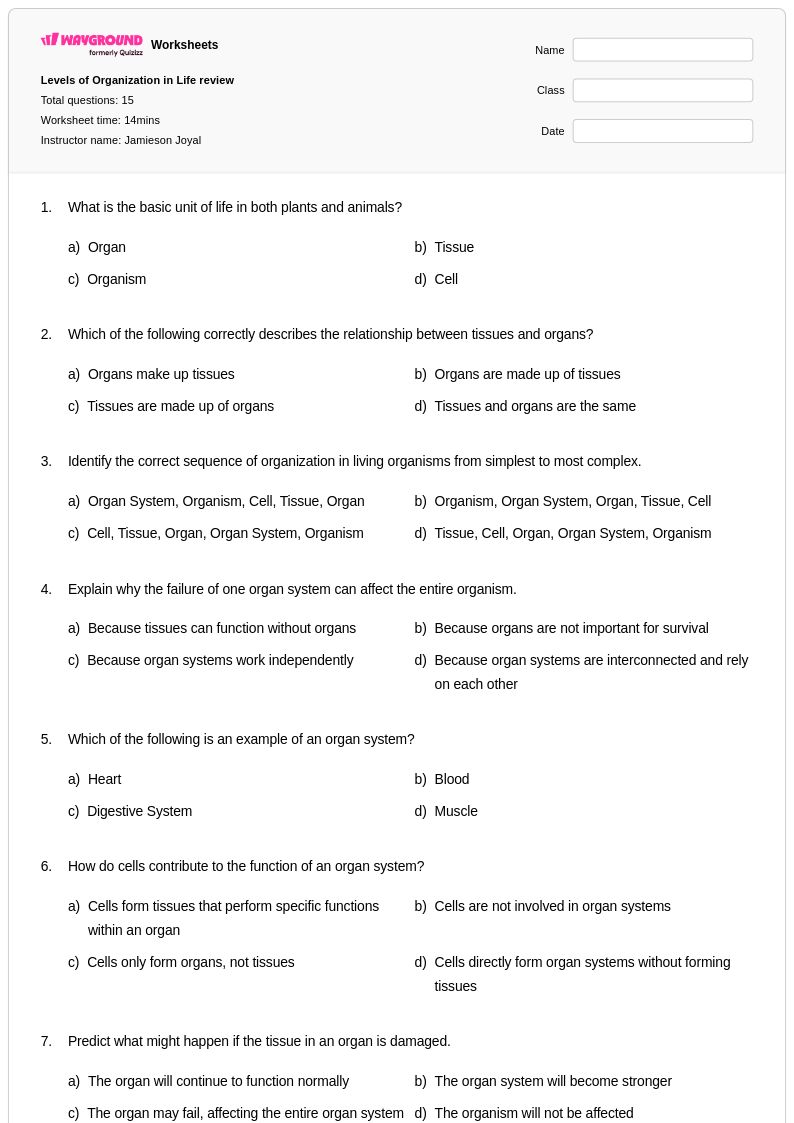
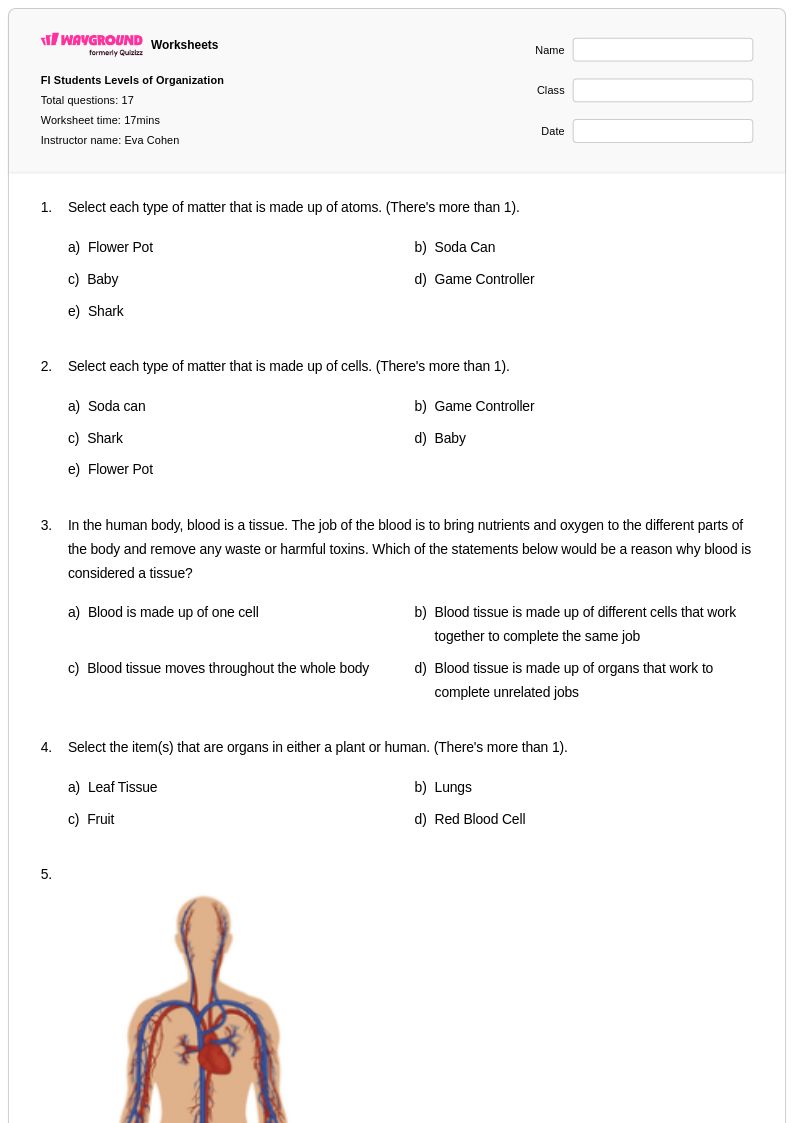
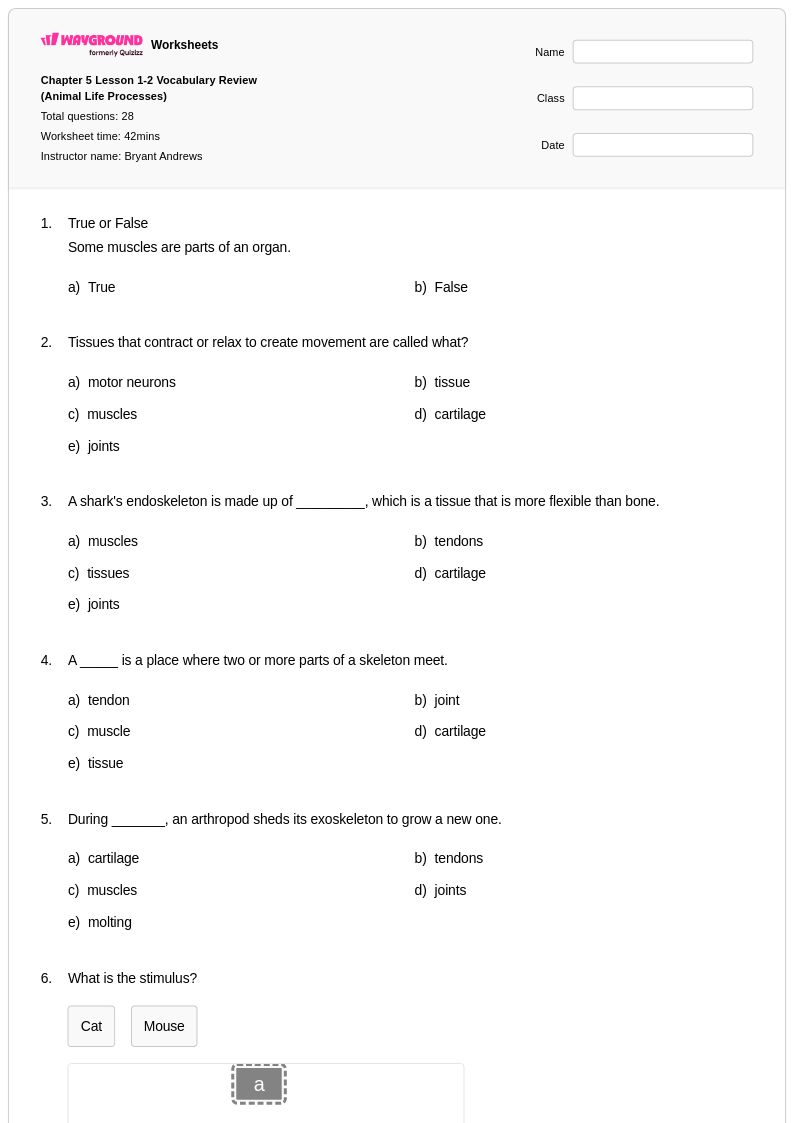
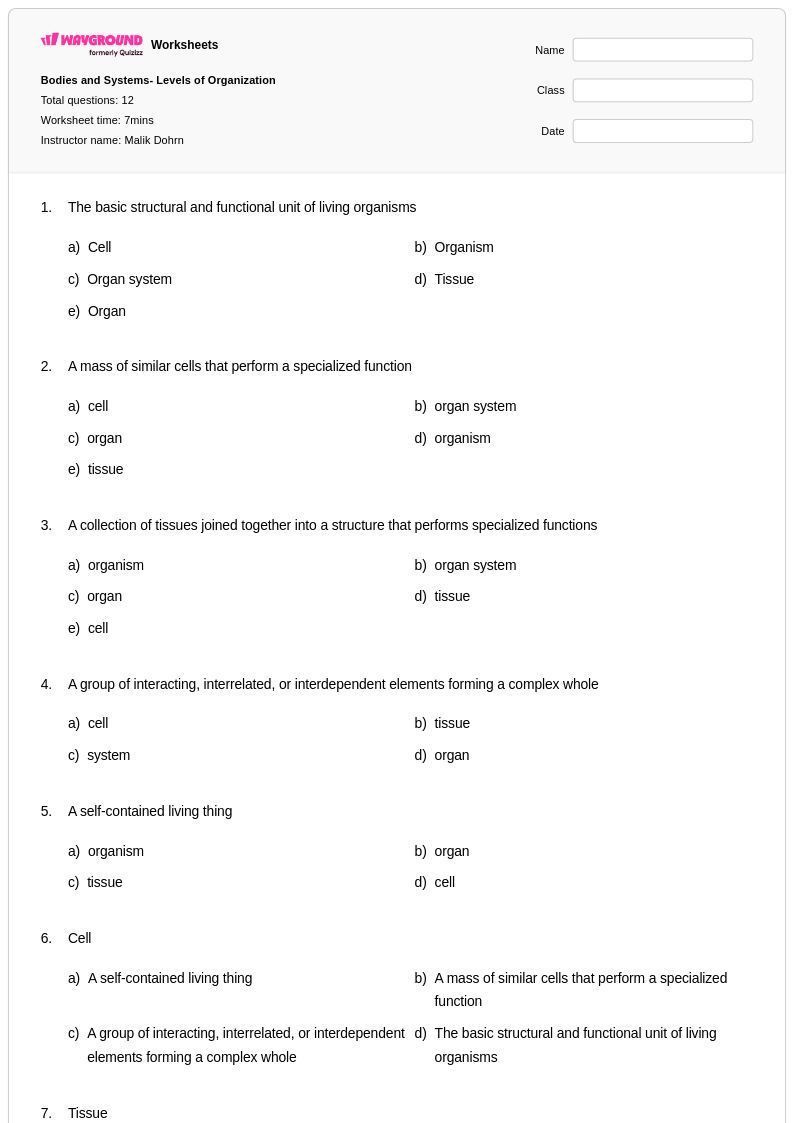
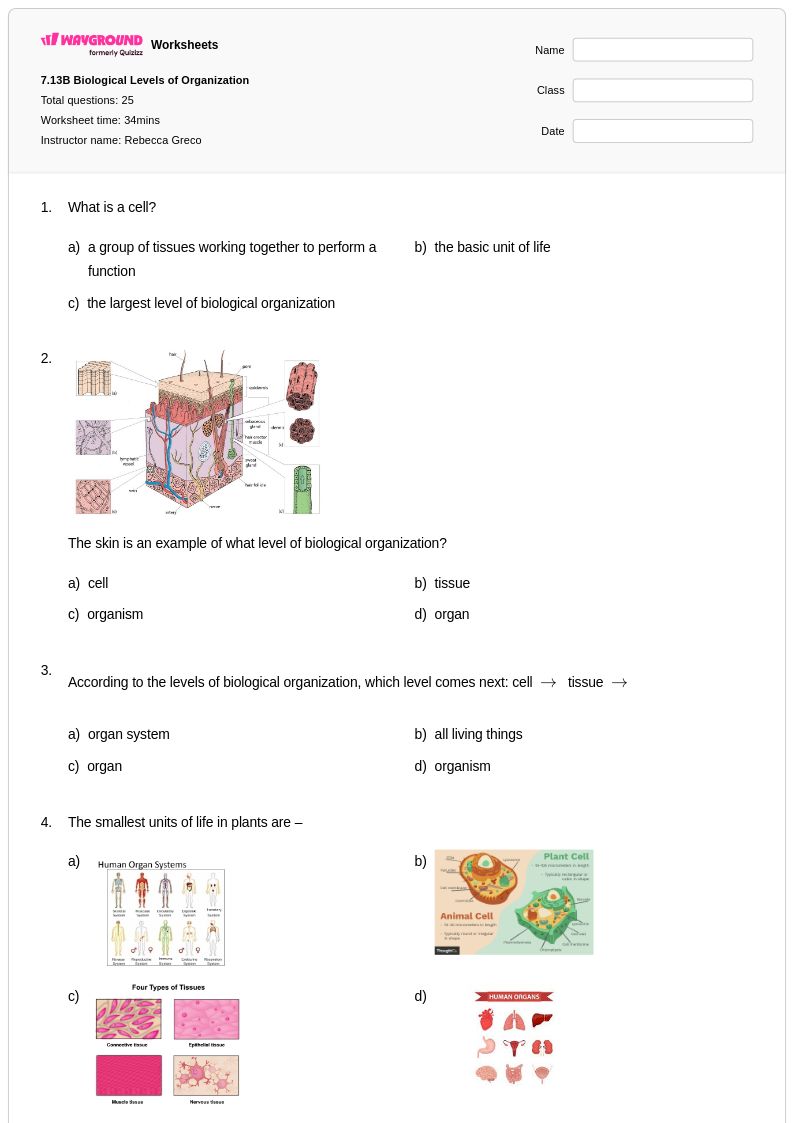
Grade 6 tissues worksheets available through Wayground (formerly Quizizz) provide comprehensive coverage of this fundamental biology concept, helping students understand how groups of similar cells work together to perform specific functions in living organisms. These educational resources strengthen critical thinking skills as students learn to identify and classify the four main tissue types in animals - epithelial, connective, muscle, and nervous tissues - while exploring their unique structures and functions. The worksheet collection includes detailed practice problems that guide students through tissue identification exercises, comparative analysis activities, and real-world applications of tissue science. Each printable resource comes with a complete answer key, making it easy for educators to assess student understanding and provide immediate feedback. These free materials are designed as pdf downloads, ensuring convenient access for both classroom instruction and independent study sessions.
Wayground's extensive tissue worksheet library draws from millions of teacher-created resources, offering educators powerful search and filtering capabilities to locate materials that perfectly match their Grade 6 biology curriculum requirements. The platform's standards alignment features ensure that tissue-related content meets educational benchmarks, while differentiation tools allow teachers to customize worksheets for students with varying ability levels and learning needs. Educators can seamlessly transition between printable pdf formats for traditional classroom use and digital versions for interactive learning experiences. These flexible resources support comprehensive lesson planning by providing materials suitable for initial concept introduction, skill practice reinforcement, targeted remediation for struggling learners, and enrichment activities for advanced students, ultimately creating a robust foundation for understanding how tissues function as building blocks of organ systems.
FAQs
How do I teach the four types of tissues in a biology class?
Start by grounding students in the idea that tissues are groups of similar cells working together to perform a specific function, then introduce the four types — epithelial, connective, muscle, and nervous — one at a time with concrete examples from the human body. Use microscopic images alongside diagrams so students can connect what tissue looks like at the cellular level to what it does structurally and functionally. Building a comparison chart as a class activity helps students see how each tissue type differs in structure, location, and role before they practice independently.
What exercises help students practice identifying tissue types?
The most effective practice exercises ask students to examine microscopic images and classify the tissue shown, explain their reasoning using structural features like cell shape, layering, and matrix presence. Labeling diagrams, matching tissue types to their functions, and completing structure-function relationship problems all reinforce classification skills at different cognitive levels. Worksheets that include both image-based and written questions give students multiple entry points for demonstrating understanding.
What mistakes do students commonly make when classifying tissues?
One of the most frequent errors is confusing connective tissue subtypes — students often struggle to distinguish between loose connective tissue, dense connective tissue, cartilage, and bone because the category is so broad. Another common misconception is conflating muscle tissue types, particularly smooth and cardiac muscle, since both are involuntary and students frequently mix up their structural features. Targeted practice problems that isolate these distinctions, especially those using microscope images with similar-looking samples, are effective at correcting these patterns.
How do I help students connect tissue structure to tissue function?
Students need repeated exposure to the principle that biological structure determines function, applied specifically at the tissue level — for example, the flat, tightly packed cells of simple squamous epithelium are suited for diffusion and filtration, while the long, striated fibers of skeletal muscle reflect its role in generating forceful contractions. Asking students to justify their tissue identifications using structural evidence rather than memorized labels builds this analytical habit. Practice problems that present an unfamiliar tissue and ask students to predict its function based on structure are particularly effective.
How do I use Wayground's tissues worksheets in my classroom?
Wayground's tissues worksheets are available as printable PDFs for traditional classroom use and in digital formats for technology-integrated or remote learning environments, including the option to host them as a quiz directly on Wayground. Each worksheet includes a complete answer key, allowing teachers to use them for guided practice, independent review, or formative assessment without additional preparation. The platform's filtering tools let teachers quickly locate worksheets aligned to specific tissue types, difficulty levels, or curriculum standards, making it straightforward to match materials to exactly where students are in the unit.
How can I differentiate tissues instruction for students with different learning needs?
For students who need additional support, reducing the number of answer choices on identification questions lowers cognitive load while keeping the core concept intact. Wayground supports per-student accommodations including read aloud, extended time, reduced answer choices, and adjustable reading modes — all configurable individually so the rest of the class is unaffected. For advanced learners, enrichment problems that ask students to analyze unfamiliar tissue samples or connect tissue pathology to structural changes push beyond recall into genuine biological reasoning.