

19 Q
7th - Uni
15 Q
7th

17 Q
7th - Uni

20 Q
8th

20 Q
7th

20 Q
7th

17 Q
7th

14 Q
7th

19 Q
7th

9 Q
7th - Uni

15 Q
7th

14 Q
7th - Uni

20 Q
7th - Uni

14 Q
6th - 7th

13 Q
6th - 7th

16 Q
6th - 8th

20 Q
7th - Uni

10 Q
7th

15 Q
7th

10 Q
6th - 8th

16 Q
7th

5 Q
6th - 7th

10 Q
6th - 7th
30 Q
6th
Explore Worksheets by Subjects
Explore printable Additive Inverse worksheets
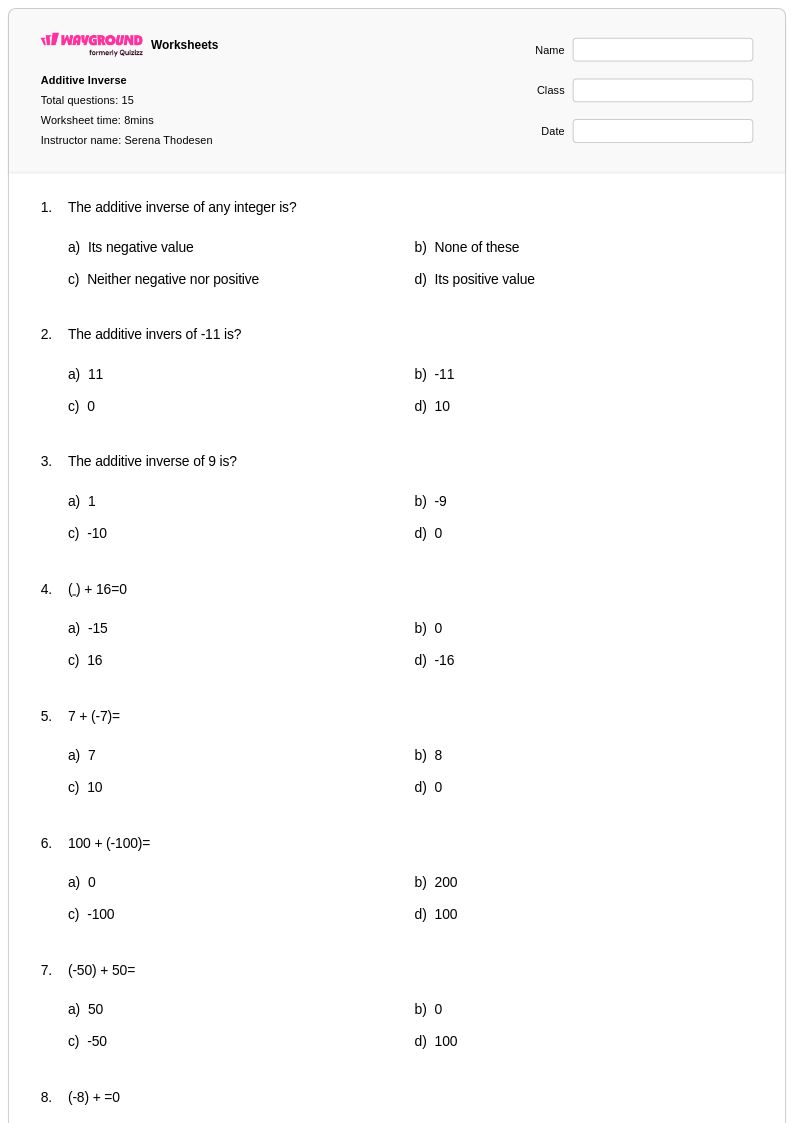
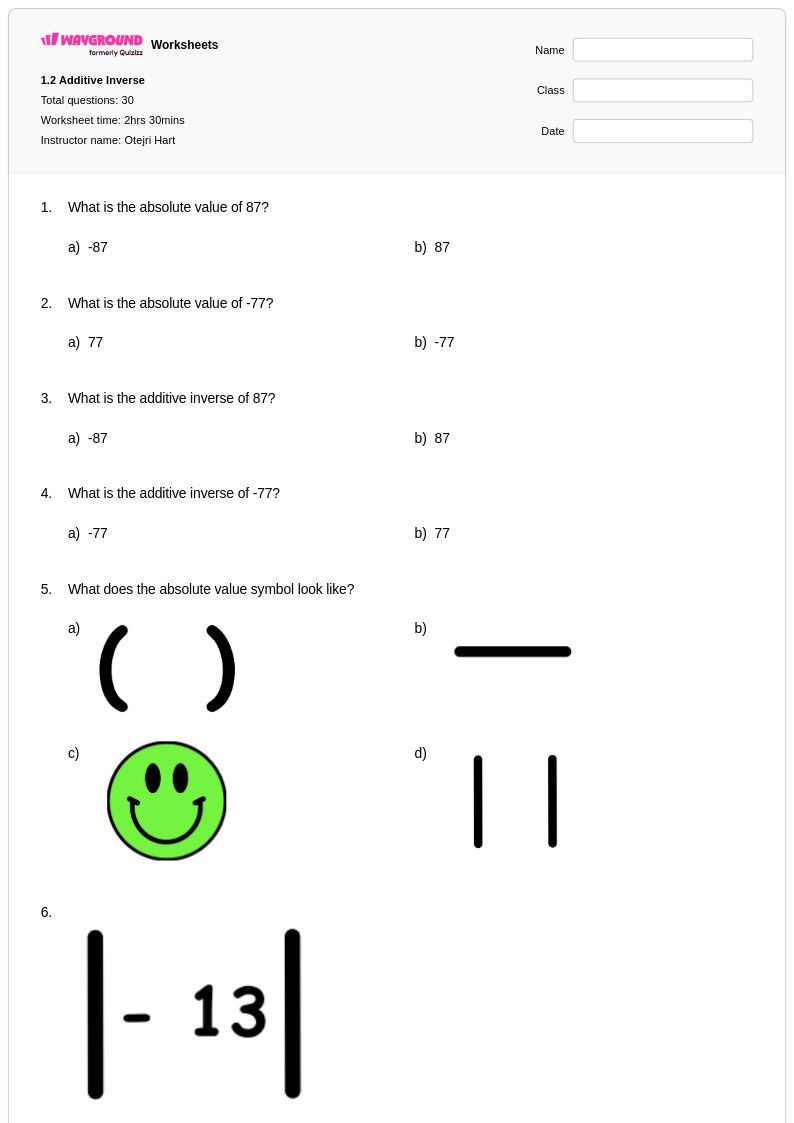
Additive inverse worksheets available through Wayground (formerly Quizizz) provide comprehensive practice with this fundamental mathematical concept that forms the foundation of algebraic thinking and equation solving. These carefully designed resources help students master the understanding that every number has an opposite, such that when added together, they equal zero, strengthening critical number sense and mathematical reasoning skills. The worksheet collections feature systematic practice problems that guide learners through identifying additive inverses, applying the concept in various mathematical contexts, and recognizing the relationship between positive and negative numbers. Each printable resource includes detailed answer keys that support both independent study and classroom instruction, while the free pdf format ensures easy accessibility for teachers seeking quality materials to reinforce this essential mathematical principle.
Wayground (formerly Quizizz) empowers educators with an extensive library of millions of teacher-created additive inverse worksheets that can be seamlessly integrated into mathematics instruction across multiple learning environments. The platform's robust search and filtering capabilities enable teachers to quickly locate resources that align with specific curriculum standards and match their students' diverse skill levels, while built-in differentiation tools allow for customized practice that addresses individual learning needs. These flexible worksheet collections are available in both printable and digital formats, including convenient pdf downloads, making them ideal for varied instructional settings from traditional classrooms to remote learning environments. Teachers can effectively utilize these resources for lesson planning, targeted remediation of conceptual gaps, enrichment activities for advanced learners, and ongoing skill practice that builds mathematical confidence and proficiency.
FAQs
How do I teach additive inverses?
What exercises help students practice additive inverses?
What mistakes do students make with additive inverses?
How can I use an additive inverse worksheet from Wayground?
How do additive inverses fit into the Common Core math progression?
How can I differentiate additive inverse practice?