Free Printable Alexander the Great Worksheets for Class 10
Explore Class 10 Alexander the Great worksheets and printables that help students master ancient history through engaging practice problems, free PDF resources, and comprehensive answer keys for effective learning.
Explore printable Alexander the Great worksheets for Class 10
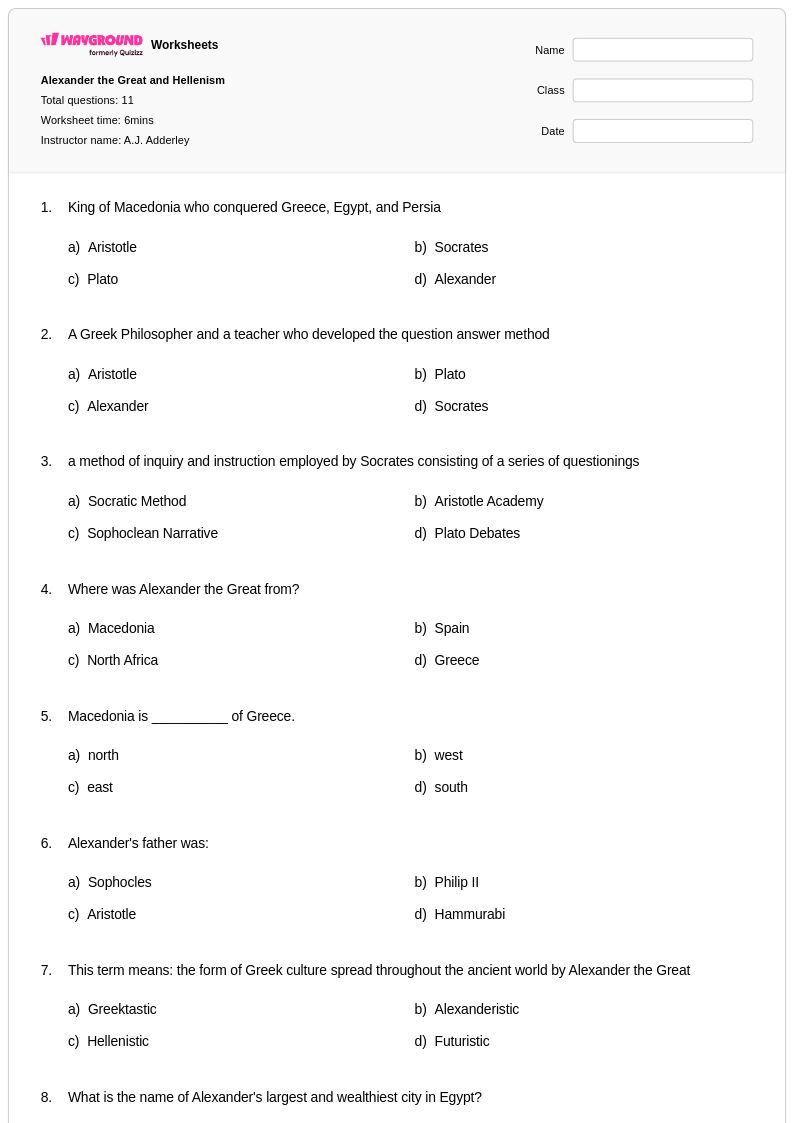
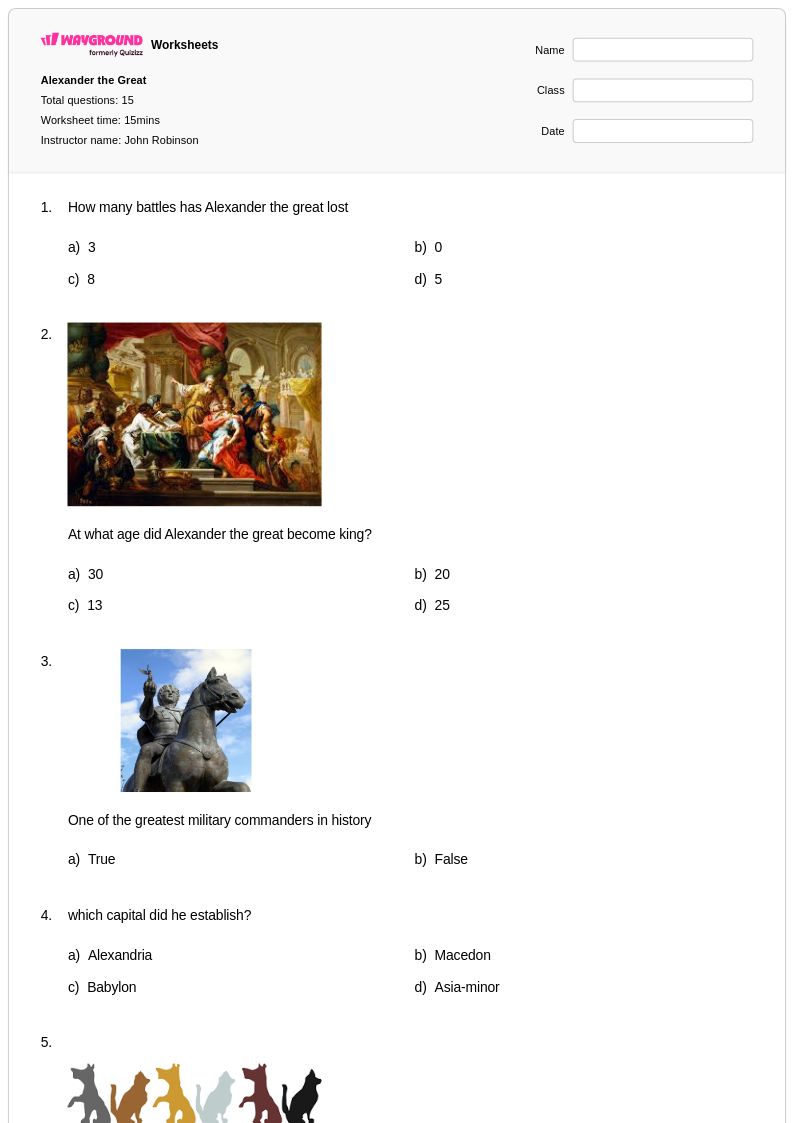
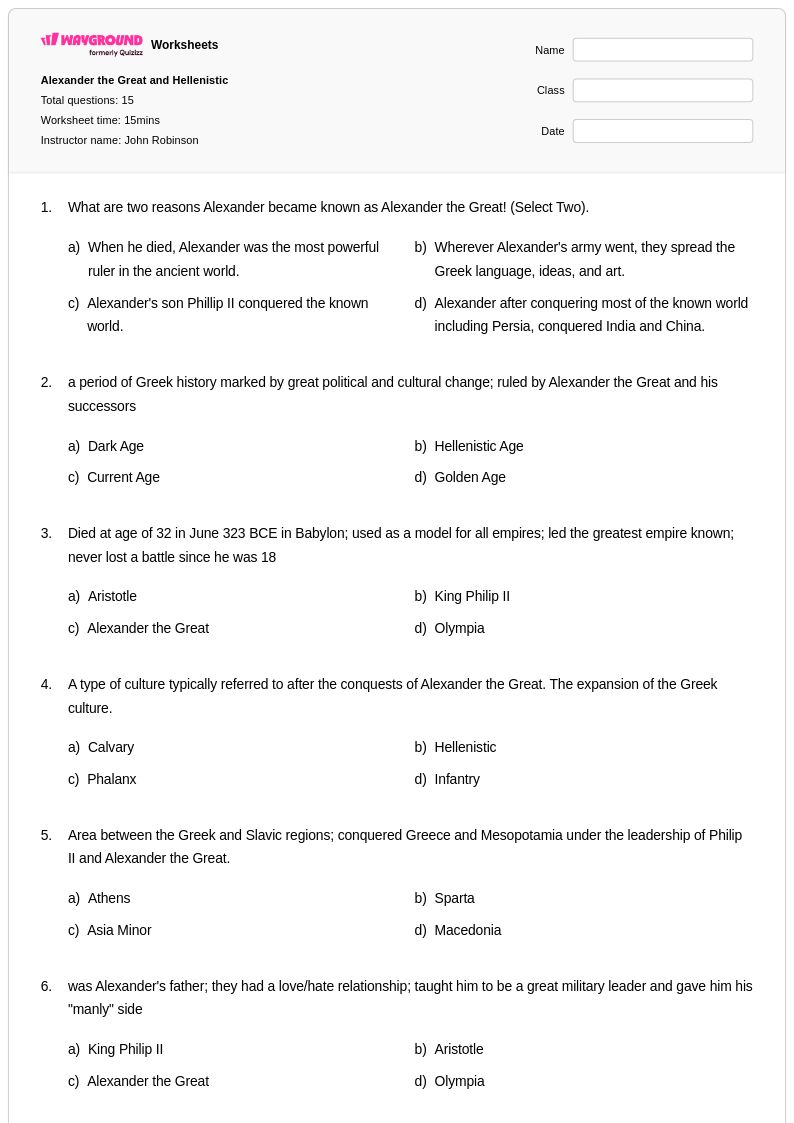
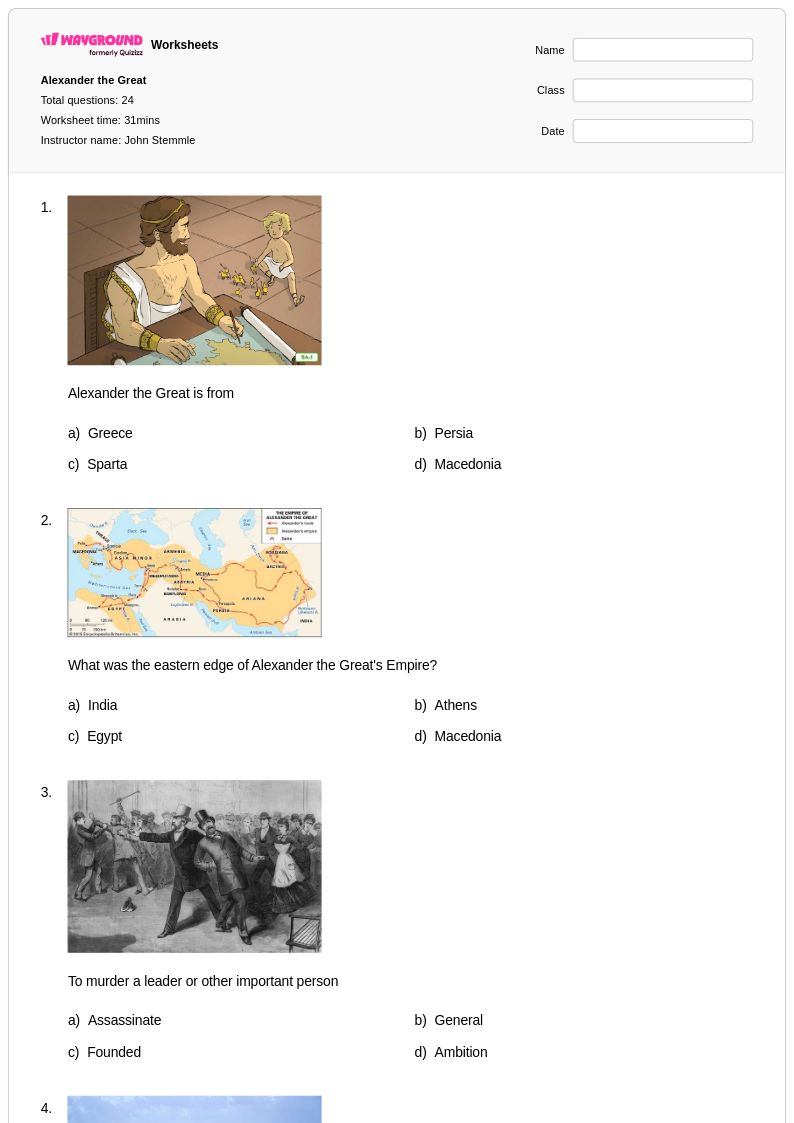
Alexander the Great worksheets for Class 10 students available through Wayground (formerly Quizizz) provide comprehensive coverage of one of history's most influential military leaders and his lasting impact on the ancient world. These educational resources strengthen critical thinking skills by examining Alexander's conquests, his strategic military tactics, and the cultural fusion that resulted from his vast empire stretching from Greece to India. Students engage with practice problems that analyze primary source documents, evaluate the effectiveness of Macedonian phalanx formations, and assess the spread of Hellenistic culture throughout the Mediterranean and Near East. The collection includes detailed answer keys that help educators guide discussions about Alexander's leadership style, his relationship with conquered peoples, and the fragmentation of his empire after his death. These free printables and pdf resources enable students to develop analytical skills while exploring complex historical causation and the long-term consequences of Alexander's campaigns on subsequent civilizations.
Wayground (formerly Quizizz) supports history teachers with an extensive collection of millions of teacher-created resources focused on Alexander the Great and other pivotal historical figures. The platform's robust search and filtering capabilities allow educators to quickly locate materials that align with specific curriculum standards and differentiate instruction based on individual student needs. Teachers can customize worksheets to emphasize particular aspects of Alexander's reign, whether focusing on military strategy, cultural diffusion, or political administration, and access materials in both printable and digital pdf formats for flexible classroom implementation. These comprehensive tools facilitate effective lesson planning while providing targeted resources for remediation and enrichment activities. The diverse range of skill practice opportunities helps educators address varying learning styles and academic levels, ensuring that all Class 10 students can engage meaningfully with the complex legacy of Alexander's conquests and their enduring influence on world history.
FAQs
How do I teach Alexander the Great to middle or high school students?
Teaching Alexander the Great effectively means anchoring instruction in cause-and-effect relationships: why he conquered, how he governed, and what collapsed after his death. Start with the political context of Macedon and Philip II's legacy, then trace the military campaigns chronologically using maps. Pairing primary source analysis with visual aids like empire maps helps students move beyond memorizing battles toward understanding Alexander's long-term cultural and political impact.
What are the best activities for practicing knowledge of Alexander the Great's campaigns?
Mapping exercises are among the most effective practice tools for Alexander the Great, as they require students to sequence campaigns geographically and connect military decisions to terrain and politics. Pairing map work with primary source analysis tasks, such as evaluating accounts from Arrian or Plutarch, reinforces historical thinking skills. Practice problems that ask students to assess cause-and-effect relationships across his conquests of Greece, Persia, and Central Asia build both content knowledge and analytical writing skills.
What common mistakes do students make when studying Alexander the Great?
Students frequently oversimplify Alexander's legacy by treating him as either purely heroic or purely destructive, missing the complexity of his cultural policies and the forced nature of his campaigns. Another common error is conflating the Hellenistic world with classical Greece, when in fact Alexander's conquests created a distinct cultural fusion across the Mediterranean and Central Asia. Students also tend to underestimate the role of his generals and the Macedonian army, attributing all strategic success to Alexander alone.
How can I use Alexander the Great worksheets in my classroom?
Alexander the Great worksheets on Wayground are available as printable PDFs for traditional classroom use and in digital formats for technology-integrated environments, including the option to host them as a quiz directly on Wayground. This flexibility makes them suitable for in-class instruction, homework, or self-paced digital assignments. Each worksheet includes a complete answer key, allowing teachers to use them for guided practice, formative assessment, or independent review without additional preparation.
How do I help struggling students understand Alexander the Great's historical significance?
For students who find ancient history abstract, grounding Alexander's significance in concrete comparisons helps, such as comparing the scale of his empire to modern geography or connecting Hellenistic cultural spread to today's concept of globalization. Wayground supports individual student accommodations including Read Aloud, which can audio-read worksheet questions for students who need it, and reduced answer choices to lower cognitive load on multiple-choice tasks. Extended time settings can also be applied per student so struggling learners have adequate time to process dense historical content.
What topics related to Alexander the Great should I cover in a history unit?
A well-rounded Alexander the Great unit should cover Macedon's rise under Philip II, the Persian Wars as context, Alexander's major campaigns from Granicus to the Indian subcontinent, his administrative and cultural policies in conquered territories, and the fragmentation of his empire after his death in 323 BCE. Including the Hellenistic period and its lasting influence on art, philosophy, and governance connects Alexander's story to broader ancient world curriculum standards.