Free Printable All Saints Day Worksheets for Class 5
Class 5 All Saints Day worksheets and printables help students explore this important cultural tradition through engaging practice problems, free PDF resources, and comprehensive answer keys for meaningful social studies learning.
Explore printable All Saints Day worksheets for Class 5
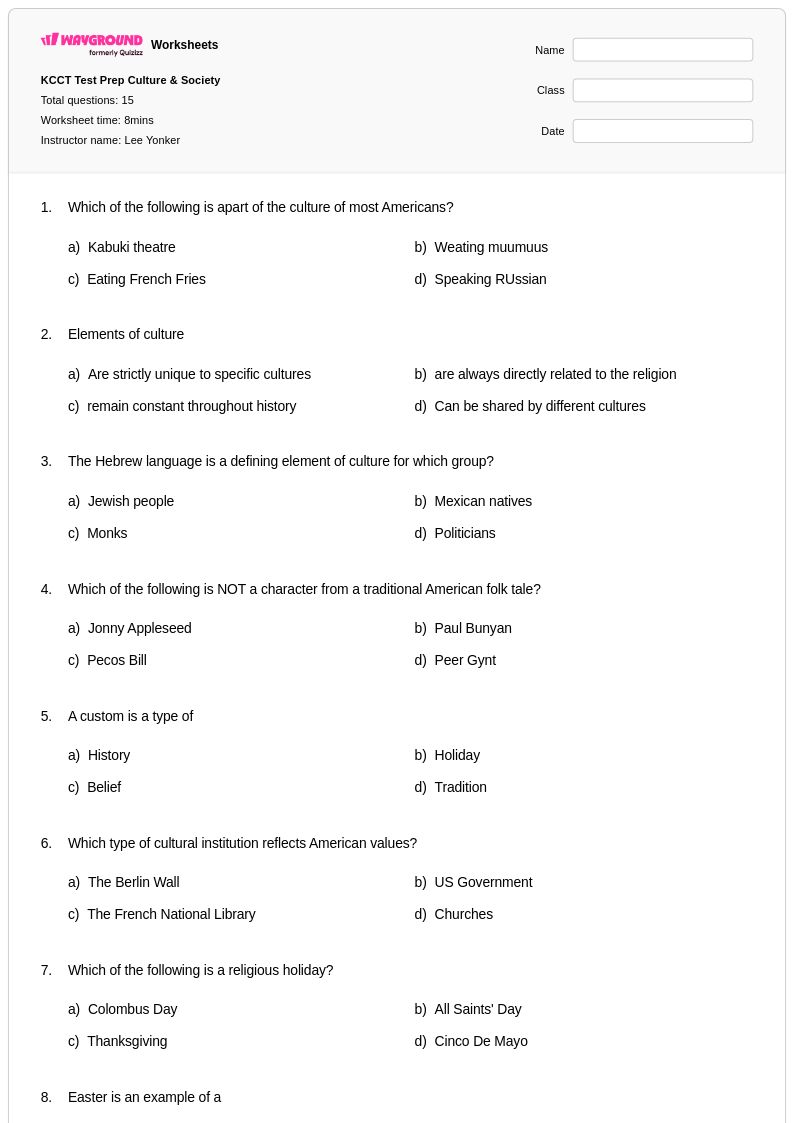
All Saints Day worksheets for Class 5 students through Wayground (formerly Quizizz) provide comprehensive educational resources that explore this significant cultural and religious observance within the broader context of community traditions and global cultures. These carefully crafted worksheets strengthen critical thinking skills by engaging students in analyzing the historical origins, cultural significance, and modern celebrations of All Saints Day across different societies. Students develop cultural awareness and comparative analysis abilities as they examine how various communities honor saints and ancestors, while building research skills through activities that require them to investigate local and international traditions. The collection includes diverse practice problems that challenge students to connect religious observances with community identity, supported by detailed answer key materials that facilitate both independent learning and guided instruction. Teachers can access these free printables in convenient pdf format, making it simple to distribute materials that promote understanding of cultural diversity and religious literacy.
Wayground (formerly Quizizz) empowers educators with millions of teacher-created resources specifically designed to support Class 5 social studies instruction on community cultures and religious observances like All Saints Day. The platform's robust search and filtering capabilities enable teachers to quickly locate age-appropriate materials that align with curriculum standards while addressing diverse learning needs through built-in differentiation tools. These comprehensive worksheet collections are available in both printable and digital formats, including downloadable pdf versions that accommodate various classroom environments and teaching preferences. Teachers benefit from flexible customization options that allow them to modify content for remediation or enrichment purposes, ensuring that every student can engage meaningfully with cultural learning objectives. The platform's extensive database supports effective lesson planning by providing ready-to-use materials that promote cultural understanding and help students develop essential skills in comparing and contrasting community traditions across different cultures and time periods.
FAQs
How do I teach All Saints Day in a social studies classroom?
Teaching All Saints Day works best when framed as a cultural and historical study rather than a purely religious lesson, making it accessible across diverse classrooms. Start by introducing the observance's origins in early Christian tradition and its evolution across different cultures and regions. From there, guide students to compare how communities in Mexico, the Philippines, Poland, and other countries mark the day, which naturally builds comparative cultural analysis skills central to social studies standards.
What activities help students understand the difference between All Saints Day, All Souls Day, and Halloween?
Students often conflate these three observances because they fall within the same two-day span on the calendar, so structured comparison activities are especially effective. Have students complete a three-column chart or Venn diagram mapping the distinct origins, purposes, and traditions of each observance. Analyzing how secular Halloween traditions diverged from the religious framework of All Saints Day and All Souls Day helps students develop skills in tracing how cultural practices evolve over time.
What common misconceptions do students have about All Saints Day?
The most frequent misconception is that All Saints Day and Halloween are interchangeable or that one directly caused the other, when in fact both drew from overlapping but distinct historical sources. Students also commonly assume All Saints Day is observed the same way across all Christian traditions, overlooking significant variation between Catholic, Anglican, and Orthodox practices. A third misconception is conflating All Saints Day with All Souls Day — students often don't realize these are two separate observances with different theological purposes.
How can I use All Saints Day worksheets to build primary source analysis skills?
All Saints Day is rich in visual primary sources, including religious artwork, altarpiece imagery, and historical texts describing commemorative practices, which makes it a strong vehicle for source analysis instruction. Worksheets that ask students to interpret iconography, identify historical context, and draw inferences about community values give them practice with skills that transfer across social studies and history curricula. Pairing visual source analysis with short readings about how different cultures honor saints deepens comprehension and encourages evidence-based reasoning.
How do I use All Saints Day worksheets in my classroom?
All Saints Day worksheets on Wayground are available as printable PDFs for traditional classroom distribution and in digital formats for technology-integrated or remote learning environments. Teachers can also host the material as a live or assigned quiz directly on the Wayground platform, which adds an interactive layer to the lesson. Complete answer keys are included, so the worksheets integrate directly into lesson plans without requiring additional preparation for grading or review.
How can I differentiate All Saints Day worksheets for students with different learning needs?
Wayground's built-in accommodation tools allow teachers to support diverse learners without creating separate materials. Individual students can be assigned extended time, read-aloud audio for questions and content, reduced answer choices to lower cognitive load, or adjusted font sizes and reading themes for accessibility. These settings are saved per student and apply automatically in future sessions, so differentiation for a culturally complex topic like All Saints Day remains consistent without extra setup each time.