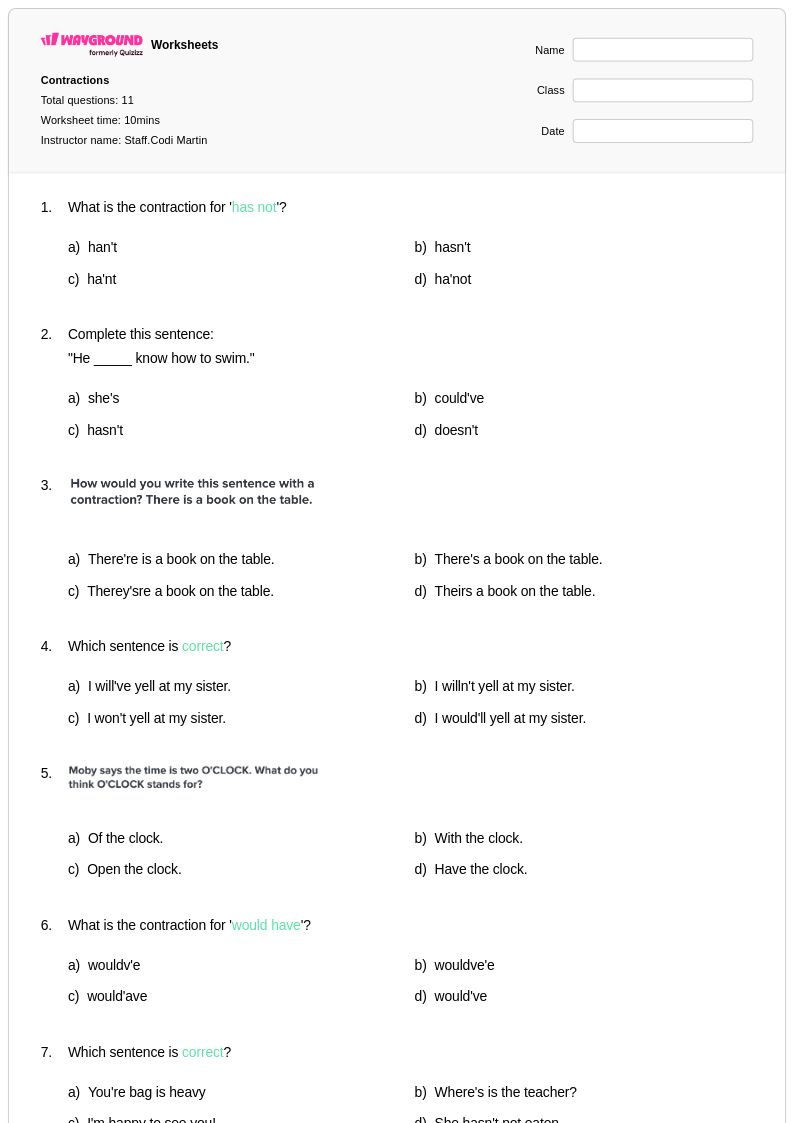
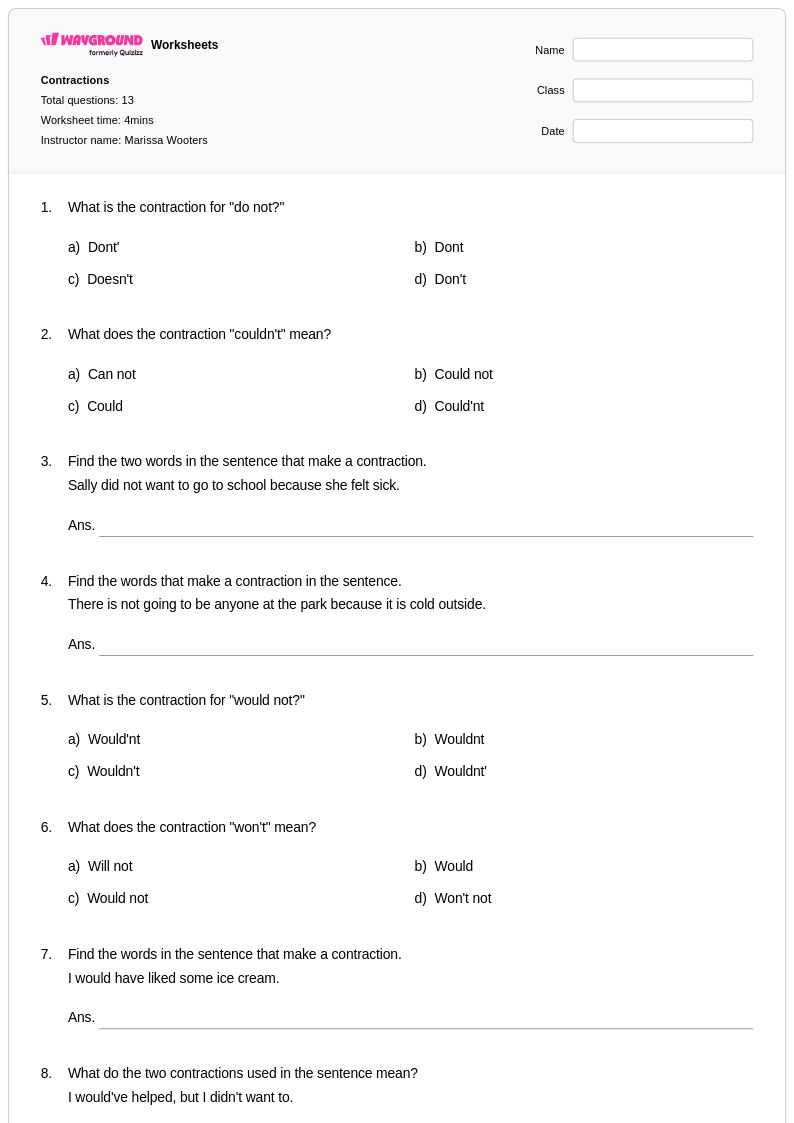
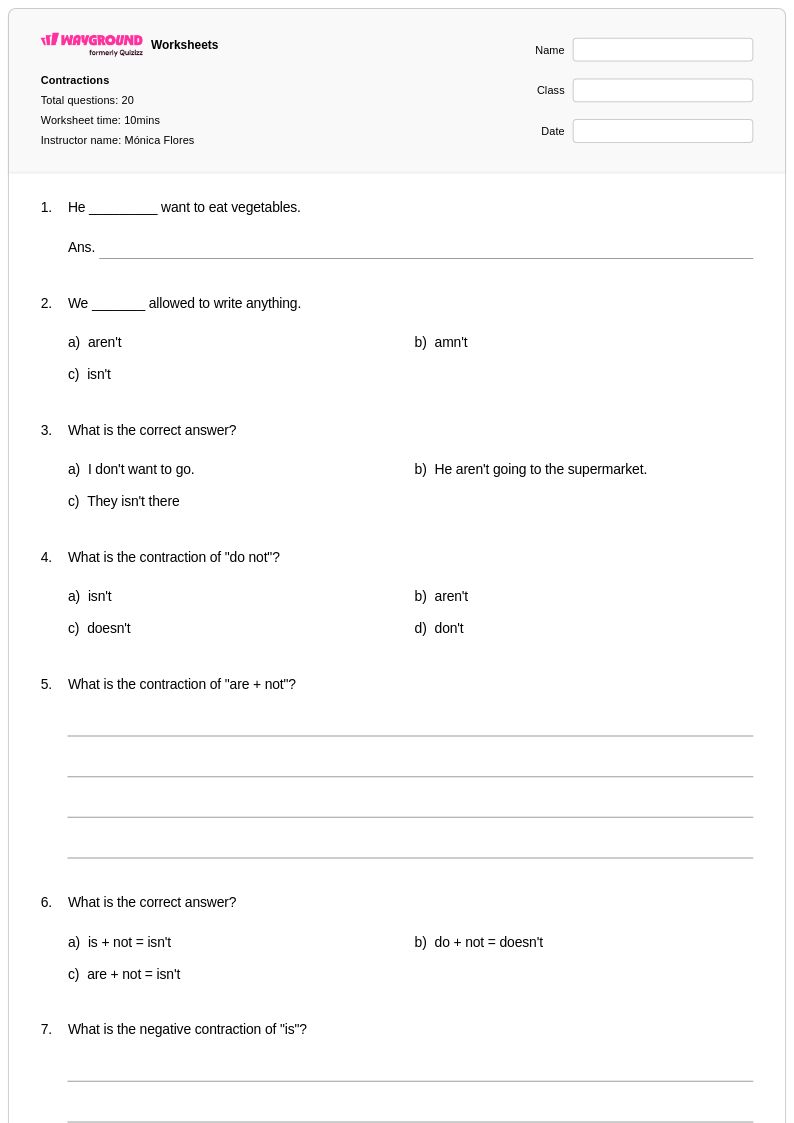
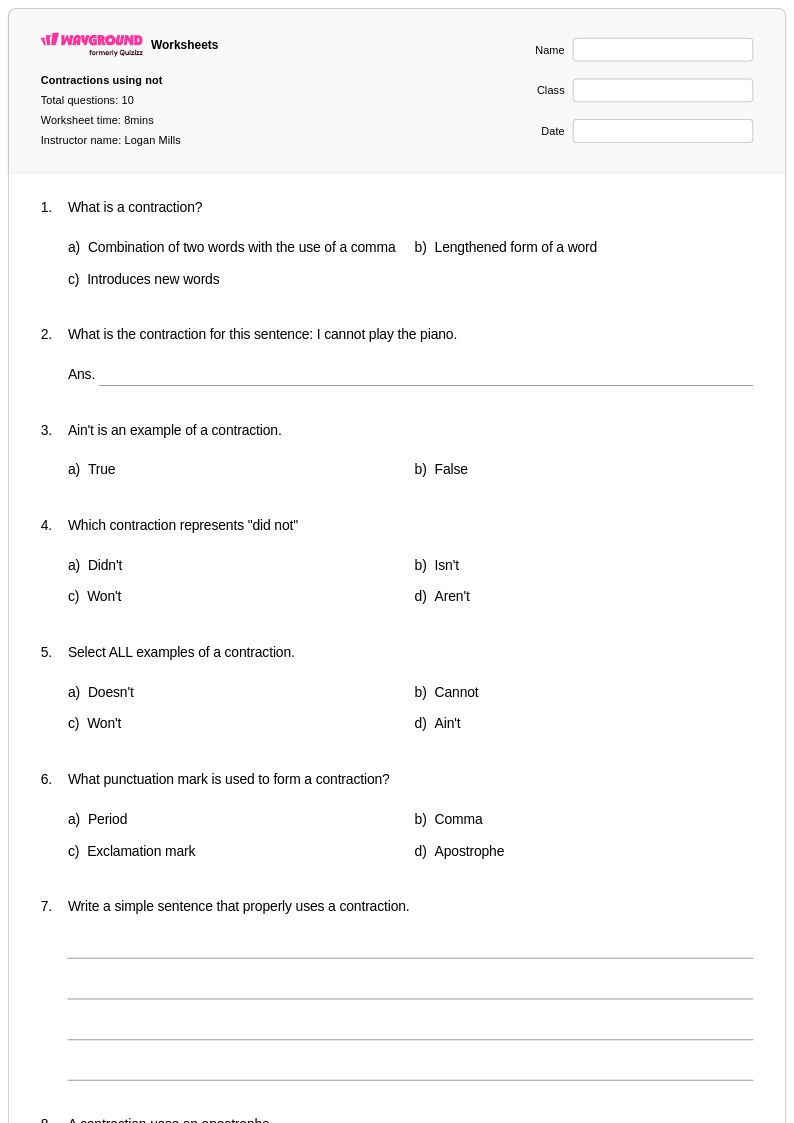
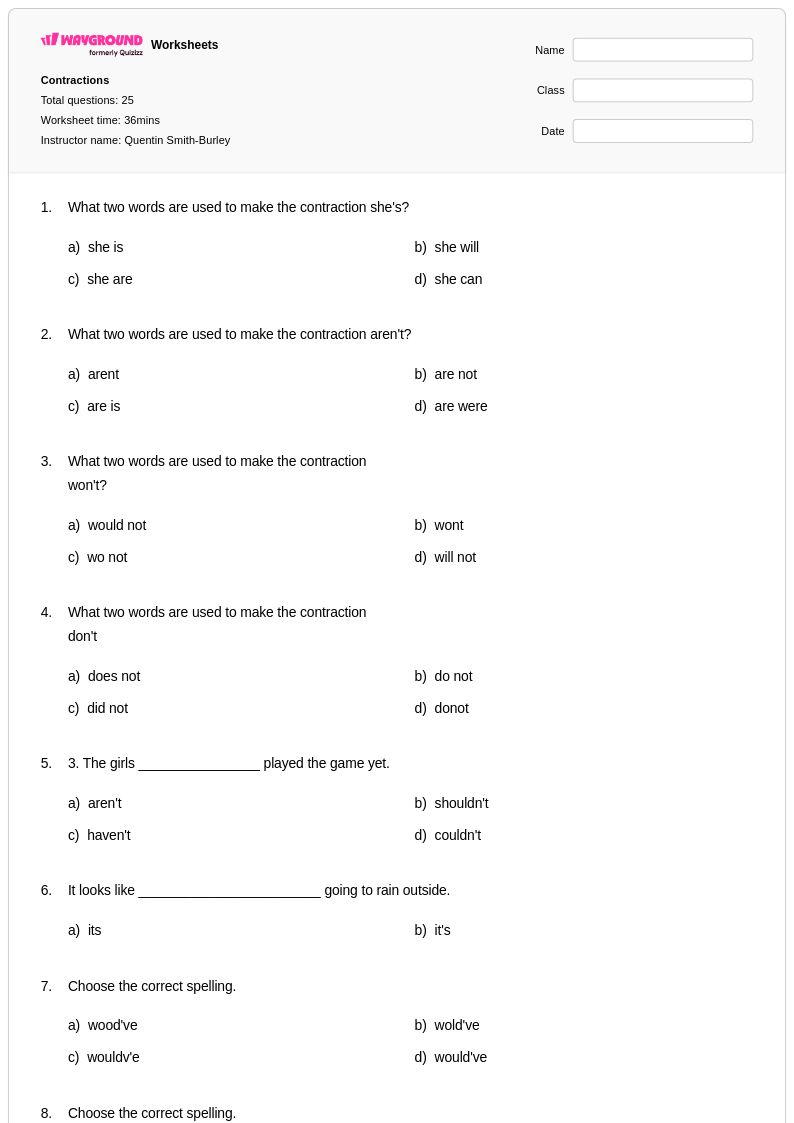
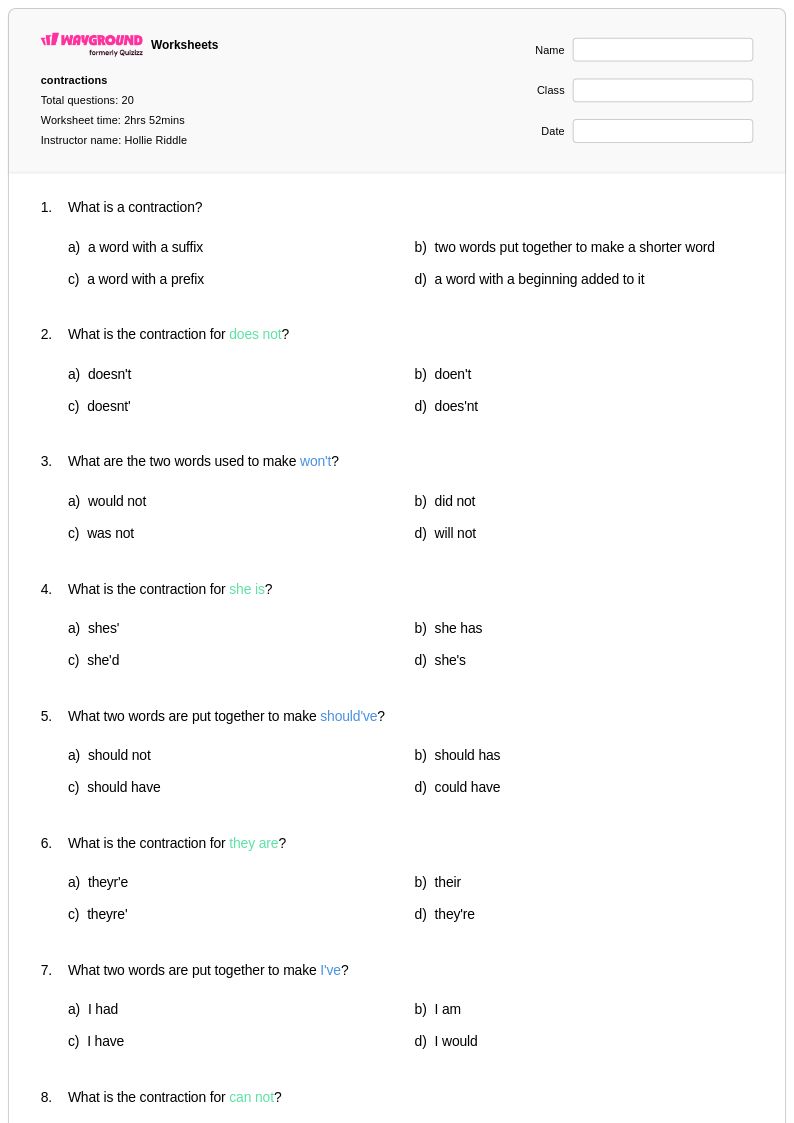
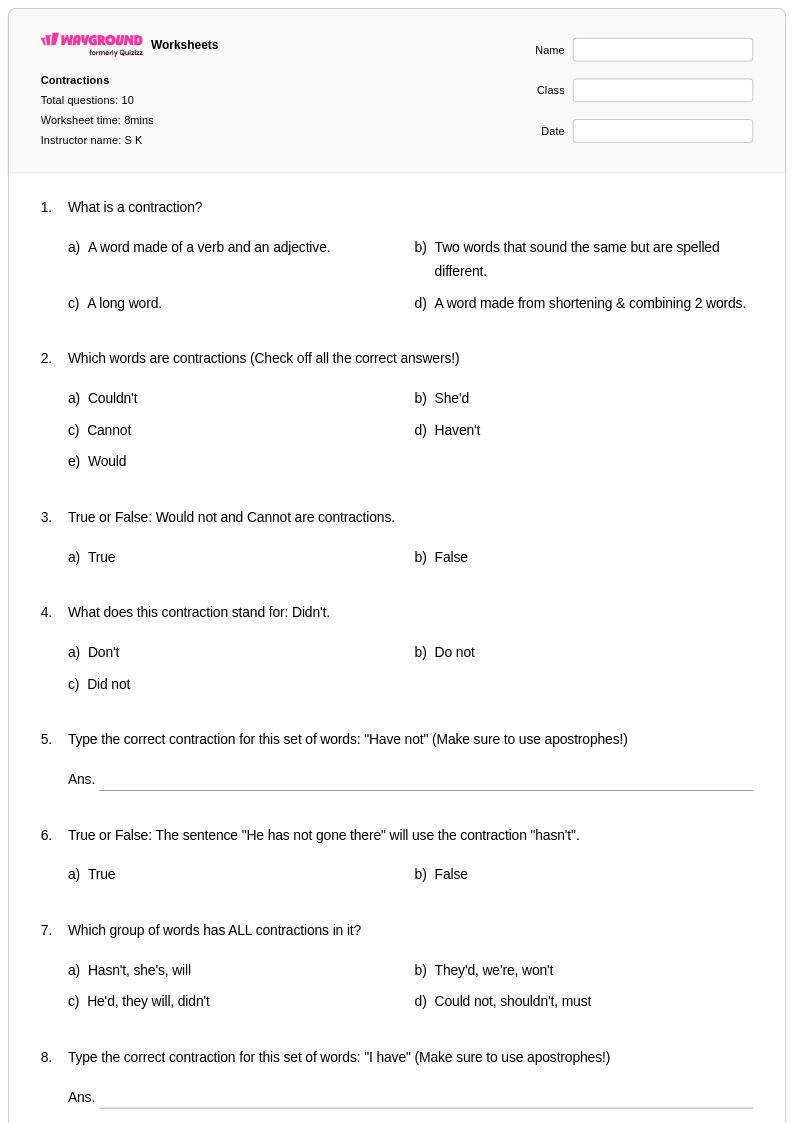
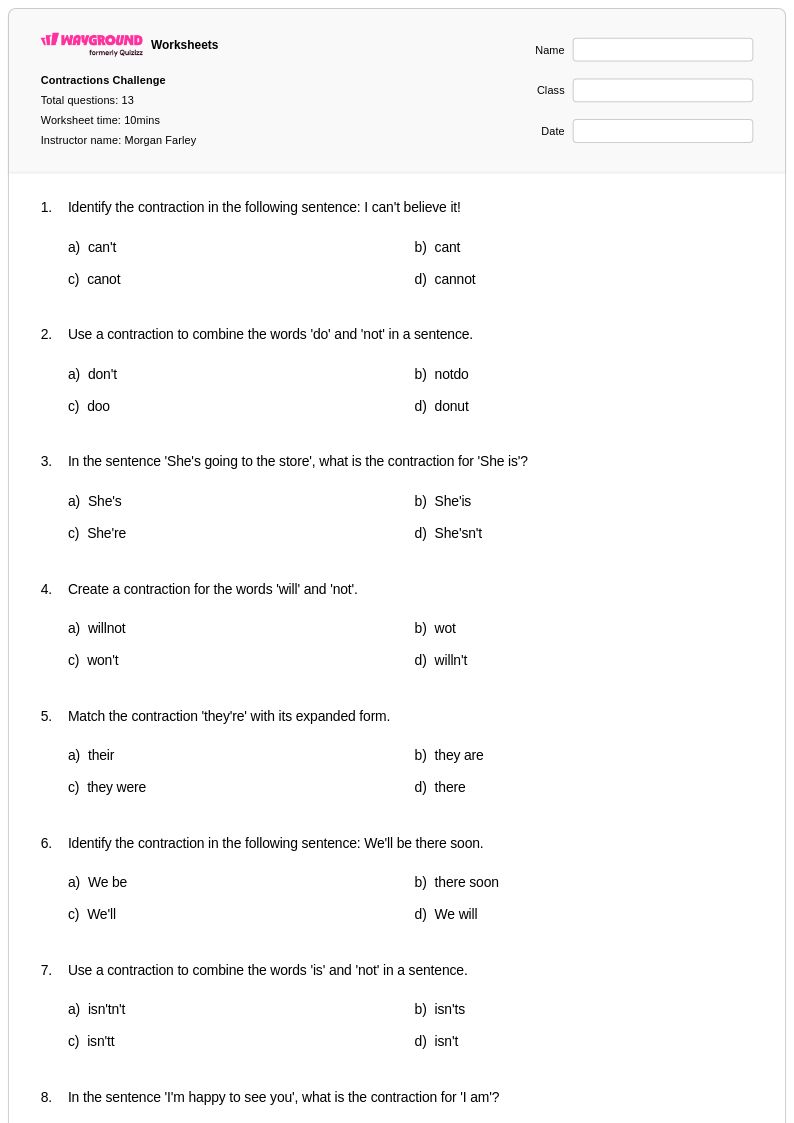
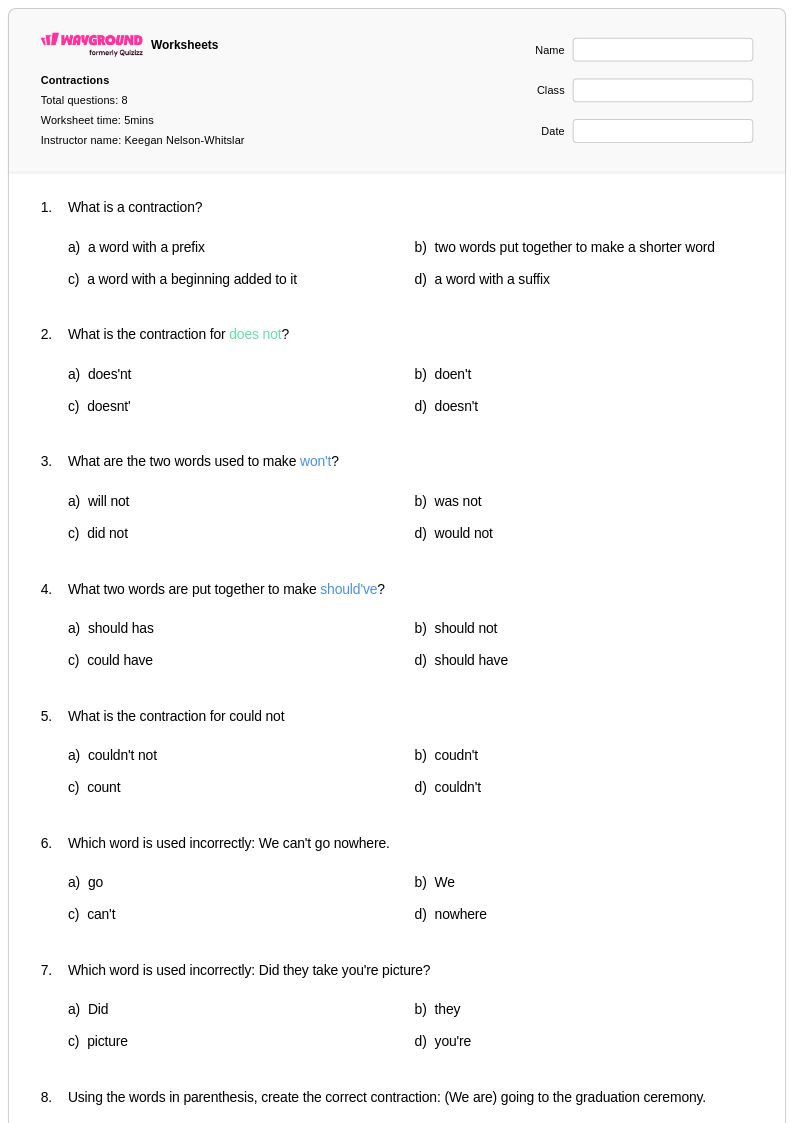
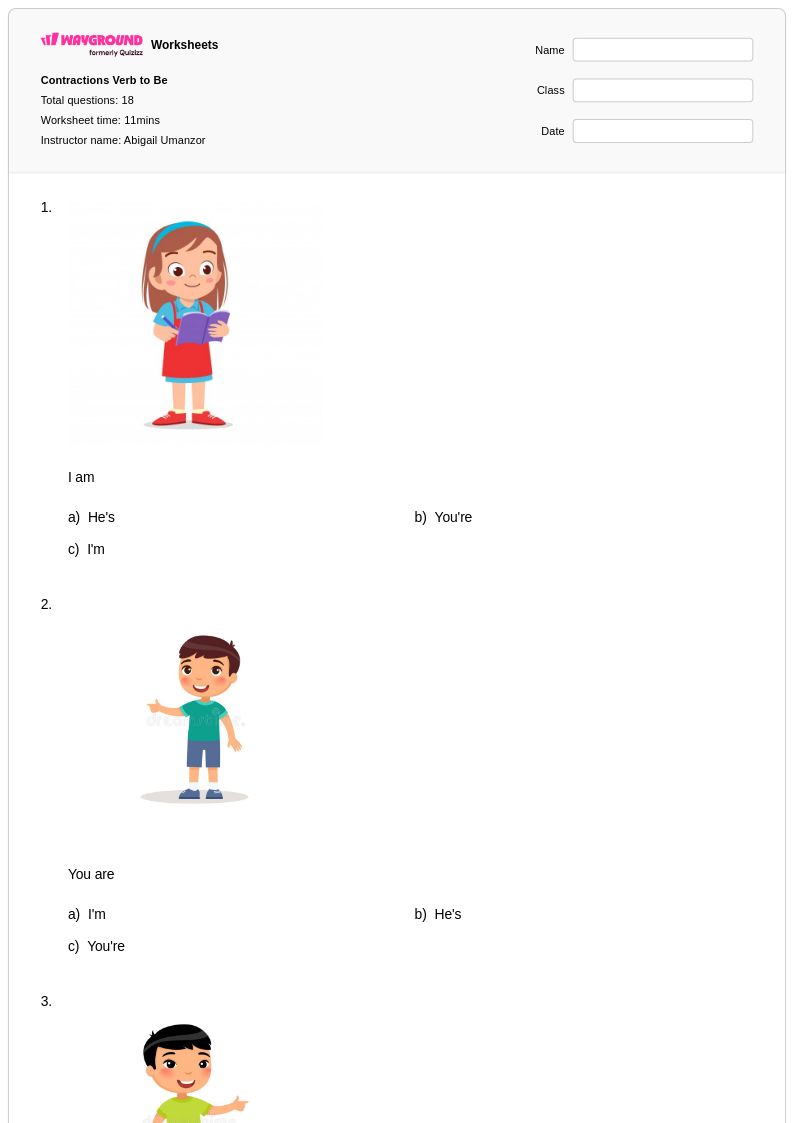
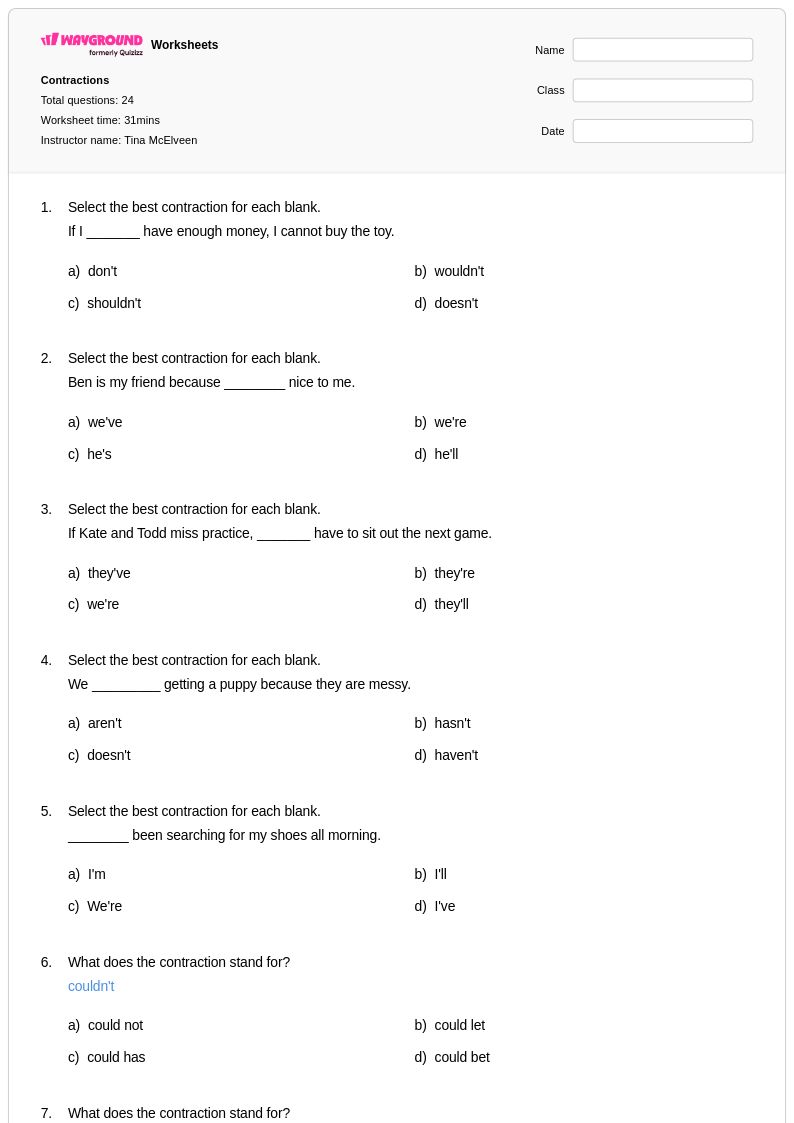
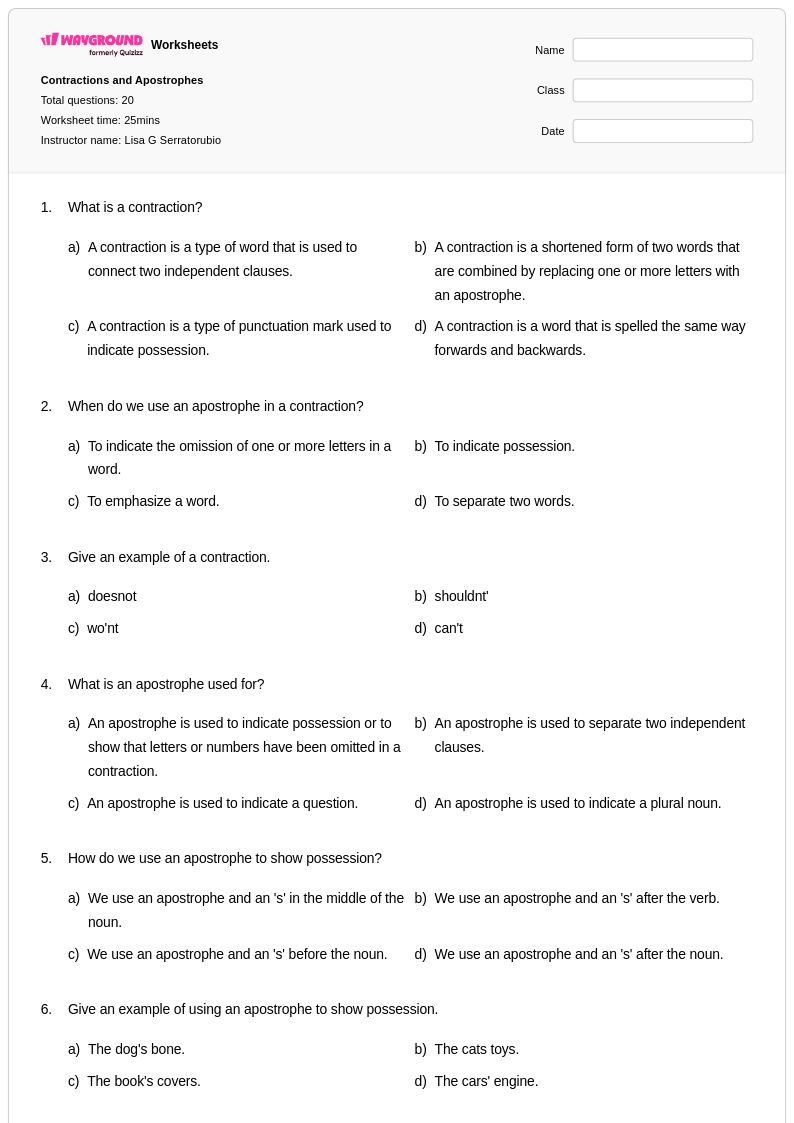
Master contractions with Wayground's free printable worksheets and practice problems that help students learn proper apostrophe placement, word combinations, and contraction rules through engaging PDF exercises with complete answer keys.
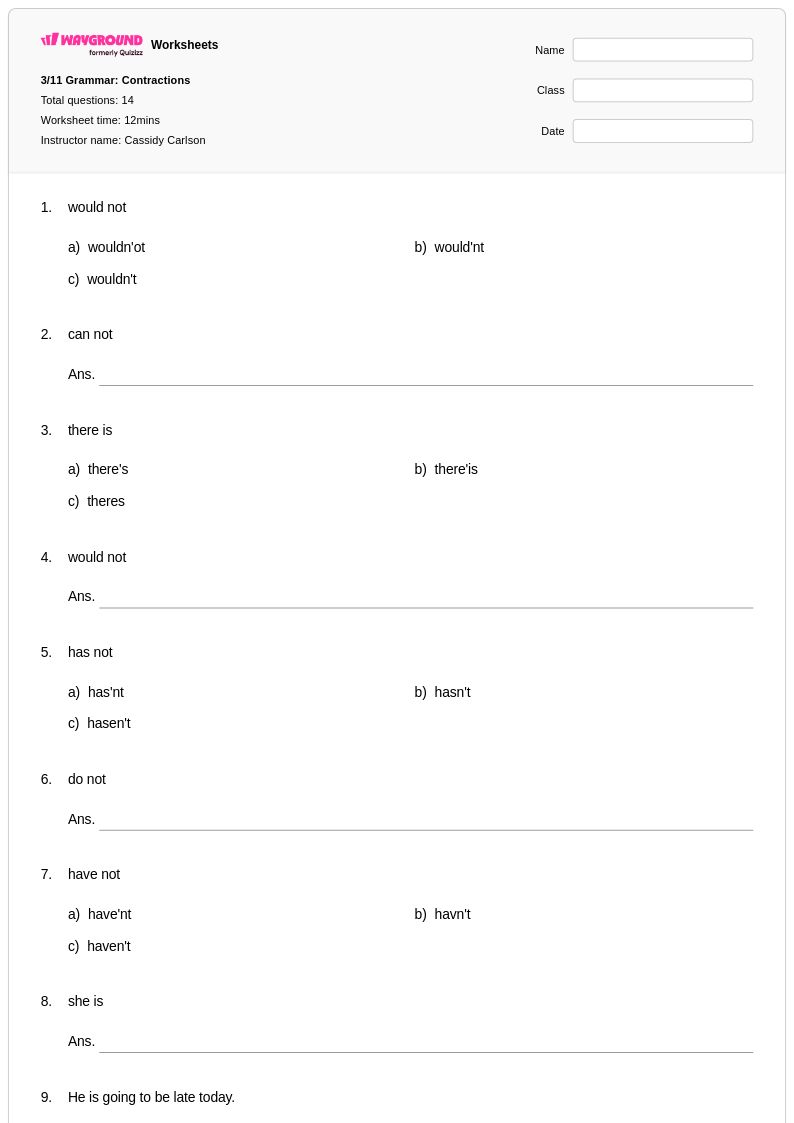
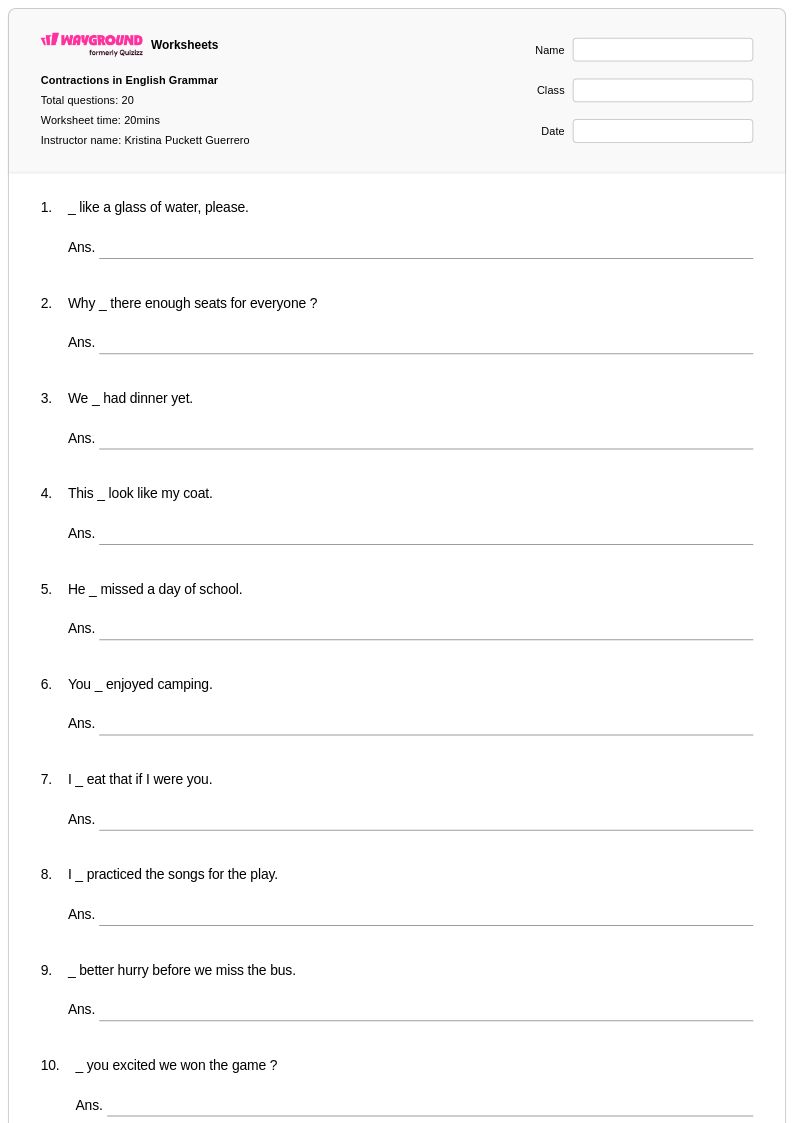
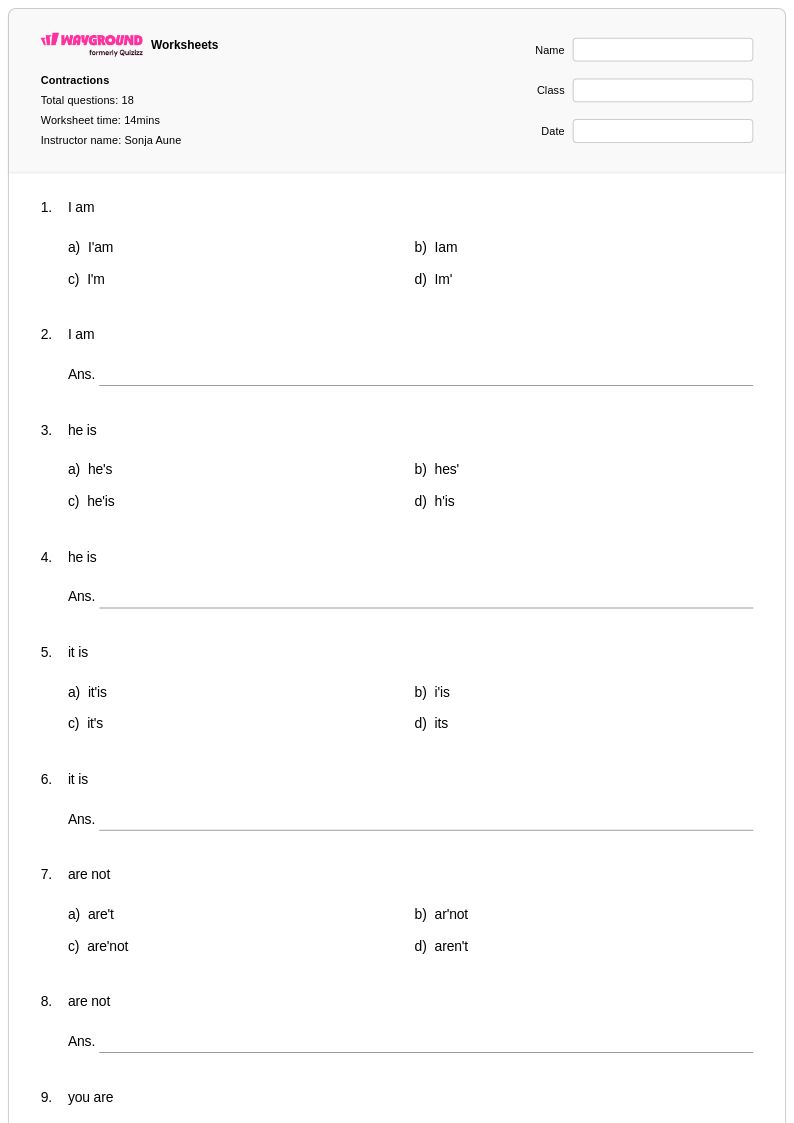
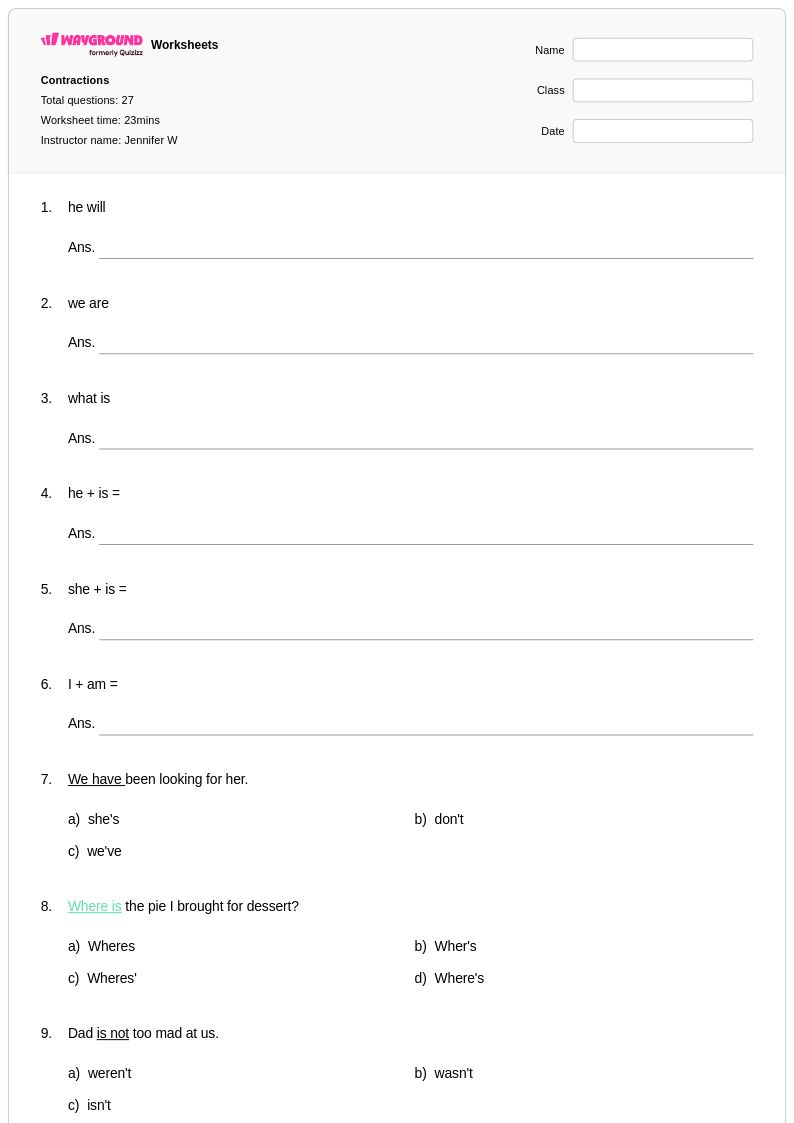
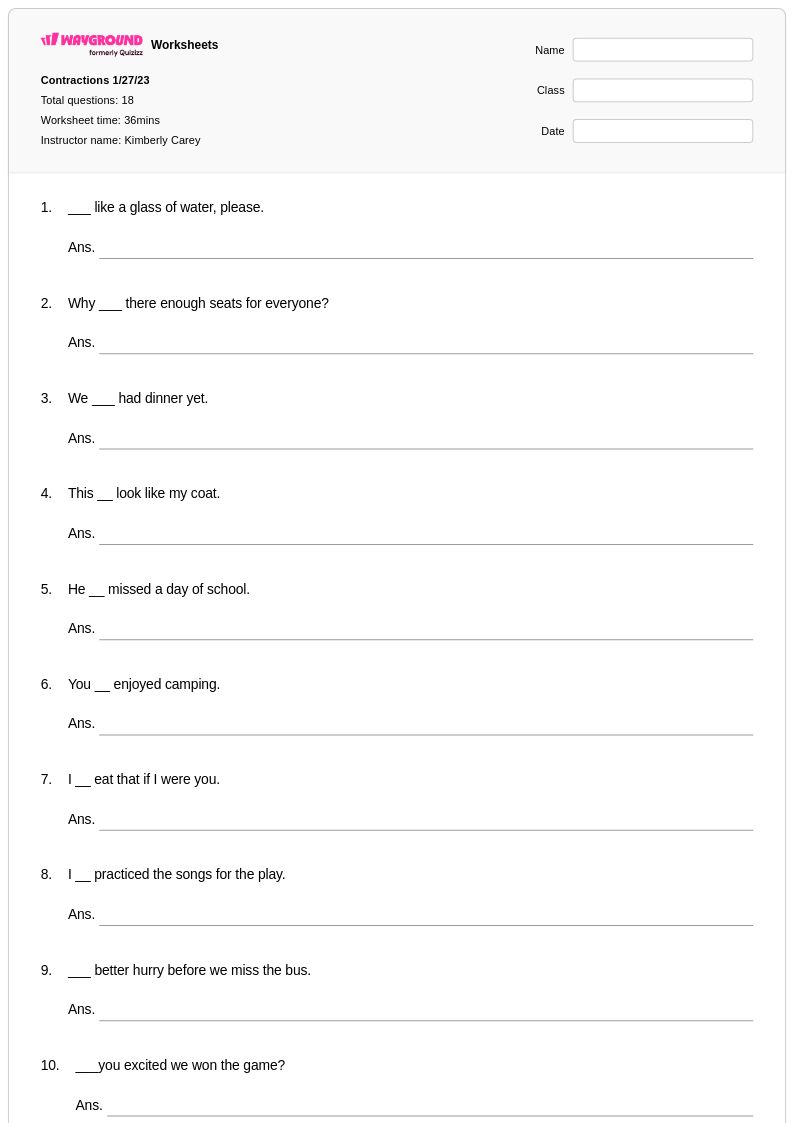
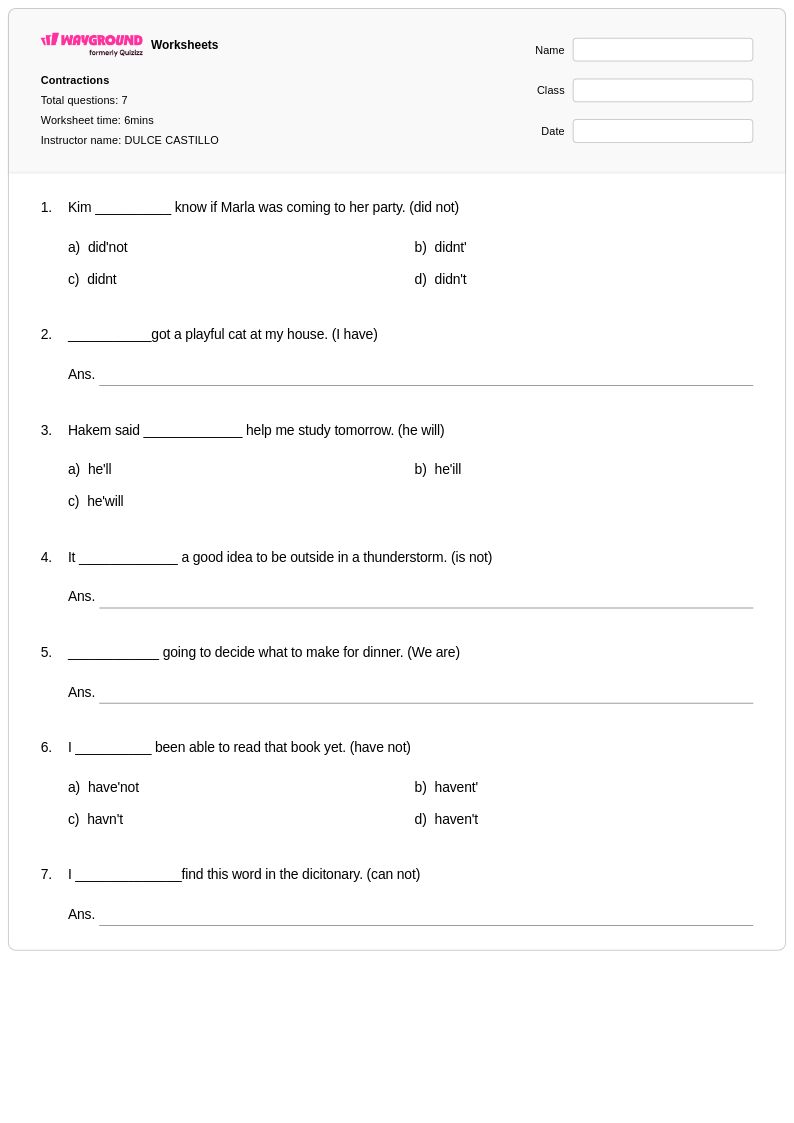
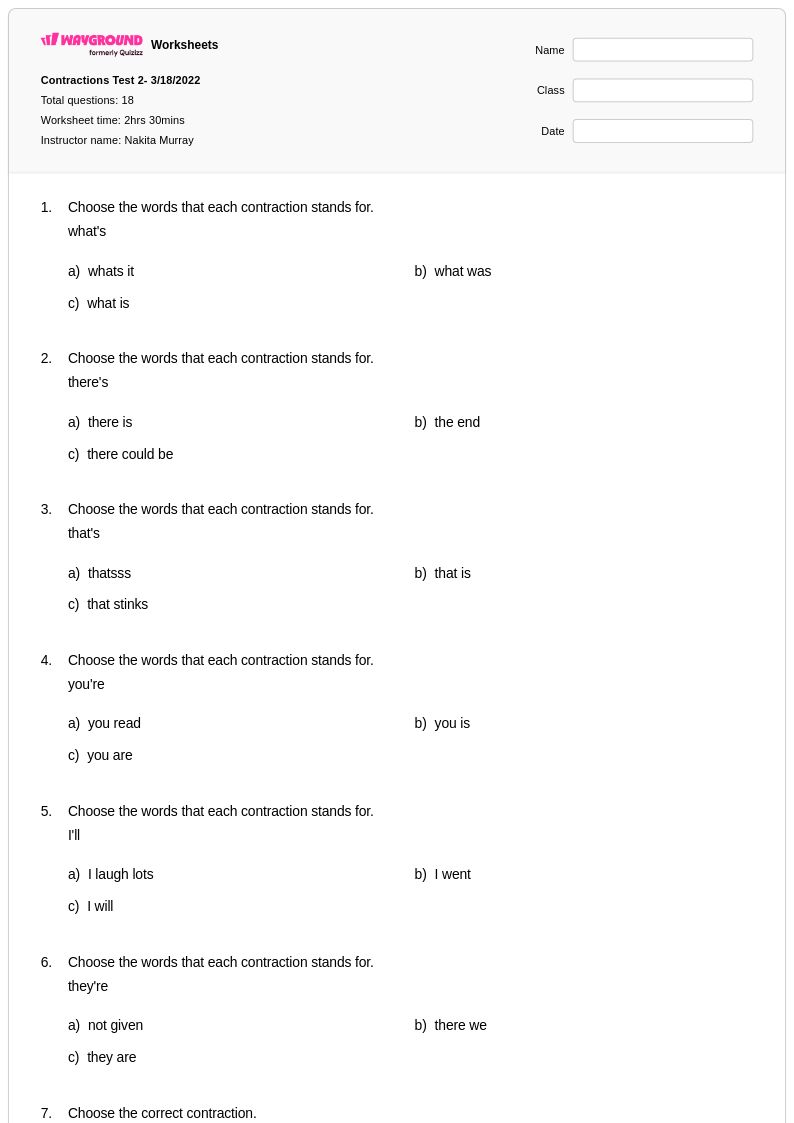
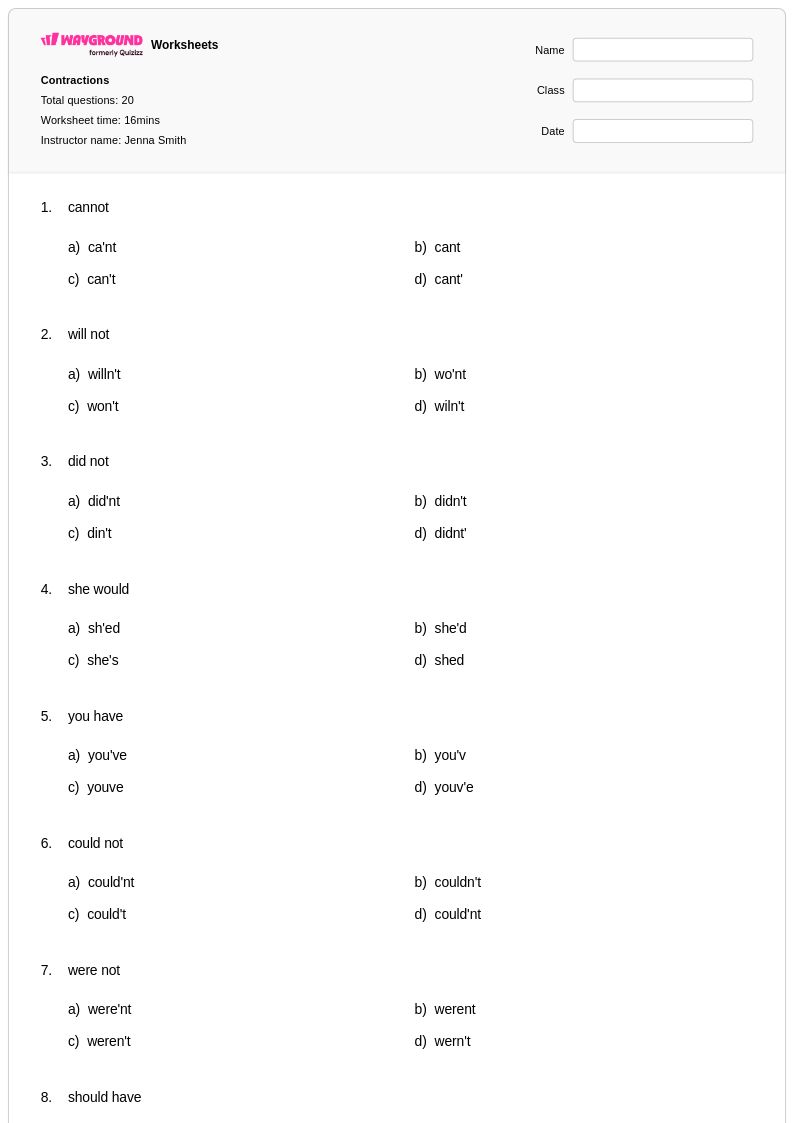
Contractions worksheets available through Wayground (formerly Quizizz) provide comprehensive practice opportunities for students to master this essential grammar skill. These educational resources focus on helping learners understand how to properly form, identify, and use contractions in written and spoken English, strengthening their command of apostrophe placement and word combination rules. The worksheets cover fundamental contraction patterns such as combining pronouns with verbs (I'm, you're, they've), negative contractions (don't, won't, isn't), and less common forms that often challenge students. Each worksheet comes with a complete answer key and is available as a free pdf download, making these printables accessible for classroom use, homework assignments, or independent practice. The practice problems range from basic identification exercises to more complex sentence completion and error correction activities that reinforce proper contraction usage in context.
Wayground (formerly Quizizz) empowers educators with an extensive collection of teacher-created contraction worksheets, drawing from millions of high-quality resources that can be easily discovered through robust search and filtering capabilities. Teachers can locate materials that align with specific curriculum standards and differentiate instruction by selecting worksheets that match their students' varying skill levels and learning needs. The platform's flexible customization tools allow educators to modify existing worksheets or create personalized versions that target specific contraction patterns or address common student misconceptions. Available in both printable pdf format and interactive digital versions, these resources seamlessly integrate into lesson planning while supporting diverse instructional approaches including whole-group instruction, small group remediation, individual enrichment, and ongoing skill practice that builds students' confidence with this fundamental aspect of English grammar and mechanics.
FAQs
How do I teach contractions to elementary students?
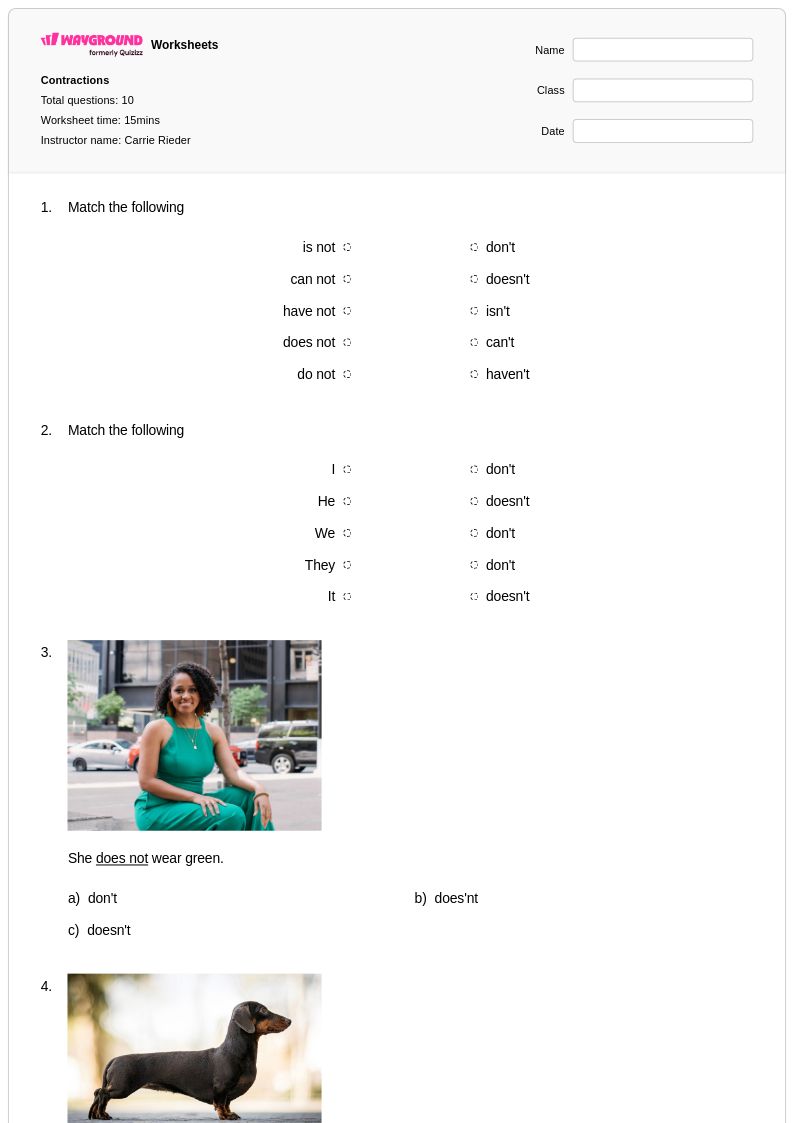
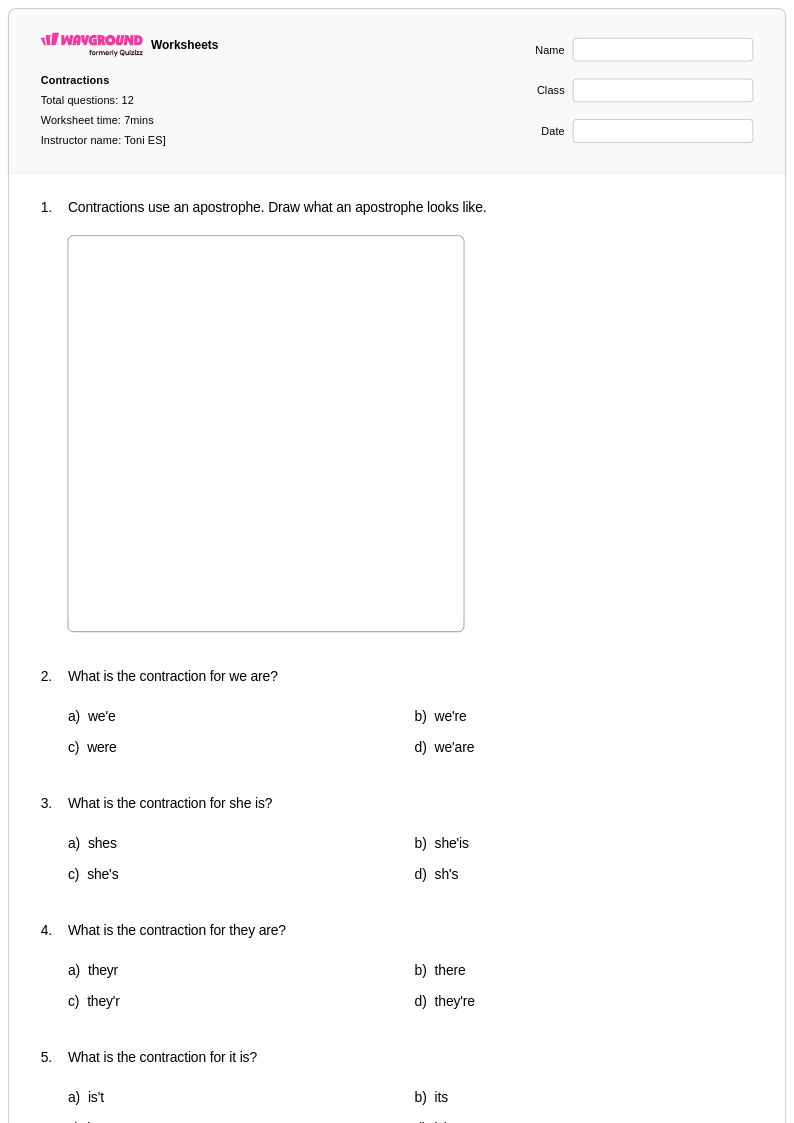
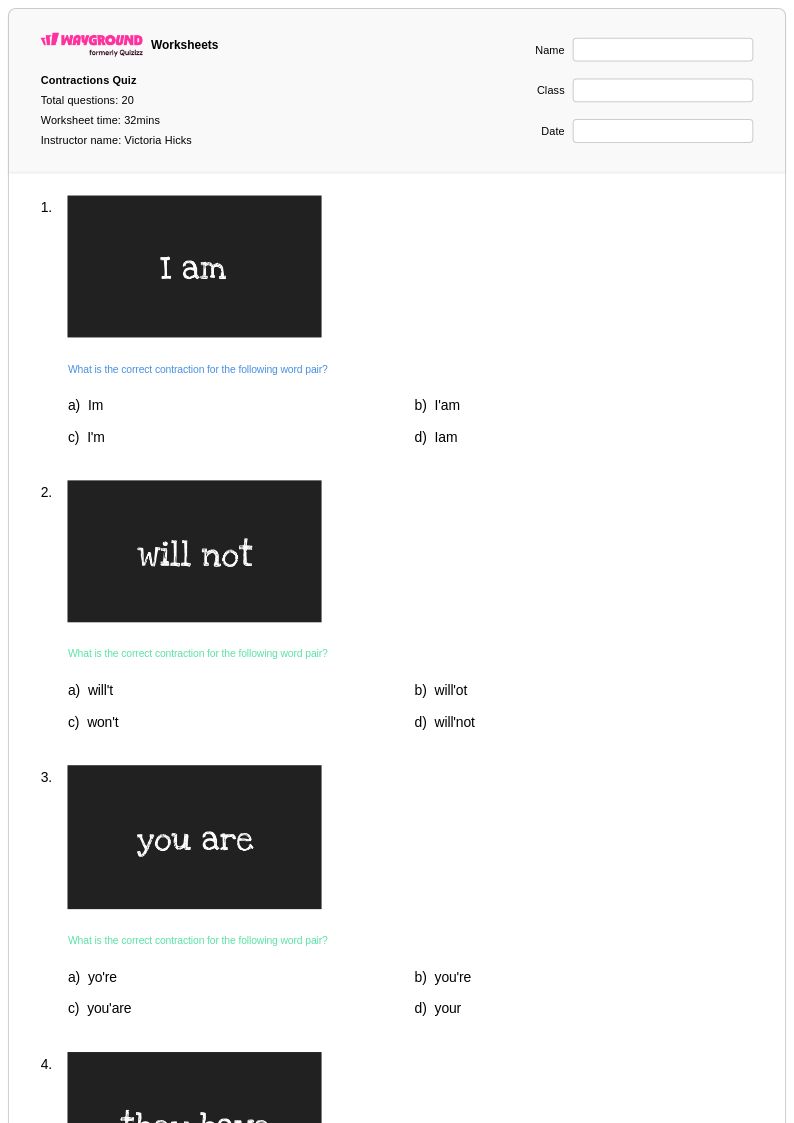
Start by helping students understand that a contraction is two words combined into one, with an apostrophe marking where letters were removed. Use familiar examples like 'I am' becoming 'I'm' and 'do not' becoming 'don't' before introducing less common forms. Sorting activities, where students match the two-word form to its contraction, build pattern recognition quickly. Once students grasp the concept with pronouns and common verbs, extend practice to negative contractions like 'won't' and 'isn't,' which tend to require more explicit instruction.
What exercises help students practice contractions?
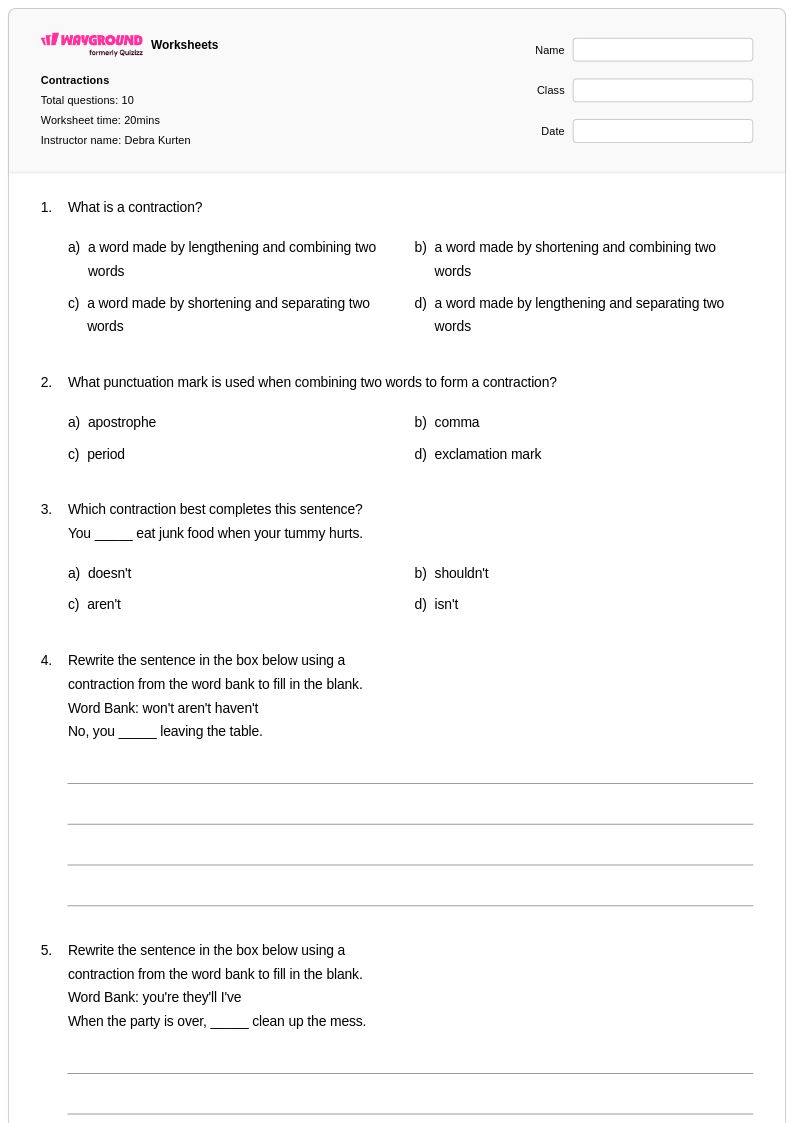
Effective contraction practice includes identification exercises where students locate contractions in sentences, expansion tasks where they write out the two words a contraction replaces, and sentence completion activities that require choosing the correct contraction in context. Error correction exercises are especially useful because they ask students to find and fix misplaced or missing apostrophes, which reinforces both contraction rules and apostrophe placement simultaneously. Mixing exercise types within a single practice session helps students apply the skill flexibly rather than memorizing isolated forms.
What mistakes do students commonly make with contractions?
The most frequent error is confusing contractions with possessive pronouns, particularly 'it's' versus 'its' and 'they're' versus 'their.' Students also commonly misplace the apostrophe, inserting it between the two words rather than at the point of omission, as in writing 'did'nt' instead of 'didn't.' Another recurring issue is treating 'won't' as irregular without understanding it derives from 'will not,' which causes confusion when students try to apply standard contraction rules. Targeted error correction exercises that address these specific patterns are the most efficient way to correct these habits.
How do I use contractions worksheets in my classroom?
Contractions worksheets on Wayground are available as printable PDFs, making them straightforward to distribute for independent work, homework, or small group practice. They are also available in digital formats, so they can be assigned for technology-integrated instruction, and teachers can host them as a quiz directly on Wayground to track student responses. Each worksheet includes a complete answer key, which reduces preparation time for grading and allows students to self-check during independent practice.
How do I differentiate contraction practice for students at different skill levels?
For students who are just beginning, focus worksheets on high-frequency pronoun-verb contractions like 'I'm,' 'you're,' and 'we're' before introducing negative forms. More advanced students benefit from error correction tasks and writing activities that require them to use contractions accurately in original sentences. On Wayground, teachers can select or customize worksheets to match specific skill levels, and digital versions support accommodations such as reduced answer choices or read-aloud features for students who need additional support.
Why do students struggle with 'won't' when learning contractions?
'Won't' is the contraction of 'will not,' but unlike most contractions, it does not follow a predictable shortening pattern, so students cannot derive it by simply removing letters and adding an apostrophe. This irregularity makes it one of the most commonly misunderstood contractions, and many students initially assume it comes from 'would not.' Direct instruction that explicitly flags 'won't' as an irregular form, paired with repeated exposure in context, is the most effective approach for building retention.