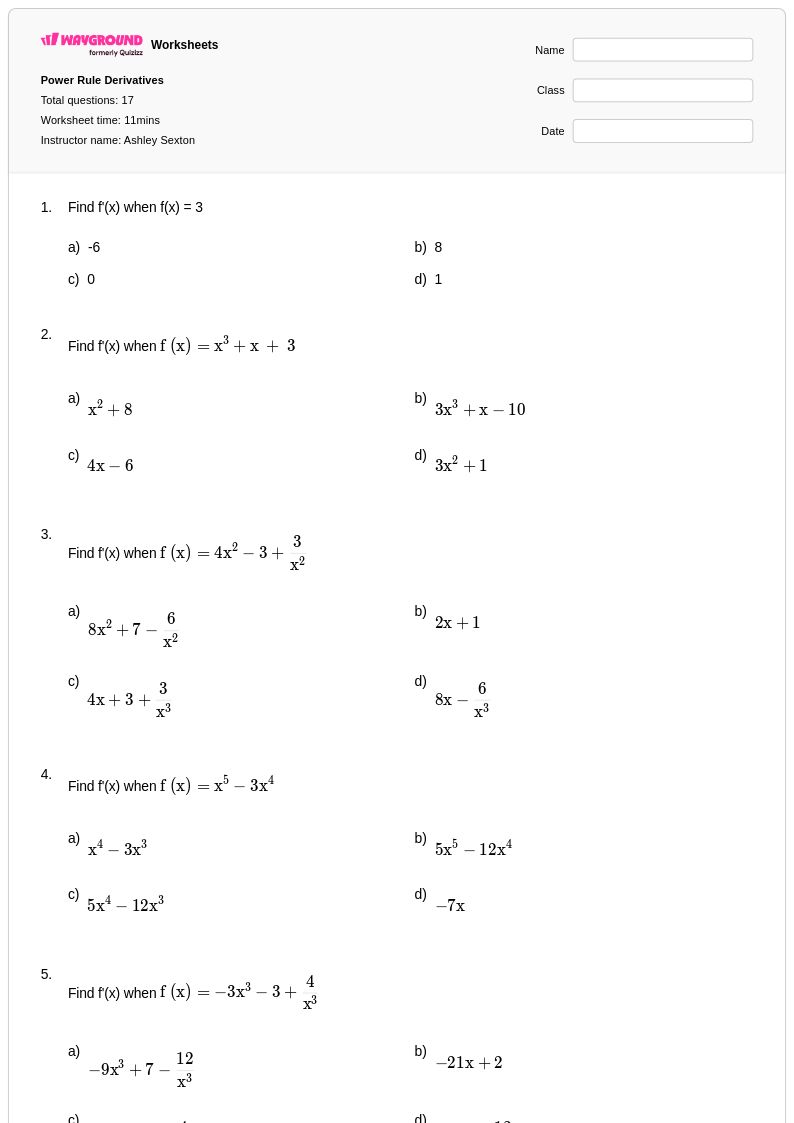
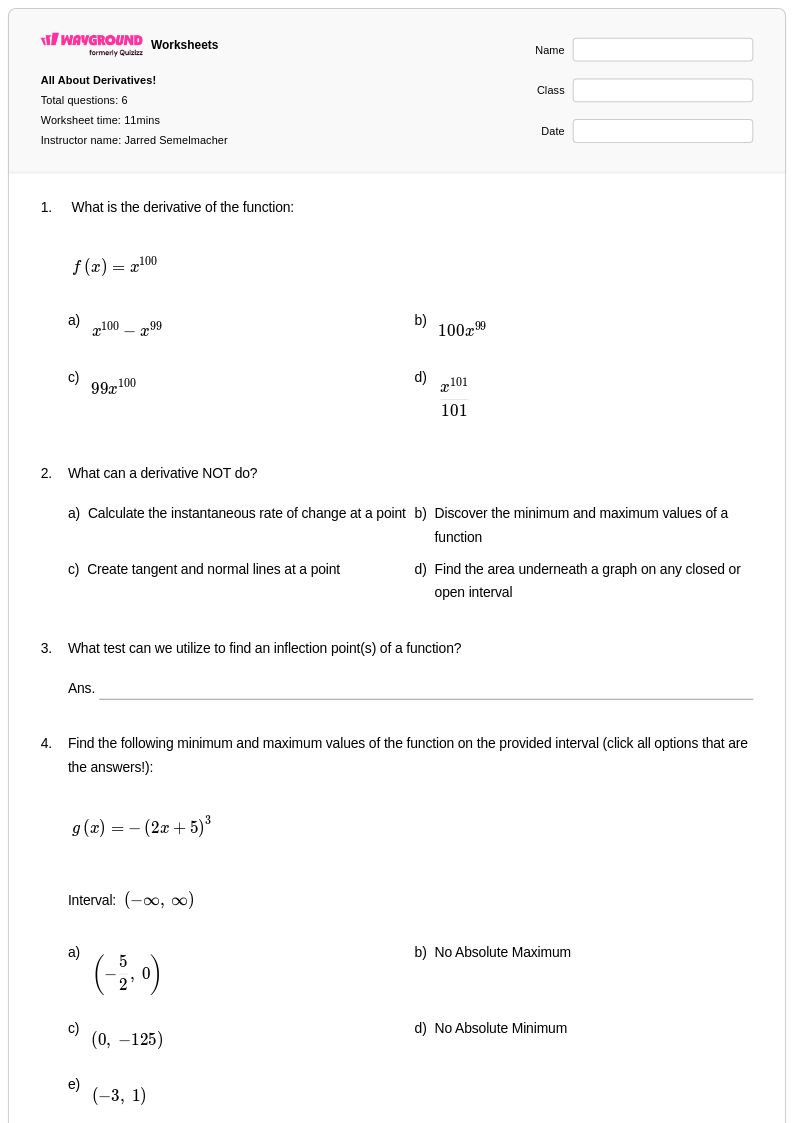
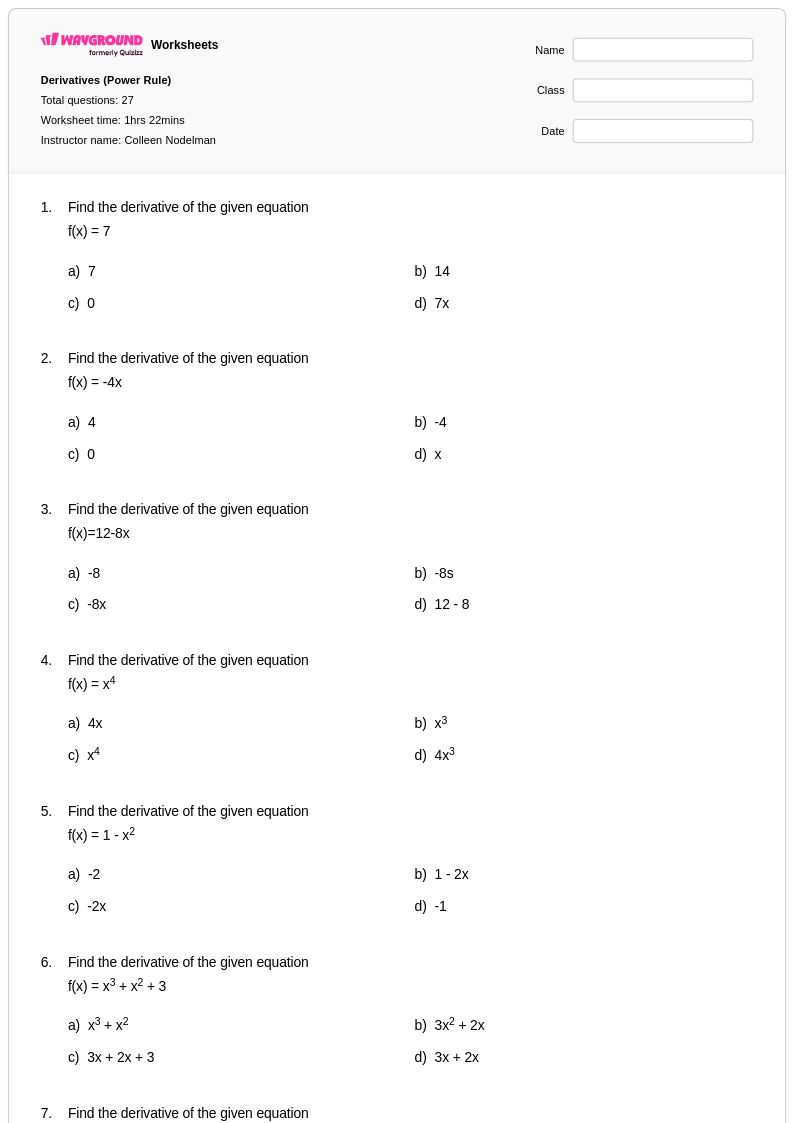
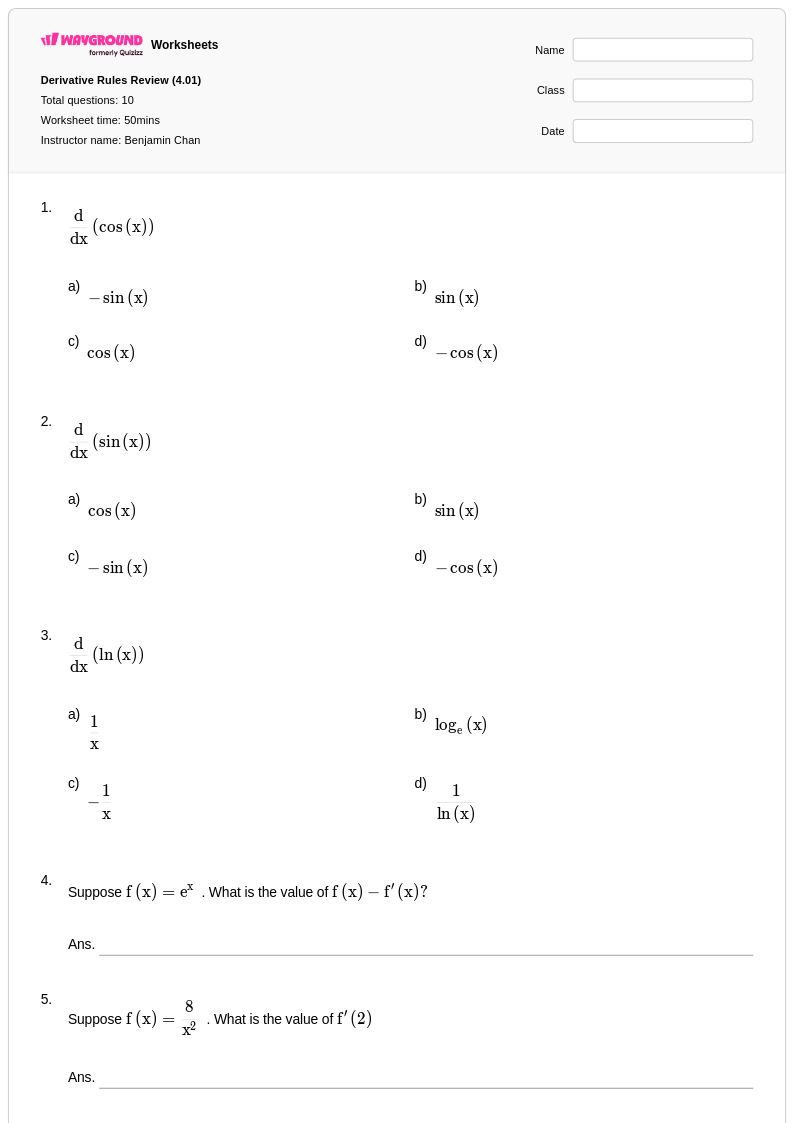
Free Printable Derivative by Definition Worksheets for Class 11
Class 11 derivative by definition worksheets provide comprehensive practice problems and answer keys to help students master the fundamental limit process of finding derivatives, with free printable PDFs available through Wayground's mathematics collection.
Explore printable Derivative by Definition worksheets for Class 11
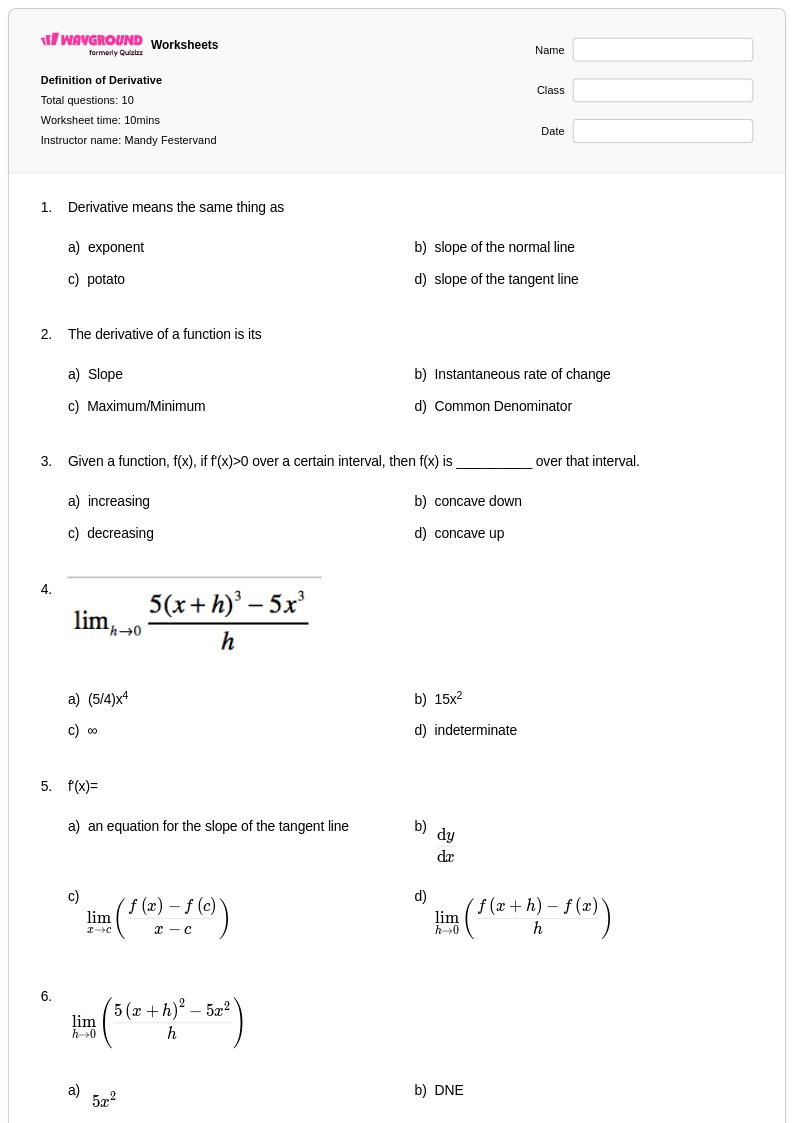
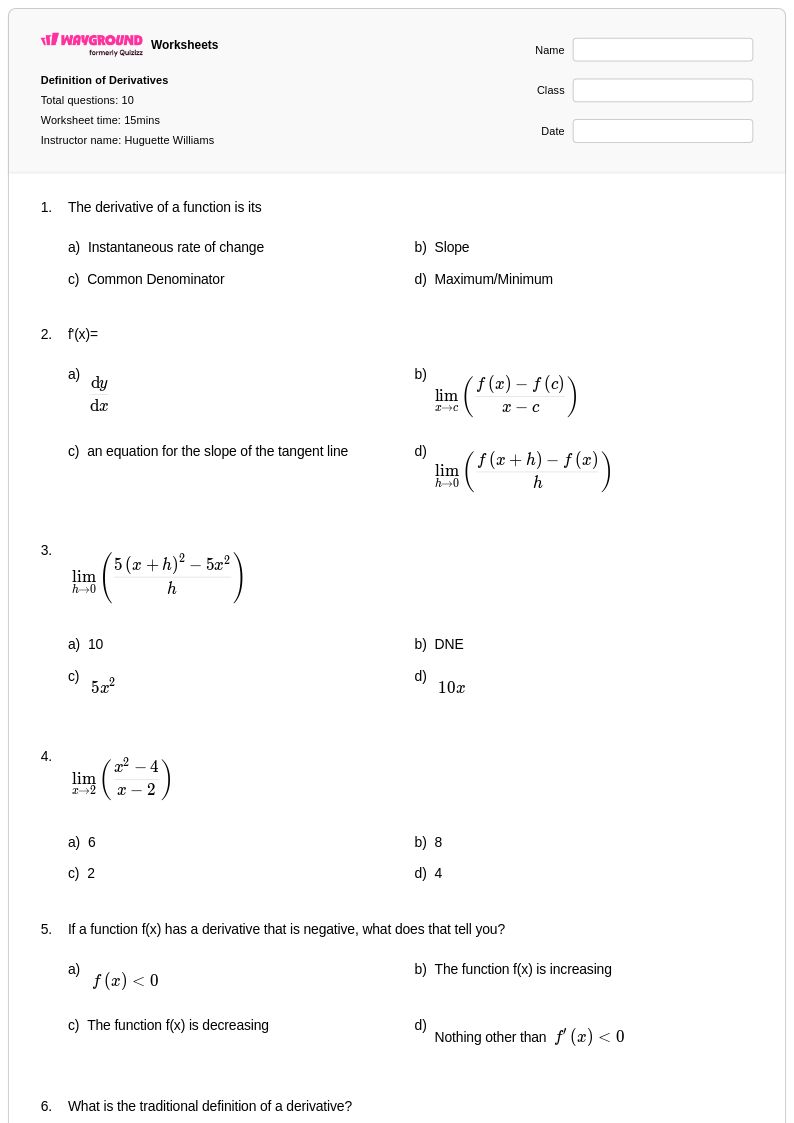
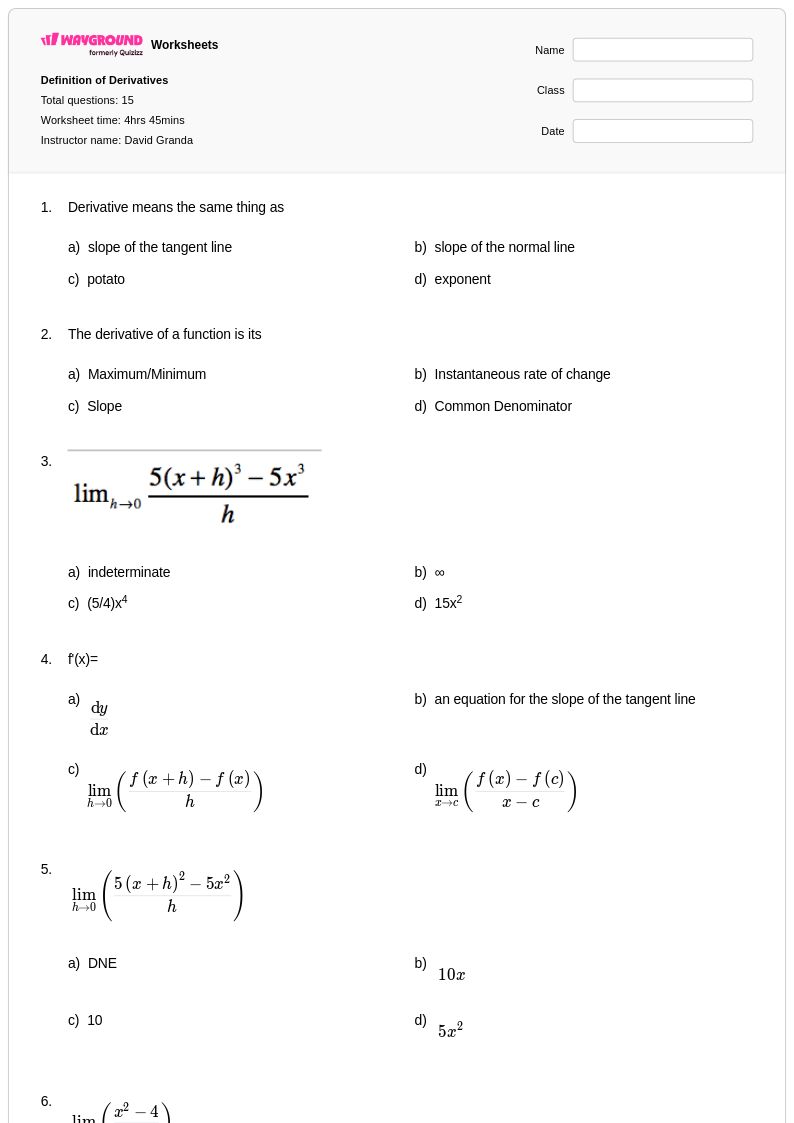
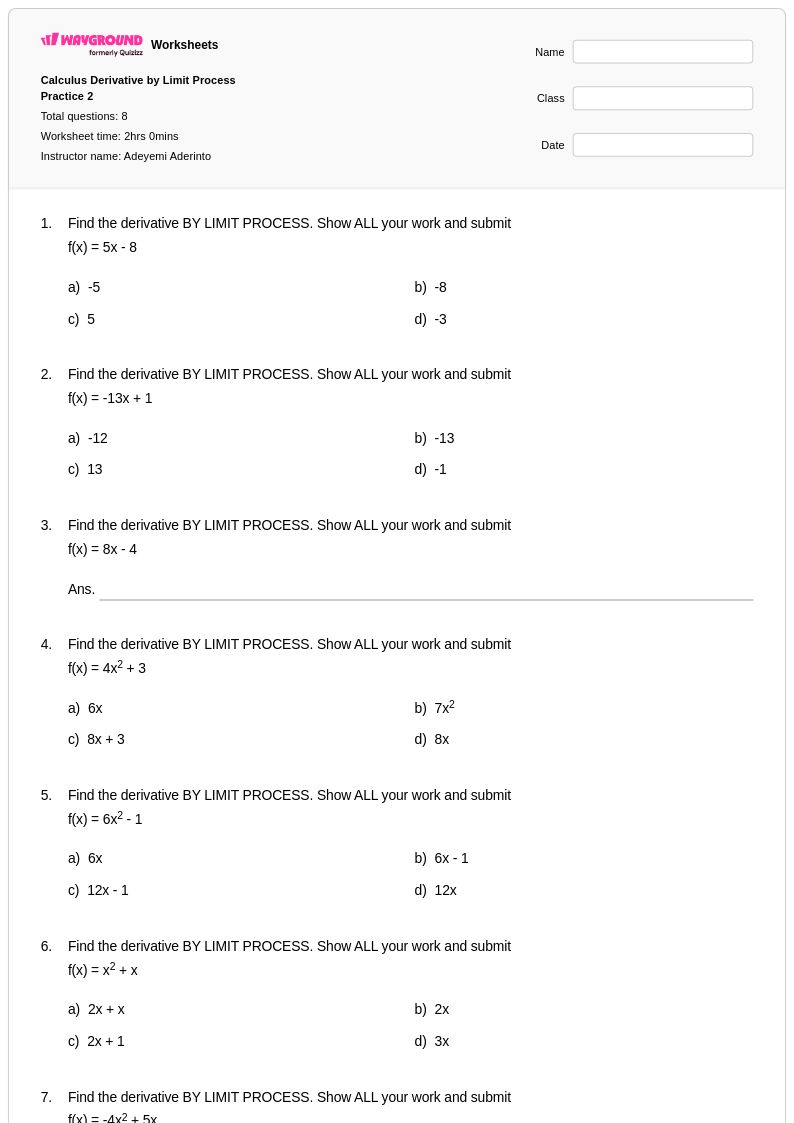
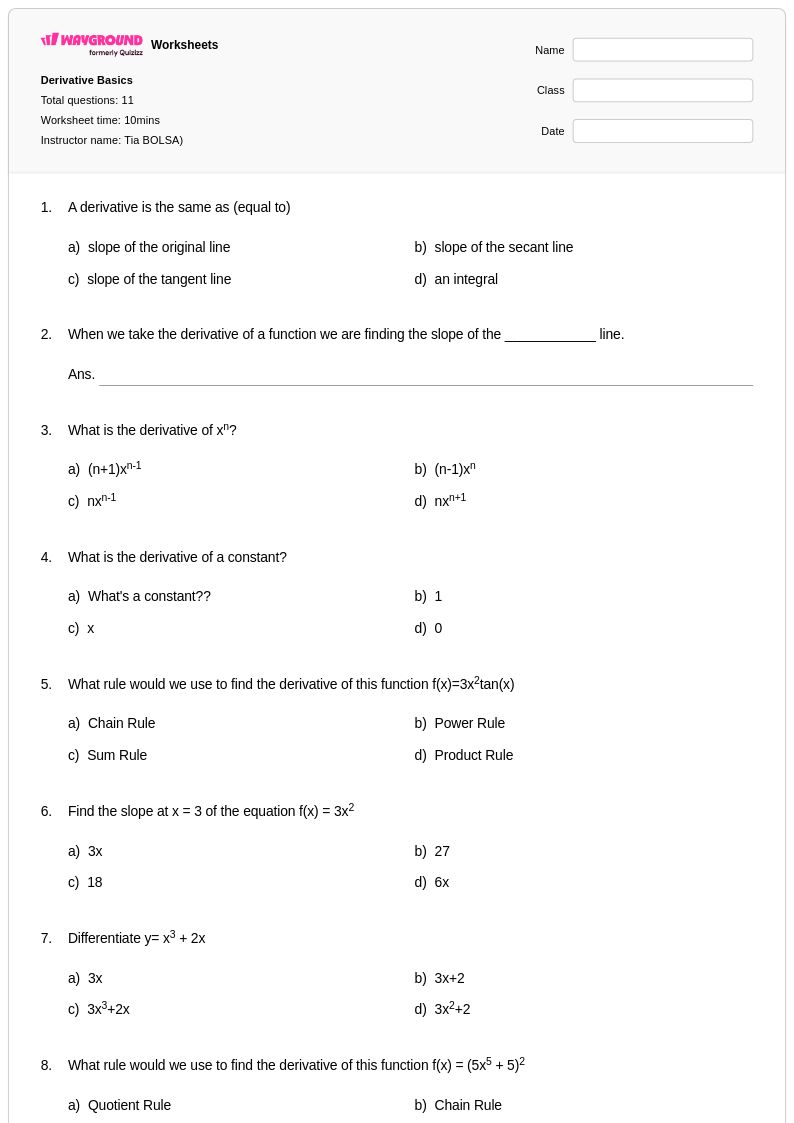
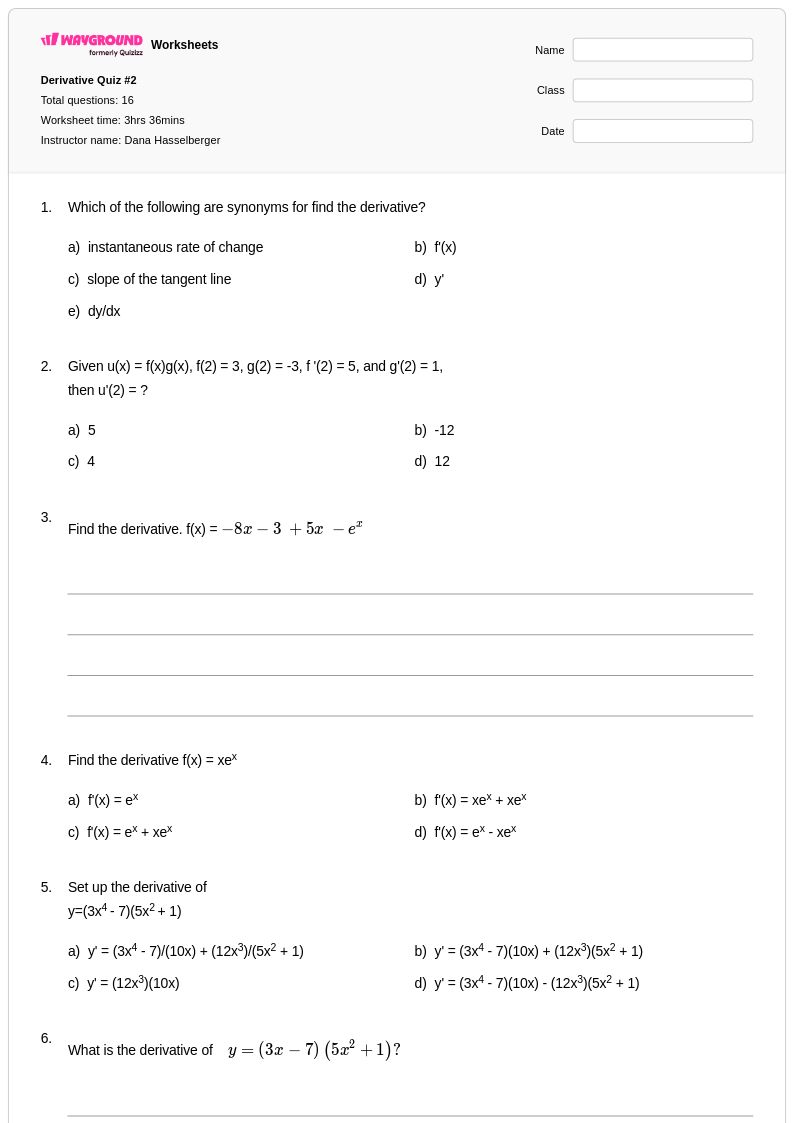
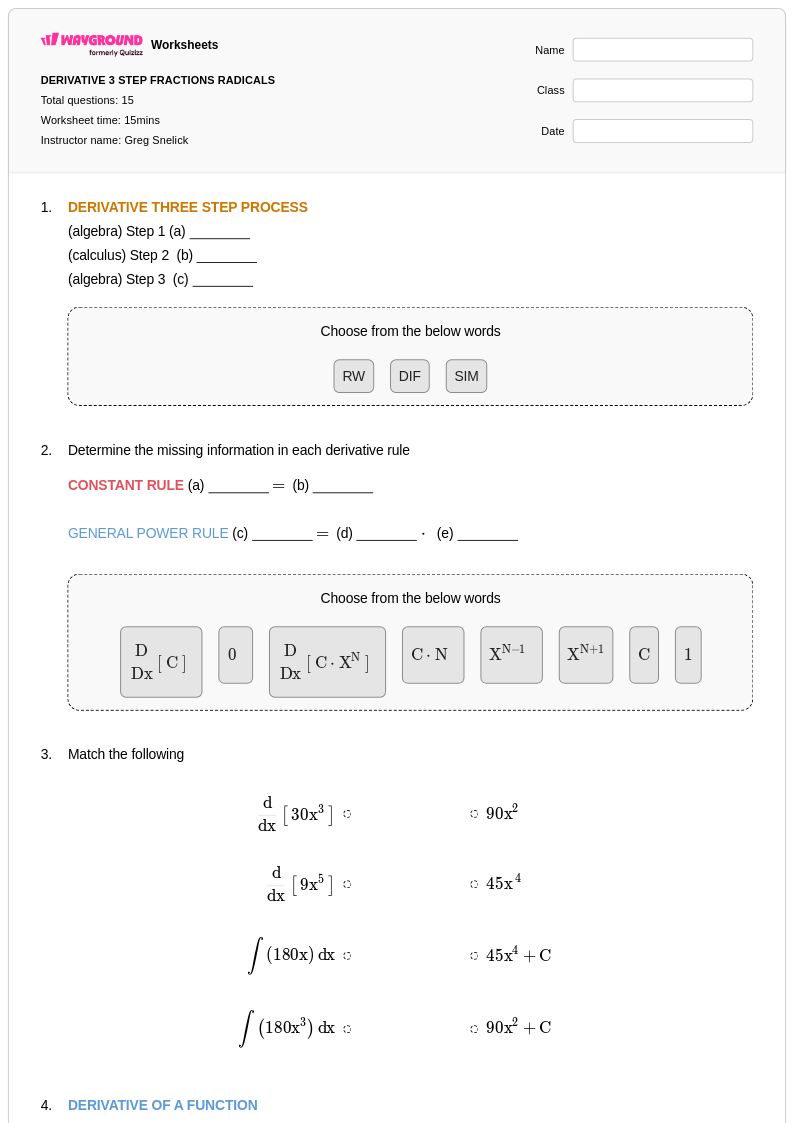
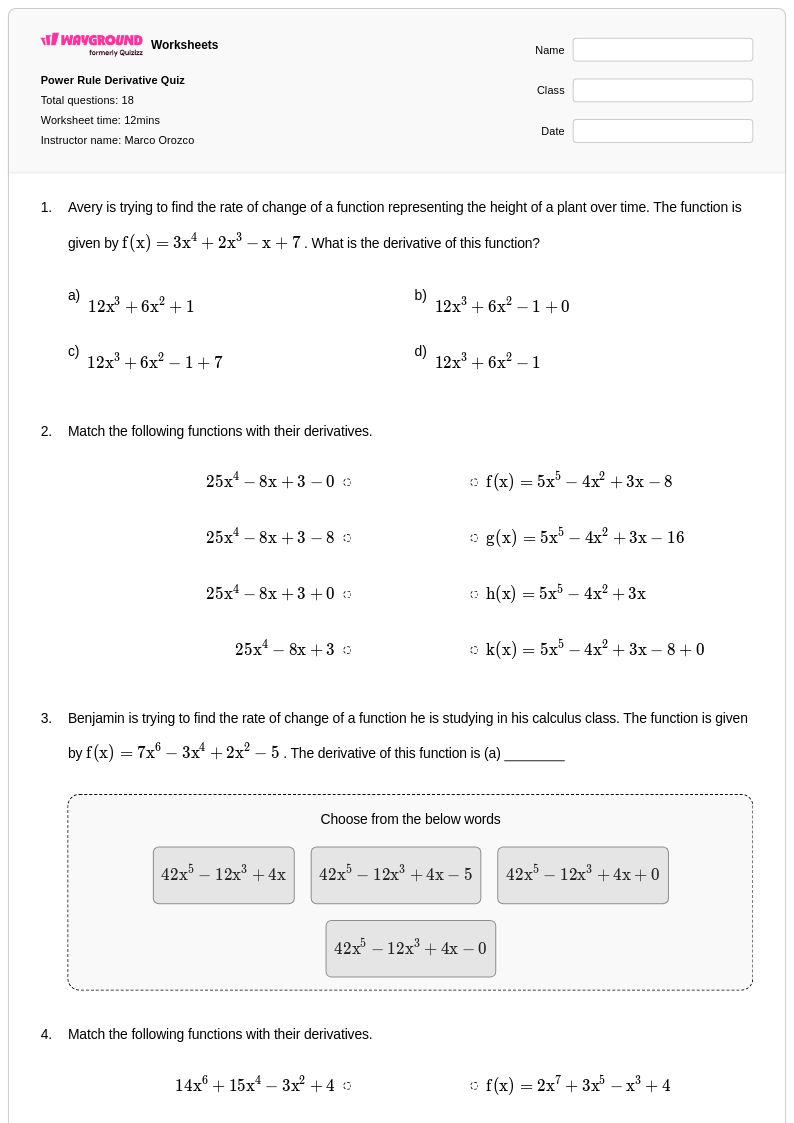
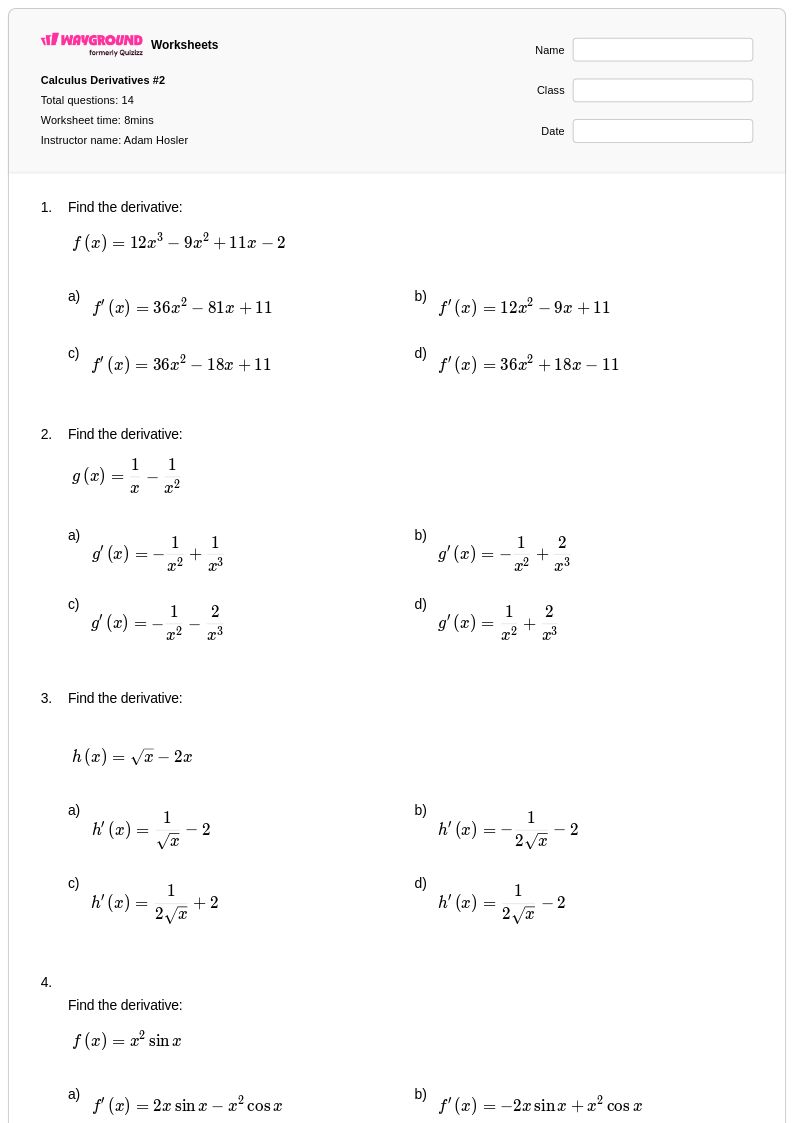
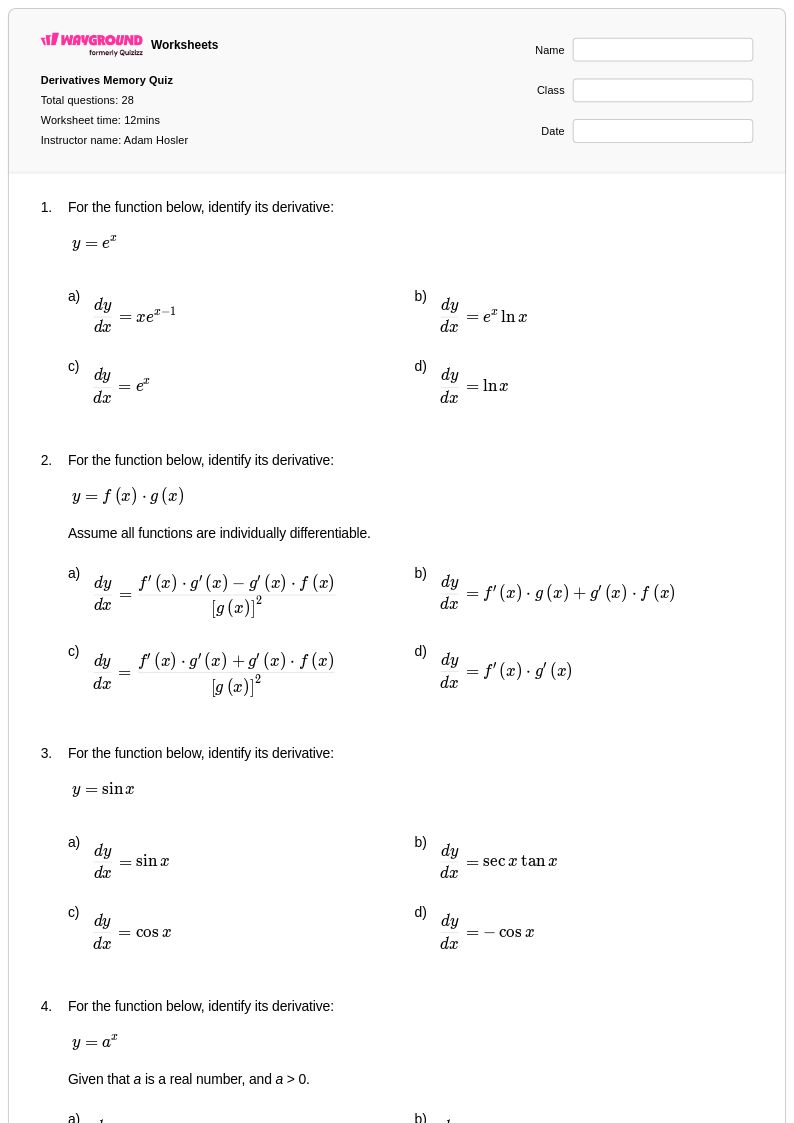
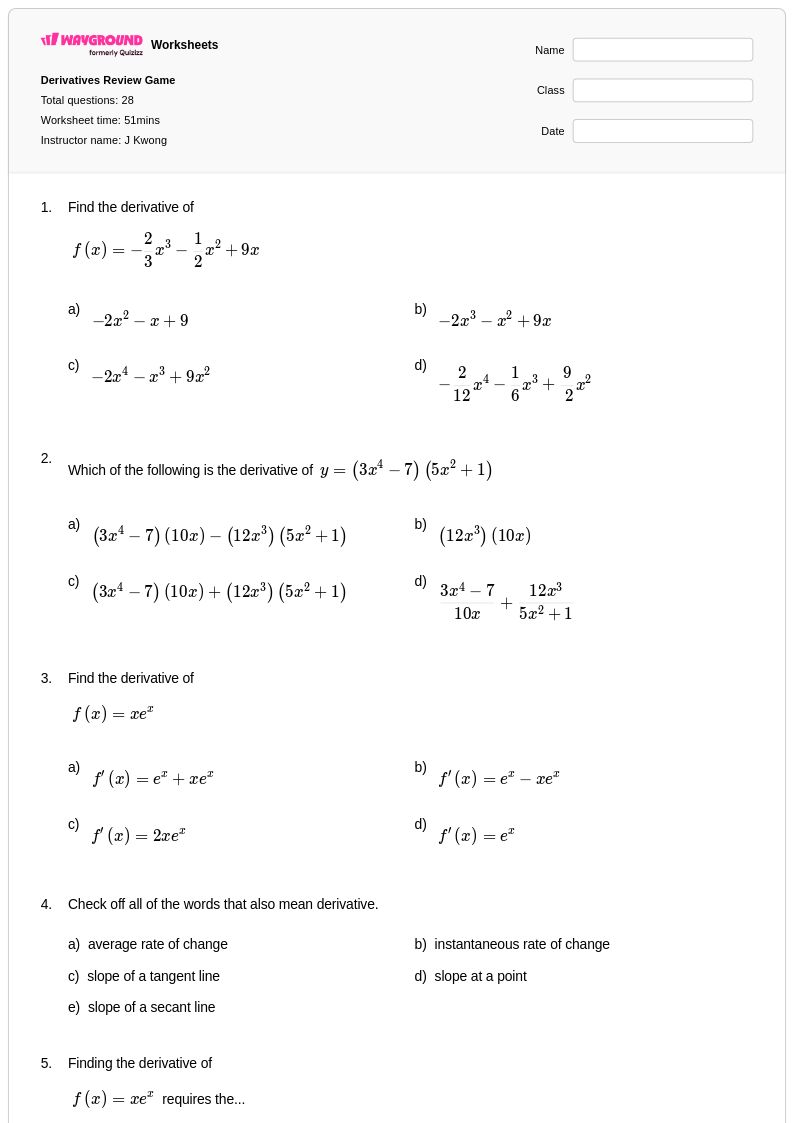
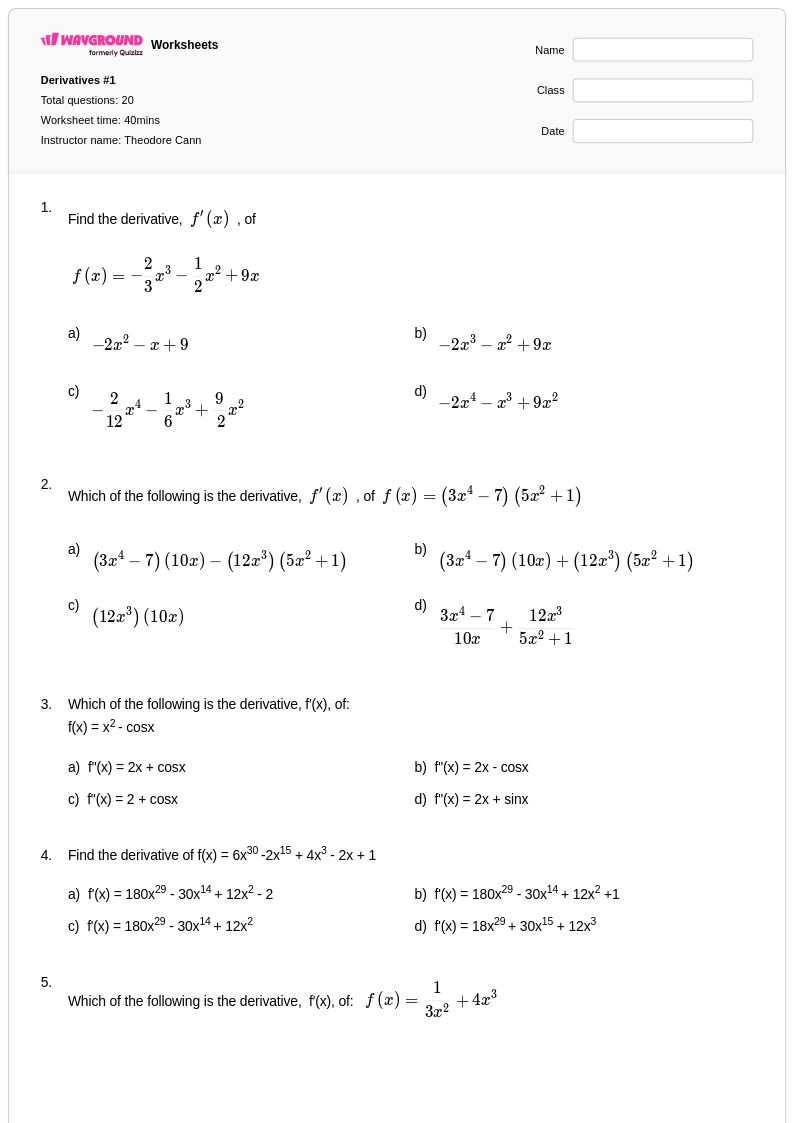
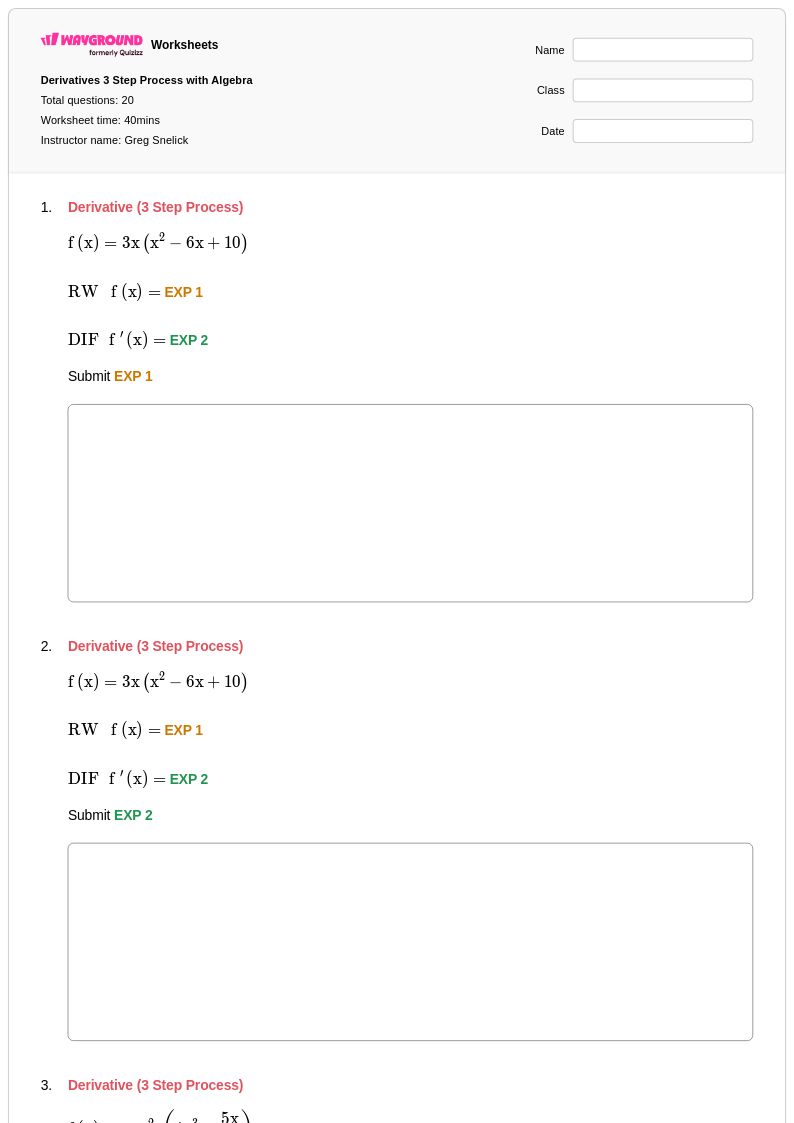
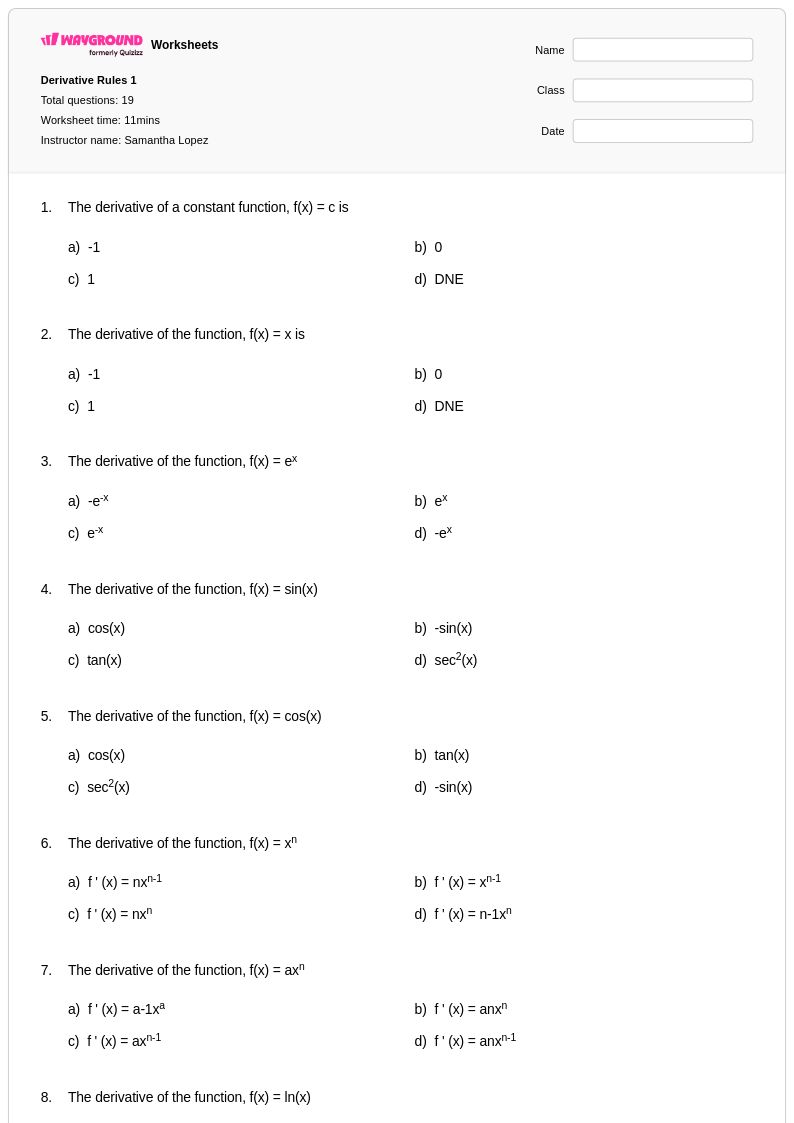
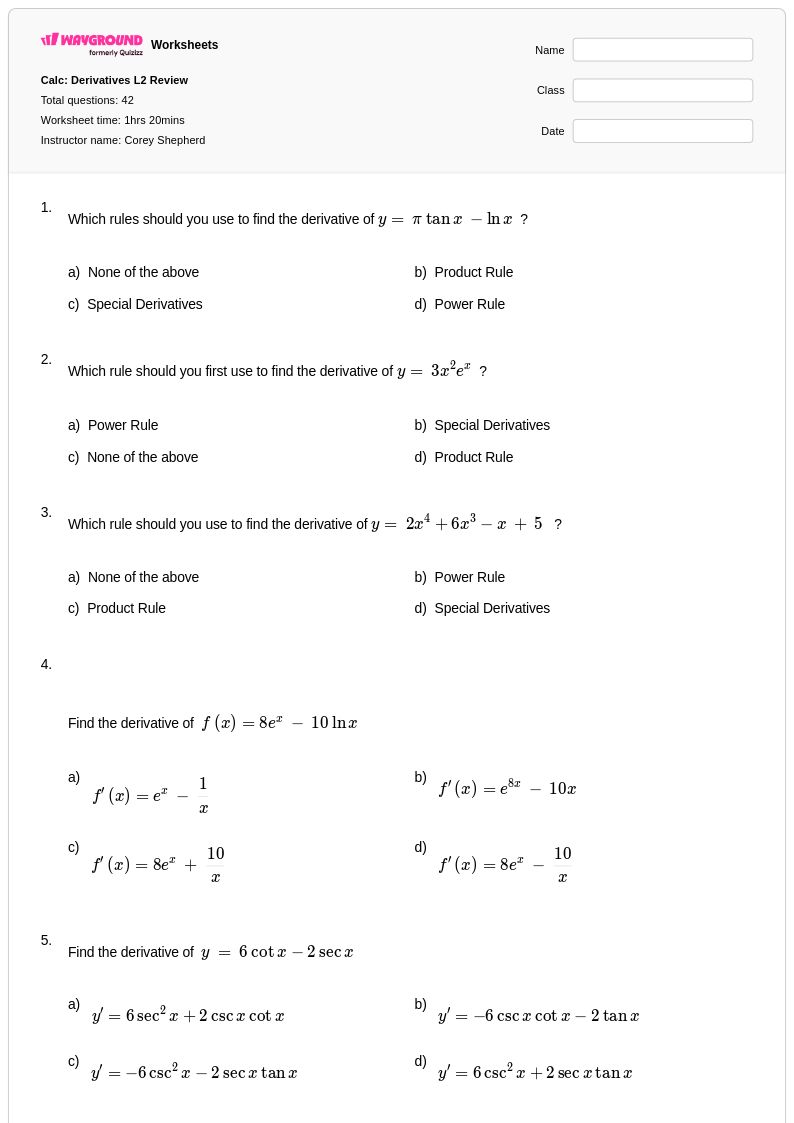
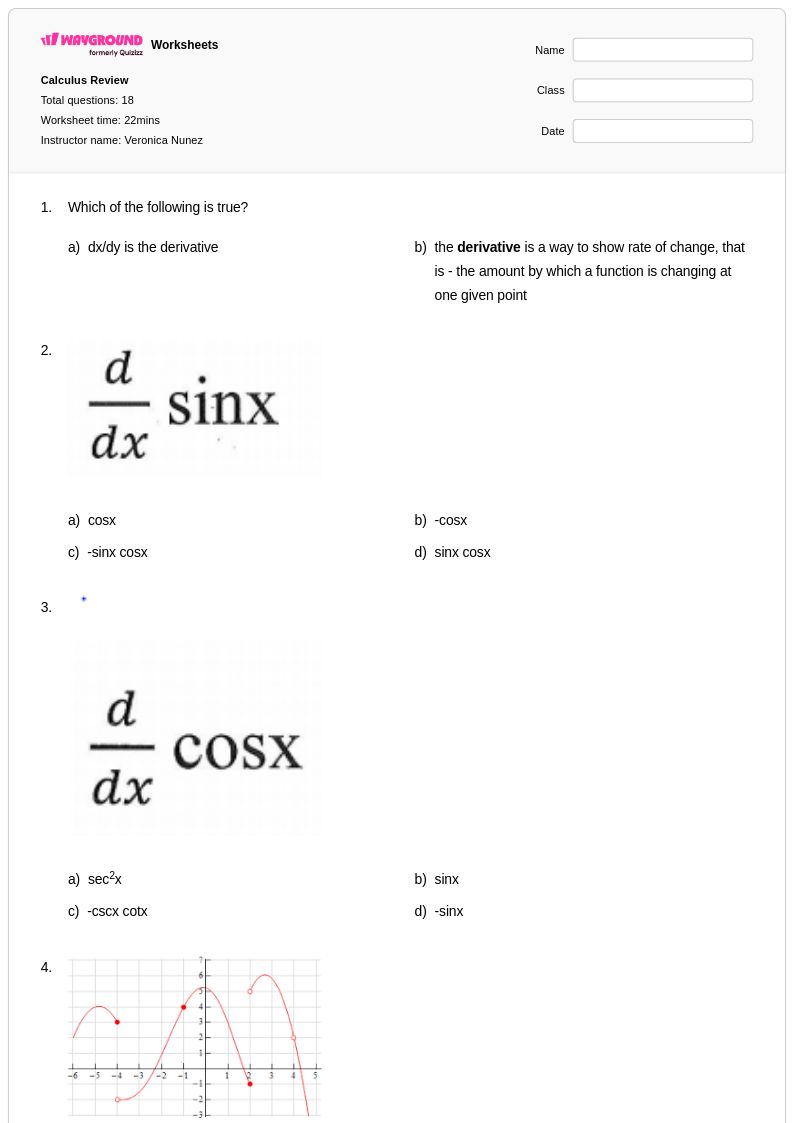
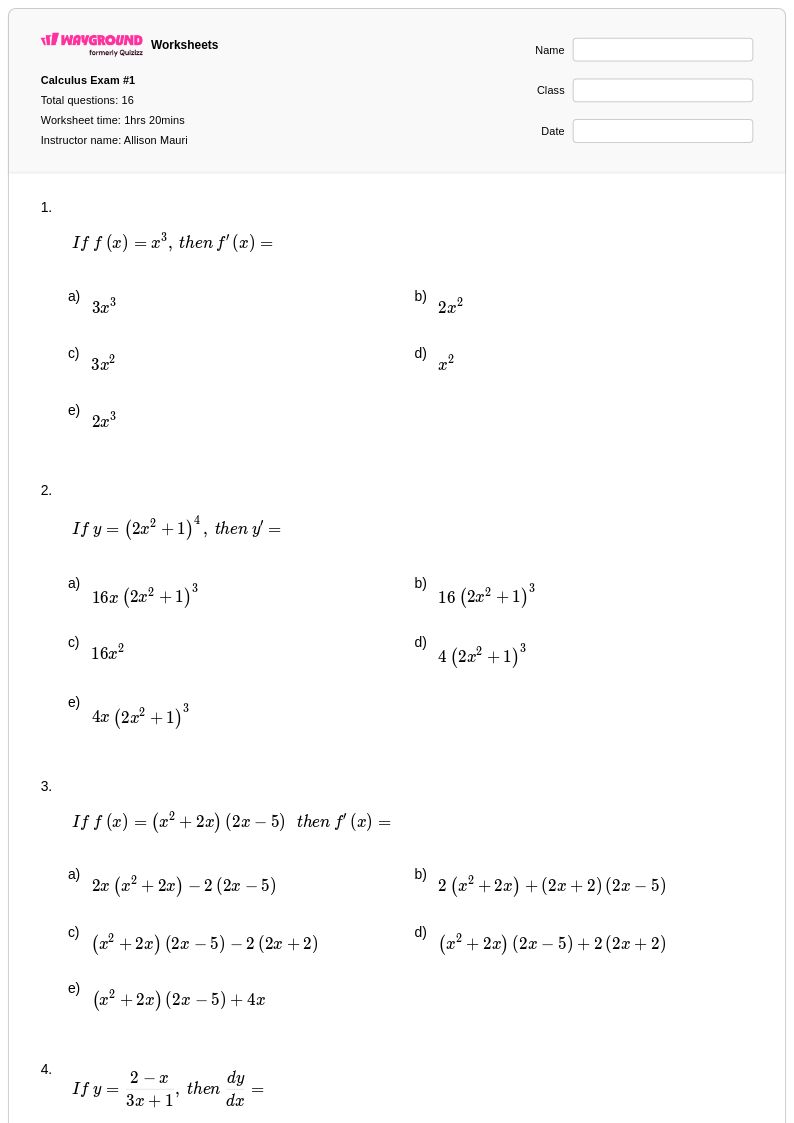
Derivative by Definition worksheets for Class 11 students provide essential practice with the fundamental concept of limits and the formal definition of derivatives in calculus. These comprehensive worksheets guide students through the rigorous process of finding derivatives using the limit definition f'(x) = lim[h→0] (f(x+h) - f(x))/h, helping them develop a deep conceptual understanding of what derivatives truly represent before moving on to shortcut rules. Students work through systematic practice problems that strengthen their algebraic manipulation skills, limit evaluation techniques, and ability to interpret the derivative as an instantaneous rate of change. Each worksheet collection includes detailed answer keys and step-by-step solutions, with printable pdf formats that make these free resources easily accessible for both classroom instruction and independent study.
Wayground, formerly Quizizz, supports mathematics educators with an extensive library of millions of teacher-created derivative by definition worksheets specifically designed for Class 11 calculus instruction. The platform's robust search and filtering capabilities enable teachers to quickly locate resources that align with specific curriculum standards and match their students' skill levels, while differentiation tools allow for seamless customization to meet diverse learning needs. Teachers can access these materials in both printable and digital formats, including downloadable pdf versions, making lesson planning more efficient and providing flexible options for homework assignments, in-class practice, remediation sessions, and enrichment activities. The comprehensive collection ensures that educators have access to varied problem types and difficulty levels, supporting effective skill development as students master this crucial foundational concept in differential calculus.
FAQs
How do I teach the derivative by definition in Grade 11?
Grade 11 is the most common point where students first encounter formal calculus, so the derivative by definition is often their introduction to the subject. The key is not to rush to the formula. Spend time on the geometric interpretation first: a secant line connecting two points on a curve, and what happens to its slope as those points get closer together. Once students can articulate that the derivative is the slope of the tangent line at a point, the formula f'(x) = lim[h→0] (f(x+h) - f(x))/h becomes a precise way of describing something they already understand intuitively.
What exercises help Grade 11 students practice the derivative by definition?
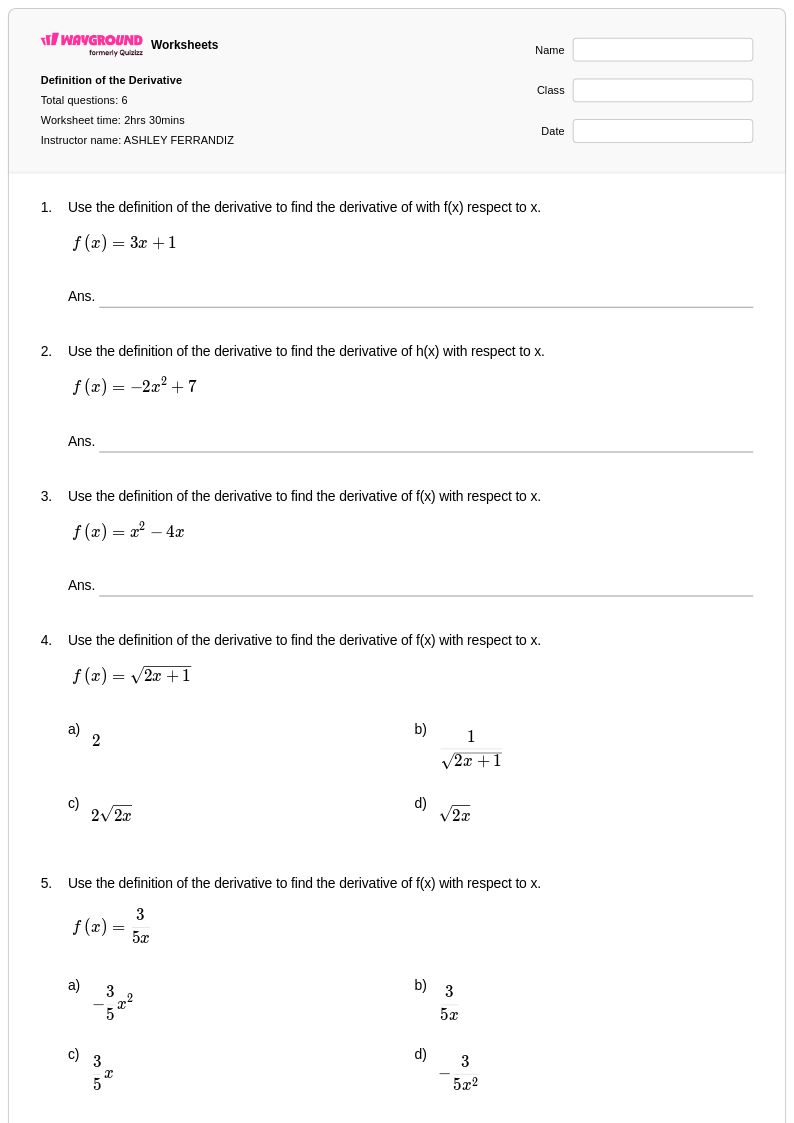
Start with polynomials, linear, then quadratic, then cubic, so students can focus on the limit process without the algebra becoming a distraction. Once the pattern is solid, introduce square root functions, which require multiplying by the conjugate to eliminate h from the denominator. That's a meaningful jump in difficulty and worth treating as its own lesson. Rational functions come after that. The goal is for students to recognize which algebraic technique each function type calls for before they even start the limit.
What mistakes do Grade 11 students commonly make with the derivative by definition?
The most persistent error is substituting h = 0 too early, before h has been canceled from the denominator, which gives 0/0 and a dead end. Students know they're supposed to take the limit as h → 0, and they do it at the wrong moment. A second common issue: when working with square root functions, students try to simplify without rationalizing first, and the algebra stalls. Making the conjugate multiplication step explicit and mandatory for that function type prevents a lot of frustration.
How do I use these Grade 11 derivative by definition worksheets in my class?
The worksheets include complete answer keys and step-by-step solutions, which makes them well-suited for independent practice or flipped classroom work where students check their own progress. You can assign them as a digital quiz on Wayground, students work through problems online and submit for instant feedback, or print the PDF for paper-based practice. For paper submissions, the Wayground for Teachers app lets you scan student work to grade it, which is useful when you want to review the algebraic steps, not just the final answer.
How does the derivative by definition fit into the Grade 11 calculus curriculum?
In the Common Core high school math framework, the derivative by definition sits at the transition from precalculus to calculus — it's where the study of limits becomes the study of change. Students arrive here having worked with average rates of change and function behavior, and the definition formalizes that into instantaneous rate of change. Mastering this before moving to derivative rules matters: students who understand the definition can derive the power rule themselves, which builds the kind of conceptual fluency that holds up under AP exam pressure and in college calculus.
How can I differentiate derivative by definition practice for my Grade 11 class?
The natural differentiation axis here is function complexity. Students who are still building confidence with the limit process should work with polynomials until the setup is automatic; students who are ready for more challenge can move to rational and radical functions where the algebra is genuinely demanding. On Wayground, you can enable Read Aloud for students who benefit from hearing multi-step problems read aloud while they work, and apply extended time for students who need more processing time on the algebraic manipulation. You can also create an alternate version of the worksheet with larger font size or wider spacing for students who find dense algebraic notation hard to parse.