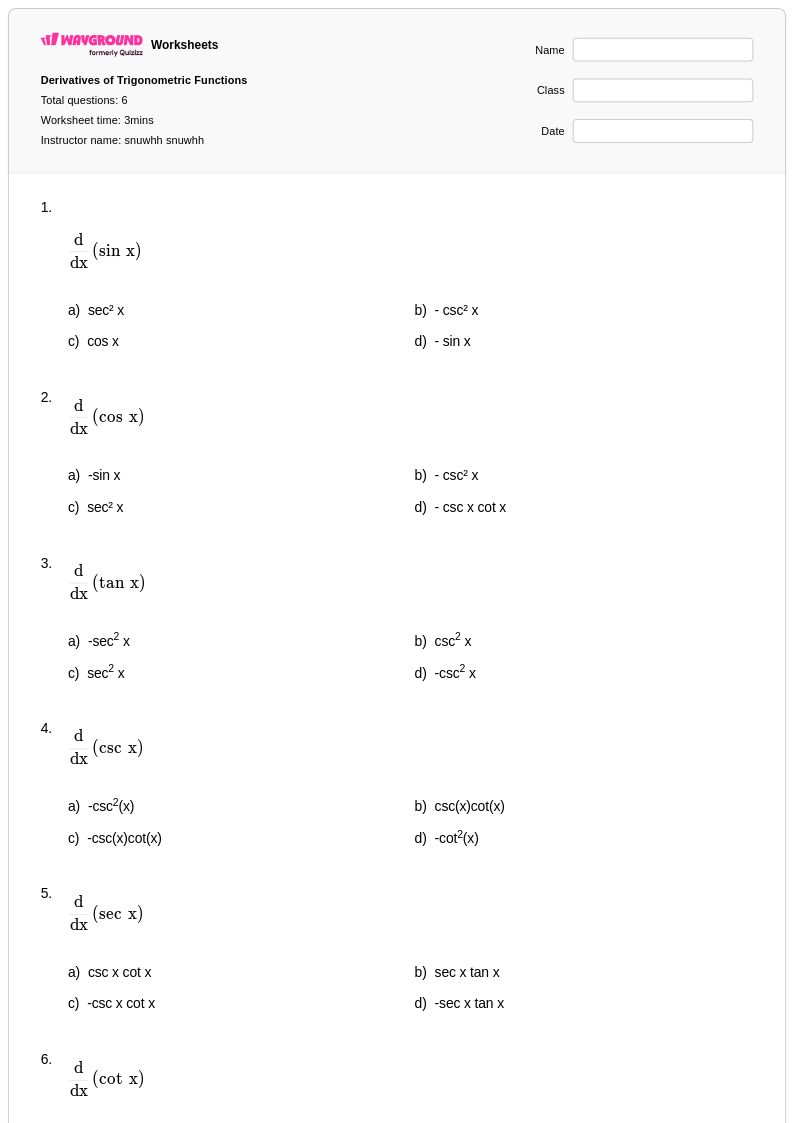
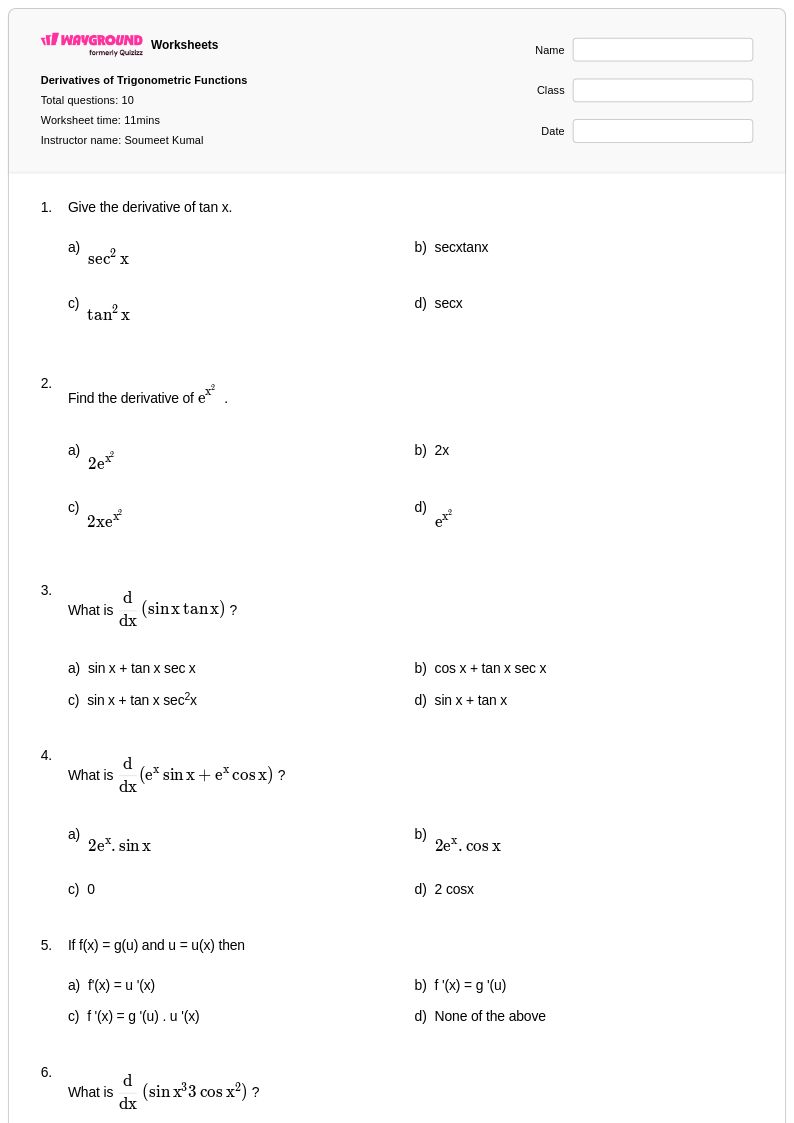
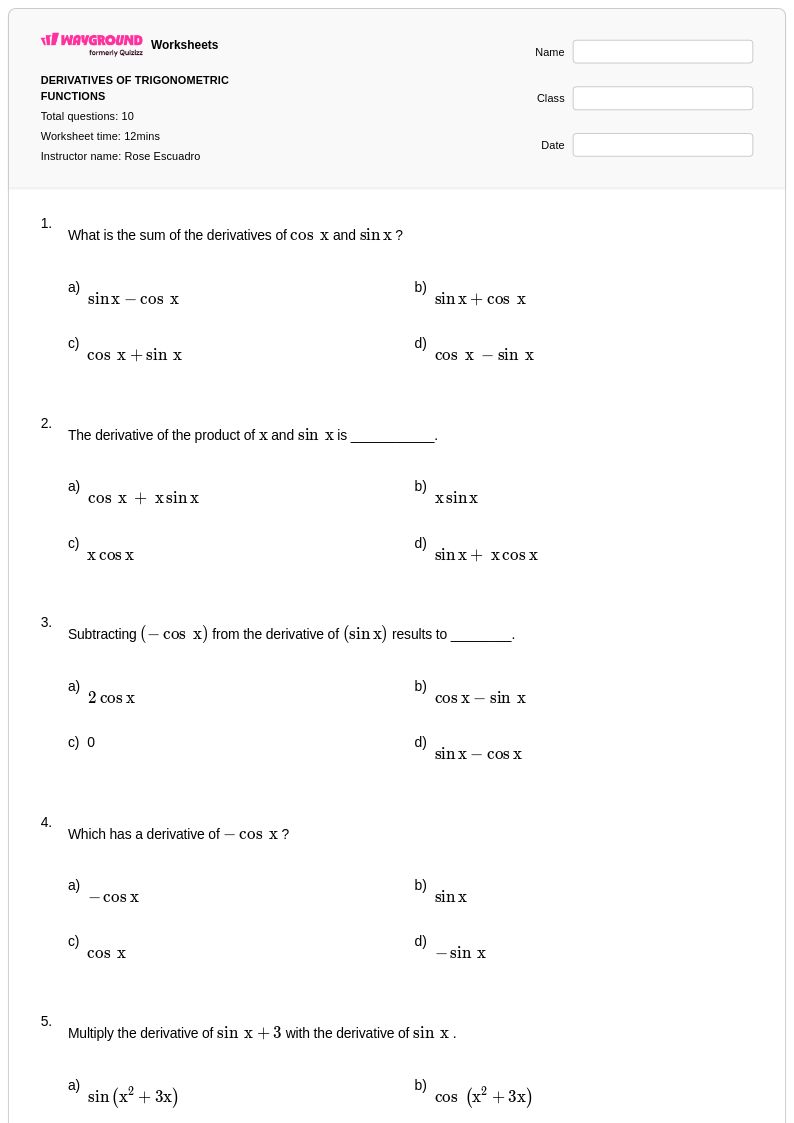
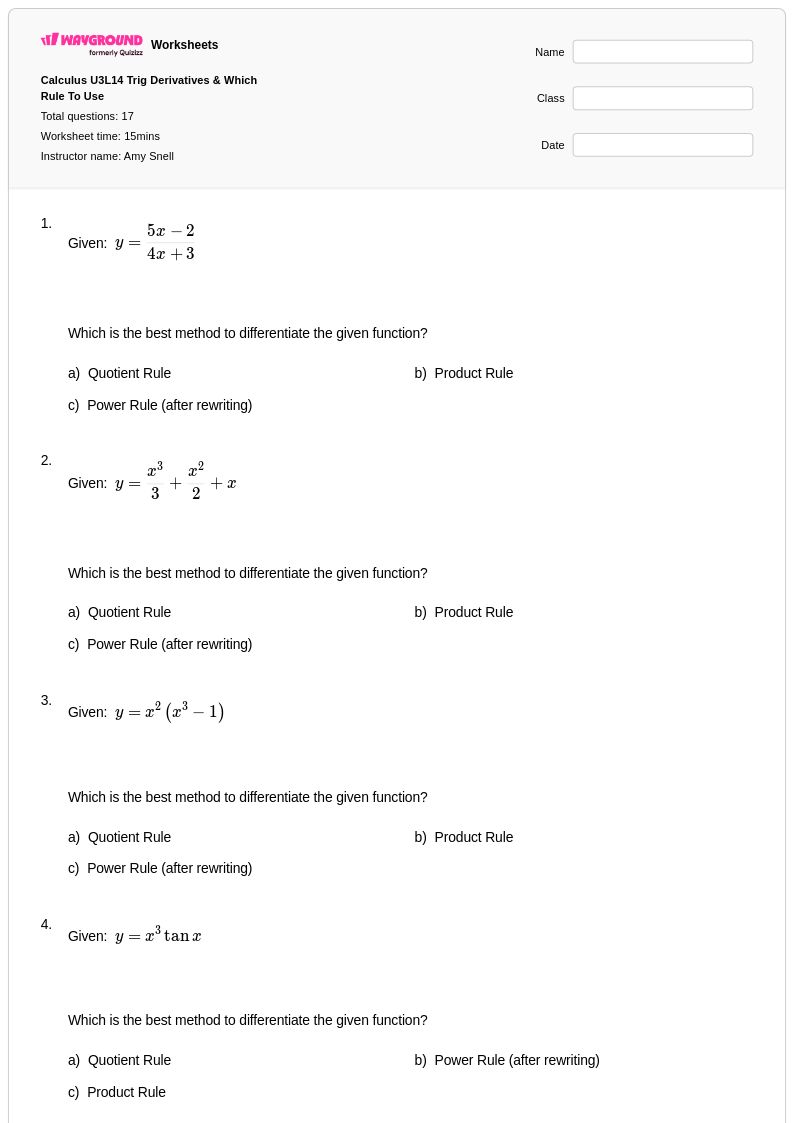
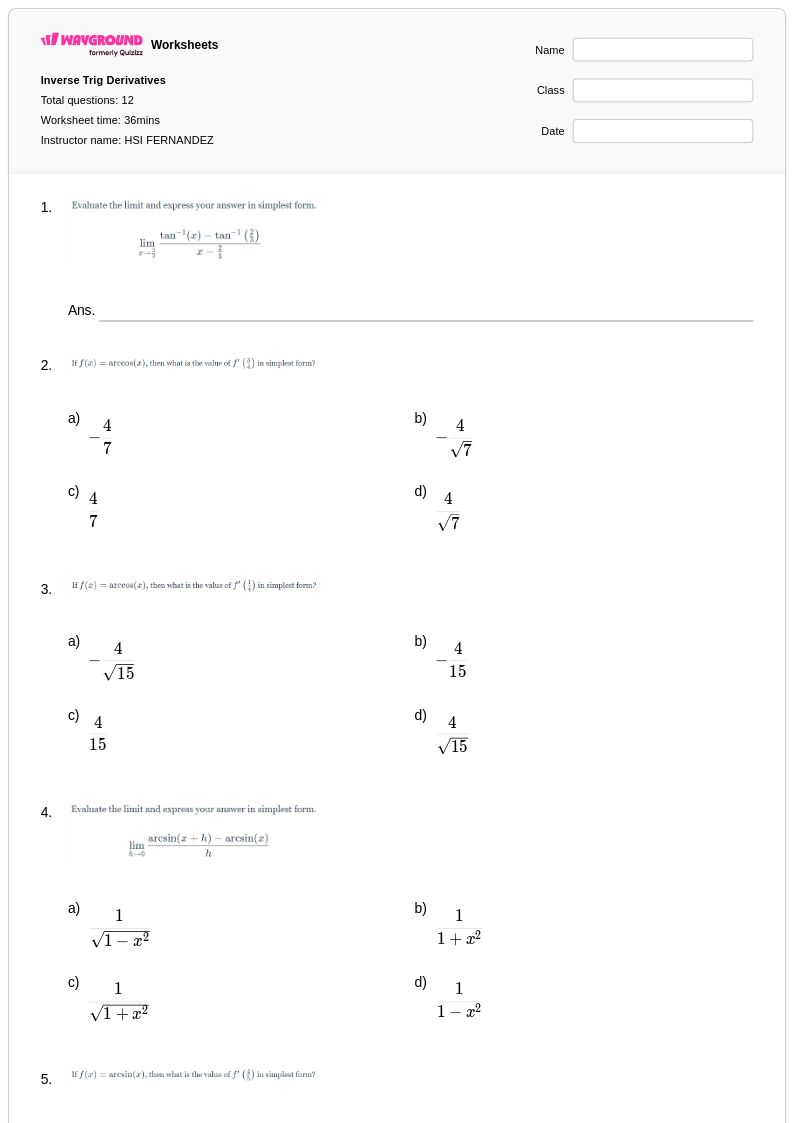
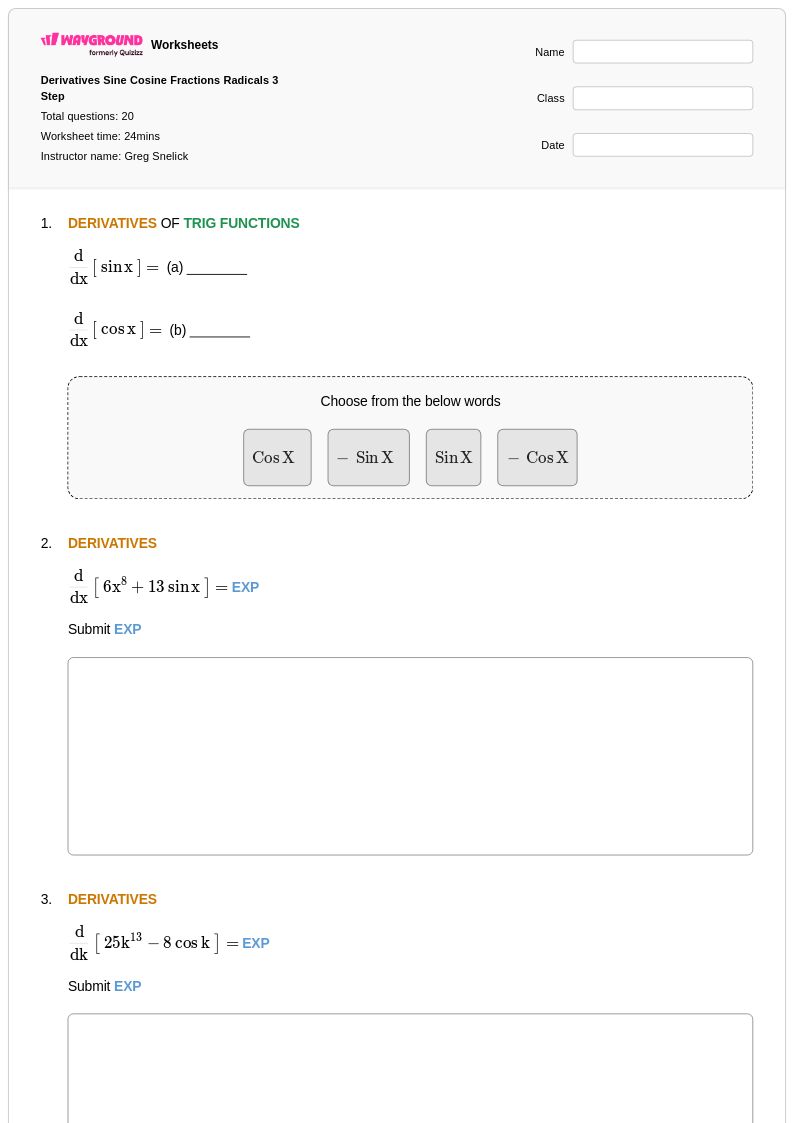
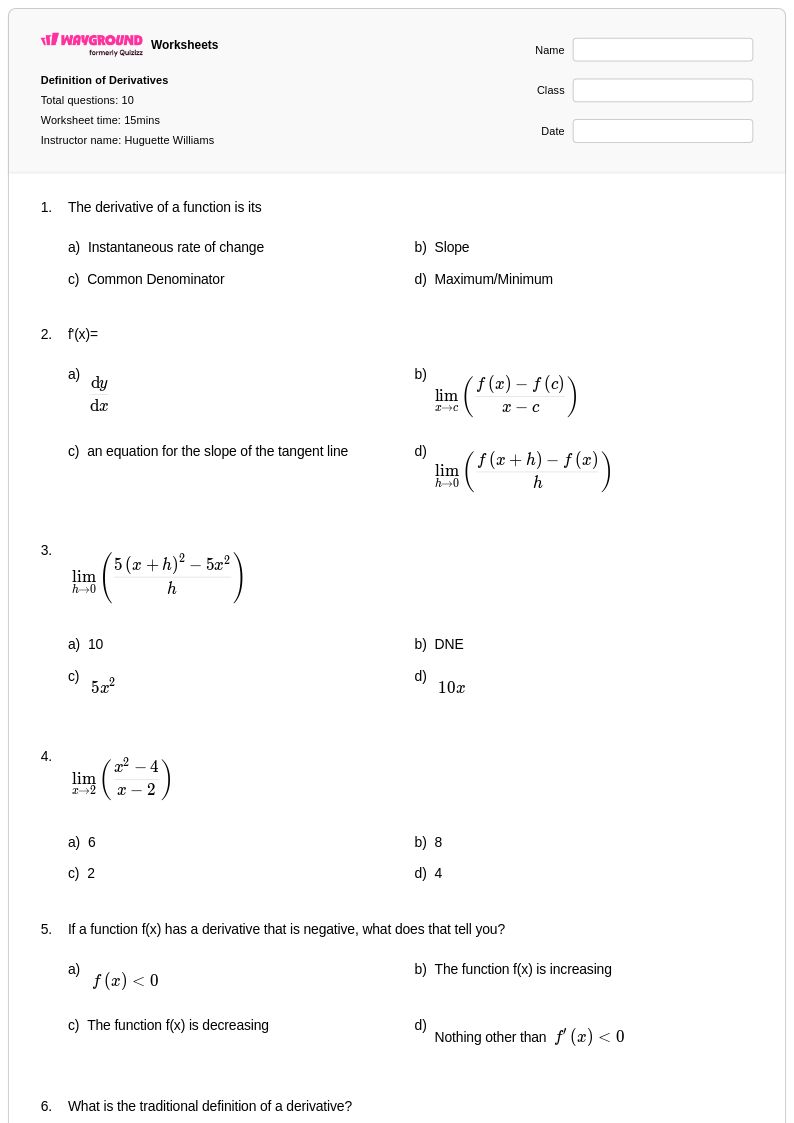
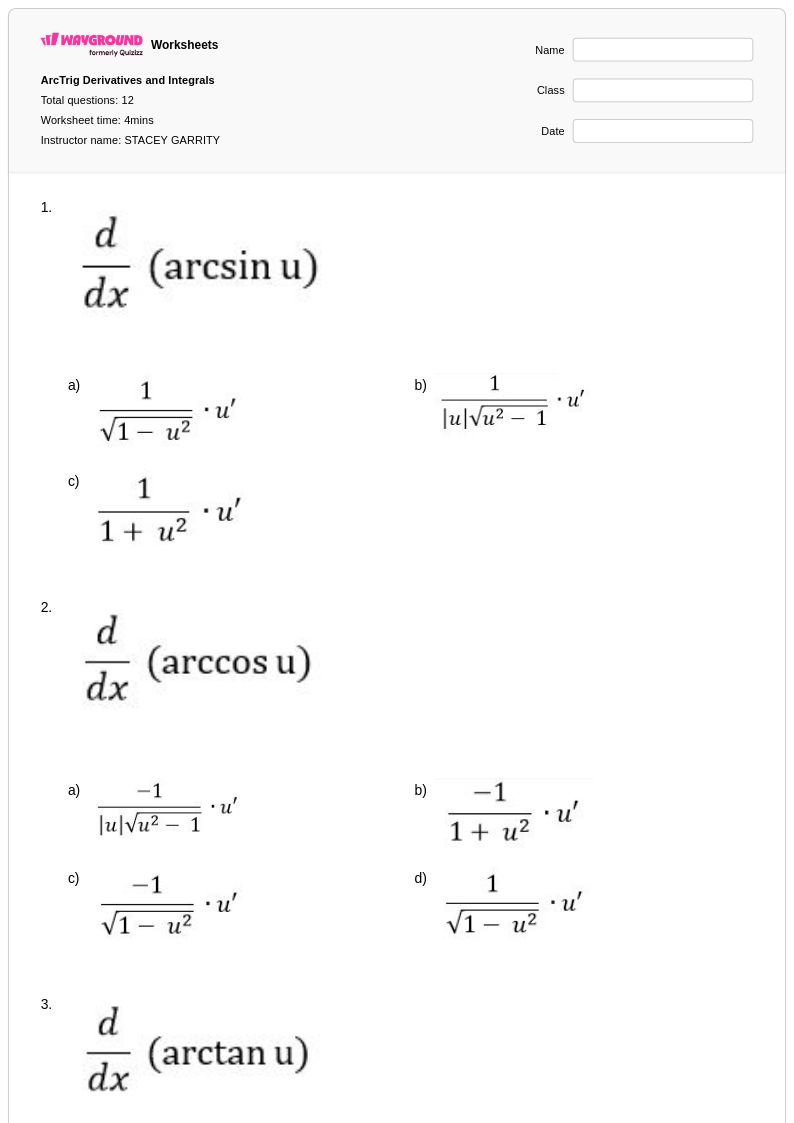
Free Printable Derivatives of Trigonometric Functions Worksheets for Class 11
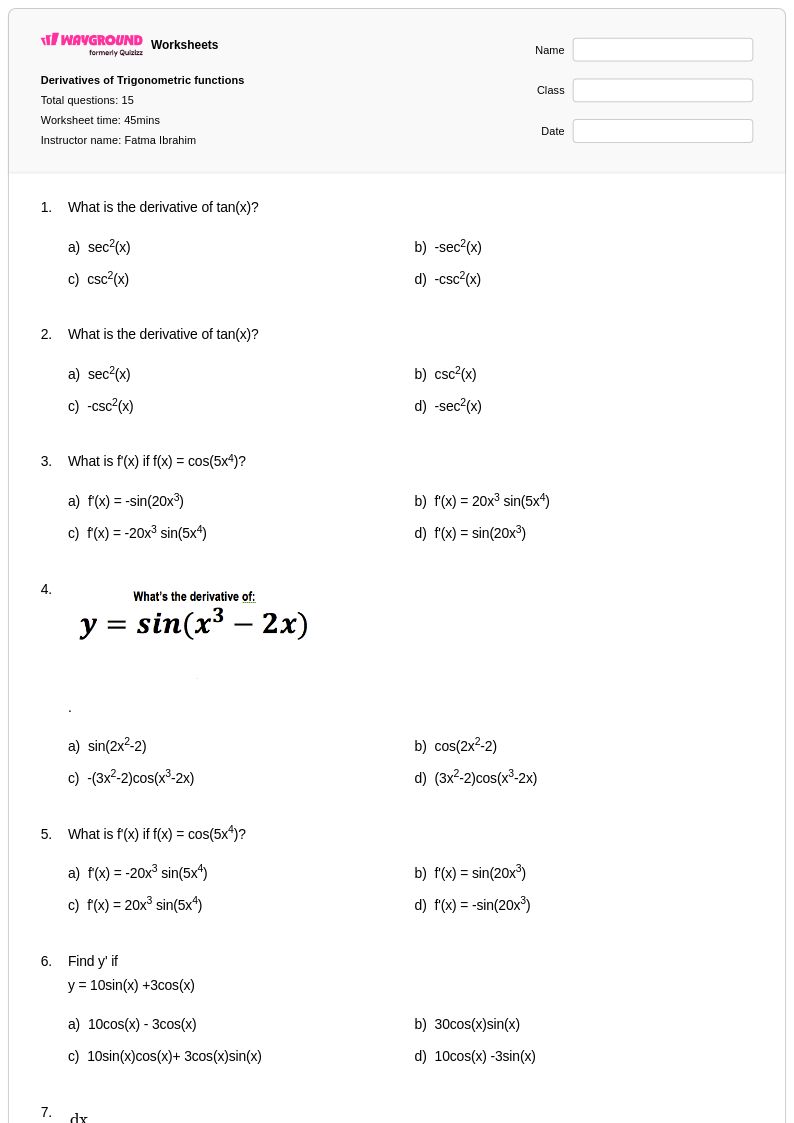
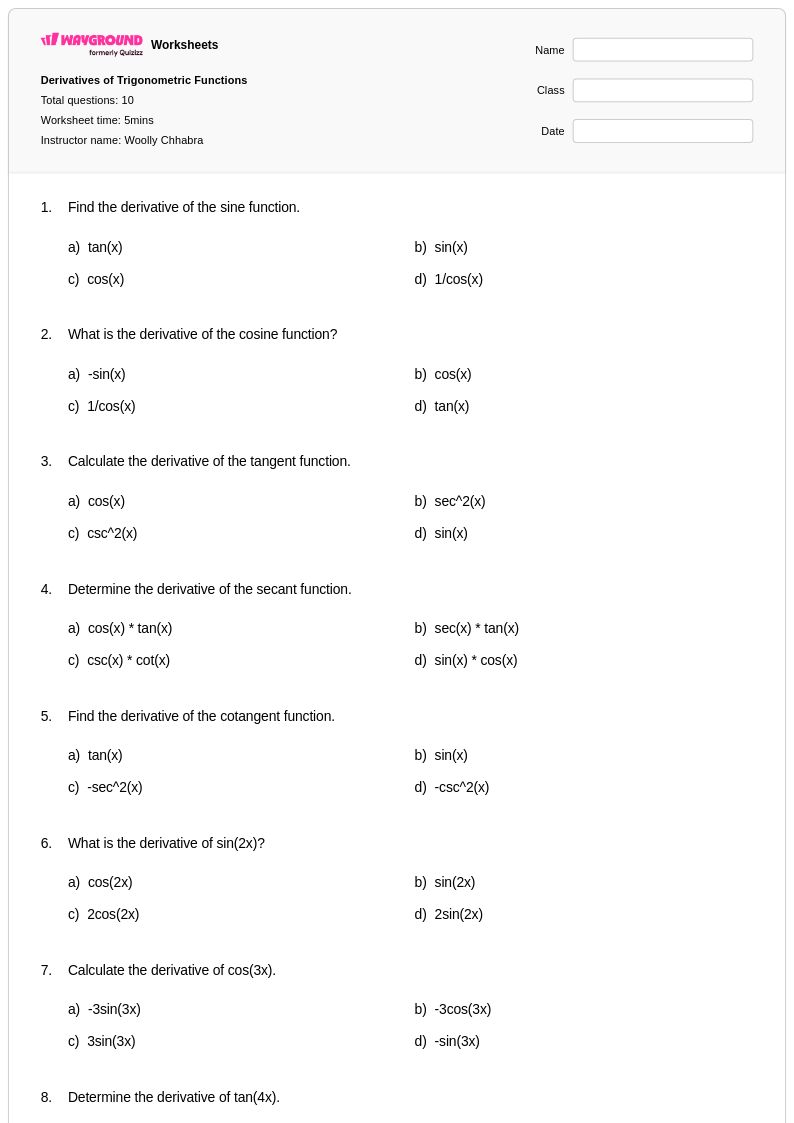
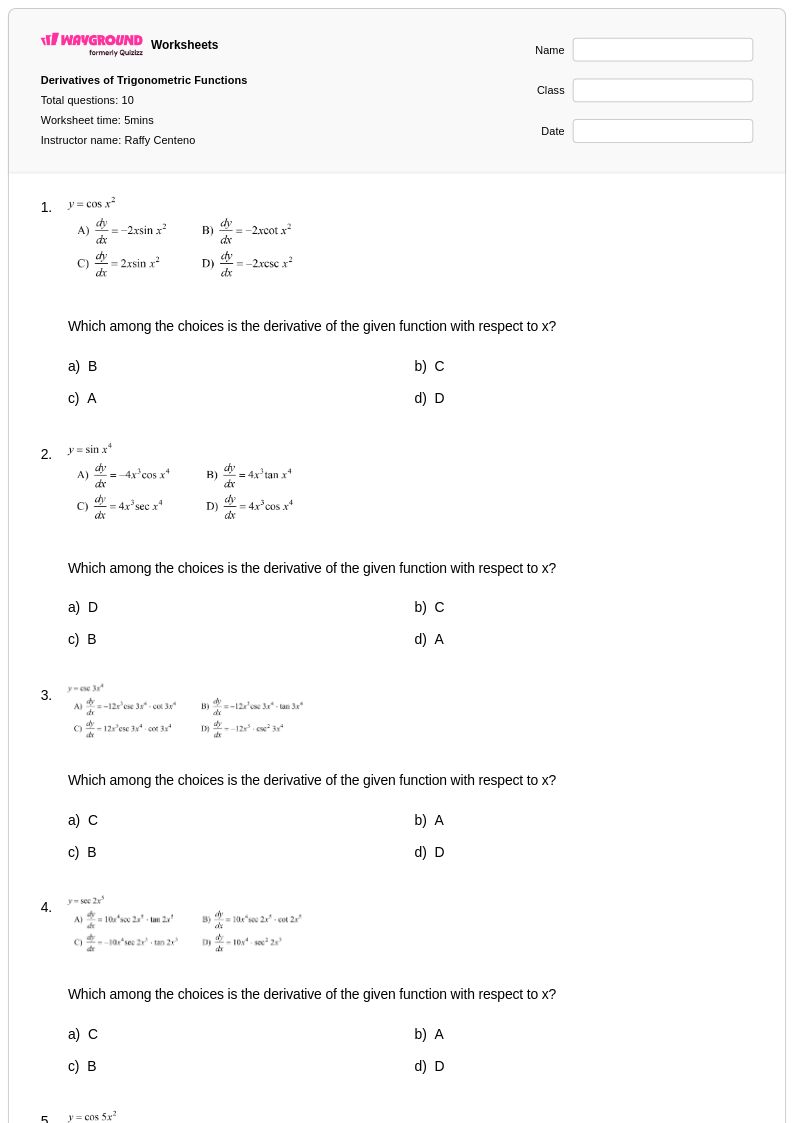
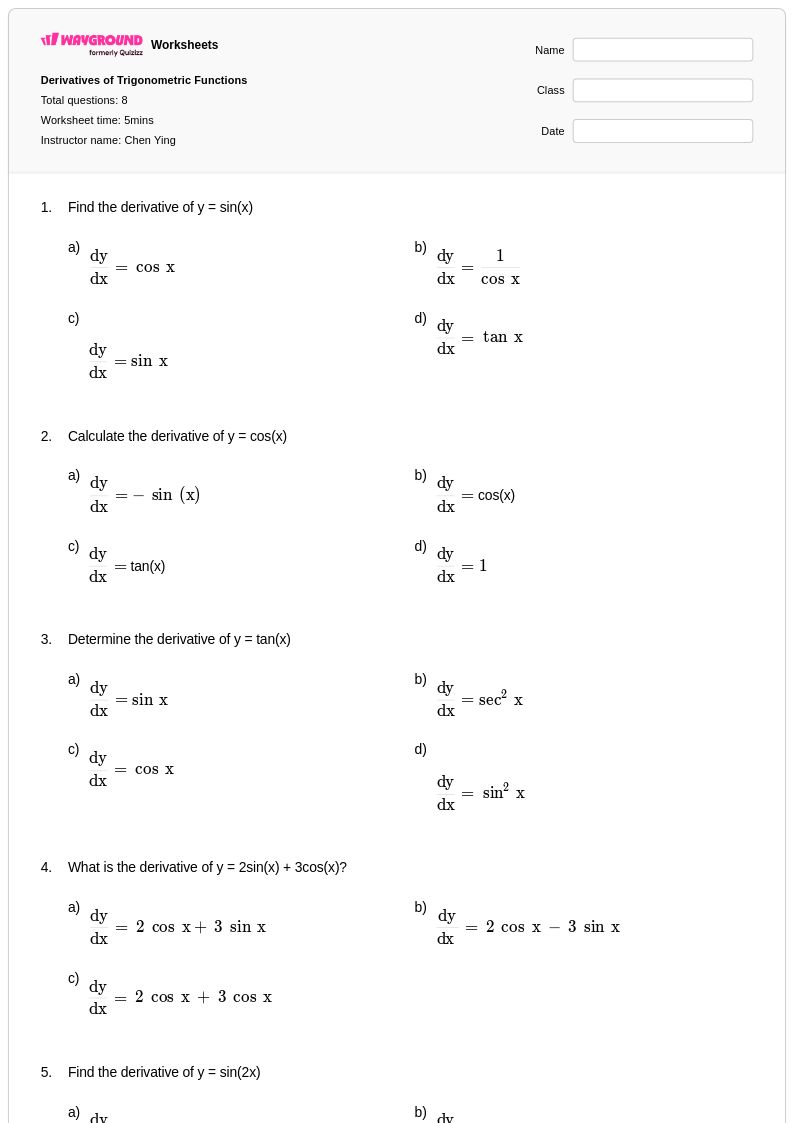
Class 11 students can master derivatives of trigonometric functions with Wayground's comprehensive collection of free worksheets, printables, and practice problems featuring detailed answer keys and PDF formats for effective calculus learning.
Explore printable Derivatives of Trigonometric Functions worksheets for Class 11
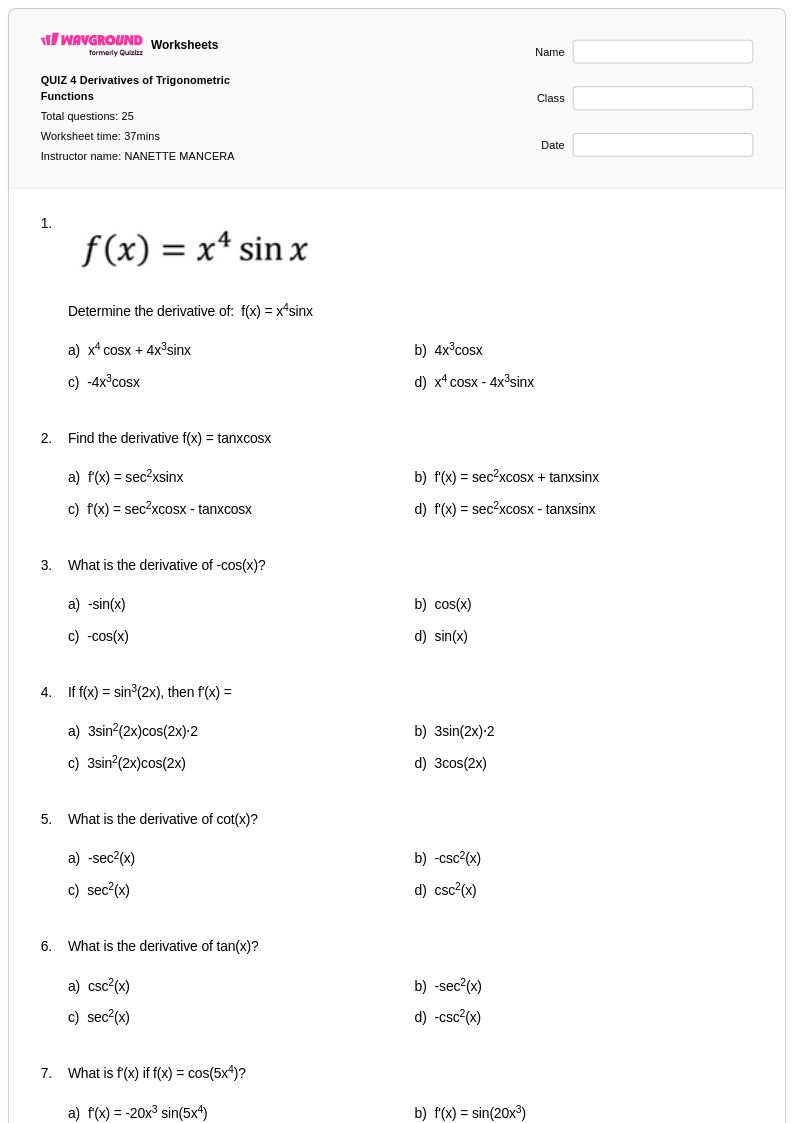
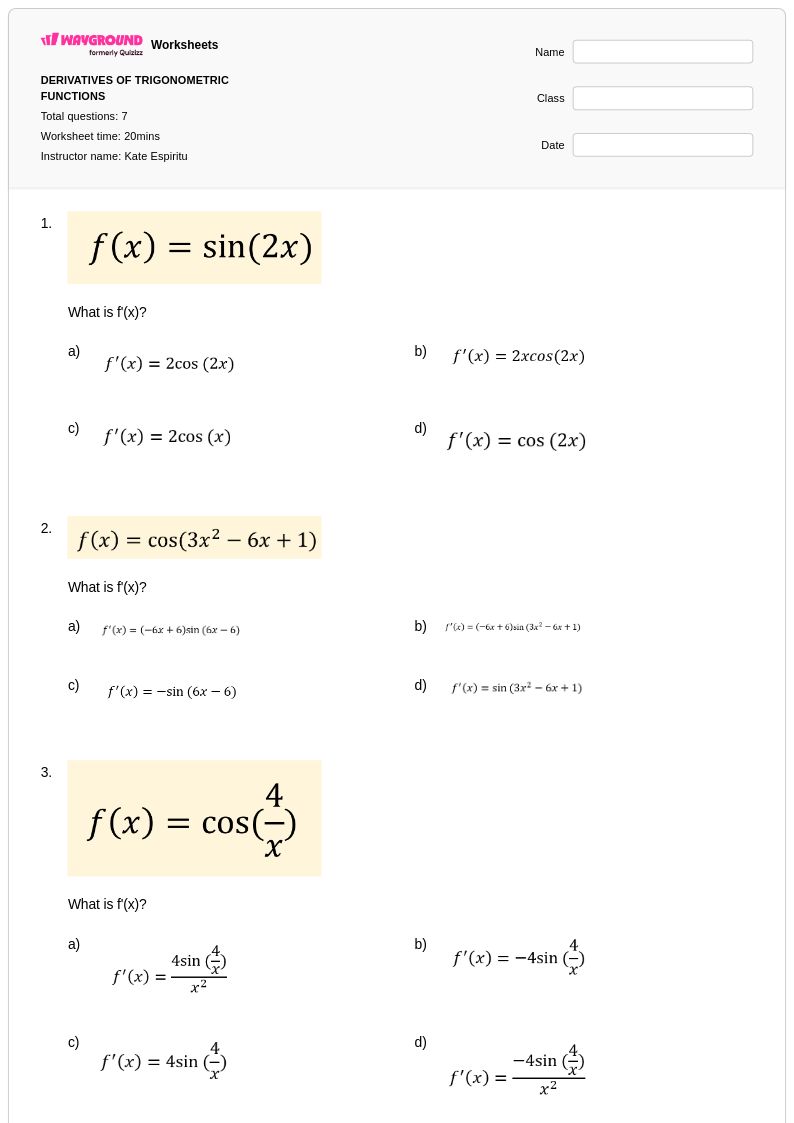
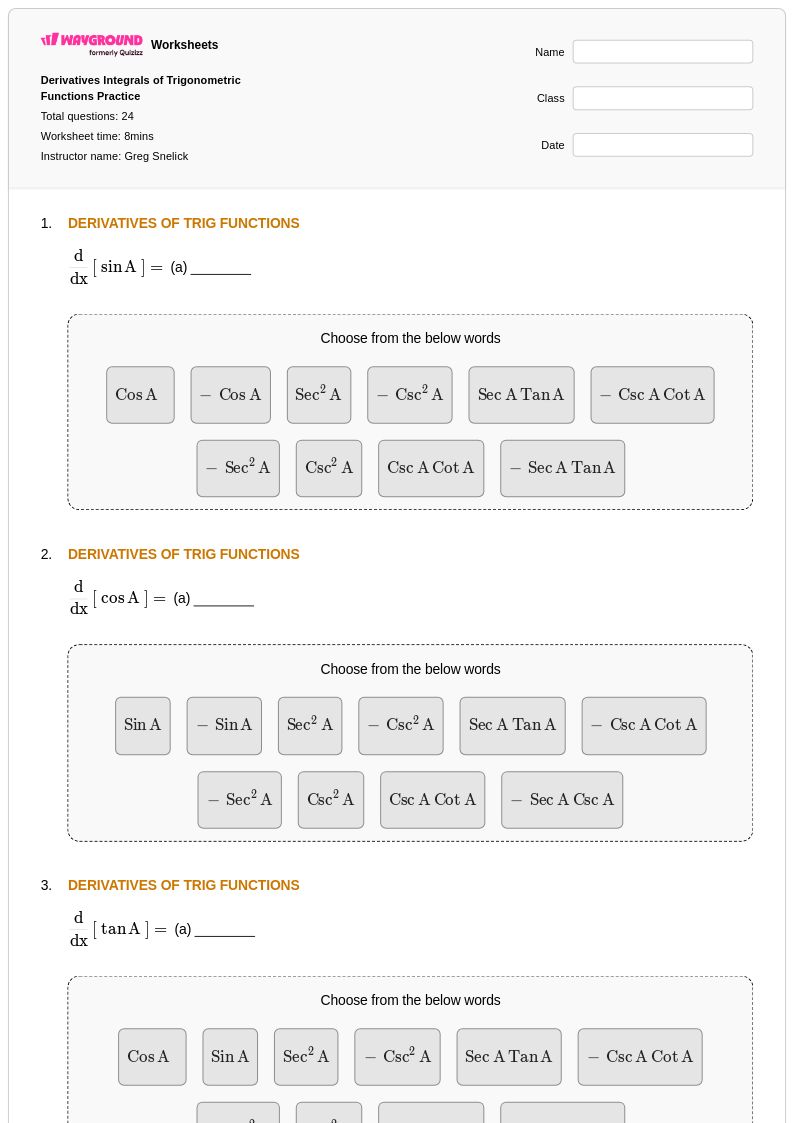
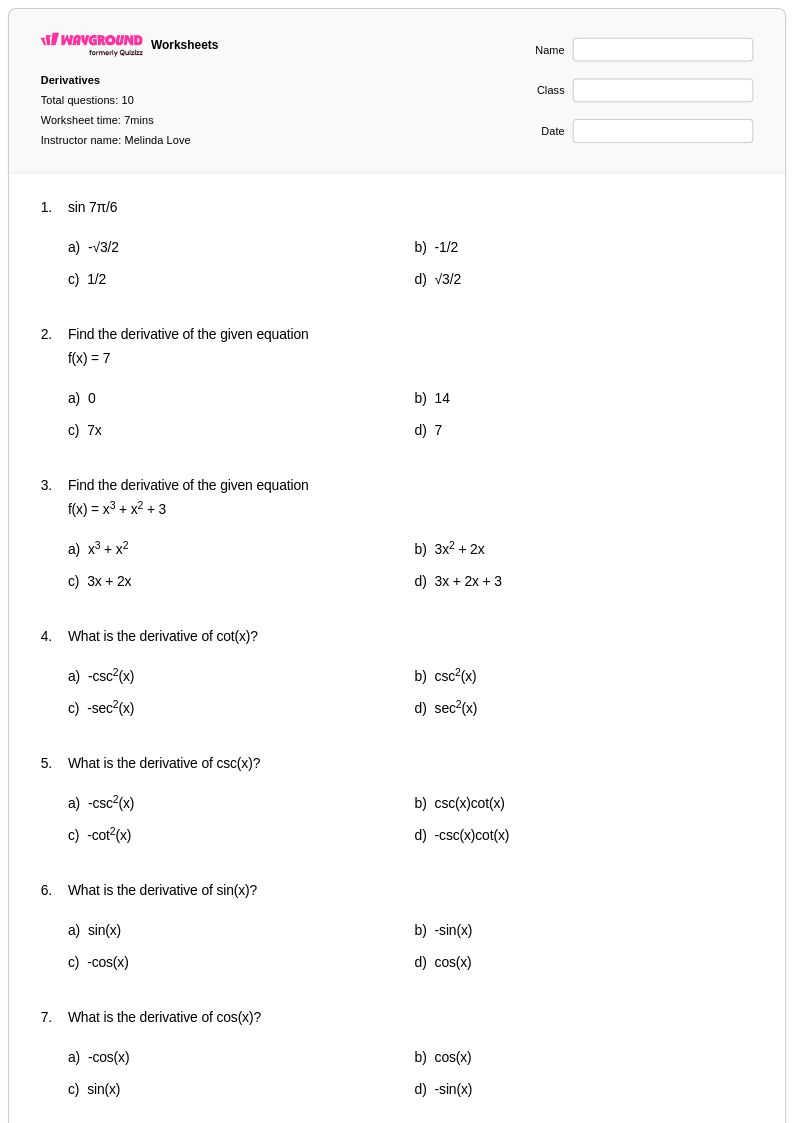
Derivatives of trigonometric functions represent a fundamental cornerstone of Class 11 calculus, requiring students to master the intricate relationships between trigonometric identities and differential calculus principles. Wayground's comprehensive worksheet collection addresses this challenging subtopic by providing expertly designed practice problems that systematically build proficiency in differentiating sine, cosine, tangent, and inverse trigonometric functions. These worksheets strengthen essential skills including application of the chain rule to composite trigonometric expressions, recognition of derivative patterns for standard trigonometric functions, and solving complex problems involving implicit differentiation of trigonometric equations. Each printable resource includes detailed answer keys that facilitate independent learning and self-assessment, while the free accessibility of these materials ensures that students can engage in consistent practice to solidify their understanding of these sophisticated mathematical concepts through targeted problem-solving exercises.
Wayground's robust platform empowers mathematics educators with millions of teacher-created resources specifically designed to support advanced calculus instruction at the Class 11 level. The sophisticated search and filtering capabilities allow instructors to quickly locate worksheets aligned with specific curriculum standards and learning objectives related to trigonometric differentiation. Teachers benefit from powerful differentiation tools that enable customization of problem complexity and scope, ensuring appropriate challenge levels for diverse learner needs during both remediation and enrichment activities. The platform's flexible delivery options, including downloadable PDF formats and interactive digital versions, provide seamless integration into various instructional approaches, whether for in-class skill practice, homework assignments, or assessment preparation. This comprehensive resource ecosystem streamlines lesson planning while providing educators with the high-quality materials necessary to guide students through the demanding conceptual transitions required for mastering derivatives of trigonometric functions.
FAQs
How do I teach derivatives of trig functions to Grade 11 students?
Grade 11 students are usually meeting calculus for the first time, so the entry point matters. Begin with the derivative of sin x and cos x, connecting them visually to the slopes of each function's graph — this gives students an intuition before they memorize. Once those two are solid, introduce the remaining four trig derivatives as patterns to recognize, then move into chain rule applications with composite trig expressions like cos(2x + 1). Holding off on product and quotient rule combinations until students are fluent with the basics prevents the common problem of students losing track of which rule they're applying.
What exercises are most effective for Grade 11 trig derivative practice?
At Grade 11, the most useful practice sequence runs from single-function differentiation (just sin, cos, tan) to chain rule problems with linear inner functions, then to chain rule with polynomial inner functions. Worksheets that mix these levels within a single problem set, rather than grouping all easy problems together, better prepare students for the variety they'll see on tests. Including a few problems that ask students to find the equation of a tangent line also connects differentiation to a concrete geometric application they can visualize.
What mistakes do Grade 11 students commonly make with trig derivatives?
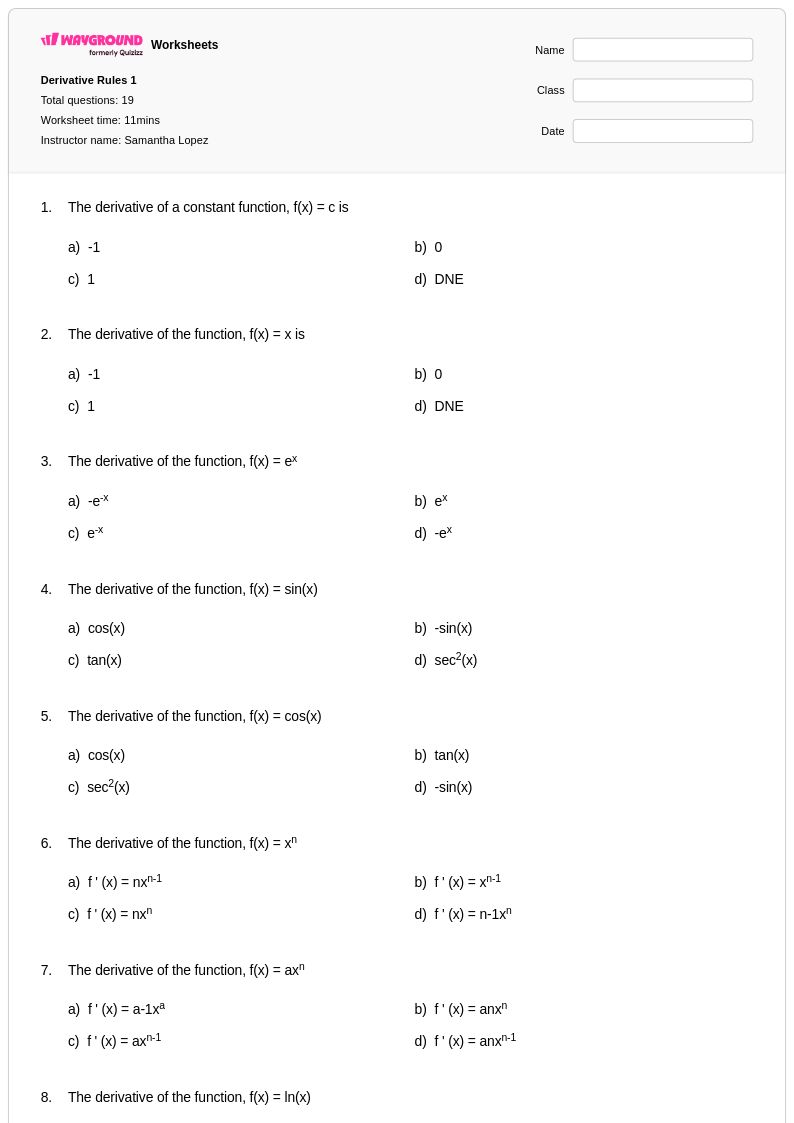
The most persistent errors at this level: dropping the negative sign on d/dx[cos x], skipping the chain rule multiplier on composite expressions, and mixing up the derivatives of tan x and cot x (or sec x and csc x) because those four are practiced less. Many Grade 11 students also make algebraic errors when simplifying after differentiating — the derivative step is correct but the simplification introduces a mistake. Separating "find the derivative" from "simplify the result" as two distinct steps in practice problems helps students isolate where their errors occur.
How do I use these Grade 11 trig derivatives worksheets in my class?
The worksheets include a full answer key, which makes them well-suited for homework or independent practice where students need to self-check. For paper-based practice, useful when you want students working through multi-step problems without a calculator or screen, print the PDF and collect submissions; you can then grade them using the Wayground for Teachers app by scanning student work. If you prefer a digital session, hosting the worksheet as a Wayground quiz gives students immediate feedback on each problem.
How does trig differentiation fit into the Grade 11 calculus curriculum?
In a typical Grade 11 calculus sequence, trig derivatives come after students have learned the power rule, product rule, and quotient rule with polynomial and rational functions. The trig derivatives unit extends those rules to a new function family and introduces the chain rule in a context where the pattern is easy to see (e.g., the derivative of sin(u) is cos(u)·u'). From here, the curriculum usually moves toward implicit differentiation and applications like related rates, both of which rely heavily on trig differentiation. Fluency at this stage is what makes those later topics manageable.
How can I support diverse learners with trig derivatives practice in Grade 11?
For students who struggle with the density of calculus notation, Wayground's adjustable font size and dyslexia-friendly font options make worksheets easier to read without changing the mathematical content. For students who need more processing time on multi-step chain rule problems, extended time can be configured per student so they're not penalized for working carefully. These settings apply individually, so the rest of the class works under standard conditions.