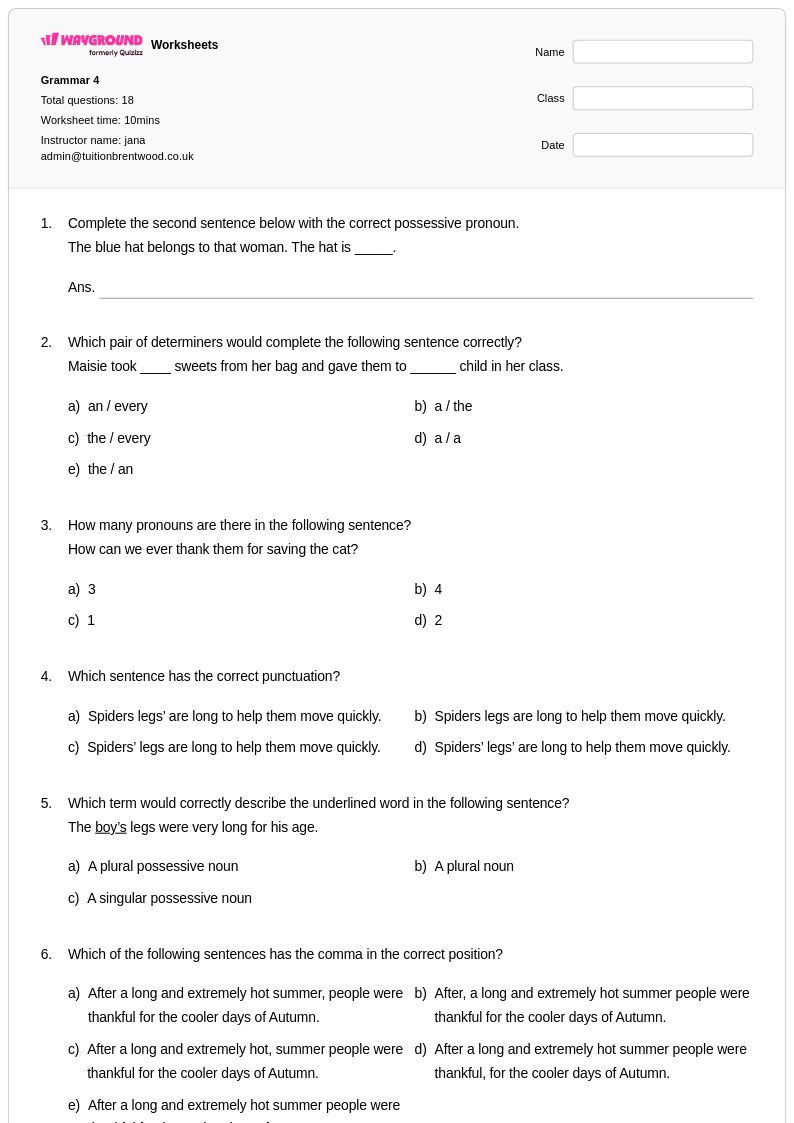
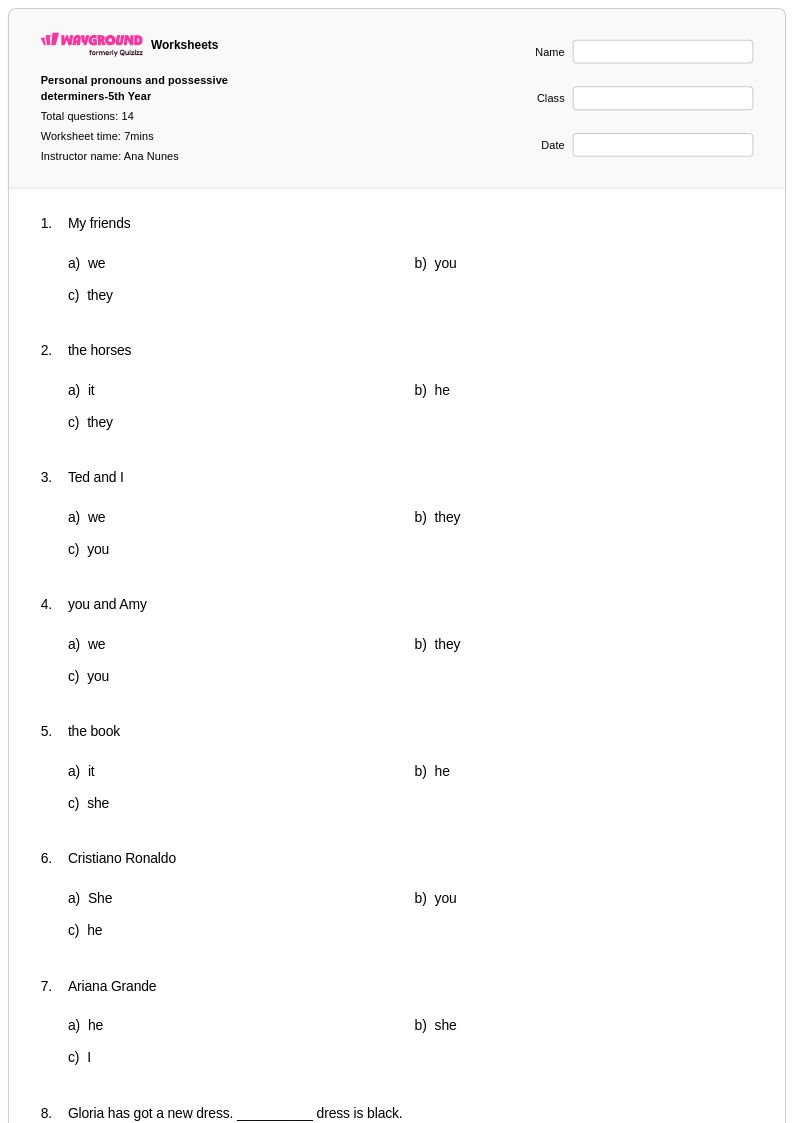
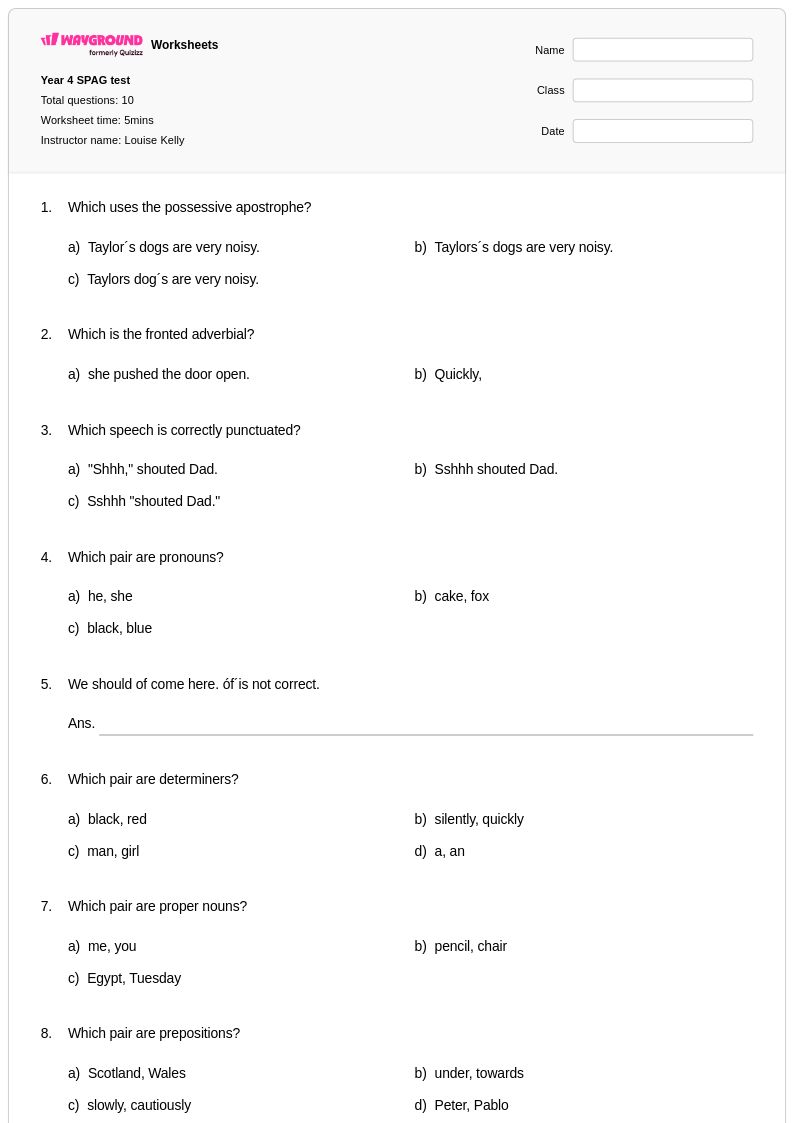
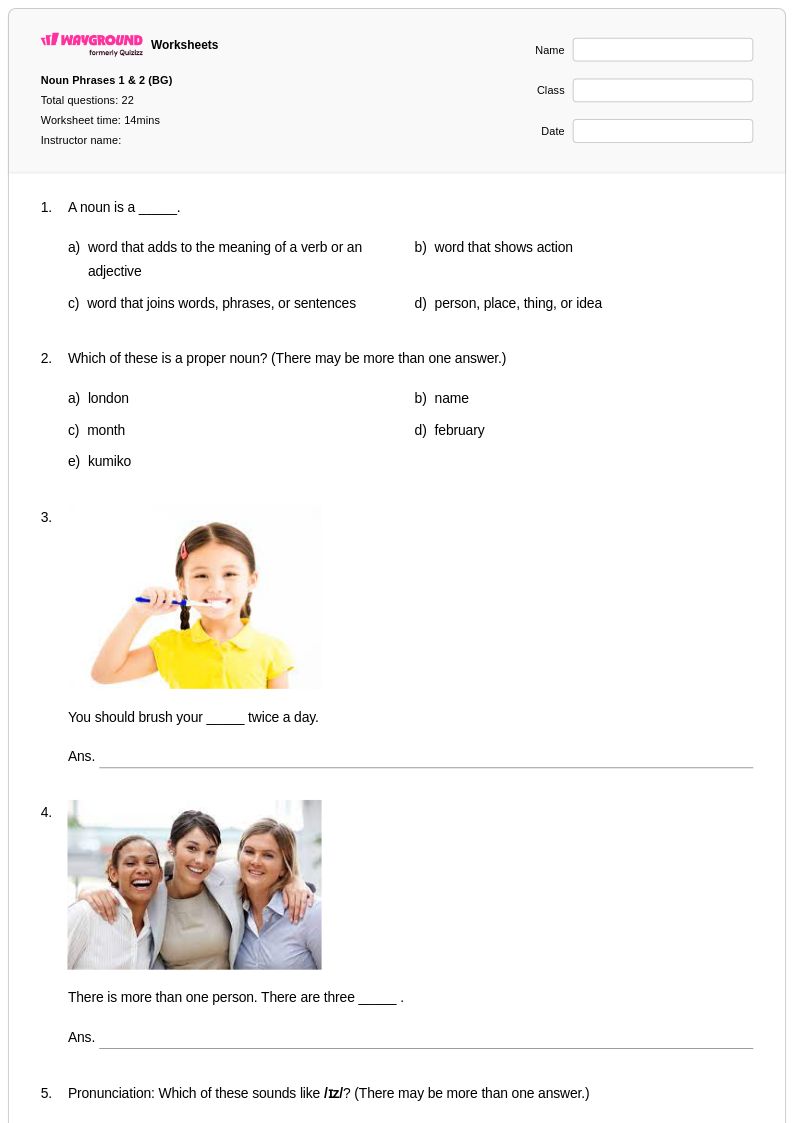
Class 4 determiners worksheets from Wayground help students master identifying and using articles, demonstratives, and quantifiers through engaging printables, practice problems, and comprehensive answer keys.
Explore printable Determiners worksheets for Class 4
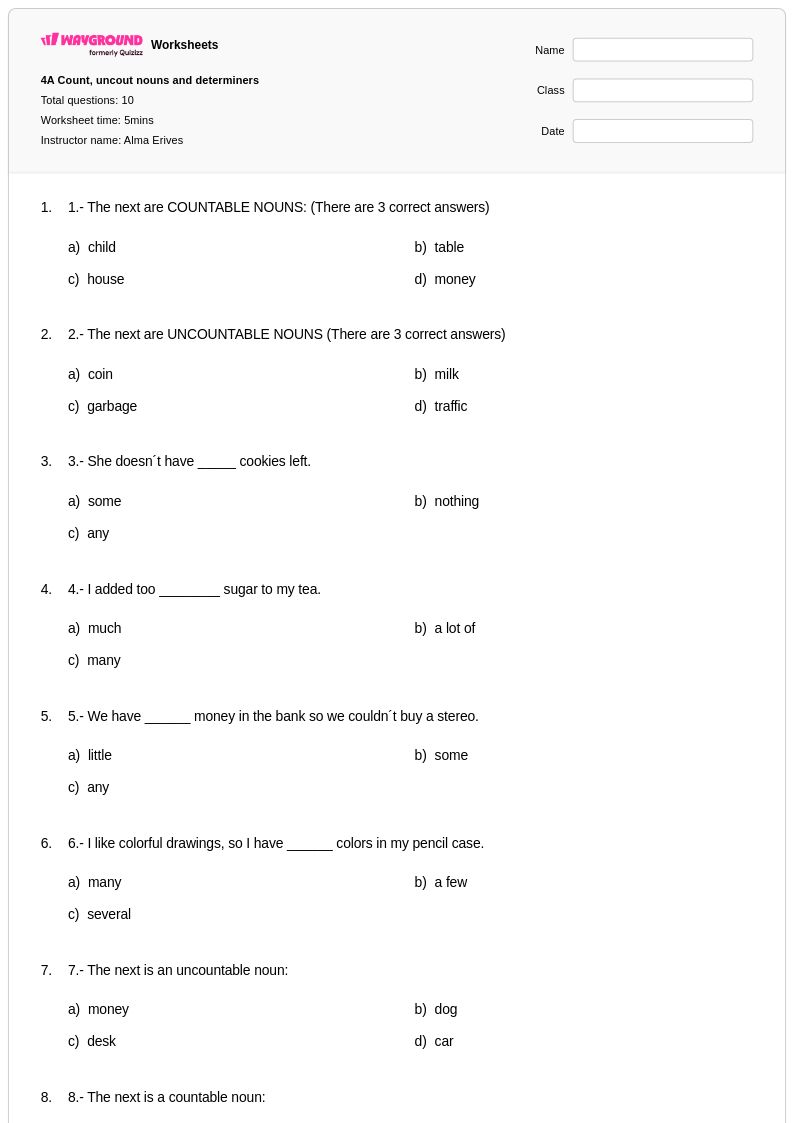
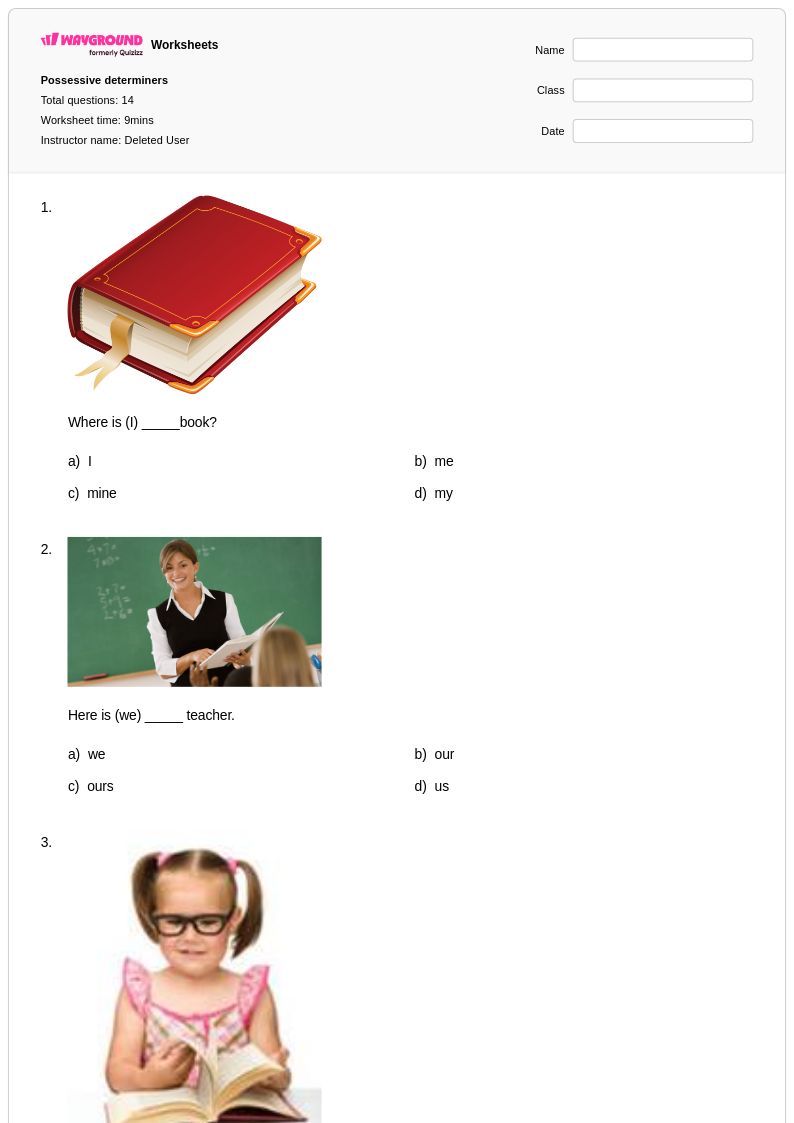
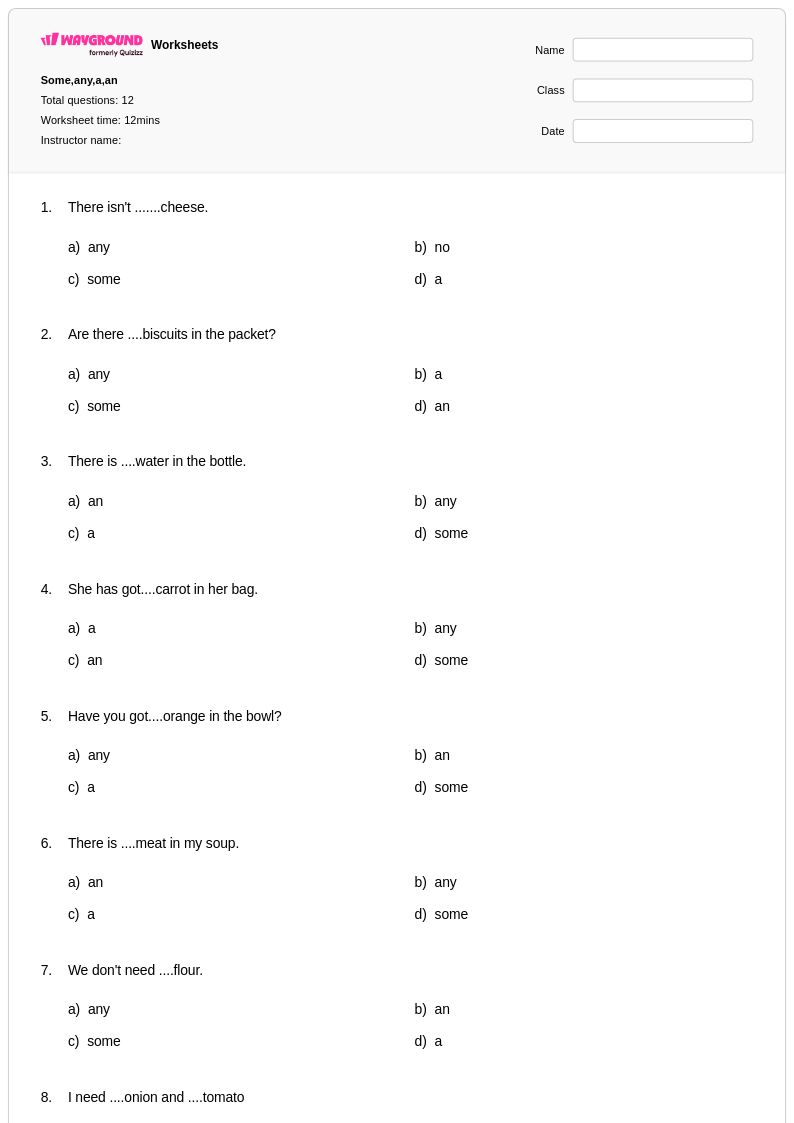
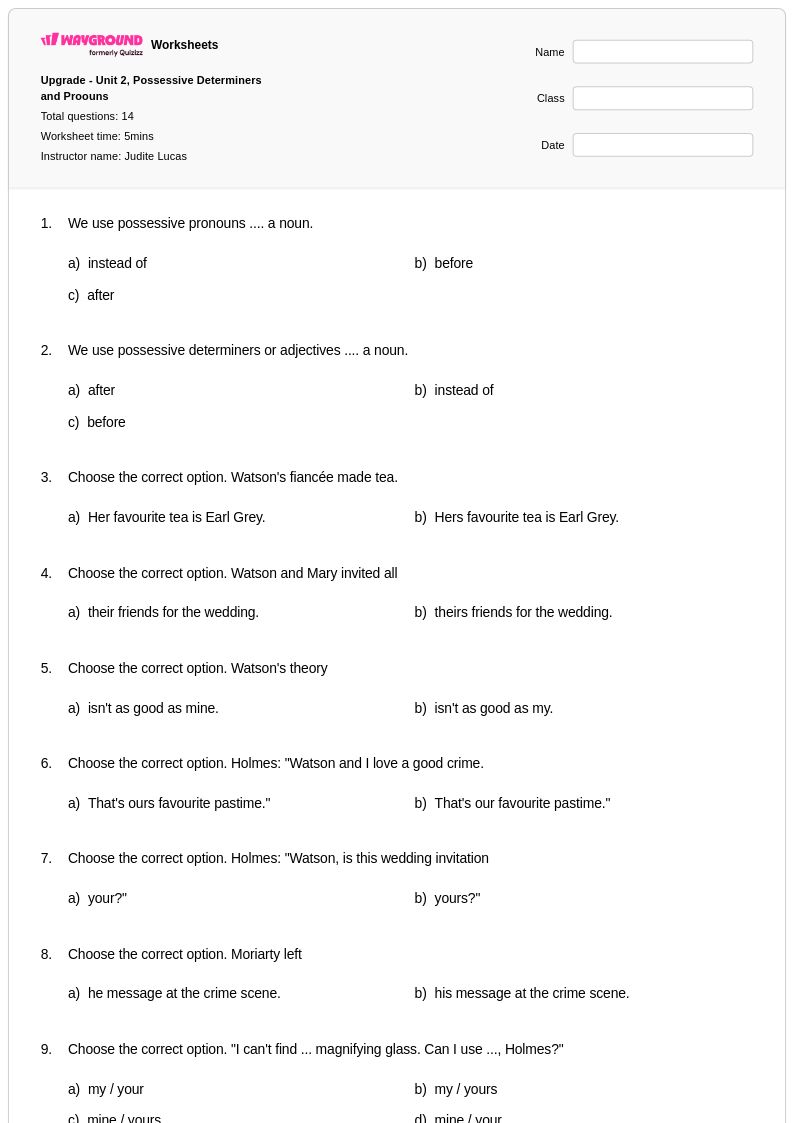
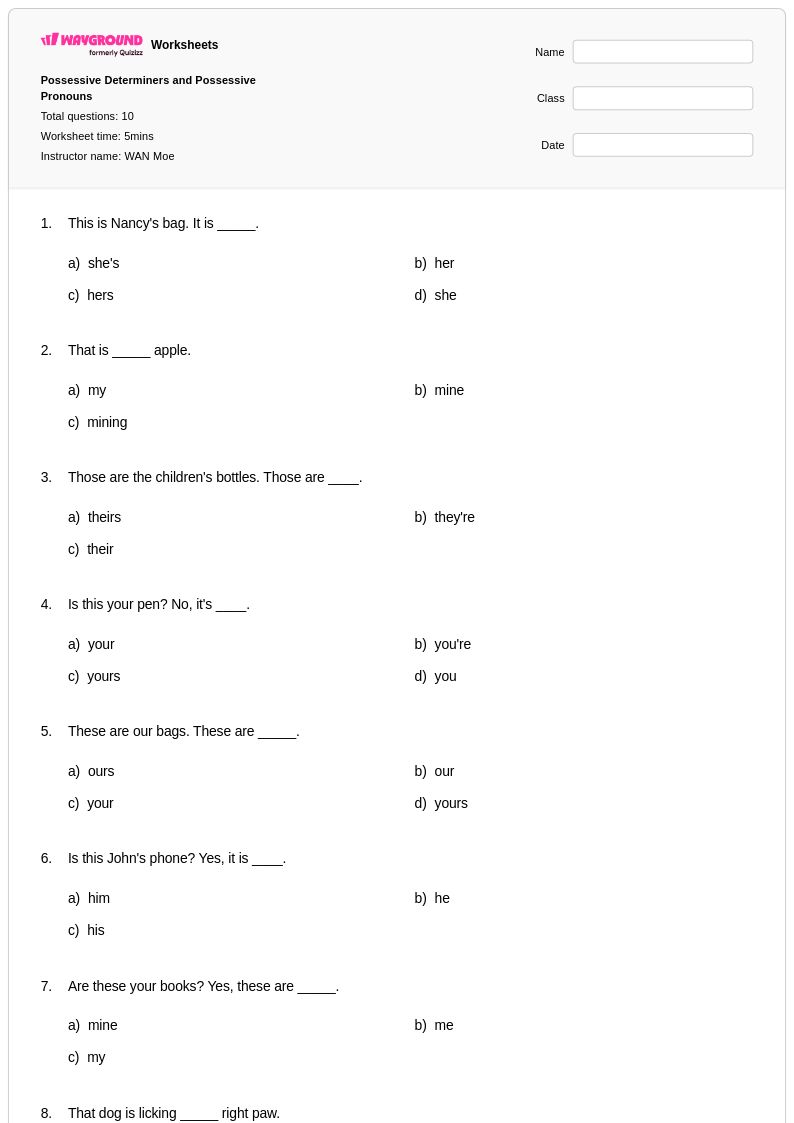
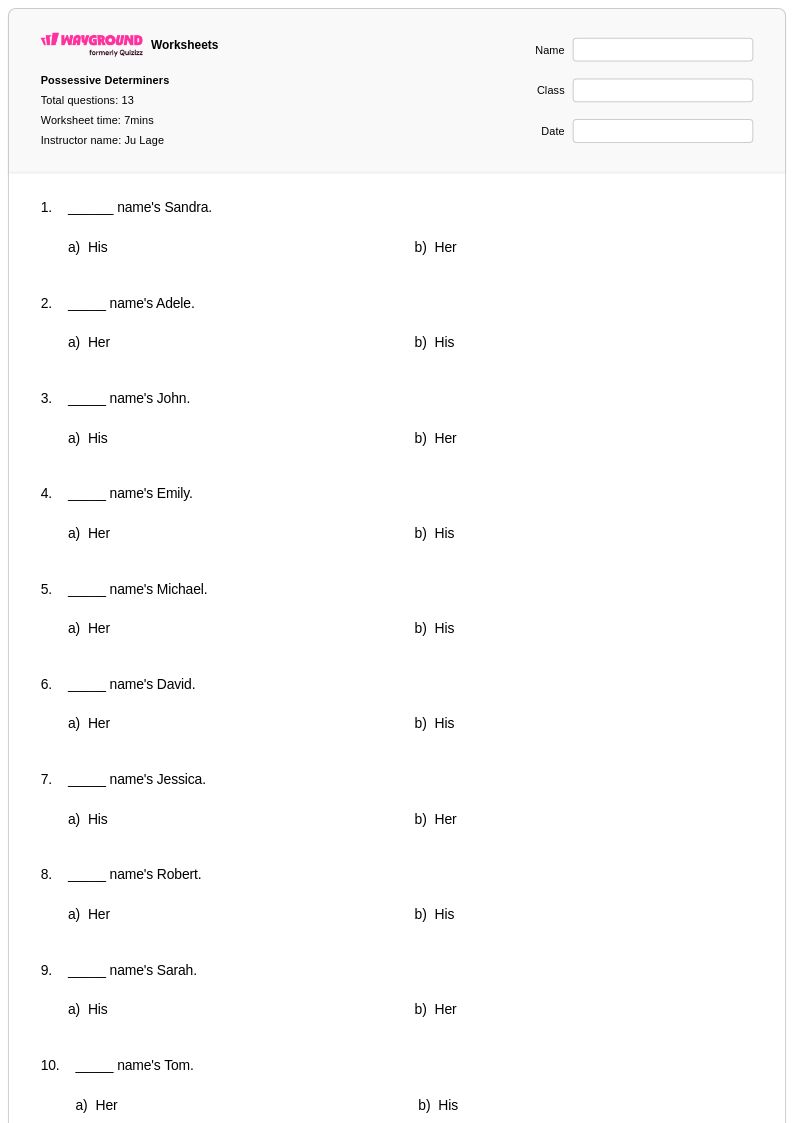
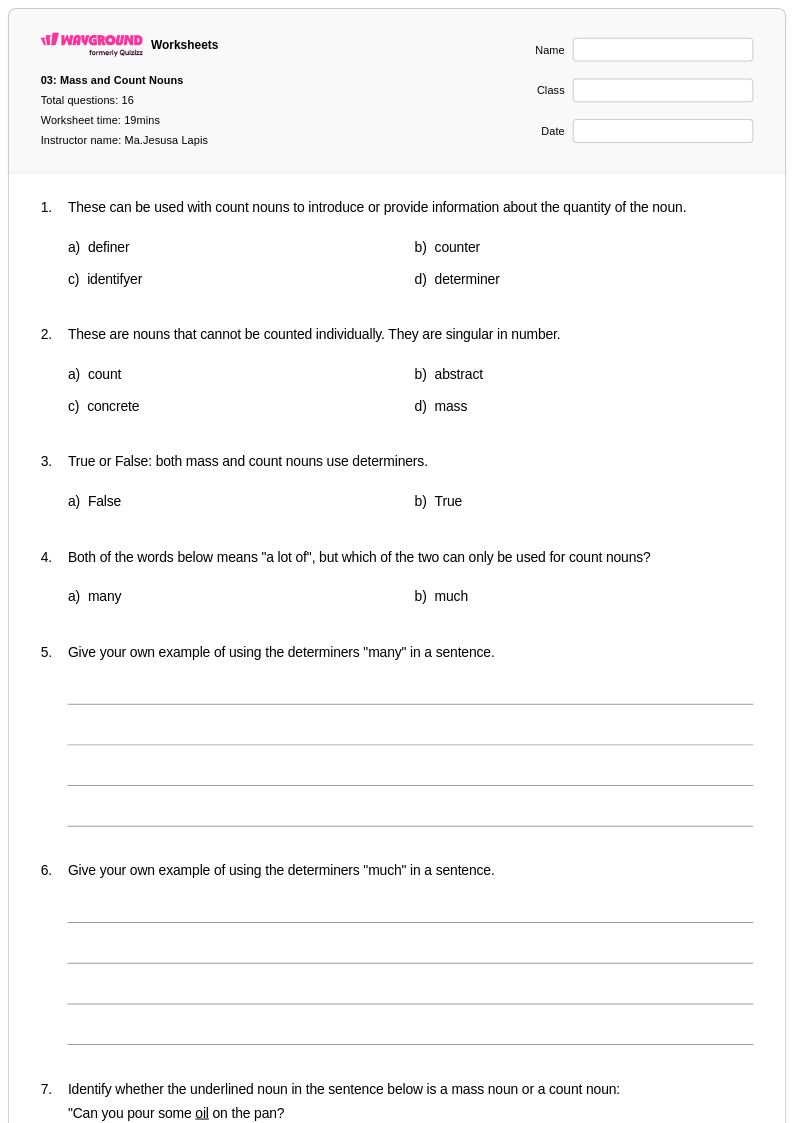
Determiners worksheets for Class 4 students available through Wayground (formerly Quizizz) provide comprehensive practice with these essential grammar building blocks that specify and identify nouns in sentences. These carefully designed educational resources help fourth-grade learners master articles (a, an, the), demonstratives (this, that, these, those), possessives (my, your, his, her), and quantifiers (some, many, few, several) through engaging practice problems that reinforce proper usage in context. Each worksheet collection includes detailed answer keys and is available as free printable pdf downloads, allowing students to strengthen their understanding of how determiners clarify meaning and establish relationships between nouns and the rest of the sentence structure.
Wayground (formerly Quizizz) supports educators with an extensive library of millions of teacher-created determiner worksheets that feature robust search and filtering capabilities aligned to grammar standards. Teachers can easily differentiate instruction by selecting from various difficulty levels and exercise types, customizing content to meet individual student needs for remediation or enrichment activities. The platform's flexible format options include both printable pdf versions for traditional classroom use and digital formats for interactive learning environments, streamlining lesson planning while providing targeted skill practice that helps students develop confidence in recognizing and correctly using determiners across different writing contexts and academic subjects.
FAQs
How do I teach determiners to English language learners?
Start by anchoring determiners to their function: they always precede a noun and signal information about it, such as which one, how many, or whose. Introduce one category at a time, beginning with articles (a, an, the) before moving to demonstratives, possessives, and quantifiers. Using sentence frames and real-world objects helps students connect determiner choice to meaning rather than memorizing rules in isolation.
What exercises help students practice choosing the right determiner?
Gap-fill exercises are highly effective because they require students to select the correct determiner based on context rather than recognition alone. Sorting activities, where students categorize determiners by type (articles, quantifiers, demonstratives, possessives), reinforce conceptual distinctions. Sentence-rewriting tasks that ask students to swap determiners and explain the meaning shift build deeper analytical understanding.
What mistakes do students commonly make with determiners?
The most frequent error is confusing definite and indefinite articles, particularly when a noun is introduced for the first time versus referenced again. Students also commonly misuse quantifiers such as 'few' versus 'a few' or 'less' versus 'fewer', not recognizing that these signal meaningfully different quantities. For English language learners, omitting articles entirely is also common, especially for students whose first language does not use articles.
How can I differentiate determiner practice for students at different skill levels?
For foundational learners, focus on article usage (a, an, the) with concrete, familiar nouns before introducing abstract contexts. More advanced students can work with complex determiner combinations, such as using multiple determiners in sequence, or analyzing how determiner choice shifts meaning in formal versus informal writing. On Wayground, teachers can apply accommodations such as reduced answer choices for students who need additional support, and extended time settings can be configured per student so the rest of the class is unaffected.
How do I use Wayground's determiner worksheets in my classroom?
Wayground's determiner worksheets are available as printable PDFs for traditional classroom use and in digital formats for technology-integrated environments, including the option to host them as a quiz directly on Wayground. Printable versions work well for individual practice, bell-ringers, or homework assignments, while the digital format supports self-paced review and immediate feedback. Both formats include answer keys, making them efficient tools for skill practice, remediation, and formative assessment.
How do demonstrative determiners differ from demonstrative pronouns, and how do I explain this to students?
A demonstrative determiner (this, that, these, those) always modifies a noun directly, as in 'this book' or 'those students.' A demonstrative pronoun stands alone in place of a noun, as in 'this is mine' or 'those are ready.' The clearest way to help students distinguish them is to check whether the word is followed by a noun; if it is, it functions as a determiner, not a pronoun.