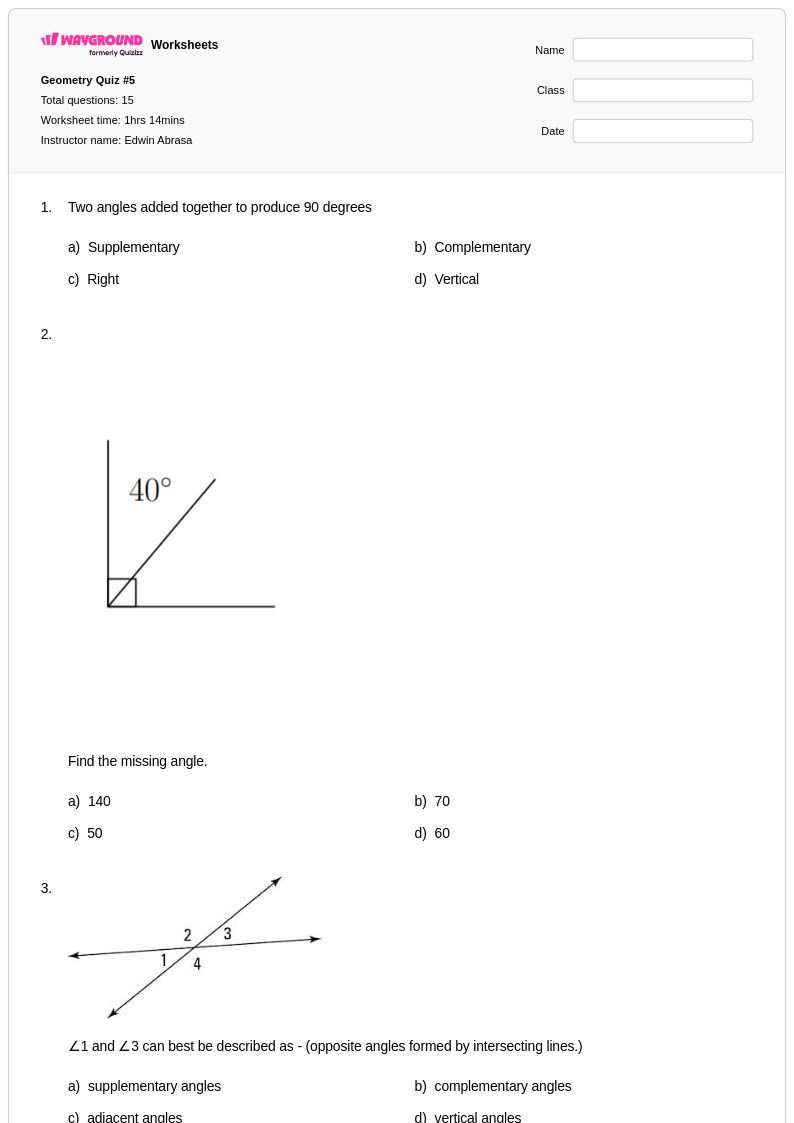
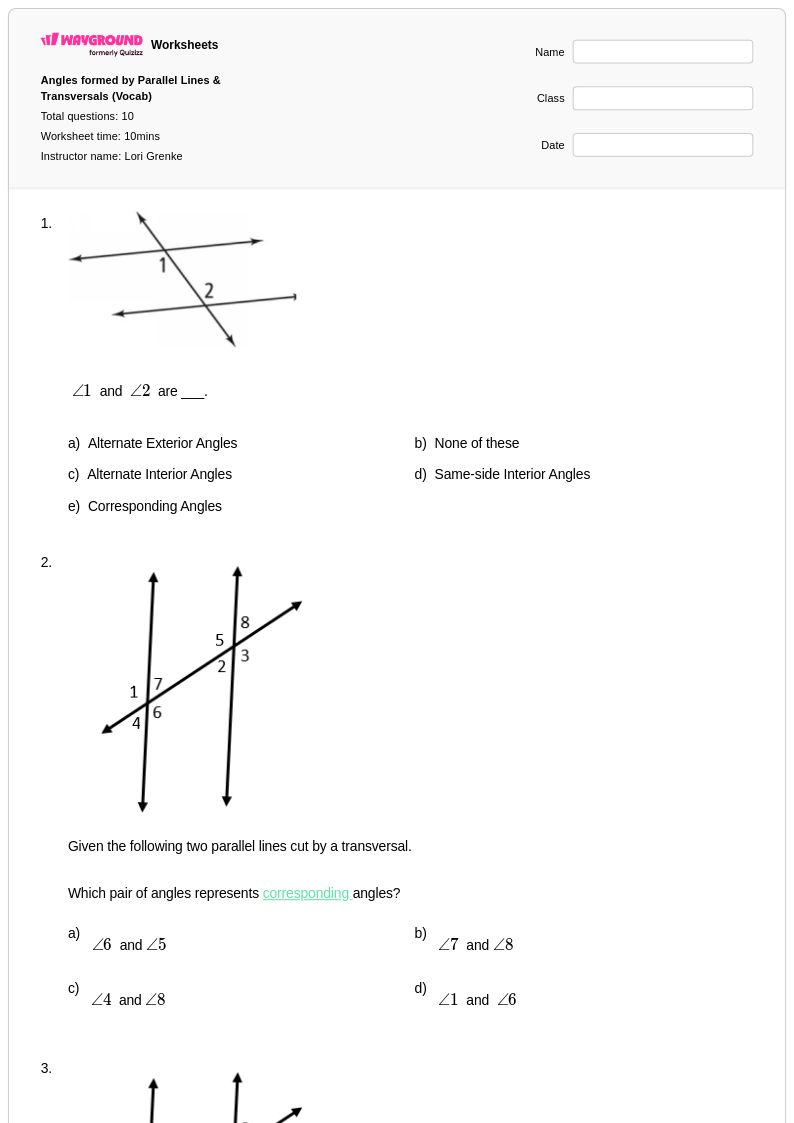
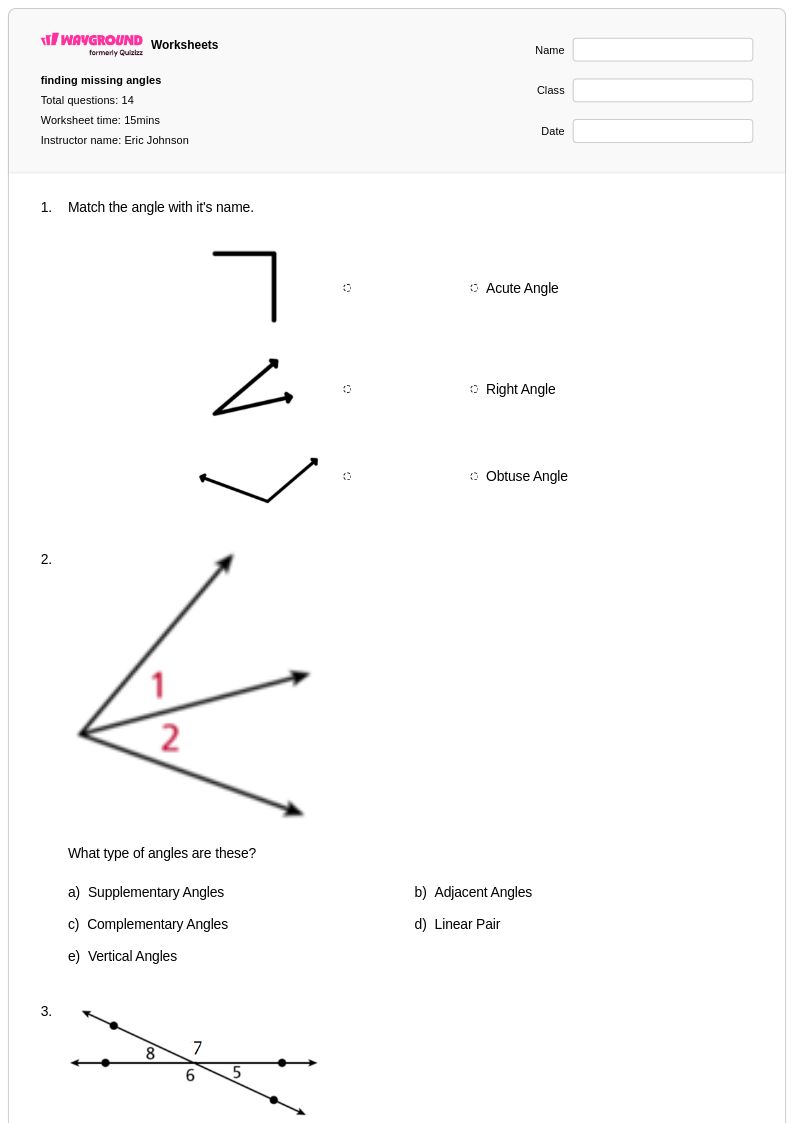
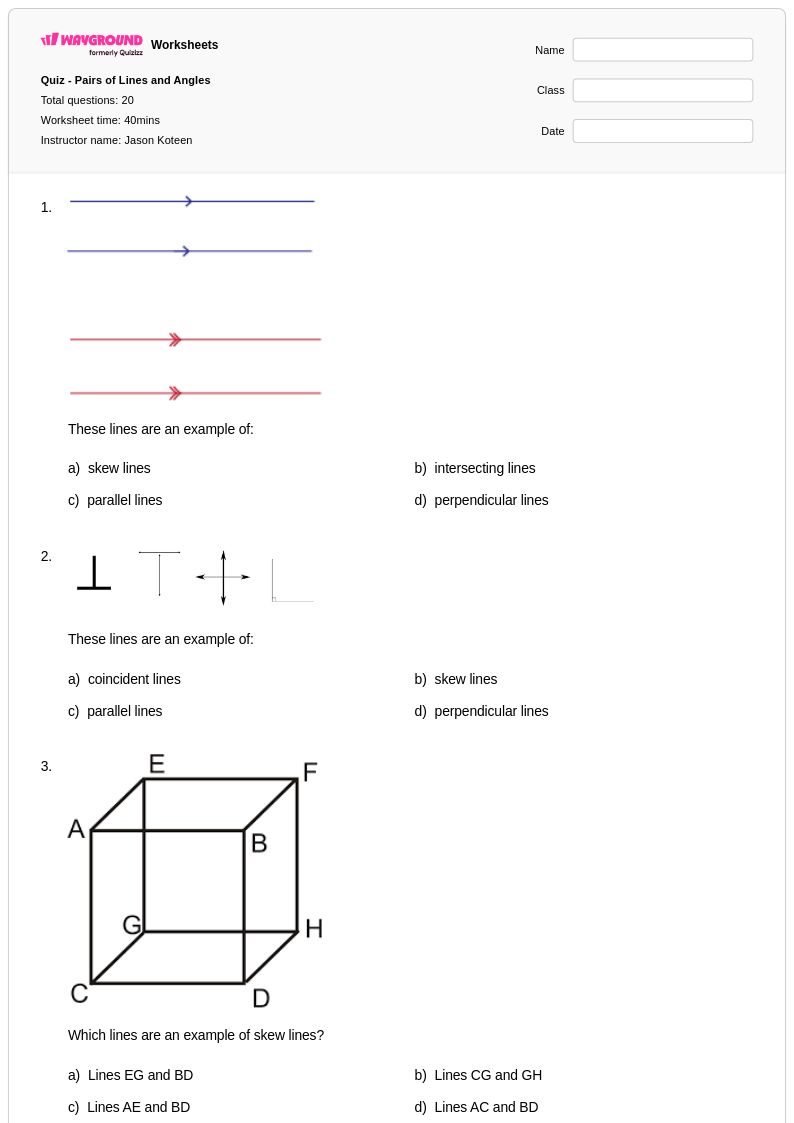
Free Printable Double Angle Identities Worksheets for Class 10
Class 10 double angle identities worksheets from Wayground provide comprehensive printables and practice problems with answer keys to help students master trigonometric formulas and solve complex equations confidently.
Explore printable Double Angle Identities worksheets for Class 10
Double angle identities worksheets for Class 10 students provide essential practice with some of trigonometry's most powerful and frequently applied formulas. These comprehensive worksheet collections through Wayground (formerly Quizizz) focus on helping students master the fundamental double angle formulas for sine, cosine, and tangent, including sin(2θ) = 2sin(θ)cos(θ), cos(2θ) = cos²(θ) - sin²(θ), and their various alternative forms. Students work through carefully structured practice problems that build proficiency in recognizing when to apply double angle identities, manipulating expressions using these formulas, and solving complex trigonometric equations. Each worksheet includes detailed answer keys and explanations, making these free printables valuable resources for both classroom instruction and independent study, while strengthening critical analytical thinking skills needed for advanced mathematics.
Wayground (formerly Quizizz) supports mathematics educators with an extensive collection of teacher-created double angle identity worksheets, drawing from millions of high-quality resources specifically designed for Class 10 trigonometry instruction. The platform's advanced search and filtering capabilities allow teachers to quickly locate worksheets that align with specific curriculum standards and match their students' skill levels, while built-in differentiation tools enable customization for diverse learning needs. These flexible resources are available in both printable pdf formats and interactive digital versions, making them ideal for classroom practice, homework assignments, remediation sessions, and enrichment activities. Teachers can efficiently plan comprehensive lesson sequences, provide targeted skill practice, and offer additional support for students struggling with trigonometric concepts, while challenging advanced learners with more complex applications of double angle formulas.
FAQs
How do I teach double angle identities in Grade 10?
By Grade 10, students have the unit circle and basic trig ratios in place, which makes this the right moment to derive double angle identities from the angle addition formulas rather than just presenting them. Walk through sin(2θ) = 2sin(θ)cos(θ) as a derivation students can reproduce, then tackle cos(2θ) and its three equivalent forms — that's where most of the instructional time should go, because choosing the right form is a skill in itself. Once students can apply the identities fluently, introduce problems that require them to simplify expressions or solve equations, which is where Grade 10 practice typically lands.
What exercises help Grade 10 students practice double angle identities?
Three problem types build the most useful skills at this level: substitution problems with known angle values (to build formula confidence), expression simplification (to develop algebraic fluency with the identities), and equation-solving problems that require applying a double angle identity to reduce complexity before solving. Problems that require choosing between the three forms of cos(2θ) are particularly valuable — they push students past rote recall into genuine understanding. Wayground's Grade 10 worksheets are structured to move through this progression, with a full answer key included.
What mistakes do Grade 10 students commonly make with double angle identities?
The persistent error is sin(2θ) = 2sin(θ) — students apply linear thinking to a nonlinear function. With cos(2θ), the issue is usually picking a form arbitrarily rather than strategically: students who don't recognize that cos²(θ) - sin²(θ) is most useful when both appear in the expression, while 1 - 2sin²(θ) is better when you need everything in terms of sine, will grind through extra algebra unnecessarily. A third common mistake in equation-solving is forgetting to check solutions against the original domain — double angle substitution can introduce extraneous solutions.
How do I use Wayground's Grade 10 double angle identities worksheets?
Each worksheet is available as a printable PDF or as a digital quiz hosted on Wayground. The digital format is convenient for online assignment and instant submission; the printable version suits paper-based practice or low-device settings, and you can grade physical submissions using the Wayground for Teachers app. A complete answer key is included with every worksheet, so these work well for independent practice, homework, or review without additional prep.
How are double angle identities sequenced in the Common Core high school math curriculum?
Within Common Core's high school Functions standards, double angle identities come after students have worked with the Pythagorean identity and angle addition formulas — they're a natural extension of that work, not a standalone topic. At Grade 10, students are typically moving from basic identity recognition toward using identities as algebraic tools: simplifying expressions, solving equations, and beginning to verify identities. The next step in the progression is applying these identities in more complex equation-solving and, eventually, in calculus-preparatory contexts where rewriting trigonometric expressions in alternate forms is a routine technique.
How can I differentiate double angle identity practice for my Grade 10 class?
The sharpest ability gap at Grade 10 is usually between students who need structured scaffolding (a formula reference, step-by-step prompts) and students ready for open-ended proof or multi-step equation problems. For students who need support, Wayground's worksheet tools let you adjust font size and spacing or apply a dyslexia-friendly font, so the page itself isn't adding friction. For digital sessions, the Read Aloud accommodation helps students who process written math problems more easily when heard. For advanced learners, the same worksheet can be extended by asking them to prove identities rather than just apply them — no separate resource needed.