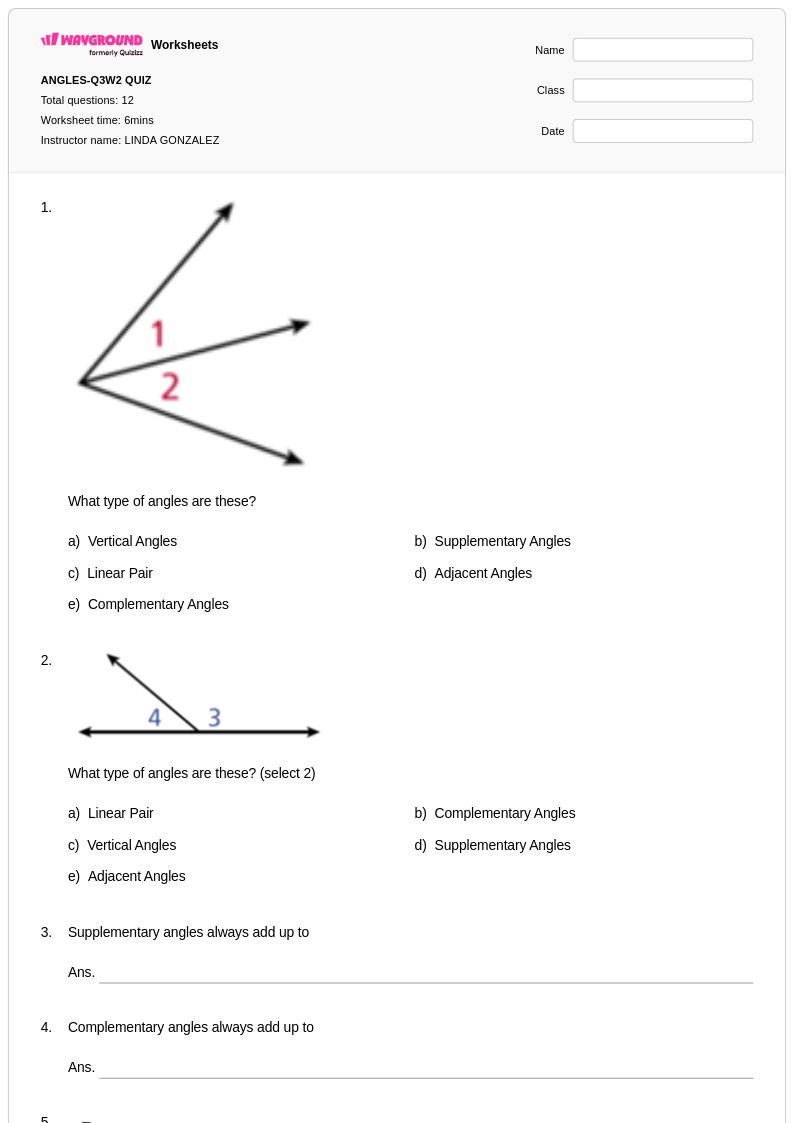
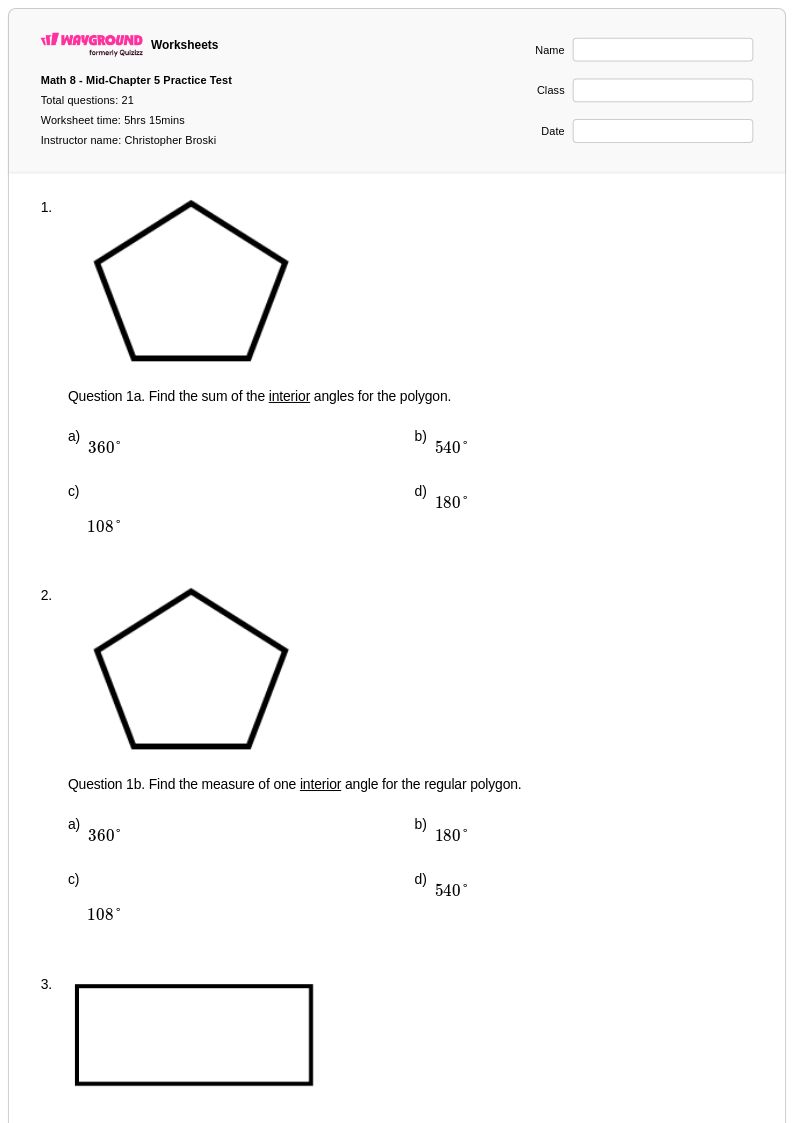
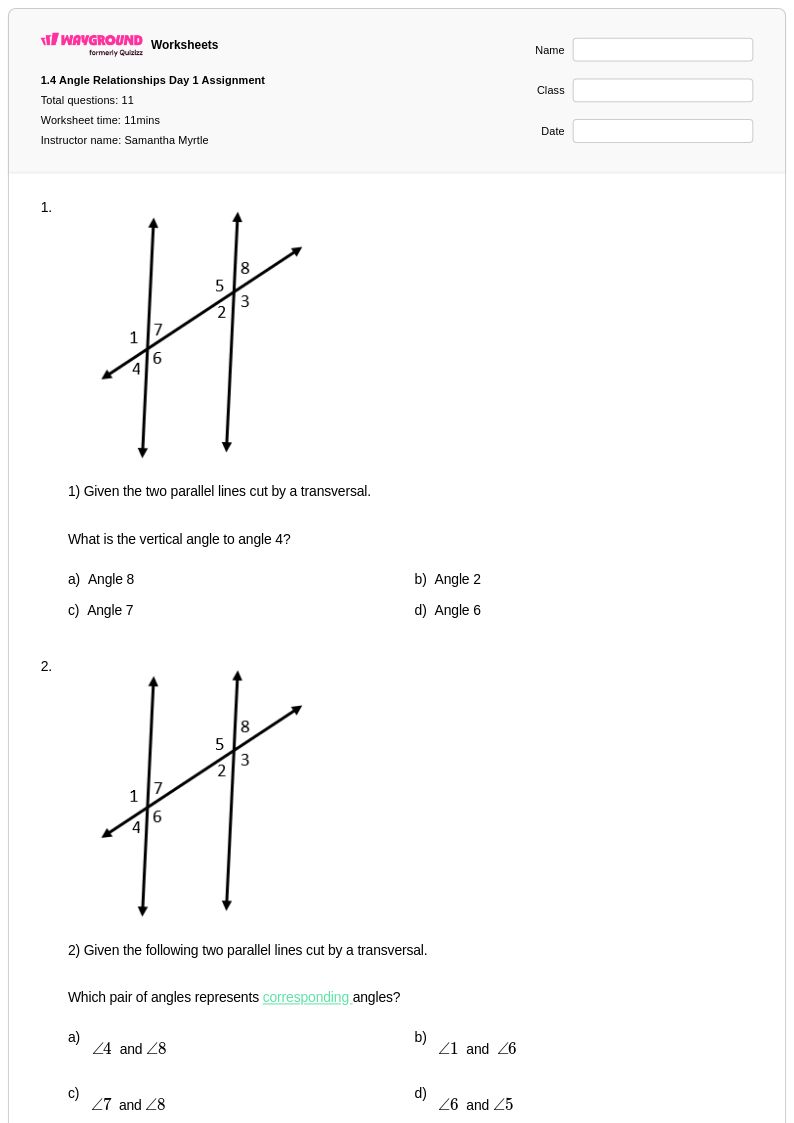
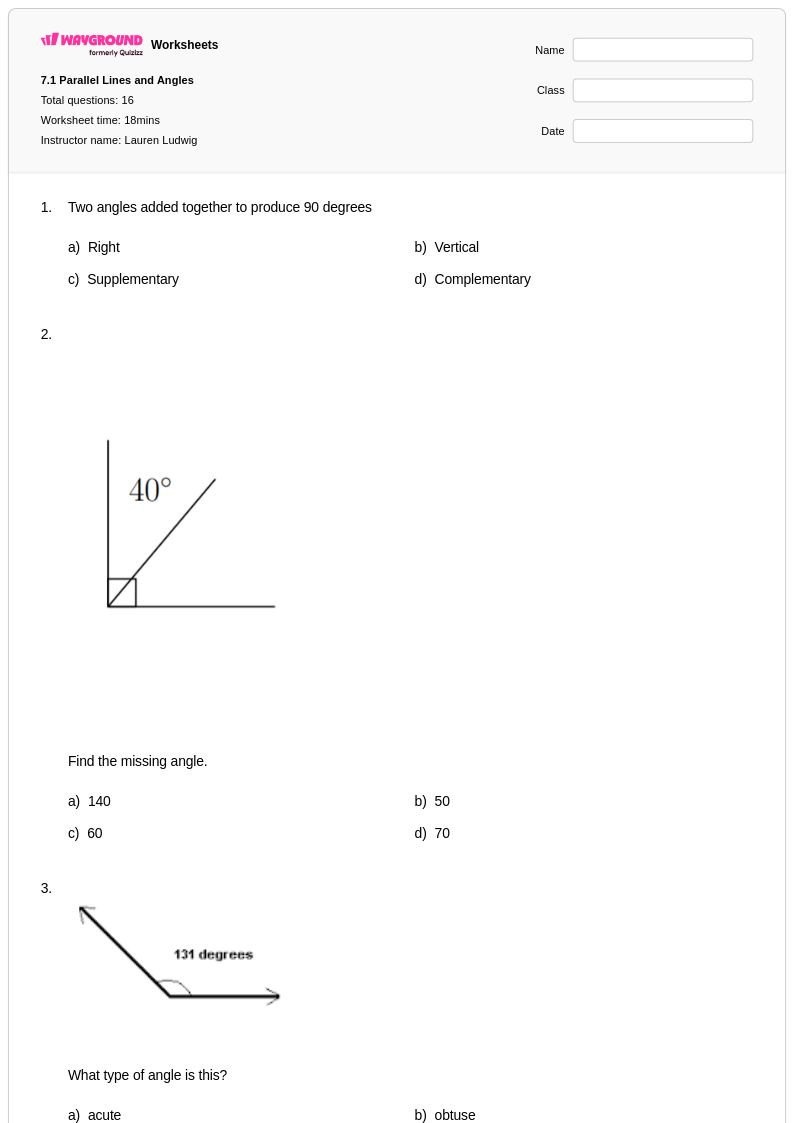
Wayground's free double angle identities worksheets provide comprehensive practice problems and answer keys to help students master trigonometric formulas involving sin(2θ), cos(2θ), and tan(2θ) through printable PDF exercises.
Double angle identities represent a crucial component of advanced trigonometry, building upon fundamental trigonometric concepts to explore relationships when angles are doubled. Wayground's comprehensive collection of double angle identities worksheets provides students with systematic practice in applying formulas such as sin(2θ), cos(2θ), and tan(2θ), while developing proficiency in both deriving and manipulating these essential trigonometric relationships. These carefully structured practice problems guide learners through step-by-step problem solving, from basic formula application to complex algebraic manipulations involving double angle transformations. Each worksheet includes detailed answer keys that support independent learning and self-assessment, with free printable pdf formats ensuring accessibility for both classroom instruction and individual study sessions.
Wayground's extensive library, featuring millions of teacher-created resources, offers mathematics educators unparalleled support for teaching double angle identities through robust search and filtering capabilities that streamline lesson planning and resource selection. The platform's standards-aligned worksheet collections enable teachers to quickly identify materials that match specific curriculum requirements, while built-in differentiation tools allow for seamless customization to accommodate varying skill levels within the classroom. Whether delivered in traditional printable format or through interactive digital presentations, these double angle identities resources support comprehensive instruction from initial concept introduction through advanced application practice. Teachers can efficiently address individual learning needs through targeted remediation worksheets for struggling students and challenging enrichment materials for advanced learners, creating a complete instructional ecosystem that strengthens trigonometric reasoning and algebraic manipulation skills.
FAQs
How do I teach double angle identities?
Start by making sure students are solid on the Pythagorean identity and basic angle addition formulas — double angle identities are derived directly from those, so gaps there will stall progress fast. Introduce sin(2θ) = 2sin(θ)cos(θ) first, since it has only one form and the derivation is clean. Once students can reproduce it from the addition formula, move to cos(2θ), which has three equivalent forms; spend time on why all three are valid and when each is most useful. Tan(2θ) tends to click once the other two are secure. Throughout, emphasize that these identities are tools for rewriting expressions, not just formulas to memorize — students who understand that purpose apply them far more flexibly.
What exercises help students practice double angle identities?
The most productive practice moves through three stages: recognition (identify which identity applies), manipulation (simplify or rewrite an expression), and proof (verify an identity holds). Start with straightforward substitution problems where θ is a known value, then shift to symbolic simplification, then to proving identities from scratch. Problems that require choosing between the three forms of cos(2θ) are especially useful — they force students to think strategically rather than mechanically. Wayground's double angle identities worksheets are structured to build through exactly this kind of progression, with a complete answer key included so students can check their reasoning at each stage.
What mistakes do students commonly make with double angle identities?
Three errors come up constantly. First, students write sin(2θ) as 2sin(θ) — dropping the cosine factor entirely. Second, they confuse which form of cos(2θ) to use and apply one form where another would simplify the problem far more cleanly. Third, when proving identities, they manipulate both sides simultaneously instead of working from one side to the other — a logical error that produces circular reasoning. Catching that third mistake early saves a lot of frustration later, especially when proofs get more complex.
How do I use Wayground's double angle identities worksheets in my class?
Each worksheet is available as a printable PDF and as a digital quiz hosted on Wayground, so you can assign the same material whether your class is working on paper or on devices. The digital format lets students submit answers online; the printable route works well for focused, paper-based practice, and you can grade physical submissions using the Wayground for Teachers app by scanning or capturing student work. Every worksheet includes a complete answer key, which makes these practical for independent practice or homework without requiring you to build a separate solution set.
How are double angle identities sequenced in the Common Core math curriculum?
Common Core's high school Functions standards treat trigonometric identities as tools for reasoning about and transforming expressions, not just formulas to recall. Double angle identities sit downstream of the unit circle, basic trig ratios, and the Pythagorean identity — students need all three before the derivations make sense. From here, the progression moves toward solving equations that require identity substitution to reduce complexity, and eventually toward modeling periodic phenomena where rewriting expressions in alternate forms has practical value. In short, double angle identities are the bridge between foundational trig and the kind of algebraic fluency with trigonometric expressions that precalculus and calculus demand.
How can I differentiate double angle identity practice for mixed-ability classes?
The biggest gap in a mixed class is usually between students who can apply a given identity when told which one to use versus students who can select and apply the right form independently. For students still building confidence, Wayground lets you create a version of the worksheet with larger font, wider spacing, or a dyslexia-friendly font to reduce visual load — so the cognitive effort goes toward the math, not decoding the page. For students who need processing support, the Read Aloud accommodation reads questions aloud during digital sessions. Advanced students benefit most from proof-based problems and tasks that require choosing strategically among the three forms of cos(2θ) — those problems have a higher ceiling without requiring a completely separate worksheet.