Free Printable Equitable Distribution Worksheets for Class 2
Class 2 equitable distribution worksheets from Wayground help students master fair sharing concepts through engaging printables, practice problems, and free PDF resources with complete answer keys.
Explore printable Equitable Distribution worksheets for Class 2
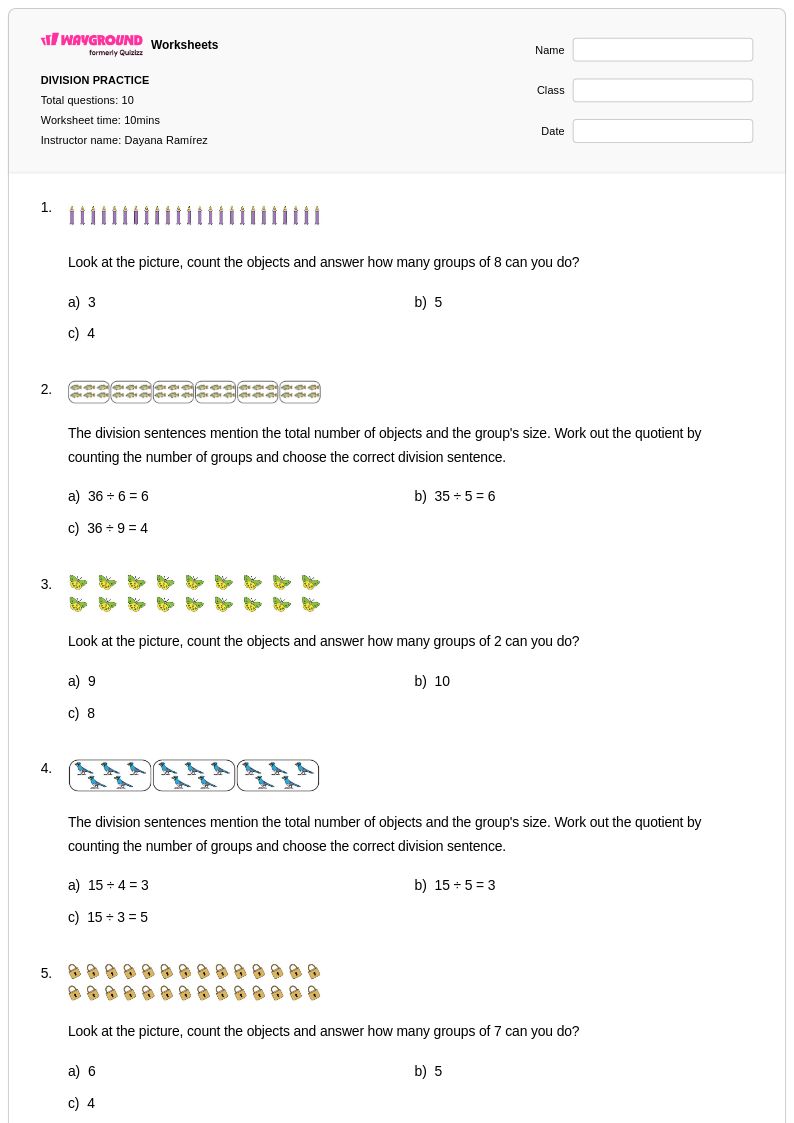
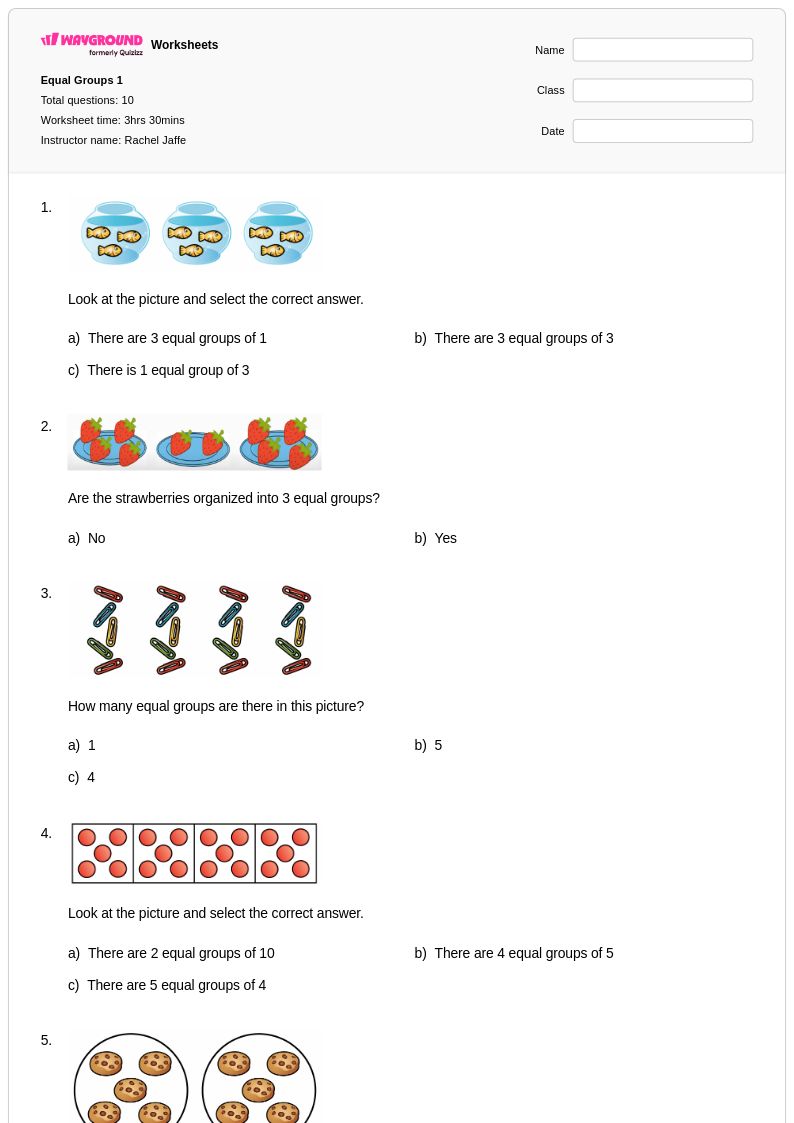
Equitable distribution worksheets for Class 2 students available through Wayground (formerly Quizizz) provide essential practice in understanding fair sharing and equal grouping concepts that form the foundation of division skills. These carefully designed printables help young learners develop critical mathematical thinking by presenting real-world scenarios where items must be shared equally among groups or distributed fairly among individuals. Students strengthen their problem-solving abilities, number sense, and early division concepts through engaging practice problems that progress from concrete manipulative-based activities to more abstract numerical representations. Each worksheet includes comprehensive answer keys that support both independent learning and guided instruction, while the free pdf format ensures accessibility for diverse classroom and home learning environments.
Wayground (formerly Quizizz) empowers educators with millions of teacher-created resources specifically designed for equitable distribution instruction, featuring robust search and filtering capabilities that allow teachers to locate materials perfectly aligned with Class 2 mathematical standards and learning objectives. The platform's differentiation tools enable instructors to customize worksheets based on individual student needs, supporting both remediation for struggling learners and enrichment opportunities for advanced students. Teachers can seamlessly integrate these resources into lesson planning through flexible digital and printable formats, while the comprehensive collection facilitates targeted skill practice across various mathematical contexts. The extensive library ensures educators have access to diverse problem types and presentation styles, supporting effective instruction that meets the varied learning preferences and academic requirements of second-grade mathematics students.
FAQs
How do I teach equitable distribution to second graders?
By Grade 2, students can handle more abstract representations, but the concept still needs a real-world anchor. A reliable approach: present a word problem (24 pencils shared equally among 4 tables), have students draw the groups, then write the number sentence. The drawing step is important — it keeps students from guessing and forces them to model the situation before computing. From there, you can introduce the connection to repeated subtraction as an alternative way to think about equal sharing.
What practice problems help second graders develop equitable distribution skills?
At Grade 2, the most useful problems mix visual and numerical formats. Students should encounter scenarios where they determine both the number of groups and the size of each share, not just one or the other. Word problems set in familiar contexts — distributing supplies, splitting a collection of objects — keep the concept meaningful. These worksheets progress from problems with visual supports to purely numerical ones, which is the right sequence for this grade.
What mistakes do second graders make with equitable distribution?
The most persistent error is treating distribution as 'giving things out' rather than 'making equal groups' — students share all the items but end up with unequal groups and don't notice. A second common mistake: when a problem asks for the number in each group, students report the number of groups instead (and vice versa). Labeling problems explicitly — 'how many groups?' vs. 'how many in each group?' — and requiring students to answer in a full sentence reduces both errors.
How do I use these Grade 2 equitable distribution worksheets in my classroom?
Download the PDF and print for independent practice or small-group work — the answer key is included so students can self-check or you can grade quickly. For a more interactive session, host the worksheet as a digital quiz on Wayground; you'll see which problems students are missing in real time, which makes it easy to pull a small group for reteaching while others continue. The Wayground for Teachers app also lets you photograph and grade paper submissions if you prefer the paper route.
How does equitable distribution fit into the Common Core progression for Grade 2?
Common Core builds toward formal division in Grade 3, and Grade 2 is where students are expected to work with equal groups as a foundation for multiplication and division. Equitable distribution practice at this level directly supports that transition — students who can fluently partition a set of objects into equal groups are ready to interpret multiplication as repeated addition and division as equal sharing when those operations are introduced formally the following year.
How can I accommodate diverse learners on equitable distribution worksheets?
For students who struggle with reading word problems, enabling Read Aloud in Wayground removes the language barrier so the math itself is what's being assessed. For students with visual processing challenges, generating a version with larger font and wider spacing makes the layout easier to work through. Both accommodations are set per student, so the rest of the class works from the standard version without any disruption.