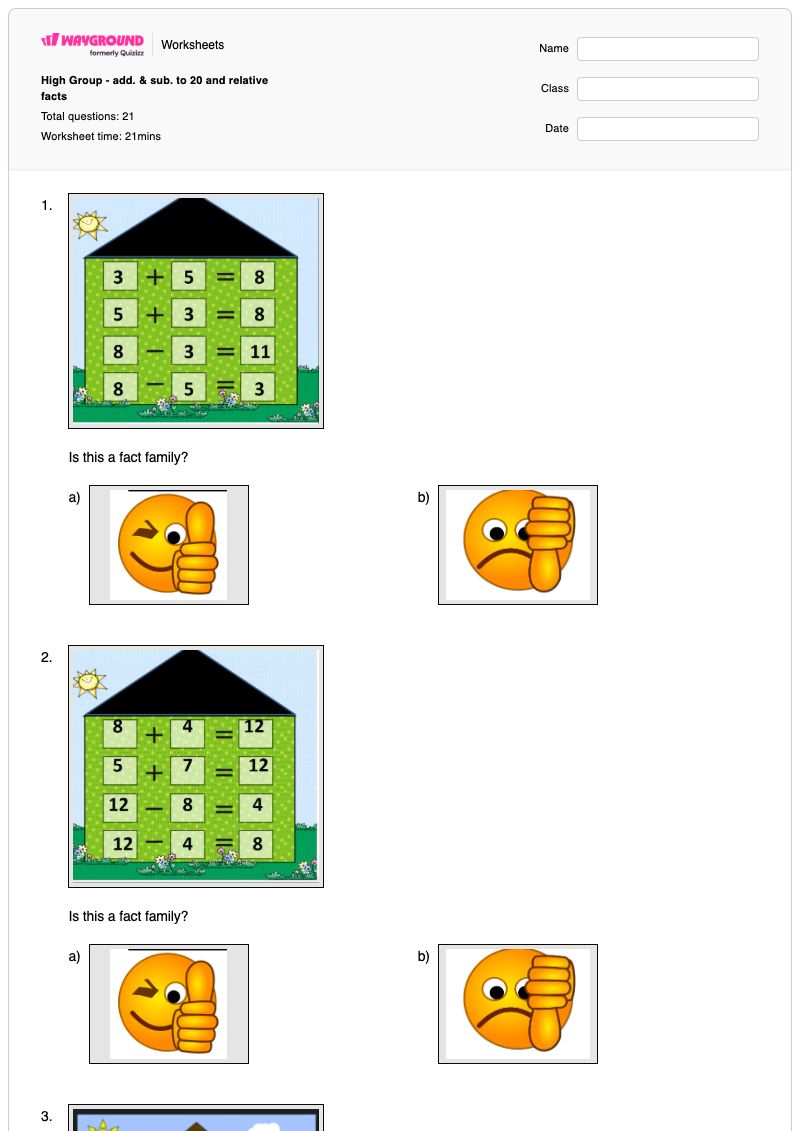
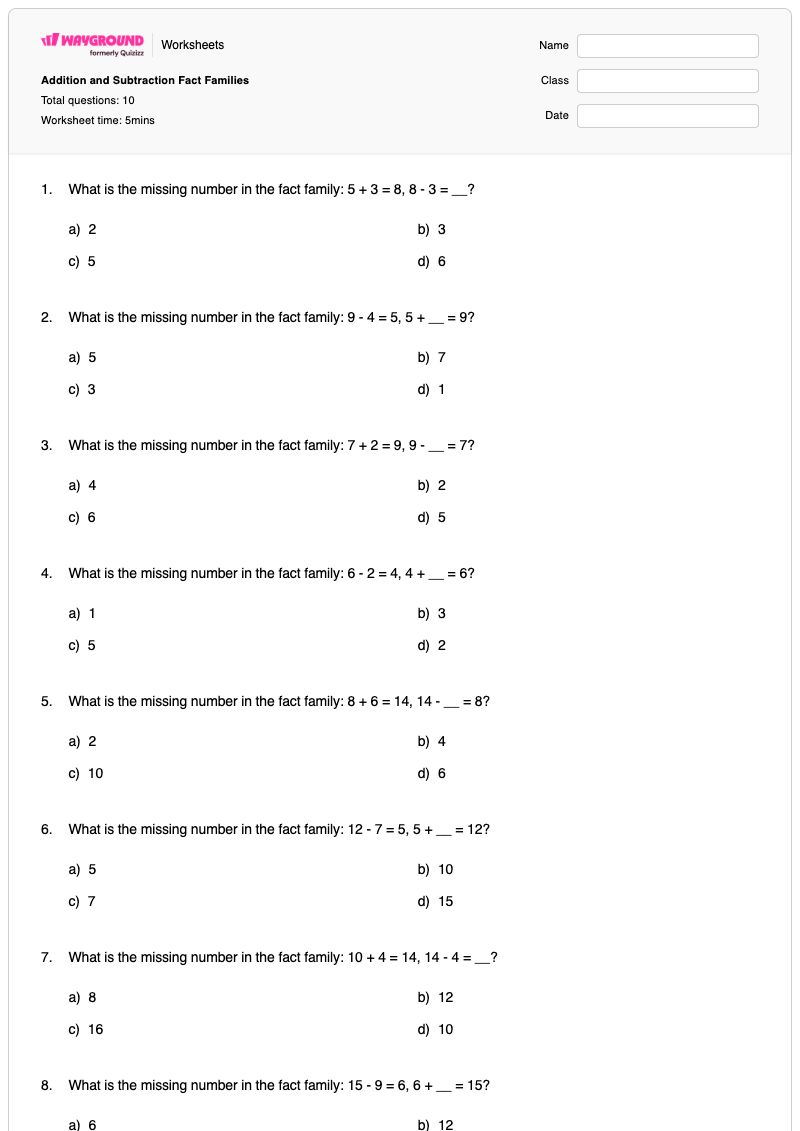
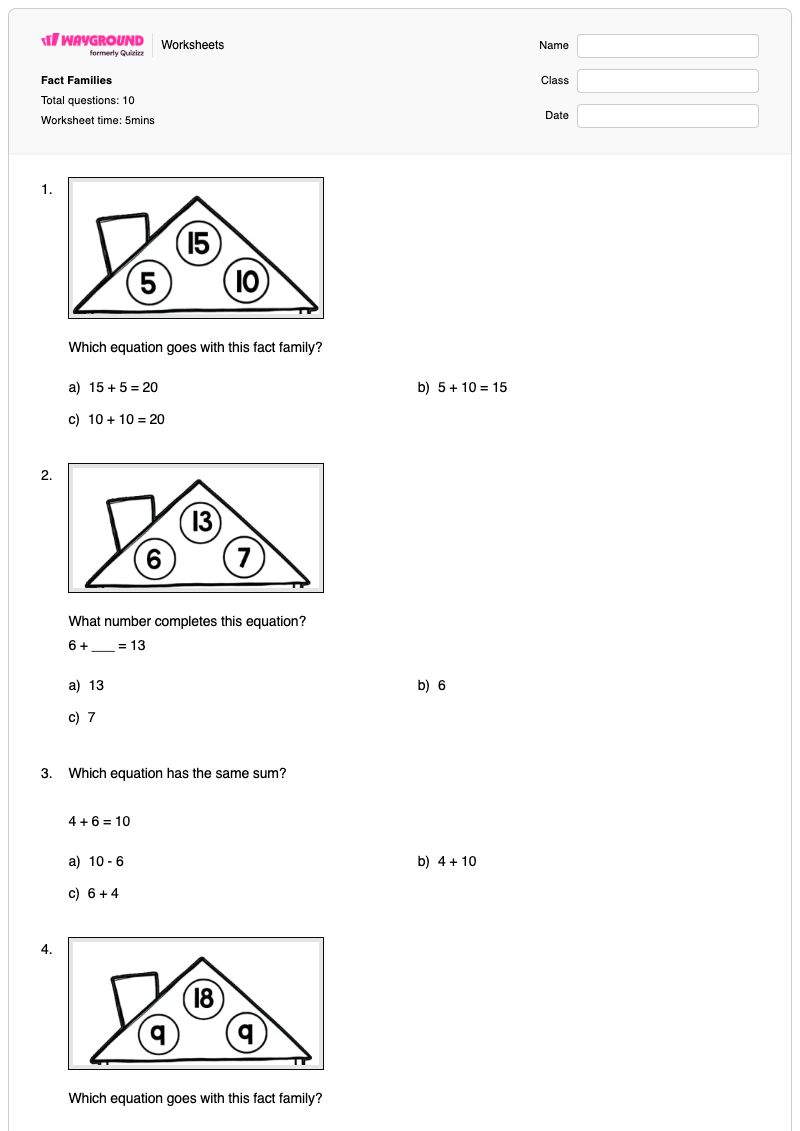
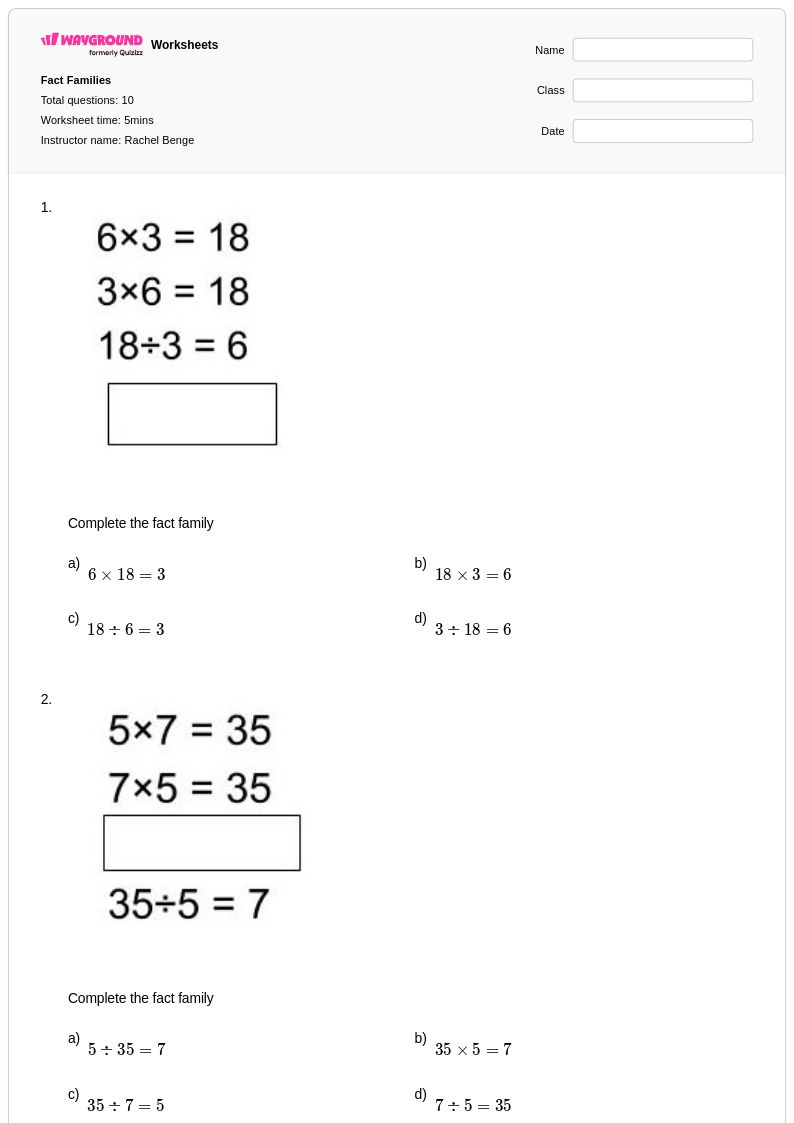
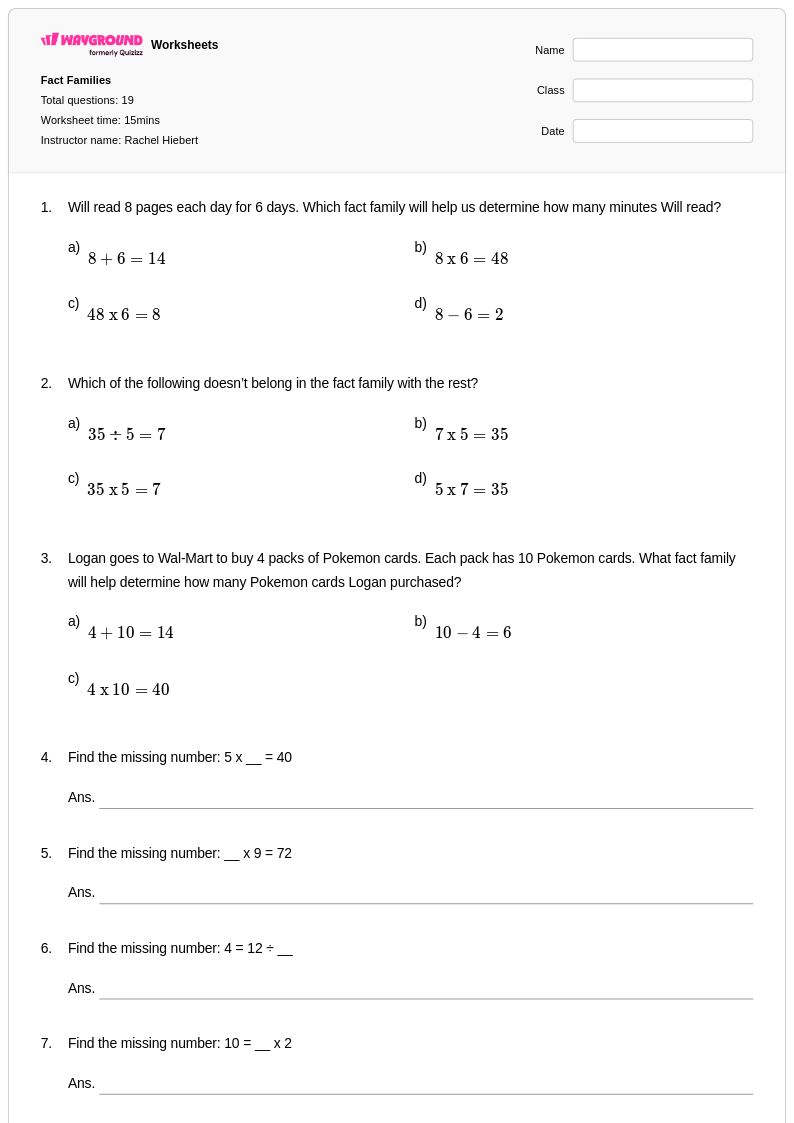
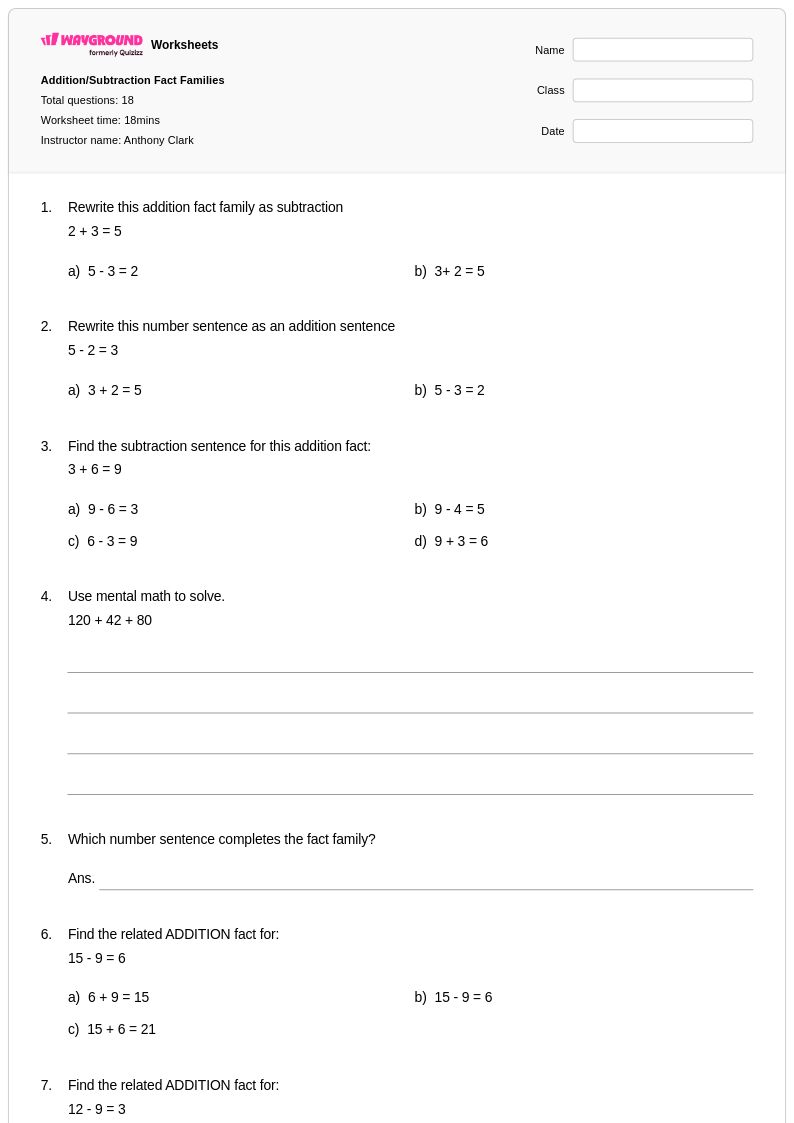
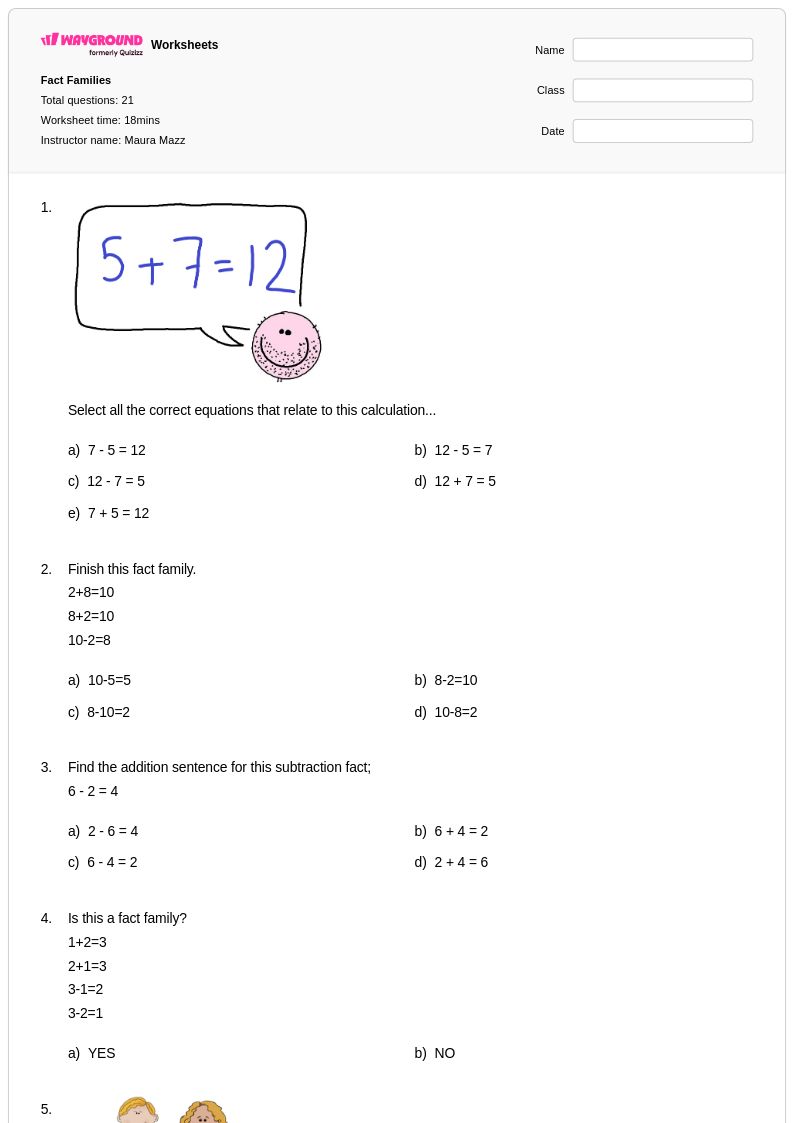
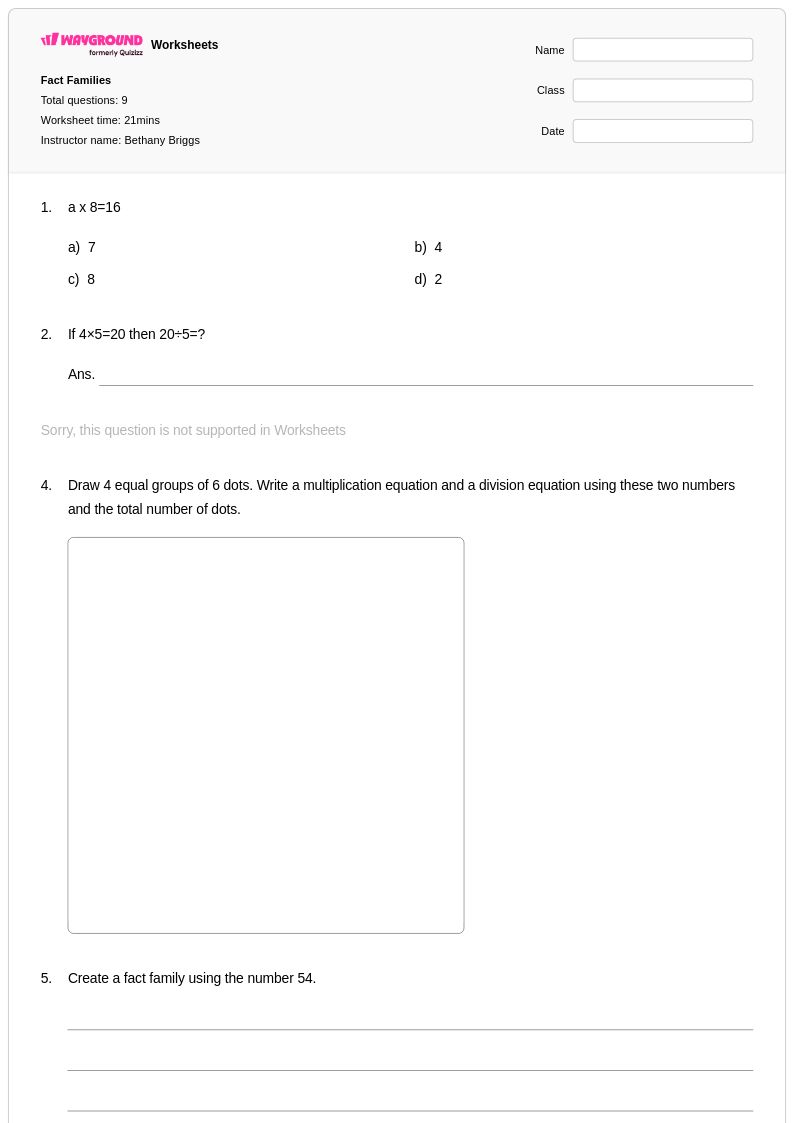
Discover free fact families worksheets and printables from Wayground that help students master the relationships between addition and subtraction through engaging practice problems with complete answer keys.
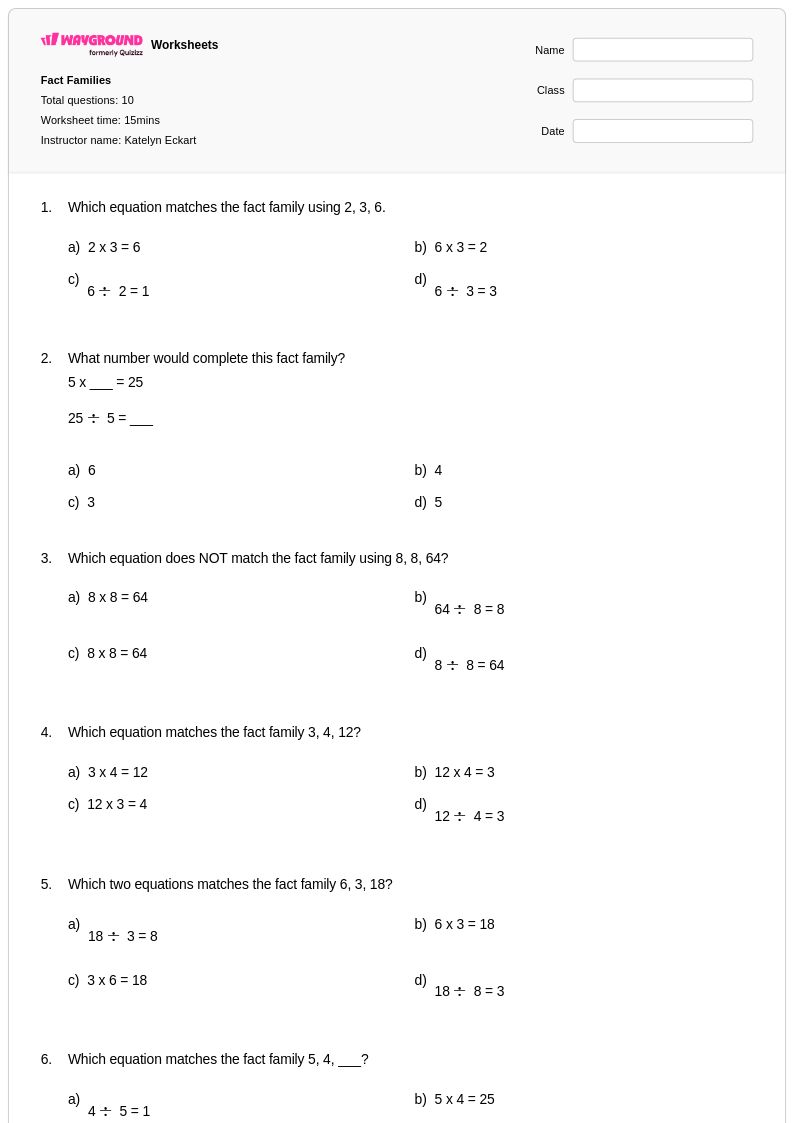
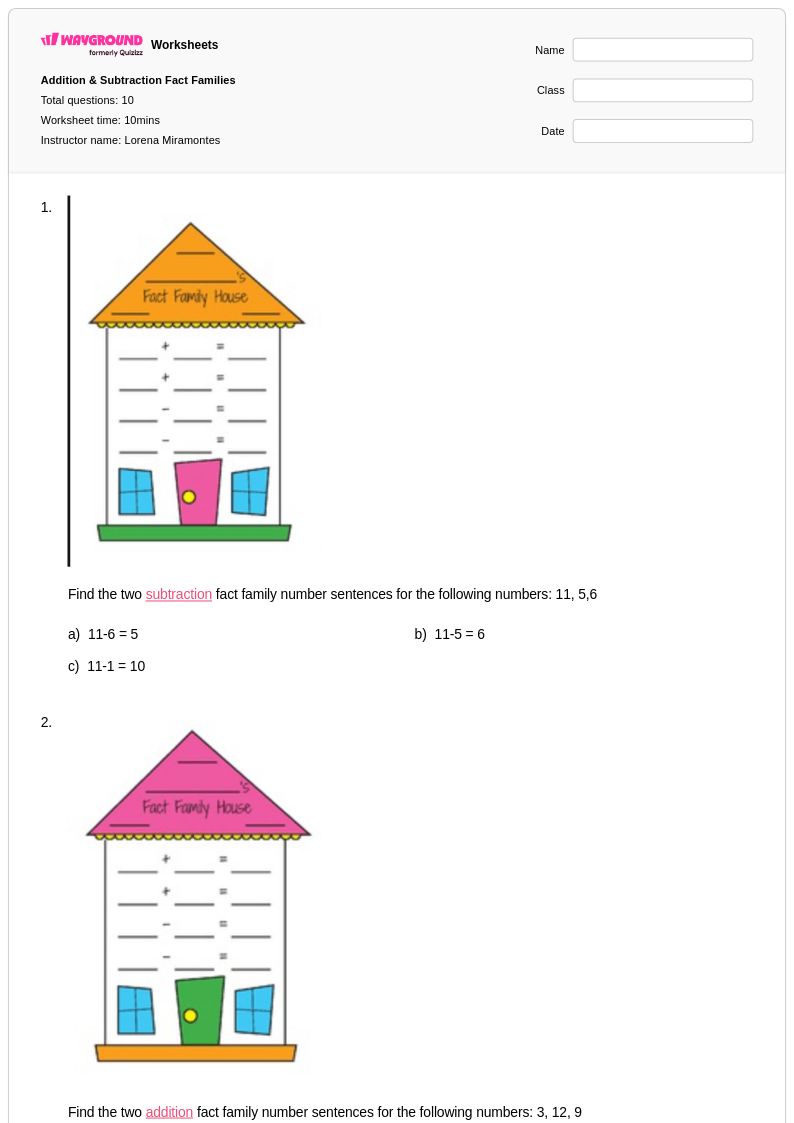
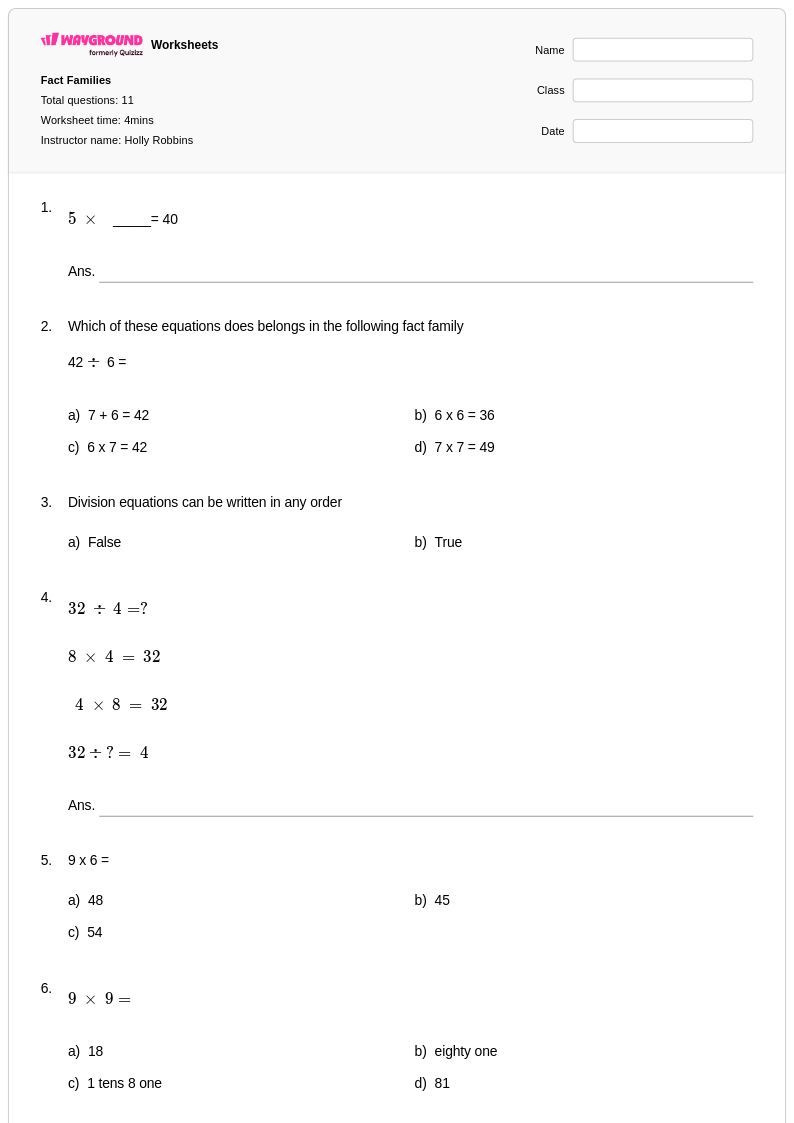
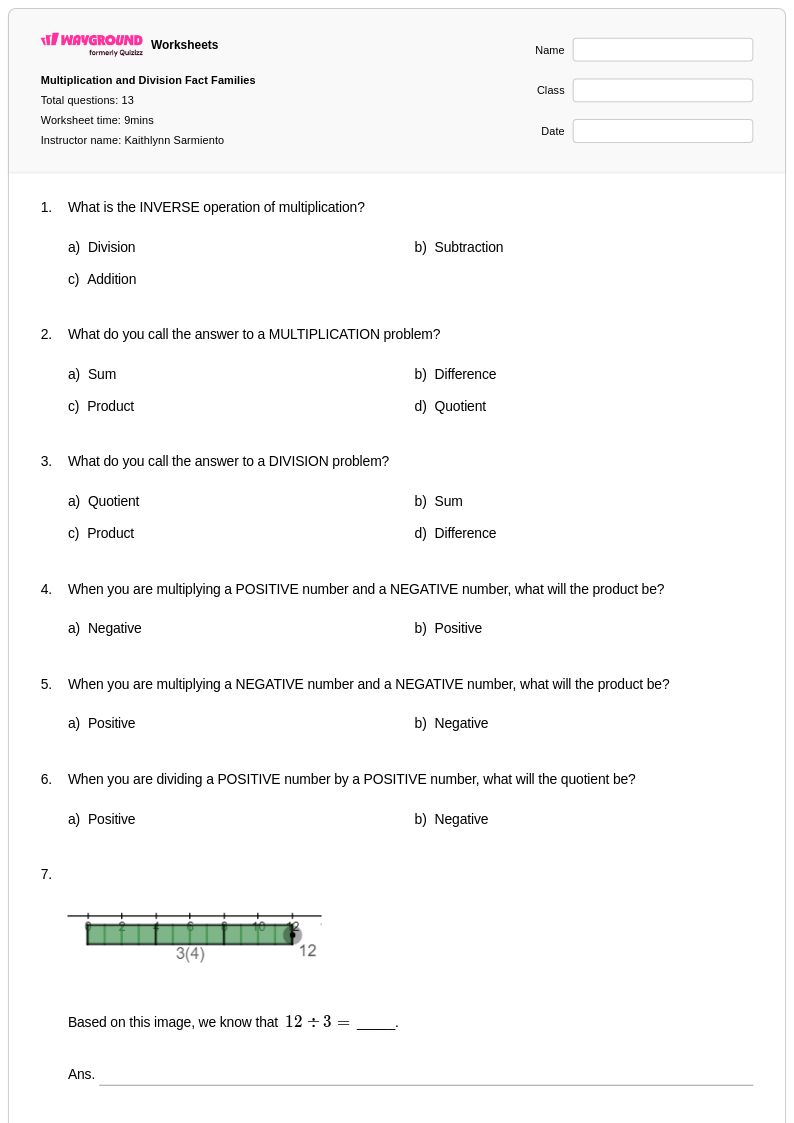
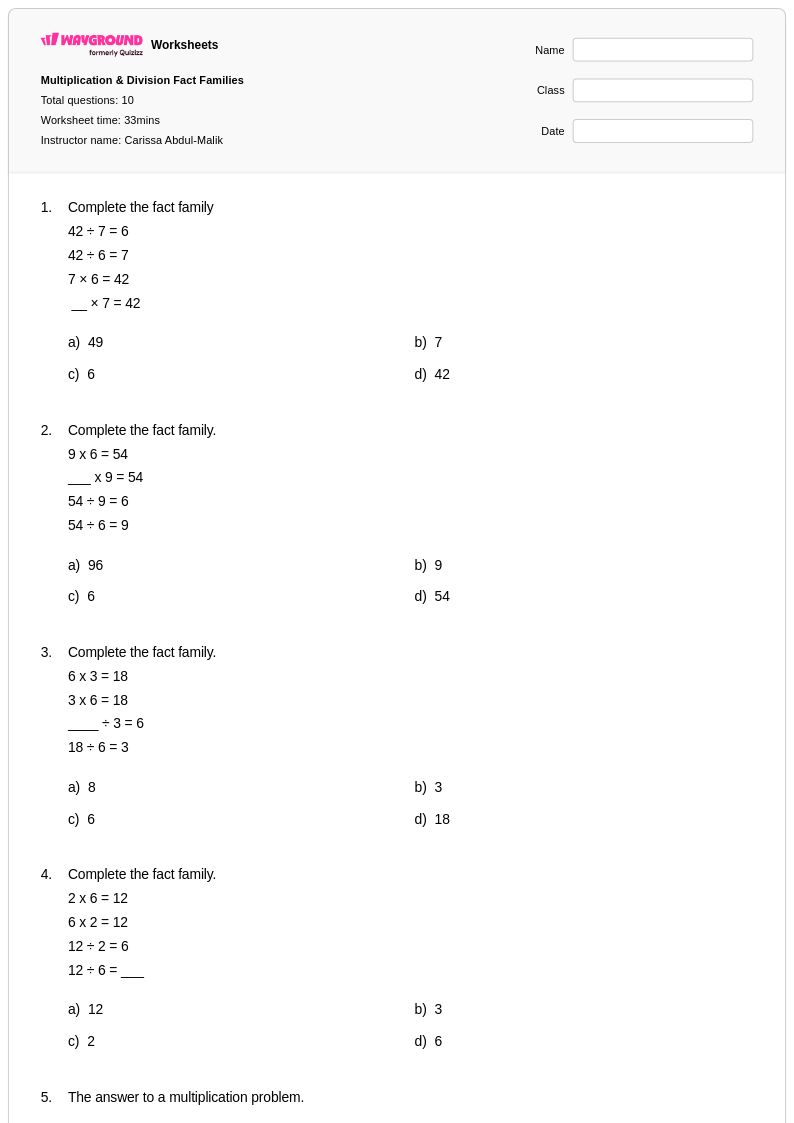
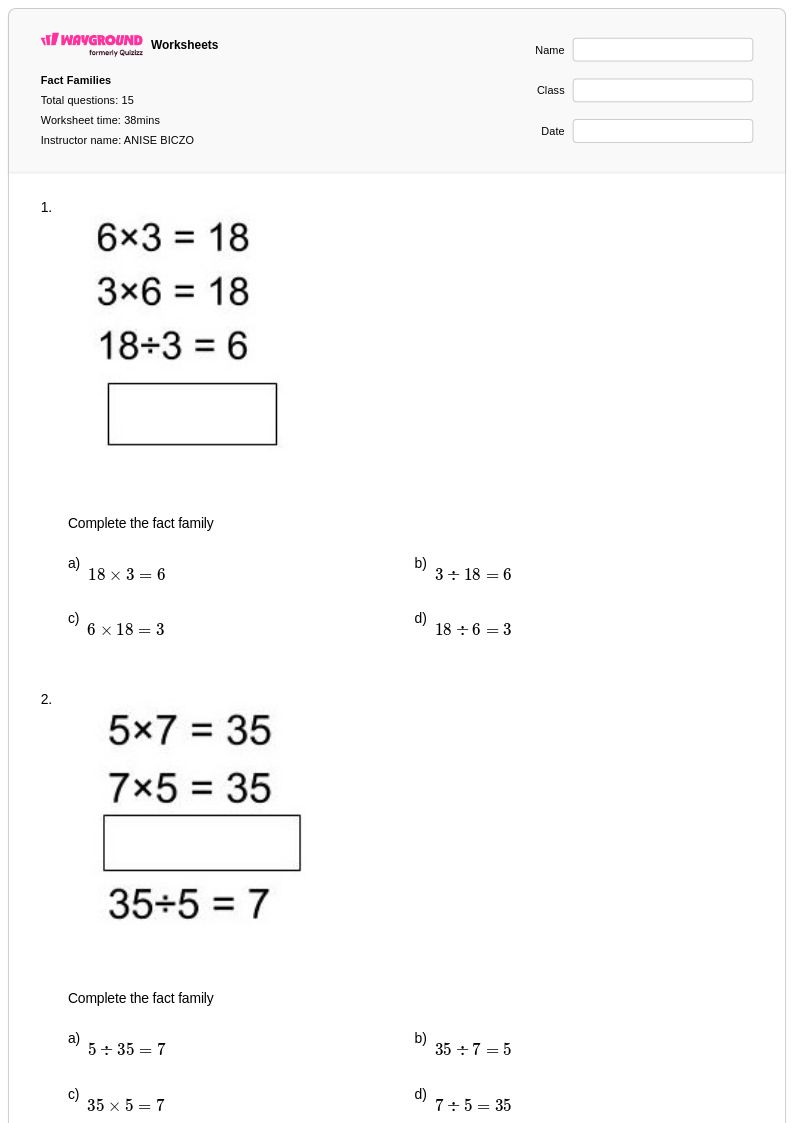
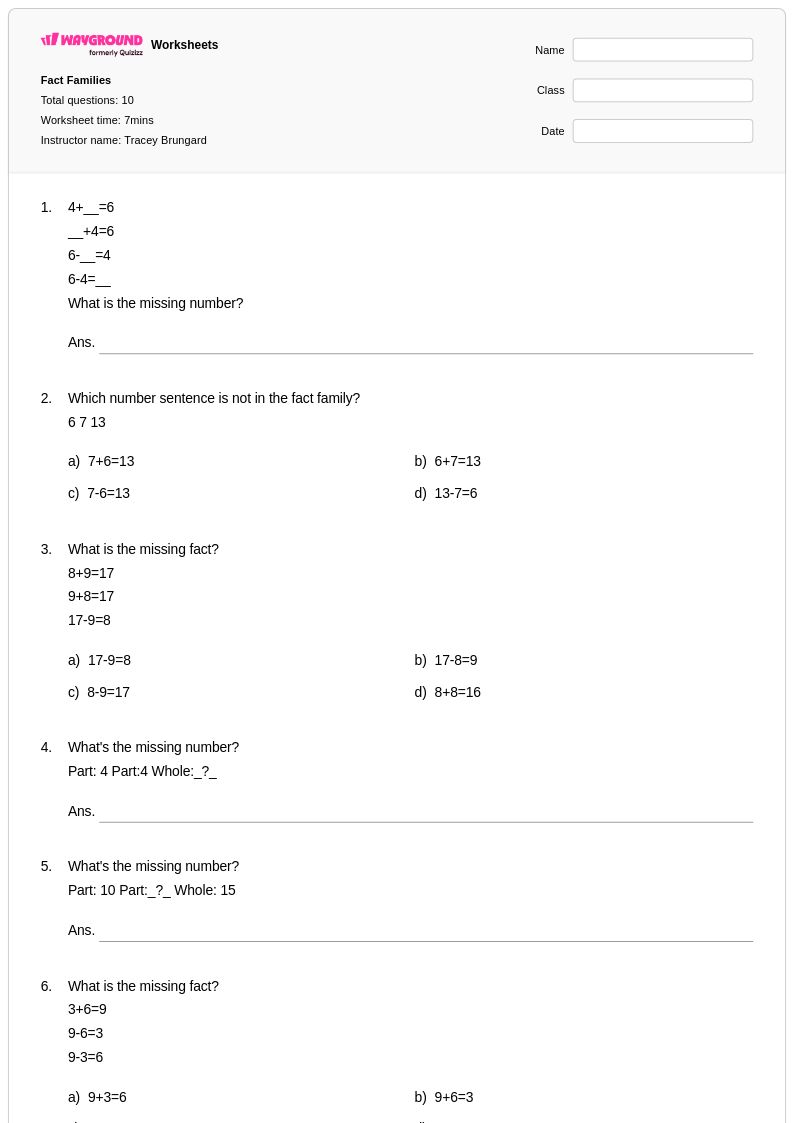
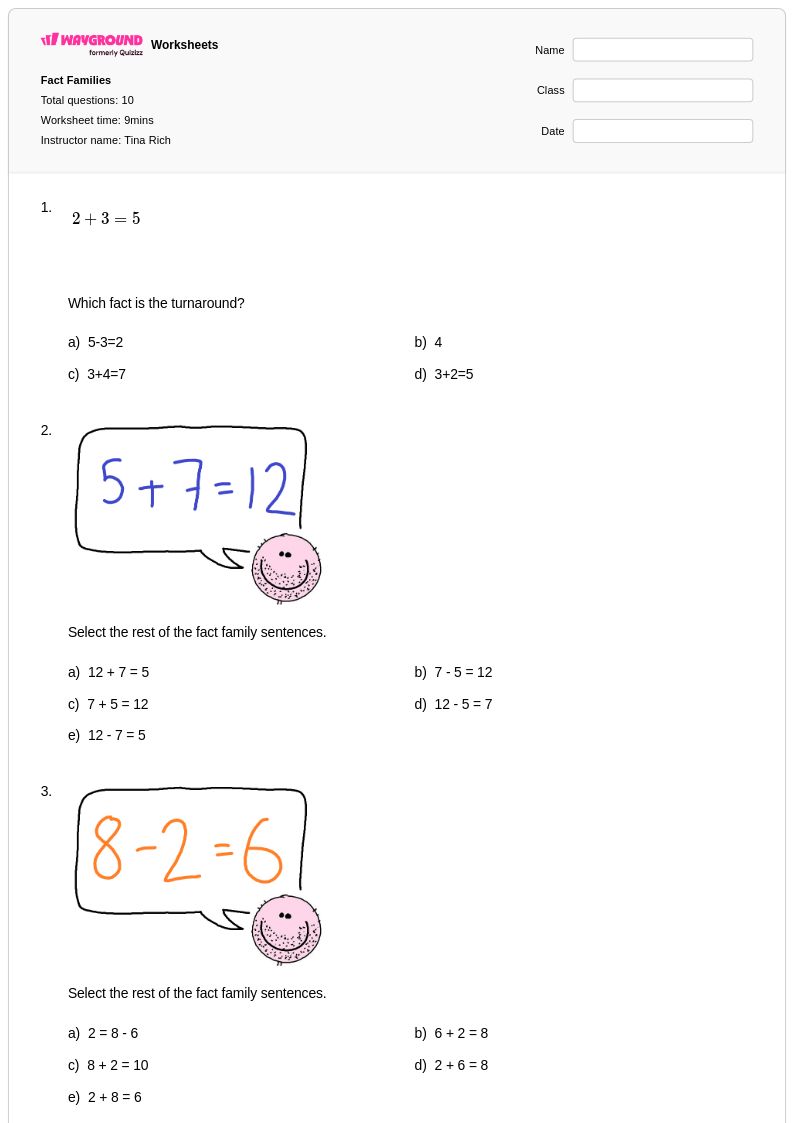
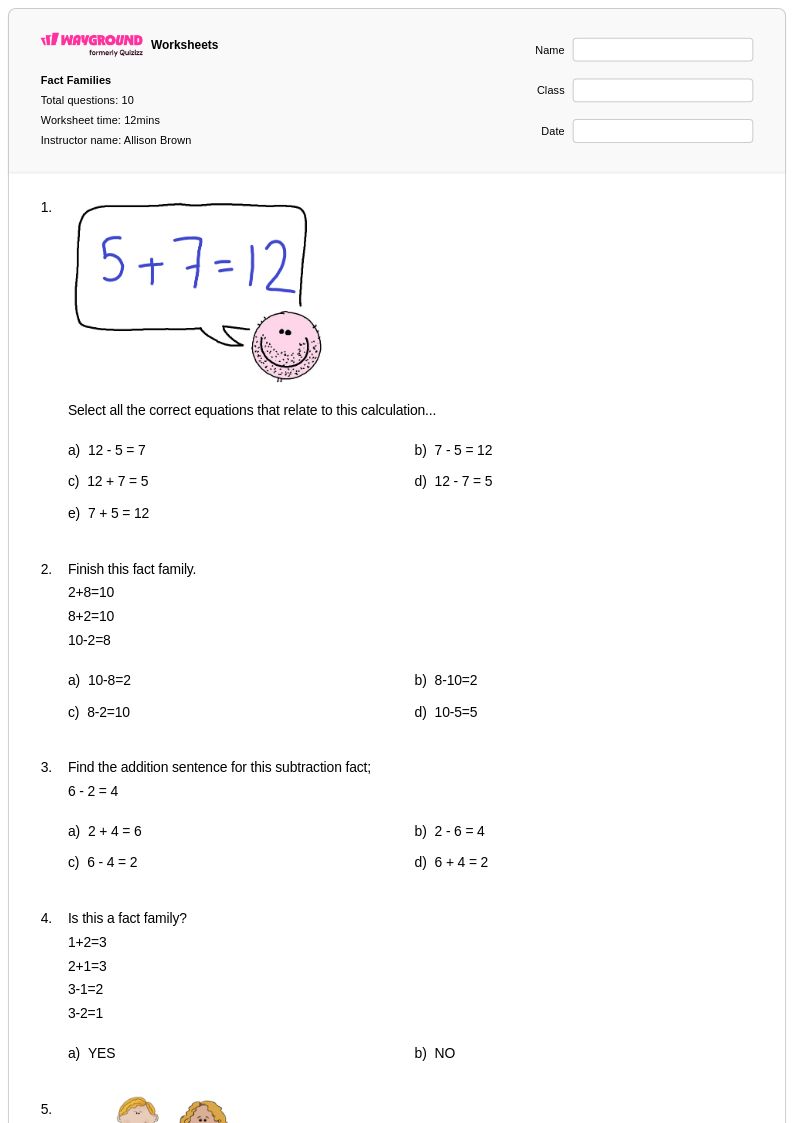
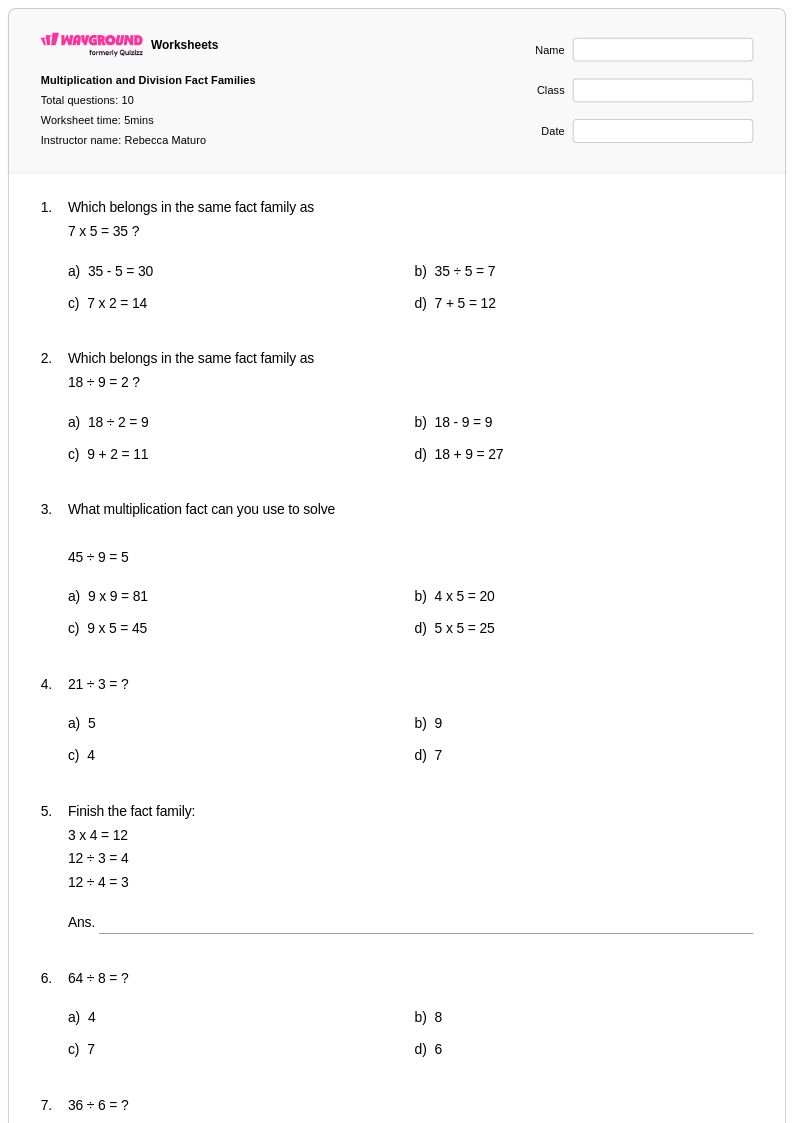
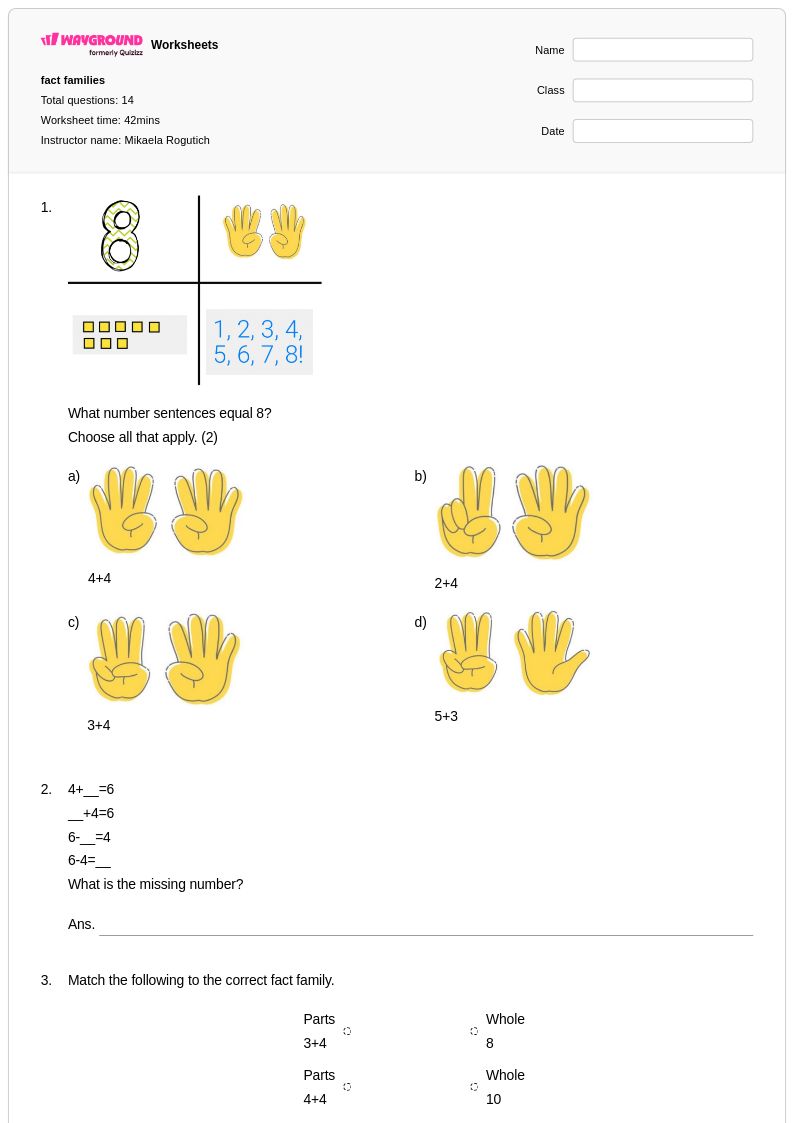
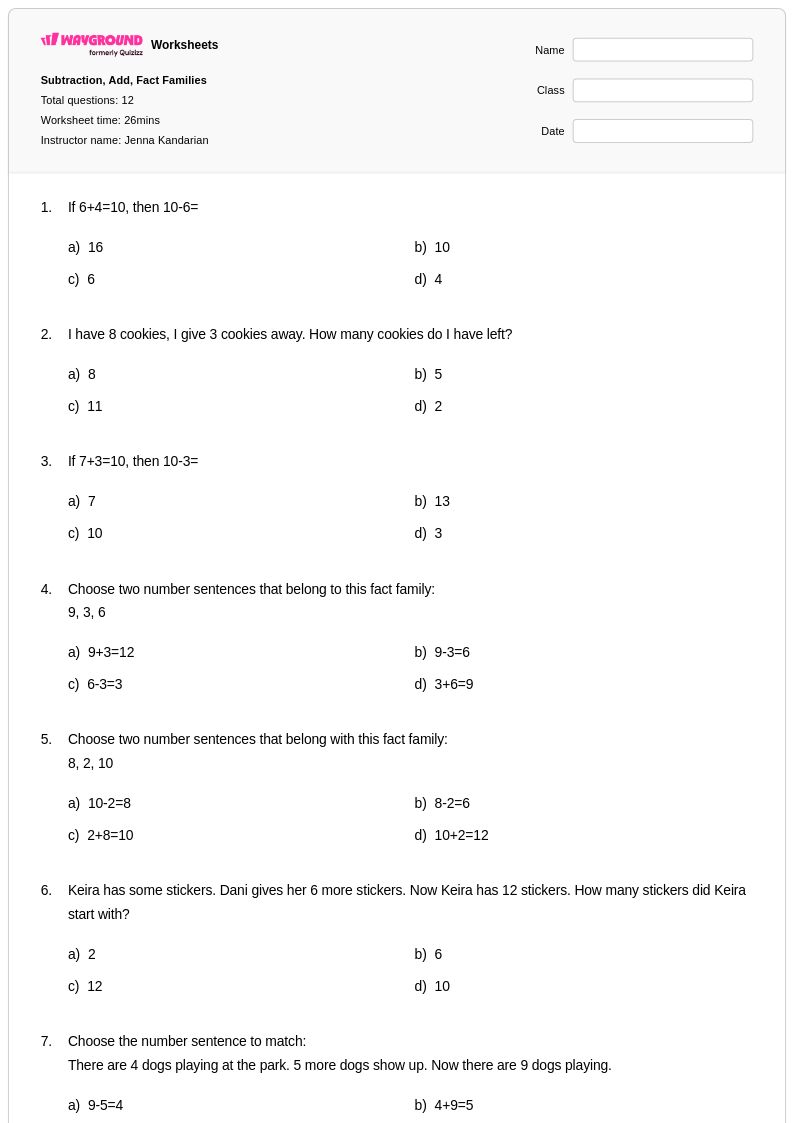
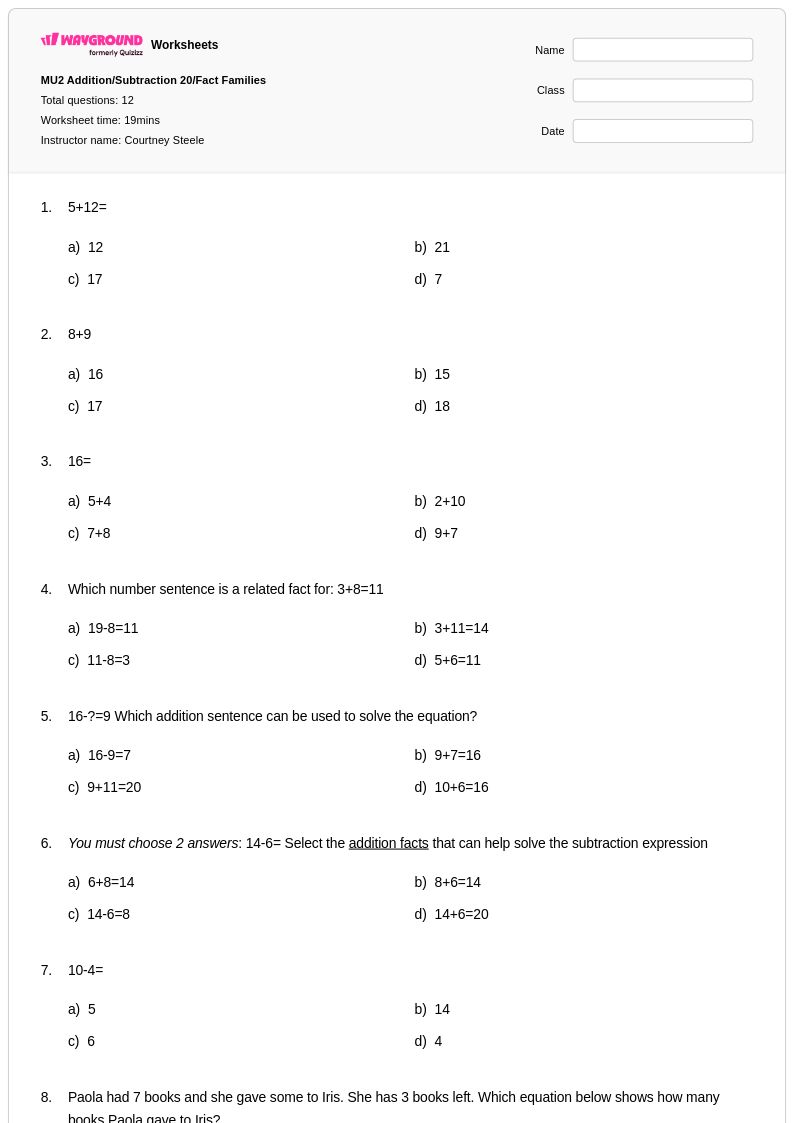
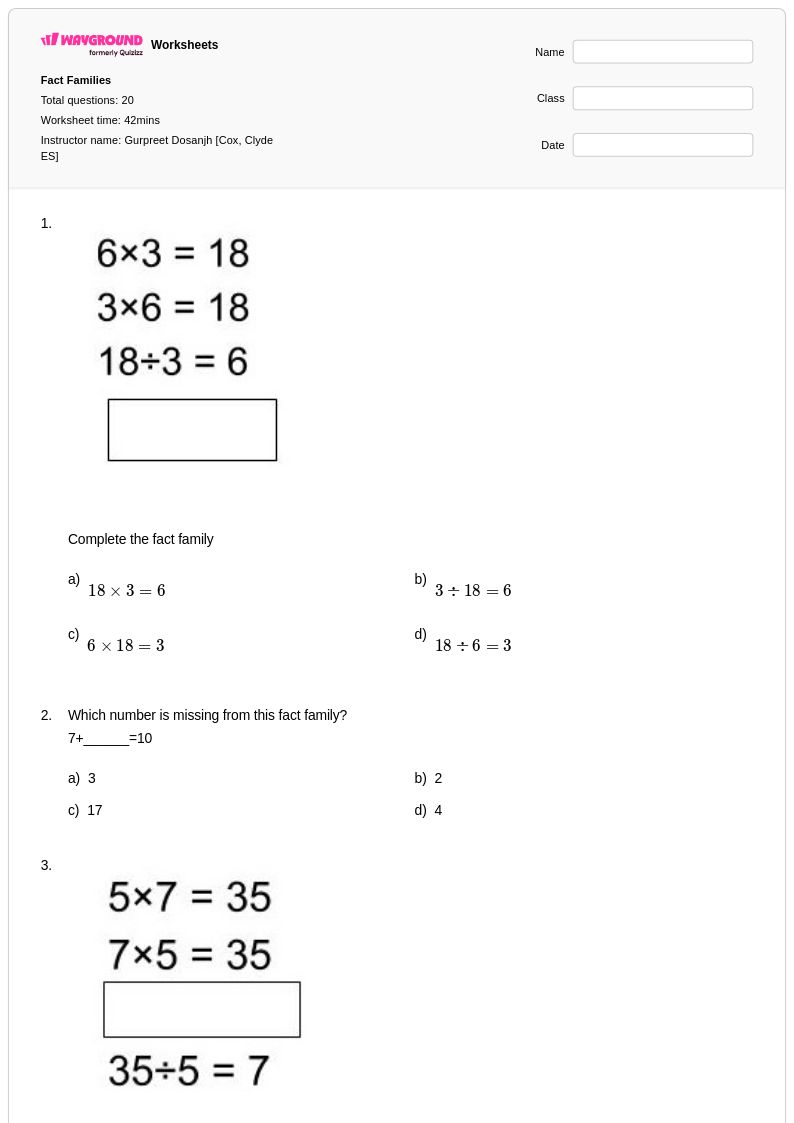
Fact families worksheets available through Wayground (formerly Quizizz) provide students with comprehensive practice in understanding the mathematical relationships between addition and subtraction operations, as well as multiplication and division combinations. These educational resources strengthen students' number sense by demonstrating how the same set of numbers can be used to create related equations, such as recognizing that 3 + 4 = 7, 4 + 3 = 7, 7 - 3 = 4, and 7 - 4 = 3 all belong to the same fact family. The worksheets include diverse practice problems that help students identify missing numbers in fact family triangles, complete fact family sets, and recognize inverse operations. Each printable resource comes with a complete answer key, making them valuable free tools for both classroom instruction and independent practice sessions where students can verify their mathematical reasoning.
Wayground (formerly Quizizz) supports educators with an extensive collection of teacher-created fact family worksheets drawn from millions of educational resources that can be easily accessed through intuitive search and filtering capabilities. Teachers can locate materials that align with specific mathematical standards and customize worksheets to match their students' varying skill levels, whether for remediation of foundational concepts or enrichment of advanced mathematical thinking. The platform offers flexible formatting options, including downloadable pdf versions for traditional paper-based learning and digital formats for technology-integrated classrooms. These differentiation tools enable teachers to efficiently plan targeted instruction, provide focused skill practice, and address individual learning needs while maintaining consistent coverage of essential mathematical relationships that form the foundation for more complex operations.
FAQs
How do I teach fact families?
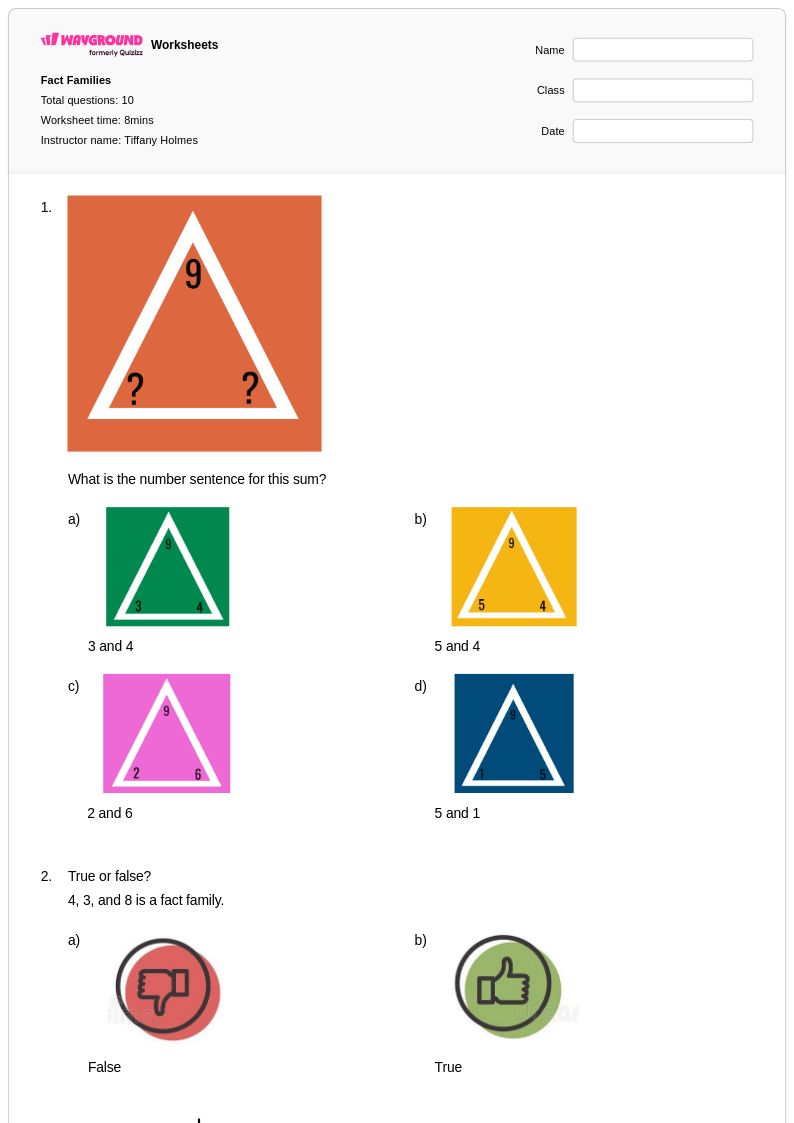
Start with a concrete number trio — say, 3, 4, and 7 — and show students how those three numbers generate four related equations: two addition, two subtraction. Fact family triangles are a reliable visual for this: the whole sits at the top, the two parts at the bottom corners. Once students can build the triangle, have them write all four equations from it before moving to any abstract practice. The key insight to reinforce is that addition and subtraction are inverse operations, not separate skills.
What exercises help students practice fact families?
The most effective practice moves through three stages: identifying the three numbers in a family, completing a partial fact family (given two equations, write the other two), and finding a missing number in one equation using the family relationship. Fact family triangles work well for the first two stages; open number sentences like 7 - ___ = 4 push students into the third. Mixing addition and subtraction problems within the same set — rather than separating them — reinforces the inverse relationship more directly than drilling each operation alone.
What mistakes do students commonly make with fact families?
The most common error is treating addition and subtraction as unrelated — students who haven't internalized the inverse relationship will recalculate 7 - 4 from scratch rather than using 3 + 4 = 7 as a shortcut. A second frequent mistake is writing only two equations from a number trio instead of all four, usually because they miss the commutative pair (3 + 4 and 4 + 3). Watch also for students who swap the whole and a part — writing 3 + 7 = 4 — which signals they don't yet understand which number is the sum.
How do I use Wayground's fact families worksheets in my classroom?
Each worksheet comes with a complete answer key, so you can hand it off for independent practice without extra prep. For paper-based work, download the printable PDF and distribute it in class — then use the Wayground for Teachers app to scan and grade student submissions directly. If you'd rather assign it digitally, host the worksheet as a quiz on Wayground and students complete it on their devices. Both routes use the same problems, so you can run paper and digital versions side by side in a mixed classroom.
Are fact families aligned to Common Core standards?
Yes. Common Core introduces fact families as part of the operations and algebraic thinking strand in kindergarten and first grade, where students are expected to understand the relationship between addition and subtraction and use that relationship to solve unknown-addend problems. By second grade, the same inverse-operations logic extends to fluency with sums and differences within 20. Fact family practice directly supports the progression from counting strategies toward knowing addition and subtraction facts from memory.
How can I differentiate fact family practice for mixed-ability learners?
For students who struggle with reading directions or number recognition, Wayground's Read Aloud accommodation reads questions aloud, and the reduced answer choices option lowers the cognitive load on multiple-choice items. For students with visual processing needs, you can generate an alternate version of the same worksheet with a larger font or a dyslexia-friendly font — same math, more accessible format. Advanced students don't need a different worksheet; they need harder number trios. Filter for higher-number fact families and assign those as an extension while the rest of the class works with smaller numbers.