Free Printable Movements of Ocean Water Worksheets for Class 9
Class 9 movements of ocean water worksheets from Wayground provide comprehensive printables and practice problems to help students master ocean currents, tides, and wave mechanics with included answer keys.
Explore printable Movements of Ocean Water worksheets for Class 9
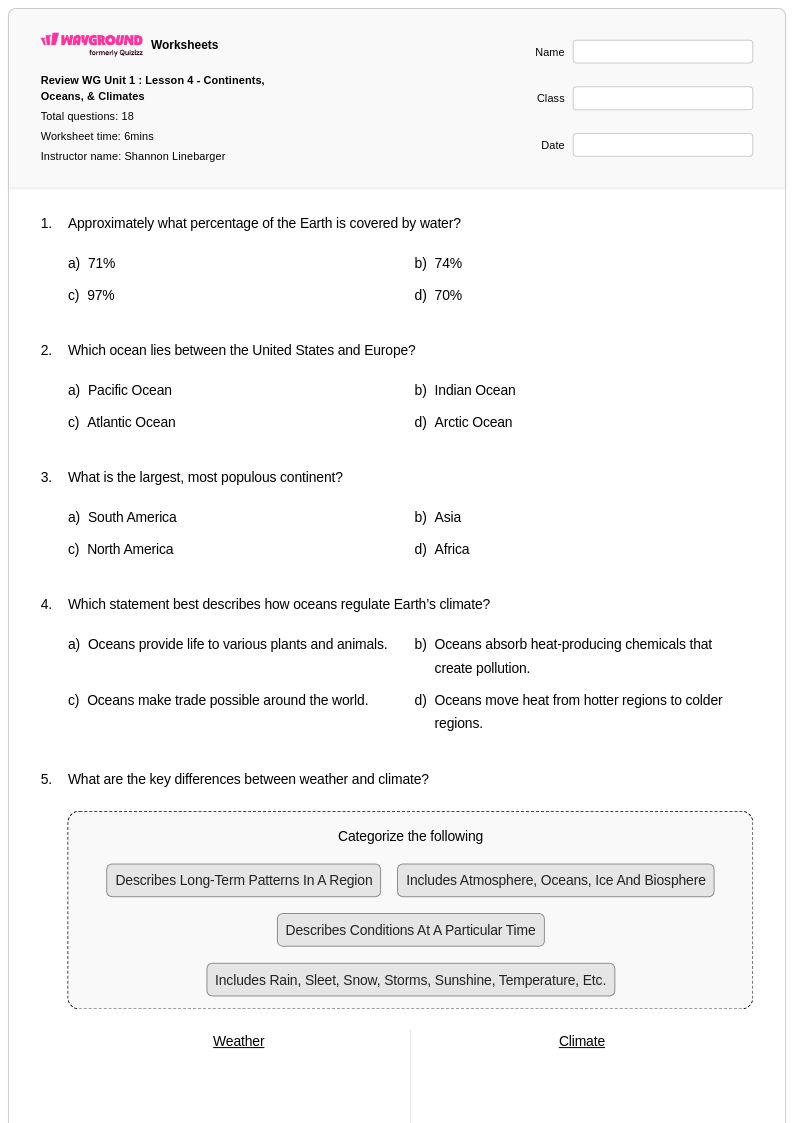
Movements of Ocean Water worksheets for Class 9 students available through Wayground (formerly Quizizz) provide comprehensive coverage of oceanic circulation patterns, tidal mechanics, and wave dynamics that form the foundation of marine geography studies. These carefully structured practice problems guide students through the complex interactions between wind patterns, temperature variations, and the Coriolis effect that drive surface currents, while also exploring deep water circulation caused by density differences in salinity and temperature. Each worksheet includes detailed answer keys that support both independent study and classroom instruction, with free printables covering essential concepts such as upwelling, downwelling, gyres, and thermohaline circulation that students must master to understand global climate patterns and marine ecosystems.
Wayground (formerly Quizizz) empowers educators with millions of teacher-created resources specifically designed for oceanography instruction, featuring robust search and filtering capabilities that allow teachers to quickly locate materials aligned with state and national geography standards. The platform's differentiation tools enable instructors to modify worksheets for varying skill levels within their Class 9 classrooms, while flexible customization options support both remediation for struggling students and enrichment activities for advanced learners. Teachers can seamlessly integrate these resources into their lesson planning through both printable pdf formats for traditional classroom use and digital formats for interactive learning environments, ensuring that students receive consistent practice with ocean water movement concepts regardless of the instructional setting.
FAQs
How do I teach movements of ocean water to my students?
Start by distinguishing between the three main types of ocean movement: surface currents driven by wind patterns, deep ocean currents driven by differences in water temperature and salinity (thermohaline circulation), and tidal movements caused by gravitational forces from the Moon and Sun. Building these categories early gives students a conceptual framework before introducing specific currents or tidal patterns. Connecting ocean movements to real-world outcomes, such as climate regulation, nutrient cycling, and coastal flooding, helps students see why these dynamics matter beyond the classroom.
What are common misconceptions students have about ocean currents and tides?
A frequent misconception is that all ocean currents are the same type of movement. Students often conflate surface currents with deep ocean currents, not realizing that deep currents are driven by density differences from temperature and salinity rather than wind. Another common error is assuming tides are caused solely by the Moon, overlooking the Sun's gravitational influence and how the alignment of both bodies produces spring and neap tides. Students also tend to underestimate the role of ocean currents in regulating global climate, treating ocean and atmosphere as separate systems rather than interconnected ones.
What practice exercises help students understand wave patterns and ocean currents?
Exercises that ask students to trace the path of major surface currents on a world map, label warm and cold currents, and explain why currents flow in their observed directions are particularly effective. Practice problems involving tidal cycles, including identifying high tide, low tide, spring tide, and neap tide from diagrams, reinforce gravitational relationships. Scenario-based questions that ask students to predict how changes in salinity or temperature would affect thermohaline circulation build analytical thinking and prepare students for higher-order assessments.
How do ocean movements affect global climate, and how can I teach this connection?
Ocean currents act as a global heat distribution system, transporting warm water from the tropics toward the poles and cold water back toward the equator, which directly moderates regional climates. The Gulf Stream, for example, keeps Western Europe significantly warmer than other regions at the same latitude. Teaching this connection works well through comparison activities where students analyze climate data for coastal versus inland locations at similar latitudes, then trace nearby ocean currents to explain the differences.
How do I use Wayground's movements of ocean water worksheets in my classroom?
Wayground's movements of ocean water worksheets are available as printable PDFs for traditional classroom use and in digital formats for technology-integrated or remote learning environments, giving teachers flexibility in how they deploy the material. Teachers can also host worksheets as a quiz directly on Wayground, enabling real-time student responses and progress tracking. Each worksheet includes a detailed answer key, supporting both independent student practice and guided classroom instruction. For students who need additional support, Wayground's accommodation settings allow teachers to enable features such as read aloud, extended time, or reduced answer choices on an individual basis without disrupting the rest of the class.
How can I differentiate ocean water movement instruction for students at different levels?
For students who need additional support, focus on the foundational distinction between surface and deep currents, using diagrams and labeled maps before introducing explanatory mechanisms. Advanced students can be challenged with thermohaline circulation analysis, exploring how freshwater input from melting ice or increased precipitation could disrupt the global conveyor belt. On Wayground, teachers can apply individual accommodations such as read aloud for struggling readers or reduced answer choices for students who need reduced cognitive load, while other students receive standard settings without any notification.