Free Printable Properties of Water Worksheets for Class 12
Class 12 chemistry students can master the properties of water through Wayground's comprehensive collection of free worksheets, printables, and practice problems with complete answer keys in PDF format.
Explore printable Properties of Water worksheets for Class 12
Properties of water worksheets for Class 12 students available through Wayground (formerly Quizizz) provide comprehensive coverage of water's unique molecular characteristics and their biological and chemical significance. These expertly crafted resources strengthen students' understanding of hydrogen bonding, polarity, cohesion, adhesion, surface tension, and water's role as the universal solvent. The practice problems guide students through analyzing water's thermal properties, including its high specific heat capacity and heat of vaporization, while exploring how these characteristics support life processes. Each worksheet comes with a detailed answer key, and the free printable pdf format makes these resources easily accessible for both classroom instruction and independent study, allowing students to master the molecular basis of water's life-sustaining properties.
Wayground (formerly Quizizz) empowers educators with millions of teacher-created worksheet collections specifically designed for advanced chemistry instruction, featuring robust search and filtering capabilities that help locate materials aligned with state and national science standards. The platform's differentiation tools enable teachers to customize properties of water worksheets according to individual student needs, supporting both remediation for struggling learners and enrichment opportunities for advanced students. Available in both printable and digital pdf formats, these resources streamline lesson planning while providing flexible options for skill practice, formative assessment, and review sessions. Teachers can efficiently modify content difficulty, select specific molecular concepts, and create targeted practice sets that reinforce the complex relationships between water's structure and its essential biological functions.
FAQs
How do I teach the properties of water to my students?
Start by grounding students in water's molecular structure, specifically the bent shape of H2O and the resulting polarity caused by oxygen's higher electronegativity. From there, build outward to hydrogen bonding and its downstream effects: cohesion, adhesion, surface tension, and water's unusually high specific heat. Using real-world examples like water striders, sweating, and ice floating on lakes helps students connect abstract molecular behavior to observable phenomena.
What exercises help students practice the properties of water?
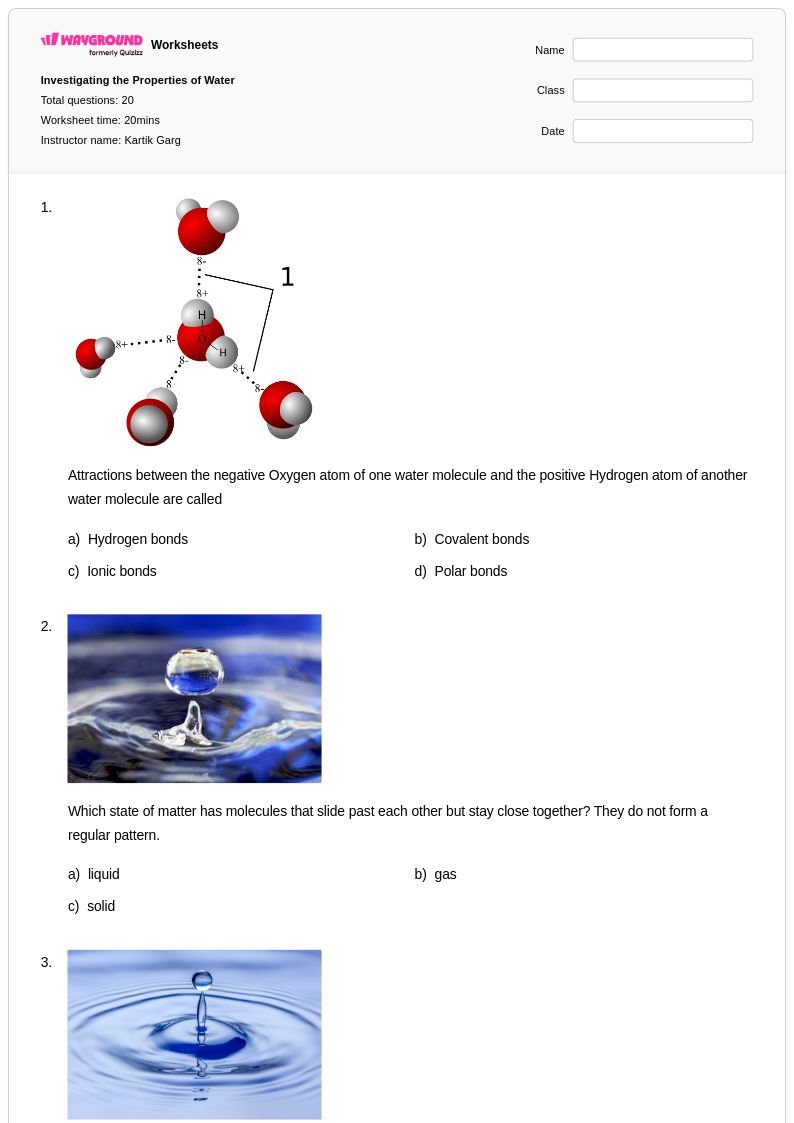
Effective practice tasks include labeling diagrams of hydrogen bond formation, comparing cohesion and adhesion with concrete examples, and completing structured problem sets on specific heat and thermal regulation. Short-answer questions that ask students to explain why water is called the universal solvent or why ice is less dense than liquid water are especially useful for pushing beyond memorization into conceptual understanding. Properties of water worksheets on Wayground provide practice problems across all of these skill areas, available as printable PDFs or in digital formats.
What mistakes do students commonly make when learning about the properties of water?
A common error is confusing cohesion and adhesion — students often reverse which term refers to water-to-water attraction versus water-to-other-surface attraction. Many students also struggle to connect polarity to hydrogen bonding, treating them as separate facts rather than understanding that polarity is the cause and hydrogen bonding is the effect. Another frequent misconception is believing that ice sinking would be 'normal'; it takes deliberate instruction to help students appreciate why water's expansion upon freezing is chemically unusual.
How can I use properties of water worksheets to differentiate for different learners?
Worksheets can be paired with Wayground's built-in accommodation tools to support diverse learners without singling students out. For students who need additional support, the Read Aloud feature can narrate questions, and reduced answer choices can lower cognitive load on multiple-choice items. Extended time settings can be configured per student, and all accommodation preferences are saved for reuse across future sessions, making differentiation manageable at scale.
How do I use Wayground's properties of water worksheets in my classroom?
Wayground's properties of water worksheets are available as downloadable printable PDFs for traditional classroom use and in digital formats for technology-integrated environments, including the option to host them as a quiz directly on Wayground. Teachers can assign them as independent practice, exit tickets, or review activities before an assessment. Each worksheet includes a complete answer key, which supports self-assessment and reduces grading time.
How does water's polarity connect to its other properties?
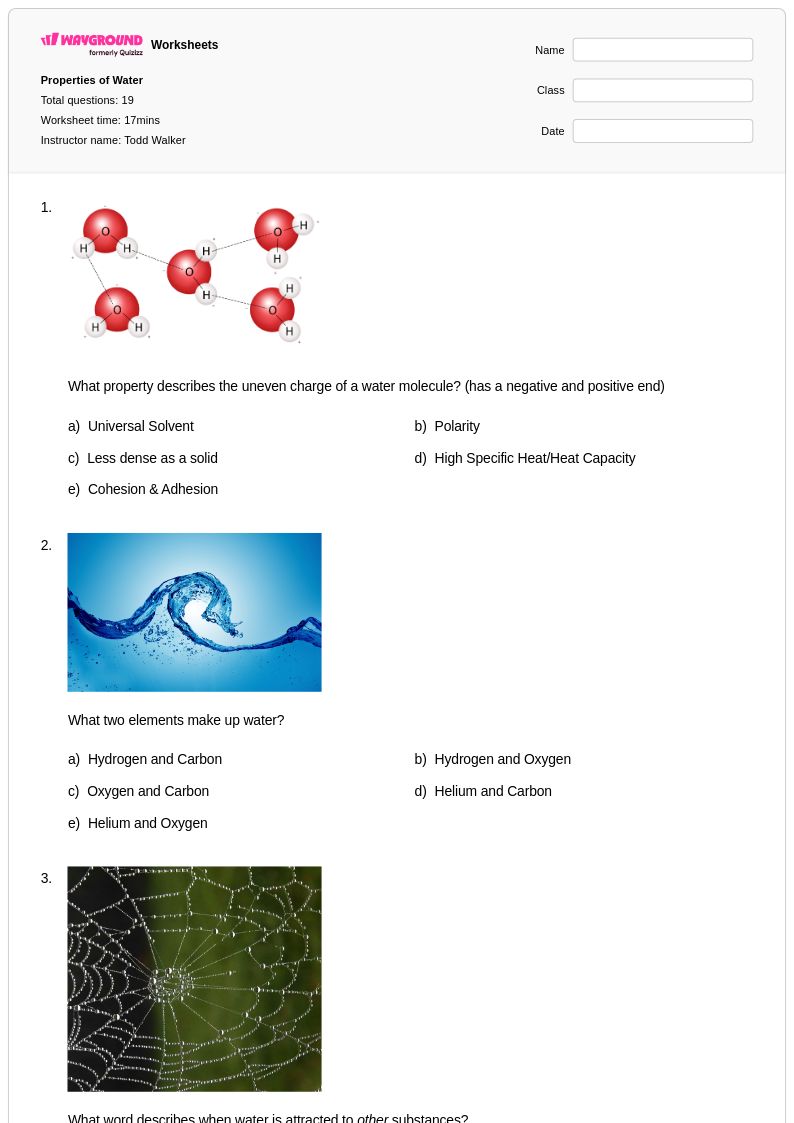
Water's polarity is the root cause of most of its unique characteristics. Because oxygen is more electronegative than hydrogen, the molecule has a partial negative charge near oxygen and partial positive charges near the hydrogens, which enables hydrogen bonds to form between adjacent water molecules. Those hydrogen bonds are directly responsible for cohesion, high surface tension, a high specific heat capacity, and water's effectiveness as a solvent for ionic and polar substances.