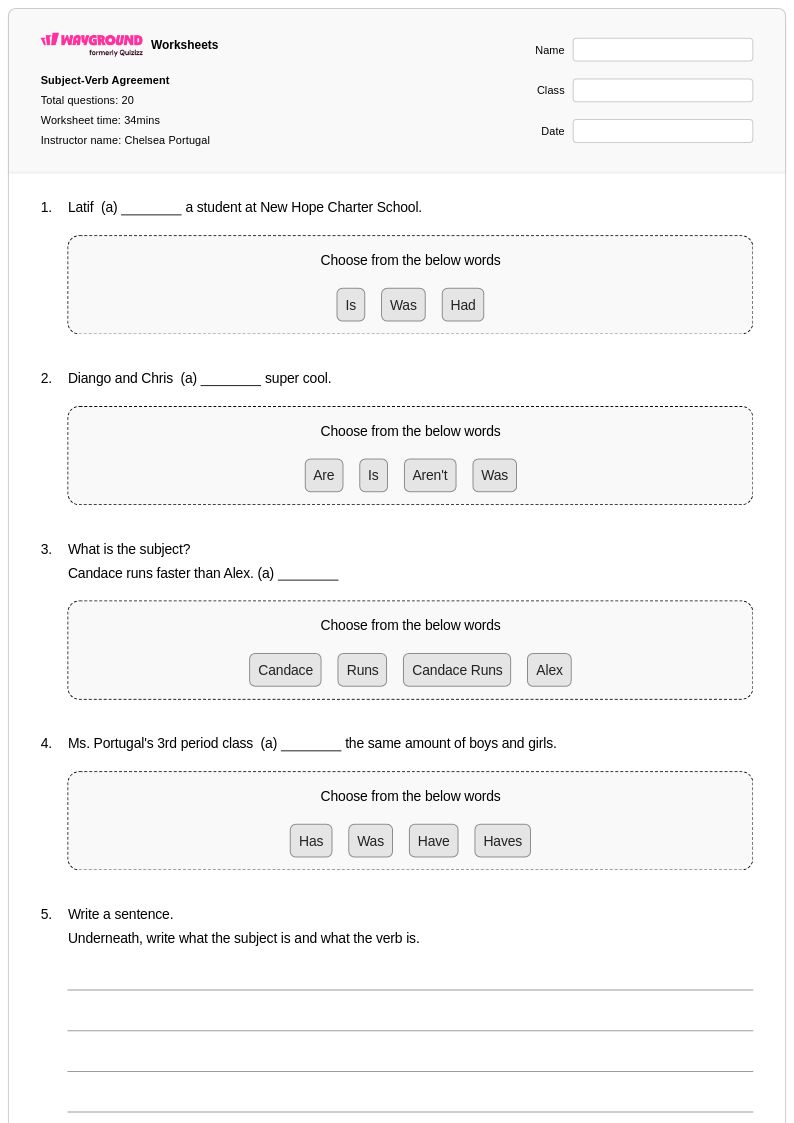
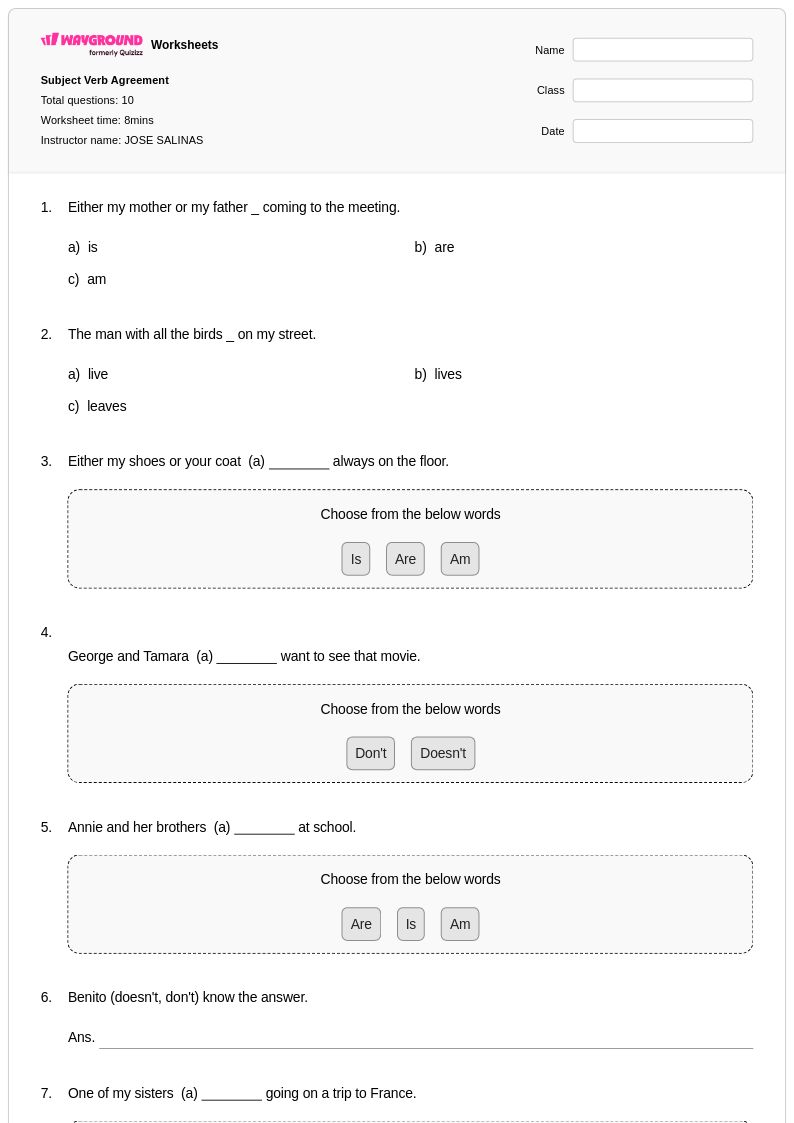
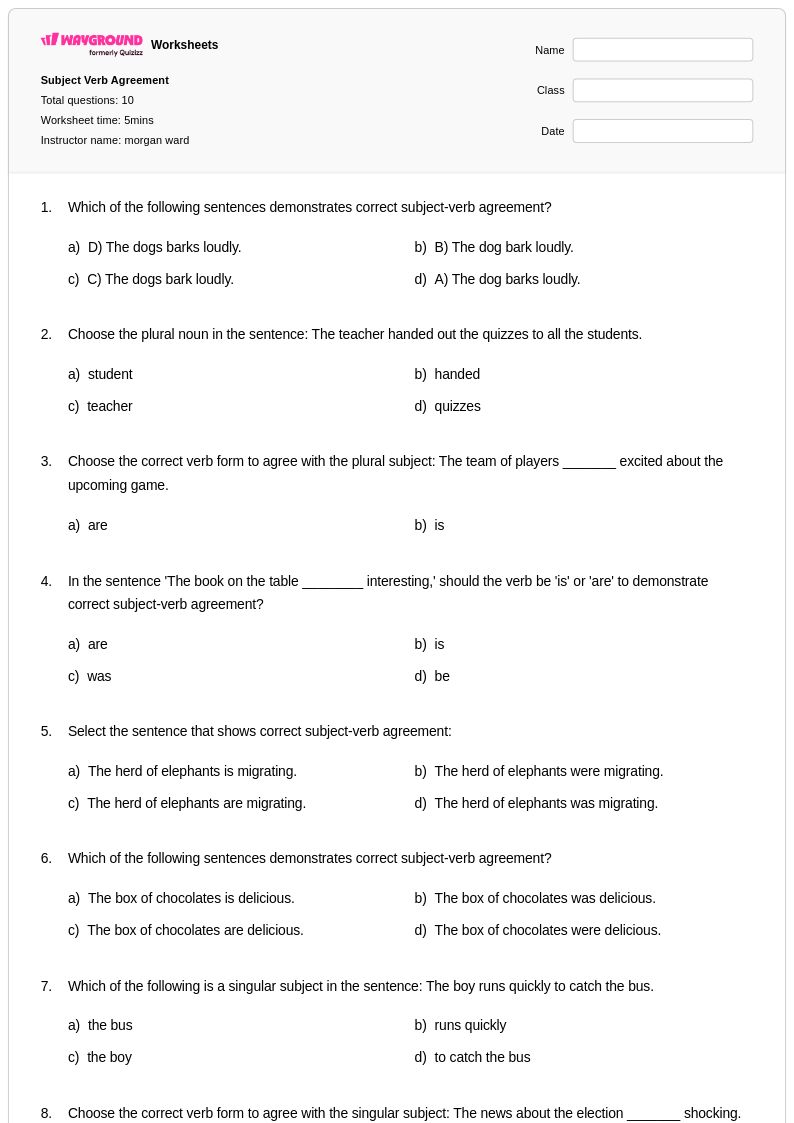
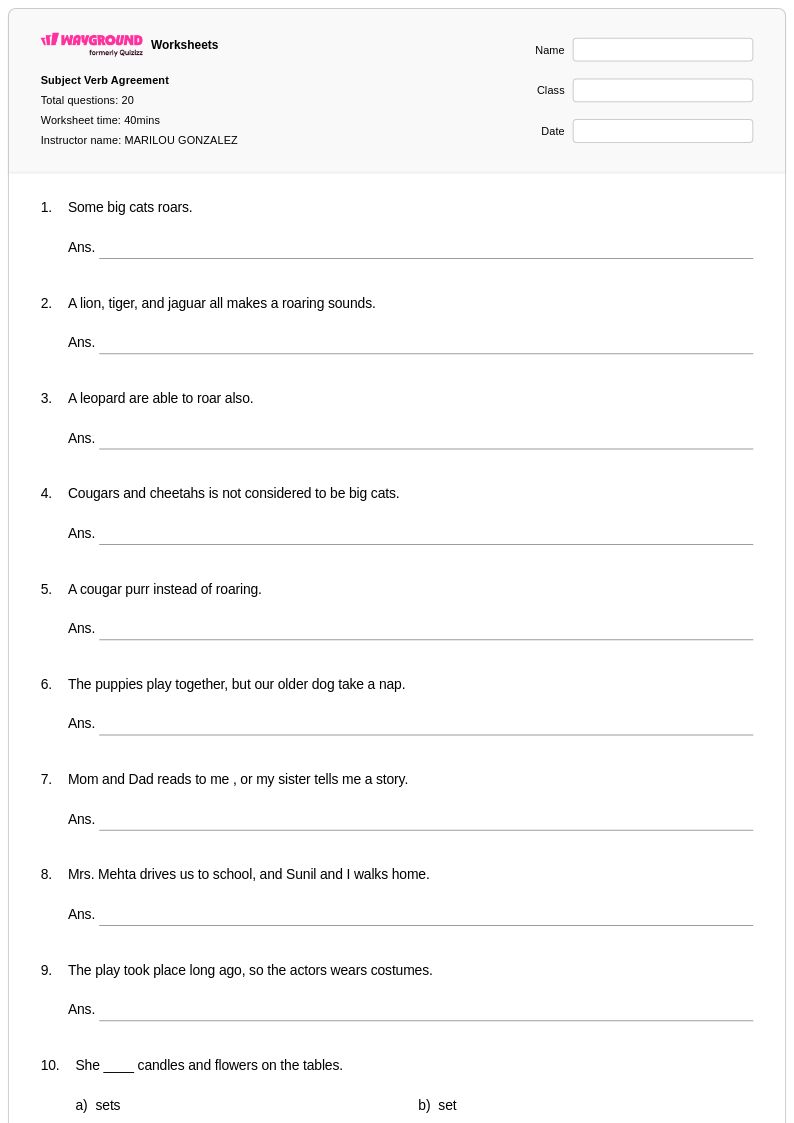
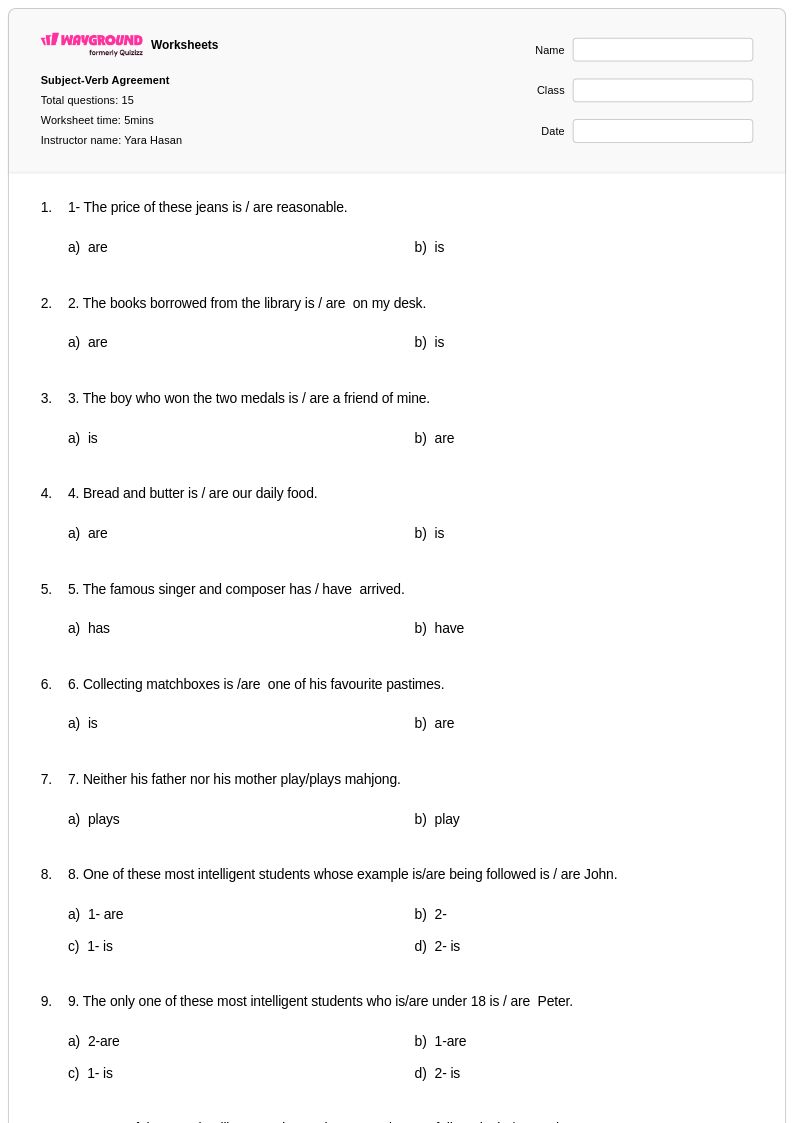
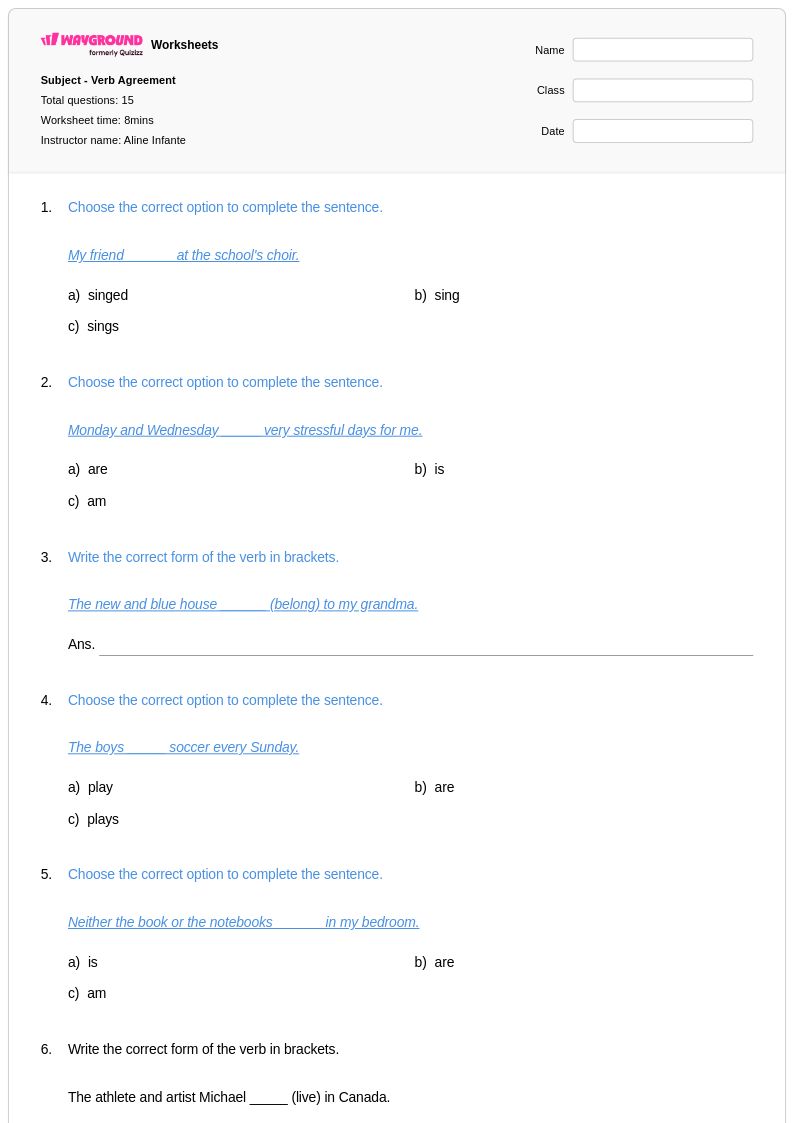
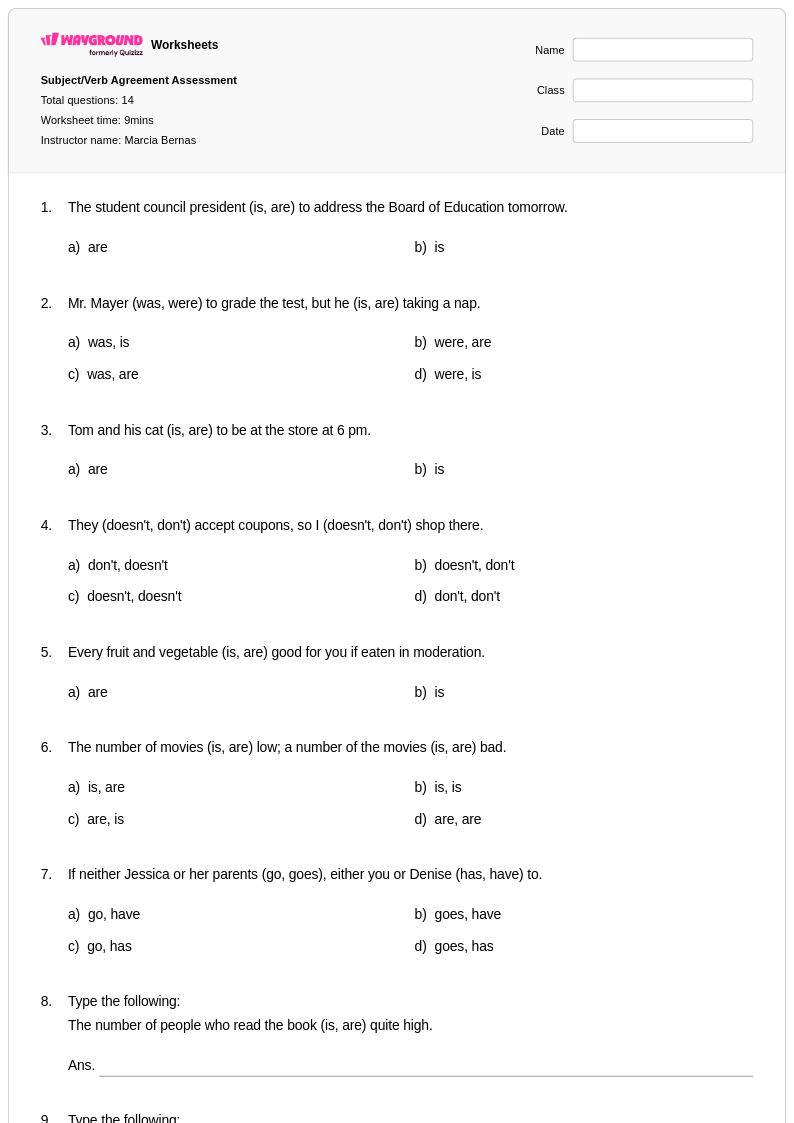
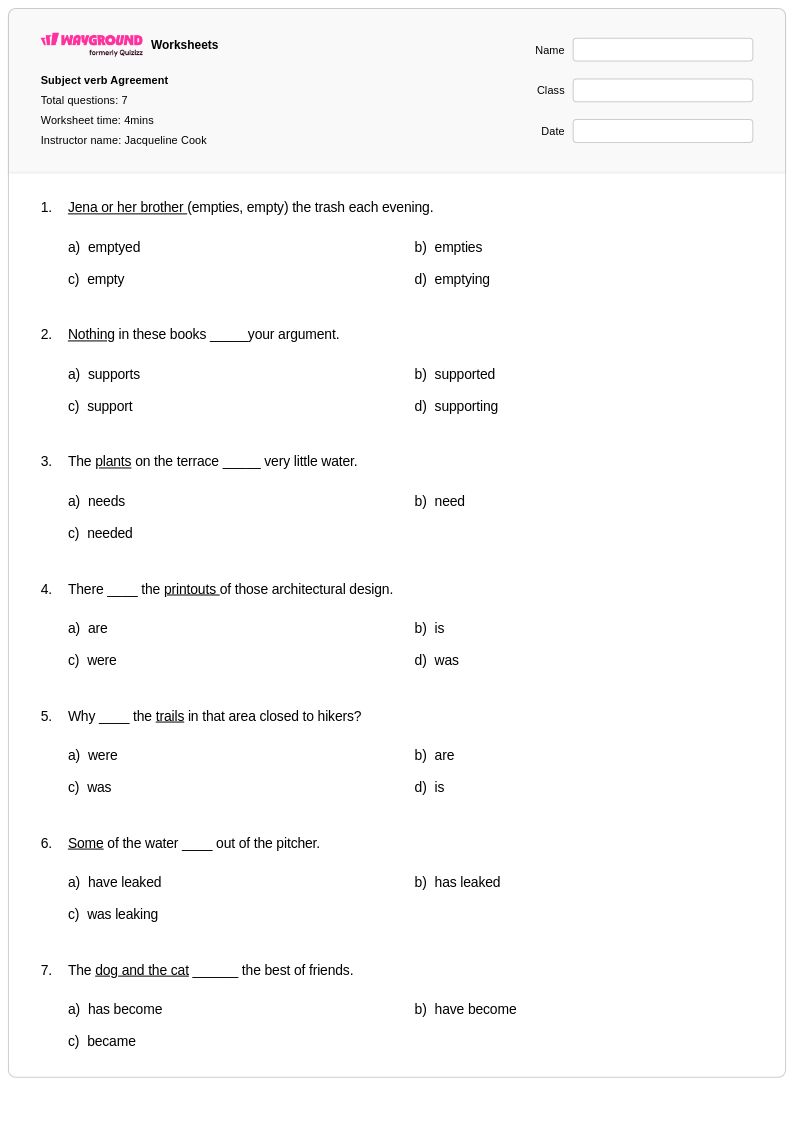
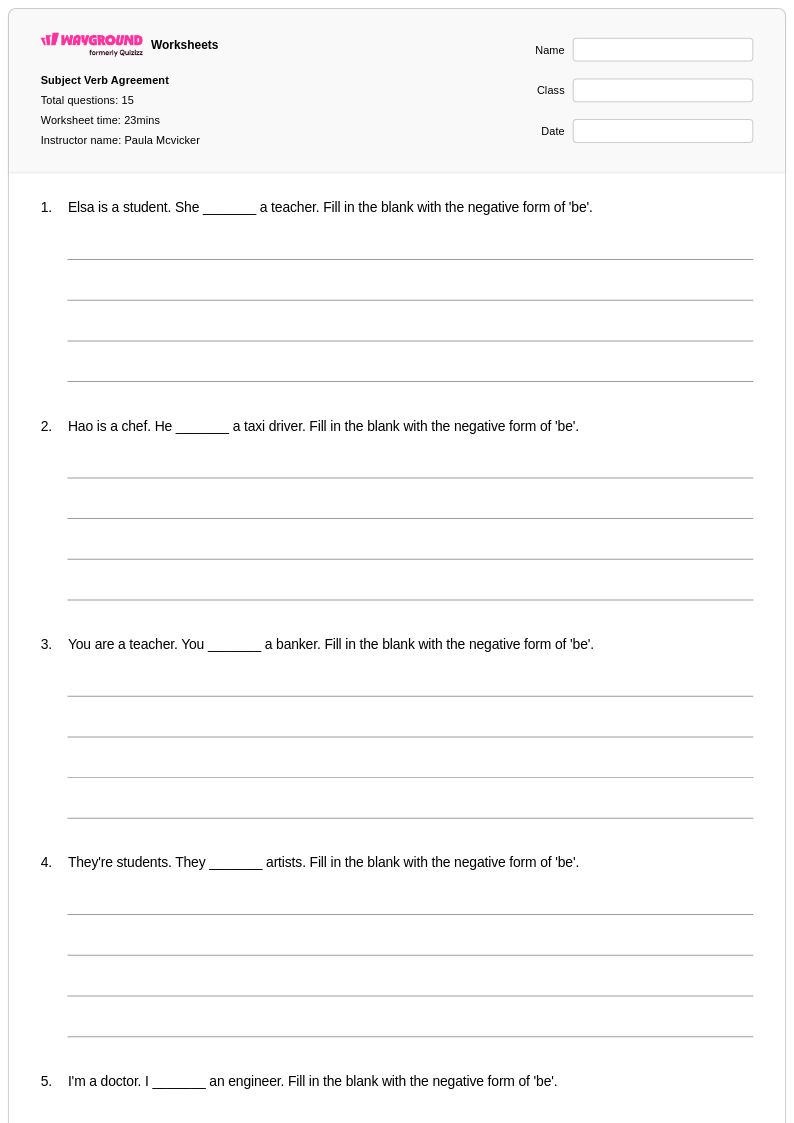
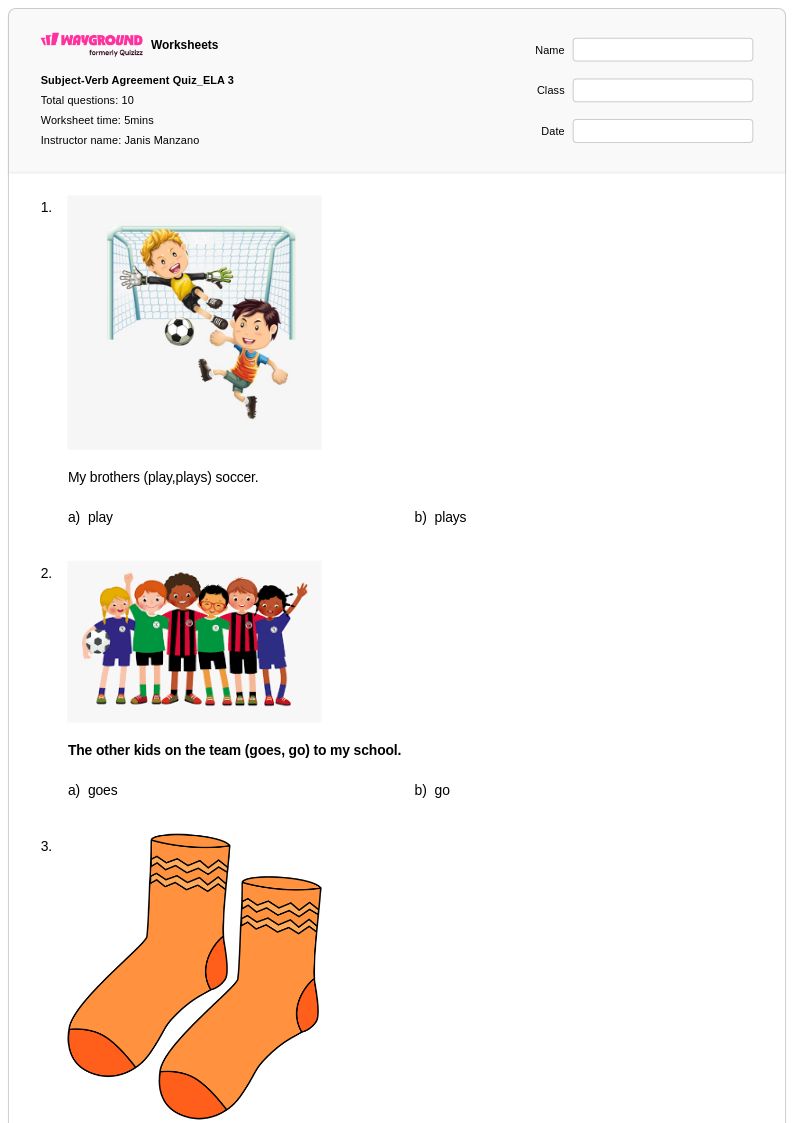
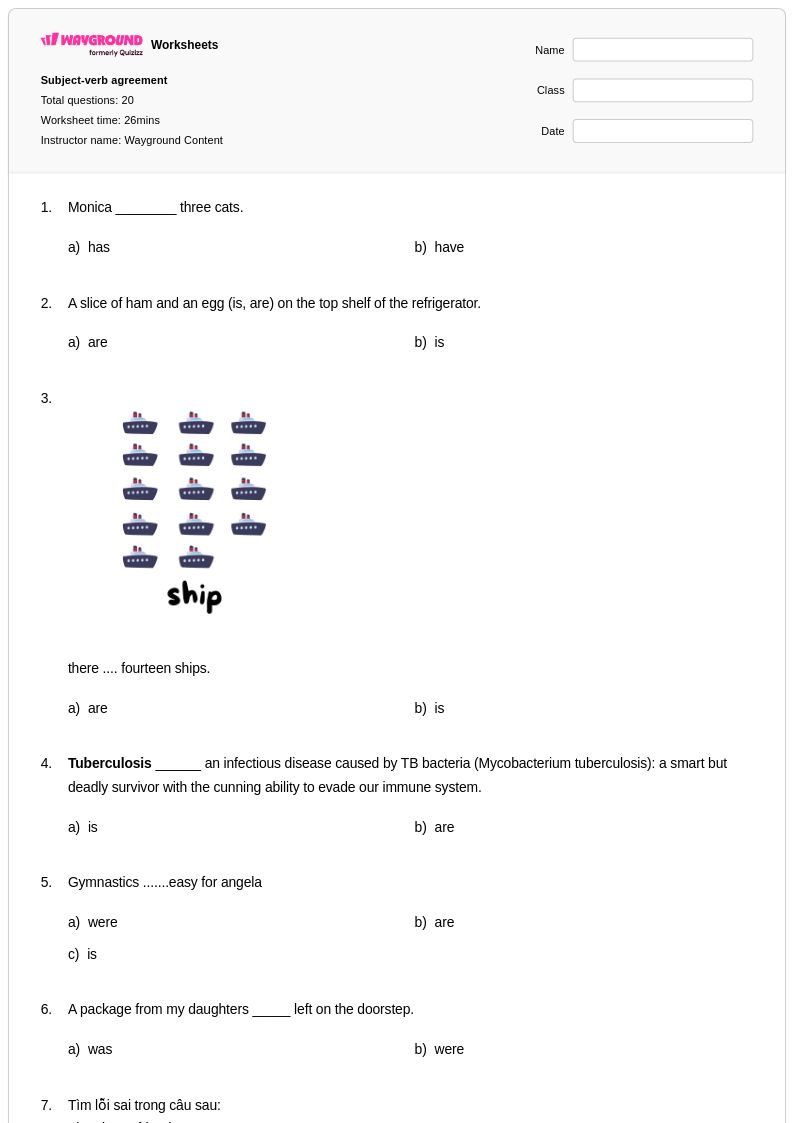
Master subject-verb agreement with Wayground's comprehensive collection of free worksheets, printables, and practice problems that help students develop essential verb skills through engaging exercises and detailed answer keys.
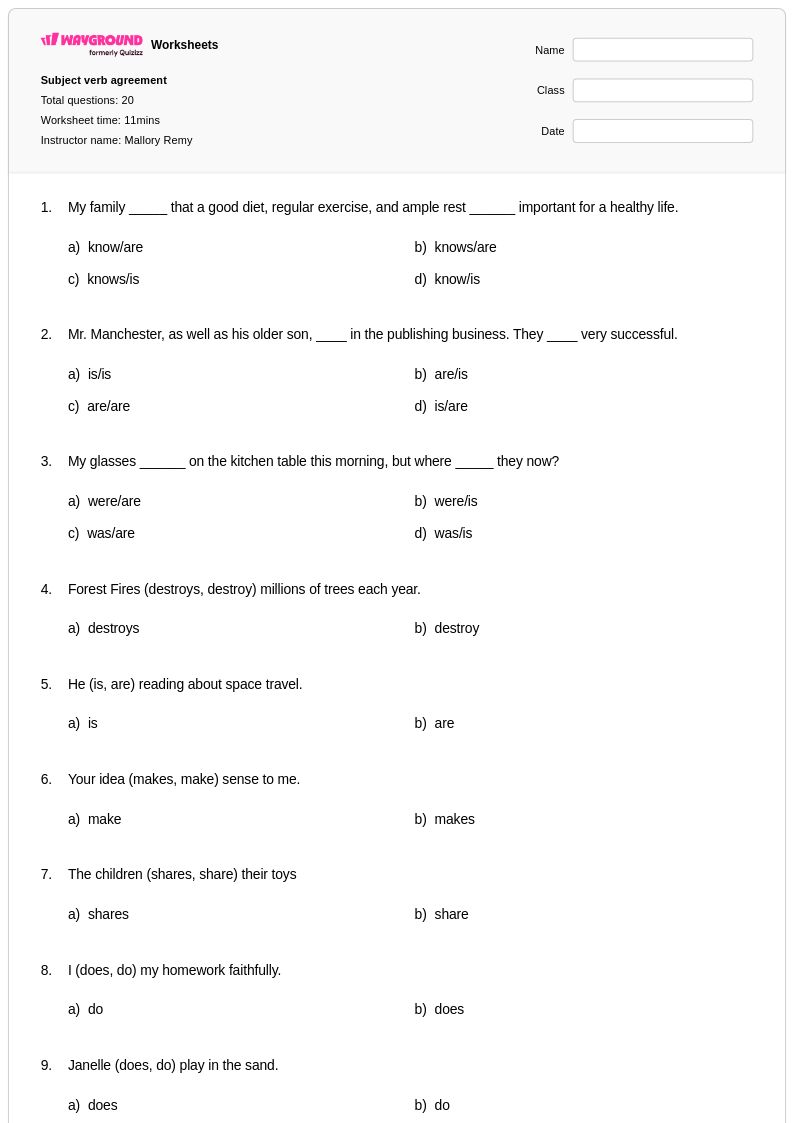
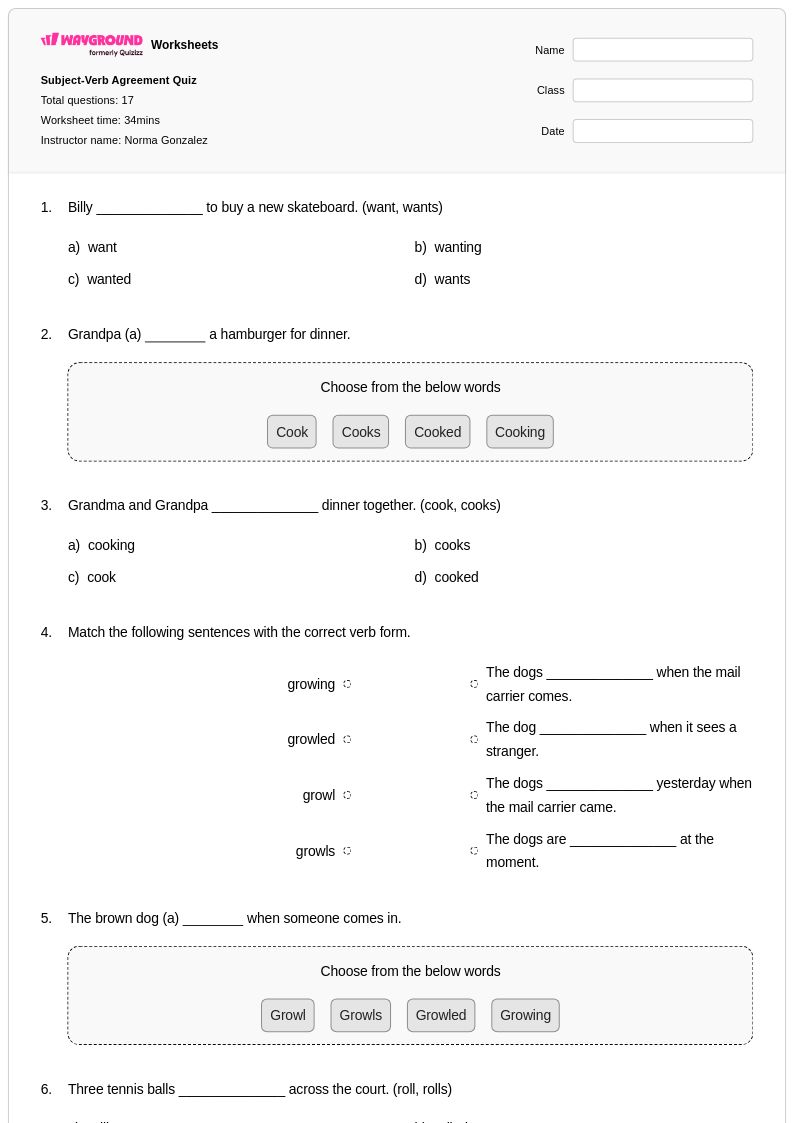
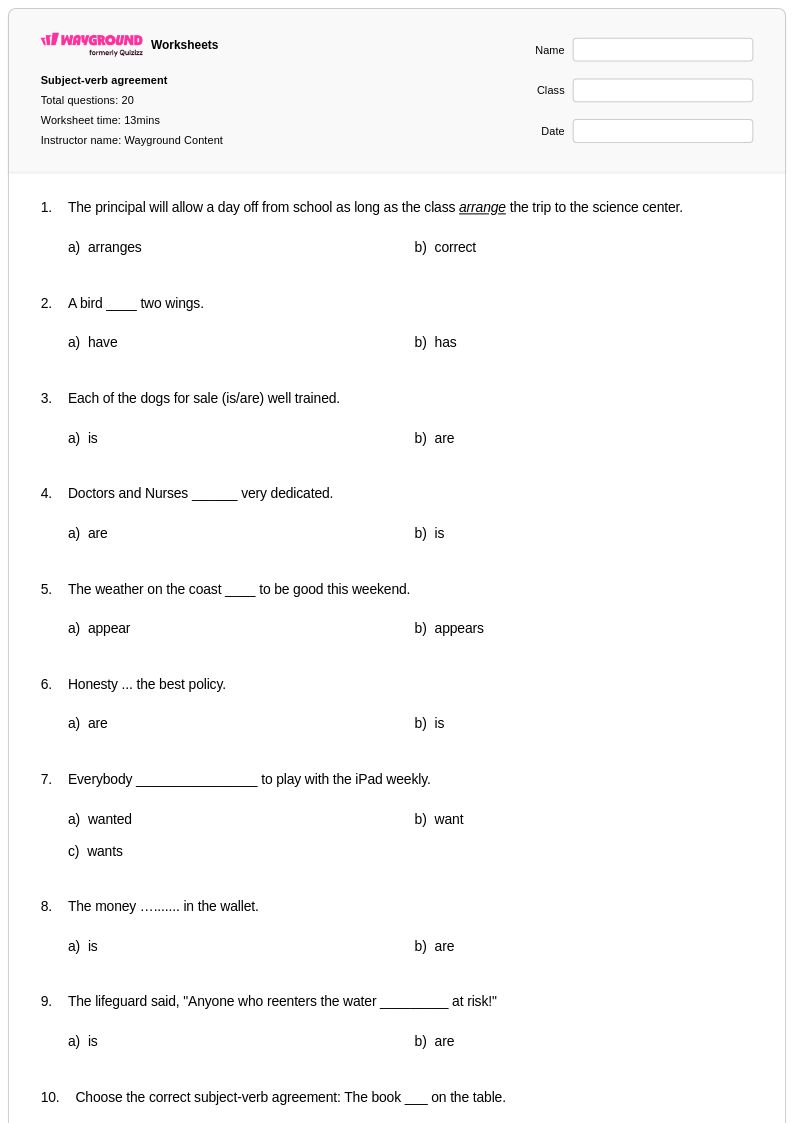
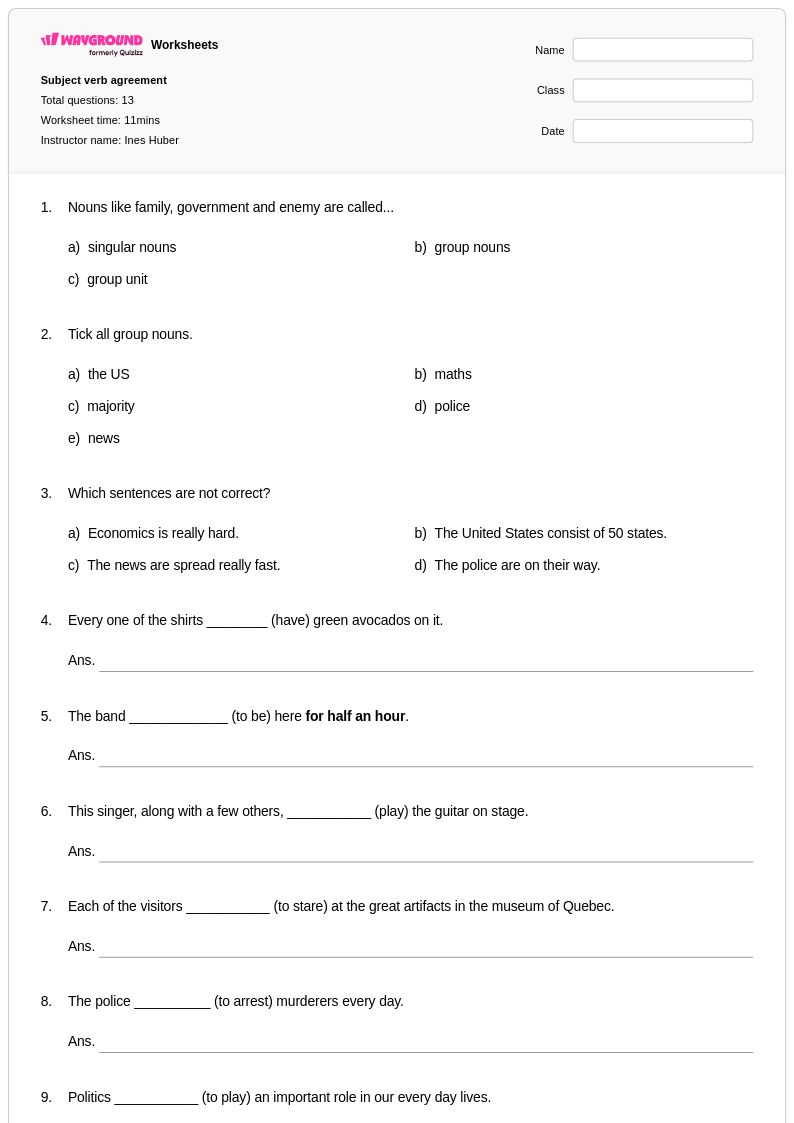
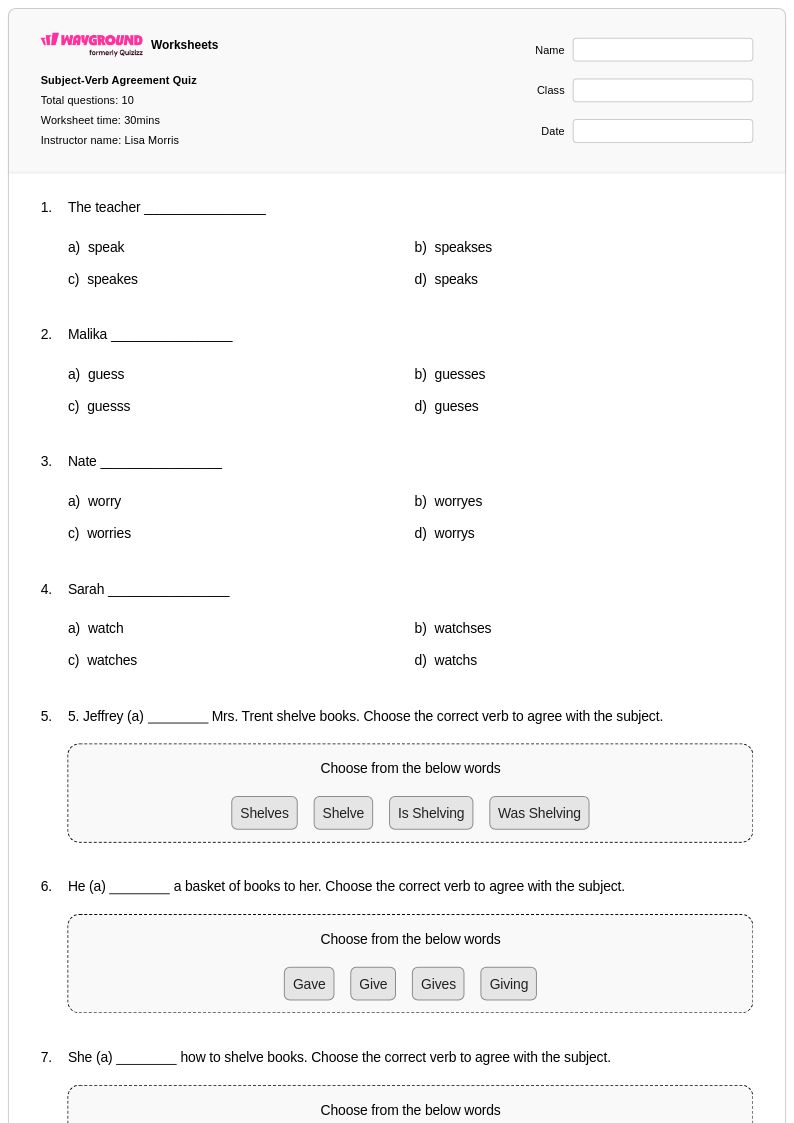
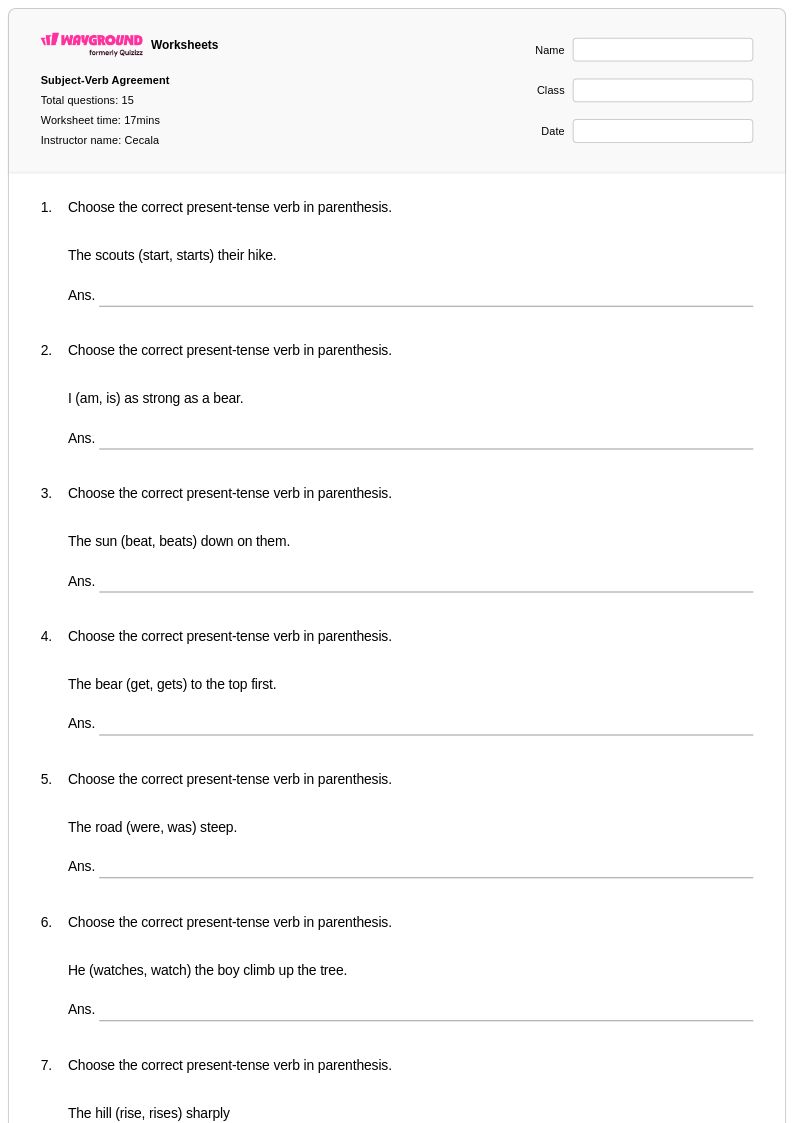
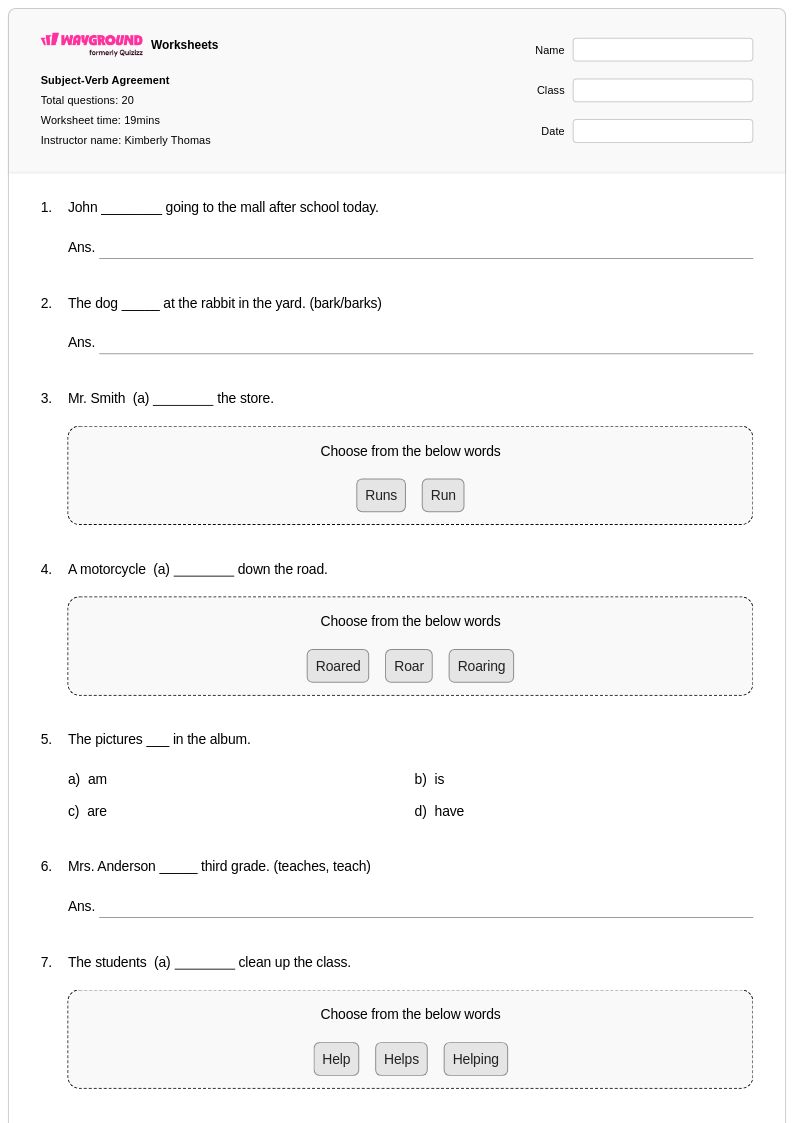
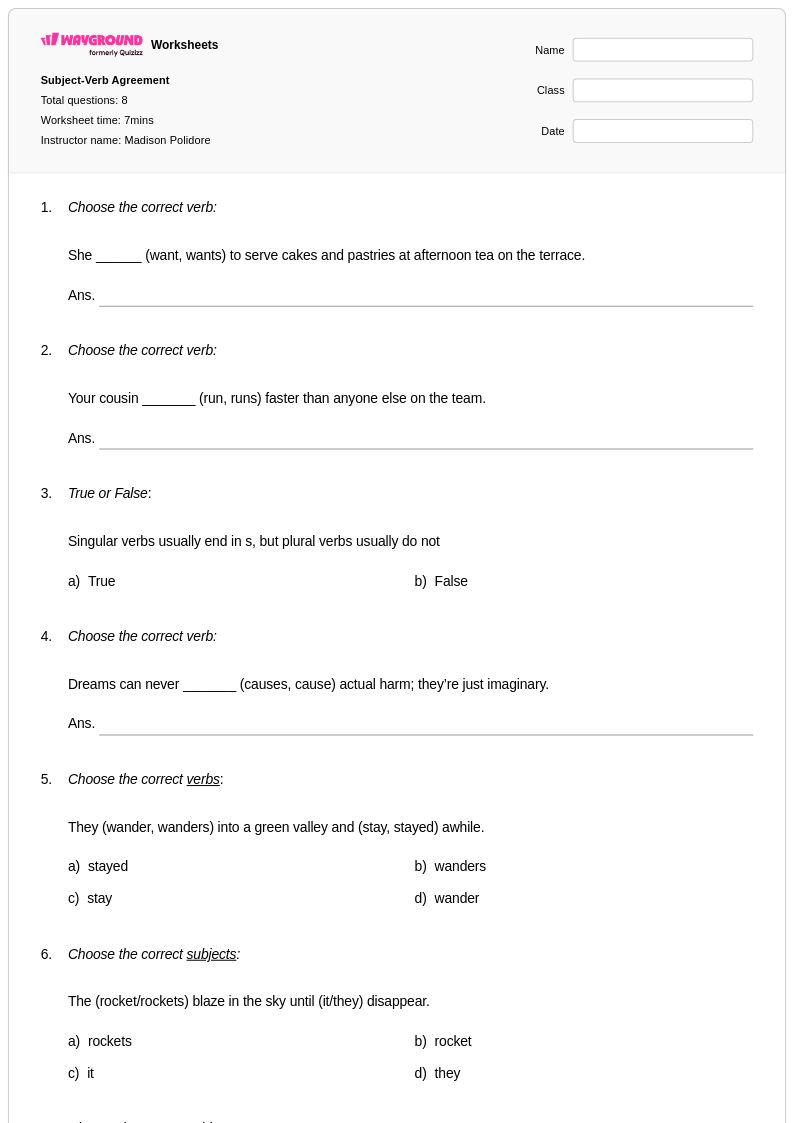
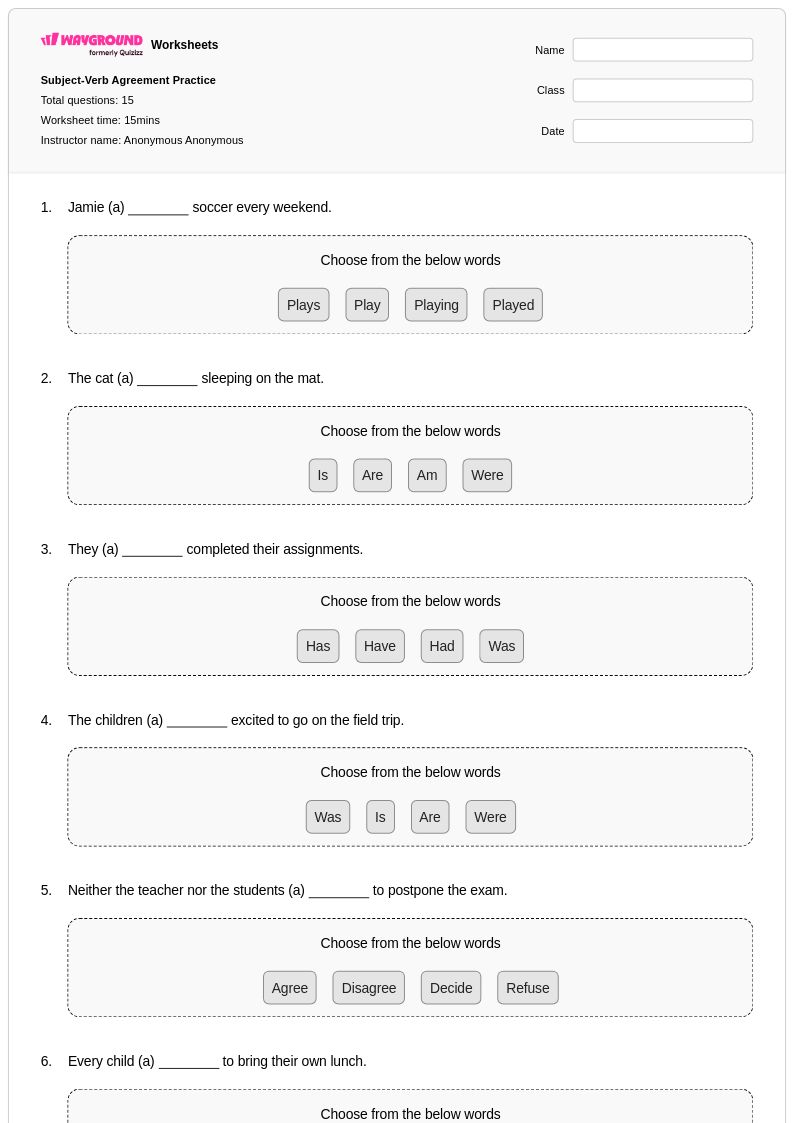
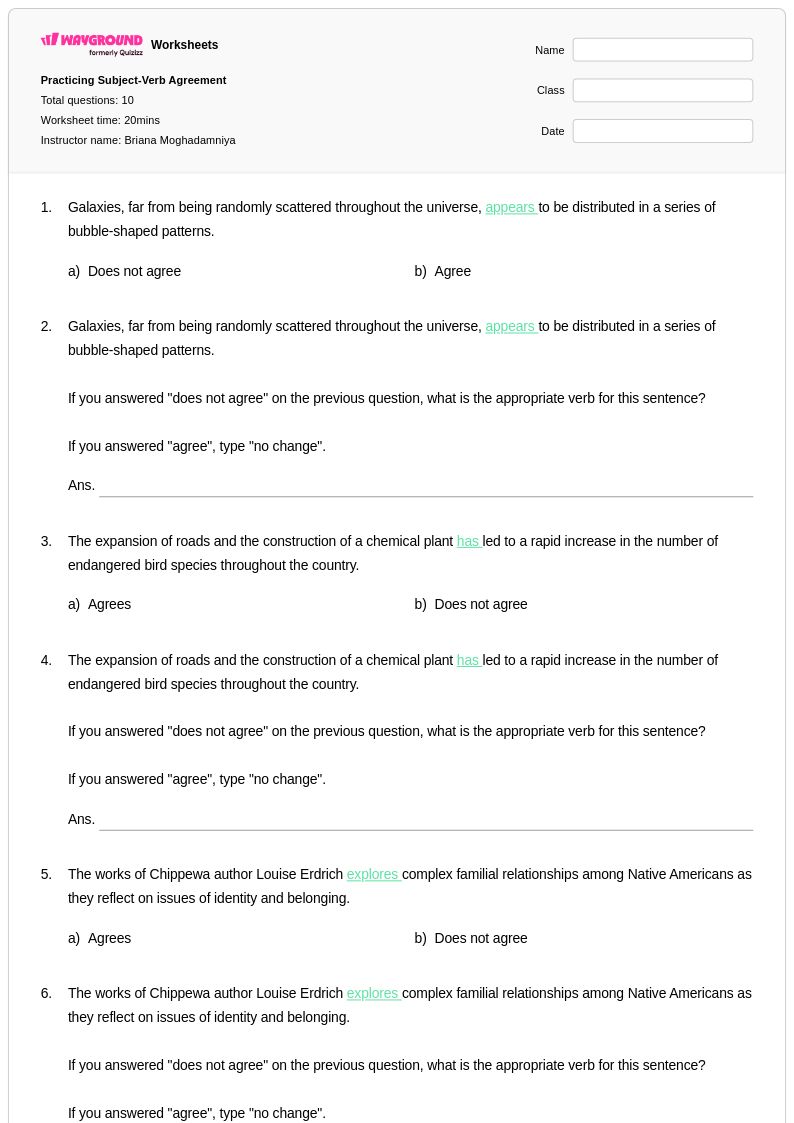
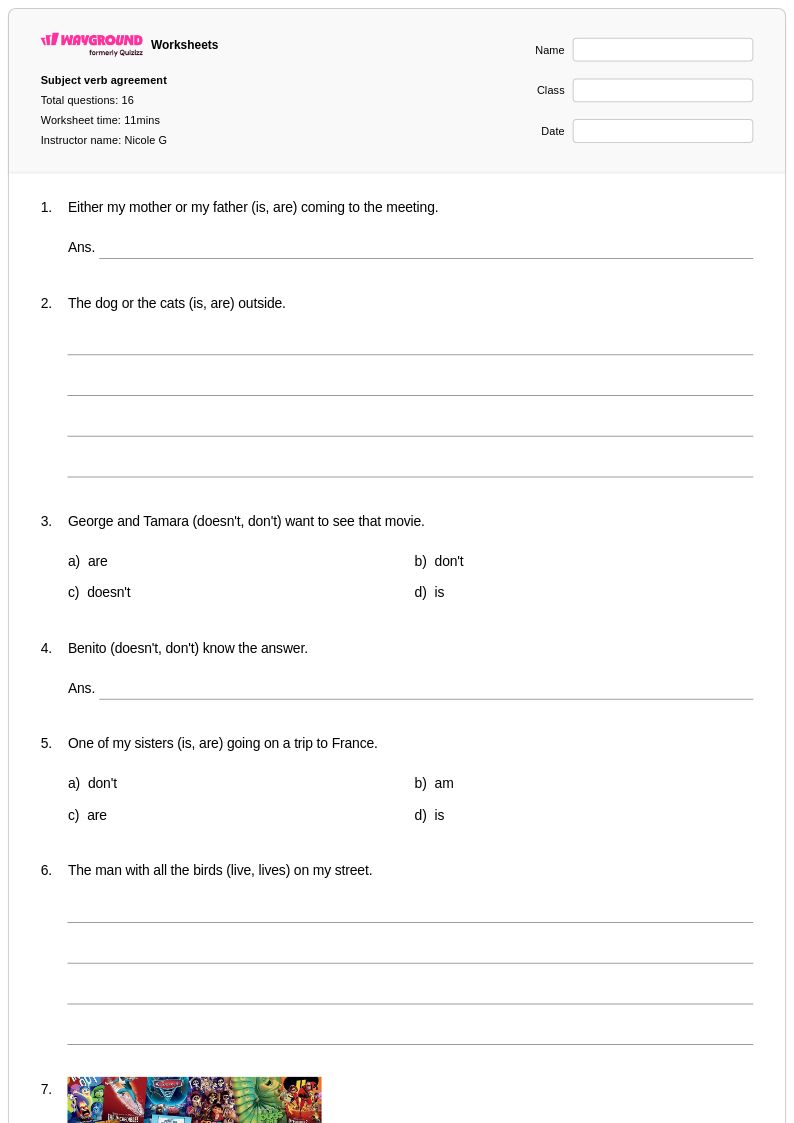
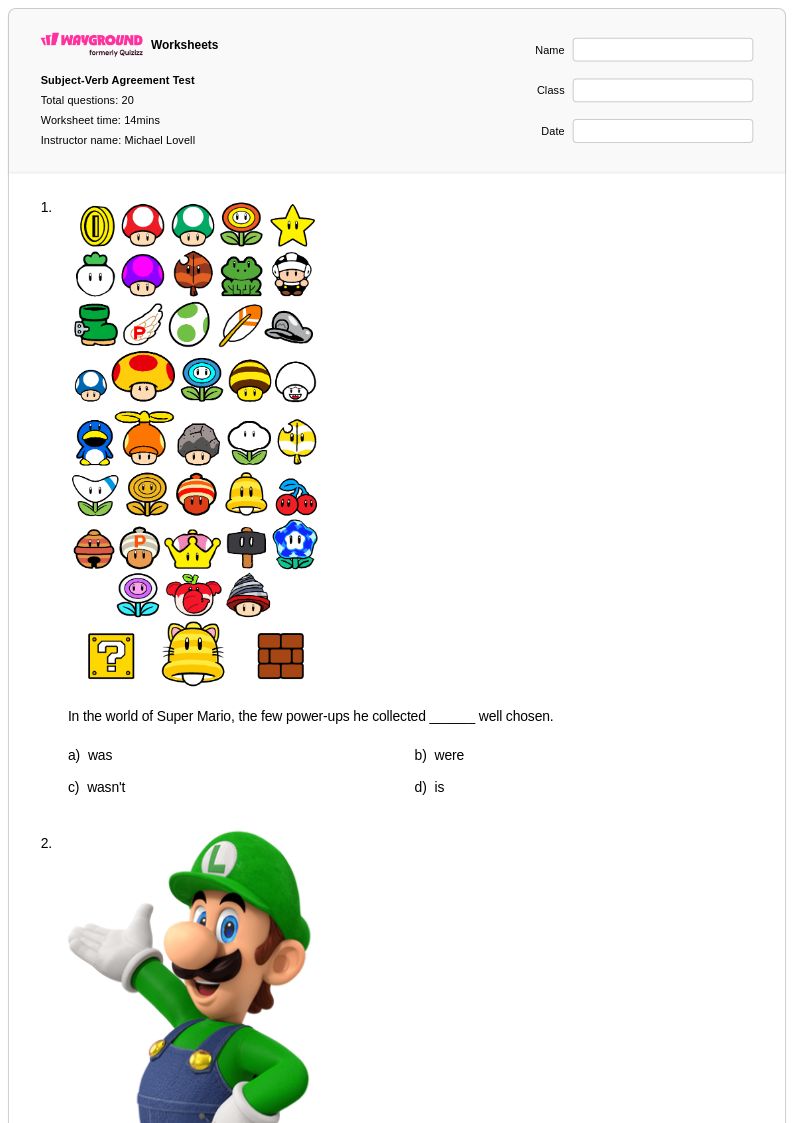
Subject-verb agreement worksheets available through Wayground (formerly Quizizz) provide comprehensive practice opportunities for students to master one of English grammar's most fundamental concepts. These carefully designed resources focus on helping learners identify singular and plural subjects and match them correctly with appropriate verb forms, strengthening essential writing and communication skills. The extensive collection includes practice problems that cover basic noun-verb pairings, complex sentences with prepositional phrases, compound subjects, indefinite pronouns, and challenging scenarios involving collective nouns and inverted sentence structures. Each worksheet comes with a detailed answer key, making them valuable tools for both independent study and classroom instruction, while the free printable pdf format ensures easy access and distribution for teachers and students alike.
Wayground's robust platform supports educators with millions of teacher-created subject-verb agreement resources that can be easily located through powerful search and filtering capabilities. Teachers can quickly find materials aligned with specific language arts standards and customize worksheets to meet diverse classroom needs, whether for initial skill introduction, targeted remediation, or advanced enrichment activities. The platform's differentiation tools allow instructors to modify difficulty levels and content focus, while the availability of both printable and digital formats, including downloadable pdfs, provides maximum flexibility for lesson planning and implementation. These comprehensive features enable teachers to efficiently address individual student needs, reinforce grammatical concepts through varied practice opportunities, and track progress as learners develop confidence in applying subject-verb agreement rules across different writing contexts.
FAQs
How do I teach subject-verb agreement to students who keep making errors?
Start by ensuring students can reliably identify the subject of a sentence before introducing verb matching — many errors stem from misidentifying the subject rather than misapplying agreement rules. Isolate common trouble spots one at a time: begin with basic singular and plural noun-verb pairings, then progress to prepositional phrases that separate subject and verb, compound subjects, indefinite pronouns, and collective nouns. Explicit modeling with sentence-level examples, followed by guided practice, helps students internalize the rules before applying them independently in writing.
What are the most common subject-verb agreement mistakes students make?
The most frequent error is agreement with the nearest noun rather than the true subject, which commonly occurs in sentences with prepositional phrases between the subject and verb (e.g., 'The box of chocolates are on the table'). Students also struggle with indefinite pronouns like 'everyone' and 'each,' which are singular but feel plural, and with compound subjects joined by 'or' or 'nor,' which require the verb to agree with the closer subject. Inverted sentence structures and collective nouns (e.g., 'team,' 'class') create additional confusion because the expected subject position is disrupted.
What exercises help students practice subject-verb agreement effectively?
Effective practice sequences move from recognition to production: start with exercises where students identify and underline the subject, then circle the correct verb form, before advancing to fill-in-the-blank and sentence-rewriting tasks. Including practice sets that isolate specific challenge areas — prepositional phrases, indefinite pronouns, compound subjects, and collective nouns — ensures targeted skill-building rather than random exposure. Short, focused practice sets with immediate answer-key feedback are especially effective for reinforcing rules and correcting persistent errors.
How do I differentiate subject-verb agreement practice for students at different skill levels?
For students still building foundational skills, focus practice on simple sentences with clear singular and plural subjects before introducing complicating structures like prepositional phrases or compound subjects. More advanced students benefit from working with inverted sentences, indefinite pronouns, and collective nouns, which require deeper grammatical reasoning. On Wayground, teachers can apply accommodations such as reduced answer choices for students who need less cognitive load, or enable Read Aloud so students can hear questions read to them — both settings can be assigned to individual students without affecting the rest of the class.
How can I use Wayground's subject-verb agreement worksheets in my classroom?
Wayground's subject-verb agreement worksheets are available as printable PDFs, making them easy to distribute for traditional pencil-and-paper practice, and in digital formats for technology-integrated classrooms or remote learning. Teachers can also host worksheets as a live quiz on Wayground, which allows for real-time student responses and built-in progress tracking. Each worksheet includes a detailed answer key, so they work equally well for independent student practice, homework assignments, or guided classroom instruction.
How do I find subject-verb agreement worksheets aligned to specific language arts standards?
Wayground's search and filtering tools allow teachers to locate subject-verb agreement resources aligned to specific language arts standards quickly, without manually sorting through unrelated materials. Teachers can filter by skill area, difficulty level, or content focus to find worksheets suited for initial instruction, targeted remediation, or enrichment, depending on where students are in their learning progression.