Free Printable Welded Sounds Worksheets for Class 3
Explore Wayground's free Class 3 welded sounds phonics worksheets and printables that help students master consonant blends and digraphs through engaging practice problems with complete answer keys.
Explore printable Welded Sounds worksheets for Class 3
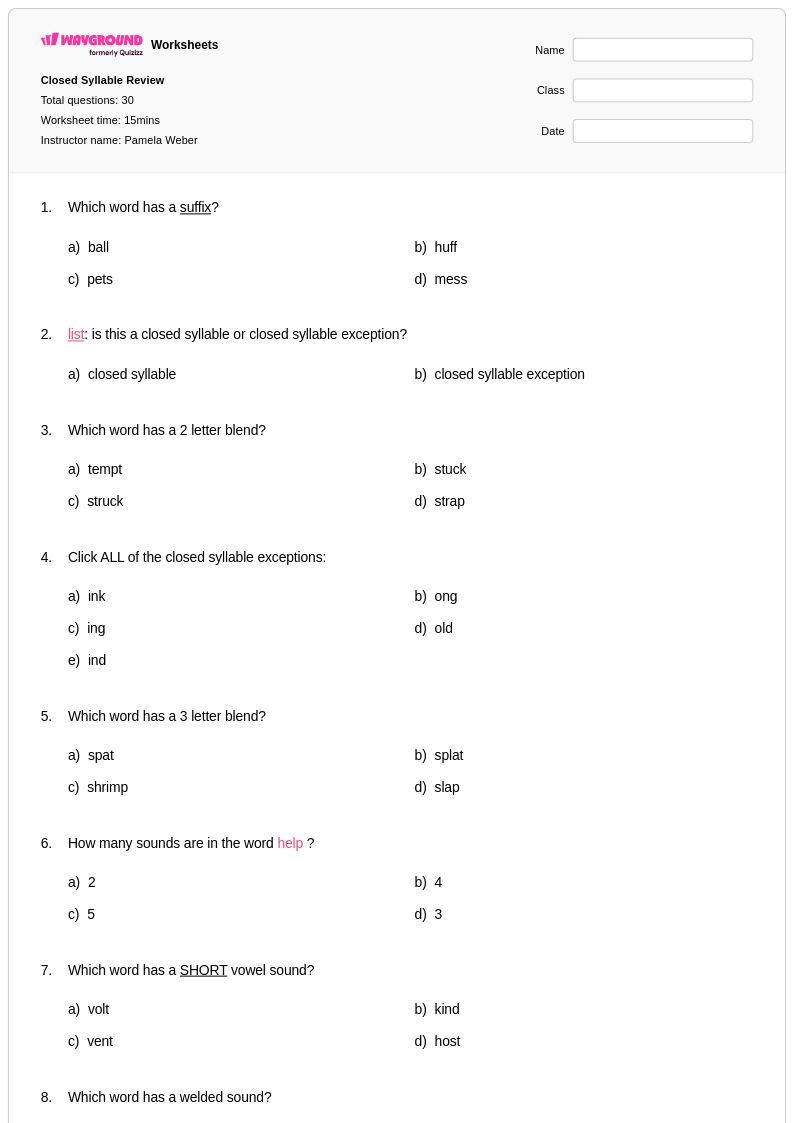
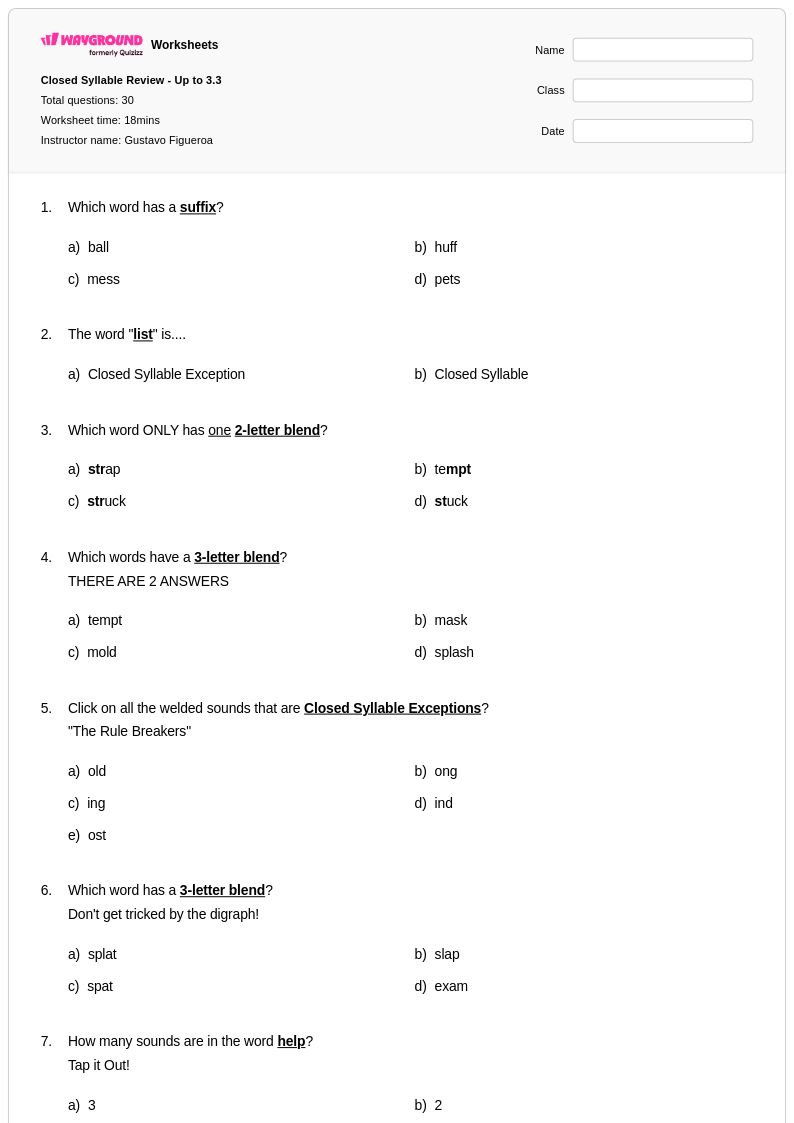
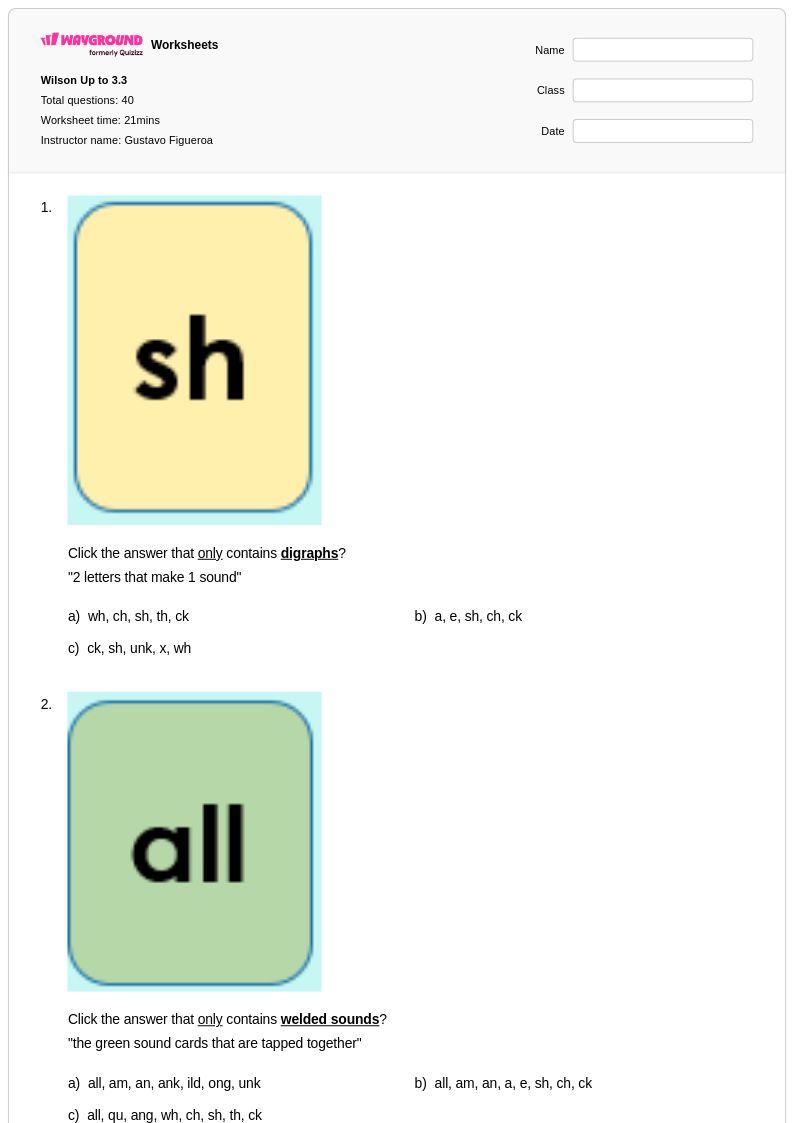
Welded sounds worksheets for Class 3 students available through Wayground (formerly Quizizz) provide comprehensive practice with consonant combinations that create single, inseparable phonetic units. These educational resources focus on helping third-grade learners master welded sounds such as -ang, -ing, -ong, -ung, -ank, -ink, -onk, and -unk, which are essential building blocks for reading fluency and spelling accuracy. The worksheets strengthen students' ability to recognize these sound patterns automatically, decode multisyllabic words containing welded sounds, and apply this knowledge in both reading and writing contexts. Each printable resource includes structured practice problems that progress from sound identification to word building and sentence application, with answer keys provided to support independent learning and quick assessment of student progress.
Wayground (formerly Quizizz) empowers educators with an extensive collection of millions of teacher-created welded sounds worksheets specifically designed to meet diverse Class 3 learning needs. The platform's robust search and filtering capabilities enable teachers to locate resources aligned with phonics standards and differentiate instruction based on individual student abilities and learning styles. These versatile materials are available in both printable pdf format for traditional classroom use and digital formats for interactive learning experiences. Teachers can customize existing worksheets or create new variations to target specific welded sound patterns that require additional reinforcement, making lesson planning more efficient while providing targeted remediation for struggling readers and enrichment opportunities for advanced students to solidify their phonemic awareness and decoding skills.
FAQs
What are welded sounds in phonics and how do I teach them?
Welded sounds (also called glued sounds) are letter combinations like 'ng,' 'nk,' and 'ck' that blend so tightly together that individual phonemes cannot be separated during decoding. Because students cannot segment these sounds the way they can with regular blends, direct instruction is essential: teach welded sounds as single units rather than encouraging letter-by-letter blending. Introduce one pattern at a time using word sorts, chanting, and repeated reading of word lists that isolate the target combination before moving to connected text.
What exercises help students practice welded sounds?
Effective practice for welded sounds includes word sorting activities where students group words by their welded pattern, fill-in-the-blank exercises that require students to choose the correct ending ('ng' vs. 'nk,' for example), and dictation tasks where students hear words and must write the correct welded combination. Repeated reading of word lists and decodable sentences that feature the target patterns builds automaticity, which is the ultimate goal for fluent decoding.
What mistakes do students commonly make with welded sounds?
The most common error is attempting to segment welded sounds into individual phonemes, which distorts pronunciation and disrupts decoding. For example, students may try to sound out 'ring' as /r/-/i/-/n/-/g/ rather than treating 'ng' as a single unit. Students also frequently confuse 'ng' and 'nk' because both end in a velar nasal sound, leading to misspellings like 'sink' written as 'sing.' Targeted practice that highlights the distinction between these patterns directly addresses this confusion.
How do welded sounds fit into a broader phonics sequence?
Welded sounds are typically introduced after students have solid mastery of short vowels, consonant blends, and digraphs, because they require students to override their default habit of segmenting every letter. In most structured literacy sequences, 'ck,' 'ng,' and 'nk' are introduced in late kindergarten or early first grade as students begin working with word families. Placing welded sounds at this stage ensures students have the phonemic awareness foundation needed to recognize why these patterns behave differently.
How do I use Wayground's welded sounds worksheets in my classroom?
Wayground's welded sounds worksheets are available as printable PDFs for traditional classroom use and in digital formats for technology-integrated learning environments, making them easy to deploy in whole-group lessons, small-group intervention, or independent center work. Teachers can also host them as a quiz directly on Wayground, and all worksheets include complete answer keys to support both self-checking and instructional review. For students who need additional support, Wayground's accommodation tools, including read-aloud and reduced answer choices, can be applied individually so targeted learners receive adjusted support without disrupting the rest of the class.
How do I differentiate welded sounds instruction for struggling readers?
For students who consistently struggle with welded sounds, reduce the number of patterns in focus at one time and increase the frequency of repetition before introducing a new combination. Multisensory techniques, such as having students tap syllables, use letter tiles, or trace the welded pattern while saying it aloud, reinforce the concept kinesthetically. On Wayground, teachers can enable the read-aloud accommodation for individual students, allowing audio support during digital practice without altering the experience for the rest of the class.