
 Worksheets
Angiosperm Life Cycle
Total questions: 36
Worksheet time: 23mins
Name
Class
Date
1.
The sticky top of the pistil that collects pollen.
a)
stamen
b)
anther
c)
stigma
d)
pollen
2.
The transfer of pollen from the anther to the stigma.
a)
pollination
b)
germination
c)
photsynthesis
d)
reprodution
3.
The structure in the pistil that contains the eggs.
a)
stigma
b)
anther
c)
sepal
d)
ovary
4.
This forms from the ovary and surrounds the seed.
a)
fruit
b)
vegetable
c)
flower
d)
pollen
5.
The female sex cell.
a)
sperm
b)
egg
6.
The colorful flower structure that attracts pollinators.
a)
sepals
b)
pistils
c)
anthers
d)
petals
7.
The male sex cell.
a)
pollen (sperm)
b)
egg
8.
The reproductive organ of many plants.
a)
berry
b)
fruit
c)
flower
d)
leaf
9.
The flower structure that contains the anther and pollen.
a)
stamen
b)
pistil
c)
sepal
d)
petal
10.
The union of a male and female sex cell (pollen and egg).
a)
germination
b)
photosynthesis
c)
fertilization
d)
respiration
11.
The flower structure that contains the stigma and ovary.
a)
pistil
b)
stamen
c)
sepal
d)
cotyledon
12.
The protective outer layer of a seed.
a)
embryo
b)
pistil
c)
cotyledon
d)
seed coat
13.
The energy source for the embryo.
a)
fruit
b)
cotyledon
c)
seed coat
d)
ovary
14.
The seed structure that is made of cells.
a)
seed coat
b)
stamen
c)
cotyledon
d)
embryo
15.
The process of a seed coming out of its dormant state.
a)
germination
b)
pollination
c)
reproduction
d)
symbiosis
16.
Protects the embryo.
a)
cotyledon
b)
seed coat
c)
ovary
d)
pollen
17.

a)
A is the Cotyledon
b)
A is the embryo
c)
A is the seed coat
d)
A is the pistil
18.

a)
B is the embryo
b)
B is the coytledon
c)
B is the stamen
d)
B is the seed coat
19.

a)
C is the embryo
b)
C is the sepal
c)
C is the seed coat
d)
C is the cotyledon
20.
What plant structure advertises to pollinators?
a)
leaves
b)
roots
c)
stems
d)
flowers
21.

a)
B is the stigma
b)
B is the anther
c)
B is the sepal
d)
B is the ovary
22.

a)
A & C are the stamen
b)
B and D are the stamen
23.

a)
B & D are parts of the pistil
b)
A & C are parts of the pistil
24.

a)
Pollination occurs at B
b)
Germination occurs at B
c)
Pollination occurs in D
d)
Germination occurs in D
25.

a)
Fertilization occurs at B
b)
Fertilization occurs at A
c)
Fertilization occurs in D
d)
Fertilization cant happen
26.
Which organelle performs PHOTOSYNTHESIS?
a)
Chloroplast
b)
Mitochondria
27.
What process occurs when light energy is captured in autotrophs and converted into sugar?
a)
Photosynthesis
b)
Cellular Respiration
28.
What is the ultimate ORIGINAL source of energy for living things
a)
Sugar
b)
Sun
c)
Moon
d)
Carbon Dioxide
29.
Which organisms perform Photosynthesis?
a)
Only Autotrophs
b)
Only Heterotrophs
c)
Autotrophs and Heterotrophs
30.
What is the pigment in chloroplasts that performs photosynthesis?
a)
Chlorosynthesis
b)
Chlorophyll
c)
ADP
d)
Electron Transport
31.
Which gas is removed from the atmosphere during photosynthesis?
a)
hydrogen
b)
oxygen
c)
nitrogen
d)
carbon dioxide
32.
What are the products of photosynthesis?
a)
water and carbon dioxide
b)
oxygen and glucose
c)
oxygen and carbon dioxide
d)
oxygen and water
33.
What is photosynthesis?
a)
The process in which humans eat their food
b)
When a photographer takes a photo.
c)
To get your pictures from the photo lab.
d)
The process in which plants make their food.
34.
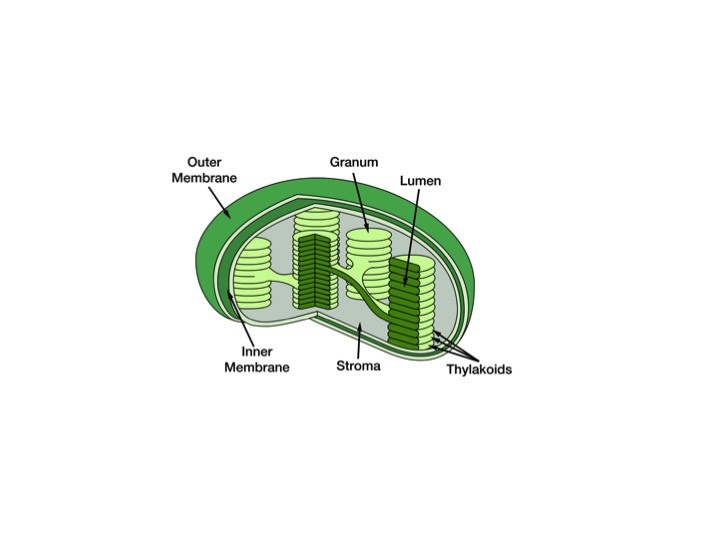
Chloroplasts are...
a)
Structures of animal cells to produce ATP
b)
Organelles where lipids are elaborated
c)
Specialized structures of plants where food is made
d)
Waste organelle of plants
35.

Which organelle from the plant cell is primarily responsible for converting sunlight to energy?
a)
Mitochonria
b)
Nucleus
c)
Vacuole
d)
Chloroplast
36.

What is produced as a result of photosynthesis?
a)
Glucose and Chlorophyll
b)
Glucose and Oxygen
c)
Water and Light energy
d)
Carbon dioxide and Water
100 %

