
Font size
 Worksheets
Relative and Absolute Age Dating Review
Total questions: 60
Worksheet time: 33mins

The statement "Intrusion B occurred after the deposition of layer E but after deposition of layers C, D, and A" can be determined to be correct because of which principle?
Principle of Horizontality
Principle of Cross-Cutting Relationships
Principle of Inclusions
Principle of Superposition
The statement that the oldest layer will be at the bottom in an undisturbed sequence of rock layers is called the Principle of ....
Inclusions
Unconformities
Cross-Cutting Relationships
Superposition
The Principle of Cross-Cutting Relationships states that an igneous intrusion is
always younger than the layers it cuts across
always older than the layers it cuts across
the same age as the rock it melted
none of the answers are correct
Relative age dating is used to determine the...
actual age of an event
length of time between two events
age of one event in comparison with other events
rate at which a gologic process occurs
Older rocks contained within newer rocks are called...
intrusions
inclusions
fossils
faults

Which of the following correctly lists the layers in order from oldest to youngest?
A, B, C, D, E
E, B, C, D, A
E, D, C, B, A
C, B, A, D, E
How old is the Earth?
4.6 billion years
1.4 billion years
4.6 million years
6000 years
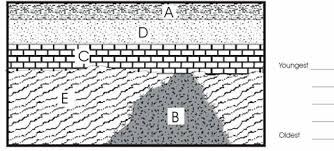
What is the oldest layer in the outcrop?
B
C
D
E
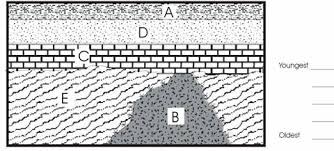
What is the youngest layer in the outcrop?
A
B
C
D

The statement "Layer B is younger than layer E" can be determined by using which principle?
Principle of Horizontality
Principle of Cross-Cutting Relationships
Principle of Inclusions
Principle of Superposition
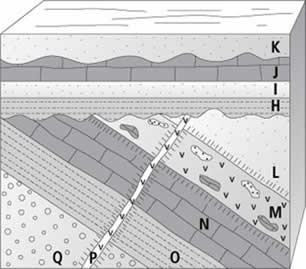
The rock formation labeled "P" is a(n)...
fault
intrusion
inclusion
unconformity
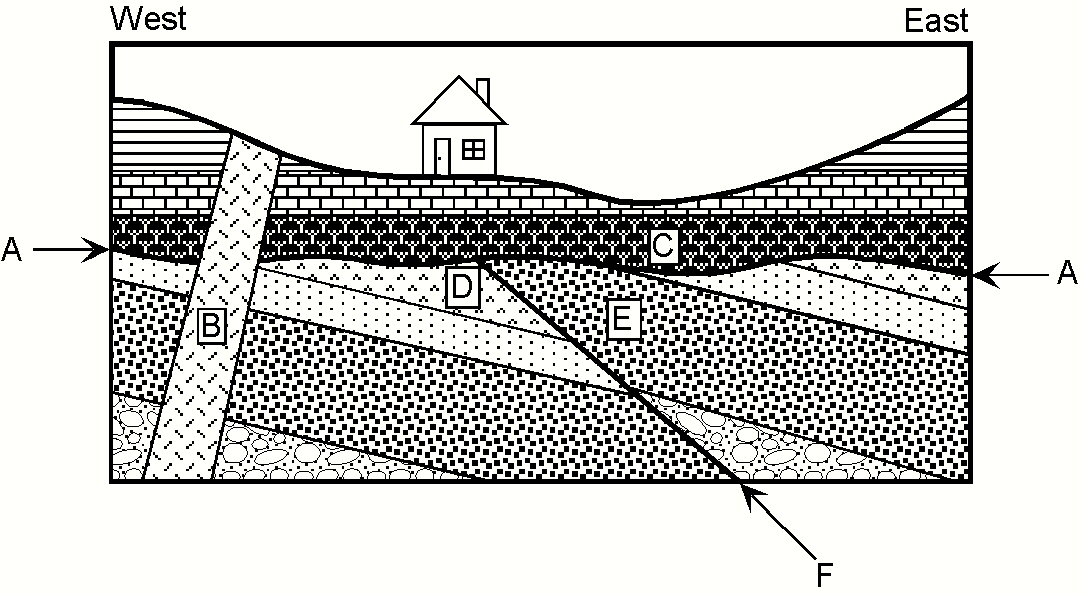
Letter "F" is a....
inclusion
intrusion
fault
unconformity
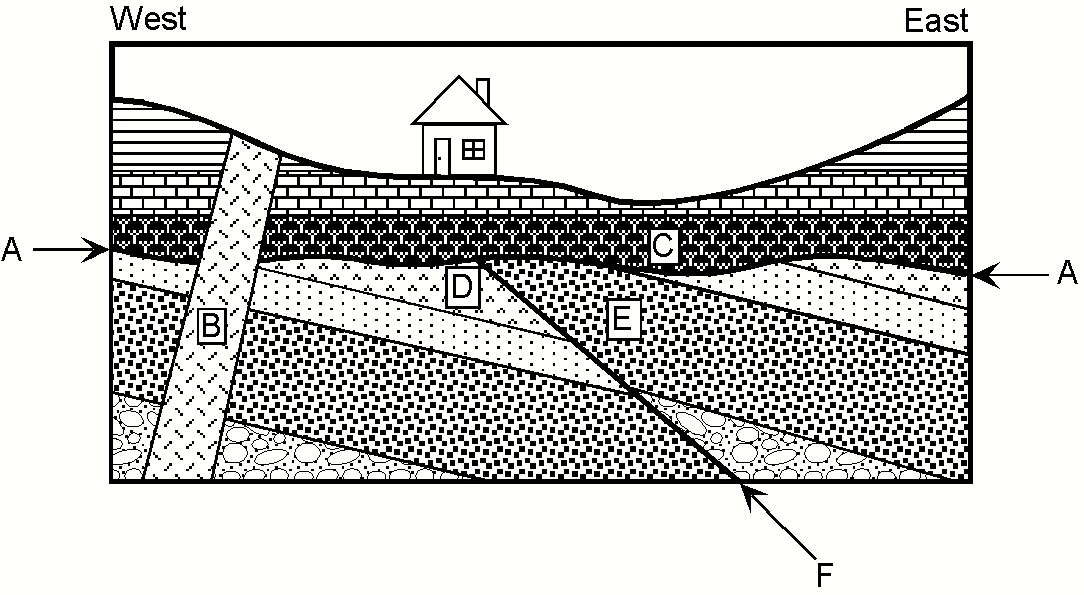
Letter "A" is an....
inclusion
intrusion
fault
unconformity
Thorium-234 has a half-life of 24 days. If a sample that originally contained 200 grams of thorium-234 now contains only 25 grams, the age of the sample is...
24 days
48 days
72 days
96 days
Archeologists have found a fossil that contains 87.5 grams of nitrogen-14 and 12.5 grams of carbon-14. The half life of carbon-14 is 5730 years. How old is the fossil?
3 million years
17,190 years
11,460 years
92,000 years
The length of time required for half of the radioactive atoms in a sample to decay is its...
era
age
half-life
eon
The original element that undergoes radioactive decay is known as the...
daughter element
half-life
parent element
carbon-14
Scientists use radioactive decay to measure...
relative time
absolute age
half-lives
time of day
A rock formed with 1000 atoms of a radioactive parent element, but only contains 250 radioactive parent atoms today. If the half-life of the parent element is one million years, how old is the rock?
250,000 years old
500,000 years old
1,000,000 years old
2,000,000 years old
What is the half life of carbon-14?
5730 years
4.5 billion years
2000 years
15 minutes
What is the daughter element of carbon-14?
nitrogen-14
sodium-14
lead-235
carbon-16
What element is used to date fossils that are no older than 60,000 years?
uranium-235
carbon-14
mercury-203
thorium-234
What percent of carbon-14 would be left after 5730 years?
12.5%
75%
50%
25%
What percent of carbon-14 would be left after 11,460 years?
12.5%
75%
50%
25%
What percent of carbon-14 would be left after 17,190 years?
12.5%
75%
50%
25%
Fossils that are not the actual organism but evidence of that organism's existence.
index fossils
trace fossils
altered hard parts
original preservation
Fossils that are not the actual organism but evidence of that organism's existence.
index fossils
trace fossils
altered hard parts
original preservation
Which of the following is a condition that will preserve remains?
amber
frozen in permafrost
tar
all of these are correct
What are fossilized feces called?
coprolites
index fossils
gastroliths
amber
What are smooth stones that dinosaurs swallowed to help digestion?
coprolites
index fossils
gastroliths
amber
What is hardened tree sap called?
coprolites
index fossils
gastroliths
amber
Fossils that haven't changed over time, all tissues are still intact.
index fossils
trace fossils
petrified fossils
preserved remains
Which of the following is an example of a trace fossil?
petrified wood
index fossils
gastroliths
amber
Which of the following is an example of a trace fossil?
coprolites
index fossils
petrified wood
amber
Fossils that are modified bone, wood or shell.
preserved remains
petrified fossils
index fossils
trace fossils
The hollowed out impression in a rock that is the same shape as a shell.
cast
mold
trace fossil
index fossil
A fossil that forms when a hollowed out impression in a rock that is the same shape as a shell fills with sediment and then hardens.
cast
mold
trace fossil
index fossil
Which of the following is not a trace fossil?
dinosaur skull
footprint
tool
gastrolith
A fossil is...
a radioactive element used to determine the age of a rock layer
the remains or evidence of a once-living organism
only the hard parts of a organism
only found in ice
A stone tool used by a Neanderthal man is an example of...
an altered hard part
original perservation
index fossil
trace fossil
Which of the following is NOT a characteristic of an index fossil?
has a wide geographic range
is hard to find
is easily recognized
existed for a short geologic time
A woolly mammoth found frozen in the permafrost of Siberia is an example of...
a mold
an altered hard part
a cast
preserved remains
Which of the following statements about fossils is NOT true?
They can be used to correlate rock layers.
They can always be found as living specimens today.
They can be used to determine relative age.
They can indicate what climates were like in the past.
Where are prehistoric insects or other small animals preserved WHOLE ?
in sedimentary rock
in amber
in obsidian
in oceans
Why is a fossil dinosaur bone much heavier than the original bone it was made from?
it has absorbed water
it is much older
much of it has dissolved
it is now made of minerals
Why don't all living things become fossils?
because some living things are too small
because some living things are too big
because some are subject to catastrophism and others are not
because environmental conditions have to be just right to prevent decay
How do fossils form?
Living things die and their remains are covered by sediment
insects are covered in tree sap
all of these are correct
Freezing preserves the remains of an organism
What kinds of things can be learned from fossils?
what organisms were alive in the past
changes in climate
how organisms have changed (evolved)
how much soda cost in 1942
when an organism went extinct
Which term means using fossils to match rock layers of the same age in different locations?
absolute age dating
correlation
relative age dating
trace fossils
If the amount of carbon 14 is 25 grams and the amount of its daughter element nitrogen 14 is 75 grams in a piece of charred wood from a campfire how old is the wood?
5730 years
11460 years
17190 years
What is the principle of superposition?
youngest layer on the bottom
oldest layer on the top
oldest layer on the bottom
all the layers are random

While examining a cliff face, you observe several layers of sedimentary rock. What principle allows you to determine the relative ages of these layers?
uniformitarianism
cross cutting relationships
superposition
fossil succession
Which of the following is an example of original preservation?
insect sealed in amber
petrified wood
fossilized bone
coprolite
What is the principle that states that in undisturbed rock layers, the oldest rocks are at the bottom?
Principle of Cross-Cutting Relationships
Principle of Superposition
Principle of Original Horizontality
Principle of Inclusions
Which type of fossil is formed when minerals replace all or part of an organism?
trace fossil
index fossil
petrified fossil
preserved remains
A (a) fossil is evidence of organism but not the organism itself, for example, a gastrolith.
Fossilized feces is known as a
(a)
A stone that was swallowed by a dinosaur to aid digestion is known as a
(a)
A (a) must exist before a cast can form.
What is Nebraska's state fossil?
(a)

