
 Worksheets
Elec 182 A
Total questions: 73
Worksheet time: 1hrs 28mins
Name
Class
Date
1.
The accumulation of excess electric charge on an object is called
a)
Static electricity
b)
Electric discharge
c)
Resistance
d)
Circuit
2.
A material in which electrons are able to move easily
a)
Circuit
b)
Insulator
c)
Resistance
d)
Conductor
3.
A material in which electrons are not able to move easily
a)
Circuit
b)
Insulator
c)
Resistance
d)
Conductor
4.
Electric current that flows in only one direction.
a)
Voltage
b)
Direct Current
c)
Alternating Current
d)
Series Circuit
5.
The flow/movement of electric charges
a)
Voltage
b)
Resistance
c)
Current
d)
Circuit
6.
The difference in potential energy that causes electric charges to flow
a)
Voltage
b)
Current
c)
Resistance
d)
Circuit
7.
A closed path that electric current follows
a)
Voltage
b)
Current
c)
Resistance
d)
Circuit
8.
The tendency for a material to oppose the flow of electrons, changing electrical energy into thermal energy and light.
a)
Voltage
b)
Current
c)
Resistance
d)
Circuit
9.
According to this law, the current in a circuit equals the voltage difference divided by the resistance.
a)
Law of Conservation of Energy
b)
Ohm's Law
c)
Law of Conservation of Charges
d)
Newton's First Law
10.
The current has only has one loop to flow through in this circuit.
a)
Series Circuit
b)
Parallel Circuit
11.
This circuit contains two or more branches for current to move through.
a)
Series Circuit
b)
Parallel Circuit
12.

The picture shows an electrical circuit. This circuit is a series circuit because:
a)
It has 3 light bulbs.
b)
The same current flows through all three light bulbs.
c)
It uses a single battery.
d)
The electrical current is divided between the three light bulbs.
13.
Which best describes a simple series circuit?
a)
Electricity flows along one pathway.
b)
The flow of electricity comes from the switch.
c)
Electricity flows along many pathways.
d)
The flow of electricity comes from the light bulb.
14.
Why are metals useful for making electrical wire?
a)
Metals do not bend.
b)
Metals hold much heat.
c)
Metals are insulators.
d)
Metals are conductors.
15.
Which of these causes electrically charged objects to attract or repel each other?
a)
An equal number of protons.
b)
An equal number of electrons.
c)
An unequal number of electrons.
d)
An unequal number of molecules.
16.
Which best describes a parallel circuit?
a)
Electricity flows along one pathway.
b)
The flow of electricity comes from more than one source.
c)
Electricity flows along more than one pathway.
d)
The flow of electricity comes from more than 1 load.
17.
What charge does a proton have?
a)
negative (-)
b)
positive (+)
c)
neutral or no charge (0)
18.
What charge does an electron have?
a)
negative (-)
b)
positive (+)
c)
neutral or no charge (0)
19.
Which is NOT an insulator.
a)
Wool
b)
Plastic
c)
Copper
d)
Glass
20.
An example of a conductor is :
a)
a glass paperweight
b)
a plastic cap
c)
a metal screw
d)
a wooden handle
21.
An ampere is unit of
a)
temperature
b)
electric current
c)
length
d)
magnetic force
22.
An example of an insulator is:
a)
iron
b)
silver
c)
copper wire
d)
rubber
23.
A series circuit is?
a)
A. Circuit with 1 path
b)
B. Circuit with more than 1 path
24.
A circuit with more than one path for energy to travel on is?×
a)
A. Series circuit
b)
B. Parallel circuit
c)
C. Ohm's Law
d)
D. Power=Voltage × Current
25.
What is an Electric Current?
a)
A. An Electric Field
b)
B. An Ampere
c)
C. The flow of electric charge.
26.
A conductor is a material that...
a)
stops electrcity
b)
lets electricity flow
c)
protects you
d)
holds a wire
27.
Which material conducts electricity?
a)
fabric
b)
plastic
c)
metal
d)
rubber
28.
An insulator is a material that...
a)
stops electrcity
b)
lets electricity flow
c)
protects you
d)
holds a wire
29.
The purpose of wires are to:
a)
carry electricity
b)
turn the circuit on and off
c)
provide energy
d)
create sound
30.
The purpose of a switch is to:
a)
carry electricity
b)
turn the circuit on and off
c)
provide energy
d)
create sound
31.

Does this diagram represent a series or parallel circuit?
a)
series circuit
b)
parallel circuit
32.

Does this diagram represent a series or parallel circuit?
a)
series circuit
b)
parallel circuit
33.

Does this diagram represent a series or parallel circuit?
a)
series circuit
b)
parallel circuit
34.
Which type of circuit has multiple paths (loops) for the electrons to flow?
a)
series circuit
b)
parallel circuit
35.

Does this diagram represent a complete or incomplete circuit?
a)
Complete
b)
Incomplete
36.

Does this diagram represent a series or parallel circuit?
a)
series circuit
b)
parallel circuit
37.

Does this diagram represent a series or parallel circuit?
a)
series circuit
b)
parallel circuit
38.
What type of circuit will have dimmer bulbs because the source voltage is shared among the bulbs?
a)
series circuit
b)
parallel circuit
39.
Which of the following is an example of an energy source?
a)
wire
b)
buzzer
c)
battery
d)
switch
40.

What part of a circuit is the image?
a)
electrical conductor
b)
switch
c)
energy source
d)
load (resistor)
41.

Does this diagram represent a series or parallel circuit?
a)
series circuit
b)
parallel circuit
42.

Does this diagram represent a complete or incomplete circuit?
a)
complete
b)
incomplete
43.

Does this diagram represent a series or parallel circuit?
a)
series circuit
b)
parallel circuit
44.

Does this diagram represent a complete or incomplete circuit?
a)
complete
b)
incomplete
45.

Does this diagram represent a complete or incomplete circuit?
a)
complete
b)
incomplete
46.

Does this diagram represent a complete or incomplete circuit?
a)
complete
b)
incomplete
47.

Does this diagram represent a complete or incomplete circuit?
a)
complete
b)
incomplete
48.

Does this diagram represent a series or parallel circuit?
a)
series circuit
b)
parallel circuit
49.

Does this diagram represent a series or parallel circuit?
a)
series circuit
b)
parallel circuit
50.

What part of the circuit is this object?
a)
switch
b)
electrical conductor
c)
load (resistor)
d)
energy source
51.
An example of Ohm's law is .
a)
R/IV=E
b)
3+RI=V
c)
V/R=I
d)
Y/V=r
52.
If a series circuit has a total of 9 volts and 3 amps the total resistance is ?
a)
6 mili ohms
b)
27 ohms
c)
6 mega ohms
d)
3 ohms
53.
8 Kilovolts can be expressed as .
a)
8,000 volts
b)
8 x10⁶
c)
4 Ohms
d)
800
54.
How many cells are in a typical 9 volt battery?
a)
1
b)
3
c)
6
d)
9
55.
DMM stands for what ?
a)
Direct Mili Mega
b)
Discharged mega mode
c)
Digital multimeter
d)
Don't mix metephors
56.
giga = ?
a)
1 million
b)
1,000,000
c)
0ne billion
d)
1 Trillion
57.
A battery is all but the which of the following...
a)
An electric storage device
b)
a DC power supply
c)
chemical reaction that produces electricity
d)
alternating current
58.
If the 4th band on a 4 band resistor is gold this means .
a)
the tolerance is plus or minus 5% of the value of the resistor.
b)
the tolerance is plus or minus 10% of the value of the resistor.
c)
You add 9 zeros to the first 3 numbers.
d)
you've struck it rich.
59.
What size resistor would produce a 3 Amp current flow with a 12 Volt battery
a)
1 Ohm
b)
3 Ohms
c)
4 Ohms
d)
12 Ohms
60.
If the battery produced 12.6 Volts and what would be the current flow be for a 6 Ohm resistor
a)
2.1 Amps
b)
2.4 Amps
c)
1.71 Amps
d)
15 Amps
61.
How many Volts would we need to produce a current flow of 8 Amps through a 6 Ohm resistor
a)
12 volts
b)
24 volts
c)
1.3333
d)
48 volts
62.
A Charging system producing 14.5 Volts with a current flow of 43.5 Amps, what is the circuit resistance
a)
58 Amps
b)
0.33 Amps
c)
13 Amps
d)
1 Amp
63.
A circuit with 3 resistors, 10 Ohms, 30 Ohms and 20 Ohms are in series. What is the total resistance
a)
30 Ohms
b)
50 Ohms
c)
60 Ohms
d)
100 Ohms
64.
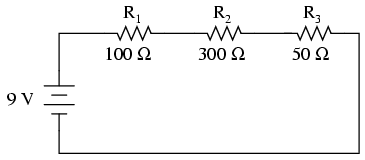
The total current through this circuit is
a)
0.02 amps
b)
0.09 amps
c)
50 amps
d)
9 amps
65.

The voltage drop across the 180 ohm resistor is
a)
9 V
b)
6 V
c)
2 V
d)
12 V
66.

Find the total resistance, total current and total voltage for the following circuit
a)
VT = 9 V
I T = 3
RT = 14
I T = 3
RT = 14
b)
VT = 9
I T = 0.64
RT = 14
I T = 0.64
RT = 14
c)
VT = 9
I T = 6.3
RT = 1.4
I T = 6.3
RT = 1.4
d)
VT = 9
I T = 0.64
RT = 1.4
I T = 0.64
RT = 1.4
67.

The voltage dropped across the 300 ohm resistor is
a)
6 V
b)
9 V
c)
2 V
d)
30 V
72.
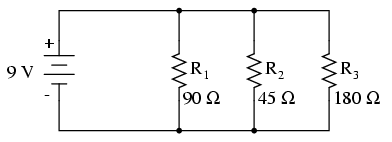
The equivalent resistance of this circuit is
a)
25.7 ohms
b)
315 ohms
c)
324 ohms
d)
90 ohms
69.
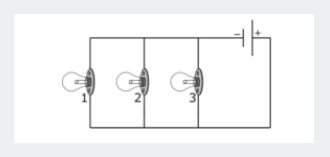
If bulb 1 burns out, what will occur?
a)
bulbs 2 and 3 will go out
b)
bulbs 2 and 3 receive more volts
c)
bulbs 2 and 3 will stay lit
d)
nothing will happen
70.

What is the total RESISTANCE of the circuit? The total VOLTAGE?
V = IR
V = IR
a)
50 ohms, 100 V
b)
2 ohms, 4 V
c)
12 ohms, 24 V
d)
0.08 ohms, 0.16 V
71.
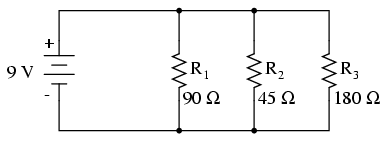
The current going through the 45 ohm resistor is
a)
0.05 amps
b)
0.2 amps
c)
0.1 amps
d)
5 amps
72.
The equivalent resistance of this circuit is
a)
25.7 ohms
b)
315 ohms
c)
324 ohms
d)
90 ohms
73.
How much CURRENT does a 1200 W bread maker draw from a 110 V outlet?
P = IV
P = I2R
P = V2/R
P = IV
P = I2R
P = V2/R
a)
132000 amps
b)
0.09 amps
c)
1200 amps
d)
10.9 amps
100 %

