
 Worksheets
Gene Expression
Total questions: 31
Worksheet time: 16mins
Name
Class
Date
1.
If an mRNA molecule has introns and exons in it, where is it?
a)
At a ribosome
b)
In the nucleus
c)
In a prokaryotic cell
d)
could be in the nucleus or the ribosome
2.
How can a person's muscle cells have the same exact DNA sequences as their nerve cells even though the look and perform completely different?
a)
The two different cells become mutated
b)
The proteins expressed in each cell are different
c)
They actually have different DNA in the two types of cells.
d)
The genome of the different cells changes
3.

Which of these is responsible for the different morphologies of these cells?
a)
Metabolism
b)
Replication
c)
Gene Expression
d)
None of these account for the different morphologies
4.
Which of these molecules gets translated?
a)
DNA
b)
mRNA
c)
tRNA
d)
amino acids
5.
What enzyme is responsible for adding nucleotides to the growing RNA strand?
a)
DNA Polymerase
b)
RNA Primase
c)
RNA Polymerase
d)
Topoisomerase
6.
Which of these is not part of a person's genome?
a)
DNA
b)
RNA
c)
Chromatin
d)
They are all part of the genome
7.
_______ is to transcription as ________ is to translation.
a)
mRNA / Amino Acid Chain
b)
Amino Acid Chain / mRNA
c)
Ribosome / Nucleus
d)
mRNA / tRNA
8.
What transcript would be produced by the following DNA sequence?
5'-CCGTAC-3'
5'-CCGTAC-3'
a)
5-GTACGG-3'
b)
5'-GGCAUG-3'
c)
5'-GUACGG-3'
d)
5'-GGCATG-3'
9.
Is transcription endergonic or exergonic
a)
endergonic
b)
exergonic
10.
True or False: a cell needs to replicate DNA each time it wants to create a protein.
a)
True
b)
False
11.
Put these in the correct order from first to last in translation:
Elongation
Termination
Initiation
Elongation
Termination
Initiation
a)
1) Elongation 2) Initiation 3)Termination
b)
1) Initiation 2) Termination 3) Elongation
c)
1) Initiation 2) Elongation 3) Termination
d)
1) Elongation 2) Termination 3) Initiation
12.
A single base pair substitution will always result in an different amino acid sequence.
a)
True
b)
False
13.
What role does RNA polymerase have in translation?
a)
Synthesizes the new mRNA molecule
b)
Synthesizes the amino acid chain
c)
Opens the DNA sequence
d)
none
14.
Which of these processes begin with an mRNA molecule?
a)
DNA Replication
b)
Transcription
c)
Translation
d)
None of them
15.
In translation, when does termination happen?
a)
When the polymerase reaches the terminator.
b)
When the release factor is in the A site of the ribosome.
c)
When the polymerase reads the stop codon.
d)
When the tRNA binds to the codon.
16.
What type of bond is forming during translation?
a)
Peptide
b)
Polypeptide
c)
Glycosidic
d)
Hydrogen
17.
Which of these is not a part of mRNA processing
a)
5' cap
b)
chromatin packaging
c)
3' Poly A tail
d)
splicing
18.
An E. Coli can experience alternative splicing depending on what is present in its environment.
a)
True
b)
False
19.
Which of these mRNA sequences will a ribosome seek out in order to start translation?
a)
TAT
b)
UAC
c)
AUG
d)
None of these
20.
Which of these is not a part of translation?
a)
DNA
b)
mRNA
c)
transcript
d)
amino acids
21.
Genes are ________ sequences.
a)
DNA
b)
mRNA
c)
amino acid
d)
DNA and mRNA
22.
Which molecule can we find the promoter and terminator in?
a)
DNA
b)
mRNA
c)
tRNA
d)
polypeptide chain
23.
Which of these do not belong in the transcript?
a)
Terminator
b)
Stop Codon
c)
Exons
d)
All of these are in the transcript.
24.
Which types of cells can experience transcription and translation simultaneously?
a)
Eukaryotes
b)
Prokaryotes
c)
Eukaryotes and Prokaryotes
d)
No cells can
25.
What structure is responsible for the splicing of the pre-mRNA?
a)
Nucleus
b)
RNAse
c)
Spliceosome
d)
ribozymes
26.
Which of these do not leave the nucleus?
a)
Guanosine cap
b)
Introns
c)
Exons
d)
Poly A tail
27.
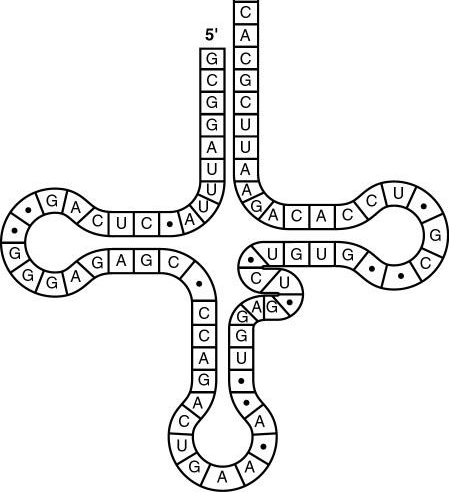
What structure of this molecule binds with the mRNA molecule?
a)
Amino Acid
b)
tRNA
c)
Anticodon
d)
Codon
28.
How many nucleotides make up a codon?
a)
1
b)
2
c)
3
d)
4
29.
Which of these enzymes is not part of transcription?
a)
DNA Polymerase
b)
Helicase
c)
Topoisomerase
d)
None of these are transcription enzymes
30.
Transcription starts with ________ and results in ________.
a)
DNA / mRNA
b)
mRNA / DNA
c)
mRNA / tRNA
d)
mRNA / Amino Acid Chain
31.

Which phase of which process does this picture show?
a)
Elongation of Transcription
b)
Termination of Transcription
c)
Termination of Translation
d)
Elongation of Translation
100 %

