
 Worksheets
AP Biology Ecology Review Quiz
Total questions: 30
Worksheet time: 35mins
Name
Class
Date
1.
Which of the following best explains why there are seldom more than five trophic levels in a food chain?
a)
Most carnivores function at more than one trophic level
b)
Trophic levels about this numbers contain too many individuals
c)
Energy is lost from each trophic level
d)
The ecosystem contains too much biomass
2.
J-Shaped curves
a)
show a decline after an increase
b)
display populations that have reached carrying capacity
c)
represent exponential growth
d)
does not depend on the numbe rof resources
3.
A herd of zebras would be considered a
a)
community
b)
species
c)
ecosystem
d)
population
4.
Two organisms of different species exist in a relationship in which each individual benefits from the activity of the other:
a)
commensalism
b)
parasitism
c)
herbivory
d)
mutualism
5.
All of the following are density-dependent factors that limit animal populations EXCEPT.
a)
weather
b)
predation
c)
food competition
d)
birthrate
6.

This population pyramid shows that
a)
the Ukraine population is in a rapid decline
b)
the Ukraine population is in a rapid increase
c)
the Ukraine population is in a stable and steady state
d)
men outlive women in the Ukraine
7.
Where an organism lives is its -
a)
niche
b)
ecosystem
c)
habitat
d)
home
8.

Which organism contains the most energy?
a)
Rabbit
b)
Grains
c)
Birds
d)
Mice
9.
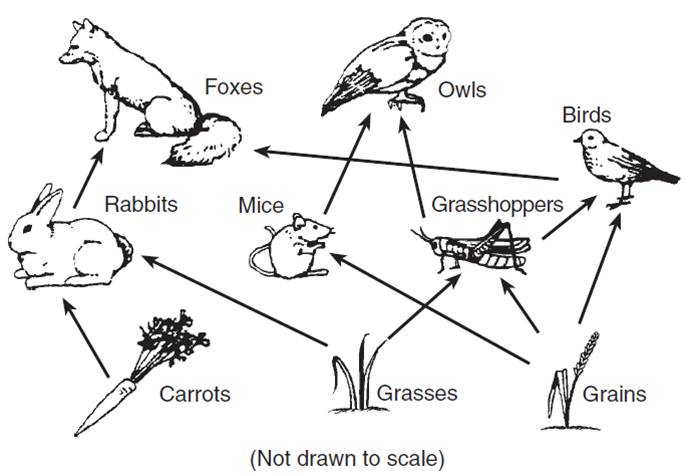
Which of the following is a primary consumer in this food web?
a)
Foxes
b)
Carrots
c)
Mice
d)
Owls
10.

Which of the following is an autotroph?
a)
Carrots
b)
Birds
c)
Mice
d)
Grasshopper
11.

Which of the following is an omnivore?
a)
Rabbit
b)
Carrots
c)
Owls
d)
Birds
12.

Which organism is a carnivore?
a)
Birds
b)
Rabbits
c)
Foxes
d)
Grains
13.

Which organism is an herbivore?
a)
Mice
b)
Foxes
c)
Birds
d)
Grains
14.
What type of organism recycles energy back into an ecosystem?
a)
Herbivore
b)
Carnivore
c)
Autotroph
d)
Decomposer
15.

What would happen in the case of a drought?
a)
iguanas would increase
b)
Eagles would increase
c)
grass would increase
d)
all organisms would decrease
16.

What happens to the populations as you move up a population pyramid?
a)
Populations increase
b)
Populations decrease
c)
Populations remain the same
d)
Populations fluctuate
17.
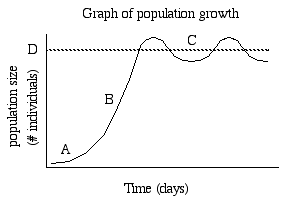
Which point on the graph represents carrying capacity?
a)
A
b)
B
c)
C
d)
D
18.
What types of organisms indicate primary succession is taking place?
a)
Trees and flowering plants
b)
Bears, deer, and rabbits
c)
moss, lichens, and insects
d)
grasses, shrubs, and birds
19.
What do decomposers (bacteria and fungi) do in an ecosystem?
a)
They return nutrients to the soil
b)
They take nutrients OUT of the soil
c)
They return energy to the soil
d)
They make energy
20.
How do Matter and Energy flow differently?
a)
Energy flows in one direction, matter is recycled
b)
Matter flows in one direction, Energy is recycled
c)
Energy and Matter are both recycled
d)
Energy and Matter both flow in one direction
21.
Nitrogen Fixation is carried out by
a)
bacteria
b)
plants
c)
herbivores
d)
mushrooms
22.
Since wind, water, and temperature are NOT living they are considered
a)
Abiotic Factors
b)
Biotic Factors
23.
If all ______________ were removed from an ecosystem, no other organisms would have any energy.
a)
Herbivores
b)
Producers
c)
Carnivores
d)
Decomposers
24.
There are 200 bears in an area. 10 emigrate, 15 immigrate, 10 are born and 20 die. How many are left?
a)
195
b)
205
c)
200
d)
260
25.
A species that is introduced to another environment that causes problems with the native food web is called a(n)...
a)
invasive species
b)
destructive species
c)
herbivores
d)
omnivores
26.
Biodiversity is the measure of all of ________________.
a)
ALL organisms including plants, animals, decomposers, etc.
b)
only plants
c)
only animals
d)
only bacteria
27.
Why is only 10% of the energy passed along to the next trophic level?
a)
90% is lost through heat, reproduction, and movement
b)
90% is gained
c)
90% is lost in light energy
d)
because only 10% is lost
28.

The illustrations below show the age and sex of the human populations in Country 1 & Country 2. The ages are grouped by -year classes, and the sexes are represented separately. The percentages in the different age classes are shown by the relative widths of successive horizontal bars.
In country 1, approximately what percentage of the individuals were younger than fifteen years of age?
In country 1, approximately what percentage of the individuals were younger than fifteen years of age?
a)
10%
b)
21%
c)
42%
d)
52%
29.
During the carbon cycle, which of the following carbon compounds would be utilized as an energy source by heterotrophs?
a)
carbonic acid
b)
organic molecules
c)
carbon dioxide
d)
carbon monoxide
30.
All of the following statements concerning characteristics of predator-prey relationship are correct EXCEPT:
a)
Camouflage is an adaptation that protects prey.
b)
A rise in the population of predators is followed by a decreased in the population of prey.
c)
A rise in the population of prey is often followed by a rise in the population of predators.
d)
The population of predators most often eliminates the population of prey
100 %

