
 Worksheets
Human Population
Total questions: 20
Worksheet time: 11mins
Name
Class
Date
1.
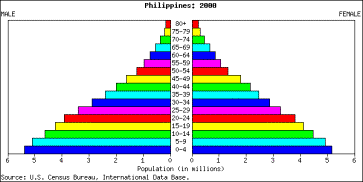
According to the population pyramid of this country, its population is most likely...
a)
growing slowly.
b)
growing rapidly.
c)
decreasing.
d)
not changing.
2.

According to the United Nations, at what number is world population expected to plateau?
a)
9-11 billion
b)
13-15 billion
c)
20-25 billion
d)
never
3.

Which has NOT been a major cause of the population explosion?
a)
modern preventive medicine
b)
increase in life expectancy
c)
improved sanitation
d)
increase in birth rates
4.

Which of the following is likely to be affected by a population of 7 billion?
a)
amount of land for agriculture
b)
amount of clean water
c)
number of people who are unemployed
d)
all of the above
5.

Which region of the world has the fastest growing population?
a)
Southeast Asia
b)
Eastern Europe
c)
Sub-Saharan Africa
d)
Latin America
6.
The number of live births per 1000 people is called the...
a)
growth rate.
b)
infant rate.
c)
baby total.
d)
birth rate.
7.

All of the following are demographic figures used in determining the total population of a country EXCEPT...
a)
immigration.
b)
birth rate.
c)
death rate.
d)
marriage rate.
8.
Deserts are usually....
a)
densely populated.
b)
sparsely populated.
c)
evenly populated.
d)
None of the above
9.
If a country has a death rate of 30 and a birth rate of 45 the natural rate of increase would show the population is ______.
a)
Increasing
b)
Decreasing
c)
Staying the same
d)
Fluctuating too much
10.
A factor that leaves one with no choice but to leave one's current home country.
a)
environmental
b)
distribution
c)
pull factor
d)
push factor
11.
The movement by people from one place to another with the intention of settling temporarily or permanently in a new location.
a)
pull factor
b)
push factor
c)
distribution
d)
migration
12.
The maximum population size of a species that the environment can sustain indefinitely, given the food, habitat, water and other necessities available in the environment.
a)
sparse population
b)
environmental
c)
carrying capacity
d)
dense population
13.
thinly scattered or distributed
a)
carrying capacity
b)
immigration
c)
dense population
d)
sparse population
14.

The average number of people living in a square kilometer is called...
a)
urbanization.
b)
internal migration.
c)
population density.
d)
pull factors.
15.

One reason for a rapid population growth is...
a)
an increase in pull factors.
b)
declining death rates.
c)
a sparse population density.
d)
internal migration.
16.

Moving from place to place in the same country
a)
Urbanization
b)
Internal Migration
c)
Pull Factor
d)
Declining death rates
17.

Something that attracts immigrants to another place
a)
Declining death rates
b)
Urbanization
c)
Pull Factor
d)
Population Density
18.
Which from the following is NOT a push factor?
a)
Political stability
b)
Natural hazards
c)
Job opportunities
d)
Disease
19.
What is a population pyramid?
a)
A type of graph showing the number of males and females in different age groups.
b)
A type of graph showing the number of males in different age groups.
c)
A type of graph showing the number of females in different age groups.
d)
A type of graph showing the number of males and females in only one age group.
20.
Areas close to rivers tend to be...
a)
Densely populated
b)
Sparsely populated
c)
Fairly populated.
d)
None of the above
100 %

