
 Worksheets
Earth Space Review
Total questions: 50
Worksheet time: 1hrs 8mins
Name
Class
Date
1.

This volcano is an example of something you would find in the:
a)
Atmosphere
b)
Biosphere
c)
Hydrosphere
d)
Geosphere
2.

This coral reef is an example of something in the:
a)
Atmosphere
b)
Biosphere
c)
Hydrosphere
d)
Geosphere
3.

This picture shows
a)
Atmosphere
b)
Biosphere
c)
Hydrosphere
d)
Geosphere
4.

The diagram represents rock layers from different periods of geologic time.
A scientist is searching for fossils. In which rock layer would the scientist most likely find the oldest fossils?
A scientist is searching for fossils. In which rock layer would the scientist most likely find the oldest fossils?
a)
Tertiary
b)
Cretaceous
c)
Jurassic
d)
Triassic
5.

The graph shows changes in a population of rabbits over a 15-year period.
What is the most likely conclusion that can be supported by the data in the graph?
What is the most likely conclusion that can be supported by the data in the graph?
a)
Between Year 1 and Year 5, food resources for rabbits decreased.
b)
Between Year 5 and Year 10, the number of rabbit predators increased.
c)
Environmental conditions were favorable for rabbits at Year 10.
d)
Rabbit reproduction rates declined after Year 15.
6.
An asteroid belt orbits the sun between the orbital paths of Mars and Jupiter. What force holds the asteroids in orbit?
a)
electrical
b)
gravitational
c)
magnetic
d)
nuclear
7.
Which of these allows scientists to estimate the relative age of fossils found in exposed sedimentary rock?
a)
size of fossils
b)
depth of fossils
c)
color of fossils
d)
abundance of fossils
8.

Which type of fault is most frequently found at convergent boundary margins?
a)
normal and reverse
b)
strike slip and normal
c)
reverse
d)
strike slip
9.
Earthquakes generally occur at plate boundaries, where
a)
stress on rocks is greatest
b)
the most rock is found
c)
stress on rocks is low
d)
magnetic pull is greatest
10.
Where do most earthquakes and volcanoes occur?
a)
in the ocean
b)
along the coast
c)
along tectonic plates
d)
in the Arctic
11.

The statue below is damaged and has holes in it due to acid rain. This is an example of...
a)
Physical Weathering
b)
Chemical Weathering
c)
Erosion
12.
Water freezes in the crack of a rock and breaks it apart. This is an example of...
a)
Physical Weathering
b)
Chemical Weathering
c)
Erosion
13.
The _____ is the thinnest layer of the earth.
a)
Inner Core
b)
Crust
c)
Mantle
d)
Outer Core
14.
The _______ is the only liquid layer of the earth.
a)
Inner Core
b)
Outer Core
c)
Crust
d)
Mantle
15.
One of the main differences between the outer and inner planets is __________.
a)
The inner planets all have water
b)
the inner planets are much bigger than the outer planets
c)
the outer planets are gas planets
d)
the outer planets have rings, and the inner planets don't
16.
Select the order from smallest to largest.
a)
Sun, Milky Way, solar system, universe
b)
Sun, Milky Way, universe, solar system
c)
Sun, solar system, Milky Way, universe
d)
Sun, solar system, universe, Milky Way
17.
True/False - Earth’s atmosphere protects Earth from harmful UV rays produced by the sun.
a)
True
b)
False
18.
Why does Earth have different seasons?
a)
because of the distance between Earth and the sun
b)
because of the speed of Earth as it rotates on its axis
c)
because of the amount of light blocked by the moon on its axis
d)
because of the tilt of Earth on its axis as it moves around the sun
19.
Which best explains why the moon has phases?
a)
The moon’s position changes in relation to the sun and Earth.
b)
The sun’s position changes in relation to the moon and Earth.
c)
The Earth casts a shadow on the moon as it rotates.
d)
The moon rotates along its axis
20.
weathering is
a)
the effects of freezing and thawing, plant roots, acid, and other forces on rock
b)
running water, ice, or wind carry away bits of broken up rock
21.
erosion is
a)
the effects of freezing an thawing, plant roots, acid, and other forces on rock.
b)
the process by which running water, wind, or ice carry away bits of broken up rock.
22.
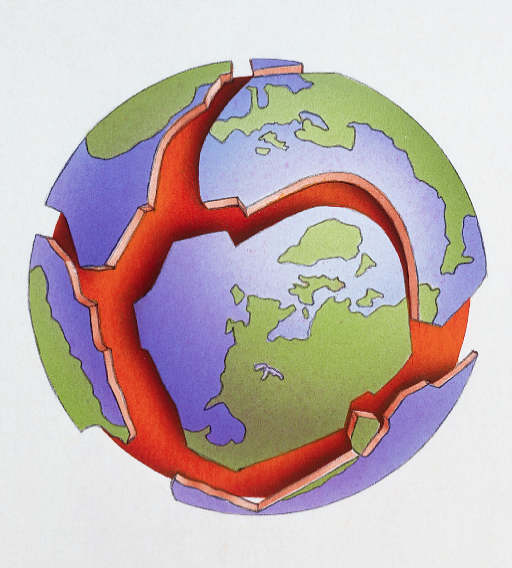
The Earth’s surface is not one solid piece of rock and soil, but is made up of large pieces called plates. These plates fit together like pieces of a puzzle and are constantly moving. Why can’t we feel the movement of these Earth plates?
a)
the plates move very quickly
b)
the plates move very slowly
c)
the plates are too small to feel
d)
the plates are underground
23.

What Moon phase is this?
a)
Waxing Crescent
b)
Waning Gibbous
c)
Waning Crescent
d)
Waxing Gibbous
24.
What is Pangea?
a)
A famous person who studied tectonic plates
b)
When the continents made a big continent
c)
A painting
d)
A random question
25.

When two plates are moving away from each other they are called (often forming rifts or valleys)?
a)
Divergent Plates
b)
Convergent Plates
c)
Transform Boundaries
d)
Mountain ranges
26.
The Inner Planets are also known as the ____________.
a)
Gas Giants
b)
Terrestrial Planets
c)
The Fab Four
d)
The Small Planets
27.
What are controlled by the moon?
a)
planets
b)
winds
c)
tides
d)
animals
28.
Which statement is true?
a)
A. Earth rotates around the sun and revolves on its axis.
b)
A. The sun revolves around Earth over a 24-hour time period.
c)
A. Earth rotates on its axis, and revolves around the sun.
d)
A. Earth revolves around the sun and the moon.
29.
Earth's (blank) takes 365 days
a)
rotation
b)
revolution
c)
obrbit
d)
axis
30.
Which shows the inner planets correctly ordered from farthest to closest from the sun?
a)
Mars, Earth, Venus, Mercury
b)
Mars, Venus, Mercury, Earth
c)
Venus, Mercury, Earth, Mars
d)
Earth, Mercury, Mars, Venus
31.

Put the stars in order from hottest to coolest.
a)
Blue, Red, White, Yellow, Orange,
b)
Red, White, Yellow, Orange, Blue
c)
Blue, White, Yellow, Red, Orange
d)
Blue, White, Yellow, Orange, Red
32.
Polaris is a red giant star that is much larger than our Sun. Why then does the Sun appear so much brighter than Polaris?
a)
The Sun is closer to the Earth than Polaris.
b)
Polaris is closer to the Earth than the Sun.
c)
Main sequence stars are always brighter than red giants.
d)
Yellow stars are always brighter than red stars.
33.
What is the term that describes the average distance from Earth to the Sun?
a)
light year
b)
astronomical unit
c)
parallax
d)
parsec
34.
What is a light year?
a)
The distance light travels in one year
b)
a measurement of time
c)
a way to measure how bright a year is
d)
Average distance from to the Sun
35.
The average weather conditions of a region
a)
daily temperature
b)
weather
c)
climate
36.
Condition of the air such as temperature, cloud cover, wind and rain describe
a)
climate
b)
gravity
c)
weather
37.

What is A?
a)
Evaporation
b)
Condensation
c)
Precipitation
d)
Runoff
38.

What is B?
a)
Evaporation
b)
Condensation
c)
Precipitation
d)
Runoff
39.

What is C?
a)
Evaporation
b)
Condensation
c)
Precipitation
d)
Runoff
40.

What is D?
a)
Evaporation
b)
Condensation
c)
Precipitation
d)
Runoff
41.
What type of winds blow constantly, predictably, and over long distances?
a)
land breezes
b)
mountain breezes
c)
global winds
d)
land breezes
42.
Which statement correctly defines wind?
a)
Wind is the movement of air from areas of low pressure to areas of high pressure
b)
Wind is the movement of air to a colder area in the atmosphere.
c)
Wind is the movement of air from areas of high pressure to areas of low pressure.
d)
Wind is the movement of air pushed around and bouncing off Earth's surface.
43.
Which term is best described as the movement of air from land to sea?
a)
global winds
b)
sea breeze
c)
land breeze
d)
local winds
44.
Near the top of the troposphere is a narrow band of high speed winds called the______.
a)
westerlies
b)
jet stream
c)
trade winds
d)
local winds
45.
Why do land breezes occur at night?
a)
Land cools off slower than water, so the air above water is cooler.
b)
Water cools off faster than land, so the air above land is warmer.
c)
Land heats up slower than water, so the air stays cooler during the day.
d)
Water cools off slower than land, so the air above water is warmer.
46.
As you go up in the atmosphere, what happens?
a)
The air pressure decreases.
b)
The air pressure makes you explode.
c)
The air pressure increases.
d)
The air pressure doesn't change.
47.
The uneven heating of the Earth creates __________ that circulate heat through the atmosphere.
a)
winds
b)
storms
c)
radiation
d)
ocean currents
48.
Which of the following is the correct order of planets in our solar system (starting from the Sun)?
a)
Sun, Earth, Mars, Venus, Mercury, Jupiter, Saturn, Neptune, Uranus
b)
Sun, Mars, Mercury, Venus, Earth, Saturn, Neptune, Uranus, Jupiter
c)
Sun, Mercury, Venus, Earth, Mars, Jupiter, Saturn, Uranus, Neptune
d)
Sun, Jupiter, Mercury, Uranus, Neptune, Earth, Mars, Venus, Pluto
49.
Which measurement allows scientist to compare the brightness of stars?
a)
parallax
b)
absolute magnitude
c)
red shift
d)
corona
50.
The force that keeps planets on there orbit...
a)
orbit
b)
stars
c)
planets
d)
gravity
100 %

