
 Worksheets
Weather
Total questions: 50
Worksheet time: 1hrs 6mins
Name
Class
Date
1.
The amount of mass in a given volume of air is _.
a)
density
b)
pressure
c)
altitude
d)
air pressure
2.

the amount of water vapor in the air
a)
warm front
b)
precipitation
c)
humidity
d)
air pressure
3.
Which term describes a circulation of air or water that is caused by uneven heating?
a)
convection current
b)
conduction current
c)
radiation current
d)
emission current
4.
____________ air sinks/falls because it is ____________dense.
a)
Cold, More
b)
Warm, Less
c)
Cold, Less
d)
Warm, More
5.
____________ air rises because it is ____________dense.
a)
Cool, Less
b)
Warm, Less
c)
Cold, More
d)
Warm, More
6.
The weight of air as it presses down on Earth's surface
a)
front
b)
air pressure
c)
air mass
d)
evaporation
7.
The place where two air masses meet.
a)
air mass
b)
air pressure
c)
water cycle
d)
front
8.

Identify the type of front that is shown in the image.
a)
Occluded Front
b)
Cold Front
c)
Stationary Front
d)
Warm Front
9.

Identify the type of front that is shown in the image.
a)
Occluded Front
b)
Cold Front
c)
Stationary Front
d)
Warm Front
10.

Identify the type of front that is shown in the image.
a)
Occluded Front
b)
Cold Front
c)
Stationary Front
d)
Warm Front
11.

Identify the type of front that is shown in the image.
a)
Occluded Front
b)
Cold Front
c)
Stationary Front
d)
Warm Front
12.

This is the symbol for a...
a)
Cold Front
b)
Warm Front
c)
Stationary Front
d)
Occluded Front
13.

This is the symbol for a...
a)
Occluded Front
b)
Stationary Front
c)
Warm Front
d)
Cold Front
14.

This is the symbol for a...
a)
Stationary Front
b)
Occluded Front
c)
Cold Front
d)
Warm Front
15.
What type of weather would a continental tropical air mass bring?
a)
dry and cold weather
b)
wet and cold weather
c)
dry and warm weather
d)
wet and warm weather
16.
An air mass that formed over the ocean near the equator would probably be -
a)
maritime polar
b)
maritime tropical
c)
continental polar
d)
continental tropical
17.
A wet, cold air mass would be -
a)
maritime tropical
b)
maritime polar
c)
continental tropical
d)
continental polar
18.

What does symbol # 3 mean?
a)
stationary front
b)
occluded front
c)
warm front
d)
cold front
19.
Where would you find a tropical maritime air mass?
a)
over the ocean, near the equator
b)
over the ocean, near the poles
c)
over a continent, near the equator
d)
over a continent, near the poles
20.
When a warm air mass and a cold air mass meet, but they push at each other and neither one can move, it is called a/an -
a)
warm front
b)
cold front
c)
occluded front
d)
stationary front
21.
When a fast moving cold air mass moves into a slower moving warm air mass, we may experience severe storms and we will have cooler weather. What type of front is this?
a)
warm front
b)
cold front
c)
occluded front
d)
stationary front
22.
When a warm air mass slides on top of a cold air mass, and you have drizzly rain and then warmer weather, what type of front is it?
a)
warm front
b)
cold front
c)
occluded front
d)
stationary front
23.
A/An ____ is a large body of air that has the same properties as the Earth's surface over which it develops.
a)
front
b)
air mass
c)
cloud
d)
tornado
24.

What type of front is this?
a)
warm front
b)
cold front
c)
stationary front
d)
occluded front
25.

What does symbol # 1 mean?
a)
stationary front
b)
occluded front
c)
warm front
d)
cold front
26.

What does symbol # 2 mean?
a)
stationary front
b)
occluded front
c)
warm front
d)
cold front
27.
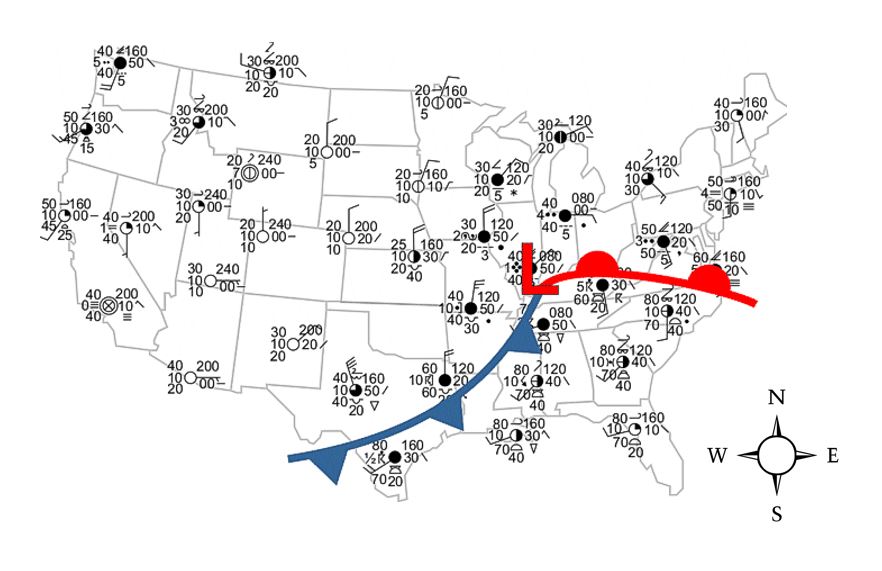
What direction is the cold front moving on the map?
a)
Southwest
b)
Northwest
c)
Southeast
d)
Northeast
28.
What direction is the warm front moving on the map?
a)
North
b)
South
c)
East
d)
West
29.
What type of weather would you expect to see after a warm front has passed through an area?
a)
cool and clear skies
b)
warm and humid
c)
thunderstorms
d)
foggy
30.
What type of weather would you expect to see after a cold front has passed through an area?
a)
cool and clear skies
b)
warm and humid
c)
thunderstorms
d)
foggy
31.
What characteristics are used to classify air masses?
a)
temperature and humidity
b)
pressure and temperature
c)
latitude and longitude
d)
wind speed and location
32.
A cold, dry air mass would be called -
a)
continental tropic
b)
continental polar
c)
maritime polar
d)
continental maritime
33.
_______ pressure systems are characterized by sinking air.
a)
High
b)
Low
34.
_______ pressure systems are characterized by rising air.
a)
High
b)
Low
35.
At the poles, air is usually ________.
a)
rising
b)
sinking
36.
Moving air is called _______.
a)
mud
b)
wind
c)
rain
d)
sunshine
37.

Does cold air rise or sink?
a)
Rise
b)
Sink
38.

Does warm air rise or sink?
a)
Rise
b)
Sink
39.

What does this symbol mean?
a)
Low Clouds
b)
Low Temperatures
c)
Light Wind
d)
Low Air Pressure
40.

What does this symbol mean?
a)
High Air Pressure
b)
High Temperatures
c)
Heavy Rain
d)
Hail
41.

Which type of front is near Seattle?
a)
cold front
b)
warm front
c)
occluded front
d)
stationary front
42.

Which front is located near San Diego?
a)
cold front
b)
warm front
c)
occluded front
d)
stationary front
43.
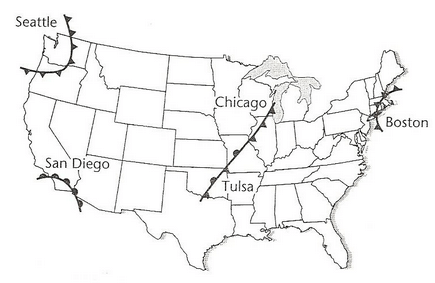
Which type of front is located near Boston?
a)
warm front
b)
cold front
c)
stationary front
d)
occluded front
44.
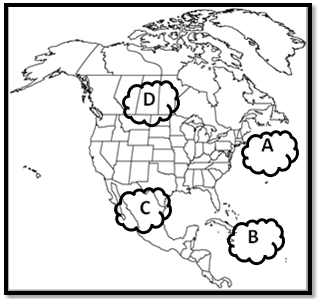
Which type of air would you find at air mass A?
a)
cold, dry
b)
warm, humid
c)
warm, dry
d)
cold, humid
45.
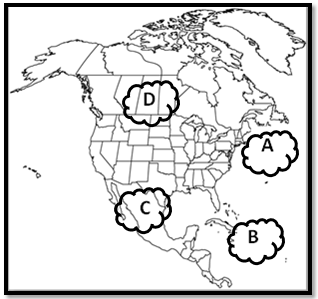
Which type of air would you find at air mass B?
a)
cold, dry
b)
warm, humid
c)
warm, dry
d)
cold, humid
46.
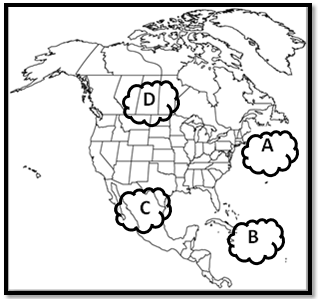
Which type of air would you find at air mass D?
a)
cold, dry
b)
warm, humid
c)
warm, dry
d)
cold, humid
47.
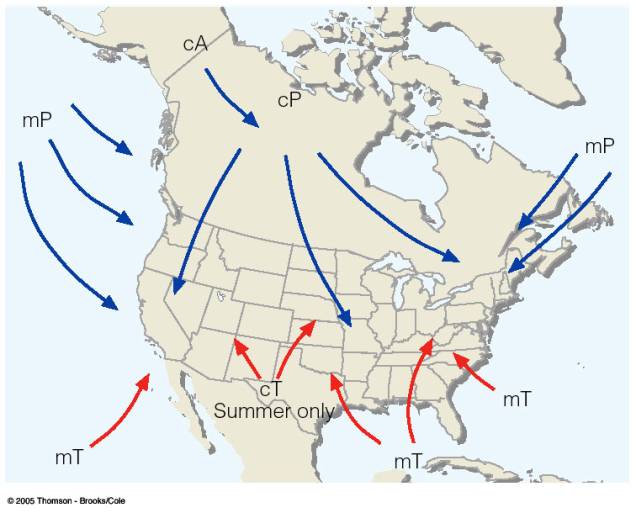
Which abbreviation of an air mass can be identified as dry and hot?
a)
cP
b)
mP
c)
cT
d)
mT
48.
Which abbreviation of an air mass can be identified as cold and moist?
a)
cP
b)
mP
c)
cT
d)
mT
49.
Which abbreviation of an air mass can be identified as warm and moist?
a)
cP
b)
mP
c)
cT
d)
mT
50.

Which abbreviation of an air mass can be identified as dry and cold?
a)
cP
b)
mP
c)
cT
d)
mT
100 %

