
 Worksheets
weather, climate & seasons UNIT TEST
Total questions: 50
Worksheet time: 40mins
Name
Class
Date
1.
During the day, the land is warmer than the water, so the warm air rises, causing a breeze to come in from the ocean. What is this called?
a)
land breeze
b)
sea breeze
c)
westerly
d)
easterly
2.
What is weather?
a)
The average weather conditions over a long period of time.
b)
The minute by minute conditions outside.
3.
What is climate?
a)
The average weather conditions over a long period of time.
b)
The minute by minute conditions outside.
4.
The boundary between two air masses is known as:
a)
front
b)
storm
c)
climate
d)
flood
5.
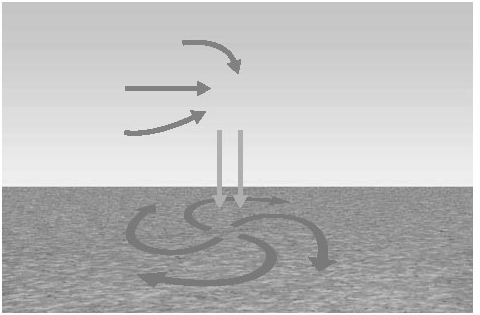
Which type of pressure system is pictured?
a)
high
b)
low
c)
medium
d)
none
6.

What type of weather would you expect with the pressure system pictured?
a)
clear
b)
cloudy
c)
severe storms
d)
hot
7.

What type of weather would you expect from the pressure system pictured?
a)
clear
b)
cloudy
c)
hot
d)
stormy
8.
In _________ pressure systems, air sinks:
a)
high
b)
low
c)
medium
d)
none
9.
In _______ pressure systems, air rises
a)
high
b)
low
c)
medium
d)
none
10.
These can be produced by thunderstorms
a)
stationary fronts
b)
tornadoes
c)
volcanoes
d)
tsunamis
11.
This type of front can bring strong storms
a)
cold
b)
warm
c)
stationary
d)
occluded
12.
This type of front results in the same weather for several days
a)
warm
b)
cold
c)
stationary
d)
occluded
13.
Which weather tool measures air pressure?
a)
thermometer
b)
barometer
c)
anemometer
d)
psychrometer
14.
Air pressure is greatest:
a)
closer to Earth
b)
farther from Earth
15.

Identify the type of front that is shown in the image.
a)
Occluded Front
b)
Cold Front
c)
Stationary Front
d)
Warm Front
16.

This is the symbol for a...
a)
Stationary Front
b)
Occluded Front
c)
Cold Front
d)
Warm Front
17.

This is the symbol for a...
a)
Stationary Front
b)
Occluded Front
c)
Cold Front
d)
Warm Front
18.

This is the symbol for a...
a)
Occluded Front
b)
Stationary Front
c)
Warm Front
d)
Cold Front
19.

This is the symbol for a...
a)
Cold Front
b)
Warm Front
c)
Stationary Front
d)
Occluded Front
20.

A _____ is a large, swirling, low-pressure system that forms over the Atlantic Ocean.
a)
blizzard
b)
cold front
c)
tornado
d)
hurricane
21.

A(n) _____ is a large body of air that has properties similar to the part of Earth's surface over which it depends.
a)
tornado
b)
pressure system
c)
front
d)
air mass
22.
What is usually the most damaging part of a hurricane?
a)
Eye
b)
Lightning
c)
Storm surge
d)
Hail
23.
In what areas of the world do hurricanes form?
a)
Warm ocean waters
b)
Polar ocean waters
c)
On lakes and rivers
d)
Over the central plains of the U.S
24.
Calmest winds of a hurricane
a)
Eye wall
b)
Eye
c)
Upper elevations
d)
Storm surge
25.
What is the difference between a hurricane, a typhoon, and a tropical cyclone?
a)
Begin on different dates
b)
Begin in warm waters
c)
Begin in different locations
d)
Begin/end on time
26.
What is the name of a scientist who studies weather?
a)
biologist
b)
geologist
c)
optometrist
d)
meterorologist
27.
The center of a hurricane is called the ______.
a)
center
b)
brain
c)
eye
d)
circle
28.
The Earth's axis is tilted _____ degrees.
a)
23.5
b)
25.3
c)
30.2
d)
24
29.

Which season is taking place in the Northern Hemisphere in Position 4?
a)
Winter
b)
Spring
c)
Summer
d)
Fall
30.

Which season is taking place in the Northern Hemisphere in Position 3?
a)
Winter
b)
Spring
c)
Summer
d)
Fall
31.

Which season is taking place in the Northern Hemisphere in Position 3?
a)
Winter
b)
Spring
c)
Summer
d)
Fall
32.

At position A, which hemisphere would have summer?
a)
Northern hemisphere
b)
Southern hemisphere
33.

What happens when the area in which you live tilts away from the sun?
a)
It is summer.
b)
It is spring.
c)
It is winter.
d)
It is fall.
34.
The term equinox means....
a)
equal amount of day light and equal amount of night
b)
Equal amount of winter and summer
c)
Equal amounts of hot dogs for everyone
d)
The longest day of the year
35.
What is the longest day of the year?
a)
winter solstice
b)
summer solstice
c)
fall equinox
d)
spring equinox
36.
Why do we experience the changing of the season on the earth?
a)
distance from the sun
b)
rotation of the earth
c)
change in solar output
d)
tilt of the earth's axix
37.
What do June 21 and December 21 have in common?
a)
equinox dates
b)
the moon is full
c)
solstice dates
d)
the cold fronts blow in
38.

Which season is taking place in the Southern Hemisphere in Position 1?
a)
Winter
b)
Spring
c)
Summer
d)
Fall
39.

Which season is taking place in the Northern Hemisphere in Position 1?
a)
Winter
b)
Spring
c)
Summer
d)
Fall
40.

Which season is taking place in the Northern Hemisphere in Position 2?
a)
Winter
b)
Spring
c)
Summer
d)
Fall
41.
How long does Earth take to make a complete rotation?
a)
365 days
b)
24 hours
42.

The hemisphere where you live
a)
equator
b)
southern
c)
northern
d)
eastern
43.
What is earth's tilt correct angle?
a)
12.5 degrees
b)
23.5 degrees
c)
32.5 degrees
d)
90 degrees
44.
Object orbiting another object.
a)
revolution
b)
rotation
45.
First day of spring
a)
Autumnal Equinox
b)
Summer Solstice
c)
Winter Solstice
d)
Vernal Equinox
46.
First day of fall
a)
Autumnal Equinox
b)
Summer Solstice
c)
Winter Solstice
d)
Vernal Equinox
47.
What causes the season to happen on earth?
a)
the sun
b)
the moon
c)
tilt of the earth on its axis
d)
the rotation around the sun
48.

What are the reasons for the season?
a)
Earth's tilt & rotation & roll
b)
Earth's tilt
c)
Earth's rovolution
d)
Earth's tilt & resolution
49.
Tornadoes happen in _______% of thunderstorms?
a)
2%`
b)
10%
c)
1%
d)
50%
50.
Ms. Hutchison is________.
a)
funny
b)
OLD
c)
a science teacher at Garrett Middle School
d)
nice
100 %

