
 Worksheets
The Water Cycle
Total questions: 46
Worksheet time: 2hrs 33mins
Name
Class
Date
1.

What part of the water cycle does this picture show?
a)
condensation
b)
precipitation
c)
evaporation
2.
Which of these is an example of precipitation?
a)
snow
b)
air
c)
clouds
d)
vapor
3.
Which is the opposite of condensation?
a)
runoff
b)
evaporation
c)
precipitation
d)
transpiration
4.
Snow, sleet, hail, and rain are all examples of ________________.
a)
evaporation
b)
condensation
c)
accumulation
d)
precipitation
5.

Does evaporation happen before or after condensation?
a)
before
b)
after
c)
during
6.

What is the next stage after EVAPORATION in the water cycle?
a)
CONDENSTATION
b)
GROUNDWATER
7.

Where does groundwater go?
a)
to our buildings, houses, and water transplant places
b)
to the sky
c)
to the sun
d)
To the Earth's surfaces
8.

What is it called when plants give off water vapor as a waste product?
a)
condensation
b)
evaporation
c)
sublimation
d)
transpiration
9.

Does warm water evaporate quicker than cold water?
a)
Yes
b)
No
10.

Snow, sleet, hail, and rain are all examples of ________________.
a)
evaporation
b)
condensation
c)
accumulation
d)
precipitation
11.
What is the water cycle?
a)
the 3 forms of water
b)
the movement of water on, above, or below the surface of the Earth
c)
when water melts
d)
when clouds form
12.
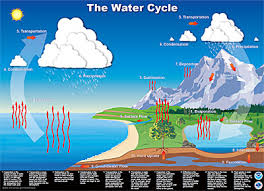
During which stage do clouds form?
a)
condensation
b)
evaporation
c)
precipitation
13.
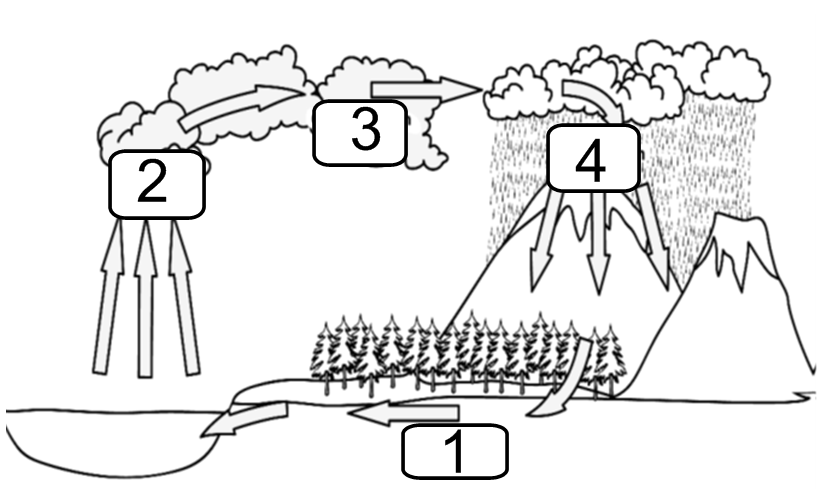
Which stage does the #2 show in the diagram?
a)
condensation
b)
evaporation
c)
precipitation
d)
run off
14.

Which stage does the #3 show in the diagram?
a)
condensation
b)
evaporation
c)
precipitation
d)
run off
15.

what does the #4 show in the diagram?
a)
condensation
b)
evaporation
c)
precipitation
d)
run off
16.
What is the process during which water cools and turns from a gas to a liquid?
a)
Codensation
b)
Runoff
c)
Precipitation
d)
Evaporation
17.
The first step in the water cycle
a)
evaporation
b)
condensation
c)
precipitation
d)
there is no first step
18.
The 2 main driving forces of the water cycle.
a)
sun
b)
biological processes
c)
gravity
d)
The Sun and gravity.
19.
Precipitation occurs because
a)
the droplets evaporate in the air
b)
the droplets are too light for the air to hold
c)
the droplets are too heavy for the air to hold
20.
The water cycle is also known as ..........
a)
Hypertonic Solution
b)
Hydrological Cycle
c)
Hyperlogical Cycle
d)
None of these
21.
What is a huge, slow-moving mass of ice and snow called?
a)
well
b)
glacier
c)
river system
d)
geyser
22.
What is a layer of rock or sediment that holds water?
a)
glacier
b)
well
c)
aquifer
d)
natural spring
23.
The water cycle has no start or end
a)
true
b)
false
24.
97% of the Earth's water is located in....
a)
ground wat
b)
the ocean
c)
lakes, rivers, and streams
d)
glaciers
25.

What is water doing when it is changed to water vapor?
a)
evaporating
b)
condensing
c)
precipitating
d)
runoff
26.

What is water vapor doing when it changes to water?
a)
evaporating
b)
condensing
c)
precipitating
d)
runoff
27.

What is water that flows in rivers and streams into the oceans and lakes?
a)
evaporating
b)
condensing
c)
precipitating
d)
runoff
28.

Which of the following causes all of the water on the planet to change its state (solid, liquid, gas) and move through the water cycle?
a)
amount of plant matter
b)
location of ice caps
c)
size of ocean
d)
temperature
29.
The oceans absorb much of the sunlight reaching Earth. When water in the oceans absorb sunlight and heat up, what process can happen to the water?
a)
accumulation
b)
condensation
c)
evaporation
d)
precipitation
30.
On which kind of day would you expect the most evaporation from the surface of a pond?
a)
cold, rainy
b)
cold, sunny
c)
warm, rainy
d)
warm, sunny
31.
What is water that flows in rivers and streams into the oceans and lakes?
a)
evaporating
b)
condensing
c)
precipitating
d)
runoff
32.
Where is most water found on Earth?
a)
glaciers
b)
lakes
c)
rivers
d)
oceans
33.
What source of energy evaporates the most water from Earth’s surface?
a)
volcanoes
b)
the sun
c)
lightning
d)
wind
34.

Why are clouds a key element of the water cycle?
a)
increase amount of water on the planet
b)
protect land from sunlight
c)
lower temperature of the air
d)
transport water from one part of the planet to another
35.
What percentage of Earth’s water is freshwater?
a)
75%
b)
3%
c)
1%
d)
97%
36.

What is A?
a)
Solid
b)
Liquid
c)
Gas
37.

What is B?
a)
Solid
b)
Liquid
c)
Gas
38.

What is C?
a)
Solid
b)
Liquid
c)
Gas
39.
When changing from a solid to a liquid, the particles are moving____________. This is caused by _________.
a)
Moving away from each other, melting
b)
Moving away from each other, evaporation
c)
getting closer to each other, heating
d)
getting closer to each other, freezing
40.
When changing from a liquid to a solid, the particles are moving____________. This is caused by _________.
a)
Moving away from each other, freezing
b)
Moving away from each other, evaporation
c)
getting closer to each other, heating
d)
getting closer to each other, freezing
41.
When changing from a liquid to a gas, the particles are moving____________. This is caused by _________.
a)
Moving away from each other, freezing
b)
Moving away from each other, evaporation
c)
getting closer to each other, heating
d)
getting closer to each other, freezing
42.

What is A?
a)
Evaporation
b)
Condensation
c)
Precipitation
d)
Runoff
43.

What is B?
a)
Evaporation
b)
Condensation
c)
Precipitation
d)
Runoff
44.

What is C?
a)
Evaporation
b)
Condensation
c)
Precipitation
d)
Runoff
45.

What is D?
a)
Evaporation
b)
Condensation
c)
Precipitation
d)
Runoff
46.
What is water vapor?
a)
Water on the land (geosphere)
b)
Water in the air (atmosphere)
c)
Water in plants
d)
Water in the water (hydrosphere)
100 %

