
 Worksheets
Plate Tectonics
Total questions: 49
Worksheet time: 27mins
Name
Class
Date
1.
The lithosphere is made up of...
a)
the crust and outer core
b)
the top portion of the mantle
c)
Earth's crust and top portion of the mantle
d)
mantle and inner core
2.
The lithosphere is broken up into many plates. These plates all move in the same direction around Earth.
a)
True
b)
False
3.
The asthenosphere is...
a)
solid rock and does not move
b)
gas that moves freely
c)
rock that can flow due to heat and pressure
d)
ice cream
4.
Colliding plates can form...
a)
rivers
b)
rift valleys
c)
mountains
d)
hot spots
5.
What causes the plates to move?
a)
conduction in the mantle
b)
radiation in the mantle
c)
convection in the mantle
d)
plasma in the mantle
6.
Which layer has the hottest temperature and most pressure?
a)
inner core
b)
outer core
c)
mantle
d)
crust
7.
Which layer do we live on?
a)
inner core
b)
outer core
c)
mantle
d)
crust
8.
Which layer is liquid metal?
a)
inner core
b)
outer core
c)
mantle
d)
crust
9.
Which layer has convection currents that move tectonic plates?
a)
inner core
b)
outer core
c)
mantle
d)
crust
10.
Oceanic crust is
a)
more dense than continental crust
b)
less dense than continental crust
c)
the same density as continental crust
d)
a type of pizza
11.
Oceanic crust goes ______ continental crust, forming ocean trenches.
a)
over
b)
under
12.
Earthquakes are most often associated with
a)
convergent boundaries
b)
divergent boundaries
c)
transform boundaries
d)
hot spots
13.
The Earth's crust is part of the
a)
asthenosphere
b)
lithosphere
c)
outer core
d)
inner core
14.
If you compare the Earth to a peach, the core is the
a)
skin
b)
flesh
c)
seed
d)
stem
15.
The inner core is solid because it is
a)
squeezed by pressure
b)
colder
c)
hotter
d)
part of the lithosphere
16.
Hot spots produce
a)
vocanoes
b)
island arcs
c)
ocean trenches
d)
seafloor spreading
17.
Younger rock is found on the seafloor near
a)
mid ocean ridges
b)
ocean trenches
18.
The _____ is made up of liquid nickel and iron that creates a magnetic field on Earth.
a)
inner core
b)
outer core
c)
mantle
d)
crust
19.
Transform boundaries are most known for
a)
earthquakes
b)
volcanoes
c)
ocean trenches
d)
mountains
20.
Hotspots are found
a)
on convergent boundaries
b)
on divergent boundaries
c)
on transform boundaries
d)
away from plate boundaries
21.
A rift valley is formed by
a)
convergent boundaries
b)
divergent boundaries
c)
transform boundaries
d)
hot spots
22.
Subduction happens when two plates
a)
collide and one goes under the other
b)
drift apart
c)
slide past each other
d)
do not move
23.
The magnetic "stripes" on the seafloor are caused by
a)
magnetic reversals and seafloor spreading
b)
magnetic reversals and hot spots
c)
magnetic reversals and transform boundaries
d)
magnetic reversals and earthquakes
24.
Volcanic arcs are caused by
a)
subduction at convergent plate boundaries
b)
mid ocean ridges at divergent plate boundaries
c)
faults at transform plate boundaries
d)
hot spots
25.
The ____ is the thinnest layer of the Earth
a)
mantle
b)
core
c)
crust
d)
asthenosphere
26.
The hottest layer of the Earth is the
a)
lithosphere
b)
asthenosphere
c)
outer core
d)
inner core
27.
Oceanic crust is _____ than continental crust
a)
thicker
b)
thinner
28.
The core is mostly
a)
iron and nickel
b)
basalt
c)
granite
d)
quartz
29.
The San Andreas fault in California is an example of a
a)
convergent boundary
b)
divergent boundary
c)
transform boundary
d)
hot spot
30.
The Himalayan mountains are an example of a _____ boundary
a)
continent-continent convergent
b)
ocean-continent convergent
c)
ocean-ocean divergent
d)
continent-continent divergent
31.
Iceland, on the Mid-Atlantic ridge, is formed by a
a)
convergent plate boundary
b)
divergent plate boundary
c)
transform plate boundary
d)
hot spot
32.
The Great Rift Valley in Africa is caused by a
a)
convergent plate boundary
b)
divergent plate boundary
c)
transform plate boundary
d)
hot spot
33.
The Hawaiian islands, in the middle of the Pacific plate, are formed by a
a)
convergent plate boundary
b)
divergent plate boundary
c)
transform plate boundary
d)
hot spot
34.
What is Pangaea?
a)
The name of a German Scientist
b)
the name of the supercontinent that existed millions of years ago
c)
another name for continental drift
d)
the name of an ancient fossil
35.
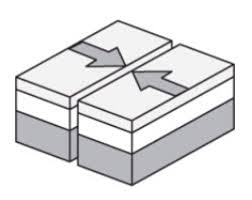
Name the boundary
a)
convergent boundary
b)
divergent boundary
c)
transform boundary
d)
sergent boundary
36.
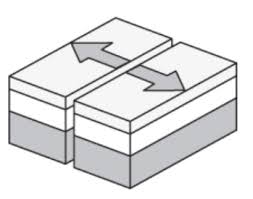
Name the boundary
a)
convergent boundary
b)
divergent boundary
c)
transform boundary
d)
sergent boundary
37.
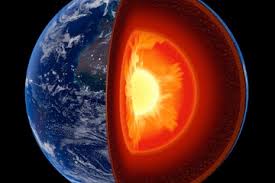
As you travel from the inner core to the crust, how would temperature, pressure and density of the material change?
a)
The would all increase
b)
The would all decrease.
c)
They would stay the same.
d)
Temperature would decrease, but pressure and density would increase.
38.
A subduction zone is formed...
a)
when one tectonic plate sinks below another
b)
at every type of convergent plate boundary
c)
at every type of divergent plate boundary
d)
at transform boundaries
39.
Plate movement is caused by ______________.
a)
the rotation of the Earth
b)
ocean tides
c)
convection currents in the mantle
d)
the moon's gravity
40.
Which of the following occurs because of convection currents?
a)
Tectonic plates on the crust move.
b)
The mantle increases in size.
c)
Pressure in the crust increases.
d)
Pressure in the crust decreases.
41.

The physical layer of Earth made of solid rock and soil is called the ___________.
a)
mesosphere
b)
lithosphere
c)
asthenosphere
d)
mantle
42.
During sea floor spreading, molten material rises up from the mantle...
a)
along the continents
b)
at the mid ocean ridges
c)
deep ocean trenches
d)
at north and south poles
43.
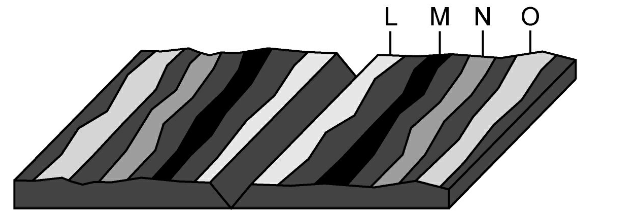
Where would the oldest rock be found?
a)
L
b)
M
c)
N
d)
O
44.
How is it possible for new crust to be formed without increasing the surface area of the Earth?
a)
Crust is destroyed at the same time it is created
b)
New crust is underwater where it sinks
c)
New crust breaks more easily than old crust
d)
New crust is never formed
45.
During sea floor spreading, molten material rises up from the mantle...
a)
along the continents
b)
at the mid ocean ridges
c)
along deep ocean trenches
d)
at north and south poles
46.
The soft layer of the mantle on which the tectonic plates move is the
a)
Asthenosphere
b)
Lithosphere
c)
Mesosphere
d)
Atmosphere
47.
What type of boundary creates an island arc?
a)
convergent ocean ocean
b)
convergent ocean continental
c)
convergent continental continental
d)
divergent
48.
When Earth's plates rub or scrape against one another, the release of energy causes
a)
a volcano
b)
an earthquake
c)
a tornado
d)
continental drift
49.
Which type of evidence was NOT used by Alfred Wegener to support his continental drift hypothesis?
a)
evidence from landforms
b)
evidence from fossils
c)
evidence from human remains
d)
evidence from climate
100 %

