
 Worksheets
WATER CYCLE & Water Distribution TEST
Total questions: 50
Worksheet time: 54mins
Name
Class
Date
1.
What are the major processes of the water cycle?
a)
evaporation, condensation, perspiration
b)
transpiration, condensation, sublimation
c)
evaporation, humidity, presipitation
d)
evaporation, condensation, precipitation
2.

What part of the water cycle does this picture show?
a)
condensation
b)
precipitation
c)
evaporation
d)
sublimation
3.
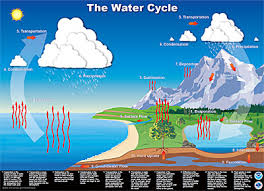
During which stage do clouds form?
a)
condensation
b)
evaporation
c)
precipitation
4.
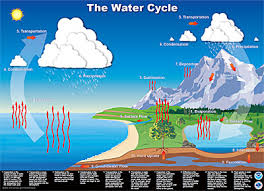
Which stages does liquid water from the ocean turn into water vapor?
a)
condesantion
b)
evaporation
c)
precipitation
d)
run off
38.
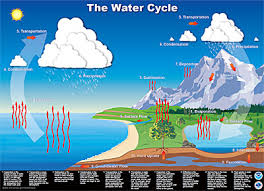
Which stage does ground water try to return to the ocean or soak into the ground?
a)
condensation
b)
evaporation
c)
precipitation
d)
run off
6.
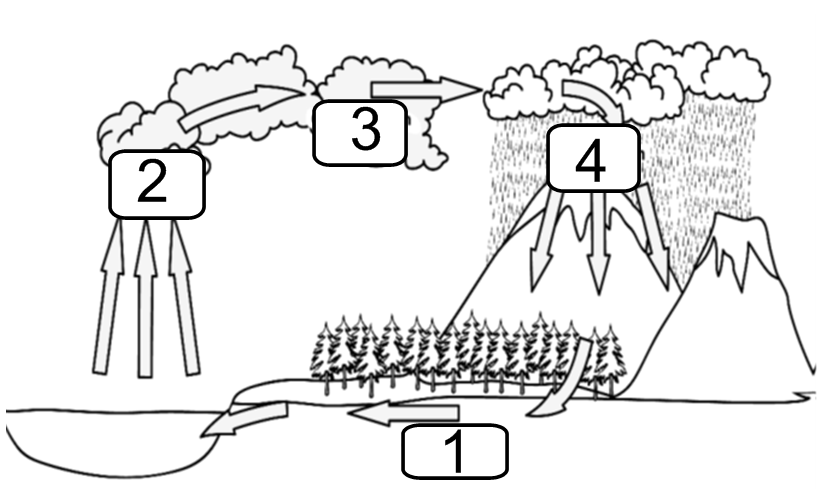
Which stage does the #2 show in the diagram?
a)
condensation
b)
evaporation
c)
precipitation
d)
run off
7.

Which stage does the #3 show in the diagram?
a)
condensation
b)
evaporation
c)
precipitation
d)
run off
8.

what does the #4 show in the diagram?
a)
condensation
b)
evaporation
c)
precipitation
d)
run off
9.

What is it called when plants give off water vapor as a waste product?
a)
condensation
b)
evaporation
c)
sublimation
d)
transpiration
10.

What is the next stage after EVAPORATION in the water cycle?
a)
CONDENSTATION
b)
GROUNDWATER
11.

After the rain falls down onto Earth's surface, what most likely happens? What is it called?
a)
1. The remains of the water is soaked into the ground.
2.Groundwater
2.Groundwater
b)
1. Groundwater
2. The remains of the water is soaked into the ground.
2. The remains of the water is soaked into the ground.
c)
1. Groundwater
2. Transpiration happens to the plants.
2. Transpiration happens to the plants.
d)
1. The liquid turns into an gas or an water vapor
2. Evaporation
2. Evaporation
12.
What happens after groundwater at the very end/beginning of the water cycle?
a)
Evaporation
b)
Transpiration
c)
Condensation
d)
Groundwater
13.
What is an aquifer?
a)
A place underground that stores water.
b)
A water pump
c)
A water purifier
d)
A place that sells aquifers
14.
Water stored below the Earth's surface is called:
a)
Groundwater
b)
Bogs
c)
Water in the ground
15.
All living things need water to carry out their body processes.
a)
True
b)
False
16.
3% of Earth's surface water is _________ water.
a)
Fresh
b)
Salt
17.
97% of Earth's water is __________ water.
a)
Fresh
b)
Salt
18.
In the water cycle, water moves between land, living things, bodies of water on Earth's surface, and the _____________________.
a)
School
b)
Animals
c)
Ocean
d)
Atmosphere
34.
When water becomes water vapor and disappears
a)
Evaporation
b)
Transpiration
c)
Precipitation
20.
When water falls to Earth as rain, snow, hail, or sleet
a)
Evaporation
b)
Transpiration
c)
Precipitation
21.
Water that fills the cracks and pores in underground soil and rock layers.
a)
pond water
b)
groundwater
c)
ditch water
d)
surface water
35.
Which represents the distribution of water on Earth?
a)
3% freshwater, 97% salt water
b)
97% freshwater, 3% salt water
c)
71% freshwater, 29% salt water
d)
29% freshwater, 71% salt water
23.
What do we call the land area that supplies water to a river system?
a)
runoff
b)
recharge
c)
watershed
d)
valley
24.

A watershed is an
a)
area that drains into a stream or river
b)
section of land that juts into the ocean
c)
the shoreline of the ocean
d)
the end of a continent
25.

Most of the Fresh water on Earth is
a)
in the ocean
b)
underground
c)
frozen
d)
in rivers
26.
What is an underground layer of rock or soil filled with water called?
a)
Aquifer
b)
Spring
c)
Well
d)
Reservoir
27.
When water soaks the ground it becomes groundwater through what process?
a)
Runoff
b)
Infiltration
c)
Transpiration
28.
Which represents the distribution of water on Earth?
a)
3% freshwater, 97% salt water
b)
97% freshwater, 3% salt water
c)
71% freshwater, 29% salt water
d)
29% freshwater, 71% salt water
29.

what is the percentage of water on the earth?
a)
baked patoes
b)
97.13
c)
72
d)
blank
30.
in what 3 percent of water on earth is in what .............
a)
ice caps,Glaciers
b)
ground water
c)
ocean water
d)
swiming pools
31.

Look at the picture of the water cycle. Which number shows evaporation?
a)
1
b)
2
c)
3
d)
4
32.

Look at the picture of the water cycle. Which number shows condensation?
a)
1
b)
2
c)
3
d)
4
33.
Frozen raindrops falling from clouds are called
a)
hail
b)
sleet
c)
snow
d)
freezing rain
34.
When water becomes water vapor and disappears
a)
Evaporation
b)
Transpiration
c)
Precipitation
35.
Which represents the distribution of water on Earth?
a)
3% freshwater, 97% salt water
b)
97% freshwater, 3% salt water
c)
71% freshwater, 29% salt water
d)
29% freshwater, 71% salt water
36.
The process that breaks down rocks and other materials on Earth's surface is called...
a)
weathering
b)
climate change
c)
destruction
d)
slime mold
37.
When water _________, dew forms.
a)
Melts
b)
Evaporates
c)
Condenses
d)
Precipitates
38.
Which stage does ground water try to return to the ocean or soak into the ground?
a)
condensation
b)
evaporation
c)
precipitation
d)
run off
39.
What follows evaporation during the water cycle? How does this occur?
a)
Water evaporates into water vapor
b)
Water vapor condenses and forms a cloud
c)
Water precipitates to the ground
d)
Water runs down into the hydrosphere
40.

The amount of dissolved solids present in the water
a)
salinity
b)
chlorine
c)
nitrogen
d)
density
41.

Approximately what percent of the Earth is covered by water?
a)
71%
b)
29%
c)
50%
d)
97%
42.
On which kind of day would you expect the most evaporation from the surface of a pond?
a)
warm, sunny
b)
cold, sunny
c)
warm, rainy
d)
cold, rainy
43.
The change of water from a liquid to a gas.
a)
evaporation
b)
precipitation
c)
condensation
d)
transpiration
44.
Any type of moisture that falls to the Earth.
a)
evaporation
b)
precipitation
c)
condensation
d)
transpiration
45.
The release of moisture by living plants.
a)
evaporation
b)
precipitation
c)
condensation
d)
transpiration
46.
Which source of freshwater is not easily available for human use?
a)
oceans
b)
freshwater lakes
c)
rivers
d)
icecaps/glaciers
47.
Where is most of the freshwater found on Earth?
a)
lakes
b)
glaciers
c)
oceans
d)
rivers
48.
The supply of freshwater under the Earth's surface.
a)
watershed
b)
mouth
c)
headwaters
d)
groundwater
49.

Most of the Earth's water is in
a)
salty oceans
b)
freshwater lakes
c)
freshwater ponds
d)
glaciers
50.

An underground layer of rock or sediment that holds water?
a)
Reservoir
b)
Aquifer
c)
Groundwater
d)
Watershed
100 %

