
 Worksheets
Hydrology Unit Review
Total questions: 55
Worksheet time: 53mins
Name
Class
Date
1.
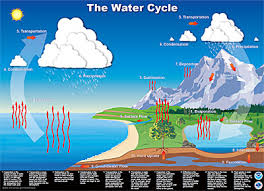
During which stage do clouds form?
a)
condensation
b)
evaporation
c)
precipitation
d)
runoff
2.
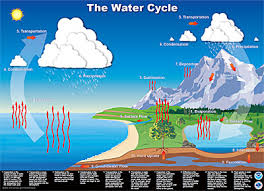
Which stages does liquid water from the ocean turn into water vapor?
a)
condesantion
b)
evaporation
c)
precipitation
d)
run off
3.
The supply of freshwater under the Earth's surface.
a)
watershed
b)
mouth
c)
headwaters
d)
groundwater
4.
The release of moisture by living plants.
a)
evaporation
b)
precipitation
c)
condensation
d)
transpiration
5.
Any type of moisture that falls to the Earth.
a)
evaporation
b)
precipitation
c)
condensation
d)
transpiration
6.
The flow of water from land into a body of water.
a)
groundwater
b)
headwaters
c)
run-off
d)
infiltration
7.
What drives the water cycle?
a)
evaporation
b)
precipitation
c)
the sun
d)
the moon
8.
A[n] ______________ tide occurs when the sun is at right angles to the line between Earth and the moon.
a)
high
b)
neap
c)
low
d)
spring
9.
A[n] ___________ tide occurs when the sun, Earth, and the moon are nearly in a line.
a)
spring
b)
high
c)
low
d)
neap
10.
A neap tide is a tide with the greatest difference between low and high tides
a)
true
b)
false
11.
Neap tides occur once a month.
a)
True
b)
False
12.
Tides are caused mainly by the differences in how much gravity from the moon and the sun pulls on different parts of the Earth.
a)
True
b)
False
13.

Wha type of tide would this arrangement of earth-moon-sun create?
a)
full moon tide
b)
new moon tide
c)
neap tide
d)
spring tide
14.

What type of tides would this arrangement of earth-moon-sun create?
a)
neap tide
b)
spring tide
c)
new moon tide
d)
full moon tide
15.
Tides are caused by
a)
strong winds that blow over ocean waters.
b)
the interaction of Earth, the moon and the sun.
c)
the shifting of the plates on the ocean floor.
d)
variations in the salinity of ocean water
16.
What causes tides?
a)
gravity
b)
wind
c)
spring
d)
neap
17.
How many low tides and high tides happen in a day?
a)
1 low tide, 1 high tide
b)
4 low tides, 4 high tides
c)
3 low tides, 3 high tides
d)
2 low tides, 2 high tides
18.
You visited the beach at 12 pm (noon) and it is high tide. If you return 6 hours later what tide will you see?
a)
high
b)
low
c)
none
d)
spring
19.
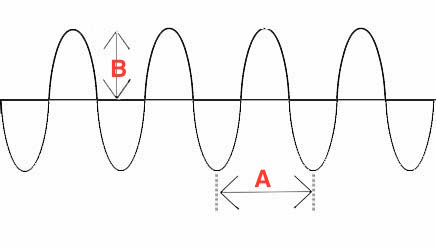
What property of this wave is represented by the letter "A"
a)
amplitude
b)
crest
c)
trough
d)
wavelength
20.
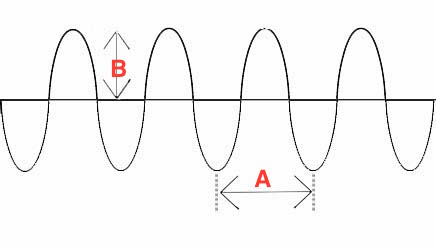
What property of the wave is represented by the letter "B"?
a)
amplitude
b)
crest
c)
trough
d)
wavelength
21.
The highest point on a wave is:
a)
the crest
b)
the trough
c)
the top
d)
the coast
22.
The lowest point on a wave is the:
a)
Amplitude
b)
Crest
c)
Trough
d)
Wavelength
23.
The number of wavelengths that pass a point each per second is:
a)
frequency
b)
period
c)
longitudinal
d)
transverse wave
24.

Which vocabulary term is used to identify the distance between points C & G?
a)
Amplitude
b)
Crest
c)
Frequency
d)
Wavelength
25.
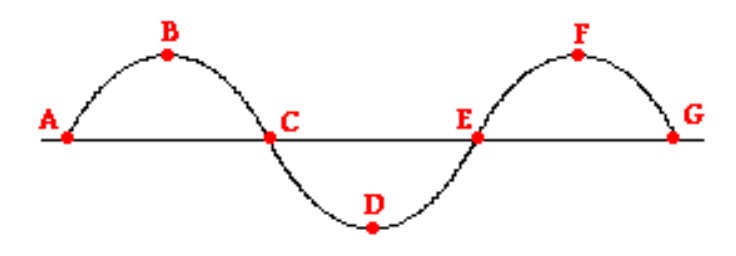
Which letter(s) represent the trough of the wave?
a)
A
b)
B & D
c)
D
d)
C & G
26.
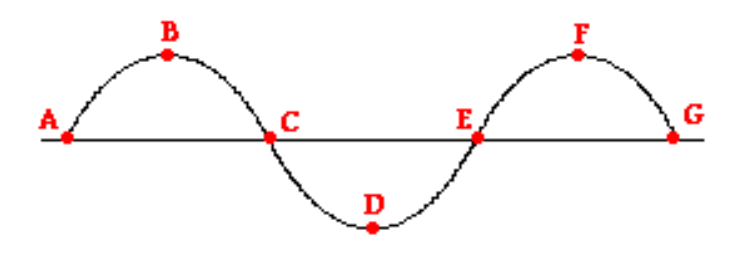
Which letter(s) represent the crest of the wave?
a)
A
b)
B & D
c)
B & F
d)
F
27.
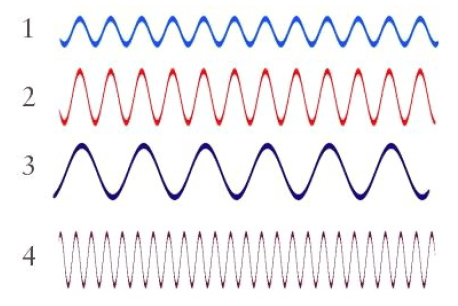
Which wave in the diagram has the greatest frequency?
a)
1
b)
2
c)
3
d)
4
28.
Cold ocean currents generally come from
a)
The North Pole
b)
The South Pole
c)
The Equator
d)
Both the north and south pole
29.
Warm ocean currents generally come from
a)
The North Pole
b)
The South Pole
c)
The Equator
d)
Both A and B
30.
Two types of water currents are
a)
local and global
b)
sea and land
c)
surface and deep
d)
warm and cold
31.
A horizontal movement of ocean water that is caused by wind and that occurs at or near the ocean's surface.
a)
Gulf Stream
b)
Global Conveyor Belt
c)
Surface Current
d)
Gyre
32.
Deep-ocean currents are driven by
a)
differences in soil
b)
differences in the water’s density,
c)
differences in nutrients
d)
None of the Above
33.
What process brings the deep cold ocean currents up to the surface?
a)
Conduction
b)
Global Wind Patterns
c)
Upwelling
d)
Temperature and salinity
34.
What is the best description of a density current
a)
surface winds cause cold, dense water to sink beneath less dense water
b)
upwelling causes cold, dense water to sink beneath less dense water
c)
gravity causes cold, dense water to sink beneath less dense water
d)
gravity causes cold, dense water to rise above less dense water
35.
Cold ocean currents are most likely to be located at deeper ocean depths than warm water currents because
a)
A.Winds push the cold water down.
b)
Ocean tides force cold water downward
c)
A.Cold water is more dense and sinks
d)
A.Cold water has less salt to help it freeze and sink.
36.
What watershed do you live in?
a)
Oconee
b)
Chattahoochee
c)
Mississippi
37.
What watershed serves Atlanta?
a)
Oconee
b)
Chattahoochee
c)
Mississippi
38.
What is the largest watershed in the United States?
a)
Oconee
b)
Chattahoochee
c)
Mississippi
39.
What is the steep slope at the edge of the continental shelf?
a)
seamount
b)
mid-ocean ridge
c)
continental slope
d)
rift zone
40.
What are underwater mountain ranges called?
a)
continental shelf
b)
mid-ocean ridges
c)
abyssal plains
d)
continental slopes
41.
Where is the shallowest part of the ocean floor?
a)
continental slope
b)
continental shelf
c)
abyssal plains
d)
rift zones
42.
What is the flat land located on either side of the mid-ocean ridge?
a)
continental slope
b)
continental shelf
c)
abyssal plain
d)
ocean basin
43.
What is the deepest part of the ocean basin?
a)
abyssal plains
b)
trenches
c)
rift zones
d)
mid-ocean ridge
44.
What is an underwater mountain formed by a volcano?
a)
trench
b)
rift zone
c)
seamount
d)
mid ocean ridge
45.

When we go to beach, we are allowed to go on ____________
a)
continental slope
b)
continental shelf
c)
abyssal plain
d)
sea mount
46.

Label F
a)
continental slope
b)
continental shelf
c)
abyssal plain
d)
sea mount
47.

Label E
a)
continental slope
b)
volcanic island
c)
abyssal plain
d)
sea mount
48.

Label C
a)
continental slope
b)
continental shelf
c)
abyssal plain
d)
sea mount
49.

What is label G
a)
Trench
b)
Mid ocean ridge
c)
abyssal plain
d)
sea mount
50.

What is label B
a)
Trench
b)
Mid ocean ridge
c)
Seamount
d)
Abyssal plain
51.
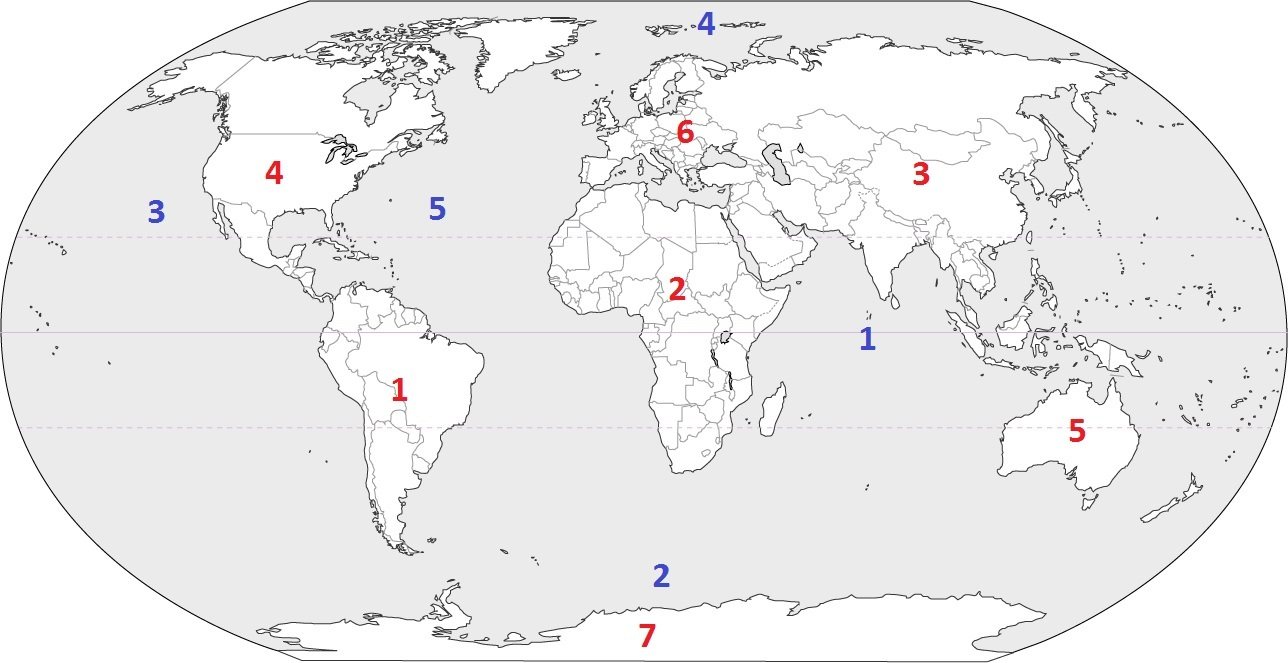
Identify the ocean at location #3
a)
Atlantic Ocean
b)
Arctic Ocean
c)
Pacific Ocean
d)
Indian Ocean
52.
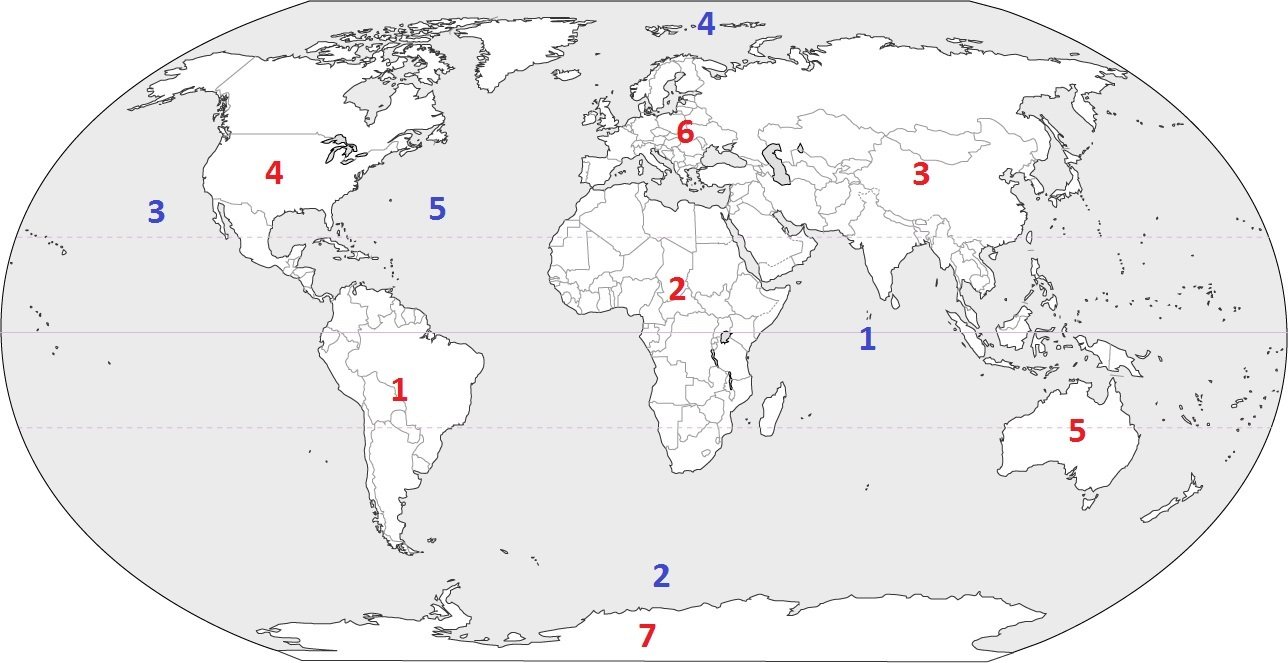
Identify the ocean at location #5
a)
Atlantic Ocean
b)
Southern Ocean
c)
Pacific Ocean
d)
Arctic Ocean
53.
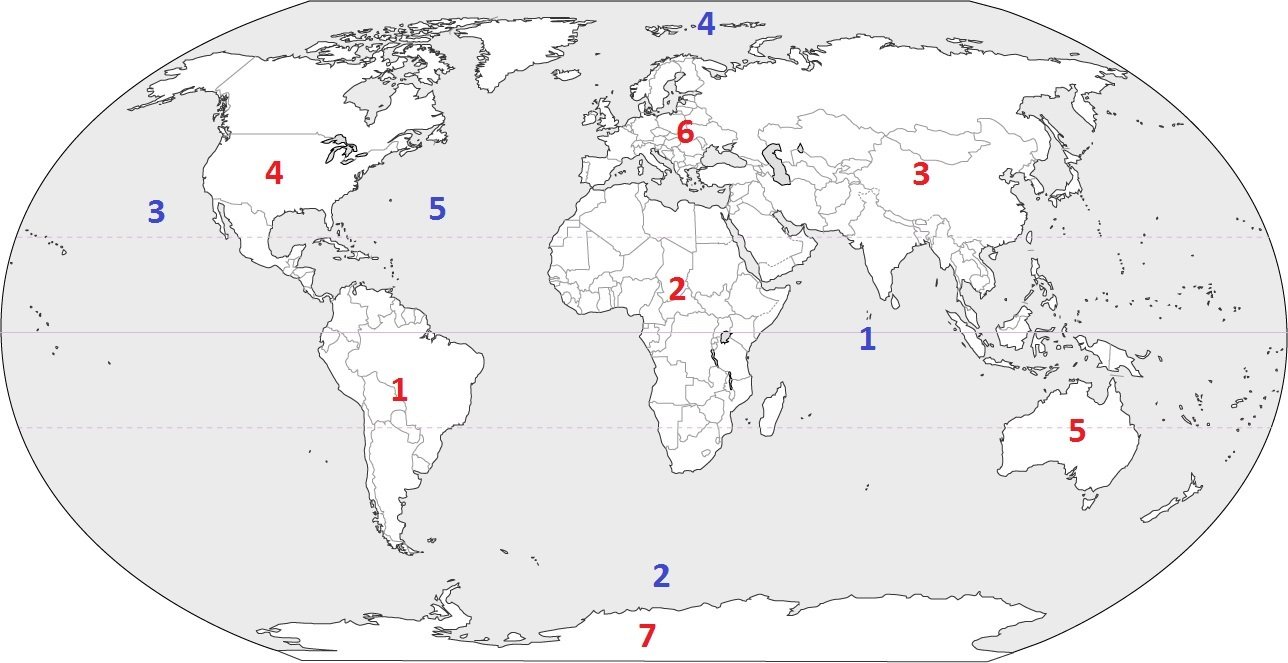
Identify the ocean at location #2
a)
Indian Ocean
b)
Pacific Ocean
c)
Southern Ocean
d)
Arctic Ocean
54.
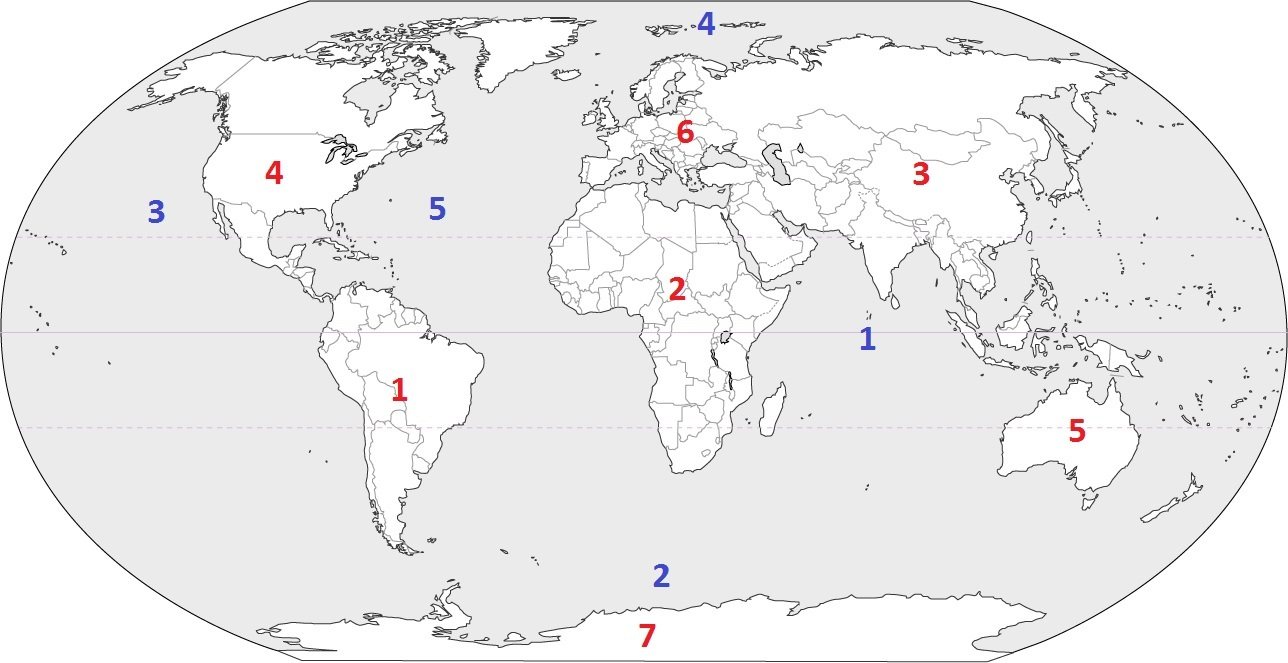
Identify the ocean at location #1
a)
Southern Ocean
b)
Arctic Ocean
c)
Atlantic Ocean
d)
Indian Ocean
55.
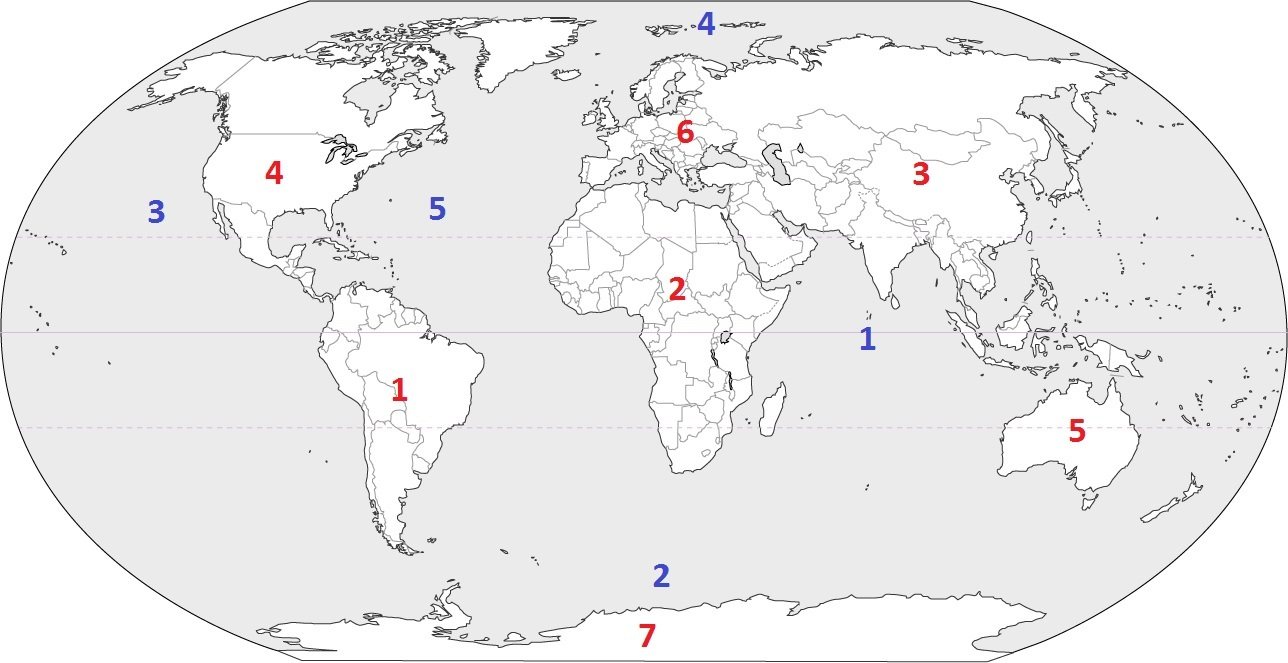
Identify the ocean at location #4
a)
Indian Ocean
b)
Pacific Ocean
c)
Arctic Ocean
d)
Atlantic Ocean
100 %

